VITAL STATISTICS IN INDIA
INTRODUCTION
 Vital statistics system was defined as including the legal
registration, statistical recording and reporting of the
occurrence, and collection, compilation, analysis, presentation
and distribution of statistics pertaining to vital events, which in
turn include live births, deaths, foetal deaths, marriages,
divorces, adoptions, legitimating, recognitions, annulments and
legal separations
 Vital Statistics, which basically refer to the births, marriages
and deaths occurring within the Spanish territory, constitute one
of the most traditional statistical operations in the National
Statistics Institute. The first volume was published in 1863 by
the National General Board of Statistics, and contains data on
the period from 1858 to 1861, which was obtained from parish
registers. Since that time, information has consistently been
published in Spain regarding these demographic phenomena,
with the sole interruption during the period from 1871 to 1885,
the time when the Civil Register was implemented, and from
which data was subsequently obtained for these statistics.
 The demographic concepts used for the compilation of these
publications have been practically the same every year, without
any variations other than those caused by the change in the
information source, which fundamentally consists of the
replacement of baptized persons by those registered in the Civil
Register, and of Catholic marriage by civil marriage.
Indian Statistical System
 India has a decentralized Statistical System
 Ministry of Statistics and Programme Implementation is the
Nodal Statistical agency in India
 Demographic Statistics in India are collected, compiled and
disseminated by concerned statistical organizations under various
Ministries.
Objective
Vital Statistics have the main objective of ascertaining the
number of births, marriages and deaths that take place within
the Spanish territory, as well as the main characteristics
relating to these demographic phenomena.
Factors Responsible
 Population Census
 Civil Registration System
 Hospital records
 Sample Registration System
 Sample Surveys
Major Organization
 Central Statistical Organization (CSO)
 National Sample Survey Organization (NSSO)
 Registrar General and Census Commissioner of India
 Ministry of Health and Family Welfare
 International Institute of Population Studies
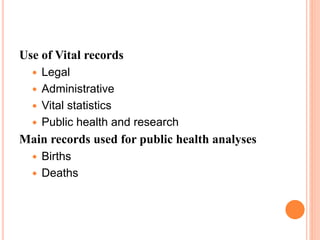
Use of Vital records
 Legal
 Administrative
 Vital statistics
 Public health and research
Main records used for public health analyses
 Births
 Deaths
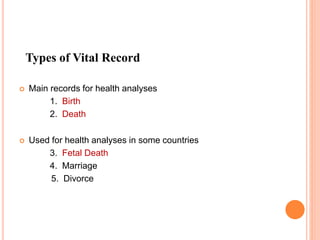
Types of Vital Record
 Main records for health analyses
1. Birth
2. Death
 Used for health analyses in some countries
3. Fetal Death
4. Marriage
5. Divorce
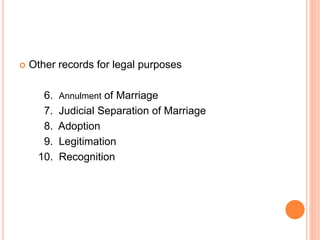
 Other records for legal purposes
6. Annulment of Marriage
7. Judicial Separation of Marriage
8. Adoption
9. Legitimation
10. Recognition
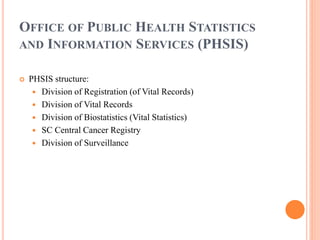
OFFICE OF PUBLIC HEALTH STATISTICS
AND INFORMATION SERVICES (PHSIS)
 PHSIS structure:
 Division of Registration (of Vital Records)
 Division of Vital Records
 Division of Biostatistics (Vital Statistics)
 SC Central Cancer Registry
 Division of Surveillance
PUBLIC HEALTH USES OF DATA
 Vital event data is very important to public health. It can
impact program areas within an agency, the community
and the nation.
 Vital event data can be used to justify the need for a new
public health program to be established, as well as keep
the program in place by showing its progress.
 Vital event data can be used at the community level for
public health community partners and studying possible
clusters of cancer, stroke, heart disease, etc.
DEATH STATISTICS
As can be derived from the above, on treating the Birth Statistics and
the Late Fetal Death Statistics, the statistical concept of death
traditionally used in Spain comprised all the deaths of persons who
had lived for more than 24 hours. As of 1975, this concept has been
broadened to include live birth infants that die in the first 24 hours of
life. This change is fundamental, as it implies the adoption of the
death criterion recommended by the International Organizations.
MARRIAGE STATISTICS
The Marriage Statistics experienced an important variation in the
year 2005, for the purpose of the entry into force of Law 13/2005, of
1 July (B.O.E. of 2 July 2005), modifying the Civil Code in terms of
the right to marry. Said law allows marriages between persons of the
same or different sexes, with complete and equal rights and
responsibilities, regardless of the composition of said marriages. The
sex variable of each of the spouses was introduced in the statistical
register. These statistics include all marriages registered in the Civil
Register.
BIRTH STATISTICS
 Since 1975, the concept of birth in the tables presenting the results
of the Vital Statistics is identified by the biological term "live birth",
which is that used in the demographic field, with the corresponding
effect on the concept of death.
 Population - 1,281,935,911 (July 2017 est.)
Age structure
0-14 years: 27.34% (male 186,087,665/female 164,398,204)
15-24 years: 17.9% (male 121,879,786/female 107,583,437)
25-54 years: 41.08% (male 271,744,709/female 254,834,569)
55-64 years: 7.45% (male 47,846,122/female 47,632,532)
65 years and over: 6.24% (male 37,837,801/female 42,091,086)
(2017 est.)
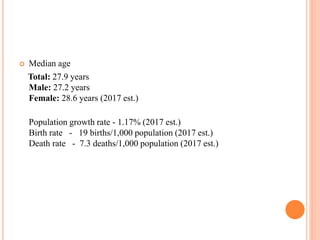
 Median age
Total: 27.9 years
Male: 27.2 years
Female: 28.6 years (2017 est.)
Population growth rate - 1.17% (2017 est.)
Birth rate - 19 births/1,000 population (2017 est.)
Death rate - 7.3 deaths/1,000 population (2017 est.)
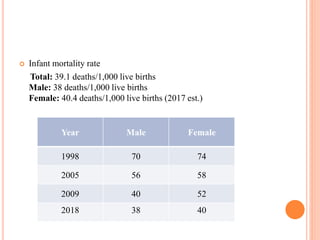
 Infant mortality rate
Total: 39.1 deaths/1,000 live births
Male: 38 deaths/1,000 live births
Female: 40.4 deaths/1,000 live births (2017 est.)
Year Male Female
1998 70 74
2005 56 58
2009 40 52
2018 38 40
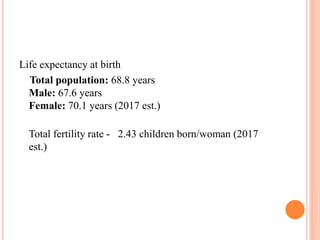
Life expectancy at birth
Total population: 68.8 years
Male: 67.6 years
Female: 70.1 years (2017 est.)
Total fertility rate - 2.43 children born/woman (2017
est.)
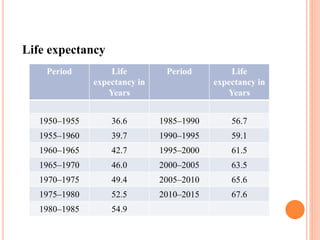
Life expectancy
Period Life
expectancy in
Years
Period Life
expectancy in
Years
1950–1955 36.6 1985–1990 56.7
1955–1960 39.7 1990–1995 59.1
1960–1965 42.7 1995–2000 61.5
1965–1970 46.0 2000–2005 63.5
1970–1975 49.4 2005–2010 65.6
1975–1980 52.5 2010–2015 67.6
1980–1985 54.9
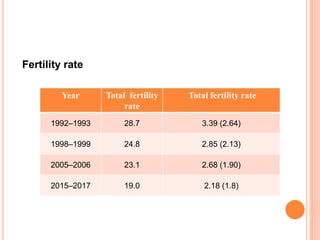
Fertility rate
Year Total fertility
rate
Total fertility rate
1992–1993 28.7 3.39 (2.64)
1998–1999 24.8 2.85 (2.13)
2005–2006 23.1 2.68 (1.90)
2015–2017 19.0 2.18 (1.8)
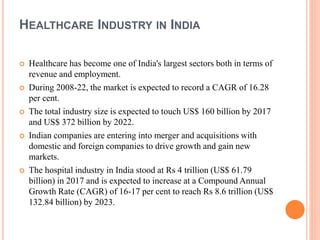
HEALTHCARE INDUSTRY IN INDIA
 Healthcare has become one of India's largest sectors both in terms of
revenue and employment.
 During 2008-22, the market is expected to record a CAGR of 16.28
per cent.
 The total industry size is expected to touch US$ 160 billion by 2017
and US$ 372 billion by 2022.
 Indian companies are entering into merger and acquisitions with
domestic and foreign companies to drive growth and gain new
markets.
 The hospital industry in India stood at Rs 4 trillion (US$ 61.79
billion) in 2017 and is expected to increase at a Compound Annual
Growth Rate (CAGR) of 16-17 per cent to reach Rs 8.6 trillion (US$
132.84 billion) by 2023.
Thank you………..

VITAL STATISTICS IN INDIA

  • 1.
  • 2.
    INTRODUCTION  Vital statisticssystem was defined as including the legal registration, statistical recording and reporting of the occurrence, and collection, compilation, analysis, presentation and distribution of statistics pertaining to vital events, which in turn include live births, deaths, foetal deaths, marriages, divorces, adoptions, legitimating, recognitions, annulments and legal separations
  • 3.
     Vital Statistics,which basically refer to the births, marriages and deaths occurring within the Spanish territory, constitute one of the most traditional statistical operations in the National Statistics Institute. The first volume was published in 1863 by the National General Board of Statistics, and contains data on the period from 1858 to 1861, which was obtained from parish registers. Since that time, information has consistently been published in Spain regarding these demographic phenomena, with the sole interruption during the period from 1871 to 1885, the time when the Civil Register was implemented, and from which data was subsequently obtained for these statistics.
  • 4.
     The demographicconcepts used for the compilation of these publications have been practically the same every year, without any variations other than those caused by the change in the information source, which fundamentally consists of the replacement of baptized persons by those registered in the Civil Register, and of Catholic marriage by civil marriage.
  • 5.
    Indian Statistical System India has a decentralized Statistical System  Ministry of Statistics and Programme Implementation is the Nodal Statistical agency in India  Demographic Statistics in India are collected, compiled and disseminated by concerned statistical organizations under various Ministries.
  • 6.
    Objective Vital Statistics havethe main objective of ascertaining the number of births, marriages and deaths that take place within the Spanish territory, as well as the main characteristics relating to these demographic phenomena.
  • 7.
    Factors Responsible  PopulationCensus  Civil Registration System  Hospital records  Sample Registration System  Sample Surveys
  • 8.
    Major Organization  CentralStatistical Organization (CSO)  National Sample Survey Organization (NSSO)  Registrar General and Census Commissioner of India  Ministry of Health and Family Welfare  International Institute of Population Studies
  • 9.
    Use of Vitalrecords  Legal  Administrative  Vital statistics  Public health and research Main records used for public health analyses  Births  Deaths
  • 10.
    Types of VitalRecord  Main records for health analyses 1. Birth 2. Death  Used for health analyses in some countries 3. Fetal Death 4. Marriage 5. Divorce
  • 11.
     Other recordsfor legal purposes 6. Annulment of Marriage 7. Judicial Separation of Marriage 8. Adoption 9. Legitimation 10. Recognition
  • 12.
    OFFICE OF PUBLICHEALTH STATISTICS AND INFORMATION SERVICES (PHSIS)  PHSIS structure:  Division of Registration (of Vital Records)  Division of Vital Records  Division of Biostatistics (Vital Statistics)  SC Central Cancer Registry  Division of Surveillance
  • 13.
    PUBLIC HEALTH USESOF DATA  Vital event data is very important to public health. It can impact program areas within an agency, the community and the nation.  Vital event data can be used to justify the need for a new public health program to be established, as well as keep the program in place by showing its progress.  Vital event data can be used at the community level for public health community partners and studying possible clusters of cancer, stroke, heart disease, etc.
  • 14.
    DEATH STATISTICS As canbe derived from the above, on treating the Birth Statistics and the Late Fetal Death Statistics, the statistical concept of death traditionally used in Spain comprised all the deaths of persons who had lived for more than 24 hours. As of 1975, this concept has been broadened to include live birth infants that die in the first 24 hours of life. This change is fundamental, as it implies the adoption of the death criterion recommended by the International Organizations.
  • 15.
    MARRIAGE STATISTICS The MarriageStatistics experienced an important variation in the year 2005, for the purpose of the entry into force of Law 13/2005, of 1 July (B.O.E. of 2 July 2005), modifying the Civil Code in terms of the right to marry. Said law allows marriages between persons of the same or different sexes, with complete and equal rights and responsibilities, regardless of the composition of said marriages. The sex variable of each of the spouses was introduced in the statistical register. These statistics include all marriages registered in the Civil Register.
  • 16.
    BIRTH STATISTICS  Since1975, the concept of birth in the tables presenting the results of the Vital Statistics is identified by the biological term "live birth", which is that used in the demographic field, with the corresponding effect on the concept of death.
  • 17.
     Population -1,281,935,911 (July 2017 est.) Age structure 0-14 years: 27.34% (male 186,087,665/female 164,398,204) 15-24 years: 17.9% (male 121,879,786/female 107,583,437) 25-54 years: 41.08% (male 271,744,709/female 254,834,569) 55-64 years: 7.45% (male 47,846,122/female 47,632,532) 65 years and over: 6.24% (male 37,837,801/female 42,091,086) (2017 est.)
  • 18.
     Median age Total:27.9 years Male: 27.2 years Female: 28.6 years (2017 est.) Population growth rate - 1.17% (2017 est.) Birth rate - 19 births/1,000 population (2017 est.) Death rate - 7.3 deaths/1,000 population (2017 est.)
  • 19.
     Infant mortalityrate Total: 39.1 deaths/1,000 live births Male: 38 deaths/1,000 live births Female: 40.4 deaths/1,000 live births (2017 est.) Year Male Female 1998 70 74 2005 56 58 2009 40 52 2018 38 40
  • 20.
    Life expectancy atbirth Total population: 68.8 years Male: 67.6 years Female: 70.1 years (2017 est.) Total fertility rate - 2.43 children born/woman (2017 est.)
  • 21.
    Life expectancy Period Life expectancyin Years Period Life expectancy in Years 1950–1955 36.6 1985–1990 56.7 1955–1960 39.7 1990–1995 59.1 1960–1965 42.7 1995–2000 61.5 1965–1970 46.0 2000–2005 63.5 1970–1975 49.4 2005–2010 65.6 1975–1980 52.5 2010–2015 67.6 1980–1985 54.9
  • 22.
    Fertility rate Year Totalfertility rate Total fertility rate 1992–1993 28.7 3.39 (2.64) 1998–1999 24.8 2.85 (2.13) 2005–2006 23.1 2.68 (1.90) 2015–2017 19.0 2.18 (1.8)
  • 23.
    HEALTHCARE INDUSTRY ININDIA  Healthcare has become one of India's largest sectors both in terms of revenue and employment.  During 2008-22, the market is expected to record a CAGR of 16.28 per cent.  The total industry size is expected to touch US$ 160 billion by 2017 and US$ 372 billion by 2022.  Indian companies are entering into merger and acquisitions with domestic and foreign companies to drive growth and gain new markets.  The hospital industry in India stood at Rs 4 trillion (US$ 61.79 billion) in 2017 and is expected to increase at a Compound Annual Growth Rate (CAGR) of 16-17 per cent to reach Rs 8.6 trillion (US$ 132.84 billion) by 2023.
  • 24.