VIT – PAST PAPERS
CHEMISTRY - UNSOLVED PAPER - 2008
SECTION – I

   Single Correct Answer Type
         There are five parts in this question. Four choices are given for each part and one of them is

          correct. Indicate you choice of the correct answer for each part in your answer-book by

          writing the letter (a), (b), (c) or (d) whichever is appropriate
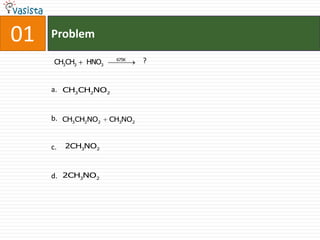
01   Problem
                       675K    ?
      CH3CH3   HNO3


     a. CH3CH2NO2


     b. CH3CH2NO2     CH3NO2


     c.   2CH3NO2


     d. 2CH3NO2
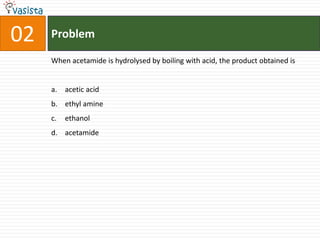
02   Problem

     When acetamide is hydrolysed by boiling with acid, the product obtained is


     a. acetic acid
     b. ethyl amine
     c.   ethanol
     d. acetamide
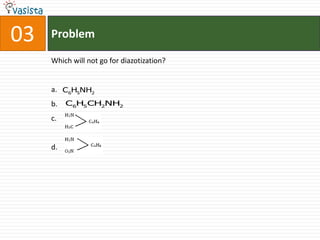
03   Problem

     Which will not go for diazotization?


     a. C 6H5NH2
     b.   C 6H5 CH2NH2

     c.


     d.
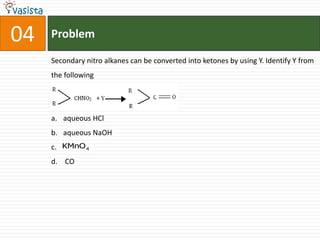
04   Problem

     Secondary nitro alkanes can be converted into ketones by using Y. Identify Y from
     the following


     a. aqueous HCl
     b. aqueous NaOH
     c. KMnO 4
     d. CO
05   Problem

     Alkyl cyanides undergo Stephen reduction to Produce


     a. aldehyde
     b. secondary a,lline
     c.   primary amine
     d. amide
06   Problem

     The continuous phase contains the dispersed phase throughout, example is


     a. water in milk
     b. fat in milk
     c. water droplets in mist
     d. coil in water
07   Problem

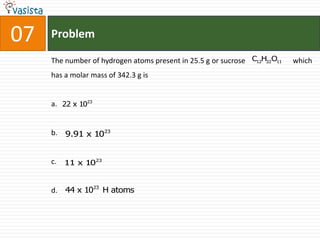
     The number of hydrogen atoms present in 25.5 g or sucrose C12H22O11   which
     has a molar mass of 342.3 g is


     a. 22 x 1023


     b. 9.91 x 10²³


     c. 11 x 1023


     d. 44 x 1023 H atoms
08   Problem

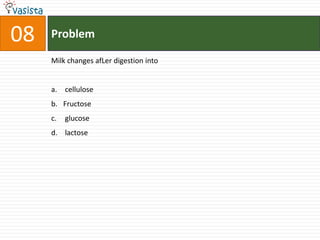
     Milk changes afLer digestion into


     a. cellulose
     b. Fructose
     c.   glucose
     d. lactose
09   Problem

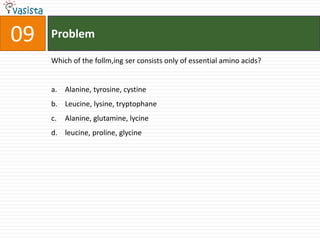
     Which of the follm,ing ser consists only of essential amino acids?


     a. Alanine, tyrosine, cystine
     b. Leucine, lysine, tryptophane
     c.   Alanine, glutamine, lycine
     d. leucine, proline, glycine
10   Problem

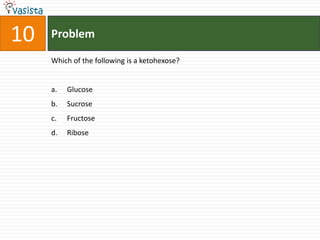
     Which of the following is a ketohexose?


     a.   Glucose
     b.   Sucrose
     c.   Fructose
     d.   Ribose
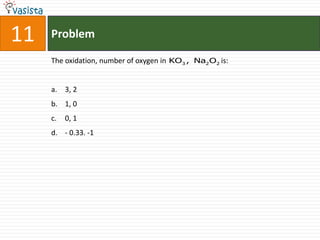
11   Problem

     The oxidation, number of oxygen in KO3 , Na2 O2 is:


     a. 3, 2
     b. 1, 0
     c.   0, 1
     d. - 0.33. -1
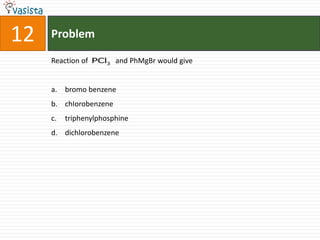
12   Problem

     Reaction of PCl3 and PhMgBr would give


     a. bromo benzene
     b. chIorobenzene
     c.   triphenylphosphine
     d. dichlorobenzene
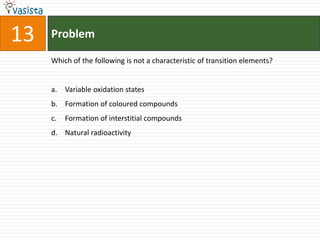
13   Problem

     Which of the following is not a characteristic of transition elements?


     a. Variable oxidation states
     b. Formation of coloured compounds
     c.   Formation of interstitial compounds
     d. Natural radioactivity
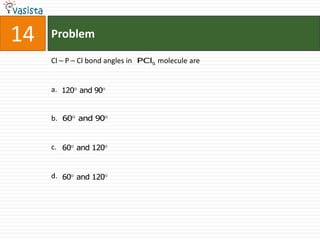
14   Problem

     Cl – P – Cl bond angles in PCl5 molecule are


     a. 120 and 90


     b. 60 and 90


     c. 60 and 120


     d. 60 and 120
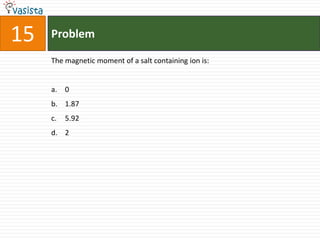
15   Problem

     The magnetic moment of a salt containing ion is:


     a. 0
     b. 1.87
     c.   5.92
     d. 2
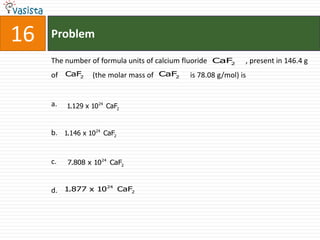
16   Problem

     The number of formula units of calcium fluoride CaF2    , present in 146.4 g
     of CaF2      (the molar mass of CaF2   is 78.08 g/mol) is


     a.   1.129 x 1024 CaF2


     b. 1.146 x 1024 CaF2


     c.   7.808 x 1024 CaF2


                  24
     d. 1.877 x 10 CaF2
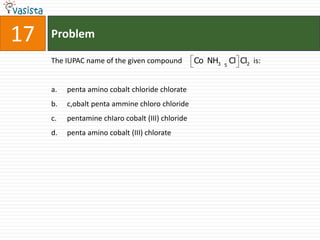
17   Problem

     The IUPAC name of the given compound          Co NH3   5
                                                                Cl Cl2 is:


     a.   penta amino cobalt chloride chlorate
     b.   c,obalt penta ammine chloro chloride
     c.   pentamine chIaro cobalt (III) chloride
     d.   penta amino cobalt (III) chlorate
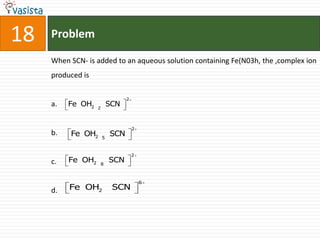
18   Problem

     When SCN- is added to an aqueous solution containing Fe(N03h, the ,complex ion
     produced is

                                 2
     a.   Fe OH2   2
                           SCN


                                     2
     b.   Fe OH2       5
                           SCN

                                     2
     c.   Fe OH2       8
                           SCN

                                         6
     d.   Fe OH2            SCN
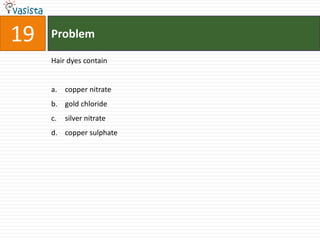
19   Problem

     Hair dyes contain


     a. copper nitrate
     b. gold chloride
     c.   silver nitrate
     d. copper sulphate
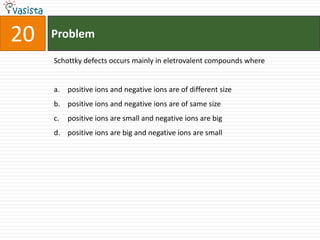
20   Problem

     Schottky defects occurs mainly in eletrovalent compounds where


     a. positive ions and negative ions are of different size
     b. positive ions and negative ions are of same size
     c.   positive ions are small and negative ions are big
     d. positive ions are big and negative ions are small
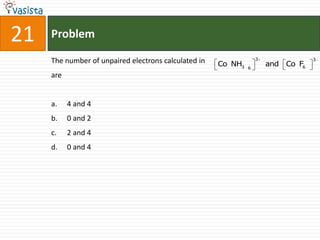
21   Problem
                                                                   3                 3
     The number of unpaired electrons calculated in   Co NH3           and   Co F6
                                                               6
     are


     a.    4 and 4
     b.    0 and 2
     c.    2 and 4
     d.    0 and 4
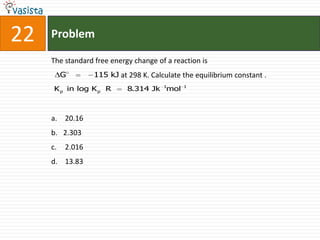
22   Problem

     The standard free energy change of a reaction is
          G       115 kJ at 298 K. Calculate the equilibrium constant .
      K p in log K p R      8.314 Jk 1mol    1


     a. 20.16
     b. 2.303
     c.   2.016
     d. 13.83
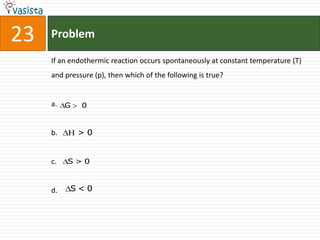
23   Problem

     If an endothermic reaction occurs spontaneously at constant temperature (T)
     and pressure (p), then which of the following is true?


     a. G     0


     b.      >0


     c.   S>0


     d.     S<0
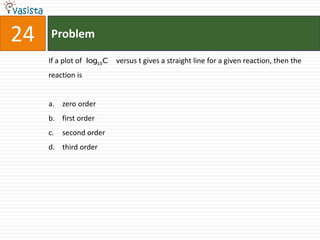
24   Problem

     If a plot of log10 C   versus t gives a straight line for a given reaction, then the
     reaction is


     a. zero order
     b. first order
     c.   second order
     d. third order
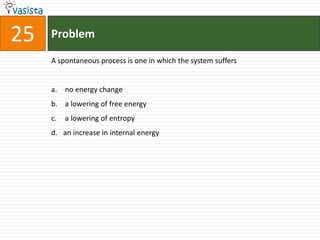
25   Problem

     A spontaneous process is one in which the system suffers


     a. no energy change
     b. a lowering of free energy
     c.   a lowering of entropy
     d. an increase in internal energy
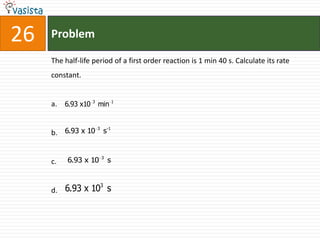
26   Problem

     The half-life period of a first order reaction is 1 min 40 s. Calculate its rate
     constant.


     a. 6.93 x10 3 min 1

                 3  -1
     b. 6.93 x 10 s


                      3
     c.   6.93 x 10       s


                      3
     d. 6.93 x 10 s
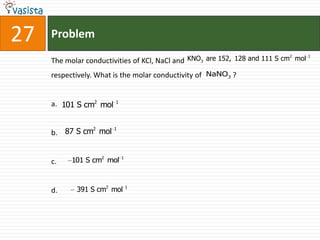
27   Problem
                                                                             2    1
     The molar conductivities of KCl, NaCl and KNO3 are 152, 128 and 111 S cm mol
     respectively. What is the molar conductivity of NaNO3 ?

     a. 101 S cm2 mol   1


               2    1
     b. 87 S cm mol


     c.    101 S cm2 mol    1


     d.     391 S cm2 mol       1
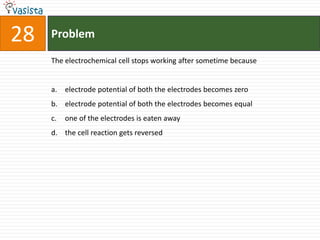
28   Problem

     The electrochemical cell stops working after sometime because


     a. electrode potential of both the electrodes becomes zero
     b. electrode potential of both the electrodes becomes equal
     c.   one of the electrodes is eaten away
     d. the cell reaction gets reversed
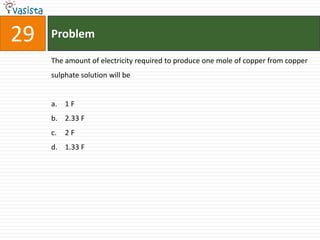
29   Problem

     The amount of electricity required to produce one mole of copper from copper
     sulphate solution will be


     a. 1 F
     b. 2.33 F
     c.   2F
     d. 1.33 F
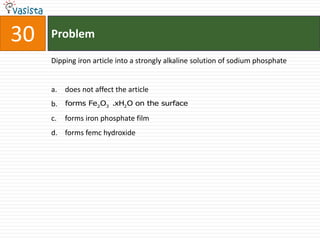
30   Problem

     Dipping iron article into a strongly alkaline solution of sodium phosphate


     a. does not affect the article
     b. forms Fe2 O3 .xH2 O on the surface
     c.   forms iron phosphate film
     d. forms femc hydroxide
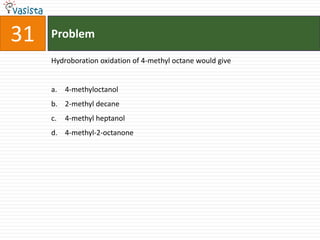
31   Problem

     Hydroboration oxidation of 4-methyl octane would give


     a. 4-methyloctanol
     b. 2-methyl decane
     c.   4-methyl heptanol
     d. 4-methyl-2-octanone
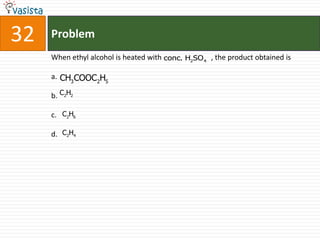
32   Problem
     When ethyl alcohol is heated with conc. H2SO 4 , the product obtained is

     a. CH COOC H
          3    2 5

     b. C2H2

     c. C2H6

     d. C2H4
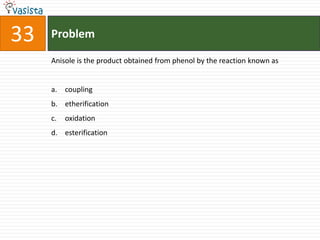
33   Problem

     Anisole is the product obtained from phenol by the reaction known as


     a. coupling
     b. etherification
     c.   oxidation
     d. esterification
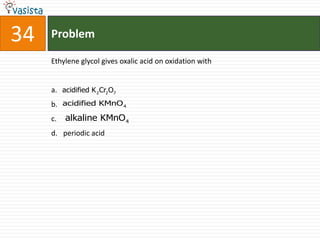
34   Problem

     Ethylene glycol gives oxalic acid on oxidation with


     a. acidified K 2Cr2O7
     b. acidified KMnO 4
     c.   alkaline KMnO 4
     d. periodic acid
35   Problem

     Diamond is hard because


     a. all the four valence electrons are bonded to each carbon atoms by
          covalent bonds
     b. it is a giant molecule
     c.   it is made up of carbon atoms
     d. it cannot be burnt
36   Problem

     A Wittig reaction with an aldehyde gives


     a. ketone compound
     b. a long chain fatty acid
     c.   olefin compound
     d. epoxide
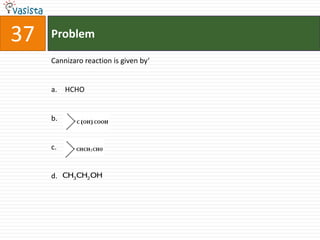
37   Problem

     Cannizaro reaction is given by‘


     a. HCHO


     b.


     c.


     d. CH3CH2 OH
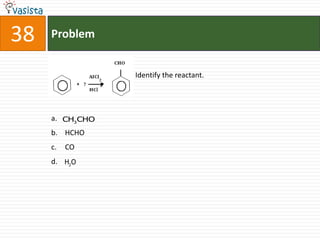
38   Problem


                  Identify the reactant.


     a. CH3 CHO
     b. HCHO
     c.   CO
     d. H2 O
39   Problem

     Maleic acid and fumaric acid are


     a. position isomers
     b. geometric isomers
     c.   enantiomers
     d. functional isomers
40   Problem

     The gas evolved on heating alkali formate with soda-lime is


     a. CO
     b. CO 2
     c.   hydrogen
     d. water vapour
FOR SOLUTION VISIT WWW.VASISTA.NET

VIT - Chemistry -2008 Unsolved Paper

  • 1.
    VIT – PASTPAPERS CHEMISTRY - UNSOLVED PAPER - 2008
  • 2.
    SECTION – I  Single Correct Answer Type  There are five parts in this question. Four choices are given for each part and one of them is correct. Indicate you choice of the correct answer for each part in your answer-book by writing the letter (a), (b), (c) or (d) whichever is appropriate
  • 3.
    01 Problem 675K ? CH3CH3 HNO3 a. CH3CH2NO2 b. CH3CH2NO2 CH3NO2 c. 2CH3NO2 d. 2CH3NO2
  • 4.
    02 Problem When acetamide is hydrolysed by boiling with acid, the product obtained is a. acetic acid b. ethyl amine c. ethanol d. acetamide
  • 5.
    03 Problem Which will not go for diazotization? a. C 6H5NH2 b. C 6H5 CH2NH2 c. d.
  • 6.
    04 Problem Secondary nitro alkanes can be converted into ketones by using Y. Identify Y from the following a. aqueous HCl b. aqueous NaOH c. KMnO 4 d. CO
  • 7.
    05 Problem Alkyl cyanides undergo Stephen reduction to Produce a. aldehyde b. secondary a,lline c. primary amine d. amide
  • 8.
    06 Problem The continuous phase contains the dispersed phase throughout, example is a. water in milk b. fat in milk c. water droplets in mist d. coil in water
  • 9.
    07 Problem The number of hydrogen atoms present in 25.5 g or sucrose C12H22O11 which has a molar mass of 342.3 g is a. 22 x 1023 b. 9.91 x 10²³ c. 11 x 1023 d. 44 x 1023 H atoms
  • 10.
    08 Problem Milk changes afLer digestion into a. cellulose b. Fructose c. glucose d. lactose
  • 11.
    09 Problem Which of the follm,ing ser consists only of essential amino acids? a. Alanine, tyrosine, cystine b. Leucine, lysine, tryptophane c. Alanine, glutamine, lycine d. leucine, proline, glycine
  • 12.
    10 Problem Which of the following is a ketohexose? a. Glucose b. Sucrose c. Fructose d. Ribose
  • 13.
    11 Problem The oxidation, number of oxygen in KO3 , Na2 O2 is: a. 3, 2 b. 1, 0 c. 0, 1 d. - 0.33. -1
  • 14.
    12 Problem Reaction of PCl3 and PhMgBr would give a. bromo benzene b. chIorobenzene c. triphenylphosphine d. dichlorobenzene
  • 15.
    13 Problem Which of the following is not a characteristic of transition elements? a. Variable oxidation states b. Formation of coloured compounds c. Formation of interstitial compounds d. Natural radioactivity
  • 16.
    14 Problem Cl – P – Cl bond angles in PCl5 molecule are a. 120 and 90 b. 60 and 90 c. 60 and 120 d. 60 and 120
  • 17.
    15 Problem The magnetic moment of a salt containing ion is: a. 0 b. 1.87 c. 5.92 d. 2
  • 18.
    16 Problem The number of formula units of calcium fluoride CaF2 , present in 146.4 g of CaF2 (the molar mass of CaF2 is 78.08 g/mol) is a. 1.129 x 1024 CaF2 b. 1.146 x 1024 CaF2 c. 7.808 x 1024 CaF2 24 d. 1.877 x 10 CaF2
  • 19.
    17 Problem The IUPAC name of the given compound Co NH3 5 Cl Cl2 is: a. penta amino cobalt chloride chlorate b. c,obalt penta ammine chloro chloride c. pentamine chIaro cobalt (III) chloride d. penta amino cobalt (III) chlorate
  • 20.
    18 Problem When SCN- is added to an aqueous solution containing Fe(N03h, the ,complex ion produced is 2 a. Fe OH2 2 SCN 2 b. Fe OH2 5 SCN 2 c. Fe OH2 8 SCN 6 d. Fe OH2 SCN
  • 21.
    19 Problem Hair dyes contain a. copper nitrate b. gold chloride c. silver nitrate d. copper sulphate
  • 22.
    20 Problem Schottky defects occurs mainly in eletrovalent compounds where a. positive ions and negative ions are of different size b. positive ions and negative ions are of same size c. positive ions are small and negative ions are big d. positive ions are big and negative ions are small
  • 23.
    21 Problem 3 3 The number of unpaired electrons calculated in Co NH3 and Co F6 6 are a. 4 and 4 b. 0 and 2 c. 2 and 4 d. 0 and 4
  • 24.
    22 Problem The standard free energy change of a reaction is G 115 kJ at 298 K. Calculate the equilibrium constant . K p in log K p R 8.314 Jk 1mol 1 a. 20.16 b. 2.303 c. 2.016 d. 13.83
  • 25.
    23 Problem If an endothermic reaction occurs spontaneously at constant temperature (T) and pressure (p), then which of the following is true? a. G 0 b. >0 c. S>0 d. S<0
  • 26.
    24 Problem If a plot of log10 C versus t gives a straight line for a given reaction, then the reaction is a. zero order b. first order c. second order d. third order
  • 27.
    25 Problem A spontaneous process is one in which the system suffers a. no energy change b. a lowering of free energy c. a lowering of entropy d. an increase in internal energy
  • 28.
    26 Problem The half-life period of a first order reaction is 1 min 40 s. Calculate its rate constant. a. 6.93 x10 3 min 1 3 -1 b. 6.93 x 10 s 3 c. 6.93 x 10 s 3 d. 6.93 x 10 s
  • 29.
    27 Problem 2 1 The molar conductivities of KCl, NaCl and KNO3 are 152, 128 and 111 S cm mol respectively. What is the molar conductivity of NaNO3 ? a. 101 S cm2 mol 1 2 1 b. 87 S cm mol c. 101 S cm2 mol 1 d. 391 S cm2 mol 1
  • 30.
    28 Problem The electrochemical cell stops working after sometime because a. electrode potential of both the electrodes becomes zero b. electrode potential of both the electrodes becomes equal c. one of the electrodes is eaten away d. the cell reaction gets reversed
  • 31.
    29 Problem The amount of electricity required to produce one mole of copper from copper sulphate solution will be a. 1 F b. 2.33 F c. 2F d. 1.33 F
  • 32.
    30 Problem Dipping iron article into a strongly alkaline solution of sodium phosphate a. does not affect the article b. forms Fe2 O3 .xH2 O on the surface c. forms iron phosphate film d. forms femc hydroxide
  • 33.
    31 Problem Hydroboration oxidation of 4-methyl octane would give a. 4-methyloctanol b. 2-methyl decane c. 4-methyl heptanol d. 4-methyl-2-octanone
  • 34.
    32 Problem When ethyl alcohol is heated with conc. H2SO 4 , the product obtained is a. CH COOC H 3 2 5 b. C2H2 c. C2H6 d. C2H4
  • 35.
    33 Problem Anisole is the product obtained from phenol by the reaction known as a. coupling b. etherification c. oxidation d. esterification
  • 36.
    34 Problem Ethylene glycol gives oxalic acid on oxidation with a. acidified K 2Cr2O7 b. acidified KMnO 4 c. alkaline KMnO 4 d. periodic acid
  • 37.
    35 Problem Diamond is hard because a. all the four valence electrons are bonded to each carbon atoms by covalent bonds b. it is a giant molecule c. it is made up of carbon atoms d. it cannot be burnt
  • 38.
    36 Problem A Wittig reaction with an aldehyde gives a. ketone compound b. a long chain fatty acid c. olefin compound d. epoxide
  • 39.
    37 Problem Cannizaro reaction is given by‘ a. HCHO b. c. d. CH3CH2 OH
  • 40.
    38 Problem Identify the reactant. a. CH3 CHO b. HCHO c. CO d. H2 O
  • 41.
    39 Problem Maleic acid and fumaric acid are a. position isomers b. geometric isomers c. enantiomers d. functional isomers
  • 42.
    40 Problem The gas evolved on heating alkali formate with soda-lime is a. CO b. CO 2 c. hydrogen d. water vapour
  • 43.
    FOR SOLUTION VISITWWW.VASISTA.NET