AMU –PAST PAPERS
CHEMISTRY- UNSOLVED PAPER - 2002
SECTION – I

   Single Correct Answer Type
         There are five parts in this question. Four choices are given for each part and one of them is

          correct. Indicate you choice of the correct answer for each part in your answer-book by

          writing the letter (a), (b), (c) or (d) whichever is appropriate
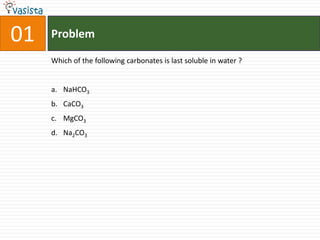
01   Problem

     Which of the following carbonates is last soluble in water ?


     a. NaHCO3
     b. CaCO3
     c. MgCO3
     d. Na2CO3
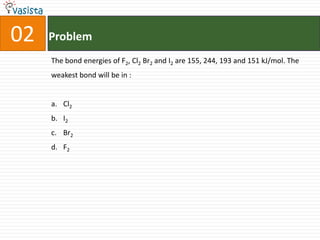
02   Problem
     The bond energies of F2, Cl2 Br2 and I2 are 155, 244, 193 and 151 kJ/mol. The
     weakest bond will be in :


     a. Cl2
     b. I2
     c. Br2
     d. F2
03   Problem

     The number of unpaired electrons in ferrous ion is :


     a. 3
     b. 2
     c. 5
     d. 4
04   Problem

     How many optically active isomers are possible for butane –2, 3-diol ?


     a. 2
     b. 4
     c. 1
     d. 3
05   Problem

     One mole of SO2 corresponds to


     a. 6.4 g of SO2
     b. 6.02 x 10²³ molecules of SO2
     c. 22.4 L at 250C and 1 atm
     d. all the these
06   Problem

     Which of the following statements about vitamin B12 is false ?


     a. It has a cobalt atom
     b. It also occurs in plants
     c. It is present in rain water
     d. It is needed for human body in very small amounts
07   Problem

     A mixture of benzoic acid and naphthalene can be separated by crystallization
     from :


     a. Cold water
     b. Ether
     c. Hot water
     d. Benzene
08   Problem

     The internal energy of one mole of a gas is :

          3
     a.   2   KT
          1
     b.   2   KT
          3
     c.   2   RT
          1
     d.   2   RT
09   Problem

     The term pH comes from :


     a. “pure voiv hydrogene” which implies potential of hydrogen
     b. pure hydrogen content
     c. purity of hydrogen ions in solution
     d. name of the scientist associated
10   Problem

     The number of atoms in 0.004 g of magnesium is close to :


     a. 2 x 10²⁰
     b. 6.02 x 10²³
     c. 24
     d. 1020
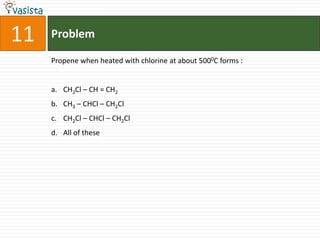
11   Problem

     Propene when heated with chlorine at about 5000C forms :


     a. CH2Cl – CH = CH2
     b. CH3 – CHCl – CH2Cl
     c. CH2Cl – CHCl – CH2Cl
     d. All of these
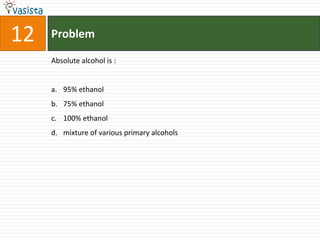
12   Problem

     Absolute alcohol is :


     a. 95% ethanol
     b. 75% ethanol
     c. 100% ethanol
     d. mixture of various primary alcohols
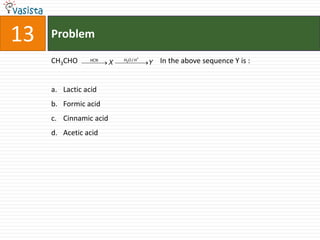
13   Problem

     CH3CHO     HCN
                        X   H2O / H
                                      Y   In the above sequence Y is :


     a. Lactic acid
     b. Formic acid
     c. Cinnamic acid
     d. Acetic acid
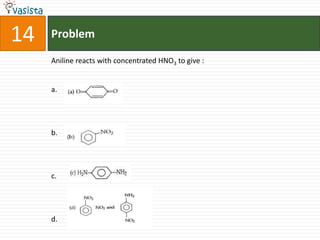
14   Problem

     Aniline reacts with concentrated HNO3 to give :


     a.


     b.


     c.


     d.
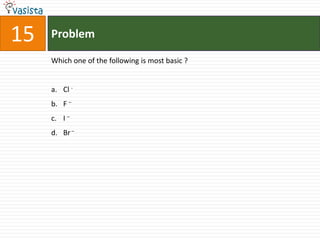
15   Problem

     Which one of the following is most basic ?


     a. Cl -
     b. F –
     c. I –
     d. Br –
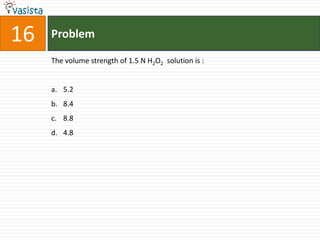
16   Problem

     The volume strength of 1.5 N H2O2 solution is :


     a. 5.2
     b. 8.4
     c. 8.8
     d. 4.8
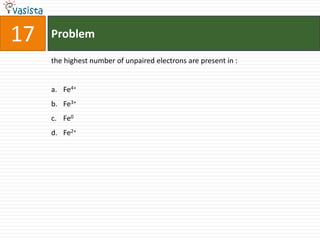
17   Problem

     the highest number of unpaired electrons are present in :


     a. Fe4+
     b. Fe3+
     c. Fe0
     d. Fe2+
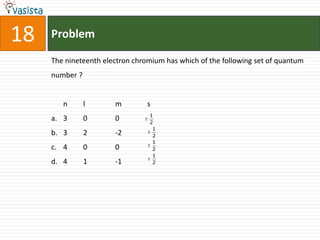
18   Problem

     The nineteenth electron chromium has which of the following set of quantum
     number ?


        n       l      m         s
                                 1
     a. 3       0      0         2
                                  1
     b. 3       2      -2         2
                                  1
     c. 4       0      0          2
                                  1
     d. 4       1      -1         2
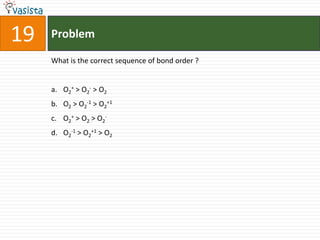
19   Problem

     What is the correct sequence of bond order ?


     a. O2+ > O2- > O2
     b. O2 > O2-1 > O2+1
     c. O2+ > O2 > O2-
     d. O2-1 > O2+1 > O2
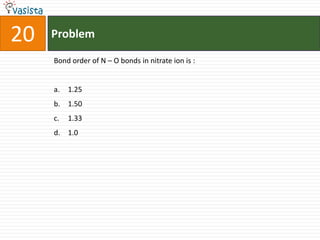
20   Problem

     Bond order of N – O bonds in nitrate ion is :


     a.   1.25
     b. 1.50
     c.   1.33
     d. 1.0
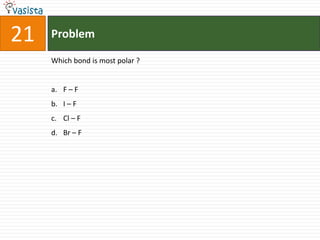
21   Problem

     Which bond is most polar ?


     a. F – F
     b. I – F
     c. Cl – F
     d. Br – F
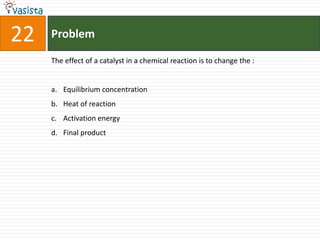
22   Problem

     The effect of a catalyst in a chemical reaction is to change the :


     a. Equilibrium concentration
     b. Heat of reaction
     c. Activation energy
     d. Final product
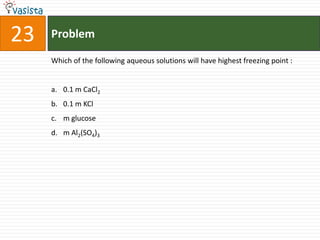
23   Problem

     Which of the following aqueous solutions will have highest freezing point :


     a. 0.1 m CaCl2
     b. 0.1 m KCl
     c. m glucose
     d. m Al2(SO4)3
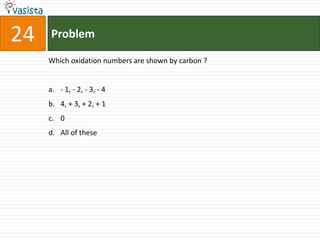
24   Problem

     Which oxidation numbers are shown by carbon ?


     a. - 1, - 2, - 3, - 4
     b. 4, + 3, + 2, + 1
     c. 0
     d. All of these
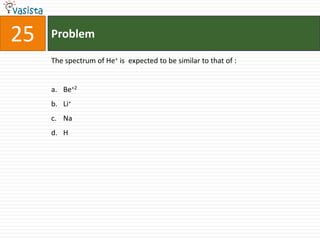
25   Problem

     The spectrum of He+ is expected to be similar to that of :


     a. Be+2
     b. Li+
     c. Na
     d. H
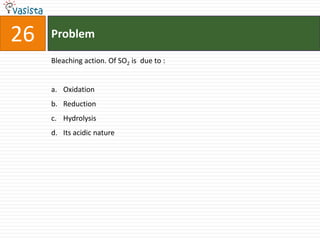
26   Problem

     Bleaching action. Of SO2 is due to :


     a. Oxidation
     b. Reduction
     c. Hydrolysis
     d. Its acidic nature
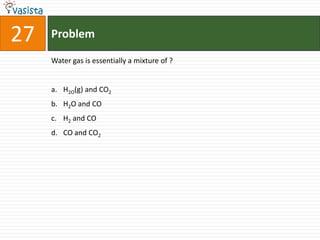
27   Problem

     Water gas is essentially a mixture of ?


     a. H2O(g) and CO2
     b. H2O and CO
     c. H2 and CO
     d. CO and CO2
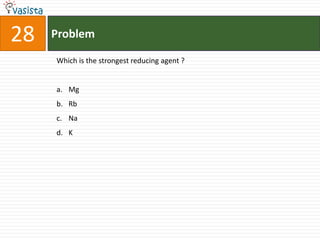
28   Problem

     Which is the strongest reducing agent ?


     a. Mg
     b. Rb
     c. Na
     d. K
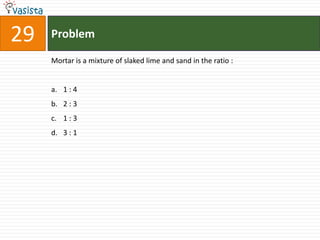
29   Problem

     Mortar is a mixture of slaked lime and sand in the ratio :


     a. 1 : 4
     b. 2 : 3
     c. 1 : 3
     d. 3 : 1
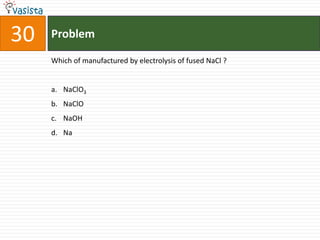
30   Problem

     Which of manufactured by electrolysis of fused NaCl ?


     a. NaClO3
     b. NaClO
     c. NaOH
     d. Na
31   Problem

     The wire in the flash bulbs is made up of :


     a. Ag
     b. Cu
     c. Ba
     d. Mg
32   Problem

     K4[Fe(CN)6] is called :


     a. Prussian blue
     b. Potasium ferricyanide
     c. Potassium hexacyano ferrate (II)
     d. Potassium hexacyanoferrate (III)
33   Problem

     Which of the following does not react with AgCl ?


     a. Na2CO3
     b. Na2S2O3
     c. NH4OH
     d. NaNO3
34   Problem

     The number of moles of KMnO4 that will be needed to react with one mole of
     sulphite ion in acidic solution is :


     a. 1
     b. 4/5
     c. 3/5
     d. 2/5
35   Problem

     Anorganic compound X on treatment with acidified K2Cr2O7 gives compound Y.
     Which reacts with I2 and sodium carbonate to form triiodomethane. The
     compound X can be :


     a. CH3CH(OH)CH3
     b. CH3CHO
     c.   **
     d. CH3OH
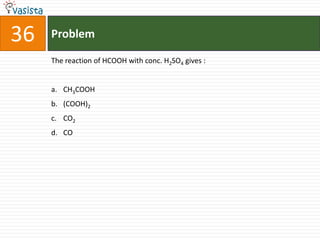
36   Problem

     The reaction of HCOOH with conc. H2SO4 gives :


     a. CH3COOH
     b. (COOH)2
     c. CO2
     d. CO
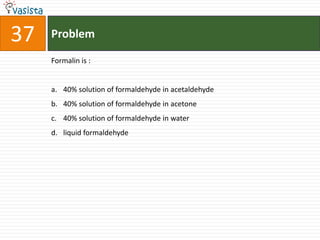
37   Problem

     Formalin is :


     a. 40% solution of formaldehyde in acetaldehyde
     b. 40% solution of formaldehyde in acetone
     c. 40% solution of formaldehyde in water
     d. liquid formaldehyde
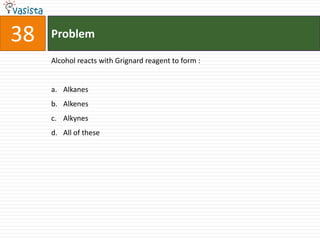
38   Problem

     Alcohol reacts with Grignard reagent to form :


     a. Alkanes
     b. Alkenes
     c. Alkynes
     d. All of these
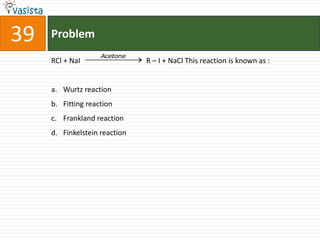
39   Problem
                    Acetone
     RCl + NaI                 R – I + NaCl This reaction is known as :


     a. Wurtz reaction
     b. Fitting reaction
     c. Frankland reaction
     d. Finkelstein reaction
40   Problem

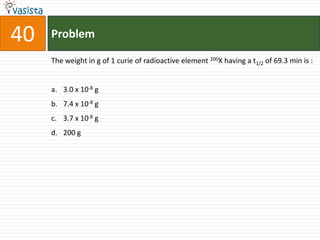
     The weight in g of 1 curie of radioactive element 200X having a t1/2 of 69.3 min is :


     a. 3.0 x 10⁻⁸ g
     b. 7.4 x 10⁻⁸ g
     c. 3.7 x 10⁻⁸ g
     d. 200 g
41   Problem

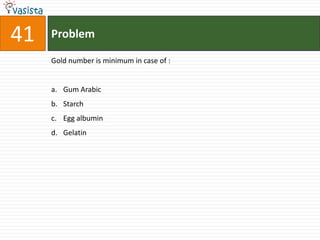
     Gold number is minimum in case of :


     a. Gum Arabic
     b. Starch
     c. Egg albumin
     d. Gelatin
42   Problem

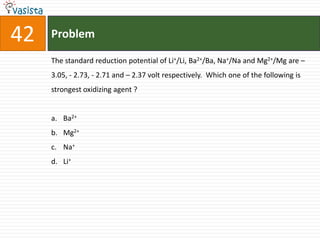
     The standard reduction potential of Li+/Li, Ba2+/Ba, Na+/Na and Mg2+/Mg are –
     3.05, - 2.73, - 2.71 and – 2.37 volt respectively. Which one of the following is
     strongest oxidizing agent ?


     a. Ba2+
     b. Mg2+
     c. Na+
     d. Li+
43   Problem

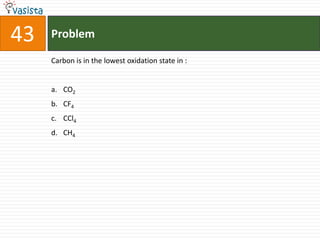
     Carbon is in the lowest oxidation state in :


     a. CO2
     b. CF4
     c. CCl4
     d. CH4
44   Problem

     Oxidation state of nitrogen is correctly given for :
     Compound                                 Oxidation state


     a. Mg3N2                                           -3
     b. NH2OH                                           +1
     c. (N2H5)2SO4                                      +2
     d. [CO(NH3)5Cl]Cl2                                     0
45   Problem

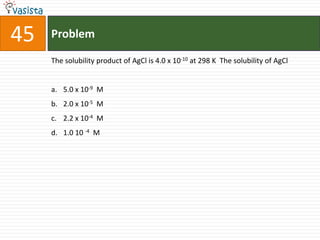
     The solubility product of AgCl is 4.0 x 10⁻¹⁰ at 298 K The solubility of AgCl


     a. 5.0 x 10⁻⁹ M
     b. 2.0 x 10⁻⁵ M
     c. 2.2 x 10⁻⁴ M
     d. 1.0 10 -4 M
46   Problem

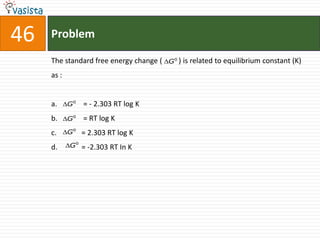
     The standard free energy change (   G0 )   is related to equilibrium constant (K)
     as :


     a.     G0   = - 2.303 RT log K
     b.     G0   = RT log K
     c.     G0   = 2.303 RT log K
     d.     G0   = -2.303 RT In K
47   Problem

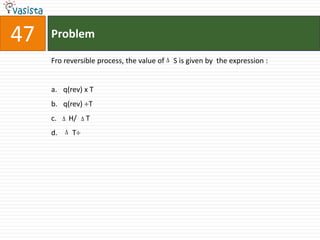
     Fro reversible process, the value of   S is given by the expression :


     a. q(rev) x T
     b. q(rev) T
     c.   H/    T
     d.    T
48   Problem

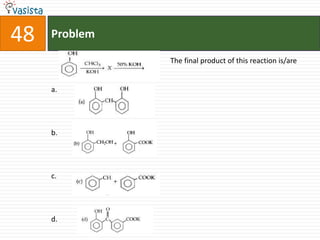
               The final product of this reaction is/are


     a.


     b.


     c.


     d.
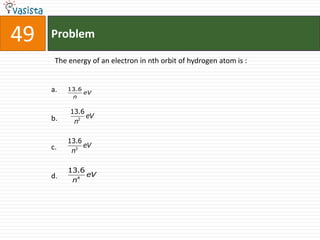
49   Problem

      The energy of an electron in nth orbit of hydrogen atom is :


     a.   13.6
               eV
           n

          13.6
     b.        eV
           n2

          13.6
     c.     3
               eV
           n

          13.6
     d.        eV
           n4
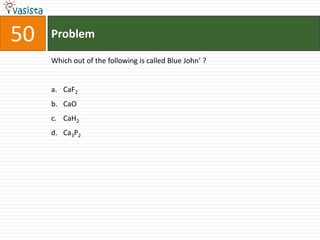
50   Problem

     Which out of the following is called Blue John’ ?


     a. CaF2
     b. CaO
     c. CaH2
     d. Ca3P2
FOR SOLUTIONS VISIT WWW.VASISTA.NET

AMU - Chemistry - 2002

  • 1.
    AMU –PAST PAPERS CHEMISTRY-UNSOLVED PAPER - 2002
  • 2.
    SECTION – I  Single Correct Answer Type  There are five parts in this question. Four choices are given for each part and one of them is correct. Indicate you choice of the correct answer for each part in your answer-book by writing the letter (a), (b), (c) or (d) whichever is appropriate
  • 3.
    01 Problem Which of the following carbonates is last soluble in water ? a. NaHCO3 b. CaCO3 c. MgCO3 d. Na2CO3
  • 4.
    02 Problem The bond energies of F2, Cl2 Br2 and I2 are 155, 244, 193 and 151 kJ/mol. The weakest bond will be in : a. Cl2 b. I2 c. Br2 d. F2
  • 5.
    03 Problem The number of unpaired electrons in ferrous ion is : a. 3 b. 2 c. 5 d. 4
  • 6.
    04 Problem How many optically active isomers are possible for butane –2, 3-diol ? a. 2 b. 4 c. 1 d. 3
  • 7.
    05 Problem One mole of SO2 corresponds to a. 6.4 g of SO2 b. 6.02 x 10²³ molecules of SO2 c. 22.4 L at 250C and 1 atm d. all the these
  • 8.
    06 Problem Which of the following statements about vitamin B12 is false ? a. It has a cobalt atom b. It also occurs in plants c. It is present in rain water d. It is needed for human body in very small amounts
  • 9.
    07 Problem A mixture of benzoic acid and naphthalene can be separated by crystallization from : a. Cold water b. Ether c. Hot water d. Benzene
  • 10.
    08 Problem The internal energy of one mole of a gas is : 3 a. 2 KT 1 b. 2 KT 3 c. 2 RT 1 d. 2 RT
  • 11.
    09 Problem The term pH comes from : a. “pure voiv hydrogene” which implies potential of hydrogen b. pure hydrogen content c. purity of hydrogen ions in solution d. name of the scientist associated
  • 12.
    10 Problem The number of atoms in 0.004 g of magnesium is close to : a. 2 x 10²⁰ b. 6.02 x 10²³ c. 24 d. 1020
  • 13.
    11 Problem Propene when heated with chlorine at about 5000C forms : a. CH2Cl – CH = CH2 b. CH3 – CHCl – CH2Cl c. CH2Cl – CHCl – CH2Cl d. All of these
  • 14.
    12 Problem Absolute alcohol is : a. 95% ethanol b. 75% ethanol c. 100% ethanol d. mixture of various primary alcohols
  • 15.
    13 Problem CH3CHO HCN X H2O / H Y In the above sequence Y is : a. Lactic acid b. Formic acid c. Cinnamic acid d. Acetic acid
  • 16.
    14 Problem Aniline reacts with concentrated HNO3 to give : a. b. c. d.
  • 17.
    15 Problem Which one of the following is most basic ? a. Cl - b. F – c. I – d. Br –
  • 18.
    16 Problem The volume strength of 1.5 N H2O2 solution is : a. 5.2 b. 8.4 c. 8.8 d. 4.8
  • 19.
    17 Problem the highest number of unpaired electrons are present in : a. Fe4+ b. Fe3+ c. Fe0 d. Fe2+
  • 20.
    18 Problem The nineteenth electron chromium has which of the following set of quantum number ? n l m s 1 a. 3 0 0 2 1 b. 3 2 -2 2 1 c. 4 0 0 2 1 d. 4 1 -1 2
  • 21.
    19 Problem What is the correct sequence of bond order ? a. O2+ > O2- > O2 b. O2 > O2-1 > O2+1 c. O2+ > O2 > O2- d. O2-1 > O2+1 > O2
  • 22.
    20 Problem Bond order of N – O bonds in nitrate ion is : a. 1.25 b. 1.50 c. 1.33 d. 1.0
  • 23.
    21 Problem Which bond is most polar ? a. F – F b. I – F c. Cl – F d. Br – F
  • 24.
    22 Problem The effect of a catalyst in a chemical reaction is to change the : a. Equilibrium concentration b. Heat of reaction c. Activation energy d. Final product
  • 25.
    23 Problem Which of the following aqueous solutions will have highest freezing point : a. 0.1 m CaCl2 b. 0.1 m KCl c. m glucose d. m Al2(SO4)3
  • 26.
    24 Problem Which oxidation numbers are shown by carbon ? a. - 1, - 2, - 3, - 4 b. 4, + 3, + 2, + 1 c. 0 d. All of these
  • 27.
    25 Problem The spectrum of He+ is expected to be similar to that of : a. Be+2 b. Li+ c. Na d. H
  • 28.
    26 Problem Bleaching action. Of SO2 is due to : a. Oxidation b. Reduction c. Hydrolysis d. Its acidic nature
  • 29.
    27 Problem Water gas is essentially a mixture of ? a. H2O(g) and CO2 b. H2O and CO c. H2 and CO d. CO and CO2
  • 30.
    28 Problem Which is the strongest reducing agent ? a. Mg b. Rb c. Na d. K
  • 31.
    29 Problem Mortar is a mixture of slaked lime and sand in the ratio : a. 1 : 4 b. 2 : 3 c. 1 : 3 d. 3 : 1
  • 32.
    30 Problem Which of manufactured by electrolysis of fused NaCl ? a. NaClO3 b. NaClO c. NaOH d. Na
  • 33.
    31 Problem The wire in the flash bulbs is made up of : a. Ag b. Cu c. Ba d. Mg
  • 34.
    32 Problem K4[Fe(CN)6] is called : a. Prussian blue b. Potasium ferricyanide c. Potassium hexacyano ferrate (II) d. Potassium hexacyanoferrate (III)
  • 35.
    33 Problem Which of the following does not react with AgCl ? a. Na2CO3 b. Na2S2O3 c. NH4OH d. NaNO3
  • 36.
    34 Problem The number of moles of KMnO4 that will be needed to react with one mole of sulphite ion in acidic solution is : a. 1 b. 4/5 c. 3/5 d. 2/5
  • 37.
    35 Problem Anorganic compound X on treatment with acidified K2Cr2O7 gives compound Y. Which reacts with I2 and sodium carbonate to form triiodomethane. The compound X can be : a. CH3CH(OH)CH3 b. CH3CHO c. ** d. CH3OH
  • 38.
    36 Problem The reaction of HCOOH with conc. H2SO4 gives : a. CH3COOH b. (COOH)2 c. CO2 d. CO
  • 39.
    37 Problem Formalin is : a. 40% solution of formaldehyde in acetaldehyde b. 40% solution of formaldehyde in acetone c. 40% solution of formaldehyde in water d. liquid formaldehyde
  • 40.
    38 Problem Alcohol reacts with Grignard reagent to form : a. Alkanes b. Alkenes c. Alkynes d. All of these
  • 41.
    39 Problem Acetone RCl + NaI R – I + NaCl This reaction is known as : a. Wurtz reaction b. Fitting reaction c. Frankland reaction d. Finkelstein reaction
  • 42.
    40 Problem The weight in g of 1 curie of radioactive element 200X having a t1/2 of 69.3 min is : a. 3.0 x 10⁻⁸ g b. 7.4 x 10⁻⁸ g c. 3.7 x 10⁻⁸ g d. 200 g
  • 43.
    41 Problem Gold number is minimum in case of : a. Gum Arabic b. Starch c. Egg albumin d. Gelatin
  • 44.
    42 Problem The standard reduction potential of Li+/Li, Ba2+/Ba, Na+/Na and Mg2+/Mg are – 3.05, - 2.73, - 2.71 and – 2.37 volt respectively. Which one of the following is strongest oxidizing agent ? a. Ba2+ b. Mg2+ c. Na+ d. Li+
  • 45.
    43 Problem Carbon is in the lowest oxidation state in : a. CO2 b. CF4 c. CCl4 d. CH4
  • 46.
    44 Problem Oxidation state of nitrogen is correctly given for : Compound Oxidation state a. Mg3N2 -3 b. NH2OH +1 c. (N2H5)2SO4 +2 d. [CO(NH3)5Cl]Cl2 0
  • 47.
    45 Problem The solubility product of AgCl is 4.0 x 10⁻¹⁰ at 298 K The solubility of AgCl a. 5.0 x 10⁻⁹ M b. 2.0 x 10⁻⁵ M c. 2.2 x 10⁻⁴ M d. 1.0 10 -4 M
  • 48.
    46 Problem The standard free energy change ( G0 ) is related to equilibrium constant (K) as : a. G0 = - 2.303 RT log K b. G0 = RT log K c. G0 = 2.303 RT log K d. G0 = -2.303 RT In K
  • 49.
    47 Problem Fro reversible process, the value of S is given by the expression : a. q(rev) x T b. q(rev) T c. H/ T d. T
  • 50.
    48 Problem The final product of this reaction is/are a. b. c. d.
  • 51.
    49 Problem The energy of an electron in nth orbit of hydrogen atom is : a. 13.6 eV n 13.6 b. eV n2 13.6 c. 3 eV n 13.6 d. eV n4
  • 52.
    50 Problem Which out of the following is called Blue John’ ? a. CaF2 b. CaO c. CaH2 d. Ca3P2
  • 53.
    FOR SOLUTIONS VISITWWW.VASISTA.NET