AEEE –Past papersCHEMISTRY - UNSOLVED PAPER - 2006
SECTION – IStraight Objective TypeThis section contains  multiple choice questions numbered 75. Each question has 4 choices (A), (B), (C) and (D), out of   which ONLY ONE is correct.
Problem01Which of the following is a redox reaction ?  NaCl + KNO3  NaNO3 + KClCaC2O4 + 2HCl  CaCl2 + H2C2O4Ca(OH)2 + 2NH4Cl  CaCl2 + 2NH3 + 2H2O2K[Ag(CN)2] + Zn  2Ag + K2 [Zn(CN)4]
Problem02For an ideal gas, number of mol per litre in terms of its pressure P, temperature T and gas constant R is : PT/RPRTP/RTRT/P
Problem03 Number of P – O bonds in P4O10 is :  1716156
Problem04 KO2 is used in space and submarines because it :  Absorbs CO2 and increases O2 concentration Absorbs moisture Absorbs CO2Produces ozone
Problem05 Which of the following ions has the maximum magnetic moment ? Mn2+Fe2+Ti2+Cr2+
Problem06 Acetylene does not react with :  NaAmmonical AgNO3HClNaOH
Problem07 Compound A given belowis :  Antiseptic Antibiotic Analgesic Pesticide
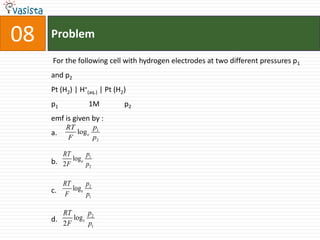
Problem08 For the following cell with hydrogen electrodes at two different pressures p1 and p2Pt (H2) | H+(aq.) | Pt (H2)p1	   1M	     p2emf is given by :a.b.c.d.
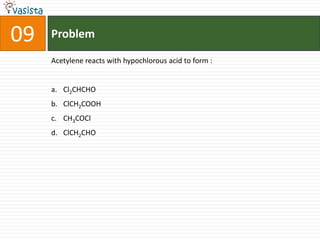
Problem09Acetylene reacts with hypochlorous acid to form :  Cl2CHCHOClCH2COOHCH3COClClCH2CHO
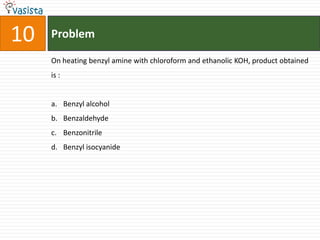
Problem10On heating benzyl amine with chloroform and ethanolic KOH, product obtained is :  Benzyl alcohol BenzaldehydeBenzonitrileBenzyl isocyanide
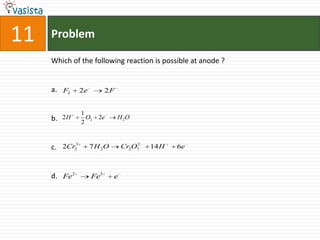
Problem11Which of the following reaction is possible at anode ? a.b.c.d.
Problem12Which of the following concentration factor is affected by change in temperature ?  MolarityMolalityMol fraction Weight fraction
Problem13Cyanide process is used for the extraction of :  Barium Silver Boron Zinc
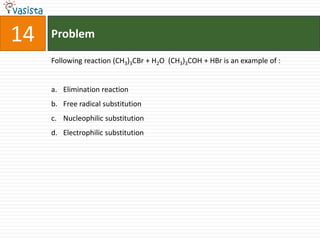
Problem14Following reaction (CH3)3CBr + H2O  (CH3)3COH + HBr is an example of :  Elimination reaction Free radical substitution Nucleophilic substitution Electrophilic substitution
Problem15A metal M forms water soluble MSO4 and inert MO. MO in aqueous solution forms insoluble M(OH)2 soluble in NaOH. Metal M is :  BeMgCaSi
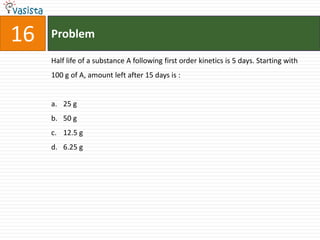
Problem16Half life of a substance A following first order kinetics is 5 days. Starting with 100 g of A, amount left after 15 days is :  25 g50 g12.5 g6.25 g
Problem17The most stable ion is :  [Fe(OH)5]3-[FeCl6]3-[Fe(CN)6]3-[Fe(H2O)6]3+
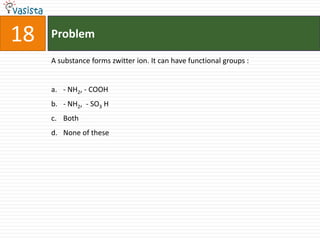
Problem18A substance forms zwitter ion. It can have functional groups :  - NH2, - COOH- NH2,  - SO3 HBoth None of these
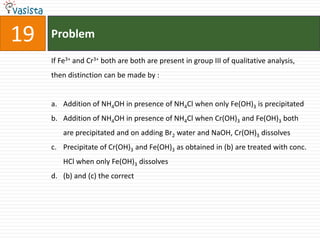
Problem19If Fe3+ and Cr3+ both are both are present in group III of qualitative analysis, then distinction can be made by :  Addition of NH4OH in presence of NH4Cl when only Fe(OH)3 is precipitated Addition of NH4OH in presence of NH4Cl when Cr(OH)3 and Fe(OH)3 both are precipitated and on adding Br2 water and NaOH, Cr(OH)3 dissolves Precipitate of Cr(OH)3 and Fe(OH)3 as obtained in (b) are treated with conc. HCl when only Fe(OH)3 dissolves (b) and (c) the correct
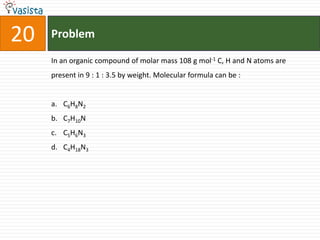
Problem20In an organic compound of molar mass 108 g mol-1 C, H and N atoms are present in 9 : 1 : 3.5 by weight. Molecular formula can be :  C6H8N2C7H10NC5H6N3C4H18N3
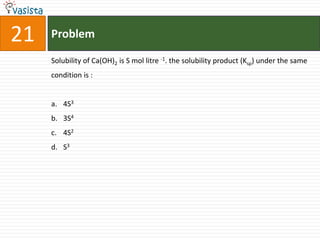
Problem21Solubility of Ca(OH)2 is S mol litre-1. the solubility product (Ksp) under the same condition is :  4S33S44S2S3
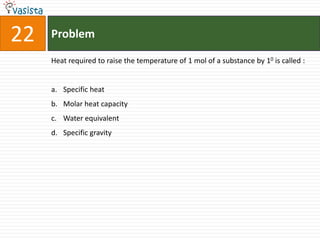
Problem22Heat required to raise the temperature of 1 mol of a substance by 10 is called :  Specific heat Molar heat capacity Water equivalent Specific gravity
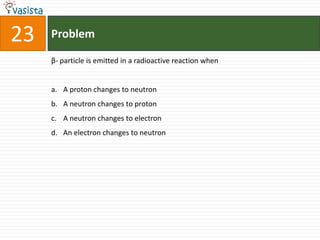
Problem23β- particle is emitted in a radioactive reaction when  A proton changes to neutron A neutron changes to proton A neutron changes to electron An electron changes to neutron
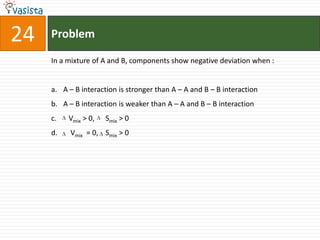
Problem24In a mixture of A and B, components show negative deviation when :  A – B interaction is stronger than A – A and B – B interaction A – B interaction is weaker than A – A and B – B interaction Vmix > 0,      Smix > 0Vmix  = 0,    Smix > 0
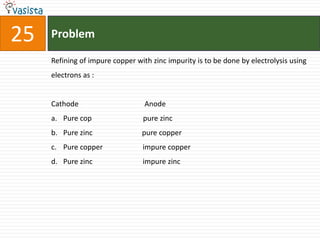
Problem25Refining of impure copper with zinc impurity is to be done by electrolysis using electrons as :  Cathode 		                Anode Pure cop                            pure zincPure zinc                           pure copper Pure copper 	               impure copper Pure zinc 	               impure zinc 
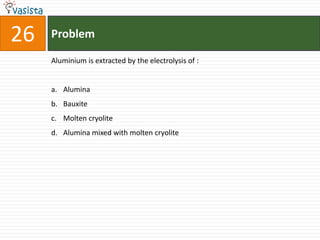
Problem26Aluminium is extracted by the electrolysis of :  Alumina Bauxite Molten cryoliteAlumina mixed with molten cryolite
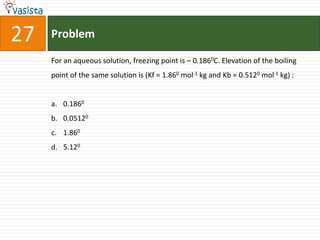
Problem27For an aqueous solution, freezing point is – 0.1860C. Elevation of the boiling point of the same solution is (Kf = 1.860 mol-1 kg and Kb = 0.5120 mol-1 kg) : 0.18600.051201.8605.120
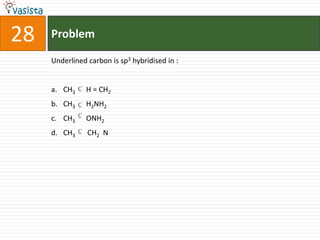
Problem28Underlined carbon is sp3hybridised in :  CH3      H = CH2CH3      H2NH2CH3      ONH2CH3          CH2  N
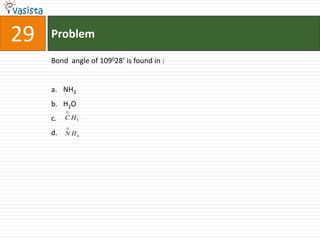
Problem29Bond  angle of 109028’ is found in :  NH3H2O
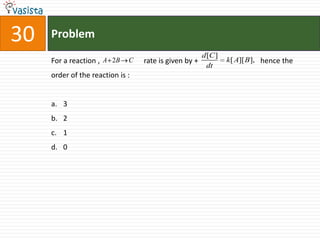
Problem30For a reaction ,                        rate is given by +                                  hence the order of the reaction is :  3210
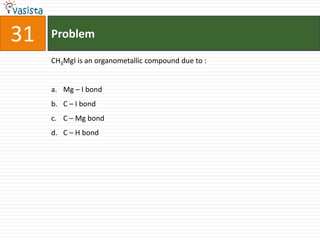
Problem31CH3MgI is an organometalliccompound due to :  Mg – I bond C – I bond C – Mg bond C – H bond
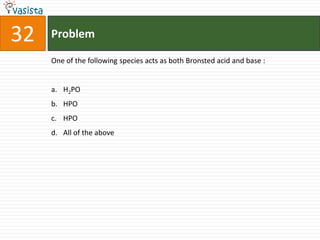
Problem32One of the following species acts as both Bronsted acid and base :  H2PO HPO HPO All of the above
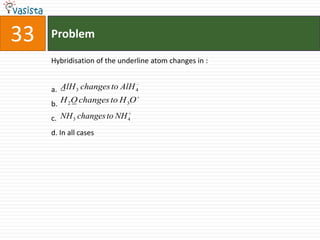
Problem33Hybridisation of the underline atom changes in : a.b.c.d. In all cases
Problem34Racemic mixture is formed by mixing two :  Isomeric compounds Chiral compounds Meso compounds Enantiomers with chiral carbon
Problem35The number of lone pairs on Xe in XeF2, XeF4 and XeF6 respectively are :  3, 2, 12, 4, 61, 2, 36, 4, 2
Problem36An aqueous solution of 1 M NaCl and 1M HCl is :  Not a buffer but pH < 7Not a buffer but pH > 7A buffer with pH < 7A buffer with pH > 7
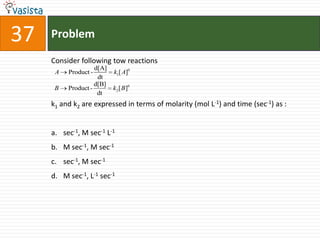
Problem37Consider following tow reactions k1 and k2 are expressed in terms of molarity (mol L-1) and time (sec-1) as :  sec-1, M sec-1 L-1M sec-1, M sec-1sec-1, M sec-1M sec-1, L-1 sec-1
Problem38RNA contains :  Ribose sugar and thymine Ribose sugar and uracilDeoxyribose sugar and uracilDeoxyribose sugar and thymine
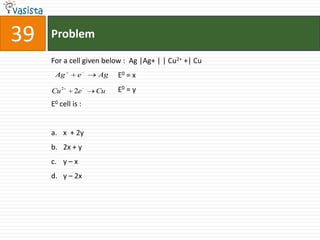
Problem39For a cell given below :  Ag |Ag+ | | Cu2+ +| Cu	                   E0 = x	                   E0 = yE0 cell is :  x  + 2y2x + yy – xy – 2x
Problem40Based on kinetic theory of gases following laws can be proved :  Boyle’s law Charle’s law Avogadro’s law All of these
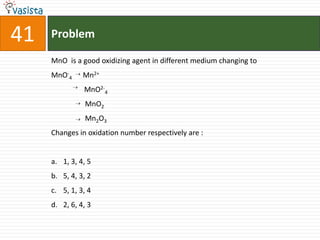
Problem41MnO  is a good oxidizing agent in different medium changing to MnO-4      Mn2+                  MnO2-4	 MnO2	 Mn2O3Changes in oxidation number respectively are :  1, 3, 4, 55, 4, 3, 25, 1, 3, 42, 6, 4, 3
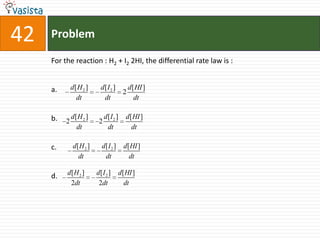
Problem42For the reaction : H2 + I2 2HI, the differential rate law is :a.b.c.d. 
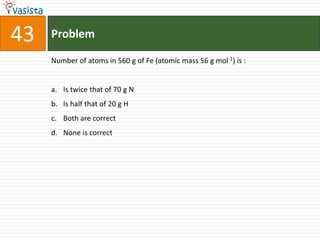
Problem43Number of atoms in 560 g of Fe (atomic mass 56 g mol-1) is :  Is twice that of 70 g NIs half that of 20 g HBoth are correct None is correct
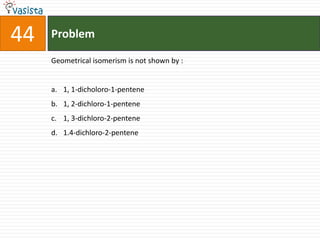
Problem44Geometrical isomerism is not shown by :  1, 1-dicholoro-1-pentene 1, 2-dichloro-1-pentene 1, 3-dichloro-2-pentene 1.4-dichloro-2-pentene
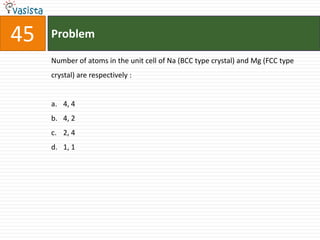
Problem45Number of atoms in the unit cell of Na (BCC type crystal) and Mg (FCC type crystal) are respectively :  4, 44, 22, 41, 1
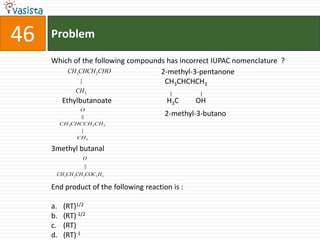
Problem46Which of the following compounds has incorrect IUPAC nomenclature  ?                                                            2-methyl-3-pentanone                                                              CH3CHCHCH3                                                                                                 |                       |Ethylbutanoate                              H3C	         OH                                                              2-methyl-3-butano3methyl butanalEnd product of the following reaction is : (RT)1/2(RT)-1/2(RT)(RT)-1
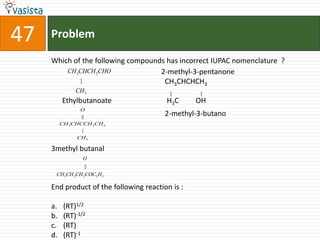
Problem47Which of the following compounds has incorrect IUPAC nomenclature  ?                                                            2-methyl-3-pentanone                                                              CH3CHCHCH3                                                                                                 |                       |Ethylbutanoate                              H3C	         OH                                                              2-methyl-3-butano3methyl butanalEnd product of the following reaction is : (RT)1/2(RT)-1/2(RT)(RT)-1
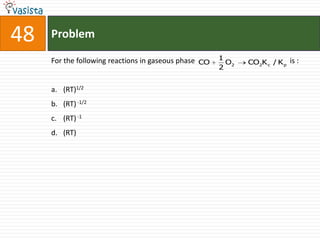
Problem48For the following reactions in gaseous phase			        is : (RT)1/2(RT) -1/2(RT)-1(RT)
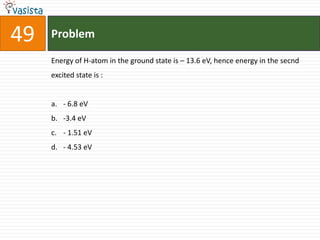
Problem49Energy of H-atom in the ground state is – 13.6 eV, hence energy in the secnd excited state is :  - 6.8 eV-3.4 eV- 1.51 eV- 4.53 eV
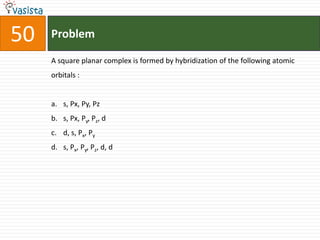
Problem50A square planar complex is formed by hybridization of the following atomic orbitals :  s, Px, Py, Pzs, Px, Py, Pz, dd, s, Px, Pys, Px, Py, Pz, d, d
Problem51Type of isomerism shown by [Cr(NH3)5NO2]Cl2 is :  Optical Ionization Geometrical Linkage
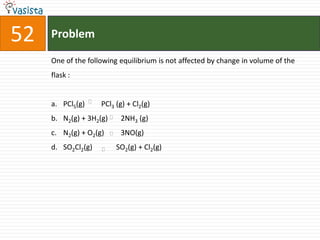
Problem52One of the following equilibrium is not affected by change in volume of the flask :  PCl5(g)         PCl3 (g) + Cl2(g)N2(g) + 3H2(g)       2NH3 (g)N2(g) + O2(g)         3NO(g)SO2Cl2(g)             SO2(g) + Cl2(g)
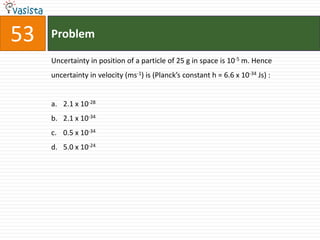
Problem53Uncertainty in position of a particle of 25 g in space is 10-5 m. Hence uncertainty in velocity (ms-1) is (Planck’s constant h = 6.6 x 10⁻³⁴ Js) :  2.1 x 10-282.1 x 10-340.5 x 10-345.0 x 10⁻²⁴
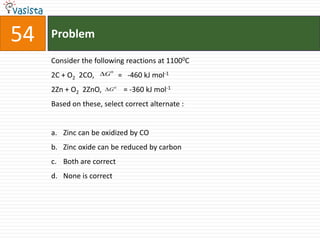
Problem54Consider the following reactions at 11000C2C + O2  2CO,             =   -460 kJ mol-12Zn + O2  2ZnO,            = -360 kJ mol-1Based on these, select correct alternate :  Zinc can be oxidized by COZinc oxide can be reduced by carbonBoth are correct None is correct
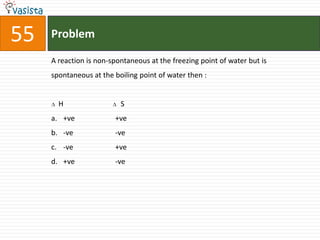
Problem55A reaction is non-spontaneous at the freezing point of water but is spontaneous at the boiling point of water then :      H		   S+ve		+ve-ve		-ve-ve		+ve+ve		-ve
Problem56Monomers converted to polymer by:Hydrolysis of monomers Condensation reaction between monomers Protonation of monomers None is correct
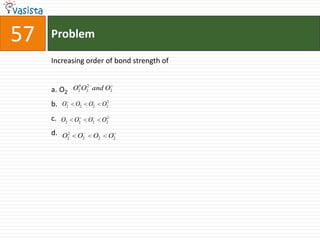
Problem57Increasing order of bond strength ofa.O2b.c.d.
Problem58Most common oxidation states of Ce(Cerium) are :  +3, +4+2, +3+2, +4+3, +5
Problem59Ce3+, La3+, Pm3+ and Yb3+ have ionic radii in the increasing order as :  La3+ < Ce3+ < Pm3+ < Yb3+Yb3+ < Pm3+ < La3+ < Ce3+La3+ = Ce3+ < Pm3+ < Yb3+Yb3+ < Pm3+ < La3+ < Ce3+
Problem60pH of 0.005 M calcium acetate (pKa of CH3COOH = 4.74) is :  7.049.379.268.37
Problem61H2 gas is absorbed on the metal surface like tungsten. This follows ….. order reaction.  Third Second Zero First
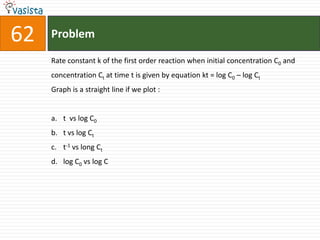
Problem62Rate constant k of the first order reaction when initial concentration C0 and concentration Ct at time t is given by equation kt = log C0 – log CtGraph is a straight line if we plot :  t  vs log C0t vs log Ctt-1vs long Ctlog C0vs log C 
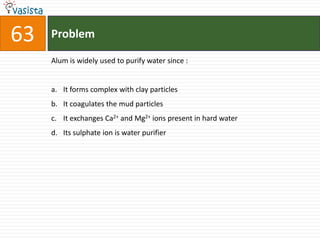
Problem63Alum is widely used to purify water since :  It forms complex with clay particles It coagulates the mud particles It exchanges Ca2+ and Mg2+ ions present in hard water Its sulphate ion is water purifier
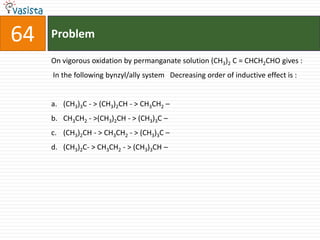
Problem64On vigorous oxidation by permanganate solution (CH3)2 C = CHCH2CHO gives :  In the following bynzyl/ally system   Decreasing order of inductive effect is :  (CH3)3C - > (CH3)2CH - > CH3CH2 – CH3CH2 - >(CH3)2CH - > (CH3)3C – (CH3)2CH - > CH3CH2 - > (CH3)3C – (CH3)2C- > CH3CH2 - > (CH3)3CH –
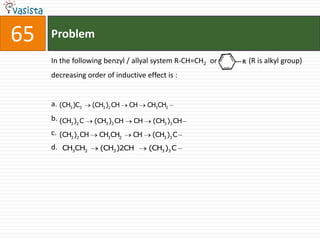
Problem65In the following benzyl / allyal system R-CH=CH2   or 	   (R is alkyl group) decreasing order of inductive effect is :a.b.c.d.
Problem66PCI3 and PCI5 both exist; NCI3 exists but NCI5 does not exist. It is due to: Lower electro negativity of P then NLower tendency of N to form covalent bond Availability of vacant d-obital in P but not in NStatement is itself incorrect
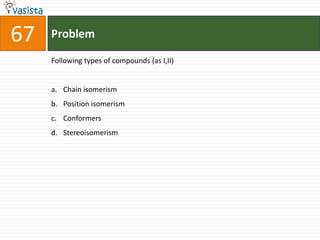
Problem67Following types of compounds (as I,II)Chain isomerism Position isomerismConformers Stereoisomerism
Problem68Conductivity (seimen’s S) is directly proportional to area of the vessel and the concentration of the solution in it and is inversely proportional to the length of the vessel, then constant of proportionality is expressed in:S m mol-1S2m2mol-2S m2mol-1S2m2mol
Problem69A heat engine absorbs heat q1 from a source at temperature T1 and heat q2 from a source at temperature T2. work done is found to be j(q1+q2).this is in accordance with : First law of thermodynamicsSecond law of thermodynamics Joules equivalent lawNone of the above
Problem70Select correct statement :When a covalent bond is formed, transfer of electrons takes placePure H2O does not contain any ionA bond is formed is formed when attractive forces overcome repulsive forcesHF is less polar than HBr
Problem71The metallic sodium dissolves in liquid ammonia to form a deep blue coloured solution, the deep blue colour is due to formation of:Solvated electron, e(NH3)-xSolvated atomic sodium, Na(NH3)­y­­(Ma++Na)NaNH2+H2
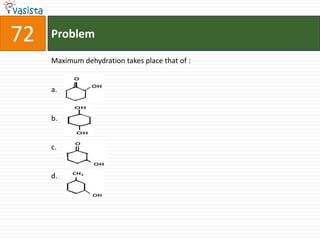
Problem72Maximum dehydration takes place that of :a.b.c.d.
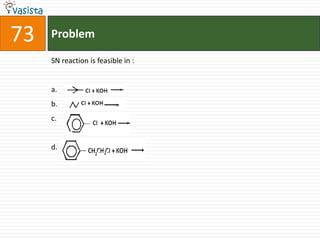
Problem73SN reaction is feasible in :a.b.c.d.
Problem74Oxidation number of CI in CaOCI (bleaching powder) is :Zero , since it contains Cl2-1, since it contains Cl-+1, since it contains ClO-+1 and -1 since it containsClO-    and Cl-
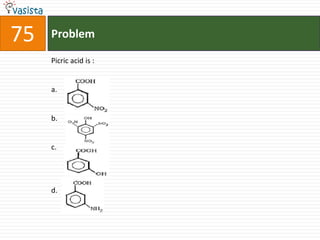
Problem75Picric acid is :a.b.c.d.

AIEEE Chemistry 2002

  • 1.
    AEEE –Past papersCHEMISTRY- UNSOLVED PAPER - 2006
  • 2.
    SECTION – IStraightObjective TypeThis section contains multiple choice questions numbered 75. Each question has 4 choices (A), (B), (C) and (D), out of which ONLY ONE is correct.
  • 3.
    Problem01Which of thefollowing is a redox reaction ?  NaCl + KNO3 NaNO3 + KClCaC2O4 + 2HCl CaCl2 + H2C2O4Ca(OH)2 + 2NH4Cl CaCl2 + 2NH3 + 2H2O2K[Ag(CN)2] + Zn 2Ag + K2 [Zn(CN)4]
  • 4.
    Problem02For an idealgas, number of mol per litre in terms of its pressure P, temperature T and gas constant R is : PT/RPRTP/RTRT/P
  • 5.
    Problem03 Number ofP – O bonds in P4O10 is :  1716156
  • 6.
    Problem04 KO2 isused in space and submarines because it :  Absorbs CO2 and increases O2 concentration Absorbs moisture Absorbs CO2Produces ozone
  • 7.
    Problem05 Which ofthe following ions has the maximum magnetic moment ? Mn2+Fe2+Ti2+Cr2+
  • 8.
    Problem06 Acetylene doesnot react with :  NaAmmonical AgNO3HClNaOH
  • 9.
    Problem07 Compound Agiven belowis :  Antiseptic Antibiotic Analgesic Pesticide
  • 10.
    Problem08 For thefollowing cell with hydrogen electrodes at two different pressures p1 and p2Pt (H2) | H+(aq.) | Pt (H2)p1 1M p2emf is given by :a.b.c.d.
  • 11.
    Problem09Acetylene reacts withhypochlorous acid to form :  Cl2CHCHOClCH2COOHCH3COClClCH2CHO
  • 12.
    Problem10On heating benzylamine with chloroform and ethanolic KOH, product obtained is :  Benzyl alcohol BenzaldehydeBenzonitrileBenzyl isocyanide
  • 13.
    Problem11Which of thefollowing reaction is possible at anode ? a.b.c.d.
  • 14.
    Problem12Which of thefollowing concentration factor is affected by change in temperature ?  MolarityMolalityMol fraction Weight fraction
  • 15.
    Problem13Cyanide process isused for the extraction of :  Barium Silver Boron Zinc
  • 16.
    Problem14Following reaction (CH3)3CBr+ H2O (CH3)3COH + HBr is an example of :  Elimination reaction Free radical substitution Nucleophilic substitution Electrophilic substitution
  • 17.
    Problem15A metal Mforms water soluble MSO4 and inert MO. MO in aqueous solution forms insoluble M(OH)2 soluble in NaOH. Metal M is :  BeMgCaSi
  • 18.
    Problem16Half life ofa substance A following first order kinetics is 5 days. Starting with 100 g of A, amount left after 15 days is :  25 g50 g12.5 g6.25 g
  • 19.
    Problem17The most stableion is :  [Fe(OH)5]3-[FeCl6]3-[Fe(CN)6]3-[Fe(H2O)6]3+
  • 20.
    Problem18A substance formszwitter ion. It can have functional groups :  - NH2, - COOH- NH2, - SO3 HBoth None of these
  • 21.
    Problem19If Fe3+ andCr3+ both are both are present in group III of qualitative analysis, then distinction can be made by :  Addition of NH4OH in presence of NH4Cl when only Fe(OH)3 is precipitated Addition of NH4OH in presence of NH4Cl when Cr(OH)3 and Fe(OH)3 both are precipitated and on adding Br2 water and NaOH, Cr(OH)3 dissolves Precipitate of Cr(OH)3 and Fe(OH)3 as obtained in (b) are treated with conc. HCl when only Fe(OH)3 dissolves (b) and (c) the correct
  • 22.
    Problem20In an organiccompound of molar mass 108 g mol-1 C, H and N atoms are present in 9 : 1 : 3.5 by weight. Molecular formula can be :  C6H8N2C7H10NC5H6N3C4H18N3
  • 23.
    Problem21Solubility of Ca(OH)2is S mol litre-1. the solubility product (Ksp) under the same condition is :  4S33S44S2S3
  • 24.
    Problem22Heat required toraise the temperature of 1 mol of a substance by 10 is called :  Specific heat Molar heat capacity Water equivalent Specific gravity
  • 25.
    Problem23β- particle isemitted in a radioactive reaction when  A proton changes to neutron A neutron changes to proton A neutron changes to electron An electron changes to neutron
  • 26.
    Problem24In a mixtureof A and B, components show negative deviation when :  A – B interaction is stronger than A – A and B – B interaction A – B interaction is weaker than A – A and B – B interaction Vmix > 0, Smix > 0Vmix = 0, Smix > 0
  • 27.
    Problem25Refining of impurecopper with zinc impurity is to be done by electrolysis using electrons as :  Cathode Anode Pure cop pure zincPure zinc pure copper Pure copper impure copper Pure zinc impure zinc 
  • 28.
    Problem26Aluminium is extractedby the electrolysis of :  Alumina Bauxite Molten cryoliteAlumina mixed with molten cryolite
  • 29.
    Problem27For an aqueoussolution, freezing point is – 0.1860C. Elevation of the boiling point of the same solution is (Kf = 1.860 mol-1 kg and Kb = 0.5120 mol-1 kg) : 0.18600.051201.8605.120
  • 30.
    Problem28Underlined carbon issp3hybridised in :  CH3 H = CH2CH3 H2NH2CH3 ONH2CH3 CH2 N
  • 31.
    Problem29Bond angleof 109028’ is found in :  NH3H2O
  • 32.
    Problem30For a reaction, rate is given by + hence the order of the reaction is :  3210
  • 33.
    Problem31CH3MgI is anorganometalliccompound due to :  Mg – I bond C – I bond C – Mg bond C – H bond
  • 34.
    Problem32One of thefollowing species acts as both Bronsted acid and base :  H2PO HPO HPO All of the above
  • 35.
    Problem33Hybridisation of theunderline atom changes in : a.b.c.d. In all cases
  • 36.
    Problem34Racemic mixture isformed by mixing two :  Isomeric compounds Chiral compounds Meso compounds Enantiomers with chiral carbon
  • 37.
    Problem35The number oflone pairs on Xe in XeF2, XeF4 and XeF6 respectively are :  3, 2, 12, 4, 61, 2, 36, 4, 2
  • 38.
    Problem36An aqueous solutionof 1 M NaCl and 1M HCl is :  Not a buffer but pH < 7Not a buffer but pH > 7A buffer with pH < 7A buffer with pH > 7
  • 39.
    Problem37Consider following towreactions k1 and k2 are expressed in terms of molarity (mol L-1) and time (sec-1) as :  sec-1, M sec-1 L-1M sec-1, M sec-1sec-1, M sec-1M sec-1, L-1 sec-1
  • 40.
    Problem38RNA contains : Ribose sugar and thymine Ribose sugar and uracilDeoxyribose sugar and uracilDeoxyribose sugar and thymine
  • 41.
    Problem39For a cellgiven below : Ag |Ag+ | | Cu2+ +| Cu E0 = x E0 = yE0 cell is : x + 2y2x + yy – xy – 2x
  • 42.
    Problem40Based on kinetictheory of gases following laws can be proved :  Boyle’s law Charle’s law Avogadro’s law All of these
  • 43.
    Problem41MnO isa good oxidizing agent in different medium changing to MnO-4 Mn2+ MnO2-4 MnO2 Mn2O3Changes in oxidation number respectively are :  1, 3, 4, 55, 4, 3, 25, 1, 3, 42, 6, 4, 3
  • 44.
    Problem42For the reaction: H2 + I2 2HI, the differential rate law is :a.b.c.d. 
  • 45.
    Problem43Number of atomsin 560 g of Fe (atomic mass 56 g mol-1) is :  Is twice that of 70 g NIs half that of 20 g HBoth are correct None is correct
  • 46.
    Problem44Geometrical isomerism isnot shown by :  1, 1-dicholoro-1-pentene 1, 2-dichloro-1-pentene 1, 3-dichloro-2-pentene 1.4-dichloro-2-pentene
  • 47.
    Problem45Number of atomsin the unit cell of Na (BCC type crystal) and Mg (FCC type crystal) are respectively :  4, 44, 22, 41, 1
  • 48.
    Problem46Which of thefollowing compounds has incorrect IUPAC nomenclature ? 2-methyl-3-pentanone CH3CHCHCH3 | |Ethylbutanoate H3C OH 2-methyl-3-butano3methyl butanalEnd product of the following reaction is : (RT)1/2(RT)-1/2(RT)(RT)-1
  • 49.
    Problem47Which of thefollowing compounds has incorrect IUPAC nomenclature ? 2-methyl-3-pentanone CH3CHCHCH3 | |Ethylbutanoate H3C OH 2-methyl-3-butano3methyl butanalEnd product of the following reaction is : (RT)1/2(RT)-1/2(RT)(RT)-1
  • 50.
    Problem48For the followingreactions in gaseous phase is : (RT)1/2(RT) -1/2(RT)-1(RT)
  • 51.
    Problem49Energy of H-atomin the ground state is – 13.6 eV, hence energy in the secnd excited state is :  - 6.8 eV-3.4 eV- 1.51 eV- 4.53 eV
  • 52.
    Problem50A square planarcomplex is formed by hybridization of the following atomic orbitals :  s, Px, Py, Pzs, Px, Py, Pz, dd, s, Px, Pys, Px, Py, Pz, d, d
  • 53.
    Problem51Type of isomerismshown by [Cr(NH3)5NO2]Cl2 is :  Optical Ionization Geometrical Linkage
  • 54.
    Problem52One of thefollowing equilibrium is not affected by change in volume of the flask :  PCl5(g) PCl3 (g) + Cl2(g)N2(g) + 3H2(g) 2NH3 (g)N2(g) + O2(g) 3NO(g)SO2Cl2(g) SO2(g) + Cl2(g)
  • 55.
    Problem53Uncertainty in positionof a particle of 25 g in space is 10-5 m. Hence uncertainty in velocity (ms-1) is (Planck’s constant h = 6.6 x 10⁻³⁴ Js) :  2.1 x 10-282.1 x 10-340.5 x 10-345.0 x 10⁻²⁴
  • 56.
    Problem54Consider the followingreactions at 11000C2C + O2 2CO, = -460 kJ mol-12Zn + O2 2ZnO, = -360 kJ mol-1Based on these, select correct alternate :  Zinc can be oxidized by COZinc oxide can be reduced by carbonBoth are correct None is correct
  • 57.
    Problem55A reaction isnon-spontaneous at the freezing point of water but is spontaneous at the boiling point of water then :   H S+ve +ve-ve -ve-ve +ve+ve -ve
  • 58.
    Problem56Monomers converted topolymer by:Hydrolysis of monomers Condensation reaction between monomers Protonation of monomers None is correct
  • 59.
    Problem57Increasing order ofbond strength ofa.O2b.c.d.
  • 60.
    Problem58Most common oxidationstates of Ce(Cerium) are :  +3, +4+2, +3+2, +4+3, +5
  • 61.
    Problem59Ce3+, La3+, Pm3+and Yb3+ have ionic radii in the increasing order as :  La3+ < Ce3+ < Pm3+ < Yb3+Yb3+ < Pm3+ < La3+ < Ce3+La3+ = Ce3+ < Pm3+ < Yb3+Yb3+ < Pm3+ < La3+ < Ce3+
  • 62.
    Problem60pH of 0.005M calcium acetate (pKa of CH3COOH = 4.74) is :  7.049.379.268.37
  • 63.
    Problem61H2 gas isabsorbed on the metal surface like tungsten. This follows ….. order reaction.  Third Second Zero First
  • 64.
    Problem62Rate constant kof the first order reaction when initial concentration C0 and concentration Ct at time t is given by equation kt = log C0 – log CtGraph is a straight line if we plot :  t vs log C0t vs log Ctt-1vs long Ctlog C0vs log C 
  • 65.
    Problem63Alum is widelyused to purify water since :  It forms complex with clay particles It coagulates the mud particles It exchanges Ca2+ and Mg2+ ions present in hard water Its sulphate ion is water purifier
  • 66.
    Problem64On vigorous oxidationby permanganate solution (CH3)2 C = CHCH2CHO gives :  In the following bynzyl/ally system Decreasing order of inductive effect is :  (CH3)3C - > (CH3)2CH - > CH3CH2 – CH3CH2 - >(CH3)2CH - > (CH3)3C – (CH3)2CH - > CH3CH2 - > (CH3)3C – (CH3)2C- > CH3CH2 - > (CH3)3CH –
  • 67.
    Problem65In the followingbenzyl / allyal system R-CH=CH2 or (R is alkyl group) decreasing order of inductive effect is :a.b.c.d.
  • 68.
    Problem66PCI3 and PCI5both exist; NCI3 exists but NCI5 does not exist. It is due to: Lower electro negativity of P then NLower tendency of N to form covalent bond Availability of vacant d-obital in P but not in NStatement is itself incorrect
  • 69.
    Problem67Following types ofcompounds (as I,II)Chain isomerism Position isomerismConformers Stereoisomerism
  • 70.
    Problem68Conductivity (seimen’s S)is directly proportional to area of the vessel and the concentration of the solution in it and is inversely proportional to the length of the vessel, then constant of proportionality is expressed in:S m mol-1S2m2mol-2S m2mol-1S2m2mol
  • 71.
    Problem69A heat engineabsorbs heat q1 from a source at temperature T1 and heat q2 from a source at temperature T2. work done is found to be j(q1+q2).this is in accordance with : First law of thermodynamicsSecond law of thermodynamics Joules equivalent lawNone of the above
  • 72.
    Problem70Select correct statement:When a covalent bond is formed, transfer of electrons takes placePure H2O does not contain any ionA bond is formed is formed when attractive forces overcome repulsive forcesHF is less polar than HBr
  • 73.
    Problem71The metallic sodiumdissolves in liquid ammonia to form a deep blue coloured solution, the deep blue colour is due to formation of:Solvated electron, e(NH3)-xSolvated atomic sodium, Na(NH3)­y­­(Ma++Na)NaNH2+H2
  • 74.
    Problem72Maximum dehydration takesplace that of :a.b.c.d.
  • 75.
    Problem73SN reaction isfeasible in :a.b.c.d.
  • 76.
    Problem74Oxidation number ofCI in CaOCI (bleaching powder) is :Zero , since it contains Cl2-1, since it contains Cl-+1, since it contains ClO-+1 and -1 since it containsClO- and Cl-
  • 77.