GATE –PAST PAPERS
ELECTRICAL ENGINEERING - UNSOLVED PAPER - 2004
SECTION – I

   Single Correct Answer Type
         There are five parts in this question. Four choices are given for each part and one of them is

          correct. Indicate you choice of the correct answer for each part in your answer-book by

          writing the letter (a), (b), (c) or (d) whichever is appropriate
01   Problem

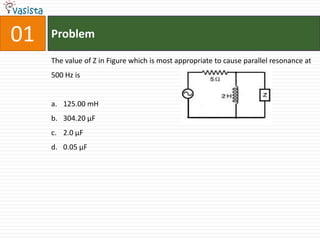
     The value of Z in Figure which is most appropriate to cause parallel resonance at
     500 Hz is


     a. 125.00 mH
     b. 304.20 µF
     c. 2.0 µF
     d. 0.05 µF
02   Problem

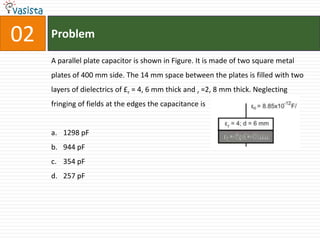
     A parallel plate capacitor is shown in Figure. It is made of two square metal
     plates of 400 mm side. The 14 mm space between the plates is filled with two
     layers of dielectrics of £r = 4, 6 mm thick and r =2, 8 mm thick. Neglecting
     fringing of fields at the edges the capacitance is


     a. 1298 pF
     b. 944 pF
     c. 354 pF
     d. 257 pF
03   Problem

     The inductance of a long solenoid of length 1000 mm wound uniformly with
     3000 turns on a cylindrical paper tube of 60 mm diameter is


     a. 3.2 µH
     b. 3.2 mH
     c. 32.0 mH
     d. 3.2 H
04   Problem

     Total instantaneous power supplied by a 3-phase ac supply to a balanced R-L
     load is


     a. zero
     b. constant
     c. pulsating with zero average3.2 H
     d. pulsating with non-zero average
05   Problem

     A 500 kVA, 3-phase transformer has iron losses of 300 W and full load copper
     losses of 600 W. The percentage load at which the transformer is expected to
     have maximum efficiency is


     a. 50.0%
     b. 70.7%
     c. 141.4%
     d. 200.0%
06   Problem

     For a given stepper motor, the following torque has the highest numerical
     value.


     a. Detent torque
     b. Pull-in torque
     c. Pull-out torque
     d. Holding torque
07   Problem

     The following motor definitely has a permanent magnet rotor


     a. DC commutator motor
     b. Brushless dc motor
     c. Stepper motor
     d. Reluctance motor
08   Problem

     The type of single-phase induction motor having the highest power factor at
     full load is


     a. shaded pole type
     b. split-phase type
     c. capacitor-start type
     d. capacitor-run type
09   Problem

     The direction of rotation of a 3-phase induction motor is clockwise when it is
     supplied with 3-phase sinusoidal voltage having phase sequence A-B-C. For
     counterclockwise rotation of the motor, the phase sequence of the power
     supply should be


     a. B-C-A
     b. C-A-B
     c. A-C-B
     d. B-C-A or C-A-B
10   Problem

     For a linear electromagnetic circuit, the following statement is true


     a. Field energy is equal
     b. Field energy is greater than the co-energy
     c. Field energy is lesser than the co-energy
     d. Co-energy is zero
11   Problem

     The rated voltage of a 3-phase power system is given as


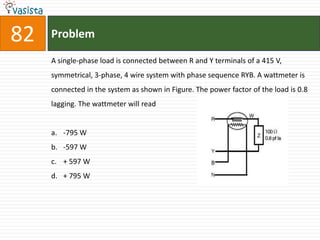
     a. rms phase voltage
     b. peak phase voltage
     c. rms line to line voltage
     d. peak line to line voltage
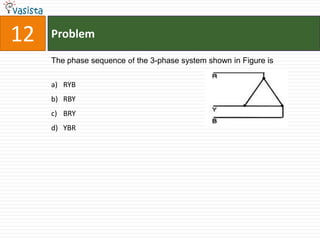
12   Problem

     The phase sequence of the 3-phase system shown in Figure is


     a) RYB
     b) RBY
     c) BRY
     d) YBR
13   Problem

     In thermal power plants, the pressure in the working fluid cycle is developed
     by


     a. condenser
     b. super heater
     c. feed water pump
     d. turbine
14   Problem

     For harnessing low variable waterheads, the suitable hydraulic turbine with
     high percentage of reaction and runner adjustable vanes is


     a. Kaplan
     b. Francis
     c. Pelton
     d. Impeller
15   Problem

     The transmission line distance protection relay having the property of being
     inherently directional is


     a. impedance relay
     b. MHO relay
     c. OHM relay
     d. reactance relay
16   Problem

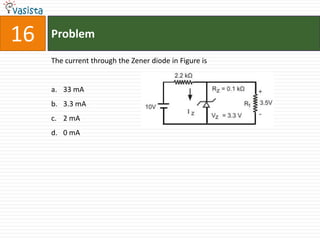
     The current through the Zener diode in Figure is


     a. 33 mA
     b. 3.3 mA
     c. 2 mA
     d. 0 mA
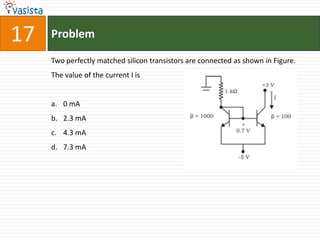
17   Problem

     Two perfectly matched silicon transistors are connected as shown in Figure.
     The value of the current I is


     a. 0 mA
     b. 2.3 mA
     c. 4.3 mA
     d. 7.3 mA
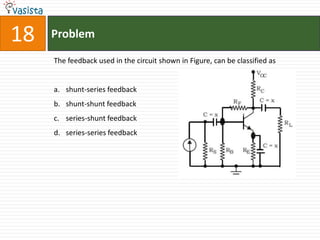
18   Problem

     The feedback used in the circuit shown in Figure, can be classified as


     a. shunt-series feedback
     b. shunt-shunt feedback
     c. series-shunt feedback
     d. series-series feedback
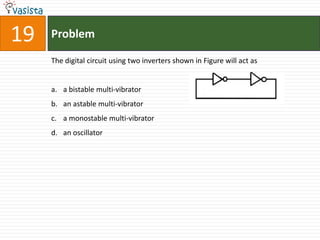
19   Problem

     The digital circuit using two inverters shown in Figure will act as


     a. a bistable multi-vibrator
     b. an astable multi-vibrator
     c. a monostable multi-vibrator
     d. an oscillator
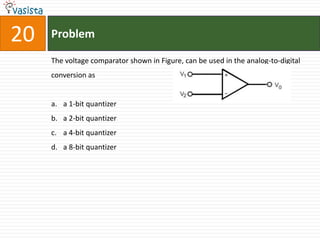
20   Problem

     The voltage comparator shown in Figure, can be used in the analog-to-digital
     conversion as


     a. a 1-bit quantizer
     b. a 2-bit quantizer
     c. a 4-bit quantizer
     d. a 8-bit quantizer
21   Problem

     The Nyquist plot of loop transfer function G(s) H(s) of a closed loop control
     system passes through the point (- 1, jO) in the G(s) H(s) plane. The phase
     margin of the system is


     a. 0°
     b. 45°
     c. 90°
     d. 180°
22   Problem

     Consider the function, F(s) = 5/(s(s2 + 3s + 2)) where F(s) is the Laplace
     transform of the function f(t). The initial value of f(t) is equal to


     a. 5
     b. 5/2
     c. 5/3
     d. 0
23   Problem

     For a tachometer, if Φ(t) is the rotor displacement is radians, e(t) is the output
     voltage and Kt is the tachometer constant in V/rad/sec, then the transfer
     function, E(s)/Q(s) will be


     a. Kts2
     b. Kt/s
     c. Kts
     d. Kt
24   Problem

     A dc potentiometer is designed to measure up to about 2 V with a slide wire of
     800 mm. A standard cell of emf 1.18 V obtains balance at 600 mm. A test cell is
     seen to obtain balance at 680 mm. The emf of the test cell is


     a. 1.00 V
     b. 1.34 V
     c. 1.50 V
     d. 1.70 V
25   Problem

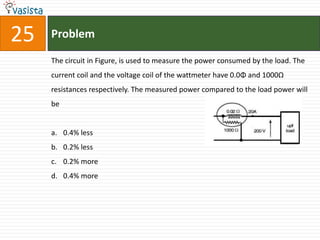
     The circuit in Figure, is used to measure the power consumed by the load. The
     current coil and the voltage coil of the wattmeter have 0.0Φ and 1000Ω
     resistances respectively. The measured power compared to the load power will
     be


     a. 0.4% less
     b. 0.2% less
     c. 0.2% more
     d. 0.4% more
26   Problem

     A galvanometer with a full scale current of 10 mA has a resistance 0Ω.100
     multiplying power (the ratio of measured current to galvanometer current) of
     a Ω100 shunt with this galvanometer is


     a. 110
     b. 100
     c. 11
     d. 10
27   Problem

     A bipolar junction transistor (BJT) is used as a power control switch by biasing
     it in the cut-off region (OFF state) or in the saturation region (ON state). In the
     ON state, for the BJT


     a. both the base-emitter and base-collector junctions are reverse biased
     b. the base-emitter junction is reverse biased, and the base-collector
        junction is forward biased
     c. the base-emitter junction is forward biased, and the base-collector
        junction is reverse biased
     d. both the ,base-emitter and base-collector junctions are forward biased
28   Problem

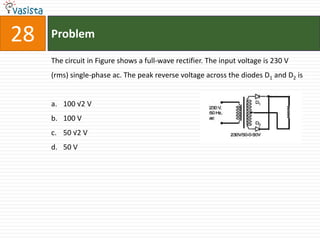
     The circuit in Figure shows a full-wave rectifier. The input voltage is 230 V
     (rms) single-phase ac. The peak reverse voltage across the diodes D1 and D2 is


     a. 100 √2 V
     b. 100 V
     c. 50 √2 V
     d. 50 V
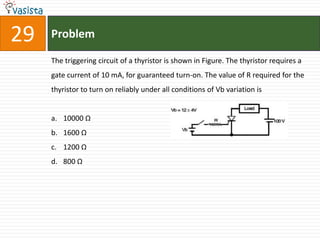
29   Problem

     The triggering circuit of a thyristor is shown in Figure. The thyristor requires a
     gate current of 10 mA, for guaranteed turn-on. The value of R required for the
     thyristor to turn on reliably under all conditions of Vb variation is


     a. 10000 Ω
     b. 1600 Ω
     c. 1200 Ω
     d. 800 Ω
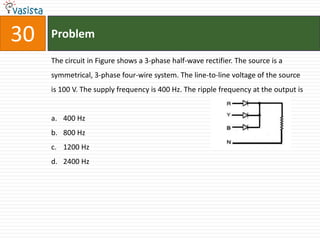
30   Problem

     The circuit in Figure shows a 3-phase half-wave rectifier. The source is a
     symmetrical, 3-phase four-wire system. The line-to-line voltage of the source
     is 100 V. The supply frequency is 400 Hz. The ripple frequency at the output is


     a. 400 Hz
     b. 800 Hz
     c. 1200 Hz
     d. 2400 Hz
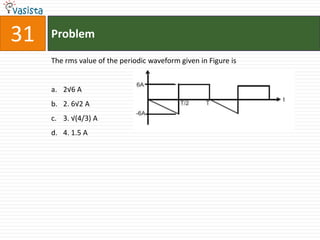
31   Problem

     The rms value of the periodic waveform given in Figure is


     a. 2√6 A
     b. 2. 6√2 A
     c. 3. √(4/3) A
     d. 4. 1.5 A
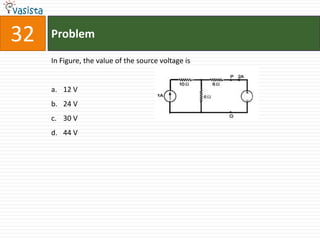
32   Problem

     In Figure, the value of the source voltage is


     a. 12 V
     b. 24 V
     c. 30 V
     d. 44 V
33   Problem

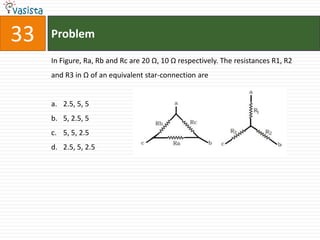
     In Figure, Ra, Rb and Rc are 20 Ω, 10 Ω respectively. The resistances R1, R2
     and R3 in Ω of an equivalent star-connection are


     a. 2.5, 5, 5
     b. 5, 2.5, 5
     c. 5, 5, 2.5
     d. 2.5, 5, 2.5
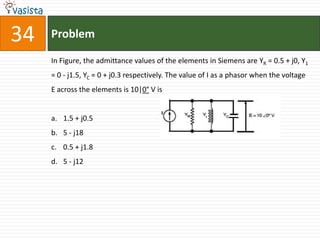
34   Problem

     In Figure, the admittance values of the elements in Siemens are YR = 0.5 + j0, Y1
     = 0 - j1.5, YC = 0 + j0.3 respectively. The value of I as a phasor when the voltage
     E across the elements is 10|0° V is


     a. 1.5 + j0.5
     b. 5 - j18
     c. 0.5 + j1.8
     d. 5 - j12
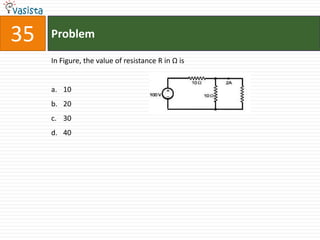
35   Problem

     In Figure, the value of resistance R in Ω is


     a. 10
     b. 20
     c. 30
     d. 40
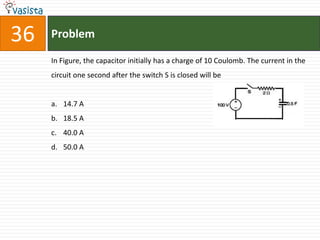
36   Problem

     In Figure, the capacitor initially has a charge of 10 Coulomb. The current in the
     circuit one second after the switch S is closed will be


     a. 14.7 A
     b. 18.5 A
     c. 40.0 A
     d. 50.0 A
37   Problem

     The rms value of the resultant current in a wire which carries a dc current of 10
     A and a sinusoidal alternating current of peak value 20 A is


     a. 14.1 A
     b. 17.3 A
     c. 22.4 A
     d. 30.0 A
38   Problem

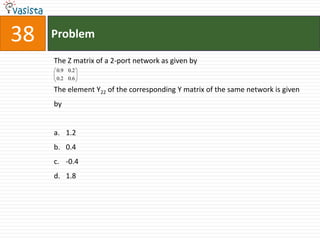
     The Z matrix of a 2-port network as given by
     0.9 0.2
     0.2 0.6

     The element Y22 of the corresponding Y matrix of the same network is given
     by


     a. 1.2
     b. 0.4
     c. -0.4
     d. 1.8
39   Problem

     The synchronous speed for the seventh space harmonic mmf wave of a 3-
     phase, 8 pole, 50 Hz induction machine is


     a. 107.14 rpm in forward direction
     b. 107.14 rpm in reverse direction
     c. 5250 rpm in forward direction
     d. 5250 rpm in reverse direction
40   Problem

     A rotating electrical machine having its self-inductances of both the stator and
     the rotor windings, independent of the rotor position will be definitely not
     develop


     a. starting torque
     b. synchronizing torque
     c. hysteresis torque
     d. reluctance torque
41   Problem

     The armature resistance of a permanent magnet dc motor is 0.8 Ω. At no load,
     the motor draws 1.5 A from a supply voltage of 25 V and runs at 1500 rpm. The
     efficiency of the motor while it is operating on load at 1500 rpm drawing a
     current of 3.5 A from the same source will be


     a. 48.0%
     b. 57.1%
     c. 59.2%
     d. 88.8%
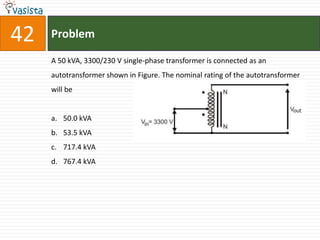
42   Problem

     A 50 kVA, 3300/230 V single-phase transformer is connected as an
     autotransformer shown in Figure. The nominal rating of the autotransformer
     will be


     a. 50.0 kVA
     b. 53.5 kVA
     c. 717.4 kVA
     d. 767.4 kVA
43   Problem

     The resistance and reactance of a 100 kVA 11000/ 400 V, Δ - Y distribution
     transformer are 0.02 and 0.07 pu respectively. The phase impedance of the
     transformer referred to the primary is


     a.   (0.02 + j0.07) Ω
     b.   (0.55 + j1.925) Ω
     c.   (15.125 + j52.94) Ω
     d.   (72.6 + j254.1) Ω
44   Problem

     A single-phase, 230 V, 50 Hz, 4 pole, capacitor-start induction motor has the
     following stand-still impedances
     Main winding Zm = 6.0 + j4.0 Ω
     Auxiliary winding Za = 8.0 + j6.0 Ω
     The value of the starting capacitor required to produce 90° phase difference
     between the currents in the main and auxiliary windings will be


     a. 176.84 µF
     b. 187.24 µF
     c. 265.26 µF
     d. 280.86 µF
45   Problem

     Two 3-phase, Y-connected alternators are to be paralleled to a set of common
     busbars. The armature has a per phase synchronous reactance of 1.Ω and
     negligible armature resistance. The line voltage of the first machine is adjusted
     to 3300 V and that of the second machine is adjusted to 3200 V. The machine
     voltages are in phase at the instant they are paralleled. Under this condition,
     the synchronizing current per phase will be


     a. 16.98 A
     b. 29.41 A
     c. 33.96 A
     d. 58.82 A
46   Problem

     A 400 V, 15 kW, 4 pole, 50 Hz, Y-connected induction motor has full load slip of
     4%. The output torque of the machine at full load is


     a. 1.66 Nm
     b. 95.50 Nm
     c. 99.47 Nm
     d. 624.73 Nm
47   Problem

     For a 1800 , 2-phase bipolar stepper motor, the stepping rate is 100 steps/
     second. The rotational speed of the motor in rpm is


     a. 15
     b. 30
     c. 60
     d. 90
48   Problem

     A 8 pole, DC generator has a simplex wave-wound armature containing 32 coils
     of 6 turns each. Its flux per pole is 0.06 Wb. The machine is running at 250
     rpm. The induced armature voltage is


     a. 96 V
     b. 192 V
     c. 384 V
     d. 768 V
49   Problem

     A 400 V, 50 kVA, 0.8 pf lea connected, 50 Hz synchronous machine has a
     synchronous reactance of and negligible armature resistance. The friction and
     windage losses are 2 kW and the core loss is 0.8 kW. The shaft is supplying 9 kW
     load at a power factor of 0.8 leading. The line current drawn is


     a. 12.29 A
     b. 16.24 A
     c. 21.29 A
     d. 36.88 A
50   Problem

     A 500 MW 3-phase Y-connected synchronous generator has a rated voltage of
     21.5 kV at 0.85 pf. The line current when operating at full load rated conditions
     will be


     a. 13.43 kA
     b. 15.79 kA
     c. 23.25 kA
     d. 27.36 kA
51   Problem

     A 800 kV transmission line is having per phase line inductance of 1.1

     mH/km and per phase line capacitance of 11.68 nF/km. Ignoring the

     length of the line, its ideal power transfer capability in MW is


      a. 1204 MW
      b. 1504 MW
      c. 2085 MW
      d. 2606 MW
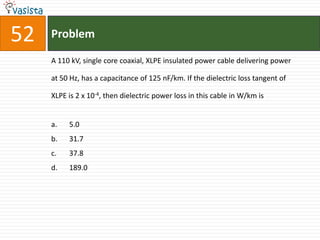
52   Problem

     A 110 kV, single core coaxial, XLPE insulated power cable delivering power

     at 50 Hz, has a capacitance of 125 nF/km. If the dielectric loss tangent of

     XLPE is 2 x 10⁻⁴, then dielectric power loss in this cable in W/km is


     a.   5.0
     b.   31.7
     c.   37.8
     d.   189.0
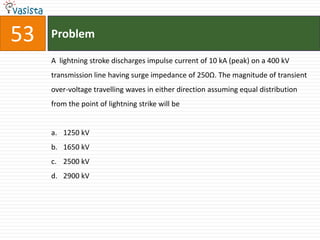
53   Problem

     A lightning stroke discharges impulse current of 10 kA (peak) on a 400 kV
     transmission line having surge impedance of 250Ω. The magnitude of transient
     over-voltage travelling waves in either direction assuming equal distribution
     from the point of lightning strike will be


     a. 1250 kV
     b. 1650 kV
     c. 2500 kV
     d. 2900 kV
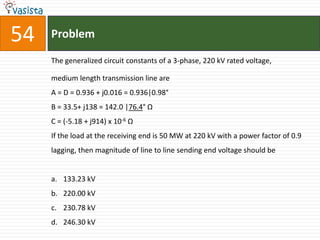
54   Problem

     The generalized circuit constants of a 3-phase, 220 kV rated voltage,

     medium length transmission line are
     A = D = 0.936 + j0.016 = 0.936|0.98°
     B = 33.5+ j138 = 142.0 |76.4° Ω
     C = (-5.18 + j914) x 10-6 Ω
     If the load at the receiving end is 50 MW at 220 kV with a power factor of 0.9
     lagging, then magnitude of line to line sending end voltage should be


     a. 133.23 kV
     b. 220.00 kV
     c. 230.78 kV
     d. 246.30 kV
55   Problem

     A new generator having Eg = 1.4 |30° pu [equivalent to (1.212 + j0.70) pu] and
     synchronous reactance 'Xs' of 1.0 pu on the system base, is to be connected to a
     bus having voltage Vt in the existing power system. This existing power system
     can be represented by Thevenin's voltage Eth = 0.9101 pu in series with
     Thevenin's impedance Zth = 0.25 |90° pu. The magnitude of the bus voltage Vt
     of the system in pu will be


      a. 0.990
      b. 0.973
      c. 0.963
      d. 0.900
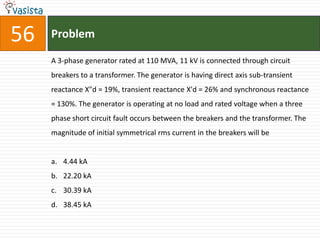
56   Problem

     A 3-phase generator rated at 110 MVA, 11 kV is connected through circuit
     breakers to a transformer. The generator is having direct axis sub-transient
     reactance X"d = 19%, transient reactance X'd = 26% and synchronous reactance
     = 130%. The generator is operating at no load and rated voltage when a three
     phase short circuit fault occurs between the breakers and the transformer. The
     magnitude of initial symmetrical rms current in the breakers will be


     a. 4.44 kA
     b. 22.20 kA
     c. 30.39 kA
     d. 38.45 kA
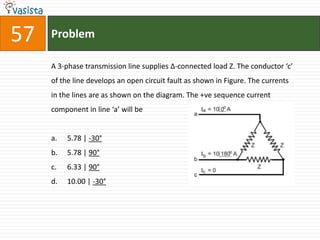
57   Problem

     A 3-phase transmission line supplies Δ-connected load Z. The conductor ‘c’
     of the line develops an open circuit fault as shown in Figure. The currents
     in the lines are as shown on the diagram. The +ve sequence current
     component in line ‘a’ will be


     a.   5.78 | -30°
     b.   5.78 | 90°
     c.   6.33 | 90°
     d.   10.00 | -30°
58   Problem

     A 500 MVA, 50 Hz, 3-phase turbo-generator produces power at 22 kV.
     Generator is Y-connected and its neutral is solidly grounded. Its sequence
     reactances are X1 = X2 = 0.15 and X0 = 0.05 pu. It is operating at rated voltage
     and disconnected from the rest of the system (no load). The magnitude of the
     sub-transient line current for single line to ground fault at the generator
     terminal in pu will be


     a. 2.851
     b. 3.333
     c. 6.667
     d. 8.553
59   Problem

     A 50 Hz, 4-pole, 500 MVA, 22 kV turbo-generator is delivering rated megavolt-
     amperes at 0.8 power factor. Suddenly a fault occurs reducing is electric power
     output by 40%. Neglect losses and assume constant power input to the shaft.
     The accelerating torque in the generator in MNm at the time of the fault will be


     a. 1.528
     b. 1.018
     c. 0.848
     d. 0.509
60   Problem

     A hydraulic turbine having rated speed of 250 rpm is connected to a
     synchronous generator. In order to produce power at 50 Hz, the number of
     poles required in the generator are


     a.   6
     b.   12
     c.   16
     d.   24
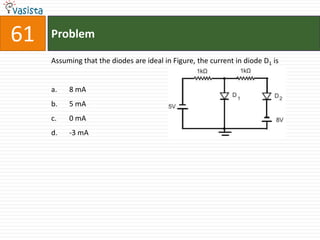
61   Problem

     Assuming that the diodes are ideal in Figure, the current in diode D1 is


     a.   8 mA
     b.   5 mA
     c.   0 mA
     d.   -3 mA
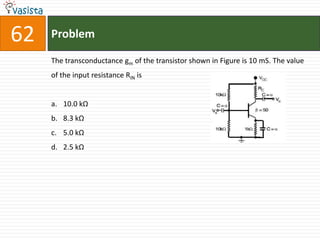
62   Problem

     The transconductance gm of the transistor shown in Figure is 10 mS. The value
     of the input resistance RIN is


     a. 10.0 kΩ
     b. 8.3 kΩ
     c. 5.0 kΩ
     d. 2.5 kΩ
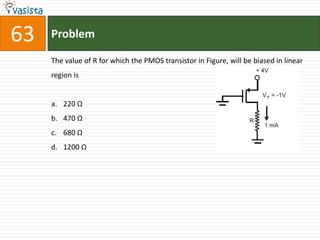
63   Problem

     The value of R for which the PMOS transistor in Figure, will be biased in linear
     region is


     a. 220 Ω
     b. 470 Ω
     c. 680 Ω
     d. 1200 Ω
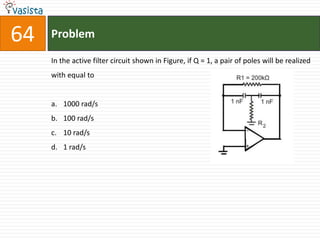
64   Problem

     In the active filter circuit shown in Figure, if Q = 1, a pair of poles will be realized
     with equal to


     a. 1000 rad/s
     b. 100 rad/s
     c. 10 rad/s
     d. 1 rad/s
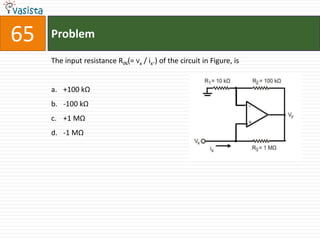
65   Problem

     The input resistance RIN(= Vx / ix.) of the circuit in Figure, is


     a. +100 kΩ
     b. -100 kΩ
     c. +1 MΩ
     d. -1 MΩ
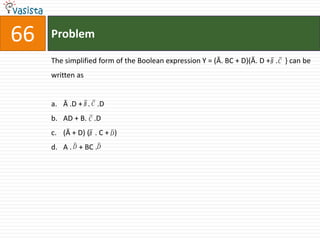
66   Problem

     The simplified form of the Boolean expression Y = (Ā. BC + D)(Ā. D +B . C } can be
     written as


     a. Ā .D + B . C .D
     b. AD + B. C .D
     c. (Ā + D) (B . C + D )
     d. A . D + BC .D
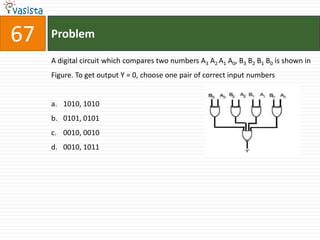
67   Problem

     A digital circuit which compares two numbers A3 A2 A1 A0, B3 B2 B1 B0 is shown in
     Figure. To get output Y = 0, choose one pair of correct input numbers


     a. 1010, 1010
     b. 0101, 0101
     c. 0010, 0010
     d. 0010, 1011
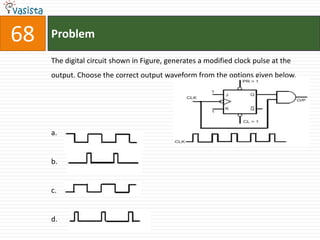
68   Problem

     The digital circuit shown in Figure, generates a modified clock pulse at the
     output. Choose the correct output waveform from the options given below.


     a.


     b.


     c.


     d.
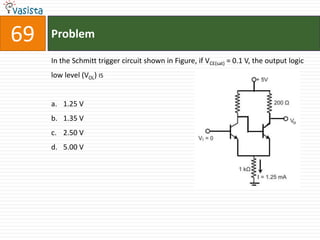
69   Problem

     In the Schmitt trigger circuit shown in Figure, if VCE(sat) = 0.1 V, the output logic
     low level (VOL) IS


     a. 1.25 V
     b. 1.35 V
     c. 2.50 V
     d. 5.00 V
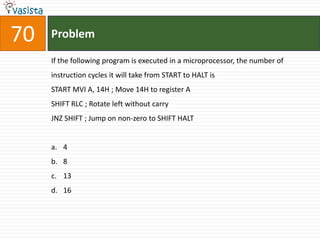
70   Problem

     If the following program is executed in a microprocessor, the number of
     instruction cycles it will take from START to HALT is
     START MVI A, 14H ; Move 14H to register A
     SHIFT RLC ; Rotate left without carry
     JNZ SHIFT ; Jump on non-zero to SHIFT HALT


     a. 4
     b. 8
     c. 13
     d. 16
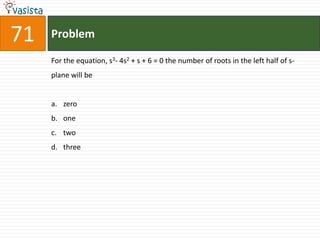
71   Problem

     For the equation, s3- 4s2 + s + 6 = 0 the number of roots in the left half of s-
     plane will be


     a. zero
     b. one
     c. two
     d. three
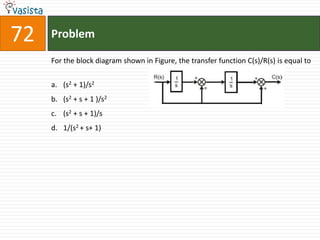
72   Problem

     For the block diagram shown in Figure, the transfer function C(s)/R(s) is equal to


     a. (s2 + 1)/s2
     b. (s2 + s + 1 )/s2
     c. (s2 + s + 1)/s
     d. 1/(s2 + s+ 1)
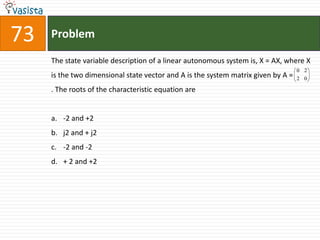
73   Problem

     The state variable description of a linear autonomous system is, X = AX, where X
                                                                                   0 2
     is the two dimensional state vector and A is the system matrix given by A =   2 0

     . The roots of the characteristic equation are


     a. -2 and +2
     b. j2 and + j2
     c. -2 and -2
     d. + 2 and +2
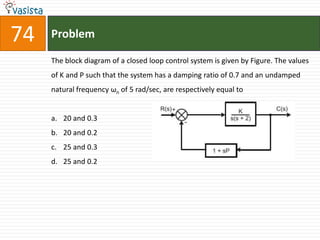
74   Problem

     The block diagram of a closed loop control system is given by Figure. The values
     of K and P such that the system has a damping ratio of 0.7 and an undamped
     natural frequency ωn of 5 rad/sec, are respectively equal to


     a. 20 and 0.3
     b. 20 and 0.2
     c. 25 and 0.3
     d. 25 and 0.2
75   Problem

     The unit impulse response of a second order under-damped system starting
     from rest is given by
     c(t) = 12.5 e-6t sin 8 t, t ≥ 0
     The steady-state value of the unit step response of the system is equal to


     a. 0
     b. 0.25
     c. 0.5
     d. 1.0
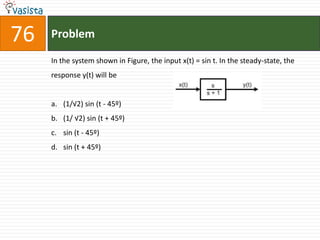
76   Problem

     In the system shown in Figure, the input x(t) = sin t. In the steady-state, the
     response y(t) will be


     a. (1/√2) sin (t - 45º)
     b. (1/ √2) sin (t + 45º)
     c. sin (t - 45º)
     d. sin (t + 45º)
77   Problem

     The open loop transfer function of a unity feedback control system is given as
     G(s) = (as + 1)/s2. The value of 'a' to give a phase margin of 45° is equal to


     a. 0.141
     b. 0.441
     c. 0.841
     d. 1.141
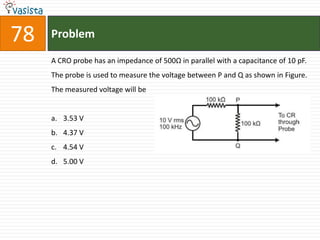
78   Problem

     A CRO probe has an impedance of 500Ω in parallel with a capacitance of 10 pF.
     The probe is used to measure the voltage between P and Q as shown in Figure.
     The measured voltage will be


     a. 3.53 V
     b. 4.37 V
     c. 4.54 V
     d. 5.00 V
79   Problem

     A moving coil of a meter has 100 turns, and a length and depth of 10 mm and
     20 mm respectively. It is positioned in a uniform radial flux density of 200 mT.
     The coil carries a current of 50 mA. The torque on the coil is


     a. 200 µNm
     b. 100 µNm
     c. 2 µNm
     d. 1 µNm
80   Problem

     A dc A-h meter is rated for 15 A, 250 V. The meter constant is 14.4 A-sec/rev.
     The meter constant at rated voltage may be expressed as


     a. 3750 rev/kWh
     b. 3600 rev/kWh
     c. 1000 rev/kWh
     d. 960 rev/kWh
81   Problem

     A moving iron ammeter produces a full scale torque of 240 µNm with a
     deflection of 120° at a current of 10 A. The rate of change of self inductance
     (µH/ radian) of the instrument at full scale is


     a. 2.0 µH/radian
     b. 4.8 µH/radian
     c. 12.0 µH/radian
     d. 114.6 µH/radian
82   Problem

     A single-phase load is connected between R and Y terminals of a 415 V,
     symmetrical, 3-phase, 4 wire system with phase sequence RYB. A wattmeter is
     connected in the system as shown in Figure. The power factor of the load is 0.8
     lagging. The wattmeter will read


     a. -795 W
     b. -597 W
     c. + 597 W
     d. + 795 W
83   Problem

     A 50 Hz, bar primary CT has a secondary with 500 turns. The secondary supplies
     5 A current into a purely resistive burden of Ω. The magnetizing ampere-turns is
     200. The phase angle between the primary and secondary current is


     a. 4.6°
     b. 85.4°
     c. 94.6°
     d. 175.40
84   Problem

     A 50 Hz, bar primary CT has a secondary with 500 turns. The secondary supplies
     5 A current into a purely resistive burden of Ω.. The magnetizing ampere-turns
     is 200. The core flux is


     a. 0
     b. 45.0 µWb
     c. 22.5 mWb
     d. 100.0 mWb
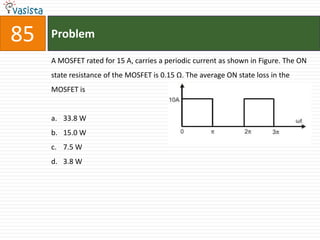
85   Problem

     A MOSFET rated for 15 A, carries a periodic current as shown in Figure. The ON
     state resistance of the MOSFET is 0.15 Ω. The average ON state loss in the
     MOSFET is


     a. 33.8 W
     b. 15.0 W
     c. 7.5 W
     d. 3.8 W
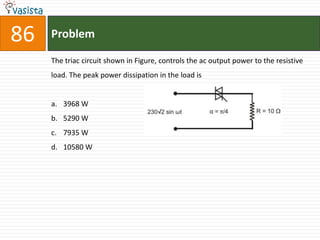
86   Problem

     The triac circuit shown in Figure, controls the ac output power to the resistive
     load. The peak power dissipation in the load is


     a. 3968 W
     b. 5290 W
     c. 7935 W
     d. 10580 W
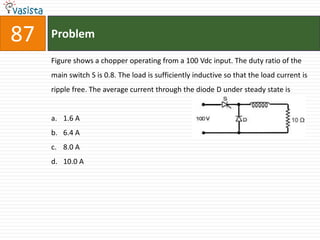
87   Problem

     Figure shows a chopper operating from a 100 Vdc input. The duty ratio of the
     main switch S is 0.8. The load is sufficiently inductive so that the load current is
     ripple free. The average current through the diode D under steady state is


     a. 1.6 A
     b. 6.4 A
     c. 8.0 A
     d. 10.0 A
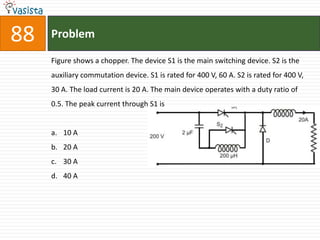
88   Problem

     Figure shows a chopper. The device S1 is the main switching device. S2 is the
     auxiliary commutation device. S1 is rated for 400 V, 60 A. S2 is rated for 400 V,
     30 A. The load current is 20 A. The main device operates with a duty ratio of
     0.5. The peak current through S1 is


     a. 10 A
     b. 20 A
     c. 30 A
     d. 40 A
89   Problem

     A single-phase half-controlled rectifier is driving a separately excited dc motor.
     The dc motor has a back emf constant of 0.5 V /rpm. The armature current is 5
     A without any ripple. The armature resistance is . The converter is working
     from a 230 V, single phase ac source with a firing angle of 30°. Under this
     operating condition, the speed of the motor will be


     a. 339 rpm
     b. 359 rpm
     c. 366 rpm
     d. 386 rpm
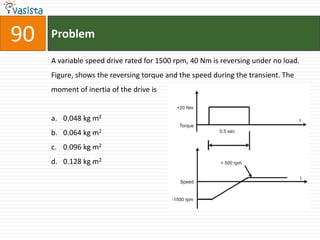
90   Problem

     A variable speed drive rated for 1500 rpm, 40 Nm is reversing under no load.
     Figure, shows the reversing torque and the speed during the transient. The
     moment of inertia of the drive is


     a. 0.048 kg m2
     b. 0.064 kg m2
     c. 0.096 kg m2
     d. 0.128 kg m2
FOR SOLUTION VISIT WWW.VASISTA.NET/

Electrical Engineering - 2004 Unsolved Paper

  • 1.
    GATE –PAST PAPERS ELECTRICALENGINEERING - UNSOLVED PAPER - 2004
  • 2.
    SECTION – I  Single Correct Answer Type  There are five parts in this question. Four choices are given for each part and one of them is correct. Indicate you choice of the correct answer for each part in your answer-book by writing the letter (a), (b), (c) or (d) whichever is appropriate
  • 3.
    01 Problem The value of Z in Figure which is most appropriate to cause parallel resonance at 500 Hz is a. 125.00 mH b. 304.20 µF c. 2.0 µF d. 0.05 µF
  • 4.
    02 Problem A parallel plate capacitor is shown in Figure. It is made of two square metal plates of 400 mm side. The 14 mm space between the plates is filled with two layers of dielectrics of £r = 4, 6 mm thick and r =2, 8 mm thick. Neglecting fringing of fields at the edges the capacitance is a. 1298 pF b. 944 pF c. 354 pF d. 257 pF
  • 5.
    03 Problem The inductance of a long solenoid of length 1000 mm wound uniformly with 3000 turns on a cylindrical paper tube of 60 mm diameter is a. 3.2 µH b. 3.2 mH c. 32.0 mH d. 3.2 H
  • 6.
    04 Problem Total instantaneous power supplied by a 3-phase ac supply to a balanced R-L load is a. zero b. constant c. pulsating with zero average3.2 H d. pulsating with non-zero average
  • 7.
    05 Problem A 500 kVA, 3-phase transformer has iron losses of 300 W and full load copper losses of 600 W. The percentage load at which the transformer is expected to have maximum efficiency is a. 50.0% b. 70.7% c. 141.4% d. 200.0%
  • 8.
    06 Problem For a given stepper motor, the following torque has the highest numerical value. a. Detent torque b. Pull-in torque c. Pull-out torque d. Holding torque
  • 9.
    07 Problem The following motor definitely has a permanent magnet rotor a. DC commutator motor b. Brushless dc motor c. Stepper motor d. Reluctance motor
  • 10.
    08 Problem The type of single-phase induction motor having the highest power factor at full load is a. shaded pole type b. split-phase type c. capacitor-start type d. capacitor-run type
  • 11.
    09 Problem The direction of rotation of a 3-phase induction motor is clockwise when it is supplied with 3-phase sinusoidal voltage having phase sequence A-B-C. For counterclockwise rotation of the motor, the phase sequence of the power supply should be a. B-C-A b. C-A-B c. A-C-B d. B-C-A or C-A-B
  • 12.
    10 Problem For a linear electromagnetic circuit, the following statement is true a. Field energy is equal b. Field energy is greater than the co-energy c. Field energy is lesser than the co-energy d. Co-energy is zero
  • 13.
    11 Problem The rated voltage of a 3-phase power system is given as a. rms phase voltage b. peak phase voltage c. rms line to line voltage d. peak line to line voltage
  • 14.
    12 Problem The phase sequence of the 3-phase system shown in Figure is a) RYB b) RBY c) BRY d) YBR
  • 15.
    13 Problem In thermal power plants, the pressure in the working fluid cycle is developed by a. condenser b. super heater c. feed water pump d. turbine
  • 16.
    14 Problem For harnessing low variable waterheads, the suitable hydraulic turbine with high percentage of reaction and runner adjustable vanes is a. Kaplan b. Francis c. Pelton d. Impeller
  • 17.
    15 Problem The transmission line distance protection relay having the property of being inherently directional is a. impedance relay b. MHO relay c. OHM relay d. reactance relay
  • 18.
    16 Problem The current through the Zener diode in Figure is a. 33 mA b. 3.3 mA c. 2 mA d. 0 mA
  • 19.
    17 Problem Two perfectly matched silicon transistors are connected as shown in Figure. The value of the current I is a. 0 mA b. 2.3 mA c. 4.3 mA d. 7.3 mA
  • 20.
    18 Problem The feedback used in the circuit shown in Figure, can be classified as a. shunt-series feedback b. shunt-shunt feedback c. series-shunt feedback d. series-series feedback
  • 21.
    19 Problem The digital circuit using two inverters shown in Figure will act as a. a bistable multi-vibrator b. an astable multi-vibrator c. a monostable multi-vibrator d. an oscillator
  • 22.
    20 Problem The voltage comparator shown in Figure, can be used in the analog-to-digital conversion as a. a 1-bit quantizer b. a 2-bit quantizer c. a 4-bit quantizer d. a 8-bit quantizer
  • 23.
    21 Problem The Nyquist plot of loop transfer function G(s) H(s) of a closed loop control system passes through the point (- 1, jO) in the G(s) H(s) plane. The phase margin of the system is a. 0° b. 45° c. 90° d. 180°
  • 24.
    22 Problem Consider the function, F(s) = 5/(s(s2 + 3s + 2)) where F(s) is the Laplace transform of the function f(t). The initial value of f(t) is equal to a. 5 b. 5/2 c. 5/3 d. 0
  • 25.
    23 Problem For a tachometer, if Φ(t) is the rotor displacement is radians, e(t) is the output voltage and Kt is the tachometer constant in V/rad/sec, then the transfer function, E(s)/Q(s) will be a. Kts2 b. Kt/s c. Kts d. Kt
  • 26.
    24 Problem A dc potentiometer is designed to measure up to about 2 V with a slide wire of 800 mm. A standard cell of emf 1.18 V obtains balance at 600 mm. A test cell is seen to obtain balance at 680 mm. The emf of the test cell is a. 1.00 V b. 1.34 V c. 1.50 V d. 1.70 V
  • 27.
    25 Problem The circuit in Figure, is used to measure the power consumed by the load. The current coil and the voltage coil of the wattmeter have 0.0Φ and 1000Ω resistances respectively. The measured power compared to the load power will be a. 0.4% less b. 0.2% less c. 0.2% more d. 0.4% more
  • 28.
    26 Problem A galvanometer with a full scale current of 10 mA has a resistance 0Ω.100 multiplying power (the ratio of measured current to galvanometer current) of a Ω100 shunt with this galvanometer is a. 110 b. 100 c. 11 d. 10
  • 29.
    27 Problem A bipolar junction transistor (BJT) is used as a power control switch by biasing it in the cut-off region (OFF state) or in the saturation region (ON state). In the ON state, for the BJT a. both the base-emitter and base-collector junctions are reverse biased b. the base-emitter junction is reverse biased, and the base-collector junction is forward biased c. the base-emitter junction is forward biased, and the base-collector junction is reverse biased d. both the ,base-emitter and base-collector junctions are forward biased
  • 30.
    28 Problem The circuit in Figure shows a full-wave rectifier. The input voltage is 230 V (rms) single-phase ac. The peak reverse voltage across the diodes D1 and D2 is a. 100 √2 V b. 100 V c. 50 √2 V d. 50 V
  • 31.
    29 Problem The triggering circuit of a thyristor is shown in Figure. The thyristor requires a gate current of 10 mA, for guaranteed turn-on. The value of R required for the thyristor to turn on reliably under all conditions of Vb variation is a. 10000 Ω b. 1600 Ω c. 1200 Ω d. 800 Ω
  • 32.
    30 Problem The circuit in Figure shows a 3-phase half-wave rectifier. The source is a symmetrical, 3-phase four-wire system. The line-to-line voltage of the source is 100 V. The supply frequency is 400 Hz. The ripple frequency at the output is a. 400 Hz b. 800 Hz c. 1200 Hz d. 2400 Hz
  • 33.
    31 Problem The rms value of the periodic waveform given in Figure is a. 2√6 A b. 2. 6√2 A c. 3. √(4/3) A d. 4. 1.5 A
  • 34.
    32 Problem In Figure, the value of the source voltage is a. 12 V b. 24 V c. 30 V d. 44 V
  • 35.
    33 Problem In Figure, Ra, Rb and Rc are 20 Ω, 10 Ω respectively. The resistances R1, R2 and R3 in Ω of an equivalent star-connection are a. 2.5, 5, 5 b. 5, 2.5, 5 c. 5, 5, 2.5 d. 2.5, 5, 2.5
  • 36.
    34 Problem In Figure, the admittance values of the elements in Siemens are YR = 0.5 + j0, Y1 = 0 - j1.5, YC = 0 + j0.3 respectively. The value of I as a phasor when the voltage E across the elements is 10|0° V is a. 1.5 + j0.5 b. 5 - j18 c. 0.5 + j1.8 d. 5 - j12
  • 37.
    35 Problem In Figure, the value of resistance R in Ω is a. 10 b. 20 c. 30 d. 40
  • 38.
    36 Problem In Figure, the capacitor initially has a charge of 10 Coulomb. The current in the circuit one second after the switch S is closed will be a. 14.7 A b. 18.5 A c. 40.0 A d. 50.0 A
  • 39.
    37 Problem The rms value of the resultant current in a wire which carries a dc current of 10 A and a sinusoidal alternating current of peak value 20 A is a. 14.1 A b. 17.3 A c. 22.4 A d. 30.0 A
  • 40.
    38 Problem The Z matrix of a 2-port network as given by 0.9 0.2 0.2 0.6 The element Y22 of the corresponding Y matrix of the same network is given by a. 1.2 b. 0.4 c. -0.4 d. 1.8
  • 41.
    39 Problem The synchronous speed for the seventh space harmonic mmf wave of a 3- phase, 8 pole, 50 Hz induction machine is a. 107.14 rpm in forward direction b. 107.14 rpm in reverse direction c. 5250 rpm in forward direction d. 5250 rpm in reverse direction
  • 42.
    40 Problem A rotating electrical machine having its self-inductances of both the stator and the rotor windings, independent of the rotor position will be definitely not develop a. starting torque b. synchronizing torque c. hysteresis torque d. reluctance torque
  • 43.
    41 Problem The armature resistance of a permanent magnet dc motor is 0.8 Ω. At no load, the motor draws 1.5 A from a supply voltage of 25 V and runs at 1500 rpm. The efficiency of the motor while it is operating on load at 1500 rpm drawing a current of 3.5 A from the same source will be a. 48.0% b. 57.1% c. 59.2% d. 88.8%
  • 44.
    42 Problem A 50 kVA, 3300/230 V single-phase transformer is connected as an autotransformer shown in Figure. The nominal rating of the autotransformer will be a. 50.0 kVA b. 53.5 kVA c. 717.4 kVA d. 767.4 kVA
  • 45.
    43 Problem The resistance and reactance of a 100 kVA 11000/ 400 V, Δ - Y distribution transformer are 0.02 and 0.07 pu respectively. The phase impedance of the transformer referred to the primary is a. (0.02 + j0.07) Ω b. (0.55 + j1.925) Ω c. (15.125 + j52.94) Ω d. (72.6 + j254.1) Ω
  • 46.
    44 Problem A single-phase, 230 V, 50 Hz, 4 pole, capacitor-start induction motor has the following stand-still impedances Main winding Zm = 6.0 + j4.0 Ω Auxiliary winding Za = 8.0 + j6.0 Ω The value of the starting capacitor required to produce 90° phase difference between the currents in the main and auxiliary windings will be a. 176.84 µF b. 187.24 µF c. 265.26 µF d. 280.86 µF
  • 47.
    45 Problem Two 3-phase, Y-connected alternators are to be paralleled to a set of common busbars. The armature has a per phase synchronous reactance of 1.Ω and negligible armature resistance. The line voltage of the first machine is adjusted to 3300 V and that of the second machine is adjusted to 3200 V. The machine voltages are in phase at the instant they are paralleled. Under this condition, the synchronizing current per phase will be a. 16.98 A b. 29.41 A c. 33.96 A d. 58.82 A
  • 48.
    46 Problem A 400 V, 15 kW, 4 pole, 50 Hz, Y-connected induction motor has full load slip of 4%. The output torque of the machine at full load is a. 1.66 Nm b. 95.50 Nm c. 99.47 Nm d. 624.73 Nm
  • 49.
    47 Problem For a 1800 , 2-phase bipolar stepper motor, the stepping rate is 100 steps/ second. The rotational speed of the motor in rpm is a. 15 b. 30 c. 60 d. 90
  • 50.
    48 Problem A 8 pole, DC generator has a simplex wave-wound armature containing 32 coils of 6 turns each. Its flux per pole is 0.06 Wb. The machine is running at 250 rpm. The induced armature voltage is a. 96 V b. 192 V c. 384 V d. 768 V
  • 51.
    49 Problem A 400 V, 50 kVA, 0.8 pf lea connected, 50 Hz synchronous machine has a synchronous reactance of and negligible armature resistance. The friction and windage losses are 2 kW and the core loss is 0.8 kW. The shaft is supplying 9 kW load at a power factor of 0.8 leading. The line current drawn is a. 12.29 A b. 16.24 A c. 21.29 A d. 36.88 A
  • 52.
    50 Problem A 500 MW 3-phase Y-connected synchronous generator has a rated voltage of 21.5 kV at 0.85 pf. The line current when operating at full load rated conditions will be a. 13.43 kA b. 15.79 kA c. 23.25 kA d. 27.36 kA
  • 53.
    51 Problem A 800 kV transmission line is having per phase line inductance of 1.1 mH/km and per phase line capacitance of 11.68 nF/km. Ignoring the length of the line, its ideal power transfer capability in MW is a. 1204 MW b. 1504 MW c. 2085 MW d. 2606 MW
  • 54.
    52 Problem A 110 kV, single core coaxial, XLPE insulated power cable delivering power at 50 Hz, has a capacitance of 125 nF/km. If the dielectric loss tangent of XLPE is 2 x 10⁻⁴, then dielectric power loss in this cable in W/km is a. 5.0 b. 31.7 c. 37.8 d. 189.0
  • 55.
    53 Problem A lightning stroke discharges impulse current of 10 kA (peak) on a 400 kV transmission line having surge impedance of 250Ω. The magnitude of transient over-voltage travelling waves in either direction assuming equal distribution from the point of lightning strike will be a. 1250 kV b. 1650 kV c. 2500 kV d. 2900 kV
  • 56.
    54 Problem The generalized circuit constants of a 3-phase, 220 kV rated voltage, medium length transmission line are A = D = 0.936 + j0.016 = 0.936|0.98° B = 33.5+ j138 = 142.0 |76.4° Ω C = (-5.18 + j914) x 10-6 Ω If the load at the receiving end is 50 MW at 220 kV with a power factor of 0.9 lagging, then magnitude of line to line sending end voltage should be a. 133.23 kV b. 220.00 kV c. 230.78 kV d. 246.30 kV
  • 57.
    55 Problem A new generator having Eg = 1.4 |30° pu [equivalent to (1.212 + j0.70) pu] and synchronous reactance 'Xs' of 1.0 pu on the system base, is to be connected to a bus having voltage Vt in the existing power system. This existing power system can be represented by Thevenin's voltage Eth = 0.9101 pu in series with Thevenin's impedance Zth = 0.25 |90° pu. The magnitude of the bus voltage Vt of the system in pu will be a. 0.990 b. 0.973 c. 0.963 d. 0.900
  • 58.
    56 Problem A 3-phase generator rated at 110 MVA, 11 kV is connected through circuit breakers to a transformer. The generator is having direct axis sub-transient reactance X"d = 19%, transient reactance X'd = 26% and synchronous reactance = 130%. The generator is operating at no load and rated voltage when a three phase short circuit fault occurs between the breakers and the transformer. The magnitude of initial symmetrical rms current in the breakers will be a. 4.44 kA b. 22.20 kA c. 30.39 kA d. 38.45 kA
  • 59.
    57 Problem A 3-phase transmission line supplies Δ-connected load Z. The conductor ‘c’ of the line develops an open circuit fault as shown in Figure. The currents in the lines are as shown on the diagram. The +ve sequence current component in line ‘a’ will be a. 5.78 | -30° b. 5.78 | 90° c. 6.33 | 90° d. 10.00 | -30°
  • 60.
    58 Problem A 500 MVA, 50 Hz, 3-phase turbo-generator produces power at 22 kV. Generator is Y-connected and its neutral is solidly grounded. Its sequence reactances are X1 = X2 = 0.15 and X0 = 0.05 pu. It is operating at rated voltage and disconnected from the rest of the system (no load). The magnitude of the sub-transient line current for single line to ground fault at the generator terminal in pu will be a. 2.851 b. 3.333 c. 6.667 d. 8.553
  • 61.
    59 Problem A 50 Hz, 4-pole, 500 MVA, 22 kV turbo-generator is delivering rated megavolt- amperes at 0.8 power factor. Suddenly a fault occurs reducing is electric power output by 40%. Neglect losses and assume constant power input to the shaft. The accelerating torque in the generator in MNm at the time of the fault will be a. 1.528 b. 1.018 c. 0.848 d. 0.509
  • 62.
    60 Problem A hydraulic turbine having rated speed of 250 rpm is connected to a synchronous generator. In order to produce power at 50 Hz, the number of poles required in the generator are a. 6 b. 12 c. 16 d. 24
  • 63.
    61 Problem Assuming that the diodes are ideal in Figure, the current in diode D1 is a. 8 mA b. 5 mA c. 0 mA d. -3 mA
  • 64.
    62 Problem The transconductance gm of the transistor shown in Figure is 10 mS. The value of the input resistance RIN is a. 10.0 kΩ b. 8.3 kΩ c. 5.0 kΩ d. 2.5 kΩ
  • 65.
    63 Problem The value of R for which the PMOS transistor in Figure, will be biased in linear region is a. 220 Ω b. 470 Ω c. 680 Ω d. 1200 Ω
  • 66.
    64 Problem In the active filter circuit shown in Figure, if Q = 1, a pair of poles will be realized with equal to a. 1000 rad/s b. 100 rad/s c. 10 rad/s d. 1 rad/s
  • 67.
    65 Problem The input resistance RIN(= Vx / ix.) of the circuit in Figure, is a. +100 kΩ b. -100 kΩ c. +1 MΩ d. -1 MΩ
  • 68.
    66 Problem The simplified form of the Boolean expression Y = (Ā. BC + D)(Ā. D +B . C } can be written as a. Ā .D + B . C .D b. AD + B. C .D c. (Ā + D) (B . C + D ) d. A . D + BC .D
  • 69.
    67 Problem A digital circuit which compares two numbers A3 A2 A1 A0, B3 B2 B1 B0 is shown in Figure. To get output Y = 0, choose one pair of correct input numbers a. 1010, 1010 b. 0101, 0101 c. 0010, 0010 d. 0010, 1011
  • 70.
    68 Problem The digital circuit shown in Figure, generates a modified clock pulse at the output. Choose the correct output waveform from the options given below. a. b. c. d.
  • 71.
    69 Problem In the Schmitt trigger circuit shown in Figure, if VCE(sat) = 0.1 V, the output logic low level (VOL) IS a. 1.25 V b. 1.35 V c. 2.50 V d. 5.00 V
  • 72.
    70 Problem If the following program is executed in a microprocessor, the number of instruction cycles it will take from START to HALT is START MVI A, 14H ; Move 14H to register A SHIFT RLC ; Rotate left without carry JNZ SHIFT ; Jump on non-zero to SHIFT HALT a. 4 b. 8 c. 13 d. 16
  • 73.
    71 Problem For the equation, s3- 4s2 + s + 6 = 0 the number of roots in the left half of s- plane will be a. zero b. one c. two d. three
  • 74.
    72 Problem For the block diagram shown in Figure, the transfer function C(s)/R(s) is equal to a. (s2 + 1)/s2 b. (s2 + s + 1 )/s2 c. (s2 + s + 1)/s d. 1/(s2 + s+ 1)
  • 75.
    73 Problem The state variable description of a linear autonomous system is, X = AX, where X 0 2 is the two dimensional state vector and A is the system matrix given by A = 2 0 . The roots of the characteristic equation are a. -2 and +2 b. j2 and + j2 c. -2 and -2 d. + 2 and +2
  • 76.
    74 Problem The block diagram of a closed loop control system is given by Figure. The values of K and P such that the system has a damping ratio of 0.7 and an undamped natural frequency ωn of 5 rad/sec, are respectively equal to a. 20 and 0.3 b. 20 and 0.2 c. 25 and 0.3 d. 25 and 0.2
  • 77.
    75 Problem The unit impulse response of a second order under-damped system starting from rest is given by c(t) = 12.5 e-6t sin 8 t, t ≥ 0 The steady-state value of the unit step response of the system is equal to a. 0 b. 0.25 c. 0.5 d. 1.0
  • 78.
    76 Problem In the system shown in Figure, the input x(t) = sin t. In the steady-state, the response y(t) will be a. (1/√2) sin (t - 45º) b. (1/ √2) sin (t + 45º) c. sin (t - 45º) d. sin (t + 45º)
  • 79.
    77 Problem The open loop transfer function of a unity feedback control system is given as G(s) = (as + 1)/s2. The value of 'a' to give a phase margin of 45° is equal to a. 0.141 b. 0.441 c. 0.841 d. 1.141
  • 80.
    78 Problem A CRO probe has an impedance of 500Ω in parallel with a capacitance of 10 pF. The probe is used to measure the voltage between P and Q as shown in Figure. The measured voltage will be a. 3.53 V b. 4.37 V c. 4.54 V d. 5.00 V
  • 81.
    79 Problem A moving coil of a meter has 100 turns, and a length and depth of 10 mm and 20 mm respectively. It is positioned in a uniform radial flux density of 200 mT. The coil carries a current of 50 mA. The torque on the coil is a. 200 µNm b. 100 µNm c. 2 µNm d. 1 µNm
  • 82.
    80 Problem A dc A-h meter is rated for 15 A, 250 V. The meter constant is 14.4 A-sec/rev. The meter constant at rated voltage may be expressed as a. 3750 rev/kWh b. 3600 rev/kWh c. 1000 rev/kWh d. 960 rev/kWh
  • 83.
    81 Problem A moving iron ammeter produces a full scale torque of 240 µNm with a deflection of 120° at a current of 10 A. The rate of change of self inductance (µH/ radian) of the instrument at full scale is a. 2.0 µH/radian b. 4.8 µH/radian c. 12.0 µH/radian d. 114.6 µH/radian
  • 84.
    82 Problem A single-phase load is connected between R and Y terminals of a 415 V, symmetrical, 3-phase, 4 wire system with phase sequence RYB. A wattmeter is connected in the system as shown in Figure. The power factor of the load is 0.8 lagging. The wattmeter will read a. -795 W b. -597 W c. + 597 W d. + 795 W
  • 85.
    83 Problem A 50 Hz, bar primary CT has a secondary with 500 turns. The secondary supplies 5 A current into a purely resistive burden of Ω. The magnetizing ampere-turns is 200. The phase angle between the primary and secondary current is a. 4.6° b. 85.4° c. 94.6° d. 175.40
  • 86.
    84 Problem A 50 Hz, bar primary CT has a secondary with 500 turns. The secondary supplies 5 A current into a purely resistive burden of Ω.. The magnetizing ampere-turns is 200. The core flux is a. 0 b. 45.0 µWb c. 22.5 mWb d. 100.0 mWb
  • 87.
    85 Problem A MOSFET rated for 15 A, carries a periodic current as shown in Figure. The ON state resistance of the MOSFET is 0.15 Ω. The average ON state loss in the MOSFET is a. 33.8 W b. 15.0 W c. 7.5 W d. 3.8 W
  • 88.
    86 Problem The triac circuit shown in Figure, controls the ac output power to the resistive load. The peak power dissipation in the load is a. 3968 W b. 5290 W c. 7935 W d. 10580 W
  • 89.
    87 Problem Figure shows a chopper operating from a 100 Vdc input. The duty ratio of the main switch S is 0.8. The load is sufficiently inductive so that the load current is ripple free. The average current through the diode D under steady state is a. 1.6 A b. 6.4 A c. 8.0 A d. 10.0 A
  • 90.
    88 Problem Figure shows a chopper. The device S1 is the main switching device. S2 is the auxiliary commutation device. S1 is rated for 400 V, 60 A. S2 is rated for 400 V, 30 A. The load current is 20 A. The main device operates with a duty ratio of 0.5. The peak current through S1 is a. 10 A b. 20 A c. 30 A d. 40 A
  • 91.
    89 Problem A single-phase half-controlled rectifier is driving a separately excited dc motor. The dc motor has a back emf constant of 0.5 V /rpm. The armature current is 5 A without any ripple. The armature resistance is . The converter is working from a 230 V, single phase ac source with a firing angle of 30°. Under this operating condition, the speed of the motor will be a. 339 rpm b. 359 rpm c. 366 rpm d. 386 rpm
  • 92.
    90 Problem A variable speed drive rated for 1500 rpm, 40 Nm is reversing under no load. Figure, shows the reversing torque and the speed during the transient. The moment of inertia of the drive is a. 0.048 kg m2 b. 0.064 kg m2 c. 0.096 kg m2 d. 0.128 kg m2
  • 93.
    FOR SOLUTION VISITWWW.VASISTA.NET/

Editor's Notes