AMU –PAST PAPERS
CHEMISTRY- UNSOLVED PAPER - 1998
SECTION – I

   Single Correct Answer Type
         There are five parts in this question. Four choices are given for each part and one of them is
          correct. Indicate you choice of the correct answer for each part in your answer-book by

          writing the letter (a), (b), (c) or (d) whichever is appropriate
01   Problem

     Sodalime is


     a. NaH + Na2CO3
     b. NaOH + CaO
     c. NaOH + NaHCO3
     d. Na2CO3 + CaO
02   Problem
     White lead is :


     a. Carbonate of lead
     b. Oxide of lead
     c. Basic carbonate of lead
     d. Basic sulphate of lead
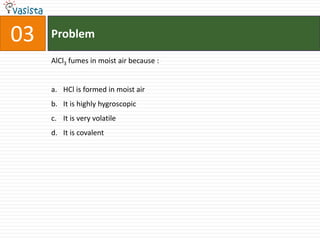
03   Problem

     AlCl3 fumes in moist air because :


     a. HCl is formed in moist air
     b. It is highly hygroscopic
     c. It is very volatile
     d. It is covalent
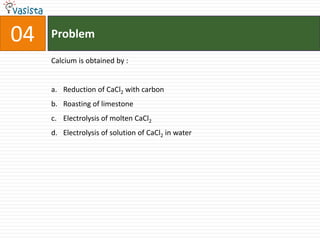
04   Problem

     Calcium is obtained by :


     a. Reduction of CaCl2 with carbon
     b. Roasting of limestone
     c. Electrolysis of molten CaCl2
     d. Electrolysis of solution of CaCl2 in water
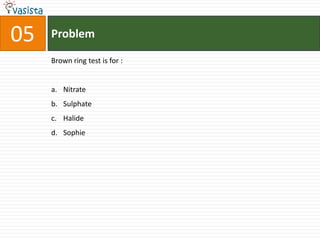
05   Problem

     Brown ring test is for :


     a. Nitrate
     b. Sulphate
     c. Halide
     d. Sophie
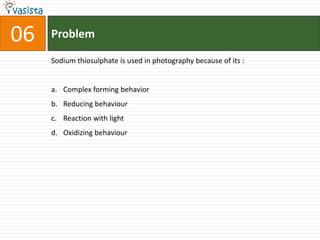
06   Problem

     Sodium thiosulphate is used in photography because of its :


     a. Complex forming behavior
     b. Reducing behaviour
     c. Reaction with light
     d. Oxidizing behaviour
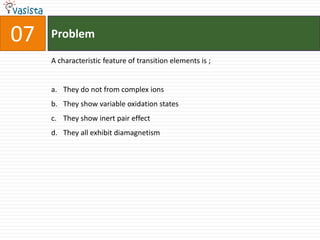
07   Problem

     A characteristic feature of transition elements is ;


     a. They do not from complex ions
     b. They show variable oxidation states
     c. They show inert pair effect
     d. They all exhibit diamagnetism
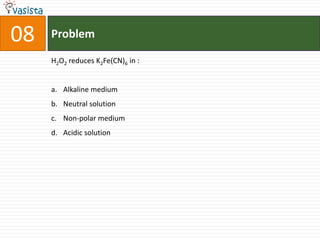
08   Problem

     H2O2 reduces K2Fe(CN)6 in :


     a. Alkaline medium
     b. Neutral solution
     c. Non-polar medium
     d. Acidic solution
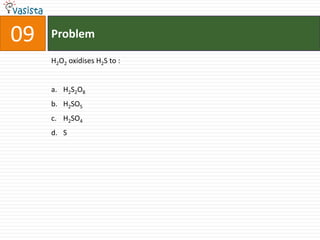
09   Problem

     H2O2 oxidises H2S to :


     a. H2S2O8
     b. H2SO5
     c. H2SO4
     d. S
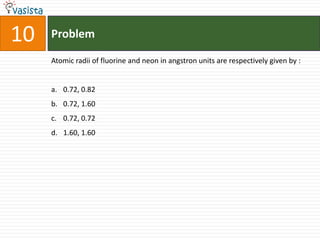
10   Problem

     Atomic radii of fluorine and neon in angstron units are respectively given by :


     a. 0.72, 0.82
     b. 0.72, 1.60
     c. 0.72, 0.72
     d. 1.60, 1.60
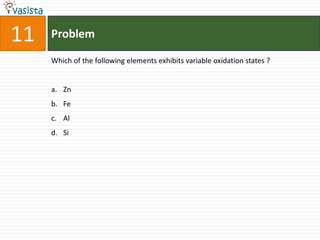
11   Problem

     Which of the following elements exhibits variable oxidation states ?


     a. Zn
     b. Fe
     c. Al
     d. Si
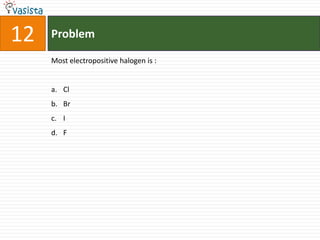
12   Problem

     Most electropositive halogen is :


     a. Cl
     b. Br
     c. I
     d. F
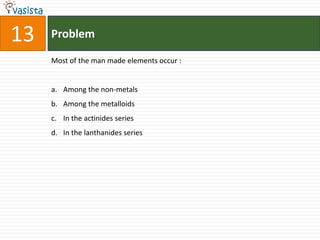
13   Problem

     Most of the man made elements occur :


     a. Among the non-metals
     b. Among the metalloids
     c. In the actinides series
     d. In the lanthanides series
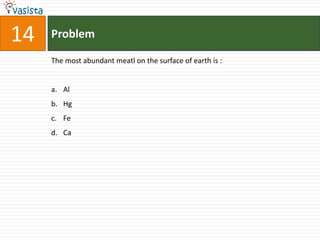
14   Problem

     The most abundant meatl on the surface of earth is :


     a. Al
     b. Hg
     c. Fe
     d. Ca
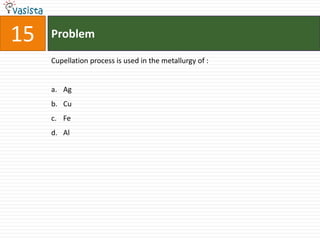
15   Problem

     Cupellation process is used in the metallurgy of :


     a. Ag
     b. Cu
     c. Fe
     d. Al
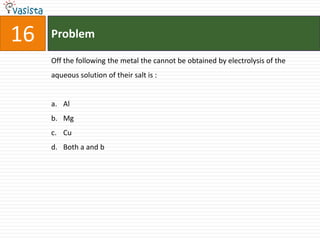
16   Problem

     Off the following the metal the cannot be obtained by electrolysis of the
     aqueous solution of their salt is :


     a. Al
     b. Mg
     c. Cu
     d. Both a and b
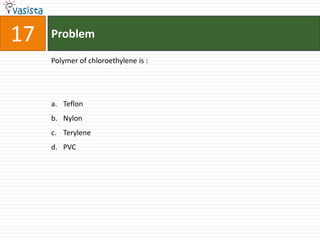
17   Problem

     Polymer of chloroethylene is :


     a. Teflon
     b. Nylon
     c. Terylene
     d. PVC
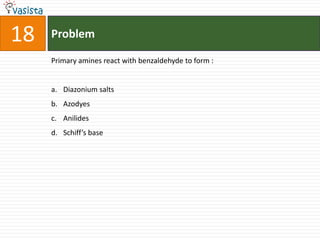
18   Problem

     Primary amines react with benzaldehyde to form :


     a. Diazonium salts
     b. Azodyes
     c. Anilides
     d. Schiff’s base
19   Problem

     Which of the following is a strong reducing agent ?


     a. Methanoic acid
     b. Ethanoic acid
     c. Chloroacetic acid
     d. Benzoic acid
20   Problem

     When ethylene bromide is treated with Zn, we get :


     a. Alkane
     b. Alkene
     c. Alkyne
     d. None of these
21   Problem

     Formaldehyde reacts with NH3 to form :


     a. (CH2)6N6
     b. (CH2)6N4
     c. (CH2)6N5
     d. (CH2)4N6
22   Problem

     Acetone is easily oxidized with :


     a. Benedict’s solution
     b. Fehling solution
     c. Acidic dichromate solution
     d. Tollen’s reagent
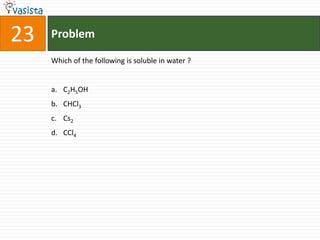
23   Problem

     Which of the following is soluble in water ?


     a. C2H5OH
     b. CHCl3
     c. Cs2
     d. CCl4
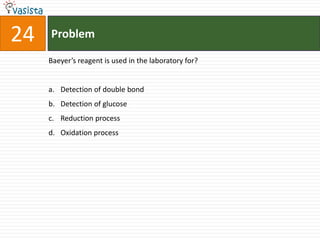
24   Problem

     Baeyer’s reagent is used in the laboratory for?


     a. Detection of double bond
     b. Detection of glucose
     c. Reduction process
     d. Oxidation process
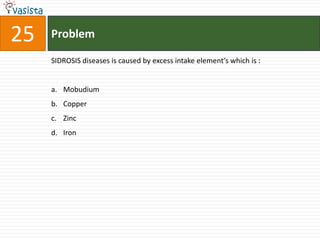
25   Problem

     SIDROSIS diseases is caused by excess intake element’s which is :


     a. Mobudium
     b. Copper
     c. Zinc
     d. Iron
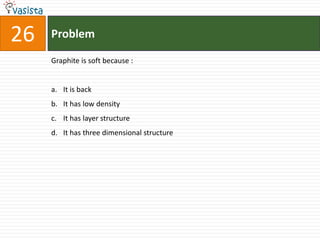
26   Problem

     Graphite is soft because :


     a. It is back
     b. It has low density
     c. It has layer structure
     d. It has three dimensional structure
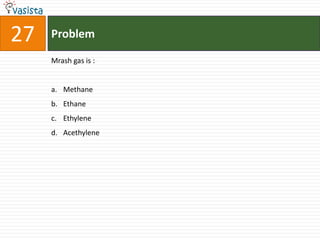
27   Problem

     Mrash gas is :


     a. Methane
     b. Ethane
     c. Ethylene
     d. Acethylene
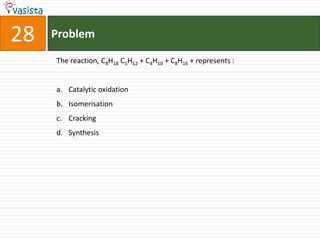
28   Problem

     The reaction, C8H18 C5H12 + C4H10 + C8H16 + represents :


     a. Catalytic oxidation
     b. Isomerisation
     c. Cracking
     d. Synthesis
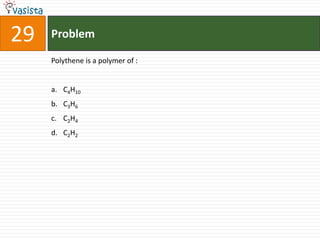
29   Problem

     Polythene is a polymer of :


     a. C4H10
     b. C3H6
     c. C2H4
     d. C2H2
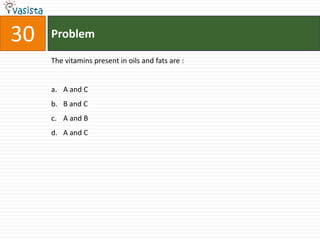
30   Problem

     The vitamins present in oils and fats are :


     a. A and C
     b. B and C
     c. A and B
     d. A and C
31   Problem

     PVC is :


     a. Thermoplastic polymer
     b. Compound polymer
     c. Thermosetting polymer
     d. Simple polymer
32   Problem

     Which element is known as ‘GIRLS BEST FRIEND’ ?


     a. Plutonium
     b. Diamind
     c. Silver
     d. Gold
33   Problem

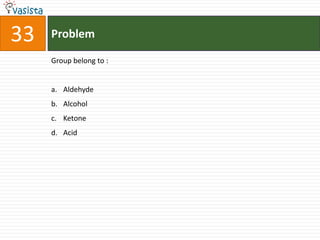
     Group belong to :


     a. Aldehyde
     b. Alcohol
     c. Ketone
     d. Acid
34   Problem

     The acid is used as VINEGAR for preparation of pickles :


     a. Oxalic acid
     b. Citraic acid
     c. Acetic acid
     d. Formic acid
35   Problem

     Polmific acid and steric acid are used as :


     a. Medicine
     b. Soap
     c. Anticeptic cream
     d. Pickle
36   Problem

     The hardest substance among the following is :


     a. Graphite
     b. Anthracite
     c. Lignite
     d. Peat
37   Problem

     Drip-day clothes are made up of :


     a. Polyster
     b. Decrone
     c. Rayon
     d. Nylon
38   Problem

     The carbon contents in lamp black is about :


     a. 98-99%
     b. 90-955
     c. 80-90%
     d. 10-20%
39   Problem

     Neoprene is a polymer of :


     a. 1-bromobutadiene
     b. 2-chlorobutadiene
     c. 2-bromobutadiene
     d. 1-chlorobutadiene
40   Problem

     Rayon is :


     a. Synthetic plastic
     b. Natural rubber
     c. Natural silk
     d. Artificial silk
41   Problem

     The natural cleaning agent are found in river :


     a. Marine animal
     b. Plants
     c. Algae
     d. Fungi
42   Problem

     Which of the following is used as a preservative for biological specimens ?


     a. Acetic acid
     b. Formic acid
     c. Formalin
     d. Liquid NH3
43   Problem

     Name the compounds which affects the ozone layer :


     a. Chloro compound
     b. Fluro compound
     c. Bromo compound
     d. Iodo compounds
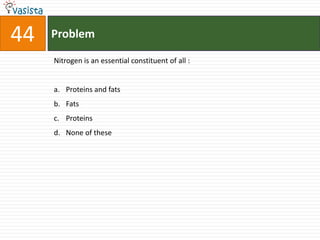
44   Problem

     Nitrogen is an essential constituent of all :


     a. Proteins and fats
     b. Fats
     c. Proteins
     d. None of these
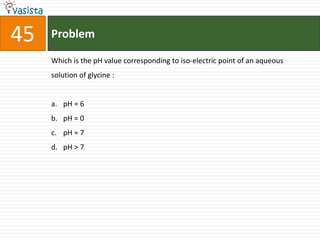
45   Problem

     Which is the pH value corresponding to iso-electric point of an aqueous
     solution of glycine :


     a. pH = 6
     b. pH = 0
     c. pH = 7
     d. pH > 7
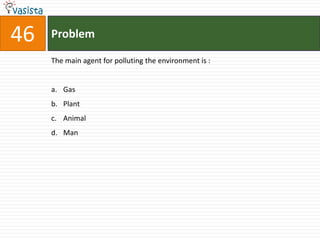
46   Problem

     The main agent for polluting the environment is :


     a. Gas
     b. Plant
     c. Animal
     d. Man
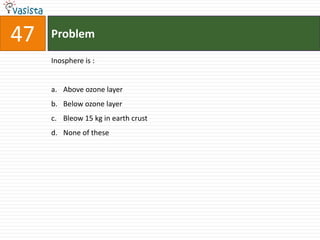
47   Problem

     Inosphere is :


     a. Above ozone layer
     b. Below ozone layer
     c. Bleow 15 kg in earth crust
     d. None of these
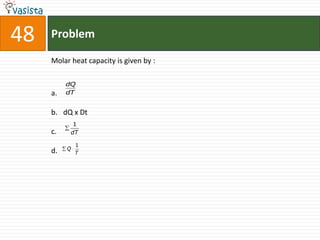
48   Problem

     Molar heat capacity is given by :

          dQ
     a.   dT


     b. dQ x Dt
            1
     c.    dT

              1
     d.   Q
              T
49   Problem

     The distance between nucleons in atomic nucleus is of the order of (1 F = 10-13
     cm) :


     a. 1000 Fermi
     b. 200 Fermi
     c. 50 Fermi
     d. 2 Fermi
50   Problem

     Nuclear reactions are balanced in terms of :


     a. Only mass
     b. Only energy
     c. Number of electrons
     d. Mass and energy
FOR SOLUTIONS VISIT WWW.VASISTA.NET

AMU - Chemistry - 1998

  • 1.
    AMU –PAST PAPERS CHEMISTRY-UNSOLVED PAPER - 1998
  • 2.
    SECTION – I  Single Correct Answer Type  There are five parts in this question. Four choices are given for each part and one of them is correct. Indicate you choice of the correct answer for each part in your answer-book by writing the letter (a), (b), (c) or (d) whichever is appropriate
  • 3.
    01 Problem Sodalime is a. NaH + Na2CO3 b. NaOH + CaO c. NaOH + NaHCO3 d. Na2CO3 + CaO
  • 4.
    02 Problem White lead is : a. Carbonate of lead b. Oxide of lead c. Basic carbonate of lead d. Basic sulphate of lead
  • 5.
    03 Problem AlCl3 fumes in moist air because : a. HCl is formed in moist air b. It is highly hygroscopic c. It is very volatile d. It is covalent
  • 6.
    04 Problem Calcium is obtained by : a. Reduction of CaCl2 with carbon b. Roasting of limestone c. Electrolysis of molten CaCl2 d. Electrolysis of solution of CaCl2 in water
  • 7.
    05 Problem Brown ring test is for : a. Nitrate b. Sulphate c. Halide d. Sophie
  • 8.
    06 Problem Sodium thiosulphate is used in photography because of its : a. Complex forming behavior b. Reducing behaviour c. Reaction with light d. Oxidizing behaviour
  • 9.
    07 Problem A characteristic feature of transition elements is ; a. They do not from complex ions b. They show variable oxidation states c. They show inert pair effect d. They all exhibit diamagnetism
  • 10.
    08 Problem H2O2 reduces K2Fe(CN)6 in : a. Alkaline medium b. Neutral solution c. Non-polar medium d. Acidic solution
  • 11.
    09 Problem H2O2 oxidises H2S to : a. H2S2O8 b. H2SO5 c. H2SO4 d. S
  • 12.
    10 Problem Atomic radii of fluorine and neon in angstron units are respectively given by : a. 0.72, 0.82 b. 0.72, 1.60 c. 0.72, 0.72 d. 1.60, 1.60
  • 13.
    11 Problem Which of the following elements exhibits variable oxidation states ? a. Zn b. Fe c. Al d. Si
  • 14.
    12 Problem Most electropositive halogen is : a. Cl b. Br c. I d. F
  • 15.
    13 Problem Most of the man made elements occur : a. Among the non-metals b. Among the metalloids c. In the actinides series d. In the lanthanides series
  • 16.
    14 Problem The most abundant meatl on the surface of earth is : a. Al b. Hg c. Fe d. Ca
  • 17.
    15 Problem Cupellation process is used in the metallurgy of : a. Ag b. Cu c. Fe d. Al
  • 18.
    16 Problem Off the following the metal the cannot be obtained by electrolysis of the aqueous solution of their salt is : a. Al b. Mg c. Cu d. Both a and b
  • 19.
    17 Problem Polymer of chloroethylene is : a. Teflon b. Nylon c. Terylene d. PVC
  • 20.
    18 Problem Primary amines react with benzaldehyde to form : a. Diazonium salts b. Azodyes c. Anilides d. Schiff’s base
  • 21.
    19 Problem Which of the following is a strong reducing agent ? a. Methanoic acid b. Ethanoic acid c. Chloroacetic acid d. Benzoic acid
  • 22.
    20 Problem When ethylene bromide is treated with Zn, we get : a. Alkane b. Alkene c. Alkyne d. None of these
  • 23.
    21 Problem Formaldehyde reacts with NH3 to form : a. (CH2)6N6 b. (CH2)6N4 c. (CH2)6N5 d. (CH2)4N6
  • 24.
    22 Problem Acetone is easily oxidized with : a. Benedict’s solution b. Fehling solution c. Acidic dichromate solution d. Tollen’s reagent
  • 25.
    23 Problem Which of the following is soluble in water ? a. C2H5OH b. CHCl3 c. Cs2 d. CCl4
  • 26.
    24 Problem Baeyer’s reagent is used in the laboratory for? a. Detection of double bond b. Detection of glucose c. Reduction process d. Oxidation process
  • 27.
    25 Problem SIDROSIS diseases is caused by excess intake element’s which is : a. Mobudium b. Copper c. Zinc d. Iron
  • 28.
    26 Problem Graphite is soft because : a. It is back b. It has low density c. It has layer structure d. It has three dimensional structure
  • 29.
    27 Problem Mrash gas is : a. Methane b. Ethane c. Ethylene d. Acethylene
  • 30.
    28 Problem The reaction, C8H18 C5H12 + C4H10 + C8H16 + represents : a. Catalytic oxidation b. Isomerisation c. Cracking d. Synthesis
  • 31.
    29 Problem Polythene is a polymer of : a. C4H10 b. C3H6 c. C2H4 d. C2H2
  • 32.
    30 Problem The vitamins present in oils and fats are : a. A and C b. B and C c. A and B d. A and C
  • 33.
    31 Problem PVC is : a. Thermoplastic polymer b. Compound polymer c. Thermosetting polymer d. Simple polymer
  • 34.
    32 Problem Which element is known as ‘GIRLS BEST FRIEND’ ? a. Plutonium b. Diamind c. Silver d. Gold
  • 35.
    33 Problem Group belong to : a. Aldehyde b. Alcohol c. Ketone d. Acid
  • 36.
    34 Problem The acid is used as VINEGAR for preparation of pickles : a. Oxalic acid b. Citraic acid c. Acetic acid d. Formic acid
  • 37.
    35 Problem Polmific acid and steric acid are used as : a. Medicine b. Soap c. Anticeptic cream d. Pickle
  • 38.
    36 Problem The hardest substance among the following is : a. Graphite b. Anthracite c. Lignite d. Peat
  • 39.
    37 Problem Drip-day clothes are made up of : a. Polyster b. Decrone c. Rayon d. Nylon
  • 40.
    38 Problem The carbon contents in lamp black is about : a. 98-99% b. 90-955 c. 80-90% d. 10-20%
  • 41.
    39 Problem Neoprene is a polymer of : a. 1-bromobutadiene b. 2-chlorobutadiene c. 2-bromobutadiene d. 1-chlorobutadiene
  • 42.
    40 Problem Rayon is : a. Synthetic plastic b. Natural rubber c. Natural silk d. Artificial silk
  • 43.
    41 Problem The natural cleaning agent are found in river : a. Marine animal b. Plants c. Algae d. Fungi
  • 44.
    42 Problem Which of the following is used as a preservative for biological specimens ? a. Acetic acid b. Formic acid c. Formalin d. Liquid NH3
  • 45.
    43 Problem Name the compounds which affects the ozone layer : a. Chloro compound b. Fluro compound c. Bromo compound d. Iodo compounds
  • 46.
    44 Problem Nitrogen is an essential constituent of all : a. Proteins and fats b. Fats c. Proteins d. None of these
  • 47.
    45 Problem Which is the pH value corresponding to iso-electric point of an aqueous solution of glycine : a. pH = 6 b. pH = 0 c. pH = 7 d. pH > 7
  • 48.
    46 Problem The main agent for polluting the environment is : a. Gas b. Plant c. Animal d. Man
  • 49.
    47 Problem Inosphere is : a. Above ozone layer b. Below ozone layer c. Bleow 15 kg in earth crust d. None of these
  • 50.
    48 Problem Molar heat capacity is given by : dQ a. dT b. dQ x Dt 1 c. dT 1 d. Q T
  • 51.
    49 Problem The distance between nucleons in atomic nucleus is of the order of (1 F = 10-13 cm) : a. 1000 Fermi b. 200 Fermi c. 50 Fermi d. 2 Fermi
  • 52.
    50 Problem Nuclear reactions are balanced in terms of : a. Only mass b. Only energy c. Number of electrons d. Mass and energy
  • 53.
    FOR SOLUTIONS VISITWWW.VASISTA.NET