AMU –PAST PAPERS
CHEMISTRY- UNSOLVED PAPER - 2006
SECTION – I

   Single Correct Answer Type
         There are five parts in this question. Four choices are given for each part and one of them is

          correct. Indicate you choice of the correct answer for each part in your answer-book by

          writing the letter (a), (b), (c) or (d) whichever is appropriate
01   Problem

     Which one of the following is not an amphoteric substance ?


     a. HNO3
     b. HCO
     c. H2O
     d. NH3
02   Problem
     When 50 cm3 of 0.2 N H2SO4 is mixed with 50 cm3 of 1 N KOH, the heat liberated
     is :


     a. 11.46 kJ
     b. 157.3 kJ
     c. 573 kJ
     d. 573 J
03   Problem

     An artificial radioactive isotope gave N after two successive -particle emissions.
     The number of neutrons in the parent nucleus must be :


     a. 9
     b. 14
     c. 5
     d. 7
04   Problem

     Stainless steel does not rust because :


     a. Chromium and nickel combine with iron
     b. Chromium forms an oxide layer and protects iron from rusting
     c. Nickel present in it, does not rust
     d. Iron forms a heard chemical compound with chromium present in it
05   Problem

     Which of the following combinations can be used to synthesis ethanol ?


     a. CH3MgI and CH3COCH3
     b. CH3MgI and C2H5OH
     c. CH3MgI and CH3COOC3H5
     d. CH3MgI and HCHO
06   Problem

     A solution contains 1.2046 x 1024 hydrochloric acid molecules in one dm3 of the
     solution. The strength of the solution is :


     a. 6 N
     b. 2 N
     c. 4 N
     d. 8 N
07   Problem

     Nuclear theory of the atom was put forward by :


     a. Rutherford
     b. Aston
     c. Neils Bohr
     d. J.J. Thomson
08   Problem

     In acetylene molecule, the two carbon atoms are linked by :


     a. One sigma-bond and two pi-bonds
     b. two sigma-bonds and one pi-bond
     c. Three sigma-bonds
     d. Three pi-bonds
09   Problem

     The enthalpy of reaction,
             1                                               1
      H2 (g)   O2 (g)    H2O(g) is   H1 and that of H2 (g)   2
                                                               O2 (g)   H2O(l ) is
             2
     H2 Then :


     a.    H1 <    H2
     b.     H1 +    H2 = 0
     c.     H1 >    H2
     d.      H1 = H2
10   Problem

     A radioactive isotope decays at such that a rate that after 192 minutes only
     1/16 of the original amount remains left. Its half-life is :


     a. 32 min
     b. 48 min
     c. 12 min
     d. 24 min
11   Problem

     The pressure and temperature of 4 dm3 of carbon dioxide gas are doubled, then
     the volume of carbon dioxide gas would be :


     a. 2 dm3
     b. 3 dm3
     c. 4 dm3
     d. 8 dm3
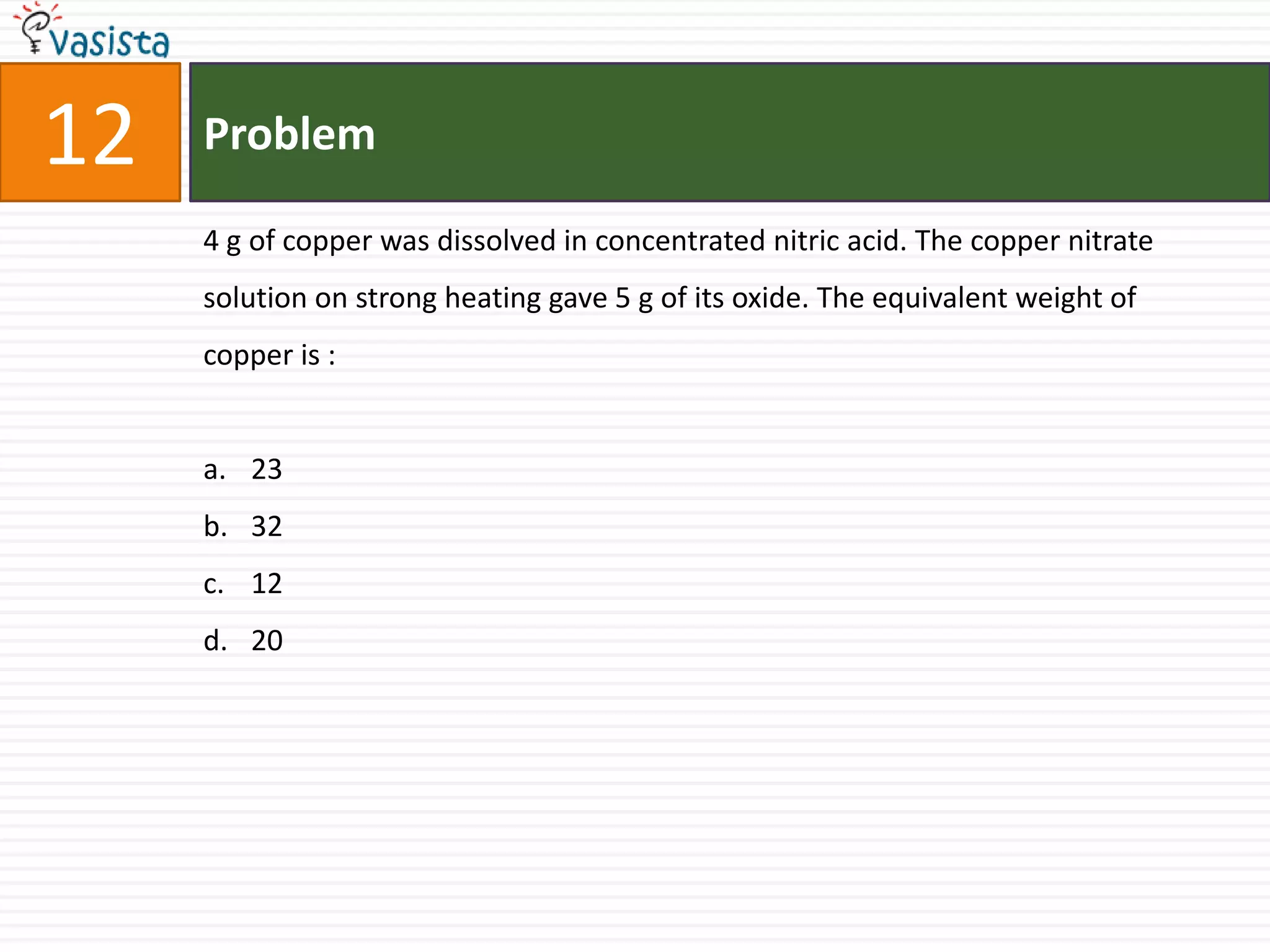
12   Problem

     4 g of copper was dissolved in concentrated nitric acid. The copper nitrate
     solution on strong heating gave 5 g of its oxide. The equivalent weight of
     copper is :


     a. 23
     b. 32
     c. 12
     d. 20
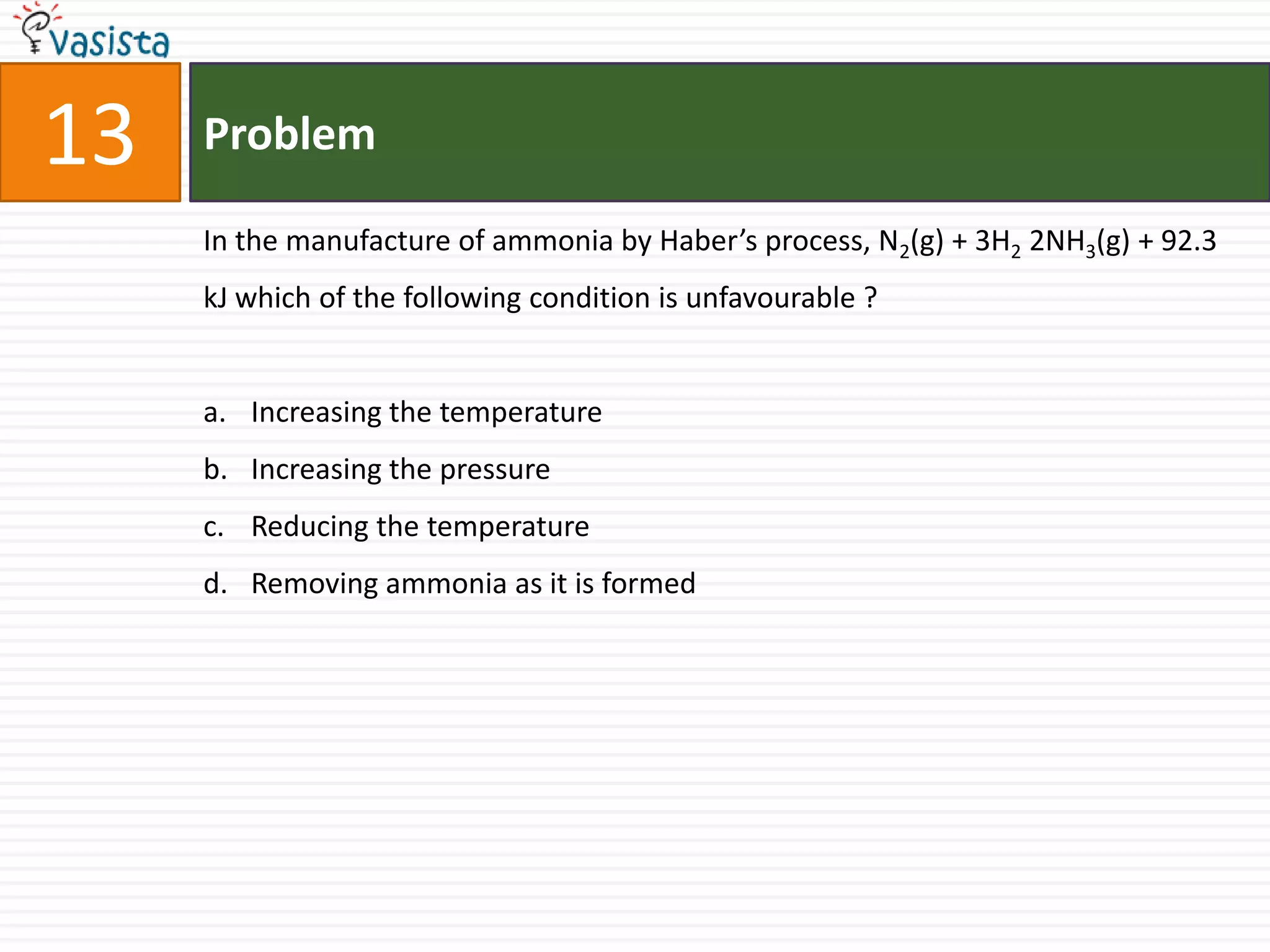
13   Problem

     In the manufacture of ammonia by Haber’s process, N2(g) + 3H2 2NH3(g) + 92.3
     kJ which of the following condition is unfavourable ?


     a. Increasing the temperature
     b. Increasing the pressure
     c. Reducing the temperature
     d. Removing ammonia as it is formed
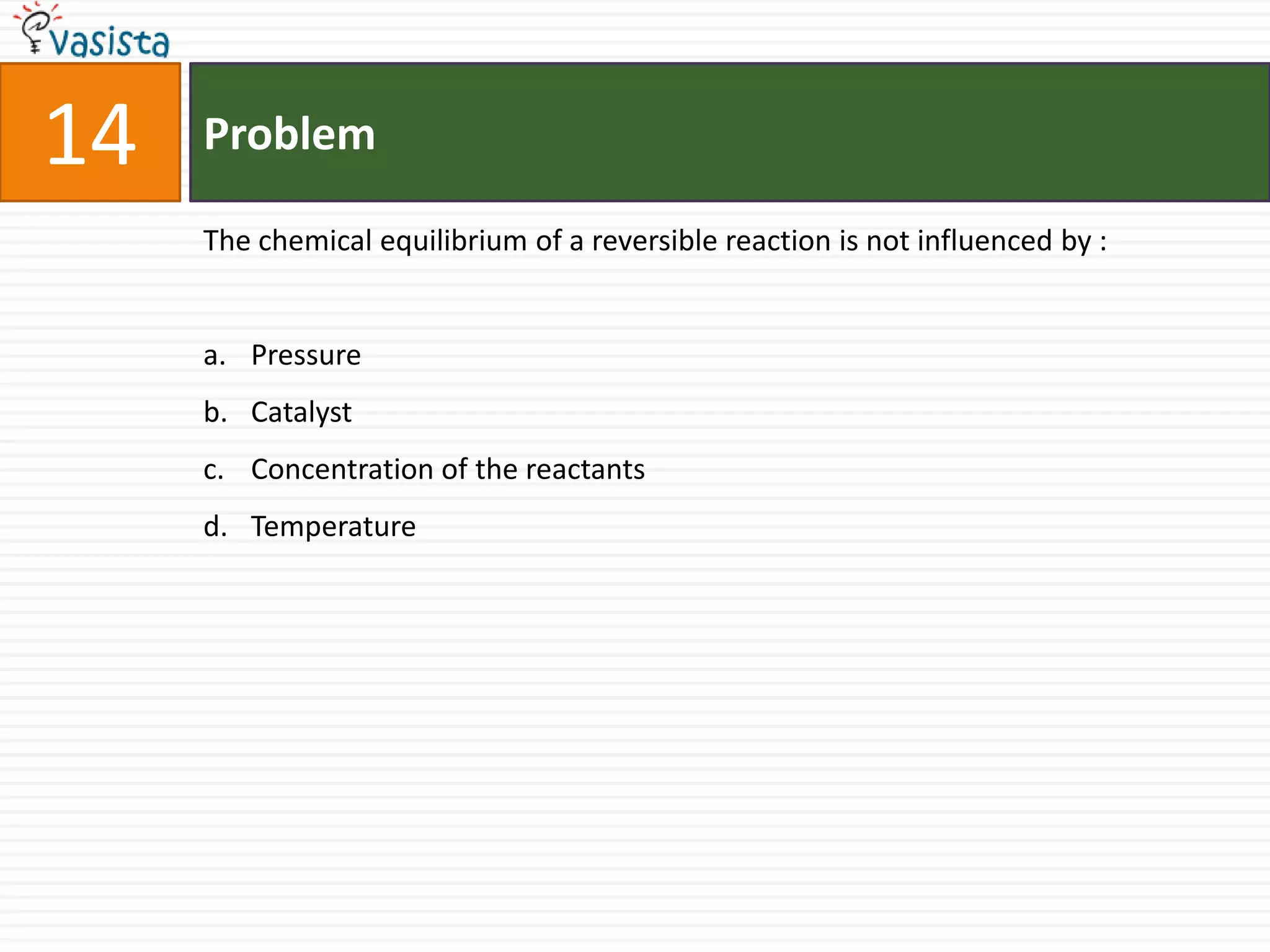
14   Problem

     The chemical equilibrium of a reversible reaction is not influenced by :


     a. Pressure
     b. Catalyst
     c. Concentration of the reactants
     d. Temperature
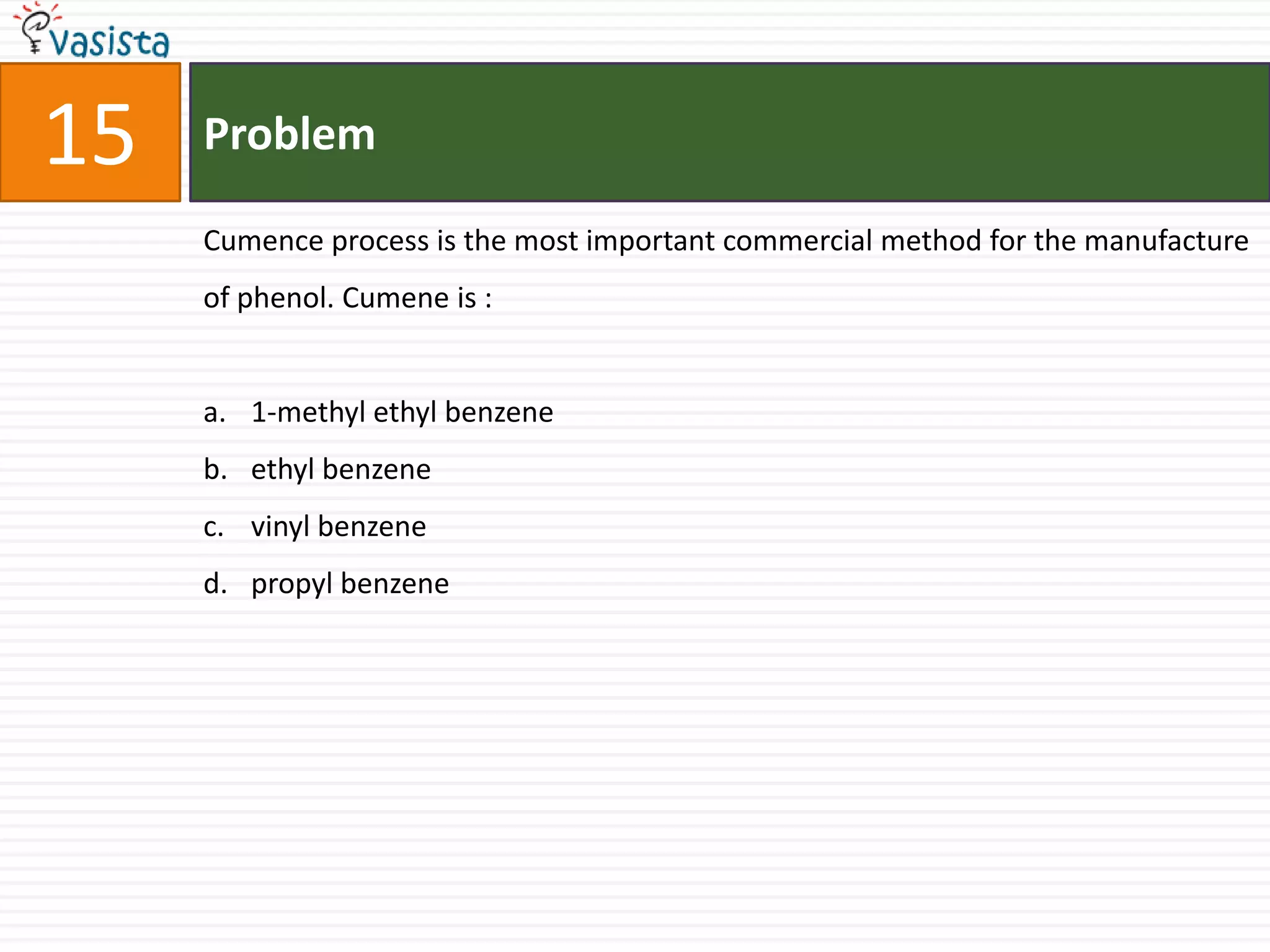
15   Problem

     Cumence process is the most important commercial method for the manufacture
     of phenol. Cumene is :


     a. 1-methyl ethyl benzene
     b. ethyl benzene
     c. vinyl benzene
     d. propyl benzene
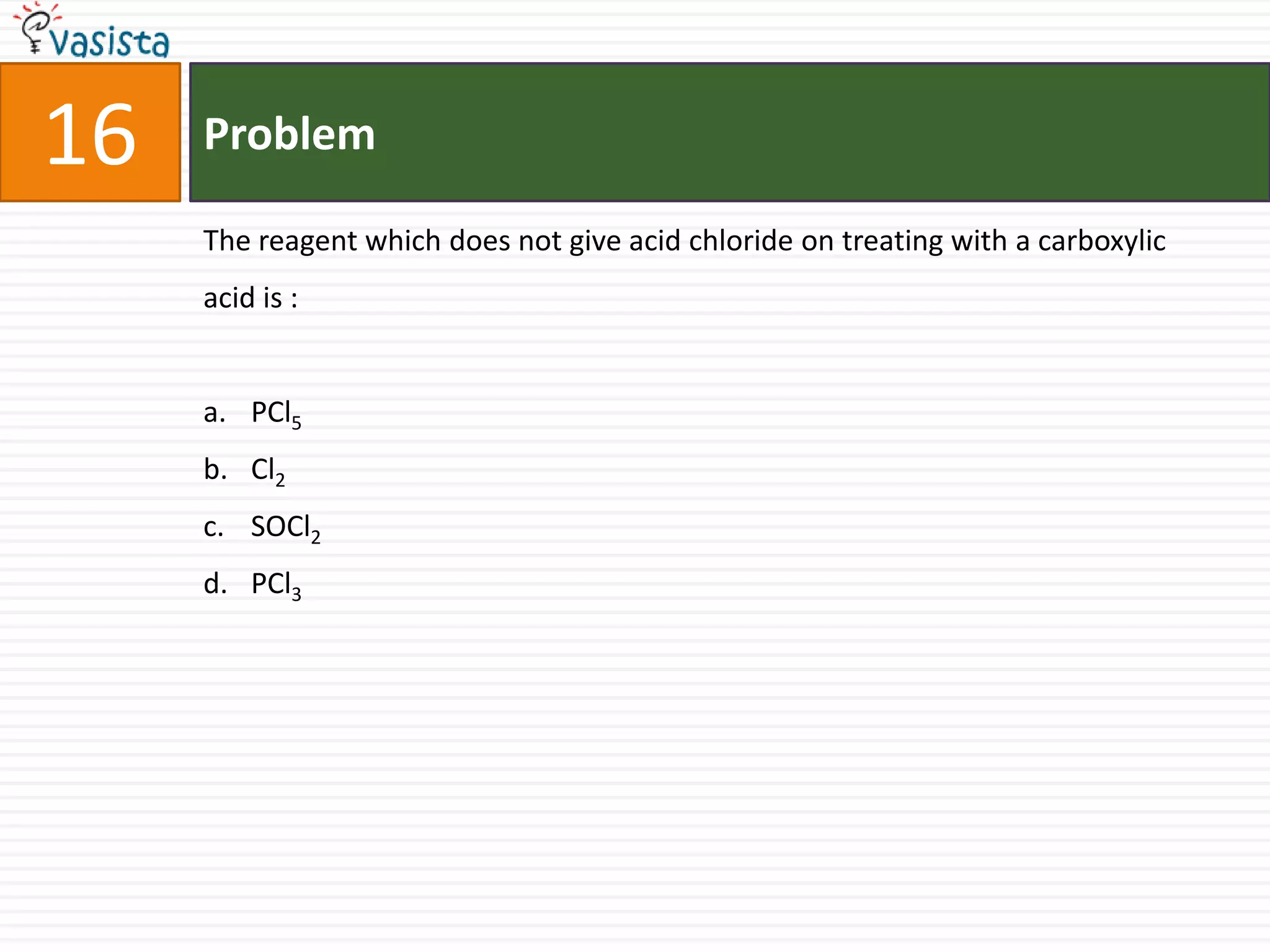
16   Problem

     The reagent which does not give acid chloride on treating with a carboxylic
     acid is :


     a. PCl5
     b. Cl2
     c. SOCl2
     d. PCl3
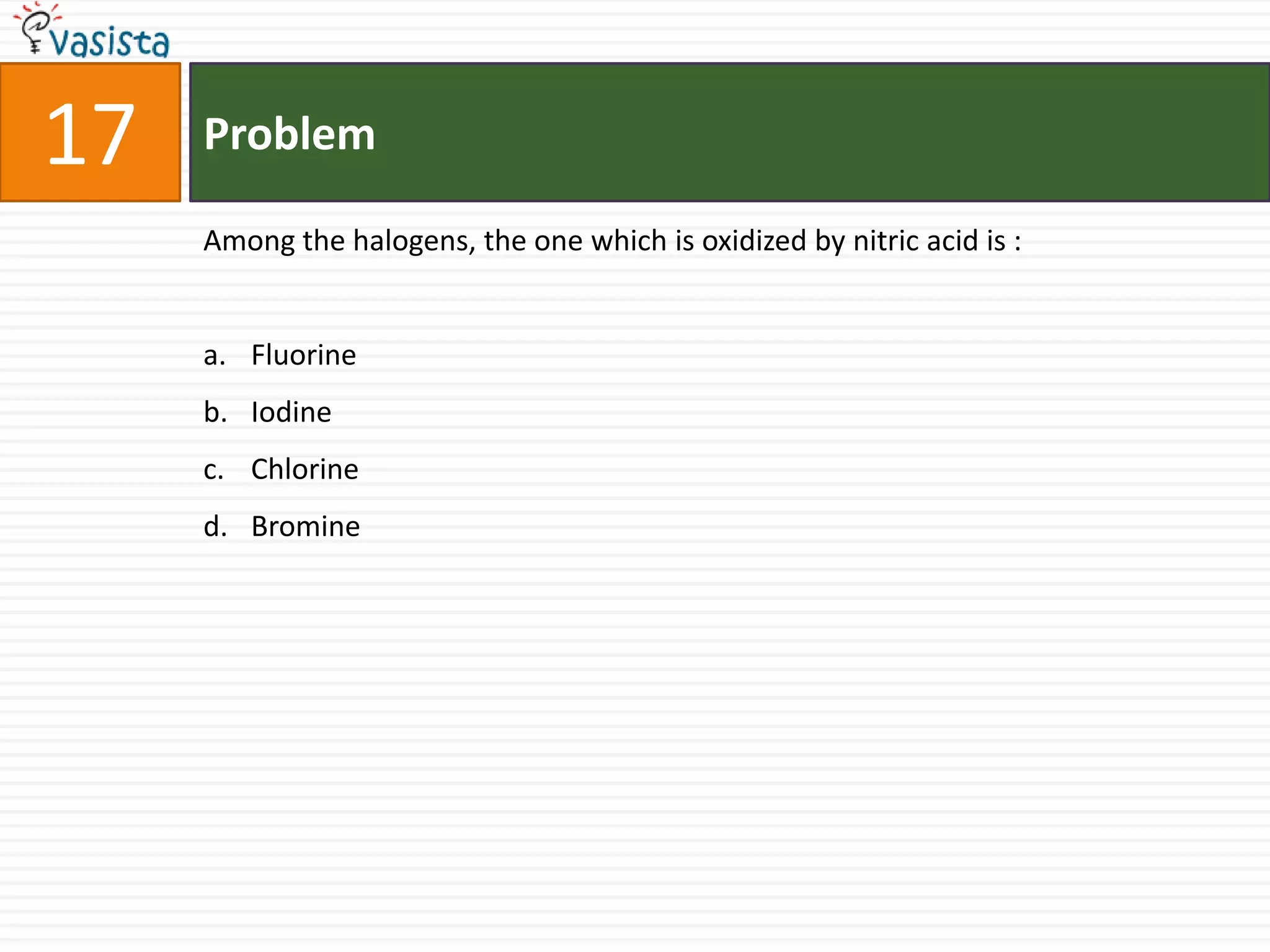
17   Problem

     Among the halogens, the one which is oxidized by nitric acid is :


     a. Fluorine
     b. Iodine
     c. Chlorine
     d. Bromine
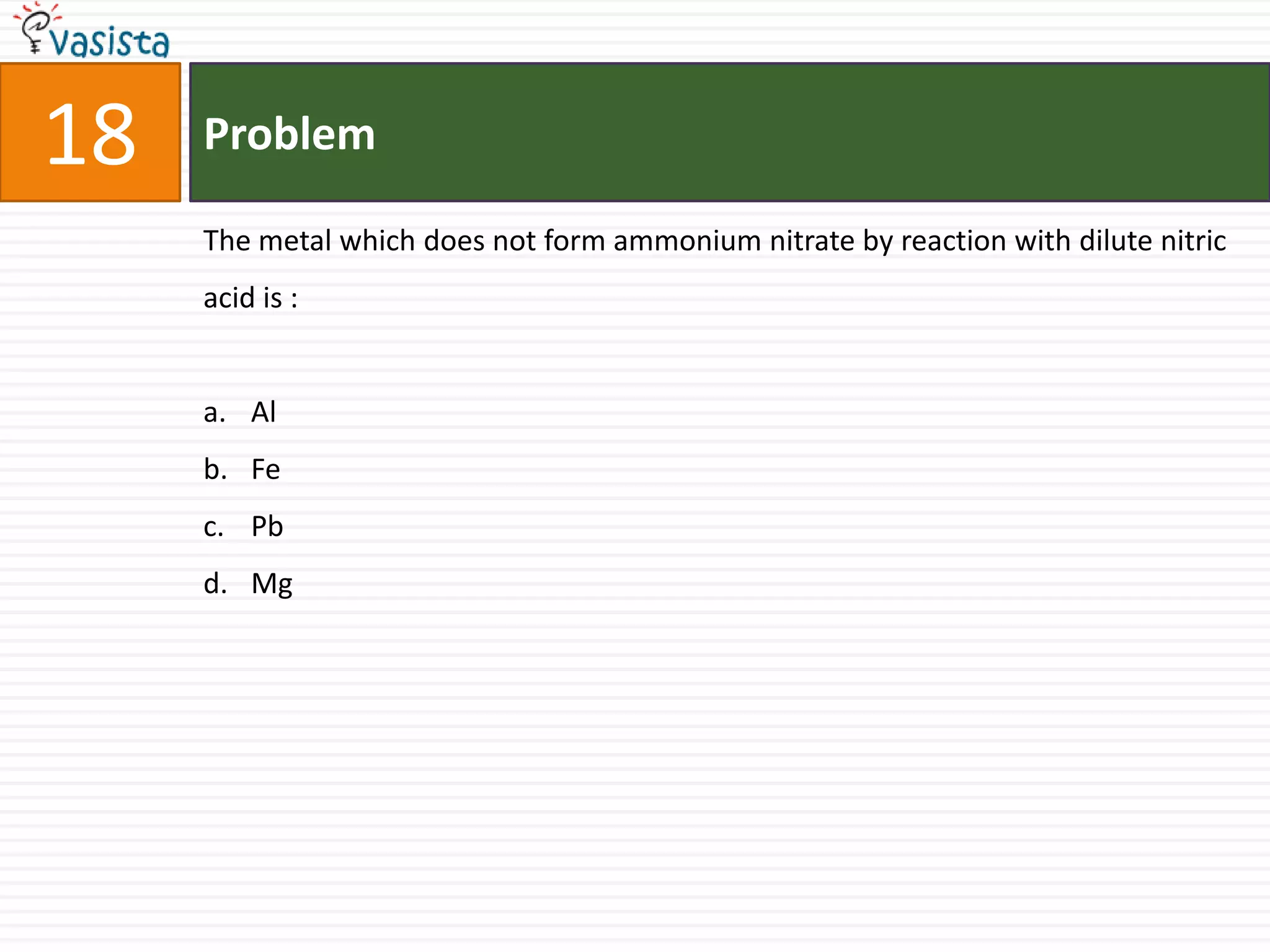
18   Problem

     The metal which does not form ammonium nitrate by reaction with dilute nitric
     acid is :


     a. Al
     b. Fe
     c. Pb
     d. Mg
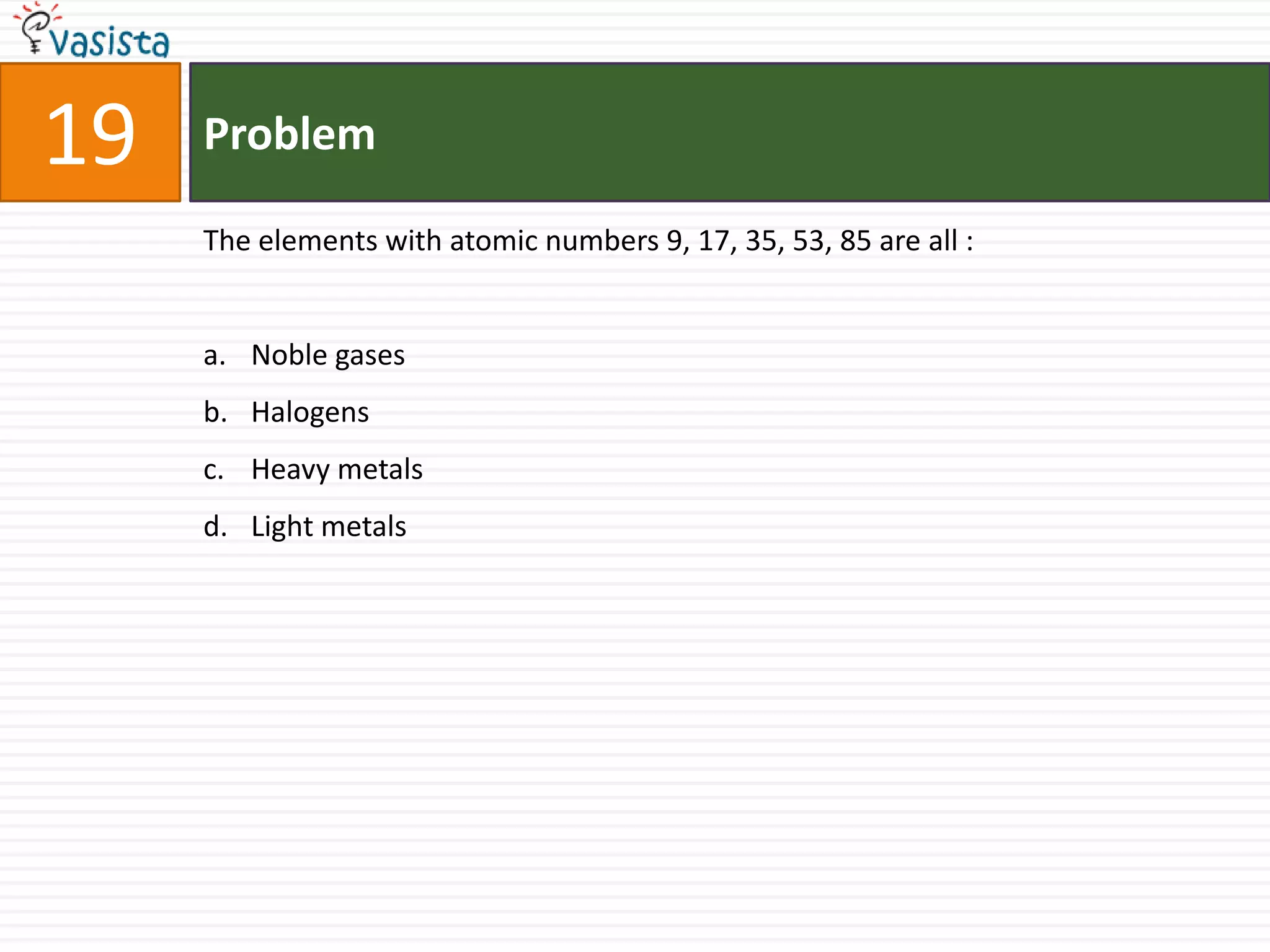
19   Problem

     The elements with atomic numbers 9, 17, 35, 53, 85 are all :


     a. Noble gases
     b. Halogens
     c. Heavy metals
     d. Light metals
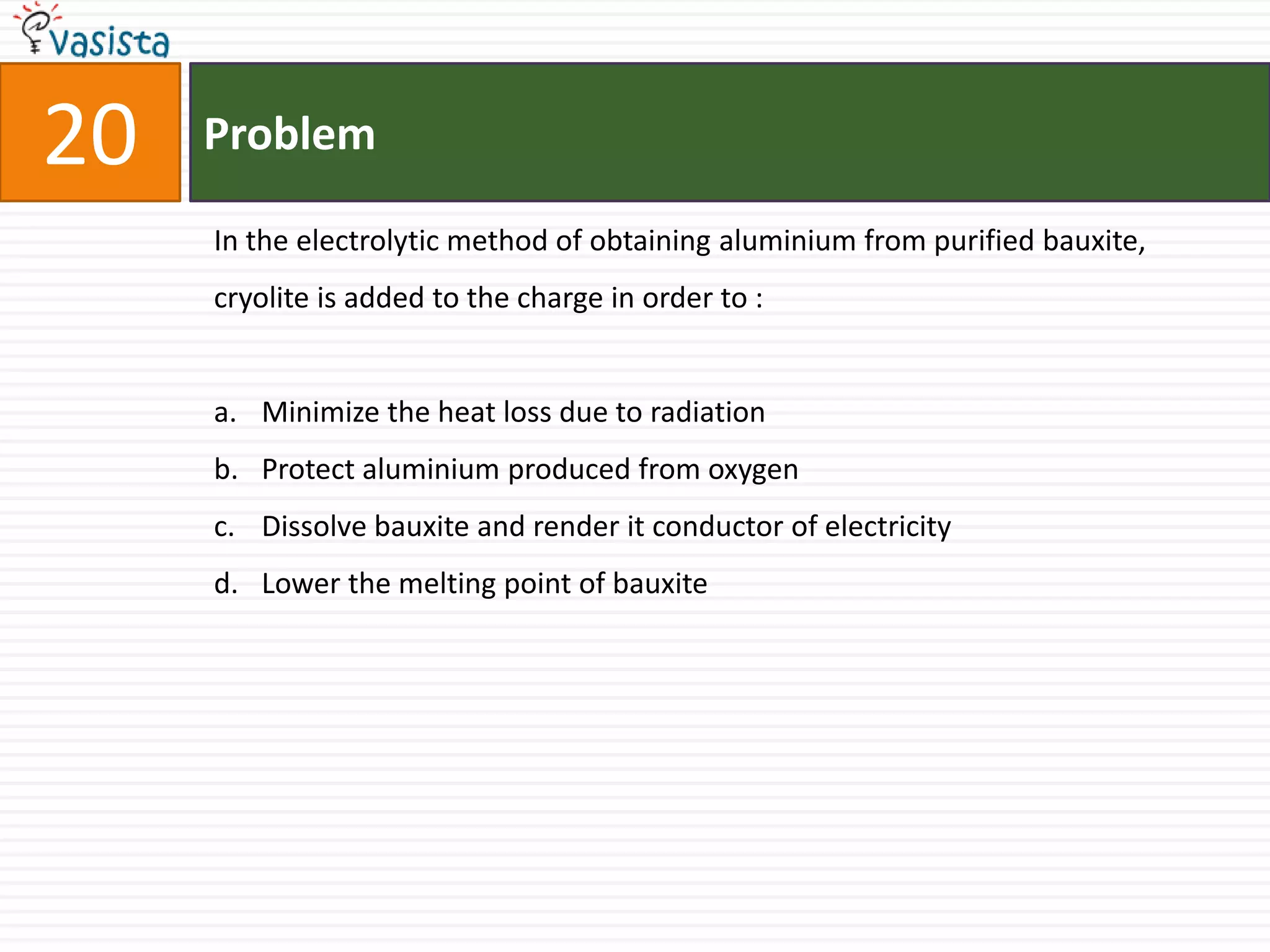
20   Problem

     In the electrolytic method of obtaining aluminium from purified bauxite,
     cryolite is added to the charge in order to :


     a. Minimize the heat loss due to radiation
     b. Protect aluminium produced from oxygen
     c. Dissolve bauxite and render it conductor of electricity
     d. Lower the melting point of bauxite
21   Problem

     The number of 2p electrons having spin quantum number s = -1/2 are :


     a. 6
     b. 0
     c. 2
     d. 3
22   Problem

     Pick out the alkane which, differs fromteh other members of the group :


     a. 2,2-dimethyl propane
     b. pentane
     c. 2-methyl butane
     d. 2,2-dimethylbutane
23   Problem

     56 g of nitrogen and 8 g of hydrogen gas are heated in a closed vessel. At
     equilibrium 34 g of ammonia are present. The equilibrium number of moles of
     nitrogen, hydrogen and ammonia are respectively :


     a. 1, 2, 2
     b. 2, 2, 1
     c. 1, 1, 2
     d. 2, 1, 2
24   Problem

     A process is taking place at constant temperature and pressure. Then :


     a.    H= E
     b.    H=T     S
     c.    H=0
     d.    S=0
25   Problem

     In a galvanic cell, the electrons flow from :


     a. Anode to cathode through the solution
     b. Cathode to anode through the solution
     c. Anode to cathode through the external circuit
     d. Cathode to anode through the external circuit
26   Problem

     The reaction, 2SO2(g) + O2 (g) 2SO3(g) is carried out in a 1 dm3 vessel and 2
     dm3 vessel separately. The ratio of the reaction velocities will be :


     a. 1 : 8
     b. 1 : 4
     c. 4 : 1
     d. 8 : 1
27   Problem

     In a mixture of acetic acid and sodium acetate the ratio of concentration of the
     salt to the acid is increased ten times. Then, the pH of the solution :


     a. Increase by one
     b. Decreases by one
     c. Decreases ten fold
     d. Increases ten fold
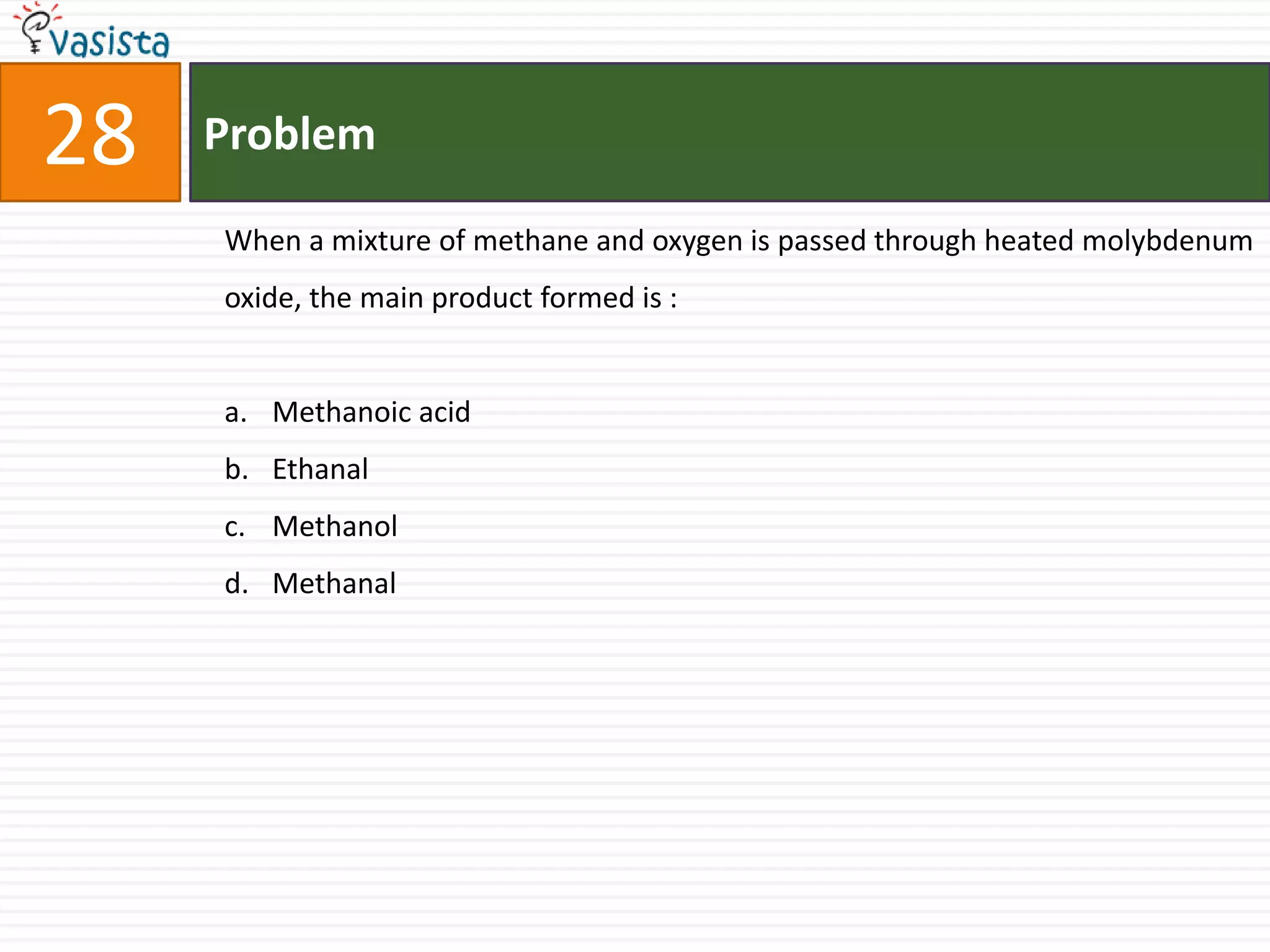
28   Problem

     When a mixture of methane and oxygen is passed through heated molybdenum
     oxide, the main product formed is :


     a. Methanoic acid
     b. Ethanal
     c. Methanol
     d. Methanal
29   Problem

     Benzene can be obtained by heating either benzoic acid with X or phenol with Y.X
     and Y are respectively :


     a. Zinc dust and soda lime
     b. Soda lime and zinc duct
     c. Zinc dust and sodium hydroxide
     d. Soda lime and copper
30   Problem

     An organic compound is boiled with alcoholic potash. The product is cooled and
     acidified potash. The product is cooled and acidified with HCl. A white solid
     separates out. The starting compound may be :


     a. Ethyl benzoate
     b. Ethyl formate
     c. Ethyl acetate
     d. Methyl acetate
31   Problem

     A nitrogen containing organic compound gave an oily liquid on heating with
     bromine and potassium hydroxide solution. On shaking the product with acetic
     anhydride, an antipyretic drug was obtained. The reactions indicate that the
     starting compound is :


     a. Aniline
     b. Benzamide
     c. Acetamide
     d. Nitrobenzene
32   Problem

     The silver slat of a fatty acid on refluxing with an alkyl halide gives an :


     a. Acid
     b. Ester
     c. Ether
     d. Amine
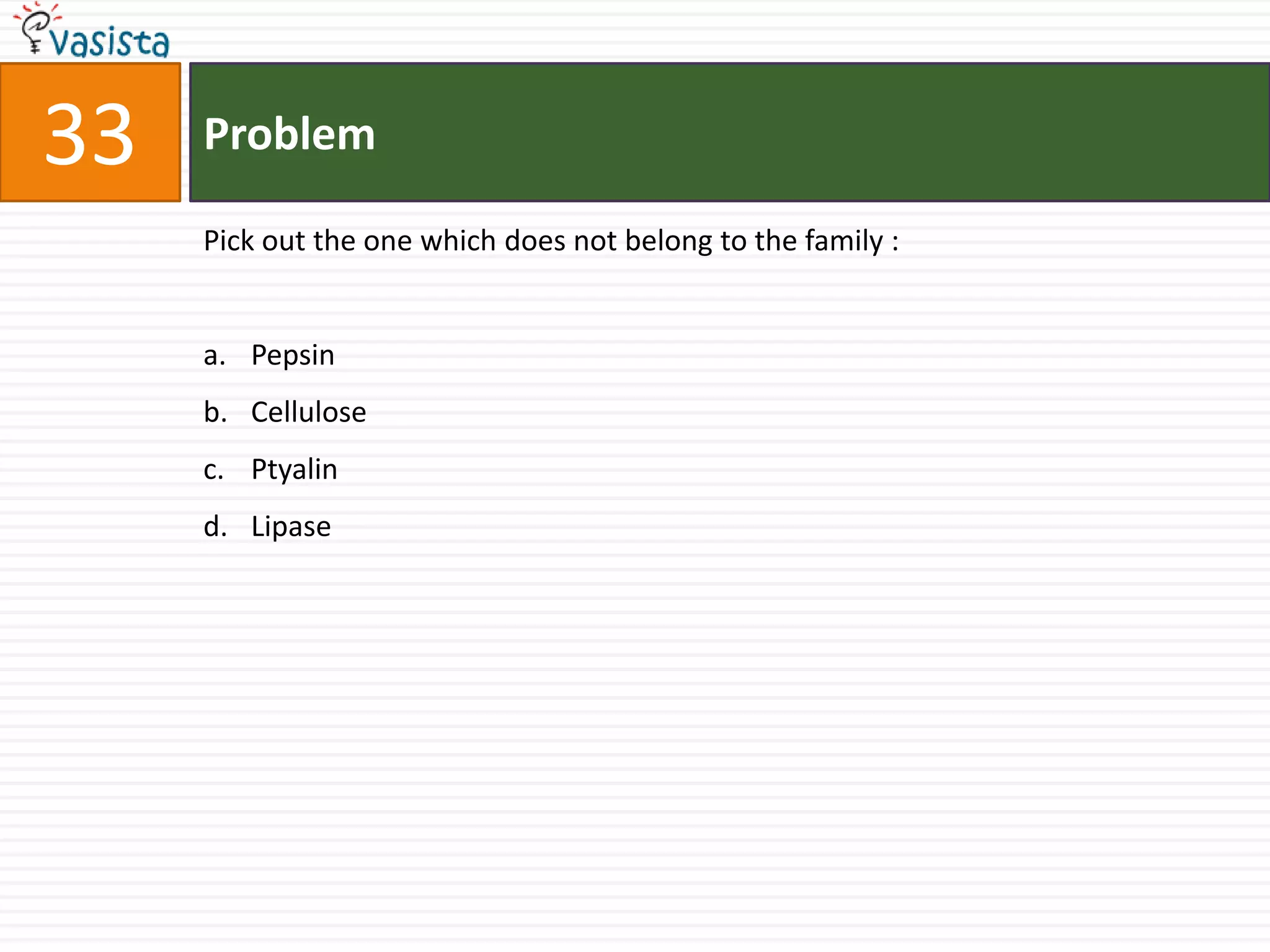
33   Problem

     Pick out the one which does not belong to the family :


     a. Pepsin
     b. Cellulose
     c. Ptyalin
     d. Lipase
34   Problem

     Which one of the following is wrongly matched ?


     a. Saponificaiton of CH3COOC2H5                   second order reaction
     b. Hydrolysis of CH3COOCH3                        pseudo unimolecular reaction
     c. Decomposition of H2O2                          first order reaction
     d. Combination of H2 and Br2 to give HBr          first order reaction
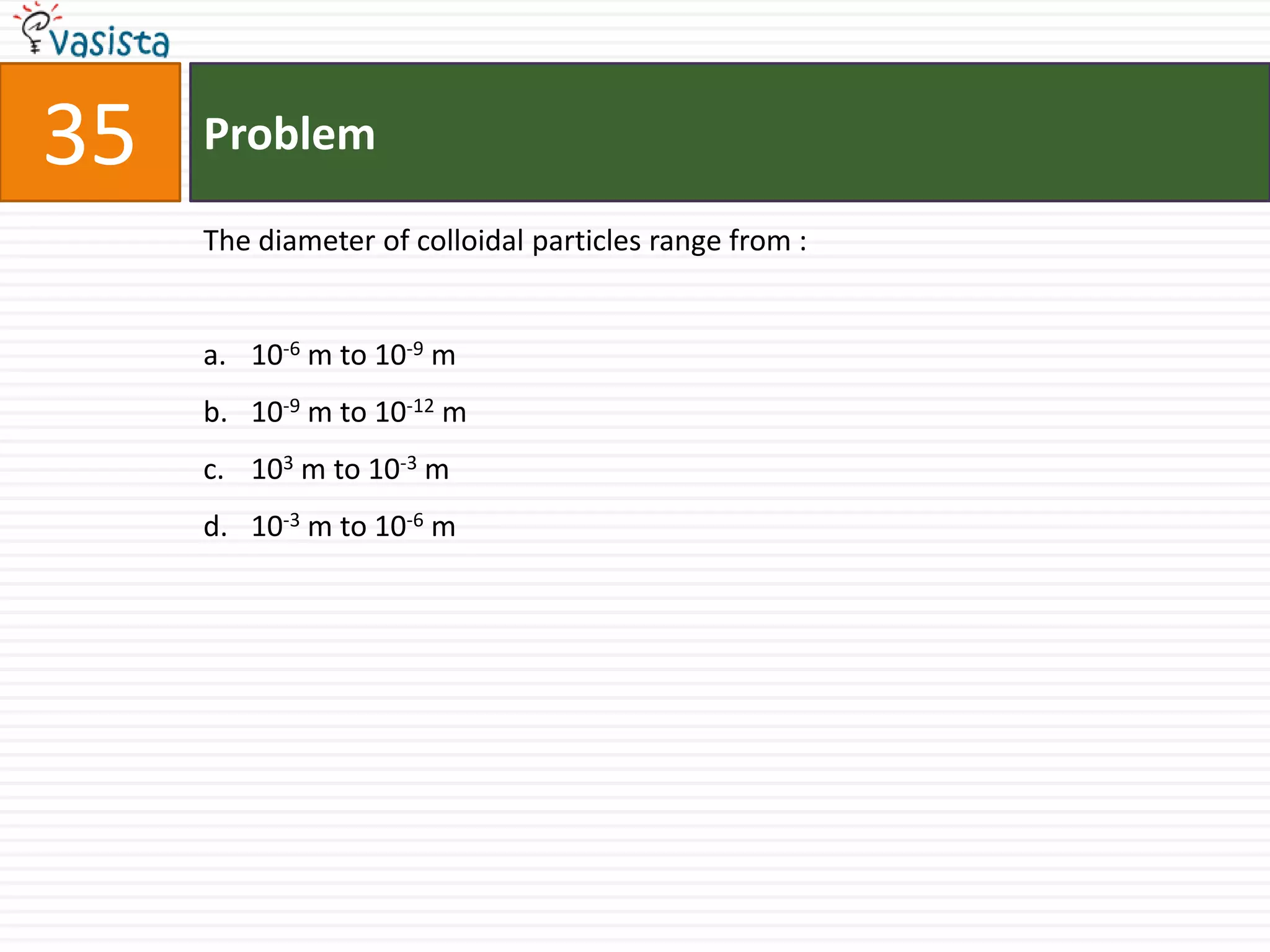
35   Problem

     The diameter of colloidal particles range from :


     a. 10-6 m to 10-9 m
     b. 10-9 m to 10-12 m
     c. 103 m to 10-3 m
     d. 10-3 m to 10-6 m
36   Problem

     On treating a mixture of two alkyl halides with sodium metal in dry ether, 2-
     methyl propane was obtained. The alkyl halides are :


     a. 2-chloropropane and chloromethane
     b. 2-chloropropane and chloromethane
     c. chloromethane and chloroethane
     d. chloromethane and 1-chloropropane
37   Problem

     Which of the following statements about benzyl chloride is incorrect ?


     a. It is less reactive than alkyl halides
     b. It can be oxidized to benzaldehyde by boiling with copper nitrate solution
     c. It is a lachrymatory liquid and answers Beilstein’s test
     d. It gives a white precipitate with alcoholic silver nitrate
38   Problem

     The main product obtained when a solution of sodium carbonate reacts with
     mercuric chloride is :


     a. Hg(OH)2
     b. HgCO3 . HgO
     c. HgCO3
     d. HgCO3 . Hg(OH)2
39   Problem

     In the electrothermal process, the compound displaced by silica from calcium
     phosphate is :


     a. Calcium phosphide
     b. Phosphine
     c. Phosphorus
     d. Phosphorus pentoxide
40   Problem

     The enthalpy of combustion of methane at 250C is 980- kJ. The heat liberated
     when 3.2 g of methane is burnt in air is :


     a. 445 kJ
     b. 278 kJ
     c. -890 kJ
     d. 178 kJ
FOR SOLUTIONS VISIT WWW.VASISTA.NET

AMU - Chemistry - 2006

  • 1.
    AMU –PAST PAPERS CHEMISTRY-UNSOLVED PAPER - 2006
  • 2.
    SECTION – I  Single Correct Answer Type  There are five parts in this question. Four choices are given for each part and one of them is correct. Indicate you choice of the correct answer for each part in your answer-book by writing the letter (a), (b), (c) or (d) whichever is appropriate
  • 3.
    01 Problem Which one of the following is not an amphoteric substance ? a. HNO3 b. HCO c. H2O d. NH3
  • 4.
    02 Problem When 50 cm3 of 0.2 N H2SO4 is mixed with 50 cm3 of 1 N KOH, the heat liberated is : a. 11.46 kJ b. 157.3 kJ c. 573 kJ d. 573 J
  • 5.
    03 Problem An artificial radioactive isotope gave N after two successive -particle emissions. The number of neutrons in the parent nucleus must be : a. 9 b. 14 c. 5 d. 7
  • 6.
    04 Problem Stainless steel does not rust because : a. Chromium and nickel combine with iron b. Chromium forms an oxide layer and protects iron from rusting c. Nickel present in it, does not rust d. Iron forms a heard chemical compound with chromium present in it
  • 7.
    05 Problem Which of the following combinations can be used to synthesis ethanol ? a. CH3MgI and CH3COCH3 b. CH3MgI and C2H5OH c. CH3MgI and CH3COOC3H5 d. CH3MgI and HCHO
  • 8.
    06 Problem A solution contains 1.2046 x 1024 hydrochloric acid molecules in one dm3 of the solution. The strength of the solution is : a. 6 N b. 2 N c. 4 N d. 8 N
  • 9.
    07 Problem Nuclear theory of the atom was put forward by : a. Rutherford b. Aston c. Neils Bohr d. J.J. Thomson
  • 10.
    08 Problem In acetylene molecule, the two carbon atoms are linked by : a. One sigma-bond and two pi-bonds b. two sigma-bonds and one pi-bond c. Three sigma-bonds d. Three pi-bonds
  • 11.
    09 Problem The enthalpy of reaction, 1 1 H2 (g) O2 (g) H2O(g) is H1 and that of H2 (g) 2 O2 (g) H2O(l ) is 2 H2 Then : a. H1 < H2 b. H1 + H2 = 0 c. H1 > H2 d. H1 = H2
  • 12.
    10 Problem A radioactive isotope decays at such that a rate that after 192 minutes only 1/16 of the original amount remains left. Its half-life is : a. 32 min b. 48 min c. 12 min d. 24 min
  • 13.
    11 Problem The pressure and temperature of 4 dm3 of carbon dioxide gas are doubled, then the volume of carbon dioxide gas would be : a. 2 dm3 b. 3 dm3 c. 4 dm3 d. 8 dm3
  • 14.
    12 Problem 4 g of copper was dissolved in concentrated nitric acid. The copper nitrate solution on strong heating gave 5 g of its oxide. The equivalent weight of copper is : a. 23 b. 32 c. 12 d. 20
  • 15.
    13 Problem In the manufacture of ammonia by Haber’s process, N2(g) + 3H2 2NH3(g) + 92.3 kJ which of the following condition is unfavourable ? a. Increasing the temperature b. Increasing the pressure c. Reducing the temperature d. Removing ammonia as it is formed
  • 16.
    14 Problem The chemical equilibrium of a reversible reaction is not influenced by : a. Pressure b. Catalyst c. Concentration of the reactants d. Temperature
  • 17.
    15 Problem Cumence process is the most important commercial method for the manufacture of phenol. Cumene is : a. 1-methyl ethyl benzene b. ethyl benzene c. vinyl benzene d. propyl benzene
  • 18.
    16 Problem The reagent which does not give acid chloride on treating with a carboxylic acid is : a. PCl5 b. Cl2 c. SOCl2 d. PCl3
  • 19.
    17 Problem Among the halogens, the one which is oxidized by nitric acid is : a. Fluorine b. Iodine c. Chlorine d. Bromine
  • 20.
    18 Problem The metal which does not form ammonium nitrate by reaction with dilute nitric acid is : a. Al b. Fe c. Pb d. Mg
  • 21.
    19 Problem The elements with atomic numbers 9, 17, 35, 53, 85 are all : a. Noble gases b. Halogens c. Heavy metals d. Light metals
  • 22.
    20 Problem In the electrolytic method of obtaining aluminium from purified bauxite, cryolite is added to the charge in order to : a. Minimize the heat loss due to radiation b. Protect aluminium produced from oxygen c. Dissolve bauxite and render it conductor of electricity d. Lower the melting point of bauxite
  • 23.
    21 Problem The number of 2p electrons having spin quantum number s = -1/2 are : a. 6 b. 0 c. 2 d. 3
  • 24.
    22 Problem Pick out the alkane which, differs fromteh other members of the group : a. 2,2-dimethyl propane b. pentane c. 2-methyl butane d. 2,2-dimethylbutane
  • 25.
    23 Problem 56 g of nitrogen and 8 g of hydrogen gas are heated in a closed vessel. At equilibrium 34 g of ammonia are present. The equilibrium number of moles of nitrogen, hydrogen and ammonia are respectively : a. 1, 2, 2 b. 2, 2, 1 c. 1, 1, 2 d. 2, 1, 2
  • 26.
    24 Problem A process is taking place at constant temperature and pressure. Then : a. H= E b. H=T S c. H=0 d. S=0
  • 27.
    25 Problem In a galvanic cell, the electrons flow from : a. Anode to cathode through the solution b. Cathode to anode through the solution c. Anode to cathode through the external circuit d. Cathode to anode through the external circuit
  • 28.
    26 Problem The reaction, 2SO2(g) + O2 (g) 2SO3(g) is carried out in a 1 dm3 vessel and 2 dm3 vessel separately. The ratio of the reaction velocities will be : a. 1 : 8 b. 1 : 4 c. 4 : 1 d. 8 : 1
  • 29.
    27 Problem In a mixture of acetic acid and sodium acetate the ratio of concentration of the salt to the acid is increased ten times. Then, the pH of the solution : a. Increase by one b. Decreases by one c. Decreases ten fold d. Increases ten fold
  • 30.
    28 Problem When a mixture of methane and oxygen is passed through heated molybdenum oxide, the main product formed is : a. Methanoic acid b. Ethanal c. Methanol d. Methanal
  • 31.
    29 Problem Benzene can be obtained by heating either benzoic acid with X or phenol with Y.X and Y are respectively : a. Zinc dust and soda lime b. Soda lime and zinc duct c. Zinc dust and sodium hydroxide d. Soda lime and copper
  • 32.
    30 Problem An organic compound is boiled with alcoholic potash. The product is cooled and acidified potash. The product is cooled and acidified with HCl. A white solid separates out. The starting compound may be : a. Ethyl benzoate b. Ethyl formate c. Ethyl acetate d. Methyl acetate
  • 33.
    31 Problem A nitrogen containing organic compound gave an oily liquid on heating with bromine and potassium hydroxide solution. On shaking the product with acetic anhydride, an antipyretic drug was obtained. The reactions indicate that the starting compound is : a. Aniline b. Benzamide c. Acetamide d. Nitrobenzene
  • 34.
    32 Problem The silver slat of a fatty acid on refluxing with an alkyl halide gives an : a. Acid b. Ester c. Ether d. Amine
  • 35.
    33 Problem Pick out the one which does not belong to the family : a. Pepsin b. Cellulose c. Ptyalin d. Lipase
  • 36.
    34 Problem Which one of the following is wrongly matched ? a. Saponificaiton of CH3COOC2H5 second order reaction b. Hydrolysis of CH3COOCH3 pseudo unimolecular reaction c. Decomposition of H2O2 first order reaction d. Combination of H2 and Br2 to give HBr first order reaction
  • 37.
    35 Problem The diameter of colloidal particles range from : a. 10-6 m to 10-9 m b. 10-9 m to 10-12 m c. 103 m to 10-3 m d. 10-3 m to 10-6 m
  • 38.
    36 Problem On treating a mixture of two alkyl halides with sodium metal in dry ether, 2- methyl propane was obtained. The alkyl halides are : a. 2-chloropropane and chloromethane b. 2-chloropropane and chloromethane c. chloromethane and chloroethane d. chloromethane and 1-chloropropane
  • 39.
    37 Problem Which of the following statements about benzyl chloride is incorrect ? a. It is less reactive than alkyl halides b. It can be oxidized to benzaldehyde by boiling with copper nitrate solution c. It is a lachrymatory liquid and answers Beilstein’s test d. It gives a white precipitate with alcoholic silver nitrate
  • 40.
    38 Problem The main product obtained when a solution of sodium carbonate reacts with mercuric chloride is : a. Hg(OH)2 b. HgCO3 . HgO c. HgCO3 d. HgCO3 . Hg(OH)2
  • 41.
    39 Problem In the electrothermal process, the compound displaced by silica from calcium phosphate is : a. Calcium phosphide b. Phosphine c. Phosphorus d. Phosphorus pentoxide
  • 42.
    40 Problem The enthalpy of combustion of methane at 250C is 980- kJ. The heat liberated when 3.2 g of methane is burnt in air is : a. 445 kJ b. 278 kJ c. -890 kJ d. 178 kJ
  • 43.
    FOR SOLUTIONS VISITWWW.VASISTA.NET