AIPMT–PAST PAPERS
CHEMISTRY- UNSOLVED PAPER - 1994
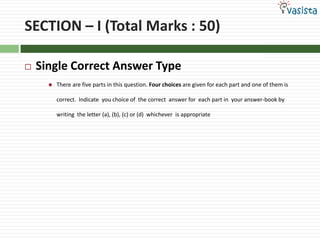
SECTION – I (Total Marks : 50)

   Single Correct Answer Type
         There are five parts in this question. Four choices are given for each part and one of them is

          correct. Indicate you choice of the correct answer for each part in your answer-book by

          writing the letter (a), (b), (c) or (d) whichever is appropriate
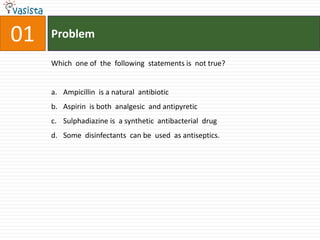
01   Problem

     Which one of the following statements is not true?


     a. Ampicillin is a natural antibiotic
     b. Aspirin is both analgesic and antipyretic
     c. Sulphadiazine is a synthetic antibacterial drug
     d. Some disinfectants can be used as antiseptics.
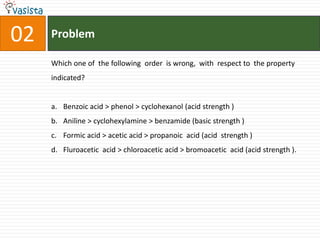
02   Problem

     Which one of the following order is wrong, with respect to the property
     indicated?


     a. Benzoic acid > phenol > cyclohexanol (acid strength )
     b. Aniline > cyclohexylamine > benzamide (basic strength )
     c. Formic acid > acetic acid > propanoic acid (acid strength )
     d. Fluroacetic acid > chloroacetic acid > bromoacetic acid (acid strength ).
03   Problem

     Compound A has a molecular formula C2Cl3OH. It reduces Fehling’s solution
     and on oxidation, it gives a monocarboxylic acid B. If A is obtained by the
     action of chlorine on ethyl alcohol, then compound A is


     a. Methyl chloride
     b. Monochloro acetic acid
     c. Chloral
     d. Chloroform.
04   Problem

     An acyl halide is formed when PCl5 reacts with an


     a. Amide
     b. Ester
     c. Acid
     d. Alcohol.
05   Problem

     Which of the following compound will undergo self aldol condensation in
     the presence of cold dilute alkali?


     a. CH C – CHO
     b. CH2 = CH – CHO
     c. C6H6CHO
     d. CH3CH2CHO.
06   Problem

     Diazo – coupling is useful to prepare some


     a. Dyes
     b. Vitamins
     c. Pesticides
     d. Proteins.
07   Problem

     On heating glycerol with conc. H2SO4, a compound is obtained which has
     bad odour. The compound is


     a. Acrolein
     b. Formic acid
     c. Allyl alcohol
     d. Glycerol sulphate.
08   Problem

     The most suitable method of the separation of a 1 : 1 mixture of ortho-
     and para-nitrophenols is


     a. Crystallization
     b. Chromatography
     c. Distillation
     d. Sublimation.
09   Problem

     Which of the following compounds will give positive test with Tollen’s
     reagent?


     a. Acetic acid
     b. Acetone
     c. Acetamide
     d. Acetaldehyde.
10   Problem

     By the action of enzymes, the rate of biochemical reaction


     a. Does not change
     b. Increases
     c. Decreases
     d. Either (a) or (c).
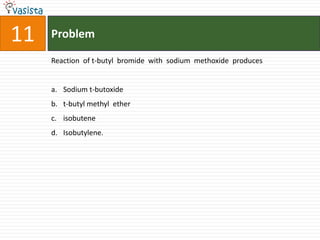
11   Problem

     Reaction of t-butyl bromide with sodium methoxide produces


     a. Sodium t-butoxide
     b. t-butyl methyl ether
     c. isobutene
     d. Isobutylene.
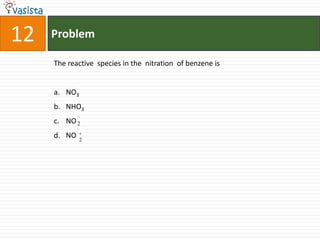
12   Problem

     The reactive species in the nitration of benzene is


     a. NO3
     b. NHO3
     c. NO 2
     d. NO   2
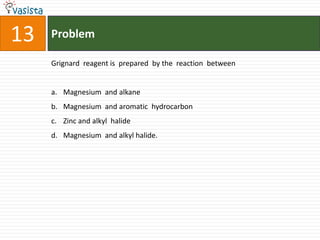
13   Problem

     Grignard reagent is prepared by the reaction between


     a. Magnesium and alkane
     b. Magnesium and aromatic hydrocarbon
     c. Zinc and alkyl halide
     d. Magnesium and alkyl halide.
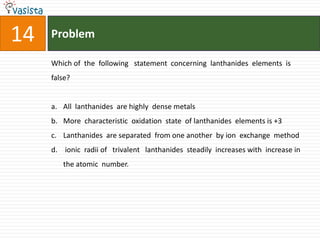
14   Problem

     Which of the following statement concerning lanthanides elements is
     false?


     a. All lanthanides are highly dense metals
     b. More characteristic oxidation state of lanthanides elements is +3
     c. Lanthanides are separated from one another by ion exchange method
     d. ionic radii of trivalent lanthanides steadily increases with increase in
        the atomic number.
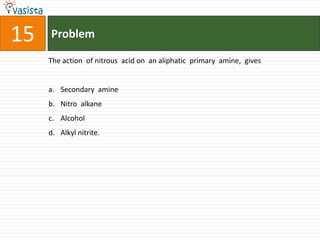
15   Problem

     The action of nitrous acid on an aliphatic primary amine, gives


     a. Secondary amine
     b. Nitro alkane
     c. Alcohol
     d. Alkyl nitrite.
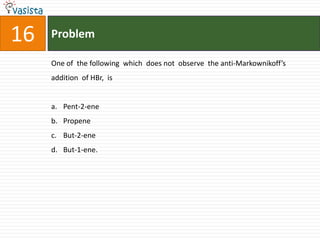
16   Problem

     One of the following which does not observe the anti-Markownikoff’s
     addition of HBr, is


     a. Pent-2-ene
     b. Propene
     c. But-2-ene
     d. But-1-ene.
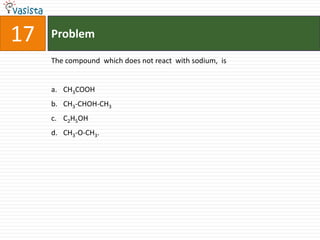
17   Problem

     The compound which does not react with sodium, is


     a. CH3COOH
     b. CH3-CHOH-CH3
     c. C2H5OH
     d. CH3-O-CH3.
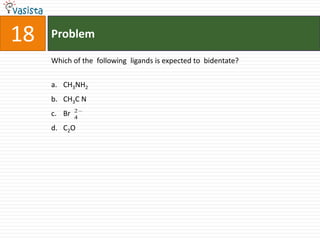
18   Problem

     Which of the following ligands is expected to bidentate?


     a. CH3NH2
     b. CH3C N
             2
     c. Br   4

     d. C2O
19   Problem

     Method used for obtaining highly pure silicon, used as a semiconductor
     material, is


     a. Crystallization
     b. Zone refining
     c. Oxidation
     d. Electro-chemical.
20   Problem

     Which one of the following statements is not correct?


     a. Mercury (II) iodide dissolves in excess of potassium iodide solution
     b. Tin (IV) chloride is made by dissolving tin solution in concentrated
        hydrochloric acid
     c. Zinc dissolves in sodium hydroxides solution
     d. Carbon monoxide reduces iron (III) oxide to iron.
21   Problem

     Carbon and silicon belong to (IV) group. The maximum coordination number
     of carbon in commonly occurring compounds is 4, whereas that of silicon is
     6, This is due to


     a. Availability of low lying Assertion (A) :- orbitals in silicon
     b. Large size of silicon
     c. More electropositive nature of silicon
     d. Both (b) and (c).
22   Problem

     Which of the following transition element shows the highest oxidation
     state?


     a. V
     b. Cr
     c. Mn
     d. Fe.
23   Problem

     Which of the following oxides of nitrogen is paramagnetic ?


     a. NO2
     b. N2O3
     c. N2O
     d. N2O5.
24   Problem

     To protect iron against corrosion, the most durable metal plating on it, is


     a. Copper plating
     b. Zinc plating
     c. Nickel plating
     d. Tin plating.
25   Problem

     Which of the following statements about H3BO3 is not correct ?


     a. It has a layer structure in which planar BO3 units are joined by
        hydrogen bonds
     b. It does not act as proton donor but acts as a Lewis acid by accepting
        hydroxyl ion
     c. It is a strong tribasic acid
     d. It is prepared by acidifying an aqueous solution of borax.
26   Problem

     Which of the following displaces Br2 from an aqueous solution containing
     bromide ions?


     a. I2
     b. I 3
     c. Cl2
     d. Cl-.
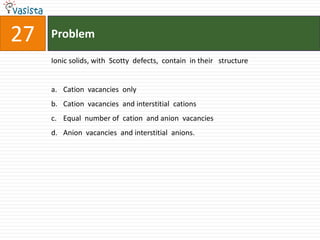
27   Problem

     Ionic solids, with Scotty defects, contain in their structure


     a. Cation vacancies only
     b. Cation vacancies and interstitial cations
     c. Equal number of cation and anion vacancies
     d. Anion vacancies and interstitial anions.
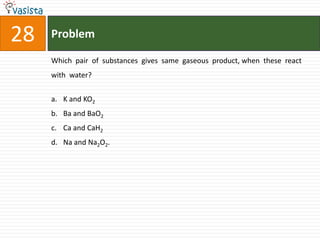
28   Problem

     Which pair of substances gives same gaseous product, when these react
     with water?


     a. K and KO2
     b. Ba and BaO2
     c. Ca and CaH2
     d. Na and Na2O2.
29   Problem

     Which of the following salt has the same value of vant’s Hoff factor I
     as that of K3[Fe(CN)6]?


     a. Na2SO4
     b. Al(NO3)3
     c. Al2(SO4)3
     d. NaCl
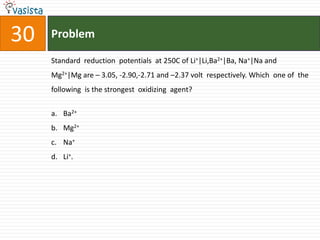
30   Problem

     Standard reduction potentials at 250C of Li+|Li,Ba2+|Ba, Na+|Na and
     Mg2+|Mg are – 3.05, -2.90,-2.71 and –2.37 volt respectively. Which one of the
     following is the strongest oxidizing agent?


     a. Ba2+
     b. Mg2+
     c. Na+
     d. Li+.
31   Problem

     The data for the reaction A + B → C, is
     Exp.                   [A]0           [B]0      Initial rate
     1                      0.012          0.035     0.10
     2                      0.024          0.070     0.80
     3                      0.024          0.035     0.10
     4                      0.012          0.070     0.80
     the rate law corresponds to the above data is


     a. rate = k[A][B]3
     b. rate = k [A]2[B]2
     c. rate = k[B]3
     d. rate = k[B]4
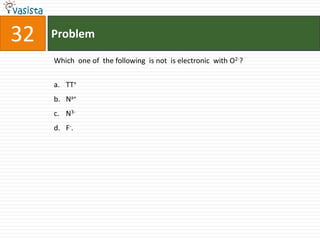
32   Problem

     Which one of the following is not is electronic with O2-?


     a. TT+
     b. Na+
     c. N3-
     d. F-.
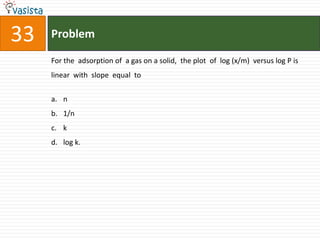
33   Problem

     For the adsorption of a gas on a solid, the plot of log (x/m) versus log P is
     linear with slope equal to


     a. n
     b. 1/n
     c. k
     d. log k.
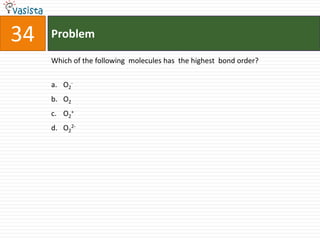
34   Problem

     Which of the following molecules has the highest bond order?


     a. O2-
     b. O2
     c. O2+
     d. O22-
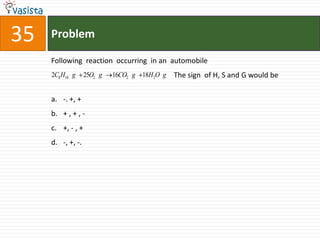
35   Problem

     Following reaction occurring in an automobile
     2C8 H18 g     25O2 g   16CO2 g   18H2O g   The sign of H, S and G would be


     a. -. +, +
     b. + , + , -
     c. +, - , +
     d. -, +, -.
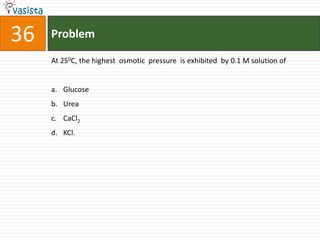
36   Problem

     At 250C, the highest osmotic pressure is exhibited by 0.1 M solution of


     a. Glucose
     b. Urea
     c. CaCl2
     d. KCl.
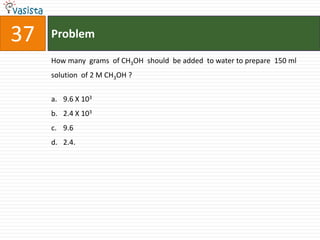
37   Problem

     How many grams of CH3OH should be added to water to prepare 150 ml
     solution of 2 M CH3OH ?


     a. 9.6 X 10³
     b. 2.4 X 10³
     c. 9.6
     d. 2.4.
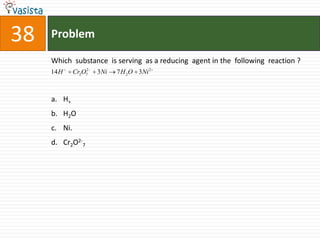
38   Problem

     Which substance is serving as a reducing agent in the following reaction ?
     14 H     Cr2O72   3Ni   7 H 2O 3Ni 2


     a. H+
     b. H2O
     c. Ni.
     d. Cr2O2-7
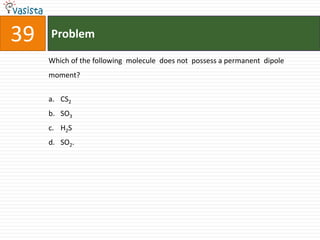
39   Problem

     Which of the following molecule does not possess a permanent dipole
     moment?


     a. CS2
     b. SO3
     c. H2S
     d. SO2.
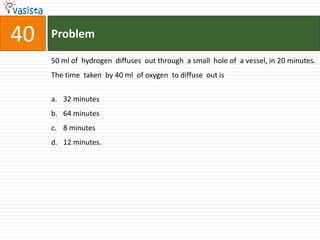
40   Problem

     50 ml of hydrogen diffuses out through a small hole of a vessel, in 20 minutes.
     The time taken by 40 ml of oxygen to diffuse out is


     a. 32 minutes
     b. 64 minutes
     c. 8 minutes
     d. 12 minutes.
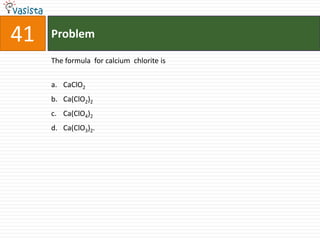
41   Problem

     The formula for calcium chlorite is


     a. CaClO2
     b. Ca(ClO2)2
     c. Ca(ClO4)2
     d. Ca(ClO3)2.
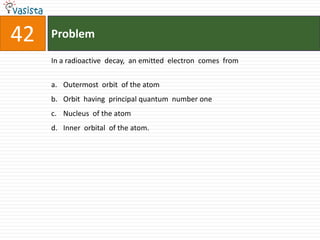
42   Problem

     In a radioactive decay, an emitted electron comes from


     a. Outermost orbit of the atom
     b. Orbit having principal quantum number one
     c. Nucleus of the atom
     d. Inner orbital of the atom.
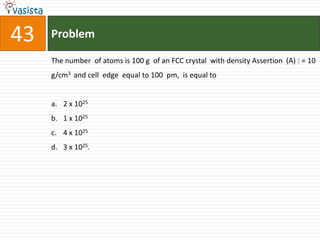
43   Problem

     The number of atoms is 100 g of an FCC crystal with density Assertion (A) : = 10
     g/cm3 and cell edge equal to 100 pm, is equal to


     a. 2 x 1025
     b. 1 x 1025
     c. 4 x 1025
     d. 3 x 1025.
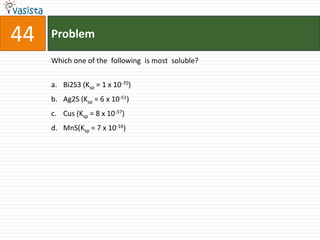
44   Problem

     Which one of the following is most soluble?


     a. Bi2S3 (Ksp = 1 x 10-70)
     b. Ag2S (Ksp = 6 x 10-51)
     c. Cus (Ksp = 8 x 10-37)
     d. MnS(Ksp = 7 x 10-16)
45   Problem

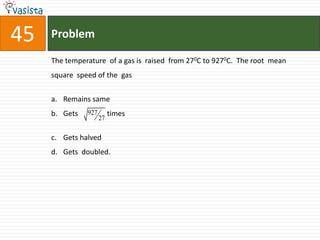
     The temperature of a gas is raised from 270C to 9270C. The root mean
     square speed of the gas


     a. Remains same
     b. Gets   927        times
                     27

     c. Gets halved
     d. Gets doubled.
46   Problem

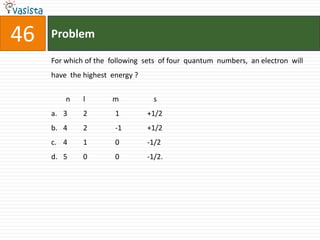
     For which of the following sets of four quantum numbers, an electron will
     have the highest energy ?


         n    l       m            s
     a. 3     2        1         +1/2
     b. 4     2        -1        +1/2
     c. 4     1        0         -1/2
     d. 5     0        0         -1/2.
47   Problem

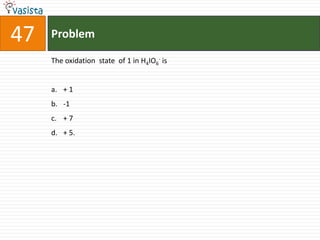
     The oxidation state of 1 in H4IO6- is


     a. + 1
     b. -1
     c. + 7
     d. + 5.
48   Problem

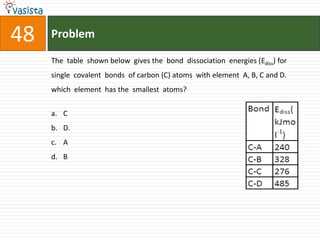
     The table shown below gives the bond dissociation energies (Ediss) for
     single covalent bonds of carbon (C) atoms with element A, B, C and D.
     which element has the smallest atoms?


     a. C
     b. D.
     c. A
     d. B
49   Problem

     At 800C, distilled water has [H3O+] concentration equal to 1 x 10⁻⁶ mole/litre.
     O   P F       1, The value of Kw at   this temperature will be


     a. 1 x 10-12
     b. 1 x 10-15
     c. 1 x 10⁻⁶
     d. 1 x 10⁻⁹
50   Problem

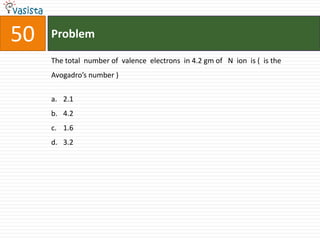
     The total number of valence electrons in 4.2 gm of N ion is ( is the
     Avogadro’s number )


     a. 2.1
     b. 4.2
     c. 1.6
     d. 3.2
For solution visit www.vasista.net

AIPMTChemistry 1994

  • 1.
  • 2.
    SECTION – I(Total Marks : 50)  Single Correct Answer Type  There are five parts in this question. Four choices are given for each part and one of them is correct. Indicate you choice of the correct answer for each part in your answer-book by writing the letter (a), (b), (c) or (d) whichever is appropriate
  • 3.
    01 Problem Which one of the following statements is not true? a. Ampicillin is a natural antibiotic b. Aspirin is both analgesic and antipyretic c. Sulphadiazine is a synthetic antibacterial drug d. Some disinfectants can be used as antiseptics.
  • 4.
    02 Problem Which one of the following order is wrong, with respect to the property indicated? a. Benzoic acid > phenol > cyclohexanol (acid strength ) b. Aniline > cyclohexylamine > benzamide (basic strength ) c. Formic acid > acetic acid > propanoic acid (acid strength ) d. Fluroacetic acid > chloroacetic acid > bromoacetic acid (acid strength ).
  • 5.
    03 Problem Compound A has a molecular formula C2Cl3OH. It reduces Fehling’s solution and on oxidation, it gives a monocarboxylic acid B. If A is obtained by the action of chlorine on ethyl alcohol, then compound A is a. Methyl chloride b. Monochloro acetic acid c. Chloral d. Chloroform.
  • 6.
    04 Problem An acyl halide is formed when PCl5 reacts with an a. Amide b. Ester c. Acid d. Alcohol.
  • 7.
    05 Problem Which of the following compound will undergo self aldol condensation in the presence of cold dilute alkali? a. CH C – CHO b. CH2 = CH – CHO c. C6H6CHO d. CH3CH2CHO.
  • 8.
    06 Problem Diazo – coupling is useful to prepare some a. Dyes b. Vitamins c. Pesticides d. Proteins.
  • 9.
    07 Problem On heating glycerol with conc. H2SO4, a compound is obtained which has bad odour. The compound is a. Acrolein b. Formic acid c. Allyl alcohol d. Glycerol sulphate.
  • 10.
    08 Problem The most suitable method of the separation of a 1 : 1 mixture of ortho- and para-nitrophenols is a. Crystallization b. Chromatography c. Distillation d. Sublimation.
  • 11.
    09 Problem Which of the following compounds will give positive test with Tollen’s reagent? a. Acetic acid b. Acetone c. Acetamide d. Acetaldehyde.
  • 12.
    10 Problem By the action of enzymes, the rate of biochemical reaction a. Does not change b. Increases c. Decreases d. Either (a) or (c).
  • 13.
    11 Problem Reaction of t-butyl bromide with sodium methoxide produces a. Sodium t-butoxide b. t-butyl methyl ether c. isobutene d. Isobutylene.
  • 14.
    12 Problem The reactive species in the nitration of benzene is a. NO3 b. NHO3 c. NO 2 d. NO 2
  • 15.
    13 Problem Grignard reagent is prepared by the reaction between a. Magnesium and alkane b. Magnesium and aromatic hydrocarbon c. Zinc and alkyl halide d. Magnesium and alkyl halide.
  • 16.
    14 Problem Which of the following statement concerning lanthanides elements is false? a. All lanthanides are highly dense metals b. More characteristic oxidation state of lanthanides elements is +3 c. Lanthanides are separated from one another by ion exchange method d. ionic radii of trivalent lanthanides steadily increases with increase in the atomic number.
  • 17.
    15 Problem The action of nitrous acid on an aliphatic primary amine, gives a. Secondary amine b. Nitro alkane c. Alcohol d. Alkyl nitrite.
  • 18.
    16 Problem One of the following which does not observe the anti-Markownikoff’s addition of HBr, is a. Pent-2-ene b. Propene c. But-2-ene d. But-1-ene.
  • 19.
    17 Problem The compound which does not react with sodium, is a. CH3COOH b. CH3-CHOH-CH3 c. C2H5OH d. CH3-O-CH3.
  • 20.
    18 Problem Which of the following ligands is expected to bidentate? a. CH3NH2 b. CH3C N 2 c. Br 4 d. C2O
  • 21.
    19 Problem Method used for obtaining highly pure silicon, used as a semiconductor material, is a. Crystallization b. Zone refining c. Oxidation d. Electro-chemical.
  • 22.
    20 Problem Which one of the following statements is not correct? a. Mercury (II) iodide dissolves in excess of potassium iodide solution b. Tin (IV) chloride is made by dissolving tin solution in concentrated hydrochloric acid c. Zinc dissolves in sodium hydroxides solution d. Carbon monoxide reduces iron (III) oxide to iron.
  • 23.
    21 Problem Carbon and silicon belong to (IV) group. The maximum coordination number of carbon in commonly occurring compounds is 4, whereas that of silicon is 6, This is due to a. Availability of low lying Assertion (A) :- orbitals in silicon b. Large size of silicon c. More electropositive nature of silicon d. Both (b) and (c).
  • 24.
    22 Problem Which of the following transition element shows the highest oxidation state? a. V b. Cr c. Mn d. Fe.
  • 25.
    23 Problem Which of the following oxides of nitrogen is paramagnetic ? a. NO2 b. N2O3 c. N2O d. N2O5.
  • 26.
    24 Problem To protect iron against corrosion, the most durable metal plating on it, is a. Copper plating b. Zinc plating c. Nickel plating d. Tin plating.
  • 27.
    25 Problem Which of the following statements about H3BO3 is not correct ? a. It has a layer structure in which planar BO3 units are joined by hydrogen bonds b. It does not act as proton donor but acts as a Lewis acid by accepting hydroxyl ion c. It is a strong tribasic acid d. It is prepared by acidifying an aqueous solution of borax.
  • 28.
    26 Problem Which of the following displaces Br2 from an aqueous solution containing bromide ions? a. I2 b. I 3 c. Cl2 d. Cl-.
  • 29.
    27 Problem Ionic solids, with Scotty defects, contain in their structure a. Cation vacancies only b. Cation vacancies and interstitial cations c. Equal number of cation and anion vacancies d. Anion vacancies and interstitial anions.
  • 30.
    28 Problem Which pair of substances gives same gaseous product, when these react with water? a. K and KO2 b. Ba and BaO2 c. Ca and CaH2 d. Na and Na2O2.
  • 31.
    29 Problem Which of the following salt has the same value of vant’s Hoff factor I as that of K3[Fe(CN)6]? a. Na2SO4 b. Al(NO3)3 c. Al2(SO4)3 d. NaCl
  • 32.
    30 Problem Standard reduction potentials at 250C of Li+|Li,Ba2+|Ba, Na+|Na and Mg2+|Mg are – 3.05, -2.90,-2.71 and –2.37 volt respectively. Which one of the following is the strongest oxidizing agent? a. Ba2+ b. Mg2+ c. Na+ d. Li+.
  • 33.
    31 Problem The data for the reaction A + B → C, is Exp. [A]0 [B]0 Initial rate 1 0.012 0.035 0.10 2 0.024 0.070 0.80 3 0.024 0.035 0.10 4 0.012 0.070 0.80 the rate law corresponds to the above data is a. rate = k[A][B]3 b. rate = k [A]2[B]2 c. rate = k[B]3 d. rate = k[B]4
  • 34.
    32 Problem Which one of the following is not is electronic with O2-? a. TT+ b. Na+ c. N3- d. F-.
  • 35.
    33 Problem For the adsorption of a gas on a solid, the plot of log (x/m) versus log P is linear with slope equal to a. n b. 1/n c. k d. log k.
  • 36.
    34 Problem Which of the following molecules has the highest bond order? a. O2- b. O2 c. O2+ d. O22-
  • 37.
    35 Problem Following reaction occurring in an automobile 2C8 H18 g 25O2 g 16CO2 g 18H2O g The sign of H, S and G would be a. -. +, + b. + , + , - c. +, - , + d. -, +, -.
  • 38.
    36 Problem At 250C, the highest osmotic pressure is exhibited by 0.1 M solution of a. Glucose b. Urea c. CaCl2 d. KCl.
  • 39.
    37 Problem How many grams of CH3OH should be added to water to prepare 150 ml solution of 2 M CH3OH ? a. 9.6 X 10³ b. 2.4 X 10³ c. 9.6 d. 2.4.
  • 40.
    38 Problem Which substance is serving as a reducing agent in the following reaction ? 14 H Cr2O72 3Ni 7 H 2O 3Ni 2 a. H+ b. H2O c. Ni. d. Cr2O2-7
  • 41.
    39 Problem Which of the following molecule does not possess a permanent dipole moment? a. CS2 b. SO3 c. H2S d. SO2.
  • 42.
    40 Problem 50 ml of hydrogen diffuses out through a small hole of a vessel, in 20 minutes. The time taken by 40 ml of oxygen to diffuse out is a. 32 minutes b. 64 minutes c. 8 minutes d. 12 minutes.
  • 43.
    41 Problem The formula for calcium chlorite is a. CaClO2 b. Ca(ClO2)2 c. Ca(ClO4)2 d. Ca(ClO3)2.
  • 44.
    42 Problem In a radioactive decay, an emitted electron comes from a. Outermost orbit of the atom b. Orbit having principal quantum number one c. Nucleus of the atom d. Inner orbital of the atom.
  • 45.
    43 Problem The number of atoms is 100 g of an FCC crystal with density Assertion (A) : = 10 g/cm3 and cell edge equal to 100 pm, is equal to a. 2 x 1025 b. 1 x 1025 c. 4 x 1025 d. 3 x 1025.
  • 46.
    44 Problem Which one of the following is most soluble? a. Bi2S3 (Ksp = 1 x 10-70) b. Ag2S (Ksp = 6 x 10-51) c. Cus (Ksp = 8 x 10-37) d. MnS(Ksp = 7 x 10-16)
  • 47.
    45 Problem The temperature of a gas is raised from 270C to 9270C. The root mean square speed of the gas a. Remains same b. Gets 927 times 27 c. Gets halved d. Gets doubled.
  • 48.
    46 Problem For which of the following sets of four quantum numbers, an electron will have the highest energy ? n l m s a. 3 2 1 +1/2 b. 4 2 -1 +1/2 c. 4 1 0 -1/2 d. 5 0 0 -1/2.
  • 49.
    47 Problem The oxidation state of 1 in H4IO6- is a. + 1 b. -1 c. + 7 d. + 5.
  • 50.
    48 Problem The table shown below gives the bond dissociation energies (Ediss) for single covalent bonds of carbon (C) atoms with element A, B, C and D. which element has the smallest atoms? a. C b. D. c. A d. B
  • 51.
    49 Problem At 800C, distilled water has [H3O+] concentration equal to 1 x 10⁻⁶ mole/litre. O P F 1, The value of Kw at this temperature will be a. 1 x 10-12 b. 1 x 10-15 c. 1 x 10⁻⁶ d. 1 x 10⁻⁹
  • 52.
    50 Problem The total number of valence electrons in 4.2 gm of N ion is ( is the Avogadro’s number ) a. 2.1 b. 4.2 c. 1.6 d. 3.2
  • 53.
    For solution visitwww.vasista.net

Editor's Notes