AMU –PAST PAPERS
CHEMISTRY- UNSOLVED PAPER - 1999
SECTION – I

   Single Correct Answer Type
         There are five parts in this question. Four choices are given for each part and one of them is

          correct. Indicate you choice of the correct answer for each part in your answer-book by
          writing the letter (a), (b), (c) or (d) whichever is appropriate
01   Problem

     Which of the following groups activates benzene nucleus towards electrophilic
     substiution ?


     a. - CHO
     b. - CN
     c. - COOR
     d. - OCOR
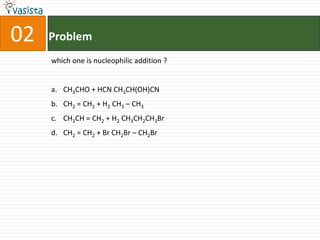
02   Problem
     which one is nucleophilic addition ?


     a. CH3CHO + HCN CH3CH(OH)CN
     b. CH2 = CH2 + H2 CH3 – CH3
     c. CH3CH = CH2 + H2 CH3CH2CH3Br
     d. CH2 = CH2 + Br CH2Br – CH2Br
03   Problem

     The reagent with which both acetaldehyde and acetone react easily is :


     a. Schiff’s reagent
     b. Tollen’s reagent
     c. Grignard reagent
     d. Fehling solution
04   Problem

     In the flame test a brick red colour is indication of :


     a. Ca
     b. Sr
     c. K
     d. Na
05   Problem

     The haemoglobin from red blood corpuscles of most mammals contain
     approximately 0.33%of iron by mass. The molecular weight of haemoglobin is
     67200. The number of iron atoms in each molecule of haemoglobin is :


     a. 2
     b. 3
     c. 4
     d. 6
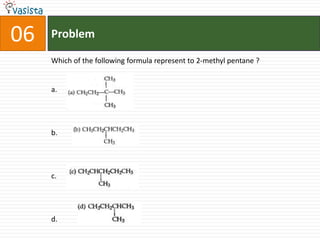
06   Problem

     Which of the following formula represent to 2-methyl pentane ?


     a.


     b.


     c.


     d.
07   Problem

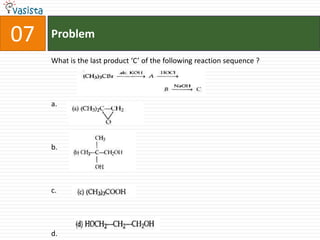
     What is the last product ‘C’ of the following reaction sequence ?


     a.


     b.


     c.


     d.
08   Problem

     Neutron was discovered by :


     a. Chadwick
     b. Moseley
     c. Faraday
     d. H. Yukama
09   Problem

     The reaction of ethylene glycol with PI3 gives :


     a. CH2 = CH – I
     b. I – CH = CH – I
     c. ICH2CH2I
     d. CH2 = CH2-
10   Problem

     The smallest ion among the following is that of :


     a. Ca
     b. Mg
     c. Li
     d. Be
11   Problem

     When phenol is heated with ammonia in presence of anhydrous zinc of
     calcium chloride, it gives :


     a. Ethyl amine
     b. Benzene
     c. Toluene
     d. Aniline
12   Problem

     Which of the following composition is capable of giving only two isomers ?


     a. C4H10
     b. C5H12
     c. C3H8
     d. C2H6
13   Problem

     Strongest acid among the following is :


     a. CCl3COOH
     b. CF3COOH
     c. CBr3COOH
     d. CH3COOH
14   Problem

     The maximum number of electron in an orbital is :


     a. 8
     b. 6
     c. 4
     d. 2
15   Problem

     Which of the following paramagnetic ?


     a. NO+
     b. CO
     c. CN –
     d. O2 –
16   Problem

     What happens when Ca is heated over O2 ?


     a. Formation of CaO + CaC2
     b. CaO + C is formed
     c. CaC2 + O2 is formed
     d. None of these
17   Problem

     Bromine can be liberated form potassium bromide solution by the action of :


     a. Potassium iodide
     b. Iodine solution
     c. Chlorine water
     d. Sodium chlorine
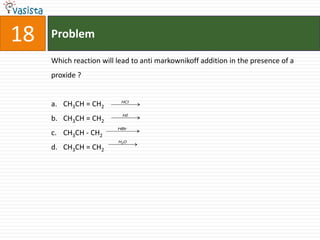
18   Problem

     Which reaction will lead to anti markownikoff addition in the presence of a
     proxide ?


                          HCl
     a. CH3CH = CH2
                           HI
     b. CH3CH = CH2
                         HBr
     c. CH3CH - CH2
                         H2O
     d. CH3CH = CH2
19   Problem

     In the electrolysis of alumina, cryolite is added to :


     a. Increase the electrical conductivity
     b. Increase the melting point of alumina
     c. Remove impurities from alumina
     d. Minimize the anodic effect
20   Problem

     The energy with which an atom binds the electrons is experimentally
     determined by measuring its :


     a. Electron negativity
     b. Electron affinity
     c. Atomic size
     d. Ionization potential
21   Problem

     Which of the following is a mixed anhydride ?


     a. N2O5
     b. NO2-
     c. N2O
     d. NO
22   Problem

     In halogen acids the order of decreasing acidity is :


     a. HCl, HBr, HI, HF
     b. HI, HBr, HF, HCl
     c. HI, HBr, HCl, HF
     d. HCl, HBr, HF, HI
23   Problem

     Which elements are chemically most similar ?


     a. Ti, Zn
     b. Zr, Hf
     c. Na, Al
     d. Cu, S
24   Problem

     The atom with atomic number 20 will likely combine with the atom whose
     atomic number is ?


     a. 25
     b. 21
     c. 16
     d. 14
25   Problem

     Which of the following electronic configuration in the outermost shell is
     characteristic of alkali metals ?


     a. (n -1)s2p6ns-1
     b. (n -1)s2p6ns2np1
     c. (n -1)s2p6d1
     d. (n -1)s2p6d103s-1
26   Problem

     A diagonal relationship exist between


     a. Na and Ca
     b. Mg and K
     c. Li and Ca
     d. Li and Mg
27   Problem

     Alkali metals cannot be obtained by reduction of their oxides because they :


     a. Are strong reducing agents
     b. Are strong oxidizing agents
     c. Are early reduced
     d. Decompose water
28   Problem

     Qualitative test of halogens in an organic compound is made by :


     a. Lassaigne’s test
     b. Beilstein test
     c. Bayer’s test
     d. Fehling’s test
29   Problem

     Dipole moment is shown by :


     a. trans-1,2-dichloro-2pentene
     b. trans-1,2-dichloroethane
     c. cis-1,2-dichloroethene
     d. both a and c
30   Problem

     In sulphuric acid the oxidation number of S is :


     a. + 2
     b. + 6
     c. - 4
     d. - 2
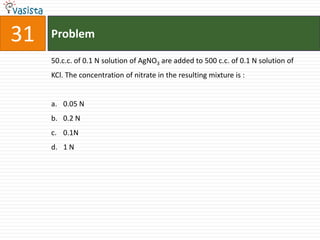
31   Problem

     50.c.c. of 0.1 N solution of AgNO3 are added to 500 c.c. of 0.1 N solution of
     KCl. The concentration of nitrate in the resulting mixture is :


     a. 0.05 N
     b. 0.2 N
     c. 0.1N
     d. 1 N
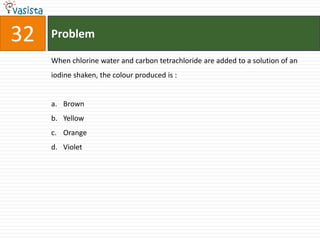
32   Problem

     When chlorine water and carbon tetrachloride are added to a solution of an
     iodine shaken, the colour produced is :


     a. Brown
     b. Yellow
     c. Orange
     d. Violet
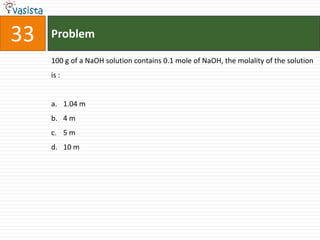
33   Problem

     100 g of a NaOH solution contains 0.1 mole of NaOH, the molality of the solution
     is :


     a. 1.04 m
     b. 4 m
     c. 5 m
     d. 10 m
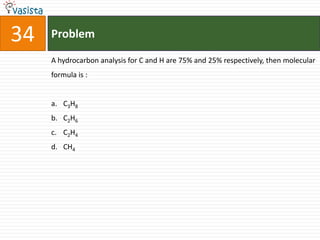
34   Problem

     A hydrocarbon analysis for C and H are 75% and 25% respectively, then molecular
     formula is :


     a. C3H8
     b. C2H6
     c. C2H4
     d. CH4
35   Problem

     How many moles of oxygen are contained in one litre of air under-standard
     conditions if it contains 21%(by volume) oxygen ?


     a. 0.0093 mole
     b. 0.816 mole
     c. 0.21 mole
     d. 2.10 mole
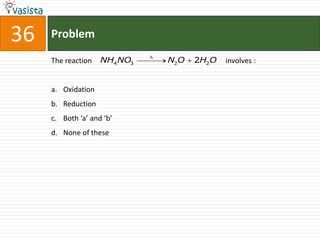
36   Problem

     The reaction   NH4 NO3   N2O   2H2O   involves :


     a. Oxidation
     b. Reduction
     c. Both ‘a’ and ‘b’
     d. None of these
37   Problem

     Oxidising number of Fe in K3[Fe(CN)6]


     a. + 1
     b. + 2
     c. + 3
     d. + 4
38   Problem

     Free-radical reactions are generally catalized by :


     a. Polar solvents
     b. Acids
     c. Bases
     d. Light
39   Problem

     The compounds which contains both ionic and covalents bonds is :


     a. KCN
     b. KCl
     c. CH4
     d. H2
40   Problem

     Radio-carbon study make use of carbon isotope with atomic weight :


     a. 16
     b. 15
     c. 14
     d. 13
41   Problem

     Variable valency is a characteristic of :


     a. s-block elements
     b. p-block elements
     c. d-block elements
     d. all elements
42   Problem

     The roasted ore is heated in a vertical retort with powdered coal and the metal
     is obtained by condensation of vapours. The metal is :


     a. Ag
     b. Fe
     c. Sn
     d. Zn
43   Problem

     In which of the following AgCl will be least soluble ?


     a. 0.01 1 M NaCl
     b. 0.01 M CaCl4
     c. 0.001 M AgNO3
     d. Pure water
44   Problem

     The ester of 1, 2, 3 propartroid are called :


     a. Glyceric acids
     b. Glycerides
     c. Glycerines
     d. Glycerels
45   Problem

     In sodium acetate is added to acetic acid then the concentration of H+ ion will
     be :


     a. Increased
     b. Decreased
     c. Un-affected
     d. PH decreased
46   Problem

     Oxidation of toluene in the presence of acetic anhydride followed by alkaline
     hydrolysis yields :


     a. Benzene
     b. Phenol
     c. Benzaldehyde
     d. Benzoic acid
47   Problem

     Which of the following possesses highest melting point ?


     a. Chlorobenzene
     b. o-dichlorobenzene
     c. m-dichlorobenzene
     d. p-dichlorobenzene
48   Problem

     the specific rate constant of a first order depends on the :


     a. concentration of the product
     b. concentration of the reactant
     c. temperature
     d. time
49   Problem

     Which of the following will not give HVZ reaction ?


     a. Trichloroethanoic acid
     b. 2-methyl botanic acid
     c. Ehtanonic acid
     d. Propanoic acid
50   Problem

     Faraday’s law of electrolysis are related to the :


     a. Speed of the cation
     b. Atomic number of the cation
     c. Atomic number of the anion
     d. Equivalent weight of the electrolyte
FOR SOLUTIONS VISIT WWW.VASISTA.NET

AMU - Chemistry - 1999

  • 1.
    AMU –PAST PAPERS CHEMISTRY-UNSOLVED PAPER - 1999
  • 2.
    SECTION – I  Single Correct Answer Type  There are five parts in this question. Four choices are given for each part and one of them is correct. Indicate you choice of the correct answer for each part in your answer-book by writing the letter (a), (b), (c) or (d) whichever is appropriate
  • 3.
    01 Problem Which of the following groups activates benzene nucleus towards electrophilic substiution ? a. - CHO b. - CN c. - COOR d. - OCOR
  • 4.
    02 Problem which one is nucleophilic addition ? a. CH3CHO + HCN CH3CH(OH)CN b. CH2 = CH2 + H2 CH3 – CH3 c. CH3CH = CH2 + H2 CH3CH2CH3Br d. CH2 = CH2 + Br CH2Br – CH2Br
  • 5.
    03 Problem The reagent with which both acetaldehyde and acetone react easily is : a. Schiff’s reagent b. Tollen’s reagent c. Grignard reagent d. Fehling solution
  • 6.
    04 Problem In the flame test a brick red colour is indication of : a. Ca b. Sr c. K d. Na
  • 7.
    05 Problem The haemoglobin from red blood corpuscles of most mammals contain approximately 0.33%of iron by mass. The molecular weight of haemoglobin is 67200. The number of iron atoms in each molecule of haemoglobin is : a. 2 b. 3 c. 4 d. 6
  • 8.
    06 Problem Which of the following formula represent to 2-methyl pentane ? a. b. c. d.
  • 9.
    07 Problem What is the last product ‘C’ of the following reaction sequence ? a. b. c. d.
  • 10.
    08 Problem Neutron was discovered by : a. Chadwick b. Moseley c. Faraday d. H. Yukama
  • 11.
    09 Problem The reaction of ethylene glycol with PI3 gives : a. CH2 = CH – I b. I – CH = CH – I c. ICH2CH2I d. CH2 = CH2-
  • 12.
    10 Problem The smallest ion among the following is that of : a. Ca b. Mg c. Li d. Be
  • 13.
    11 Problem When phenol is heated with ammonia in presence of anhydrous zinc of calcium chloride, it gives : a. Ethyl amine b. Benzene c. Toluene d. Aniline
  • 14.
    12 Problem Which of the following composition is capable of giving only two isomers ? a. C4H10 b. C5H12 c. C3H8 d. C2H6
  • 15.
    13 Problem Strongest acid among the following is : a. CCl3COOH b. CF3COOH c. CBr3COOH d. CH3COOH
  • 16.
    14 Problem The maximum number of electron in an orbital is : a. 8 b. 6 c. 4 d. 2
  • 17.
    15 Problem Which of the following paramagnetic ? a. NO+ b. CO c. CN – d. O2 –
  • 18.
    16 Problem What happens when Ca is heated over O2 ? a. Formation of CaO + CaC2 b. CaO + C is formed c. CaC2 + O2 is formed d. None of these
  • 19.
    17 Problem Bromine can be liberated form potassium bromide solution by the action of : a. Potassium iodide b. Iodine solution c. Chlorine water d. Sodium chlorine
  • 20.
    18 Problem Which reaction will lead to anti markownikoff addition in the presence of a proxide ? HCl a. CH3CH = CH2 HI b. CH3CH = CH2 HBr c. CH3CH - CH2 H2O d. CH3CH = CH2
  • 21.
    19 Problem In the electrolysis of alumina, cryolite is added to : a. Increase the electrical conductivity b. Increase the melting point of alumina c. Remove impurities from alumina d. Minimize the anodic effect
  • 22.
    20 Problem The energy with which an atom binds the electrons is experimentally determined by measuring its : a. Electron negativity b. Electron affinity c. Atomic size d. Ionization potential
  • 23.
    21 Problem Which of the following is a mixed anhydride ? a. N2O5 b. NO2- c. N2O d. NO
  • 24.
    22 Problem In halogen acids the order of decreasing acidity is : a. HCl, HBr, HI, HF b. HI, HBr, HF, HCl c. HI, HBr, HCl, HF d. HCl, HBr, HF, HI
  • 25.
    23 Problem Which elements are chemically most similar ? a. Ti, Zn b. Zr, Hf c. Na, Al d. Cu, S
  • 26.
    24 Problem The atom with atomic number 20 will likely combine with the atom whose atomic number is ? a. 25 b. 21 c. 16 d. 14
  • 27.
    25 Problem Which of the following electronic configuration in the outermost shell is characteristic of alkali metals ? a. (n -1)s2p6ns-1 b. (n -1)s2p6ns2np1 c. (n -1)s2p6d1 d. (n -1)s2p6d103s-1
  • 28.
    26 Problem A diagonal relationship exist between a. Na and Ca b. Mg and K c. Li and Ca d. Li and Mg
  • 29.
    27 Problem Alkali metals cannot be obtained by reduction of their oxides because they : a. Are strong reducing agents b. Are strong oxidizing agents c. Are early reduced d. Decompose water
  • 30.
    28 Problem Qualitative test of halogens in an organic compound is made by : a. Lassaigne’s test b. Beilstein test c. Bayer’s test d. Fehling’s test
  • 31.
    29 Problem Dipole moment is shown by : a. trans-1,2-dichloro-2pentene b. trans-1,2-dichloroethane c. cis-1,2-dichloroethene d. both a and c
  • 32.
    30 Problem In sulphuric acid the oxidation number of S is : a. + 2 b. + 6 c. - 4 d. - 2
  • 33.
    31 Problem 50.c.c. of 0.1 N solution of AgNO3 are added to 500 c.c. of 0.1 N solution of KCl. The concentration of nitrate in the resulting mixture is : a. 0.05 N b. 0.2 N c. 0.1N d. 1 N
  • 34.
    32 Problem When chlorine water and carbon tetrachloride are added to a solution of an iodine shaken, the colour produced is : a. Brown b. Yellow c. Orange d. Violet
  • 35.
    33 Problem 100 g of a NaOH solution contains 0.1 mole of NaOH, the molality of the solution is : a. 1.04 m b. 4 m c. 5 m d. 10 m
  • 36.
    34 Problem A hydrocarbon analysis for C and H are 75% and 25% respectively, then molecular formula is : a. C3H8 b. C2H6 c. C2H4 d. CH4
  • 37.
    35 Problem How many moles of oxygen are contained in one litre of air under-standard conditions if it contains 21%(by volume) oxygen ? a. 0.0093 mole b. 0.816 mole c. 0.21 mole d. 2.10 mole
  • 38.
    36 Problem The reaction NH4 NO3 N2O 2H2O involves : a. Oxidation b. Reduction c. Both ‘a’ and ‘b’ d. None of these
  • 39.
    37 Problem Oxidising number of Fe in K3[Fe(CN)6] a. + 1 b. + 2 c. + 3 d. + 4
  • 40.
    38 Problem Free-radical reactions are generally catalized by : a. Polar solvents b. Acids c. Bases d. Light
  • 41.
    39 Problem The compounds which contains both ionic and covalents bonds is : a. KCN b. KCl c. CH4 d. H2
  • 42.
    40 Problem Radio-carbon study make use of carbon isotope with atomic weight : a. 16 b. 15 c. 14 d. 13
  • 43.
    41 Problem Variable valency is a characteristic of : a. s-block elements b. p-block elements c. d-block elements d. all elements
  • 44.
    42 Problem The roasted ore is heated in a vertical retort with powdered coal and the metal is obtained by condensation of vapours. The metal is : a. Ag b. Fe c. Sn d. Zn
  • 45.
    43 Problem In which of the following AgCl will be least soluble ? a. 0.01 1 M NaCl b. 0.01 M CaCl4 c. 0.001 M AgNO3 d. Pure water
  • 46.
    44 Problem The ester of 1, 2, 3 propartroid are called : a. Glyceric acids b. Glycerides c. Glycerines d. Glycerels
  • 47.
    45 Problem In sodium acetate is added to acetic acid then the concentration of H+ ion will be : a. Increased b. Decreased c. Un-affected d. PH decreased
  • 48.
    46 Problem Oxidation of toluene in the presence of acetic anhydride followed by alkaline hydrolysis yields : a. Benzene b. Phenol c. Benzaldehyde d. Benzoic acid
  • 49.
    47 Problem Which of the following possesses highest melting point ? a. Chlorobenzene b. o-dichlorobenzene c. m-dichlorobenzene d. p-dichlorobenzene
  • 50.
    48 Problem the specific rate constant of a first order depends on the : a. concentration of the product b. concentration of the reactant c. temperature d. time
  • 51.
    49 Problem Which of the following will not give HVZ reaction ? a. Trichloroethanoic acid b. 2-methyl botanic acid c. Ehtanonic acid d. Propanoic acid
  • 52.
    50 Problem Faraday’s law of electrolysis are related to the : a. Speed of the cation b. Atomic number of the cation c. Atomic number of the anion d. Equivalent weight of the electrolyte
  • 53.
    FOR SOLUTIONS VISITWWW.VASISTA.NET