ARCHITECTURAL DESIGN - V
CONVENTION CENTER
REMARKS:
Y. SRUJANA REDDY
18031AA079
VI – SEMESTER
CSIIT ; HYDERABAD
A1
INTODUCTION
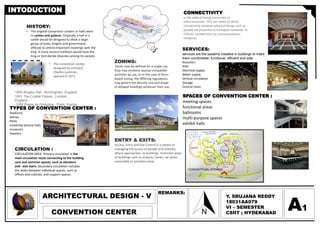
HISTORY:
• The original convention centers or halls were
in castles and palaces. Originally a hall in a
castle would be designed to allow a large
group of lords, knights and government
officials to attend important meetings with the
king. A more ancient tradition would have the
king or lord decide disputes among his people.
• The convention center,
designed by architect
Charles Luckman,
opened in 1971
1850 Bingley Hall , Birmingham, England
1851 The Crystal Palace , London,
England
1855 Palais de l'Industrie , Paris, France
ZONING:
Zones may be defined for a single use,
they may combine several compatible
activities by use, or in the case of form-
based zoning, the differing regulations
may govern the density, size and shape
of allowed buildings whatever their use.
CIRCULATION :
CIRCULATION AREA Primary circulation is the
main circulation route connecting to the building
core and common spaces, such as elevators
and . exit stairs. Secondary circulation includes
the aisles between individual spaces, such as
offices and cubicles, and support spaces.
ENTRY & EXITS:
Access, Entry and Exit Control is a means of
managing the access of people and vehicles,
where appropriate, to buildings, restricted areas
of buildings such as airports, banks, car parks,
vulnerable or sensitive areas.
CONNECTIVITY :
is the state of being connected or
interconnected. This can relate to direct
connectivity between physical things such as
people via proximity or transport networks, or
indirect connectivity via communications
networks.
SERVICES:
services are the systems installed in buildings to make
them comfortable, functional, efficient and safe.
Acoustics
AHU
Electrical supply
Water supply
Vertical circulation
Storage
Control room
TYPES OF CONVENTION CENTER :
Stadiums
arenas
Parks
university lecture halls
museums
theaters
SPACES OF CONVENTION CENTER :
meeting spaces
functional areas
ballrooms
multi-purpose spaces
exhibit halls
ARCHITECTURAL DESIGN - V
CONVENTION CENTER
REMARKS:
Y. SRUJANA REDDY
18031AA079
VI – SEMESTER
CSIIT ; HYDERABAD
A2
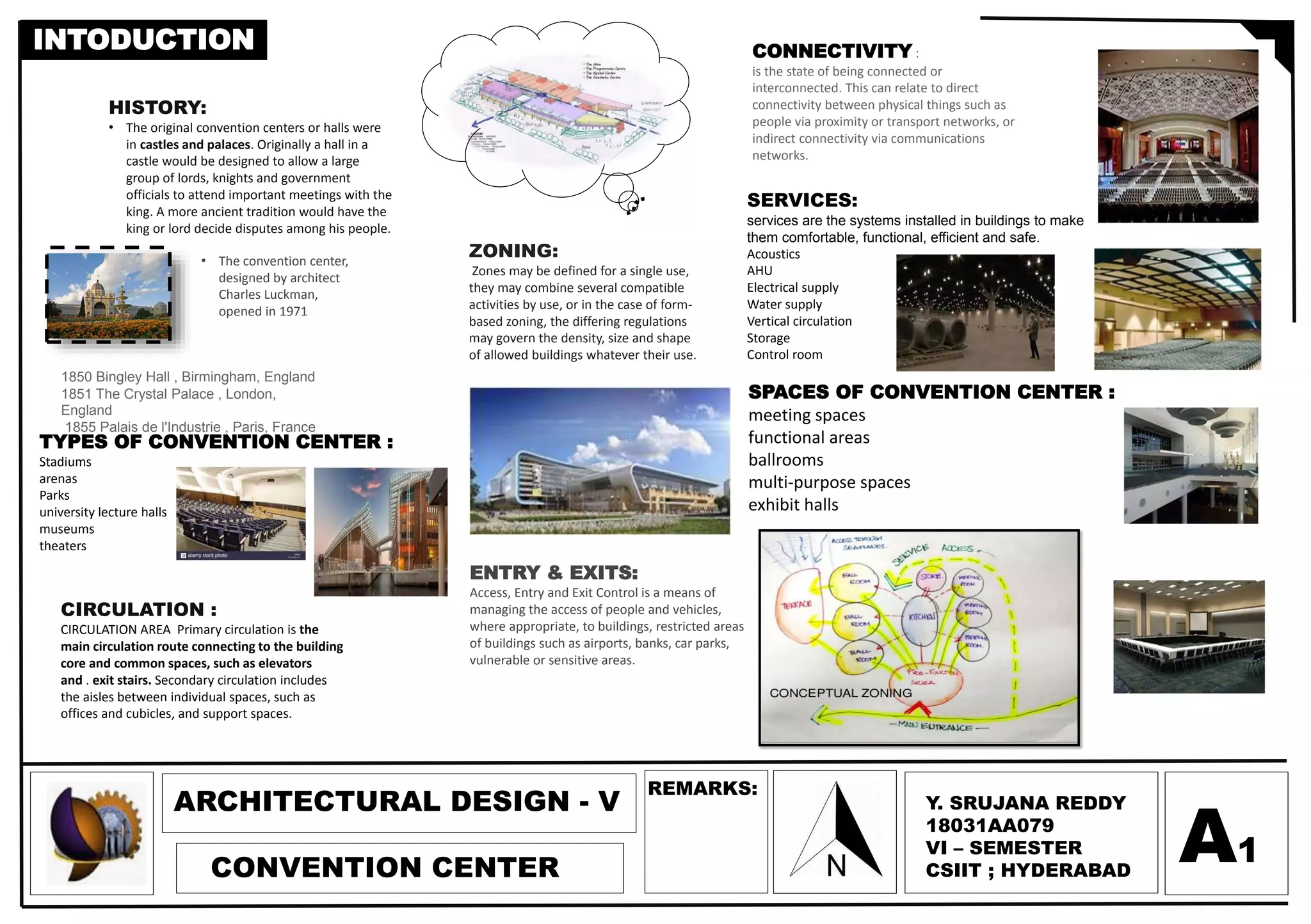
HALL SHOULD HAVE A CAPACITY TO
ACCOMMODATE AT LEAST 20 BOOTHS OF 3
MTS BY 3 MTS IN SIZE EXCLUDING PASSAGES
IN BETWEEN THE BOOTHS.
DESIGN CONSIDERATIONS:
Zoning
Booths / kiosks
Roofing
Circulation
Acoustics0
Escape routes
EXHIBITION HALL
BUBBLE DIAGRAM
Space per person for various
areas in exhibition hall
Entrance dimensions
Weidth
SPACE AREA IN SQM
Entrance door 2.9m (height)
booth 2.7m (height)
Hall area 333sqm
SPACE AREA FOER EXHIBITION HALLS
LONG SPAN STRUCTURE : SPAN LONGER THAN 30M
ARCHITECTURAL DESIGN - V
CONVENTION CENTER
REMARKS:
Y. SRUJANA REDDY
18031AA079
VI – SEMESTER
CSIIT ; HYDERABAD
A3
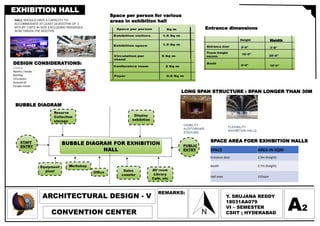
MEN WOMEN CHILDREN
HEIGHT 5'9" 5'3" 5'2"
EYE LEVEL 5'4" 4'11" 3'5"
ATRIUM+
VERTICAL
SERVICE
LOBBY
PARKING
MAIN
ENTRY
PLAZA
PLAZA
ENTRY
PLAZA
PEDESTRIAN
ENTRY
MAIN
ENTRY
ADMINISTRATION
RESTROOM
PLAZA
SELLING
SPACE
PEDESTRIAN
ENTRY
CIRCULATION PATTERN
ARCHITECTURAL DESIGN - V
CONVENTION CENTER
REMARKS:
Y. SRUJANA REDDY
18031AA079
VI – SEMESTER
CSIIT ; HYDERABAD
A4
CONVENTION CENTER
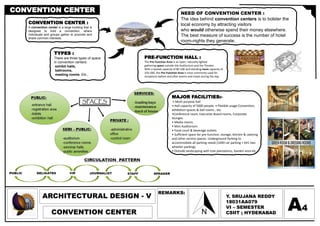
CONVENTION CENTER :
A convention center is a large building that is
designed to hold a convention, where
individuals and groups gather to promote and
share common interests.
TYPES :
There are three types of space
in convention centers:
exhibit halls,
ballrooms,
meeting rooms. Etc.,
PRE-FUNCTION HALL :
The Pre-Function Area is an open, naturally lighted
gathering space outside the Auditorium and the Theater.
With a seated capacity of 80-100 and standing room capacity of
150-200, the Pre-Function Area is most commonly used for
receptions before and after events and meals during the day.
NEED OF CONVENTION CENTER :
The idea behind convention centers is to bolster the
local economy by attracting visitors
who would otherwise spend their money elsewhere.
The best measure of success is the number of hotel
room-nights they generate.
MAJOR FACILITIES:-
• Multi purpose hall
• Hall capacity of 5000 people. • Flexible usage-Convention,
exhibition spaces & ball rooms , etc.
•Conference room, Executive Board rooms, Corporate
lounges.
• Media rooms.
• Mini Auditorium.
• Food court & beverage outlets
• Sufficient space for pre-function, storage, kitchen & catering
and other service spaces. Underground Parking to
accommodate all parking needs (1040 car parking + 641 two
wheeler parking).
• Outside landscaping with tree plantations, Garden area etc.
ARCHITECTURAL DESIGN - V
CONVENTION CENTER
REMARKS:
Y. SRUJANA REDDY
18031AA079
VI – SEMESTER
CSIIT ; HYDERABAD
A5
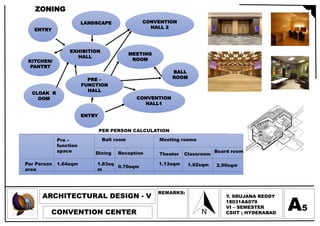
ENTRY
LANDSCAPE
PRE –
FUNCTION
HALL
KITCHEN/
PANTRT
CONVENTION
HALL 2
CONVENTION
HALL1
MEETING
ROOM
CLOAK R
OOM
ENTRY
EXHIBITION
HALL
BALL
ROOM
ZONING
Per Person
area
Pre –
function
space
1.64sqm
Ball room
Dining Reception
1.83sq
m
0.70sqm
Meeting rooms
Theater Classroom
Board room
1.13sqm 1.92sqm 2.90sqm
PER PERSON CALCULATION
ARCHITECTURAL DESIGN - V
CONVENTION CENTER
REMARKS:
Y. SRUJANA REDDY
18031AA079
VI – SEMESTER
CSIIT ; HYDERABAD
A6
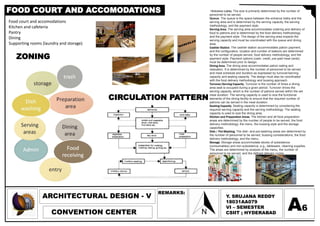
Food court and accomodations
Kitchen and cafeteria
Pantry
Dining
Supporting rooms (laundry and storage)
FOOD COURT AND ACCOMODATIONS
ZONING
CIRCULATION PATTERN
•Entrance Lobby. The size is primarily determined by the number of
personnel to be served.
Queue. The queue is the space between the entrance lobby and the
serving area and is determined by the serving capacity, the serving
methodology, and the payment style.
Serving Area. The serving area accommodates ordering and delivery of
food to patrons and is determined by the food delivery methodology
and the payment style. The design of the serving area impacts the
serving capacity and must be coordinated with the queue and dining
area.
Cashier Station. The cashier station accommodates patron payment,
and the configuration, location and number of stations are determined
by the number of people served, food delivery methodology, and the
payment style. Payment options (cash, credit, pre-paid meal cards)
must be determined prior to design.
Dining Area. The dining area accommodates patron eating and
relaxation. It is determined by the number of personnel to be served
and meal schedule and duration as expressed by turnover/serving
capacity and seating capacity. The design must also be coordinated
with the food delivery methodology and bussing approach.
Turnover/Serving Capacity. Turnover is the number of times a dining
area seat is occupied during a given period. Turnover drives the
serving capacity, which is the number of patrons served within the set
meal duration. The serving capacity is used to size the functional
elements of the dining facility to ensure that the required number of
patrons can be served in the meal duration.
Seating Capacity. Seating capacity is determined by considering the
required serving capacity and the serving methodology. The seating
capacity is used to size the dining area.
Kitchen and Preparation Areas. The kitchen and all food preparation
areas are determined by the number of people to be served, the food
delivery methodology, the menu, the bussing style and the storage
capacities.
Dish / Pot-Washing. The dish- and pot-washing areas are determined by
the number of personnel to be served, bussing considerations, the food
delivery methodology, and the menu.
Storage. Storage areas accommodate stocks of subsistence
(consumables) and non-subsistence, e.g., tableware, cleaning supplies.
The areas are determined by analysis of the menu, the number of
personnel to be served, and the defined delivery cycles.
ARCHITECTURAL DESIGN - V
CONVENTION CENTER
REMARKS:
Y. SRUJANA REDDY
18031AA079
VI – SEMESTER
CSIIT ; HYDERABAD
A7
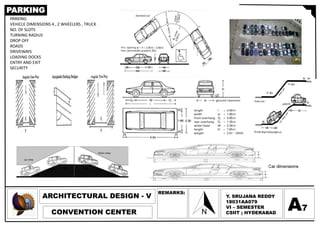
PARKING
VEHICLE DIMENSIONS 4 , 2 WHEELERS , TRUCK
NO. OF SLOTS
TURNING RADIUS
DROP OFF
ROADS
DRIVEWAYS
LOADING DOCKS
ENTRY AND EXIT
SECURITY
PARKING
ARCHITECTURAL DESIGN - V
CONVENTION CENTER
REMARKS:
Y. SRUJANA REDDY
18031AA079
VI – SEMESTER
CSIIT ; HYDERABAD
A8
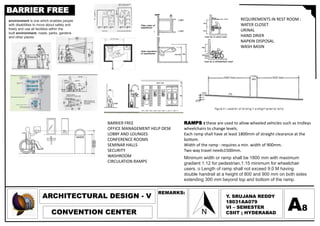
environment is one which enables people
with disabilities to move about safely and
freely and use all facilities within the
built environment, roads, parks, gardens
and other places.
BARRIER FREE
Minimum width or ramp shall be 1800 mm with maximum
gradient 1:12 for pedestrian,1:15 minimum for wheelchair
users. o Length of ramp shall not exceed 9.0 M having
double handrail at a height of 800 and 900 mm on both sides
extending 300 mm beyond top and bottom of the ramp.
RAMPS : these are used to allow wheeled vehicles such as trolleys
wheelchairs to change levels.
Each ramp shall have at least 1800mm of straight clearance at the
bottom.
Width of the ramp : requires a min. width of 900mm.
Two way travel needs1500mm.
BARRIER FREE
OFFICE MANAGEMENT HELP DESK
LOBBY AND LOUNGES
CONFERENCE ROOMS
SEMINAR HALLS
SECURITY
WASHROOM
CIRCULATION RAMPS
REQUIREMENTS IN REST ROOM :
WATER CLOSET
URINAL
HAND DRIER
NAPKIN DISPOSAL
WASH BASIN
ARCHITECTURAL DESIGN - V
CONVENTION CENTER
REMARKS:
Y. SRUJANA REDDY
18031AA079
VI – SEMESTER
CSIIT ; HYDERABAD
A9
SERVICES
BUILDING SETBACKS :
• the setback from the main boulevard must be no less than 10 meters, in order to create a
small square.
• the distance between buildings and the side street shall be no less than 2 meters; there shall
be no building concession directly to squares, greens, streets or public spaces, without the 2
meters’ setback.
• the setback from the neighboring lot shall be no less than 3 meters.
• the distance between buildings shall comply with fire control requirements.
HEIGHT OF BUILDINGS :
• the height of the covered part of exhibition space (or building height) must be less
than 12 meters.
• the height limit for any additional architectural elements (such as skylights, roof
elements, vertical connections to the roof, sunscreens, signals, etc.) is 17 meters.
Internal staircase:
• All assembly buildings having area more than 500 m² on each
floor shall have a minimum of two staircases.
• The minimum width for a staircase in an assembly building shall
be 1500mm. The formula for most staircases of twice the rise
plus the going lies between
• 600 and 630mm will give a suitable relationship. The rise should
not exceed 190 mm, and the going should not be less than
• 250 mm.
• The top of the handrail should be between 900 and 1000 mm
above the pitch line
• The minimum headroom in a passage under the landing of a
staircase and under the staircase shall be 2.2 m
MAXIMUM PITCH RISE GOING MAXIMUM RISE
PER FLIGHT
32.7 DEGREE MINIMUM 135
MAXIMUM 180
MINIMUM 280
MAXIMUM 340
16 RISERS
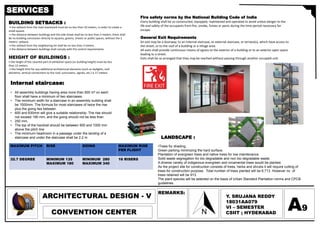
Fire safety norms by the National Building Code of India
Every building shall be so constructed, equipped, maintained and operated to avoid undue danger to the
life and safety of the occupants from fire, smoke, fumes or panic during the time period necessary for
escape.
General Exit Requirements
An exit may be a doorway; to an Internal staircase, or external staircase, or terrace(s), which have access to
the street, or to the roof of a building or a refuge area.
All exits shall provide continuous means of egress to the exterior of a building or to an exterior open space
leading to a street.
Exits shall be so arranged that they may be reached without passing through another occupled unit.
•Trees for shading.
Green parking minimizing the hard surface.
Plantation of evergreen trees and native trees for low maintenance.
Solid waste segregation for bio degradable and non bio degradable waste.
A diverse variety of indigenous evergreen and ornamental trees would be planted.
As the project site for construction consists of trees, herbs and shrubs it will require cutting of
trees for construction purpose. Total number of trees planted will be 6,713. However no of
trees retained will be 913.
The plant species will be selected on the basis of Urban Standard Plantation norms and CPCB
guidelines.
LANDSCAPE :

convention center litrature

  • 1.
    ARCHITECTURAL DESIGN -V CONVENTION CENTER REMARKS: Y. SRUJANA REDDY 18031AA079 VI – SEMESTER CSIIT ; HYDERABAD A1 INTODUCTION HISTORY: • The original convention centers or halls were in castles and palaces. Originally a hall in a castle would be designed to allow a large group of lords, knights and government officials to attend important meetings with the king. A more ancient tradition would have the king or lord decide disputes among his people. • The convention center, designed by architect Charles Luckman, opened in 1971 1850 Bingley Hall , Birmingham, England 1851 The Crystal Palace , London, England 1855 Palais de l'Industrie , Paris, France ZONING: Zones may be defined for a single use, they may combine several compatible activities by use, or in the case of form- based zoning, the differing regulations may govern the density, size and shape of allowed buildings whatever their use. CIRCULATION : CIRCULATION AREA Primary circulation is the main circulation route connecting to the building core and common spaces, such as elevators and . exit stairs. Secondary circulation includes the aisles between individual spaces, such as offices and cubicles, and support spaces. ENTRY & EXITS: Access, Entry and Exit Control is a means of managing the access of people and vehicles, where appropriate, to buildings, restricted areas of buildings such as airports, banks, car parks, vulnerable or sensitive areas. CONNECTIVITY : is the state of being connected or interconnected. This can relate to direct connectivity between physical things such as people via proximity or transport networks, or indirect connectivity via communications networks. SERVICES: services are the systems installed in buildings to make them comfortable, functional, efficient and safe. Acoustics AHU Electrical supply Water supply Vertical circulation Storage Control room TYPES OF CONVENTION CENTER : Stadiums arenas Parks university lecture halls museums theaters SPACES OF CONVENTION CENTER : meeting spaces functional areas ballrooms multi-purpose spaces exhibit halls
  • 2.
    ARCHITECTURAL DESIGN -V CONVENTION CENTER REMARKS: Y. SRUJANA REDDY 18031AA079 VI – SEMESTER CSIIT ; HYDERABAD A2 HALL SHOULD HAVE A CAPACITY TO ACCOMMODATE AT LEAST 20 BOOTHS OF 3 MTS BY 3 MTS IN SIZE EXCLUDING PASSAGES IN BETWEEN THE BOOTHS. DESIGN CONSIDERATIONS: Zoning Booths / kiosks Roofing Circulation Acoustics0 Escape routes EXHIBITION HALL BUBBLE DIAGRAM Space per person for various areas in exhibition hall Entrance dimensions Weidth SPACE AREA IN SQM Entrance door 2.9m (height) booth 2.7m (height) Hall area 333sqm SPACE AREA FOER EXHIBITION HALLS LONG SPAN STRUCTURE : SPAN LONGER THAN 30M
  • 3.
    ARCHITECTURAL DESIGN -V CONVENTION CENTER REMARKS: Y. SRUJANA REDDY 18031AA079 VI – SEMESTER CSIIT ; HYDERABAD A3 MEN WOMEN CHILDREN HEIGHT 5'9" 5'3" 5'2" EYE LEVEL 5'4" 4'11" 3'5" ATRIUM+ VERTICAL SERVICE LOBBY PARKING MAIN ENTRY PLAZA PLAZA ENTRY PLAZA PEDESTRIAN ENTRY MAIN ENTRY ADMINISTRATION RESTROOM PLAZA SELLING SPACE PEDESTRIAN ENTRY CIRCULATION PATTERN
  • 4.
    ARCHITECTURAL DESIGN -V CONVENTION CENTER REMARKS: Y. SRUJANA REDDY 18031AA079 VI – SEMESTER CSIIT ; HYDERABAD A4 CONVENTION CENTER CONVENTION CENTER : A convention center is a large building that is designed to hold a convention, where individuals and groups gather to promote and share common interests. TYPES : There are three types of space in convention centers: exhibit halls, ballrooms, meeting rooms. Etc., PRE-FUNCTION HALL : The Pre-Function Area is an open, naturally lighted gathering space outside the Auditorium and the Theater. With a seated capacity of 80-100 and standing room capacity of 150-200, the Pre-Function Area is most commonly used for receptions before and after events and meals during the day. NEED OF CONVENTION CENTER : The idea behind convention centers is to bolster the local economy by attracting visitors who would otherwise spend their money elsewhere. The best measure of success is the number of hotel room-nights they generate. MAJOR FACILITIES:- • Multi purpose hall • Hall capacity of 5000 people. • Flexible usage-Convention, exhibition spaces & ball rooms , etc. •Conference room, Executive Board rooms, Corporate lounges. • Media rooms. • Mini Auditorium. • Food court & beverage outlets • Sufficient space for pre-function, storage, kitchen & catering and other service spaces. Underground Parking to accommodate all parking needs (1040 car parking + 641 two wheeler parking). • Outside landscaping with tree plantations, Garden area etc.
  • 5.
    ARCHITECTURAL DESIGN -V CONVENTION CENTER REMARKS: Y. SRUJANA REDDY 18031AA079 VI – SEMESTER CSIIT ; HYDERABAD A5 ENTRY LANDSCAPE PRE – FUNCTION HALL KITCHEN/ PANTRT CONVENTION HALL 2 CONVENTION HALL1 MEETING ROOM CLOAK R OOM ENTRY EXHIBITION HALL BALL ROOM ZONING Per Person area Pre – function space 1.64sqm Ball room Dining Reception 1.83sq m 0.70sqm Meeting rooms Theater Classroom Board room 1.13sqm 1.92sqm 2.90sqm PER PERSON CALCULATION
  • 6.
    ARCHITECTURAL DESIGN -V CONVENTION CENTER REMARKS: Y. SRUJANA REDDY 18031AA079 VI – SEMESTER CSIIT ; HYDERABAD A6 Food court and accomodations Kitchen and cafeteria Pantry Dining Supporting rooms (laundry and storage) FOOD COURT AND ACCOMODATIONS ZONING CIRCULATION PATTERN •Entrance Lobby. The size is primarily determined by the number of personnel to be served. Queue. The queue is the space between the entrance lobby and the serving area and is determined by the serving capacity, the serving methodology, and the payment style. Serving Area. The serving area accommodates ordering and delivery of food to patrons and is determined by the food delivery methodology and the payment style. The design of the serving area impacts the serving capacity and must be coordinated with the queue and dining area. Cashier Station. The cashier station accommodates patron payment, and the configuration, location and number of stations are determined by the number of people served, food delivery methodology, and the payment style. Payment options (cash, credit, pre-paid meal cards) must be determined prior to design. Dining Area. The dining area accommodates patron eating and relaxation. It is determined by the number of personnel to be served and meal schedule and duration as expressed by turnover/serving capacity and seating capacity. The design must also be coordinated with the food delivery methodology and bussing approach. Turnover/Serving Capacity. Turnover is the number of times a dining area seat is occupied during a given period. Turnover drives the serving capacity, which is the number of patrons served within the set meal duration. The serving capacity is used to size the functional elements of the dining facility to ensure that the required number of patrons can be served in the meal duration. Seating Capacity. Seating capacity is determined by considering the required serving capacity and the serving methodology. The seating capacity is used to size the dining area. Kitchen and Preparation Areas. The kitchen and all food preparation areas are determined by the number of people to be served, the food delivery methodology, the menu, the bussing style and the storage capacities. Dish / Pot-Washing. The dish- and pot-washing areas are determined by the number of personnel to be served, bussing considerations, the food delivery methodology, and the menu. Storage. Storage areas accommodate stocks of subsistence (consumables) and non-subsistence, e.g., tableware, cleaning supplies. The areas are determined by analysis of the menu, the number of personnel to be served, and the defined delivery cycles.
  • 7.
    ARCHITECTURAL DESIGN -V CONVENTION CENTER REMARKS: Y. SRUJANA REDDY 18031AA079 VI – SEMESTER CSIIT ; HYDERABAD A7 PARKING VEHICLE DIMENSIONS 4 , 2 WHEELERS , TRUCK NO. OF SLOTS TURNING RADIUS DROP OFF ROADS DRIVEWAYS LOADING DOCKS ENTRY AND EXIT SECURITY PARKING
  • 8.
    ARCHITECTURAL DESIGN -V CONVENTION CENTER REMARKS: Y. SRUJANA REDDY 18031AA079 VI – SEMESTER CSIIT ; HYDERABAD A8 environment is one which enables people with disabilities to move about safely and freely and use all facilities within the built environment, roads, parks, gardens and other places. BARRIER FREE Minimum width or ramp shall be 1800 mm with maximum gradient 1:12 for pedestrian,1:15 minimum for wheelchair users. o Length of ramp shall not exceed 9.0 M having double handrail at a height of 800 and 900 mm on both sides extending 300 mm beyond top and bottom of the ramp. RAMPS : these are used to allow wheeled vehicles such as trolleys wheelchairs to change levels. Each ramp shall have at least 1800mm of straight clearance at the bottom. Width of the ramp : requires a min. width of 900mm. Two way travel needs1500mm. BARRIER FREE OFFICE MANAGEMENT HELP DESK LOBBY AND LOUNGES CONFERENCE ROOMS SEMINAR HALLS SECURITY WASHROOM CIRCULATION RAMPS REQUIREMENTS IN REST ROOM : WATER CLOSET URINAL HAND DRIER NAPKIN DISPOSAL WASH BASIN
  • 9.
    ARCHITECTURAL DESIGN -V CONVENTION CENTER REMARKS: Y. SRUJANA REDDY 18031AA079 VI – SEMESTER CSIIT ; HYDERABAD A9 SERVICES BUILDING SETBACKS : • the setback from the main boulevard must be no less than 10 meters, in order to create a small square. • the distance between buildings and the side street shall be no less than 2 meters; there shall be no building concession directly to squares, greens, streets or public spaces, without the 2 meters’ setback. • the setback from the neighboring lot shall be no less than 3 meters. • the distance between buildings shall comply with fire control requirements. HEIGHT OF BUILDINGS : • the height of the covered part of exhibition space (or building height) must be less than 12 meters. • the height limit for any additional architectural elements (such as skylights, roof elements, vertical connections to the roof, sunscreens, signals, etc.) is 17 meters. Internal staircase: • All assembly buildings having area more than 500 m² on each floor shall have a minimum of two staircases. • The minimum width for a staircase in an assembly building shall be 1500mm. The formula for most staircases of twice the rise plus the going lies between • 600 and 630mm will give a suitable relationship. The rise should not exceed 190 mm, and the going should not be less than • 250 mm. • The top of the handrail should be between 900 and 1000 mm above the pitch line • The minimum headroom in a passage under the landing of a staircase and under the staircase shall be 2.2 m MAXIMUM PITCH RISE GOING MAXIMUM RISE PER FLIGHT 32.7 DEGREE MINIMUM 135 MAXIMUM 180 MINIMUM 280 MAXIMUM 340 16 RISERS Fire safety norms by the National Building Code of India Every building shall be so constructed, equipped, maintained and operated to avoid undue danger to the life and safety of the occupants from fire, smoke, fumes or panic during the time period necessary for escape. General Exit Requirements An exit may be a doorway; to an Internal staircase, or external staircase, or terrace(s), which have access to the street, or to the roof of a building or a refuge area. All exits shall provide continuous means of egress to the exterior of a building or to an exterior open space leading to a street. Exits shall be so arranged that they may be reached without passing through another occupled unit. •Trees for shading. Green parking minimizing the hard surface. Plantation of evergreen trees and native trees for low maintenance. Solid waste segregation for bio degradable and non bio degradable waste. A diverse variety of indigenous evergreen and ornamental trees would be planted. As the project site for construction consists of trees, herbs and shrubs it will require cutting of trees for construction purpose. Total number of trees planted will be 6,713. However no of trees retained will be 913. The plant species will be selected on the basis of Urban Standard Plantation norms and CPCB guidelines. LANDSCAPE :