Important Properties
• Rabies is a Rhabdovirus.
• Its is a single-stranded RNA enclosed within
a bullet-shaped capsid surrounded by
lipoprotein envelope.
• Virion contains an RNA-dependent RNA
polymerase .
• This virus enters the victim via exposure to
the saliva of an infected animal. This virus
only affects mammals, which includes
humans.
Mode Of Transmission
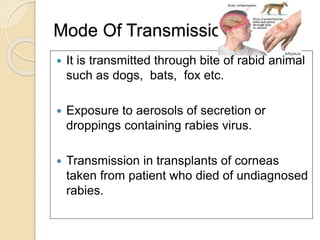
 It is transmitted through bite of rabid animal
such as dogs, bats, fox etc.
 Exposure to aerosols of secretion or
droppings containing rabies virus.
 Transmission in transplants of corneas
taken from patient who died of undiagnosed
rabies.
Pathogenesis
Signs And Symptoms
 Lack of appetite
 Headache
 Irritability
 Anxiety
 Paralysis of the jaw, mouth and throat
muscles
 Excessive sweating
 Hydrophobia
 Increased production of saliva
 Double Vision
Laboratory Diagnosis
 Saliva test – a sample of your saliva is
tested for the presence of the rabies virus.
 Lumbar puncture – a needle is used to
remove a small sample of cerebrospinal
fluid (CSF), which can be checked for the
rabies antibodies.
 Blood tests – your blood is checked for the
rabies antibodies .
 Examination of brain tissue by using either
PCR, fluorescent antibody to rabies virus.
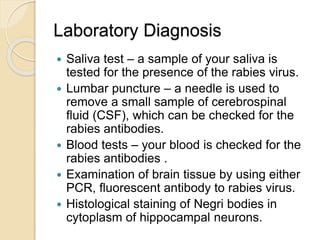
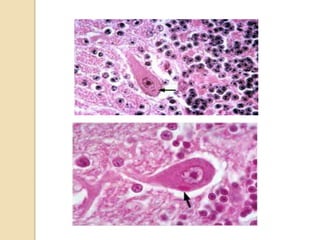
 Histological staining of Negri bodies in
cytoplasm of hippocampal neurons.
Treatment And Prevention
 Pre and post-exposure prophylaxis are available
Post-exposure prophylaxis consists of three
elements:
i. cleaning the wound (alcohol,ethanol,iodine)
ii. administering rabies immunoglobulin – a special
preparation of antibodies.
iii. administering a course of the rabies vaccine
a) Human diploid cell vaccine (HDCV), which is
created by using samples of human cells
b) purified chick embryo cell rabies vaccine
(PCEC), which is created by using samples of
chicken embryos
c) nerve tissue vaccine, which is created using
samples of nerves taken from animal brains
Vaccine Administration
Rabies virus

Rabies virus

  • 2.
    Important Properties • Rabiesis a Rhabdovirus. • Its is a single-stranded RNA enclosed within a bullet-shaped capsid surrounded by lipoprotein envelope. • Virion contains an RNA-dependent RNA polymerase . • This virus enters the victim via exposure to the saliva of an infected animal. This virus only affects mammals, which includes humans.
  • 4.
    Mode Of Transmission It is transmitted through bite of rabid animal such as dogs, bats, fox etc.  Exposure to aerosols of secretion or droppings containing rabies virus.  Transmission in transplants of corneas taken from patient who died of undiagnosed rabies.
  • 5.
  • 6.
    Signs And Symptoms Lack of appetite  Headache  Irritability  Anxiety  Paralysis of the jaw, mouth and throat muscles  Excessive sweating  Hydrophobia  Increased production of saliva  Double Vision
  • 7.
    Laboratory Diagnosis  Salivatest – a sample of your saliva is tested for the presence of the rabies virus.  Lumbar puncture – a needle is used to remove a small sample of cerebrospinal fluid (CSF), which can be checked for the rabies antibodies.  Blood tests – your blood is checked for the rabies antibodies .  Examination of brain tissue by using either PCR, fluorescent antibody to rabies virus.  Histological staining of Negri bodies in cytoplasm of hippocampal neurons.
  • 9.
    Treatment And Prevention Pre and post-exposure prophylaxis are available Post-exposure prophylaxis consists of three elements: i. cleaning the wound (alcohol,ethanol,iodine) ii. administering rabies immunoglobulin – a special preparation of antibodies. iii. administering a course of the rabies vaccine a) Human diploid cell vaccine (HDCV), which is created by using samples of human cells b) purified chick embryo cell rabies vaccine (PCEC), which is created by using samples of chicken embryos c) nerve tissue vaccine, which is created using samples of nerves taken from animal brains
  • 10.