
PRESENTED BY:VIPIN KUMAR MISHRA
EC IIET
FINAL YEAR







Brief Introduction of BSNL.
Leased line in BSNL.
GSM.
UMTS.
LTE.
Call Forwarding.
•

Bharat Sanchar Nigam Limited (known as BSNL) is
a public sector telecommunication company in india.

•

It is india's largest telecommunication company with 24%
market share.

•

Currently has a customer base of 90 million as of june 2009.

•

It has the status of mani-ratna, a status assigned to reputed
public sector companies in india.





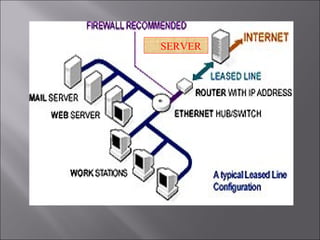
A leased line (dedicated line) is a permanent fiber optic or
telephone connection between two points set up by a
telecommunications carrier.
They can be used for telephone, data, or internet services.
Businesses use a leased line to connect to geographically
distant offices because it guarantees bandwidth for network
traffic.
SERVER
SERVER


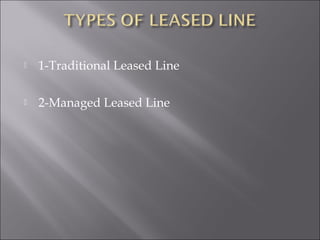
1-Traditional Leased Line



2-Managed Leased Line






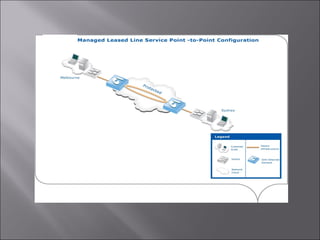
The MLLN is a Managed Leased Line Network system
which provides variable bandwidth leased line connectivity.
The State-of-the art technology equipment MLLN is
designed mainly for having effective control, on the leased
lines so that the down time is very much minimized.
This mainly supports with data circuits ranging from
64
KBPs to 2048 KBPs.









24 hrs Performance Monitoring of the circuit.
Circuit fault reports generated proactively.
On Demand the Bandwidth can be increased.
Low lead time for new circuit provisioning.
Protection against the failure of the circuit through
recovery Management process either automatic or
manually.
Long drive on single copper pair.( for 64 kbps & 2mbps)
Centrally managed from ROT connected to the NMS.


Corporate high speed internet access through Broadband.



LAN interconnection.



Hotline connectivity for voice.



Point to point connection for data circuit.



Point to multipoint connection.






In wireless communication every region is divided into cells.
Cell size is constant for whole system.
GSM is a form of multiplexing, which divides the available
bandwidth among the different channels.
GSM differs from its predecessor technologies in that both
signaling and speech channels are digital, and thus GSM is
considered a second generation (2G) mobile phone system.






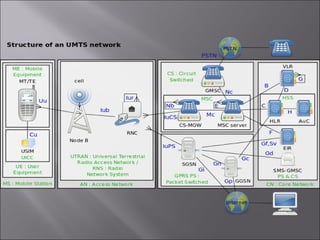
The Universal Mobile Telecommunications System
(UMTS) is a third generation mobile cellular system for
networks based on the GSM standard.
UMTS is a component of the International
Telecommunications Union IMT-2000 standard set and
compares with the CDMA2000 standard set for networks
based on the competing CDMA technology.
UMTS uses wideband code division multiple access (WCDMA).


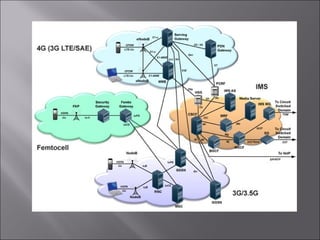
LTE Advanced is a mobile communication standard,
formally submitted as a candidate 4G system to ITU
International Telecommunications Union in 2009.



It was finalized by 3GPP in March 2011.It is standardized by
the 3rd Generation Partnership Project (3GPP) as a major
enhancement of the Long Term Evolution (LTE) standard.


Call forwarding, or call diversion, is a
telephony feature of some telephone switching
systems which redirects a telephone call to
another destination.


WIMAX
Vip bsnl.ppt1

Vip bsnl.ppt1

  • 1.
    PRESENTED BY:VIPIN KUMARMISHRA EC IIET FINAL YEAR
  • 2.
          Brief Introduction ofBSNL. Leased line in BSNL. GSM. UMTS. LTE. Call Forwarding.
  • 3.
    • Bharat Sanchar NigamLimited (known as BSNL) is a public sector telecommunication company in india. • It is india's largest telecommunication company with 24% market share. • Currently has a customer base of 90 million as of june 2009. • It has the status of mani-ratna, a status assigned to reputed public sector companies in india.
  • 4.
       A leased line(dedicated line) is a permanent fiber optic or telephone connection between two points set up by a telecommunications carrier. They can be used for telephone, data, or internet services. Businesses use a leased line to connect to geographically distant offices because it guarantees bandwidth for network traffic.
  • 5.
  • 6.
  • 7.
       The MLLN isa Managed Leased Line Network system which provides variable bandwidth leased line connectivity. The State-of-the art technology equipment MLLN is designed mainly for having effective control, on the leased lines so that the down time is very much minimized. This mainly supports with data circuits ranging from 64 KBPs to 2048 KBPs.
  • 9.
           24 hrs PerformanceMonitoring of the circuit. Circuit fault reports generated proactively. On Demand the Bandwidth can be increased. Low lead time for new circuit provisioning. Protection against the failure of the circuit through recovery Management process either automatic or manually. Long drive on single copper pair.( for 64 kbps & 2mbps) Centrally managed from ROT connected to the NMS.
  • 10.
     Corporate high speedinternet access through Broadband.  LAN interconnection.  Hotline connectivity for voice.  Point to point connection for data circuit.  Point to multipoint connection.
  • 11.
       In wireless communicationevery region is divided into cells. Cell size is constant for whole system. GSM is a form of multiplexing, which divides the available bandwidth among the different channels. GSM differs from its predecessor technologies in that both signaling and speech channels are digital, and thus GSM is considered a second generation (2G) mobile phone system.
  • 13.
       The Universal MobileTelecommunications System (UMTS) is a third generation mobile cellular system for networks based on the GSM standard. UMTS is a component of the International Telecommunications Union IMT-2000 standard set and compares with the CDMA2000 standard set for networks based on the competing CDMA technology. UMTS uses wideband code division multiple access (WCDMA).
  • 15.
     LTE Advanced isa mobile communication standard, formally submitted as a candidate 4G system to ITU International Telecommunications Union in 2009.  It was finalized by 3GPP in March 2011.It is standardized by the 3rd Generation Partnership Project (3GPP) as a major enhancement of the Long Term Evolution (LTE) standard.
  • 17.
     Call forwarding, orcall diversion, is a telephony feature of some telephone switching systems which redirects a telephone call to another destination.
  • 18.