4th(13) 
Types of Teeth 
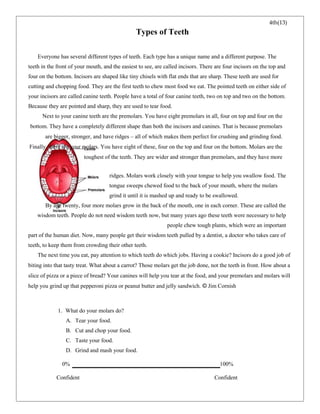
Everyone has several different types of teeth. Each type has a unique name and a different purpose. The 
teeth in the front of your mouth, and the easiest to see, are called incisors. There are four incisors on the top and 
four on the bottom. Incisors are shaped like tiny chisels with flat ends that are sharp. These teeth are used for 
cutting and chopping food. They are the first teeth to chew most food we eat. The pointed teeth on either side of 
your incisors are called canine teeth. People have a total of four canine teeth, two on top and two on the bottom. 
Because they are pointed and sharp, they are used to tear food. 
Next to your canine teeth are the premolars. You have eight premolars in all, four on top and four on the 
bottom. They have a completely different shape than both the incisors and canines. That is because premolars 
are bigger, stronger, and have ridges – all of which makes them perfect for crushing and grinding food. 
Finally, there are your molars. You have eight of these, four on the top and four on the bottom. Molars are the 
toughest of the teeth. They are wider and stronger than premolars, and they have more 
ridges. Molars work closely with your tongue to help you swallow food. The 
tongue sweeps chewed food to the back of your mouth, where the molars 
grind it until it is mashed up and ready to be swallowed. 
By age twenty, four more molars grow in the back of the mouth, one in each corner. These are called the 
wisdom teeth. People do not need wisdom teeth now, but many years ago these teeth were necessary to help 
people chew tough plants, which were an important 
part of the human diet. Now, many people get their wisdom teeth pulled by a dentist, a doctor who takes care of 
teeth, to keep them from crowding their other teeth. 
The next time you eat, pay attention to which teeth do which jobs. Having a cookie? Incisors do a good job of 
biting into that tasty treat. What about a carrot? Those molars get the job done, not the teeth in front. How about a 
slice of pizza or a piece of bread? Your canines will help you tear at the food, and your premolars and molars will 
help you grind up that pepperoni pizza or peanut butter and jelly sandwich. © Jim Cornish 
1. What do your molars do? 
A. Tear your food. 
B. Cut and chop your food. 
C. Taste your food. 
D. Grind and mash your food. 
0% 100% 
Confident Confident
4th(13) 
2. A tooth that looks like a chisel would be what shape? 
A. Pointy and sharp. 
B. Flat and sharp. 
C. Curved and shiny. 
D. Long and jagged. 
0% 100% 
Confident Confident 
3. What would be another good t itle for this reading passage? 
A. Many Kinds of Molars. 
B. The Food I Love to Eat. 
C. How to Prevent Cavities. 
D. Different Types of Teeth. 
0% 100% 
Confident Confident 
4. Why do some teeth have different shapes? 
A. To pass food to the back of the mouth. 
B. To help us speak clearly. 
C. To help us chew tough plants. 
D. To help us chew different types of food. 
0% 100% 
Confident Confident 
5. Why is the tongue important to the eating process? 
A. It pushes food to the front of the mouth. 
B. It helps people talk. 
C. It pushes chewed food to the back of the mouth. 
D. It sits next to the wisdom teeth. 
0% 100% 
Confident Confident 
On a scale between 1 and 10 with 1 being low and 10 being how well did you like this passage? 
Didn’t 
I Really 
Like It 1 2 3 4 5 6 7 8 9 10 
Liked It
4th(13) 
Connections: Describe your favorite food, and then explain which teeth would be used to 
help you eat that food.

Types teeth

  • 1.
    4th(13) Types ofTeeth Everyone has several different types of teeth. Each type has a unique name and a different purpose. The teeth in the front of your mouth, and the easiest to see, are called incisors. There are four incisors on the top and four on the bottom. Incisors are shaped like tiny chisels with flat ends that are sharp. These teeth are used for cutting and chopping food. They are the first teeth to chew most food we eat. The pointed teeth on either side of your incisors are called canine teeth. People have a total of four canine teeth, two on top and two on the bottom. Because they are pointed and sharp, they are used to tear food. Next to your canine teeth are the premolars. You have eight premolars in all, four on top and four on the bottom. They have a completely different shape than both the incisors and canines. That is because premolars are bigger, stronger, and have ridges – all of which makes them perfect for crushing and grinding food. Finally, there are your molars. You have eight of these, four on the top and four on the bottom. Molars are the toughest of the teeth. They are wider and stronger than premolars, and they have more ridges. Molars work closely with your tongue to help you swallow food. The tongue sweeps chewed food to the back of your mouth, where the molars grind it until it is mashed up and ready to be swallowed. By age twenty, four more molars grow in the back of the mouth, one in each corner. These are called the wisdom teeth. People do not need wisdom teeth now, but many years ago these teeth were necessary to help people chew tough plants, which were an important part of the human diet. Now, many people get their wisdom teeth pulled by a dentist, a doctor who takes care of teeth, to keep them from crowding their other teeth. The next time you eat, pay attention to which teeth do which jobs. Having a cookie? Incisors do a good job of biting into that tasty treat. What about a carrot? Those molars get the job done, not the teeth in front. How about a slice of pizza or a piece of bread? Your canines will help you tear at the food, and your premolars and molars will help you grind up that pepperoni pizza or peanut butter and jelly sandwich. © Jim Cornish 1. What do your molars do? A. Tear your food. B. Cut and chop your food. C. Taste your food. D. Grind and mash your food. 0% 100% Confident Confident
  • 2.
    4th(13) 2. Atooth that looks like a chisel would be what shape? A. Pointy and sharp. B. Flat and sharp. C. Curved and shiny. D. Long and jagged. 0% 100% Confident Confident 3. What would be another good t itle for this reading passage? A. Many Kinds of Molars. B. The Food I Love to Eat. C. How to Prevent Cavities. D. Different Types of Teeth. 0% 100% Confident Confident 4. Why do some teeth have different shapes? A. To pass food to the back of the mouth. B. To help us speak clearly. C. To help us chew tough plants. D. To help us chew different types of food. 0% 100% Confident Confident 5. Why is the tongue important to the eating process? A. It pushes food to the front of the mouth. B. It helps people talk. C. It pushes chewed food to the back of the mouth. D. It sits next to the wisdom teeth. 0% 100% Confident Confident On a scale between 1 and 10 with 1 being low and 10 being how well did you like this passage? Didn’t I Really Like It 1 2 3 4 5 6 7 8 9 10 Liked It
  • 3.
    4th(13) Connections: Describeyour favorite food, and then explain which teeth would be used to help you eat that food.