1
LEADERSHIP
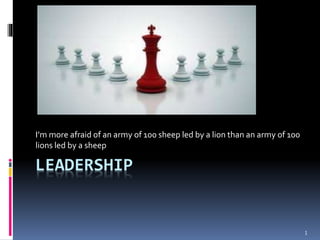
I’m more afraid of an army of 100 sheep led by a lion than an army of 100
lions led by a sheep
What is leadership
 We define leadership as the ability to
influence a group toward the achievement of
goal
 Organizations need strong leadership and
strong management for optical effectiveness.
 Leader set a direction manager makeup a
plan
2
 Trait theories
 Trait theories focus on personal qualities and
characteristics, trait research provides a basis for
selection of right people for leadership
 Good leaders possess certain traits
 Born not made
 Good supervision a selection problem
 Good leaders good in all situations
 Problems and limitations
 Some inconsistency of results
 Lack of insight into process
 Ignores situational specificity
3
 Behavioral theories
 A leader is likely to define his role and of employees
for goal attainment, a behavior differentiate from
leaders to non leaders
 Good leaders do certain things
 Leaders made not born
 Good supervision as training problem
 Problems and limitations
 Ignores situational differences
 Ignores individual differences
 Contingency theories
 Focus on situational influences; work in very bad
times and good times
4
The fielder Model
 Effective group performance depends on the
proper match between leader’s style and the
degree to which the situation gives the leader
control
1. Identifying leadership style; fielder introduces
LPC- least preferred Coworker-, LPC describes a
person you least enjoyed to work with and
rating the person from pleasant to hostile, a
high LPC relationship oriented, a low LPC task
oriented
5
The fielder Model
2. Defining the situation; After identification of
basic leadership style we match leader with the
situation
1. Leader member relations- degree of confidence and
trust
2. Task structure- the degree to which job is structured
3. Position power- leader power variables
3. Matching leader- situation
6
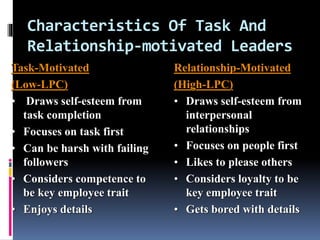
Characteristics Of Task And
Relationship-motivated Leaders
Task-Motivated
(Low-LPC)
• Draws self-esteem from
task completion
• Focuses on task first
• Can be harsh with failing
followers
• Considers competence to
be key employee trait
• Enjoys details
Relationship-Motivated
(High-LPC)
• Draws self-esteem from
interpersonal
relationships
• Focuses on people first
• Likes to please others
• Considers loyalty to be
key employee trait
• Gets bored with details
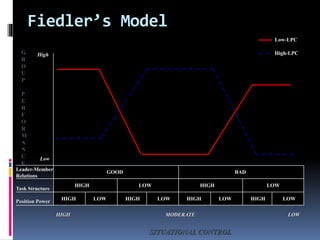
Fiedler’s Model
G
R
O
U
P
P
E
R
F
O
R
M
A
N
C
E
High
Low
SITUATIONAL CONTROL
Leader-Member
Relations
Task Structure
Position Power
HIGH MODERATE LOW
GOOD BAD
HIGH LOW
HIGH HIGH
HIGH
HIGHHIGHLOW LOW LOW LOW
LOW
Low-LPC
High-LPC
Contingency Model’s
Implications For Managers
• Leaders must understand their own style
and their leadership situation
• Leaders should focus on changing the
situation to match their style
• A good relationship with followers is key to
• the leader’s ability to lead
• Leaders can seek training to compensate
for task ambiguity
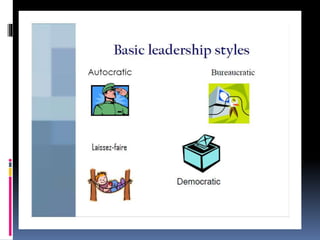
The Leadership Styles
The Autocratic Leadership
 Managers retain as much power and
decision making authority as possible
 Don’t consult staff and don’t allow to give
any input
 Structured set of rewards and punishment
 its good for untrained staff, worker need to
be coordinated with other departments
 Ineffective low staff morale high turn over
are results
The Bureaucratic Leadership
 Manages by the ‘’book’’
 Every thing done according to policy if not
covered than refer to the above level
 Effective when staff to do repetitive tasks
 StaffTraining conducted
 Ineffective
 Habits are hard to break when they are no
longer useful
 Staff loose interest in jobs
The Democratic Leadership
 Also known as participative style,
encourage staff to be part of decision
making
 Keep staff informed of every thing
 Women leaders are tend to be more
democratic
 Develop staff to self evaluate their work
 Allow staff to establish goals , encourage
employees to grow
 Recognises achievement
The Leader
 A leader has final say but gathers
information from staff to make a decision
 Produces a lot of quality work over time
 Staff respond with cooperation and high
spirit and high morale
Lassiez free
 Also known as the hand off style
 Give staff as much freedom, make decision
and resolve problems
Other leadership styles
Transformational Leadership
 Creates and sustains a context that
maximizes human and organizational
capabilities;
 Facilitate multiple levels of transformation;
and
 • Align them with core values and a unified
purpose To respond to a dynamic environment
Transformational Leadership
 Make change happen in:
 Self,
 Others,
 Groups, and
 Organizations
 Charisma a special leadership style
commonly associated with transformational
leadership; extremely powerful, extremely
hard to teach
Transactional Leadership
 Emphasizes getting things done within the
umbrella of the status quo
 In opposition to transformational leadership
“By the book" approach - the person works
within the rules
 Commonly seen in large, bureaucratic
organizations
Change Leadership
 • Endorses alteration
 • Beyond thinking about individuals and
individual organization, single problems and
single solutions
 Rethinking systems to introduce change on
parts of the whole and their relationship to
one another
The Leadership Challenge
 Leader may be low-LPC who gains a sense
of control and accomplishments by working
in very low situational control
 Intervention may be necessary to help him
learn to change the situation without
creating chaos
 Allow selection and building of cohesive
team, provide leader with task training,
and maintain his power

Leadership

  • 1.
    1 LEADERSHIP I’m more afraidof an army of 100 sheep led by a lion than an army of 100 lions led by a sheep
  • 2.
    What is leadership We define leadership as the ability to influence a group toward the achievement of goal  Organizations need strong leadership and strong management for optical effectiveness.  Leader set a direction manager makeup a plan 2
  • 3.
     Trait theories Trait theories focus on personal qualities and characteristics, trait research provides a basis for selection of right people for leadership  Good leaders possess certain traits  Born not made  Good supervision a selection problem  Good leaders good in all situations  Problems and limitations  Some inconsistency of results  Lack of insight into process  Ignores situational specificity 3
  • 4.
     Behavioral theories A leader is likely to define his role and of employees for goal attainment, a behavior differentiate from leaders to non leaders  Good leaders do certain things  Leaders made not born  Good supervision as training problem  Problems and limitations  Ignores situational differences  Ignores individual differences  Contingency theories  Focus on situational influences; work in very bad times and good times 4
  • 5.
    The fielder Model Effective group performance depends on the proper match between leader’s style and the degree to which the situation gives the leader control 1. Identifying leadership style; fielder introduces LPC- least preferred Coworker-, LPC describes a person you least enjoyed to work with and rating the person from pleasant to hostile, a high LPC relationship oriented, a low LPC task oriented 5
  • 6.
    The fielder Model 2.Defining the situation; After identification of basic leadership style we match leader with the situation 1. Leader member relations- degree of confidence and trust 2. Task structure- the degree to which job is structured 3. Position power- leader power variables 3. Matching leader- situation 6
  • 7.
    Characteristics Of TaskAnd Relationship-motivated Leaders Task-Motivated (Low-LPC) • Draws self-esteem from task completion • Focuses on task first • Can be harsh with failing followers • Considers competence to be key employee trait • Enjoys details Relationship-Motivated (High-LPC) • Draws self-esteem from interpersonal relationships • Focuses on people first • Likes to please others • Considers loyalty to be key employee trait • Gets bored with details
  • 8.
    Fiedler’s Model G R O U P P E R F O R M A N C E High Low SITUATIONAL CONTROL Leader-Member Relations TaskStructure Position Power HIGH MODERATE LOW GOOD BAD HIGH LOW HIGH HIGH HIGH HIGHHIGHLOW LOW LOW LOW LOW Low-LPC High-LPC
  • 9.
    Contingency Model’s Implications ForManagers • Leaders must understand their own style and their leadership situation • Leaders should focus on changing the situation to match their style • A good relationship with followers is key to • the leader’s ability to lead • Leaders can seek training to compensate for task ambiguity
  • 10.
  • 11.
    The Autocratic Leadership Managers retain as much power and decision making authority as possible  Don’t consult staff and don’t allow to give any input  Structured set of rewards and punishment  its good for untrained staff, worker need to be coordinated with other departments  Ineffective low staff morale high turn over are results
  • 12.
    The Bureaucratic Leadership Manages by the ‘’book’’  Every thing done according to policy if not covered than refer to the above level  Effective when staff to do repetitive tasks  StaffTraining conducted  Ineffective  Habits are hard to break when they are no longer useful  Staff loose interest in jobs
  • 13.
    The Democratic Leadership Also known as participative style, encourage staff to be part of decision making  Keep staff informed of every thing  Women leaders are tend to be more democratic  Develop staff to self evaluate their work  Allow staff to establish goals , encourage employees to grow  Recognises achievement
  • 14.
    The Leader  Aleader has final say but gathers information from staff to make a decision  Produces a lot of quality work over time  Staff respond with cooperation and high spirit and high morale
  • 15.
    Lassiez free  Alsoknown as the hand off style  Give staff as much freedom, make decision and resolve problems
  • 16.
  • 17.
    Transformational Leadership  Createsand sustains a context that maximizes human and organizational capabilities;  Facilitate multiple levels of transformation; and  • Align them with core values and a unified purpose To respond to a dynamic environment
  • 18.
    Transformational Leadership  Makechange happen in:  Self,  Others,  Groups, and  Organizations  Charisma a special leadership style commonly associated with transformational leadership; extremely powerful, extremely hard to teach
  • 19.
    Transactional Leadership  Emphasizesgetting things done within the umbrella of the status quo  In opposition to transformational leadership “By the book" approach - the person works within the rules  Commonly seen in large, bureaucratic organizations
  • 20.
    Change Leadership  •Endorses alteration  • Beyond thinking about individuals and individual organization, single problems and single solutions  Rethinking systems to introduce change on parts of the whole and their relationship to one another
  • 21.
    The Leadership Challenge Leader may be low-LPC who gains a sense of control and accomplishments by working in very low situational control  Intervention may be necessary to help him learn to change the situation without creating chaos  Allow selection and building of cohesive team, provide leader with task training, and maintain his power