i
Industrial Training Report
On
ADVANCED TELECOM
Of
MAKAUT UNIVERSITY
by
Ashish Nandan
(EXAMATION ROLL NO.:14800315023)
(UNIVERSITY REGISTRATION NO.:151480110208 of 2015-16)
Under the Supervision of
Mr. Subhabrata Banerjee
Department of Electronics & Communication Engineering
FUTURE INSTITUTE OF ENGINEERING AND MANAGEMENT
KOLKATA, INDIA
ii
Acknowledgment
This report is the end of my journey after industrial training. This report has been kept on track
and been through to completion with the support and encouragement of numerous people
including my well-wishers, my friends, and teacher.
First and foremost, I express my sincerest gratitude to my supervisor Mr. Subhabrata Banerjee,
who has supported me throughout my report with patience and knowledge. Without him, this
thesis world not has been a successful one.
I would also like to thank Prof. Dipankar Ghosh, Head of the Department, Electronics and
Communication Engineering, Future Institute of Engineering and Management for his
continuous motivation and support.
Finally, I thanks to my family members, without their support I didn’t reach this level. They
always admire me, understand me.
Place: Kolkata __________________________
Date: Ashish Nandan
iii
iv
v
CONTENTS
1. Introduction
2. Overview of Telecommunication Networks
a) Telecom Industry in India – Institutional Machanism & Role
3. Digital Switching Principles
a) Telecom Network Architecture – Local & Trunk Network
b) Call Routing
c) PCM Principles & Multiplexing of Telecom signals
d) Signalling – CAS and CCS7
e) Introduction to latest switches in Telecom Industry
4. Fiber Optics Communication Principles
a) Characteristics of Optical Fiber
b) OF transmission system and their features
c) Concept of SDH and DWDM
5. Mobile Communication Principles
a) Cellular Principles
b) Principles of GSM, Network, Architecture, Call Processing, Handover, GPRS,
EDGE
c) CDMA – Principles, Network, Architecture, Call Processing, Handover, Power
Control, EVDO
6. Broadband DSL Technologies
a) Principles Network Architecture
b) Broadband Services
c) Data Network Concepts & IP Fundamentals
7. Intelligent Network
a) Network Architecture
b) IN Service
c) ISDN and Mobile IN
8. Next Generation Network
a) Overview and Architecture
9. Conclusion
vi
Introduction
All industries operate in a specific environment which keeps changing and the firms in the
business need to understand it to dynamically adjust their actions for best results. Like minded
firms get together to form associations in order to protect their common interests. Other stake
holders also develop a system to take care of their issues. Governments also need to intervene
for ensuring fair competition and the best value for money for its citizens. This handout gives
exposure on the Telecom Environment in India and also dwells on the role of international
bodies in standardizing and promoting Telecom Growth in the world.
Telecommunication is the transmission of signs, signals, messages, words, writings, images and
sounds or information of any nature by wire, radio, optical or electromagnetic systems.
Telecommunication occurs when the exchange of information between communication
participants includes the use of technology. It is transmitted either electrically over physical
media, such as cables, or via electromagnetic radiation. Such transmission paths are often
divided into communication channels which afford the advantages of multiplexing. Since the
Latin term communication is considered the social process of information exchange, the term
telecommunications is often used in its plural form because it involves many different
technologies.
Early means of communicating over a distance included visual signals, such as beacons, smoke
signals, semaphore telegraphs, signal flags, and optical heliographs. Other examples of pre-
modern long-distance communication included audio messages such as coded drumbeats, lung-
blown horns, and loud whistles. 20th- and 21st-century technologies for long-distance
communication usually involve electrical and electromagnetic technologies, such as telegraph,
telephone, and teleprinter, networks, radio, microwave transmission, fiber optics, and
communications satellites.
On 11 September 1940, George Stibitz transmitted problems for his Complex Number
Calculator in New York using a teletype, and received the computed results back at Dartmouth
College in New Hampshire. This configuration of a centralized computer (mainframe) with
remote dumb terminals remained popular well into the 1970s. However, already in the 1960s,
researchers started to investigate packet switching, a technology that sends a message in
portions to its destination asynchronously without passing it through a centralized mainframe.
A four-node network emerged on 5 December 1969, constituting the beginnings of the
ARPANET, which by 1981 had grown to 213 nodes. ARPANET eventually merged with other
networks to form the Internet. While Internet development was a focus of the Internet
Engineering Task Force (IETF) who published a series of Request for Comment documents,
other networking advancement occurred in industrial laboratories, such as the local area
network (LAN) developments of Ethernet (1983) and the token ring protocol (1984).
A revolution in wireless communication began in the first decade of the 20th century with the
pioneering developments in radio communications by Guglielmo Marconi, who won the Nobel
Prize in Physics in 1909, and other notable pioneering inventors and developers in the field of
electrical and electronic telecommunications. These included Charles Wheatstone and Samuel
Morse (inventors of the telegraph), Alexander Graham Bell (inventor of the telephone), Edwin
Armstrong and Lee de Forest (inventors of radio), as well as Vladimir K. Zworykin, John Logie
Baird and Philo Farnsworth (some of the inventors of television).
vii
Overview of Telecommunication Networks
Institutional mechanism and role:
Institutional Framework: It is defined as the systems of formal laws, regulations, and
procedures, and informal conventions, customs, and norms, that broaden, mold, and restrain
socio-economic activity and behaviour. In India, The Indian telegraph act of 1885 amended
from time to time governs the telecommunications sector. Under this act, the government is in-
charge of policymaking and was responsible for provisioning of services till the opening of
telecom sector to private participation. The country has been divided into units called Circles,
Metro Districts, Secondary Switching Areas (SSA), Long Distance Charging Area (LDCA) and
Short Distance Charging Area (SDCA). Major changes in telecommunications in India began
in the 1980s. The initial phase of telecom reforms began in 1984 with the creation of Center for
Department of Telematics (C-DOT) for developing indigenous technologies and private
manufacturing of customer premise equipment. Soon after, the Mahanagar Telephone Nigam
Limited (MTNL) and Videsh Sanchar Nigam Limited (VSNL) were set up in 1986. The
Telecom Commission was established in 1989. A crucial aspect of the institutional reform of
the Indian telecom sector was setting up of an independent regulatory body in 1997 – the
Telecom Regulatory Authority of India (TRAI), to assure investors that the sector would be
regulated in a balanced and fair manner. In 2000, DoT corporatized its services wing and created
Bharat Sanchar Nigam Limited. Further changes in the regulatory system took place with the
TRAI Act of 2000 that aimed at restoring functional clarity and improving regulatory quality
and a separate disputes settlement body was set up called Telecom Disputes Settlement and
Appellate Tribunal (TDSAT) to fairly adjudicate any dispute between licensor and licensee,
between service provider, between service provider and a group of consumers. In October 2003,
Unified Access Service Licenses regime for basic and cellular services was introduced. This
regime enabled services providers to offer fixed and mobile services under one license. Since
then, Indian telecom has seen unprecedented customer growth crossing 600 million
connections. India is the fourth largest telecom market in Asia after China, Japan and South
Korea. The Indian telecom network is the eighth largest in the world and the second largest
among emerging economies. A brief on telecom echo system and various key elements in
institutional framework is given below:
Department of Telecommunications: In India, DoT is the nodal agency for taking care of
telecom sector on behalf of government. Its basic functions are:
 Policy Formulation
 Review of performance
 Licensing
 Wireless spectrum management
 Administrative monitoring of PSUs
 Research & Development
 Standardization/Validation of Equipment
 International Relations
viii
Main wings within DoT:
 Telecom Engineering Center (TEC)
 USO Fund
 Wireless Planning & Coordination Wing (WPC)
 Telecom Enforcement, Resource and Monitoring (TERM) Cell
 Telecom Centers of Excellence (TCOE)
Public Sector Units:
 Bharat Sanchar Nigam Limited(BSNL)
 Indian Telephone Industries Limited (ITI)
 Mahanagar Telephone Nigam Limited(MTNL)
 Telecommunications Consultants India Limited(TCIL)
R&D Unit
 Center for development of Telematics (C-DoT)
The other key governmental institutional units are TRAI & TDSAT. Important units are briefed
below:
Telecom Engineering Center (TEC): It is a technical body representing the interest of
Department of Telecom, Government of India. Its main functions are:
 Specification of common standards with regard to Telecom network equipment,
services and interoperability.
 Generic Requirements (GRs), Interface Requirements (IRs)
 Issuing Interface Approvals and Service Approvals
 Formulation of Standards and Fundamental Technical Plans
 Interact with multilateral agencies like APT, ETSI and ITU etc. for standardisation
 Develop expertise to imbibe the latest technologies and results of R&D
 Provide technical support to DOT and technical advice to TRAI & TDSAT
 Coordinate with C-DOT on the technological developments in the Telecom Sector
for policy planning by DOT www.tec.gov.in
Universal Service Obligation Fund (USO): This fund was created in 2002. This fund is
managed by USO administrator. All telecom operators contribute to this fund as per government
policy. The objective of this fund is to bridge the digital divide i.e. ensure equitable growth of
telecom facilities in rural areas. Funds are allocated to operators who bid lowest for providing
telecom facilities in the areas identified by USO administrator.
WIRELESS PLANNING & COORDINATION (WPC) This unit was created in 1952 and
is the National Radio Regulatory Authority responsible for Frequency Spectrum Management,
including licensing and caters for the needs of all wireless users (Government and Private) in
the country. It exercises the statutory functions of the Central Government and issues licenses
to establish, maintain and operate wireless stations. WPC is divided into major sections like
Licensing and Regulation (LR), New Technology Group (NTG) and Standing Advisory
Committee on Radio Frequency Allocation (SACFA). SACFA makes the recommendations on
major frequency allocation issues, formulation of the frequency allocation plan, making
ix
recommendations on the various issues related to International Telecom Union (ITU), to sort
out problems referred to the committee by various wireless users, Siting clearance of all
wireless installations in the country etc.
Telecom Enforcement, Resource and Monitoring (TERM) Cell: In order to ensure that
service providers adhere to the licence conditions and for taking care of telecom network
security issues, DoT opened these cells in 2004 and at present 34 cells are operating in various
Circles and big districts in the country. Key functions of these units are Inspection of premises
of Telecom and Internet Service Providers, Curbing illegal activities in telecom services,
Control over clandestine / illegal operation of telecom networks by vested interests having no
license, To file FIR against culprits, pursue the cases, issue notices indicating violation of
conditions of various Acts in force from time to time, Analysis of call/subscription/traffic data
of various licensees, arrangement for lawful interception / monitoring of all communications
passing through the licensee’s network, disaster management, network performance
monitoring, Registration of OSPs and Telemarketers in License Service Areas etc..
Telecom Centers of Excellence (TCOE): The growth of Indian Telecommunications sector
has been astounding, particularly in the last decade. This growth has been catalysed by
telecommunications sector liberalization and reforms. Some of the areas needing immediate
attention to consolidate and maintain the growth are:
 Capacity building for industry talent pool
 Continuous adaptation of the regulatory environment to facilitate induction/
 adaptation of high potential new technologies and business models
 Bridging of high rural - urban teledensity/digital divide
 Faster deployment of broadband infrastructure across the country
Centres of Excellence have been created to work on
 Enhancing talent pool,
 Technological innovation,
 Secure information infrastructure and
 Bridging of digital divide.
These COEs are also expected to cater to requirements of South Asia as regional leaders. The
main sponsor (one of the telecom operators), the academic institute where the Centers are
located and the tentative field of excellence are enumerated in the table below: Field of
Excellence in Telecom Associated Institute Sponsor Next Generation Network & Network
Technology IIT, Kharagpur Vodafone Essar Telecom Technology & Management IIT, Delhi
Bharti Airtel Technology Integration, Multimedia & Computational Maths IIT, Kanpur BSNL
Telecom Policy, Regulation, Governance, Customer Care & Marketing IIM, Ahmedabad IDEA
Cellular Telecom Infrastructure & Energy IIT, Chennai Reliance Disaster Management of Info
systems Information Security IISc, Bangalore Aircel Rural Application IIT Mumbai Tata
Telecom Spectrum Management (Proposed) WPC, Chennai Govt. with Industry consortium.
Telecom Regulatory Authority of India (TRAI): TRAI was established under TRAI Act
1997 enacted on 28.03.1997. The act was amended in 2000. Its Organization setup consists of
One Chairperson, Two full-time members & Two part-time members. Its primary role is to
x
deals with regulatory aspects in Telecom Sector & Broadcasting and Cable services. TRAI has
two types of functions as mentioned below:
Mandatory Functions
 Tariff policies
 Interconnection policies
 Quality of Service
 Ensure implementation of terms and conditions of license
Recommendatory Functions
 New license policies
 Spectrum policies
 Opening of sector
Key International Standardization Bodies for Telecom sector:
ITU is the leading United Nations agency for information and communication technology
issues, and the global focal point for governments and the private sector in developing networks
and services. For nearly 145 years, ITU has coordinated the shared global use of the radio
spectrum, promoted international cooperation in assigning satellite orbits, worked to improve
telecommunication infrastructure in the developing world, established the worldwide standards
that foster seamless interconnection of a vast range of communications systems and addressed
the global challenges of our times, such as mitigating climate change and strengthening
cybersecurity. Vast spectrum of its work area includes broadband Internet to latest-generation
wireless technologies, from aeronautical and maritime navigation to radio astronomy and
satellite-based meteorology, from convergence in fixed-mobile phone, Internet access, data,
voice and TV broadcasting to next-generation networks. ITU also organizes worldwide and
regional exhibitions and forums, such as ITU TELECOM WORLD, bringing together the most
influential representatives of government and the telecommunications and ICT industry to
exchange ideas, knowledge and technology for the benefit of the global community, and in
particular the developing world.
Asia Pacific Telecommunity: Headquartered at Bangkok, the APT is a unique organization of
Governments, telecom service providers, manufactures of communication equipment, research
& development organizations and other stake holders active in the field of communication and
information technology. APT serves as the focal organization for communication and
information technology in the Asia Pacific region. The APT has 34 Members, 4 Associate
Members and 121 Affiliate Members. The objective of the Telecommunity is to faster the
development of telecommunication services and information infrastructure throughout the
region with a particular focus on the expansion thereof in less developed areas. APT has been
conducting HRD Programme for developing the skills of APT Members to meet the objectives
of APT. The topics include Information Communication Technologies (ICT), Network and
Information Security, Finance and Budget, Telecommunication Management, Mobile
Communications, Multimedia, Satellite Communication, Telecommunications and ICT Policy
and Regulation, Broadband Technologies, e-Applications, Rural Telecommunications
Technologies, IP Networks and Services, Customer Relations, etc. www.aptsec.org
xi
The European Telecommunications Standards Institute (ETSI) produces Globally
applicable standards for Information and Communications Technologies (ICT), including fixed,
mobile, radio, converged, broadcast and internet technologies. It is officially recognized by the
European Union as a European Standards Organization. ETSI is a not-forprofit organization
with more than 700 ETSI member organizations drawn from 62 countries across 5 continents
world-wide. ETSI unites Manufacturers, Network operators, National Administrations, Service
providers, Research bodies, User groups Consultancies. This cooperation has resulted in a
steady stream of highly successful ICT standards in mobile, fixed, and radio communications
and a range of other standards that cross these boundaries, including Security, Satellite,
Broadcast, Human Factors, Testing & Protocols, Intelligent transport, Power-line telecoms,
eHealth, Smart Cards, Emergency communications, GRID & Clouds, Aeronautical etc. ETSI
is consensus-based and conducts its work through Technical Committees, which produce
standards and specifications, with the ETSI General Assembly and Board. www.etsi.org
BSNL: Bharat Sanchar Nigam Limited was formed in year 2000 and took over the service
providers role from DoT. Today, BSNL has a customer base of over 9 crore and is the fourth
largest integrated telecom operator in the country. BSNL is the market leader in Broadband,
landline and national transmission network. BSNL is also the only operator covering over 5
lakh village with telecom connectivity. Area of operation of BSNL is all India except Delhi
&Mumbai.
MTNL: Mahanagar Telephone Nigam Limited, formed in 1984 is the market leader in landline
and broadband in its area of operation. www.mtnl.net.in
TCIL: TCIL, a prime engineering and consultancy company, is a wholly owned Government
of India Public Sector Enterprise. TCIL was set up in 1978 for providing Indian telecom
expertise in all fields of telecom, Civil and IT to developing countries around the world. It has
its presence in over 70 countries. www.tcil-india.com
ITI: Indian telephone Industries is the oldest manufacturing unit for telephone instruments. To
keep pace with changing times, it has started taking up manufacturing of new technology
equipment such as GSM, OFC equipment, Invertors, Power plants, Defence equipment,
Currency counting machines etc.
Centre for Development of Telematics (C DoT): This is the R&D unit under DoT setup in
1984. The biggest contribution of this centre to Indian telecom sector is the development of low
capacity (128 port) Rural automatic Exchange (RAX) which enabled provisioning of telephone
in even the smallest village. This was specially designed to suit Indian environment, capable of
withstanding natural temperature and dusty conditions.
Prominent Licenses provided by DoT:
Access Service (CMTS & Unified Access Service): The Country is divided into 23 Service
Areas consisting of 19 Telecom Circle Service Areas and 4 Metro Service Areas for providing
Cellular Mobile Telephone Service (CMTS). Consequent upon announcement of guidelines for
Unified Access (Basic& Cellular) Services licenses on 11.11.2003, some of the CMTS
operators have been permitted to migrate from CMTS License to Unified Access Service
License (UASL). No new CMTS and Basic service licenses are being awarded after issuing the
xii
guidelines for Unified Access Service Licence(UASL). As on 31st March 2008, 39 CMTS and
240 UASL licenses operated.
3G & BWA (Broadband Wireless Access): Department of Telecom started the auction
process for sale of spectrum for 3G and BWA (WiMAX) in April 2010 for 22 services areas in
the country. BSNL & MTNL have already been given spectrum for 3G and BWA and they need
to pay the highest bid amount as per auction results. BSNL & MTNL both are providing 3G
services. BSNL has rolled out its BWA service by using WiMAX technology.
Mobile Number Portability (MNP) Service: Licenses have been awarded to two operators to
provide MNP in India. DoT is ensuring the readiness of all mobile operators and expects to start
this service any time after June 2010.
Infrastructure Provider: There are two categories IP-I and IP-II. For IP-I the applicant
company is required to be registered only. No license is issued for IP-I. Companies registered
as IP-I can provide assets such as Dark Fibre, Right of Way, Duct space and Tower. This was
opened to private sector with effect from 13.08.2000. An IP-II license can lease / rent out /sell
end to end bandwidth i.e. digital transmission capacity capable to carry a message. This was
opened to private sector with effect from 13.08.2000. Issuance of IP-II Licence has been
discontinued from. 14.12.05
INMARSAT: INMARSAT (International Maritime Satellite Organisation) operates a
constellation of geo-stationary satellites designed to extend phone, fax and data
communications all over the world. Videsh Sanchar Nigam Ltd (VSNL) is permitted to provide
Inmarsat services in India under their International Long Distance(ILD) licence granted by
Department of Telecommunications(DoT). VSNL has commissioned their new Land Earth
Station (LES) at Dighi, Pune compatible with 4th generation INMARSAT Satellites (I-4) and
INMARSAT-B, M, Mini-M & M-4 services are now being provided through this new LES
after No Objection Certificate (NOC) is issued by DoT on case by case basis.
National Long Distance: There is no limit on number of operators for this service and license
is for 20 years.
International Long Distance: This was opened to private sector on 1st April 2002 with no
limit on number of operators. The license period is 20 years.
Resale of IPLC: For promoting competition and affordability in International Private Leased
Circuits (IPLC) Segment, Government permitted the “Resale of IPLC” by introducing a new
category of License called as – “Resale of IPLC” Service License with effect from 24th
September 2008. The Reseller can provide end-to-end IPLC between India and country of
destination for any capacity denomination. For providing the IPLC service, the Reseller has to
take the IPLC from International Long Distance (ILD) Service Providers licensed and permitted
to enter into an arrangement for leased line with Access Providers, National Long Distance
Service Providers and International Long Distance Service Providers for provision of IPLC to
end customers.
Sale of International Roaming SIM cards /Global Calling Cards in India: The cards being
offered to Indian Customers will be for use only outside India. However, if it is essential to
activate the card for making test calls/emergent calls before the departure of customer and /or
xiii
after the arrival of the customer, the same shall be permitted for forty-eight (48) hours only
prior to departure from India and twenty-four (24) hours after arrival in India.
Internet without Telephony: The Internet Service Provider (ISP) Policy was announced in
November, 98. ISP Licenses, which prohibit telephony on Internet, are being issued starting
from 6.11.98 on non-exclusive basis. Three category of license exist namely A, B and C. A is
all India, B is telecom Circles, Metro Districts and major districts where as C is SSA wide.
Internet with Telephony: Only ISP licensees are permitted, within their service area, to offer
Internet Telephony service. The calls allowed are PC to PC in India, PC in India to
PC/Telephone outside India, IP based calls from India to other countries.
VPN: Internet Service Providers (ISPs) can provide Virtual Private Network (VPN) Services.
VPN shall be configured as Closed User Group(CUG) only and shall carry only the traffic
meant for the internal use of CUG and no third party traffic shall be carried on the VPN. VPN
shall not have any connectivity with PSTN / ISDN / PLMN except when the VPN has been set
up using Internet access dial-up facility to the ISP node. Outward dialling facility from ISP
node is not permitted.
VSAT & Satellite Communication: There are two types of CUG VSAT licenses: (i)
Commercial CUG VSAT license and (ii) Captive CUG VSAT license. The commercial VSAT
service provider can offer the service on commercial basis to the subscribers by setting up a
number of Closed User Groups (CUGs) whereas in the captive VSAT service only one CUG
can be set up for the captive use of the licensee. The scope of the service is to provide data
connectivity between various sites scattered within territorial boundary of India via INSAT
Satellite System using Very Small Aperture Terminals (VSATs). However, these sites should
form part of a Closed User Group (CUG). PSTN connectivity is not permitted.
Radio Paging: The bids for the Radio Paging Service in 27 cities were invited in 1992,the
licenses were signed in 1994 and the service was commissioned in 1995. There was a provision
for a fixed license fee for first 3 years and review of the license fee afterwards. The license was
for 10 years and in 2004 Govt offered a extended 10 years license with certain license fee
waivers but with the wide spread use of mobile phones, this service has lost its utility.
PMRTS: Public Mobile Radio Trunking service allows city wide connectivity through wireless
means. This service is widely used by Radio Taxi operators and companies whose workforce
is on the move and there is need to locate the present position of employee for best results.
PSTN connectivity is permitted.
INSAT MSS: INSAT Mobile Satellite System Reporting Service (INSAT MSS Reporting
Service) is a one-way satellite based messaging service available through INSAT. The basic
nature of this service is to provide a reporting channel via satellite to the group of people, who
by virtue of their nature of work are operating from remote locations without any telecom
facilities and need to send short textual message or short data occasionally to a central station.
Voice Mail/ Audiotex/ UMS (Unified Messaging Service): Initially a separate license was
issued for these services. For Unified Messaging Service, transport of Voice Mail Messages to
other locations and subsequent retrieval by the subscriber must be on a nonreal time basis. For
providing UMS under the licence, in addition to the licence for Voice Mail/Audiotex/UMS, the
licensee must also have an ISP licence. The ISP licence as well as Voice Mail/Audiotex/ UMS
xiv
licence should be for the areas proposed to be covered by UMS service. Since start of NTP-99,
all access provider i.e. CMTS, UASL, fixed service providers are also allowed to provide these
services as Value Added Service (VAS) under their license conditions.
Telemarketing: Companies intending to operate as Telemarketers need to obtain this license
from DoT.
Other Service Provider (including BPO): As per New Telecom Policy (NTP) 1999, Other
Service Providers (OSP), such as tele-banking, tele-medicine, tele-trading, ecommerce,
Network Operation Centres and Vehicle Tracking Systems etc are allowed to operate by using
infrastructure provided by various access providers for non-telecom services.
Telecom Operators: Interested companies obtain license for various services to get
authorization to provide licensed telecom services in India. While hundreds of license holders
exist in India for various services, major operators are BSNL, Bharti (Airtel), Vodafone,
Reliance, Aircel, Idea and Tata etc. There is a stiff competition in the market and operators
struggle to provide innovative services earlier than others, at rates lower than rivals,
continuously find ways to extend better customer care and improve profit margins by managing
costs. A typical diagram depicting various macro level activities performed by a telecom service
provider is given below:
In today’s fast growing customer base in telecom market, rising expectations of customers for
prompt service support, very efficient & powerful software solutions are a must. For this
purpose, over the years, OSS (Operations Support Systems) & BSS (Business Support Systems)
software solutions have been developed to manage these activities. The term OSS most
frequently describes "network systems" dealing with the telecom network itself, supporting
processes such as maintaining network inventory, provisioning services, configuring network
components, and managing faults. Business Support Systems or BSS typically refers to
"business systems" dealing with customers, supporting processes such as taking orders,
processing bills, and collecting payments. The two systems together are often abbreviated
BSS/OSS or simply B/OSS. Many proprietary software solutions are available from different
vendors. A standardization initiative has been taken up by Telecom Management forum, an
international membership organization of communications service providers and suppliers to
the communications industry. TM Forum is regarded as the most authoritative source for
standards and frameworks in OSS. TM Forum has been active in proving a framework and
discussion forum for advancements in OSS and BSS. A typical architecture of OSS/BSS
application is given below: Optical-OFC, DWDM etc., Transport-SDH, PDH, ATM, PSTN,
DSL etc., IP-MPLS, Internet, IP TV, Multicast etc., Fixed/Wireless-PSTN, GSM, CDMA,
WiMax, 3G etc., System- Windows, Unix etc.
Sector Specific industry associations:
The Cellular Operators Association of India (COAI) was constituted in 1995 as a registered,
non-profit, non-governmental society dedicated to the advancement of communication,
particularly modern communication through Cellular Mobile Telephone Services. COAI
represents Indian Cellular industry and on its behalf it interacts with the policy maker, the
licensor, the regulator, the spectrum management agency and the industry (telecom /non-
telecom) associations.
xv
Job opportunities in Telecom Sector
Government sector: Every year UPSC conducts Indian Engineering Services exam for
recruitment to fill up vacancies notified by various departments such as Broadcasting, Military
Engineering Service, Indian Telecom Service, Indian Railways, Wireless Planning etc.
Numbers of vacancies vary year to year.
Entry level engineers with Telecom Operators: All operators recruit thousands on fresh
engineers every year owing to the high growth in telecom market. BSNL recruits of the order
of thousand fresh graduates every year at Junior Telecom Officer level.
Sales Engineers: Many Telecom solutions are very sophisticated and technical. Such sales need
to be handled by telecom engineers.
Manufacturing Sector: Most of the MNCs have set up factories in India for manufacturing
telecom network equipment as well as Customer premises equipment. There is enough job
potential with these firms.
Support jobs in Non-Telecom sector: In today’s scenario, all industries use many telecom
facilities for faster and efficient communication. All such activities require maintenance
professionals. Even in medical sector, growing use of telemedicine has created a new market
for telecom professionals.
Research & Development: Many MNCs have outsourced R & D in telecom to Indian firms.
For example, Nokia has outsourced its product design to M/s TCS. All such deals create job
opportunities for telecom engineers.
IT sector: The core of BPO sector is the telecom network. IT sectors generates huge telecom
jobs.
Education sector: Government of India’s mission mode project on Education such as Sarva
shiksha Abhiyan, connecting all libraries in India, providing broadband to all schools etc.
requires telecom professionals to install and manage this huge network.
National E-Governance Project: The ambitions plan of India to network each nook & corner
of the country and provide a citizen centric, single window service counter requires creation of
vast telecom network across the country. Each State is implementing State Wide Area Network
(SWAN). All such projects create demand for telecom professionals. Research executives with
Consultancy Firms: Telecom growth impacts a country’s economy. Many consultancy firms
thrive on generating reports on business models, future potential and extending guidance to
existing and new entrants in telecom market. There is a significant need for telecom
professionals with such firms also.
xvi
Digital Switching Principles
About Telephone Networks:
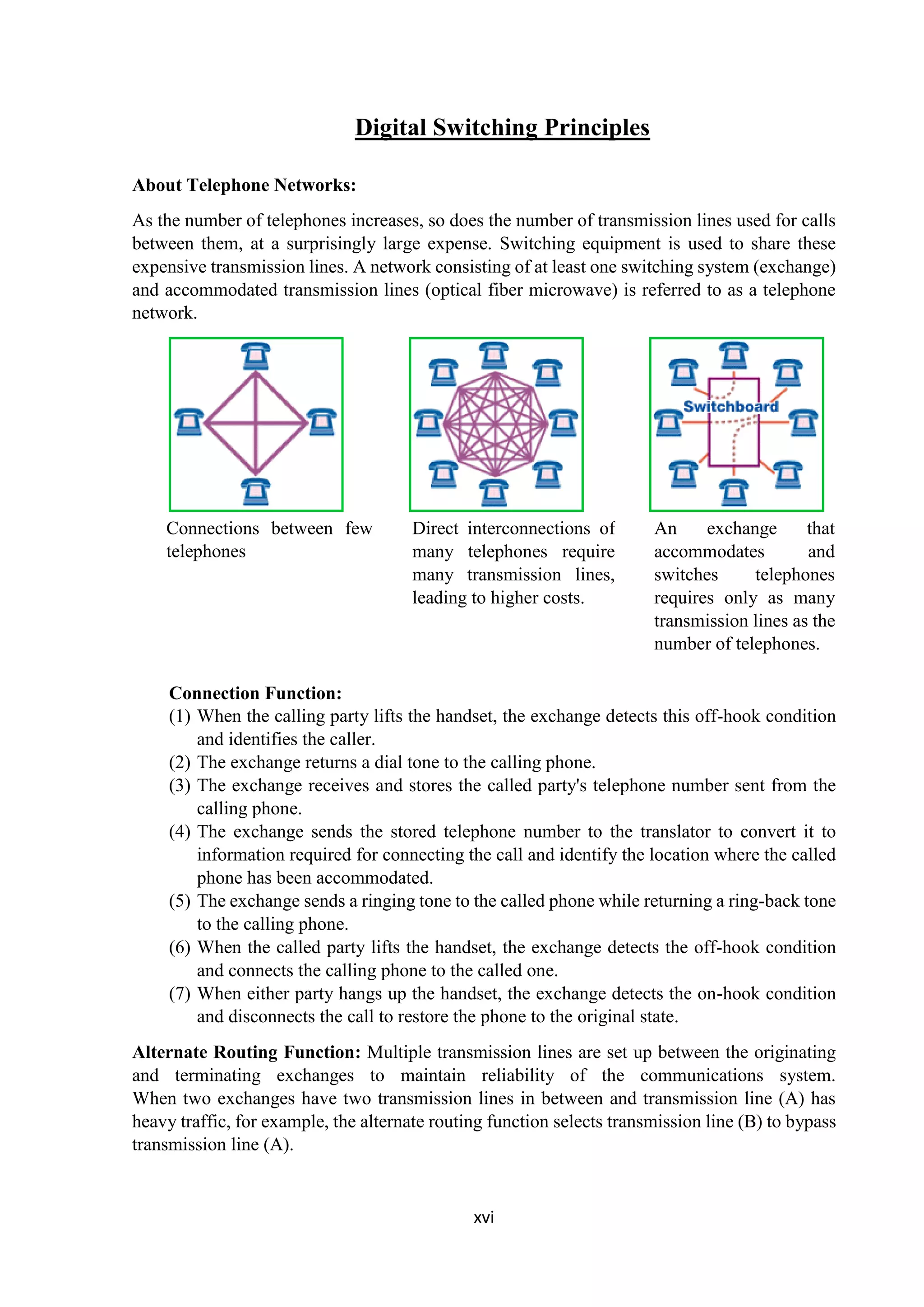
As the number of telephones increases, so does the number of transmission lines used for calls
between them, at a surprisingly large expense. Switching equipment is used to share these
expensive transmission lines. A network consisting of at least one switching system (exchange)
and accommodated transmission lines (optical fiber microwave) is referred to as a telephone
network.
Connections between few
telephones
Direct interconnections of
many telephones require
many transmission lines,
leading to higher costs.
An exchange that
accommodates and
switches telephones
requires only as many
transmission lines as the
number of telephones.
Connection Function:
(1) When the calling party lifts the handset, the exchange detects this off-hook condition
and identifies the caller.
(2) The exchange returns a dial tone to the calling phone.
(3) The exchange receives and stores the called party's telephone number sent from the
calling phone.
(4) The exchange sends the stored telephone number to the translator to convert it to
information required for connecting the call and identify the location where the called
phone has been accommodated.
(5) The exchange sends a ringing tone to the called phone while returning a ring-back tone
to the calling phone.
(6) When the called party lifts the handset, the exchange detects the off-hook condition
and connects the calling phone to the called one.
(7) When either party hangs up the handset, the exchange detects the on-hook condition
and disconnects the call to restore the phone to the original state.
Alternate Routing Function: Multiple transmission lines are set up between the originating
and terminating exchanges to maintain reliability of the communications system.
When two exchanges have two transmission lines in between and transmission line (A) has
heavy traffic, for example, the alternate routing function selects transmission line (B) to bypass
transmission line (A).
xvii
PCM Principles & Multiplexing of Telecom Signals:
A long distance or local telephone conversation between two persons could be provided by
using a pair of open wire lines or underground cable as early as early as mid of 19th century.
However, due to fast industrial development and increased telephone awareness, demand
for trunk and local traffic went on increasing at a rapid rate. To cater to the increased demand
of traffic between two stations or between two subscribers at the same station we resorted to
the use of an increased number of pairs on either the open wire alignment, or in underground
cable. This could solve the problem for some time only as there is a limit to the number of open
wire pairs that can be installed on one alignment due to headway consideration and
maintenance problems. Similarly increasing the number of open wire pairs that can be installed
on one alignment due to headway consideration and maintenance problems. Similarly
increasing the number of pairs to the underground cable is uneconomical and leads to
maintenance problems. It, therefore, became imperative to think of new technical innovations
which could exploit the available bandwidth of transmission media such as open wire lines or
underground cables to provide more number of circuits on one pair. The technique used to
provide a number of circuits using a single transmission link is called Multiplexing.
MULTIPLEXING TECHNIQUES
There are basically two types of multiplexing techniques
i. Frequency Division Multiplexing (FDM)
ii. Time Division Multiplexing (TDM)
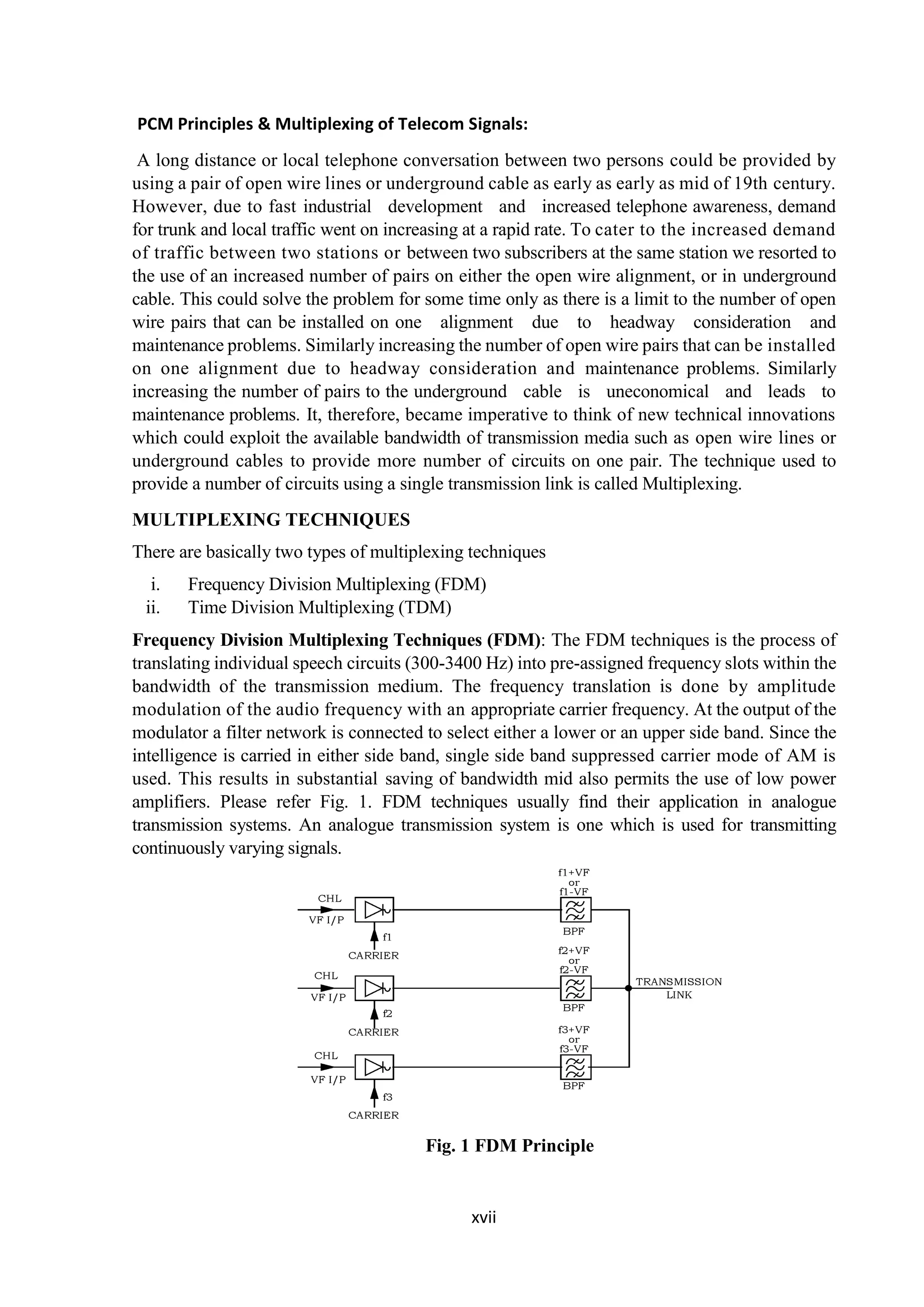
Frequency Division Multiplexing Techniques (FDM): The FDM techniques is the process of
translating individual speech circuits (300-3400 Hz) into pre-assigned frequency slots within the
bandwidth of the transmission medium. The frequency translation is done by amplitude
modulation of the audio frequency with an appropriate carrier frequency. At the output of the
modulator a filter network is connected to select either a lower or an upper side band. Since the
intelligence is carried in either side band, single side band suppressed carrier mode of AM is
used. This results in substantial saving of bandwidth mid also permits the use of low power
amplifiers. Please refer Fig. 1. FDM techniques usually find their application in analogue
transmission systems. An analogue transmission system is one which is used for transmitting
continuously varying signals.
Fig. 1 FDM Principle
xviii
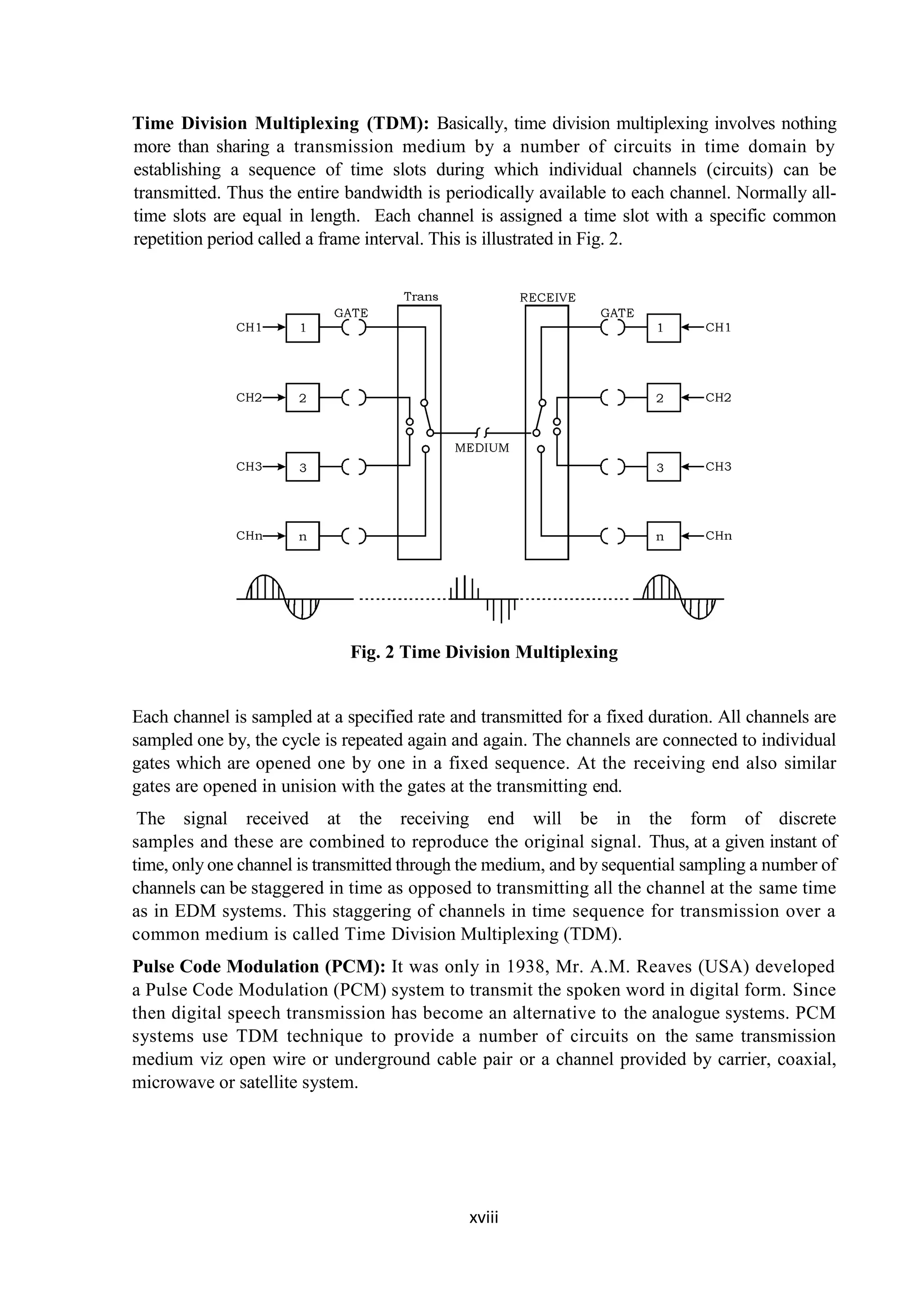
Time Division Multiplexing (TDM): Basically, time division multiplexing involves nothing
more than sharing a transmission medium by a number of circuits in time domain by
establishing a sequence of time slots during which individual channels (circuits) can be
transmitted. Thus the entire bandwidth is periodically available to each channel. Normally all-
time slots are equal in length. Each channel is assigned a time slot with a specific common
repetition period called a frame interval. This is illustrated in Fig. 2.
Fig. 2 Time Division Multiplexing
Each channel is sampled at a specified rate and transmitted for a fixed duration. All channels are
sampled one by, the cycle is repeated again and again. The channels are connected to individual
gates which are opened one by one in a fixed sequence. At the receiving end also similar
gates are opened in unision with the gates at the transmitting end.
The signal received at the receiving end will be in the form of discrete
samples and these are combined to reproduce the original signal. Thus, at a given instant of
time, only one channel is transmitted through the medium, and by sequential sampling a number of
channels can be staggered in time as opposed to transmitting all the channel at the same time
as in EDM systems. This staggering of channels in time sequence for transmission over a
common medium is called Time Division Multiplexing (TDM).
Pulse Code Modulation (PCM): It was only in 1938, Mr. A.M. Reaves (USA) developed
a Pulse Code Modulation (PCM) system to transmit the spoken word in digital form. Since
then digital speech transmission has become an alternative to the analogue systems. PCM
systems use TDM technique to provide a number of circuits on the same transmission
medium viz open wire or underground cable pair or a channel provided by carrier, coaxial,
microwave or satellite system.
xix
Basic Requirements for PCM System
To develop a PCM signal from several analogue signals, the following processing steps are
required
 Filtering
 Sampling
 Quantisation
 Encoding
 Line Coding
FILTERING
Filters are used to limit the speech signal to the frequency band 300-3400 Hz.
SAMPLING
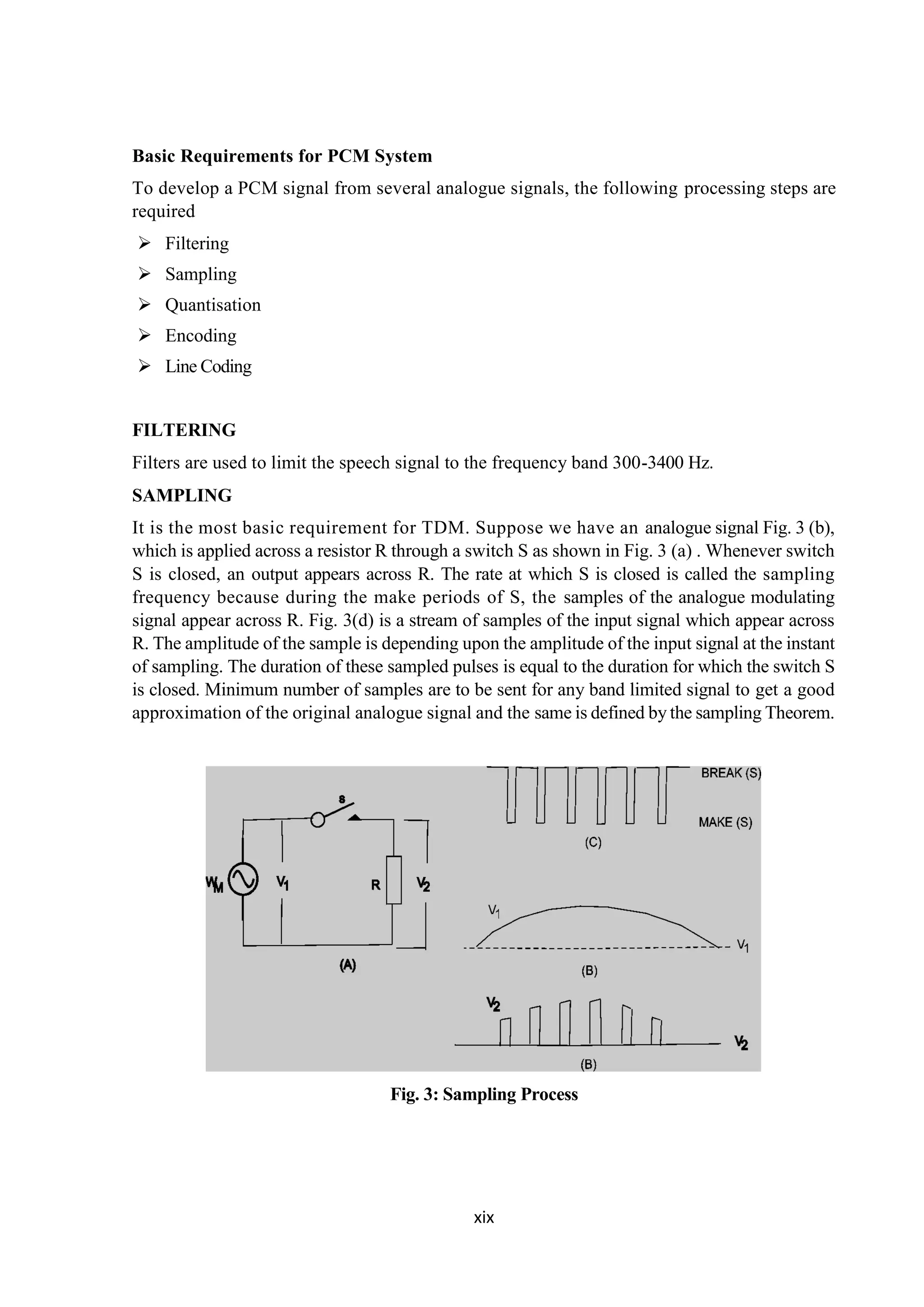
It is the most basic requirement for TDM. Suppose we have an analogue signal Fig. 3 (b),
which is applied across a resistor R through a switch S as shown in Fig. 3 (a) . Whenever switch
S is closed, an output appears across R. The rate at which S is closed is called the sampling
frequency because during the make periods of S, the samples of the analogue modulating
signal appear across R. Fig. 3(d) is a stream of samples of the input signal which appear across
R. The amplitude of the sample is depending upon the amplitude of the input signal at the instant
of sampling. The duration of these sampled pulses is equal to the duration for which the switch S
is closed. Minimum number of samples are to be sent for any band limited signal to get a good
approximation of the original analogue signal and the same is defined by the sampling Theorem.
Fig. 3: Sampling Process
xx
Sampling Theorem: A complex signal such as human speech has a wide range of frequency
components with the amplitude of the signal being different at different frequencies. To put it
in a different way, a complex signal will have certain amplitudes for all frequency components
of which the signal is made. Let us say that these frequency components occupy a certain
bandwidth B. If a signal does not have any value beyond this bandwidth B, then it is said to be
band limited. The extent of B is determined by the highest frequency components of the signal.
Sampling Theorem States: If a band limited signal is sampled at regular intervals of time and at
a rate equal to or more than twice the highest signal frequency in the band, then the sample
contains all the information of the original signal." Mathematically, if fH is the highest
frequency in the signal to be sampled then the sampling frequency Fs needs to be greater than 2 fH.
i.e. Fs>2fH
Let us say our voice signals are band limited to 4 KHz and let sampling frequency be 8 KHz.
Time period of sampling Ts = 1 sec
8000
or Ts = 125 micro seconds
If we have just one channel, then this can be sampled every 125 microseconds and the resultant
samples will represent the original signal. But, if we are to sample N channels one by one at
the rate specified by the sampling theorem, then the time available for sampling each channel
would be equal to Ts/N microseconds.
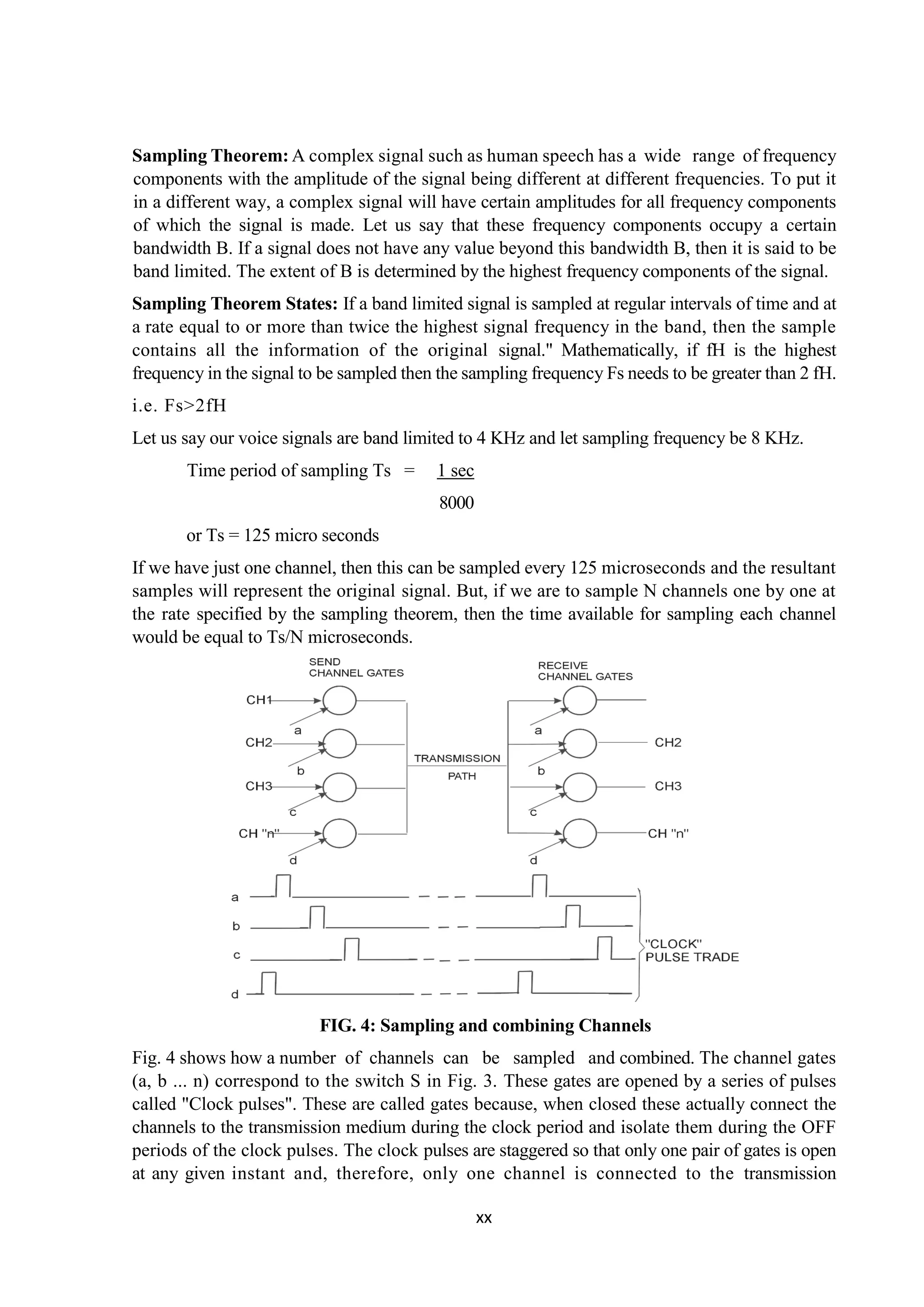
FIG. 4: Sampling and combining Channels
Fig. 4 shows how a number of channels can be sampled and combined. The channel gates
(a, b ... n) correspond to the switch S in Fig. 3. These gates are opened by a series of pulses
called "Clock pulses". These are called gates because, when closed these actually connect the
channels to the transmission medium during the clock period and isolate them during the OFF
periods of the clock pulses. The clock pulses are staggered so that only one pair of gates is open
at any given instant and, therefore, only one channel is connected to the transmission
xxi
medium. The time intervals during which the common transmission medium is allocated to a
particular channel is called the Time Slot for that channel. The width of the time slot will depend,
as stated above, upon the number of channels to be combined and the clock pulse frequency i.e.
the sampling frequency. In a 30 channel PCM system. TS i.e. 125 microseconds are divided into
32 parts. That is 30 time slots are used for 30 speech signals, one time slot for signalling of all
the 30 chl’s, and one time slot for synchronization between Transmitter & Receiver. The
time available per channel would be Ts/N = 125/32 = 3.9 microseconds. Thus in a 30 channel
PCM system, time slot is 3.9 microseconds and time period of sampling i.e. The interval between
2 consecutive samples of a channel is 125 microseconds. This duration i.e. 125 microseconds is
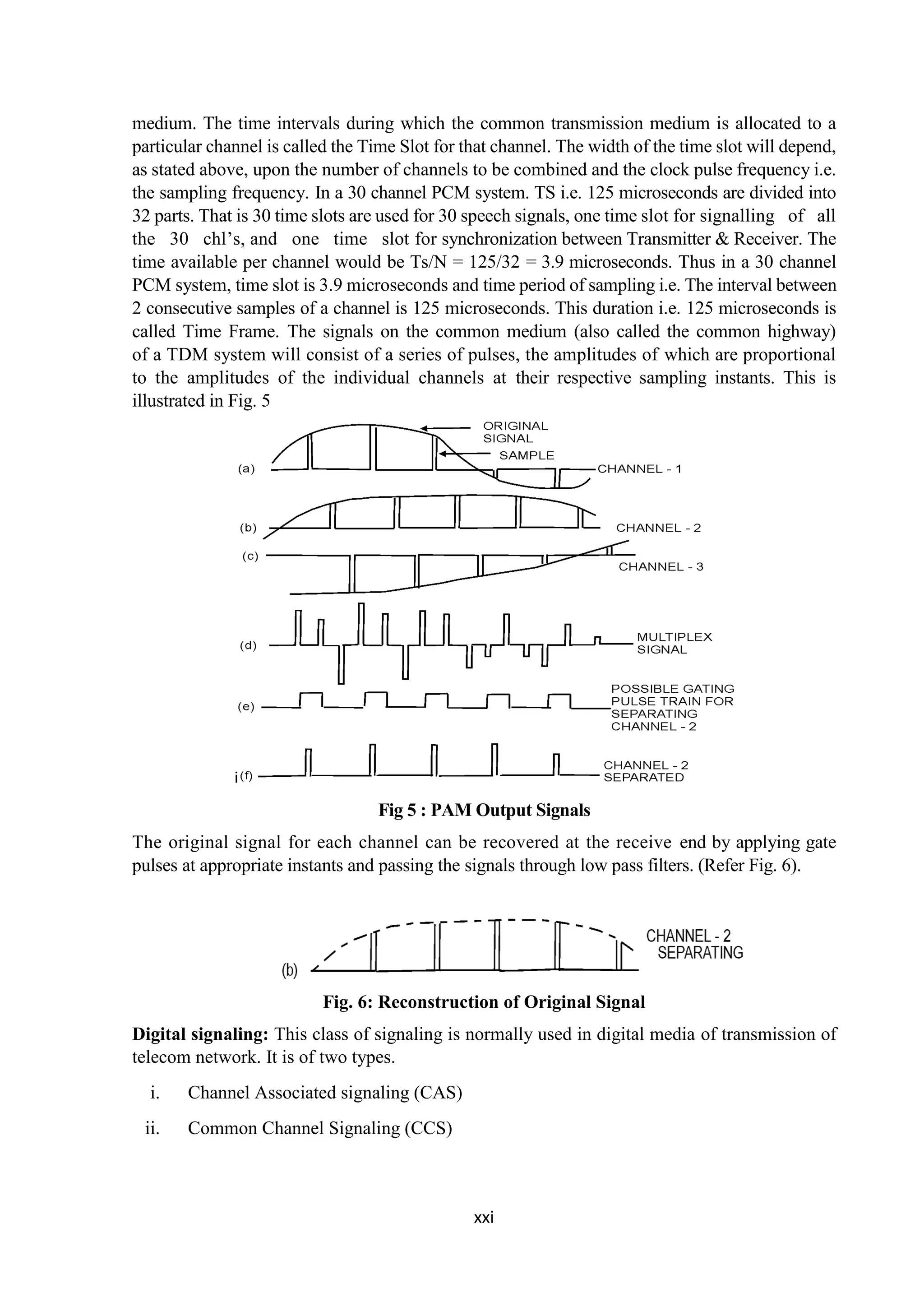
called Time Frame. The signals on the common medium (also called the common highway)
of a TDM system will consist of a series of pulses, the amplitudes of which are proportional
to the amplitudes of the individual channels at their respective sampling instants. This is
illustrated in Fig. 5
i
Fig 5 : PAM Output Signals
The original signal for each channel can be recovered at the receive end by applying gate
pulses at appropriate instants and passing the signals through low pass filters. (Refer Fig. 6).
Fig. 6: Reconstruction of Original Signal
Digital signaling: This class of signaling is normally used in digital media of transmission of
telecom network. It is of two types.
i. Channel Associated signaling (CAS)
ii. Common Channel Signaling (CCS)
xxii
Channel Associated Signaling: A signaling system is called CAS when the location of the
signaling information is related directly to the user voice/data or in the 30 channel PCM link
(also called 2Mb link), a frame consists of 32 timeslots. Of the 32 timeslots, 30 channels are
used to transport user voice/ data, one channel (timeslot 0) is used for timing, status and
synchronization. One channel (timeslot 16) is used to carry signaling information Every
timeslot consists of 8 bits.
CCS (Common Channel Signaling)#7: When a Channel is common for sending all signals of
a number of users, that signaling system is called CCS. In this case also TS16 is normally used
as common channel i.e. signaling link. All 8 bits are used for signal/control. CCS only requires
one signalling channel for up to 1000 traffic channels.
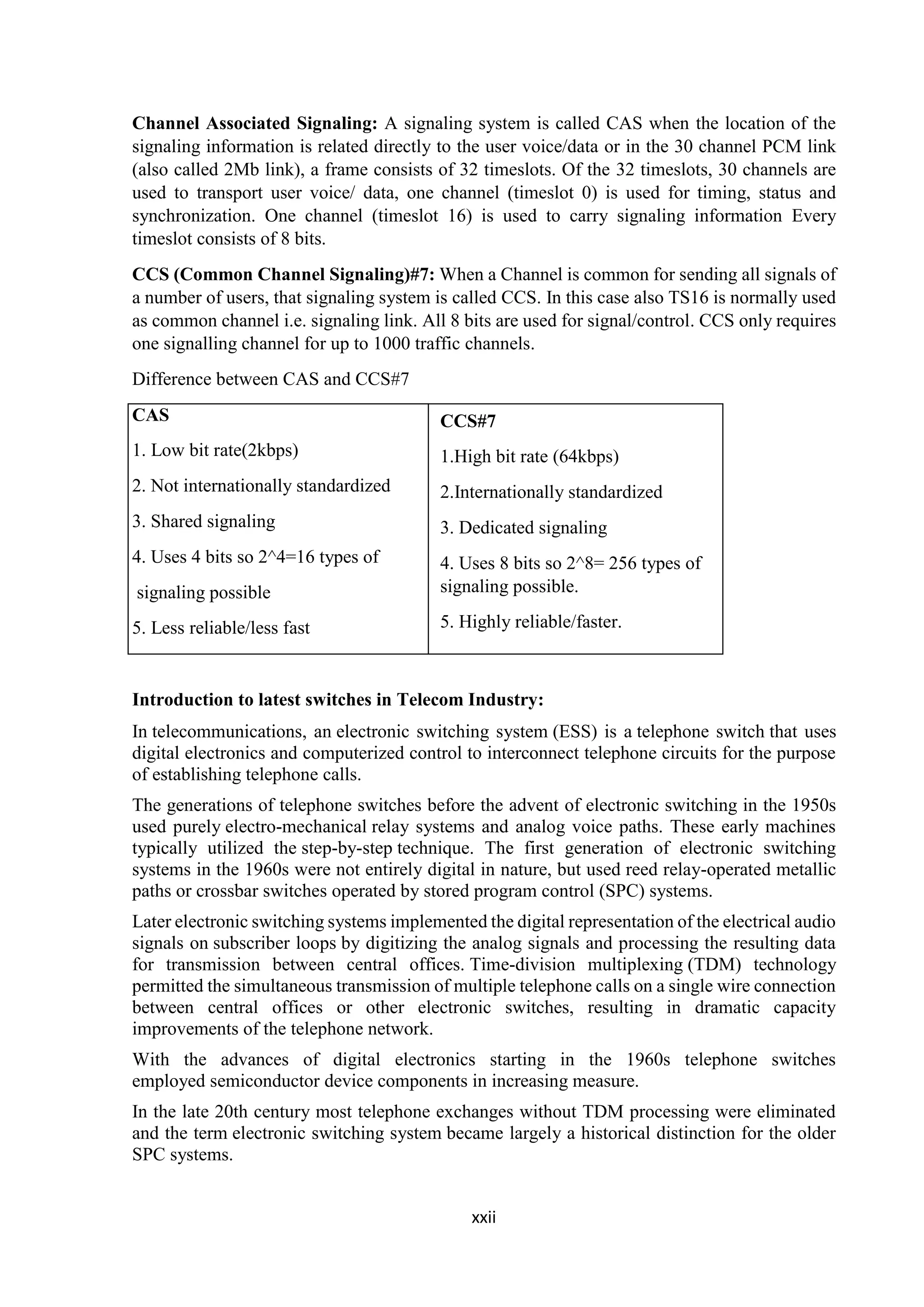
Difference between CAS and CCS#7
CAS
1. Low bit rate(2kbps)
2. Not internationally standardized
3. Shared signaling
4. Uses 4 bits so 2^4=16 types of
signaling possible
5. Less reliable/less fast
Introduction to latest switches in Telecom Industry:
In telecommunications, an electronic switching system (ESS) is a telephone switch that uses
digital electronics and computerized control to interconnect telephone circuits for the purpose
of establishing telephone calls.
The generations of telephone switches before the advent of electronic switching in the 1950s
used purely electro-mechanical relay systems and analog voice paths. These early machines
typically utilized the step-by-step technique. The first generation of electronic switching
systems in the 1960s were not entirely digital in nature, but used reed relay-operated metallic
paths or crossbar switches operated by stored program control (SPC) systems.
Later electronic switching systems implemented the digital representation of the electrical audio
signals on subscriber loops by digitizing the analog signals and processing the resulting data
for transmission between central offices. Time-division multiplexing (TDM) technology
permitted the simultaneous transmission of multiple telephone calls on a single wire connection
between central offices or other electronic switches, resulting in dramatic capacity
improvements of the telephone network.
With the advances of digital electronics starting in the 1960s telephone switches
employed semiconductor device components in increasing measure.
In the late 20th century most telephone exchanges without TDM processing were eliminated
and the term electronic switching system became largely a historical distinction for the older
SPC systems.
CCS#7
1.High bit rate (64kbps)
2.Internationally standardized
3. Dedicated signaling
4. Uses 8 bits so 2^8= 256 types of
signaling possible.
5. Highly reliable/faster.
xxiii
Fiber Optics Communication Principles
An optical fiber is a cylindrical dielectric waveguide (nonconducting waveguide) that transmits
light along its axis, by the process of total internal reflection. The fiber consists of
a core surrounded by a cladding layer, both of which are made of dielectric materials. To
confine the optical signal in the core, the refractive index of the core must be greater than that
of the cladding. The boundary between the core and cladding may either be abrupt, in step-
index fiber, or gradual, in graded-index fiber.
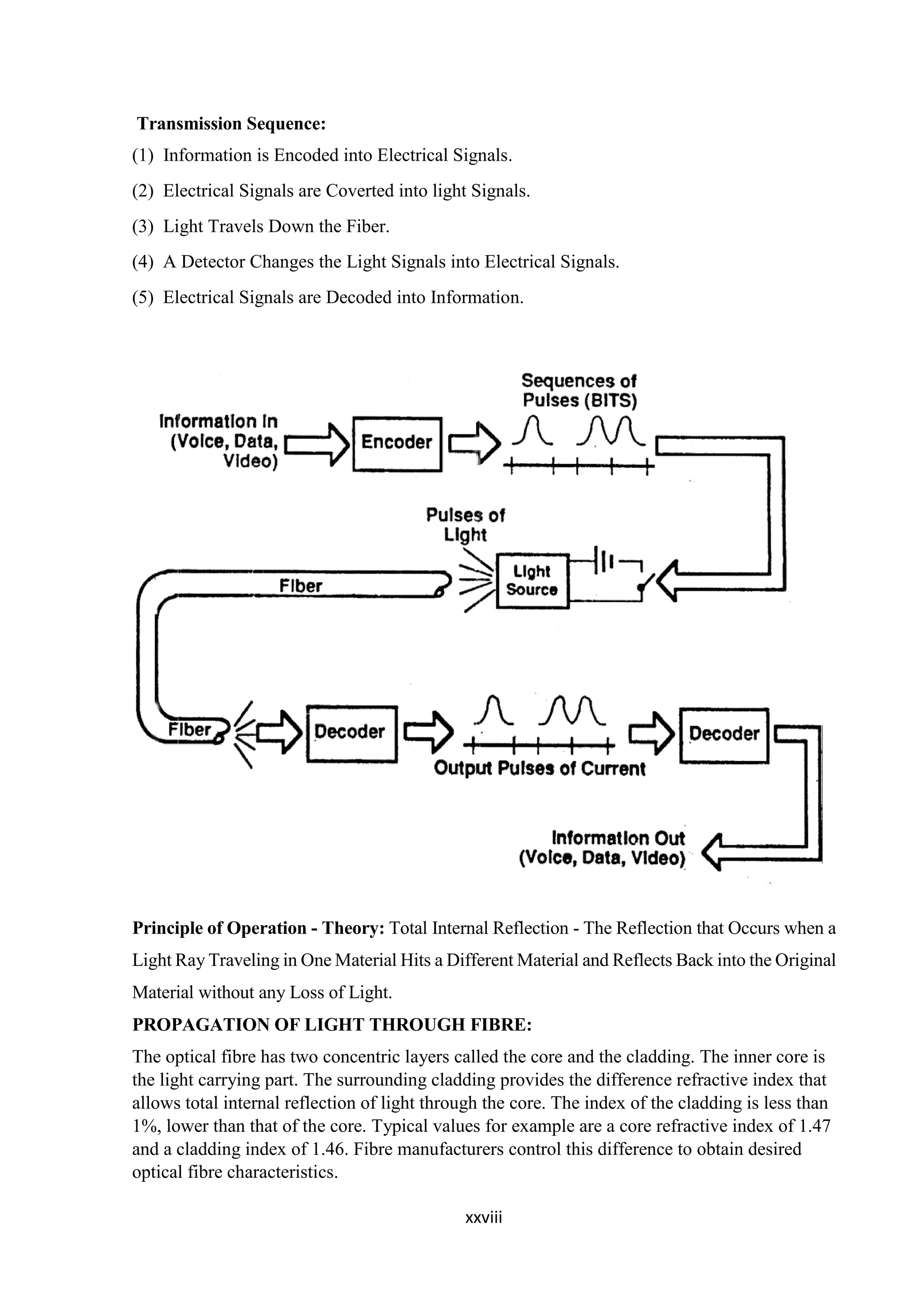
Optical Fiber is new medium, in which information (voice, Data or Video) is transmitted
through a glass or plastic fibre, in the form of light, following the transmission sequence give
below:
 Information is encoded into electrical signals.
 Electrical signals are converted into light signals.
 Light travels down the fibre.
 A detector changes the light signals into electrical signals.
 Electrical signals are decoded into information.
Index of refraction: The index of refraction (or refractive index) is a way of measuring
the speed of light in a material. Light travels fastest in a vacuum, such as in outer space. The
speed of light in a vacuum is about 300,000 kilometers (186,000 miles) per second. The
refractive index of a medium is calculated by dividing the speed of light in a vacuum by the
speed of light in that medium. The refractive index of a vacuum is therefore 1, by definition. A
typical singlemode fiber used for telecommunications has a cladding made of pure silica, with
an index of 1.444 at 1500 nm, and a core of doped silica with an index around 1.4475. The
larger the index of refraction, the slower light travels in that medium.
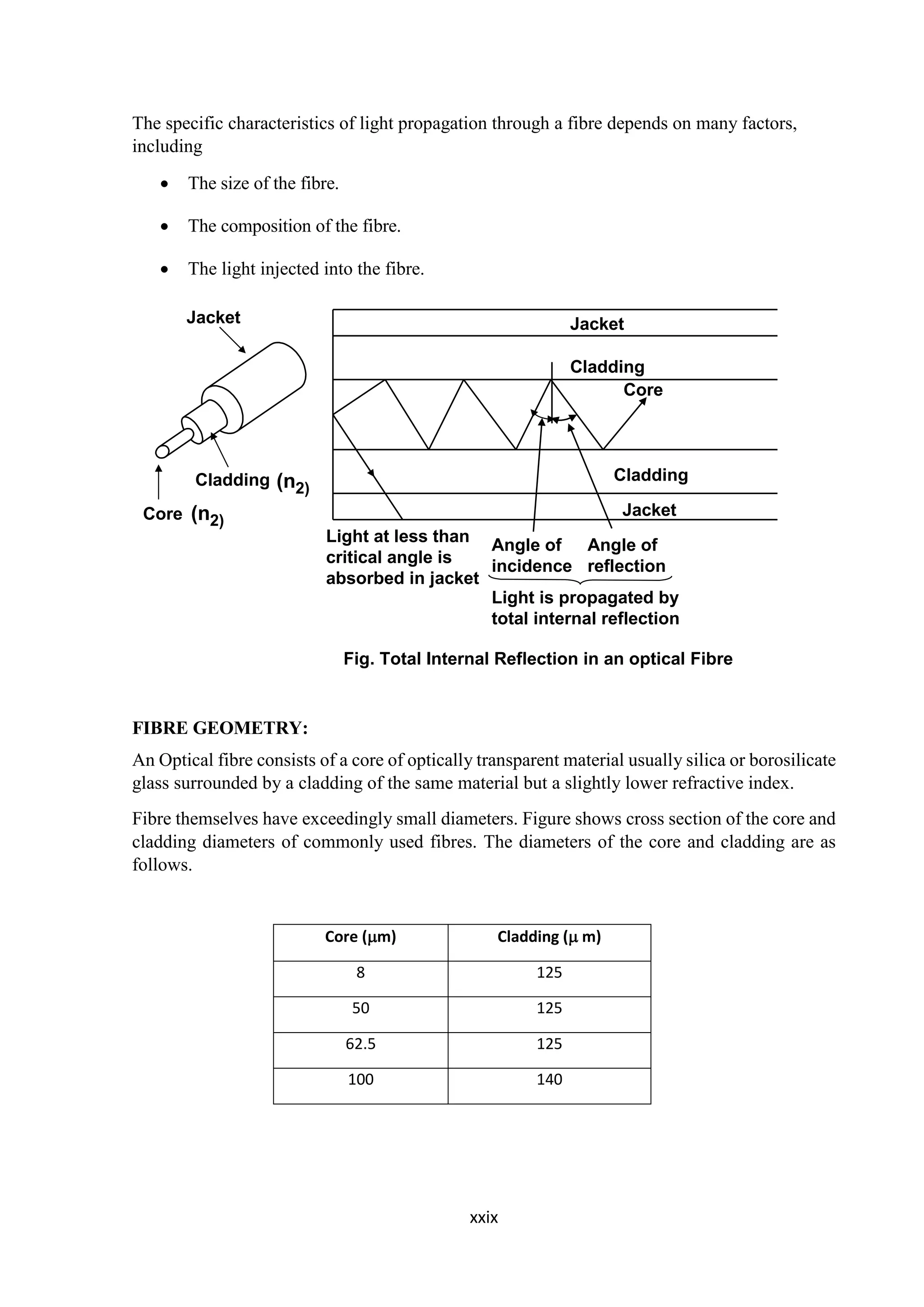
Total internal reflection: When light traveling in an optically dense medium hits a boundary
at a steep angle (larger than the critical angle for the boundary), the light is completely reflected.
This is called total internal reflection. This effect is used in optical fibers to confine light in the
core. Light travels through the fiber core, bouncing back and forth off the boundary between
the core and cladding. Because the light must strike the boundary with an angle greater than the
critical angle, only light that enters the fiber within a certain range of angles can travel down
the fiber without leaking out. This range of angles is called the acceptance cone of the fiber.
The size of this acceptance cone is a function of the refractive index difference between the
fiber's core and cladding.
FIBRE TYPES:
The refractive Index profile describes the relation between the indices of the core and cladding.
Two main relationship exists:
1) Step Index
2) Graded Index
The step index fibre has a core with uniform index throughout. The profile shows a sharp step
at the junction of the core and cladding. In contrast, the graded index has a non-uniform core.
The Index is highest at the center and gradually decreases until it matches with that of the
cladding. There is no sharp break in indices between the core and the cladding.
xxiv
By this classification there are three types of fibres:
1) Multimode Step Index fibre (Step Index fibre)
2) Multimode graded Index fibre (Graded Index fibre)
3) Single- Mode Step Index fibre (Single Mode Fibre
Multi-mode fiber: Fiber with large core diameter (greater than 10 micrometers) may be
analyzed by geometrical optics. Such fiber is called multi-mode fiber, from the electromagnetic
analysis (see below). In a step-index multi-mode fiber, rays of light are guided along the fiber
core by total internal reflection. Rays that meet the core-cladding boundary at a high angle
(measured relative to a line normal to the boundary), greater than the critical angle for this
boundary, are completely reflected. The critical angle (minimum angle for total internal
reflection) is determined by the difference in index of refraction between the core and cladding
materials. Rays that meet the boundary at a low angle are refracted from the core into the
cladding, and do not convey light and hence information along the fiber. The critical angle
determines the acceptance angle of the fiber, often reported as a numerical aperture. A high
numerical aperture allows light to propagate down the fiber in rays both close to the axis and at
various angles, allowing efficient coupling of light into the fiber. However, this high numerical
aperture increases the amount of dispersion as rays at different angles have different path
lengths and therefore take different times to traverse the fiber.
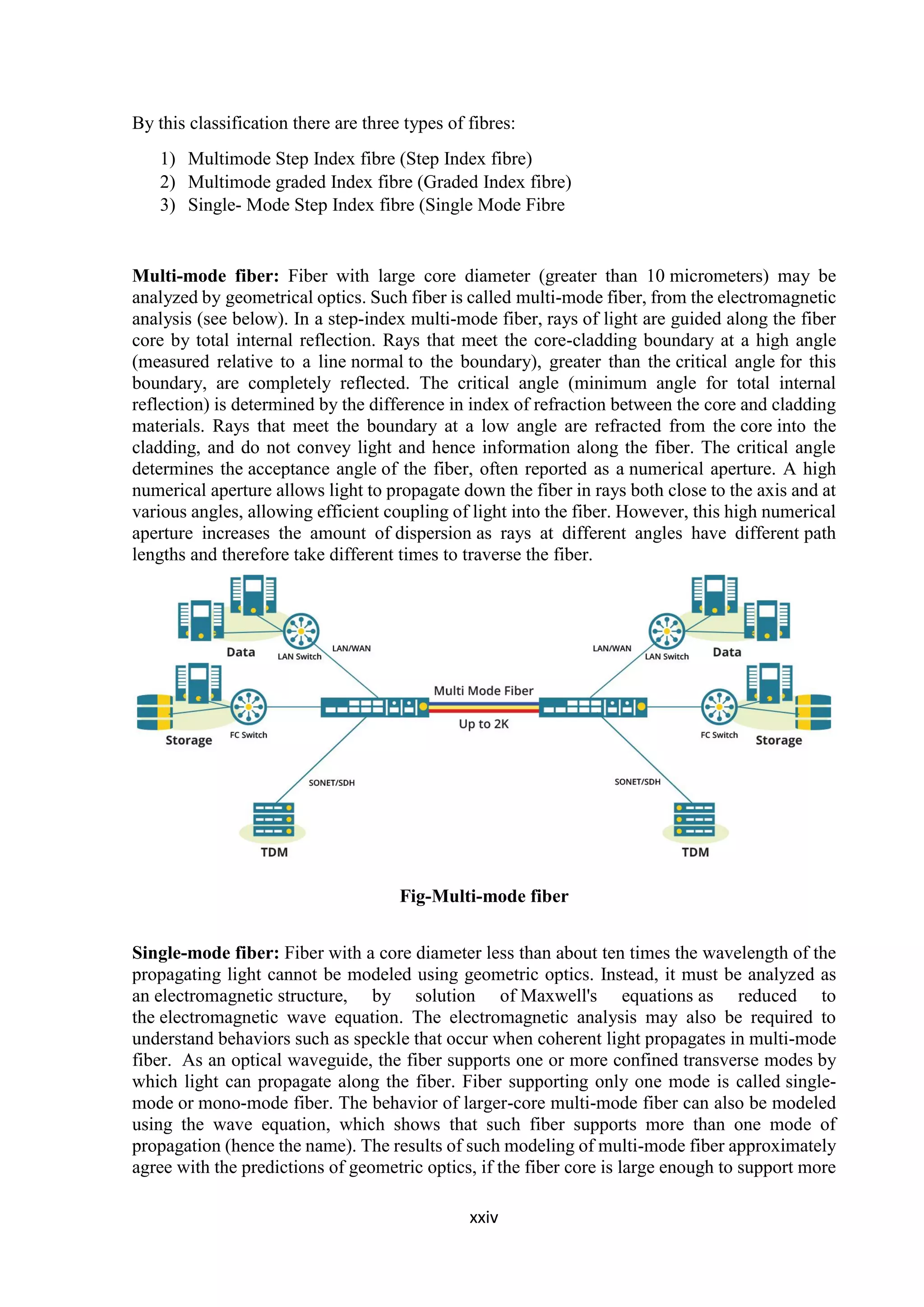
Fig-Multi-mode fiber
Single-mode fiber: Fiber with a core diameter less than about ten times the wavelength of the
propagating light cannot be modeled using geometric optics. Instead, it must be analyzed as
an electromagnetic structure, by solution of Maxwell's equations as reduced to
the electromagnetic wave equation. The electromagnetic analysis may also be required to
understand behaviors such as speckle that occur when coherent light propagates in multi-mode
fiber. As an optical waveguide, the fiber supports one or more confined transverse modes by
which light can propagate along the fiber. Fiber supporting only one mode is called single-
mode or mono-mode fiber. The behavior of larger-core multi-mode fiber can also be modeled
using the wave equation, which shows that such fiber supports more than one mode of
propagation (hence the name). The results of such modeling of multi-mode fiber approximately
agree with the predictions of geometric optics, if the fiber core is large enough to support more
xxv
than a few modes. The waveguide analysis shows that the light energy in the fiber is not
completely confined in the core. Instead, especially in single-mode fibers, a significant fraction
of the energy in the bound mode travels in the cladding as an evanescent wave.
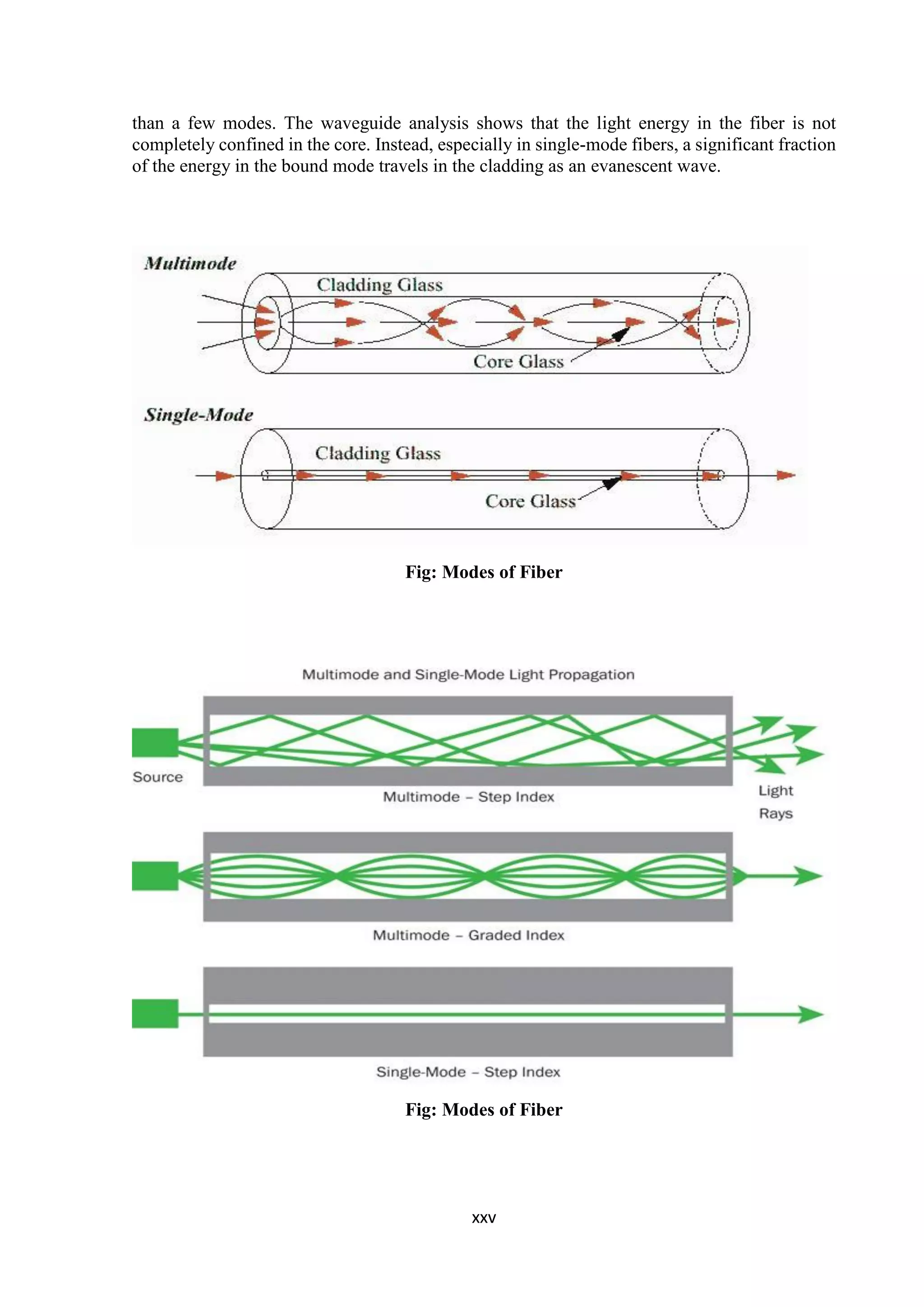
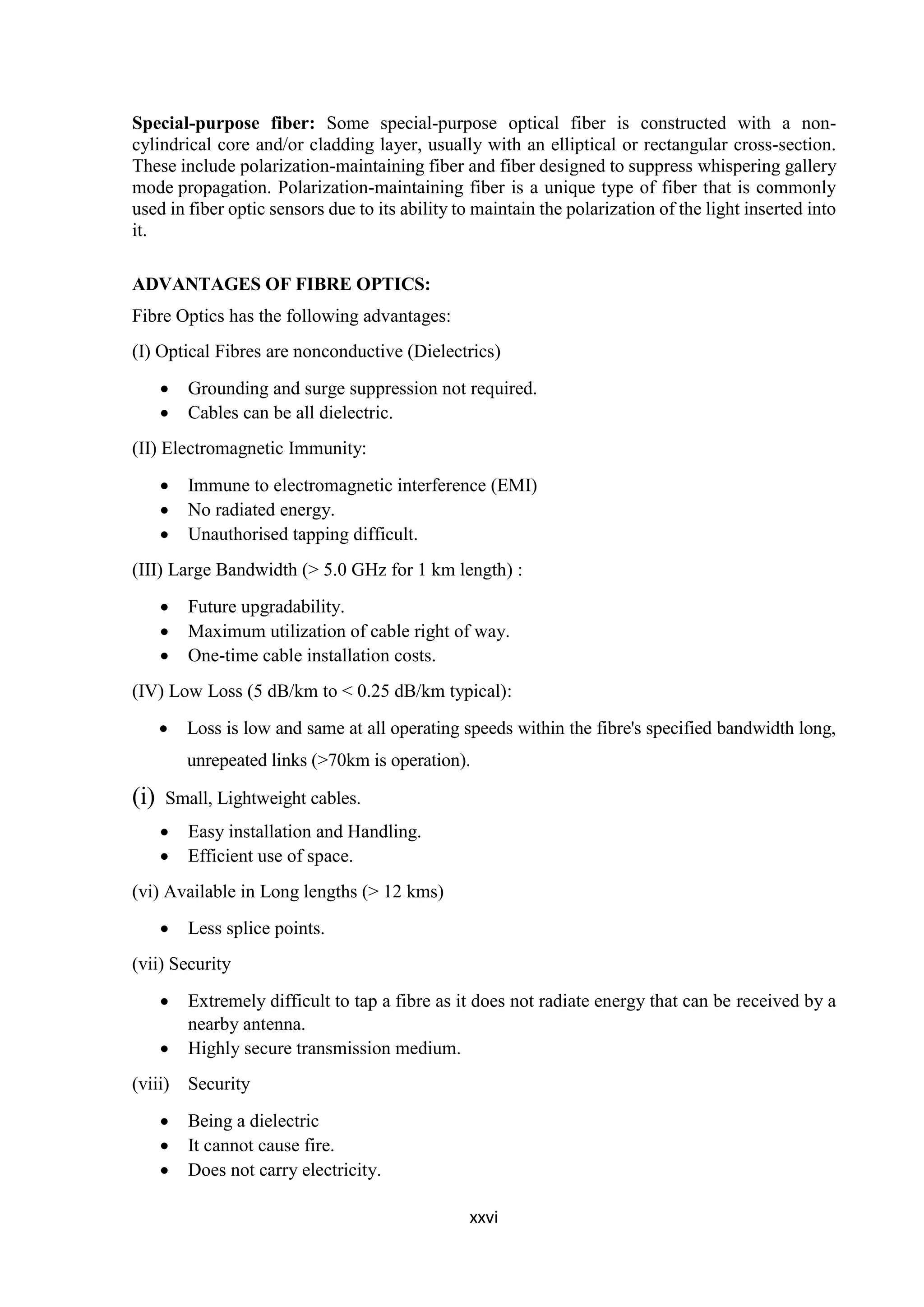
Fig: Modes of Fiber
Fig: Modes of Fiber
xxvi
Special-purpose fiber: Some special-purpose optical fiber is constructed with a non-
cylindrical core and/or cladding layer, usually with an elliptical or rectangular cross-section.
These include polarization-maintaining fiber and fiber designed to suppress whispering gallery
mode propagation. Polarization-maintaining fiber is a unique type of fiber that is commonly
used in fiber optic sensors due to its ability to maintain the polarization of the light inserted into
it.
ADVANTAGES OF FIBRE OPTICS:
Fibre Optics has the following advantages:
(I) Optical Fibres are nonconductive (Dielectrics)
 Grounding and surge suppression not required.
 Cables can be all dielectric.
(II) Electromagnetic Immunity:
 Immune to electromagnetic interference (EMI)
 No radiated energy.
 Unauthorised tapping difficult.
(III) Large Bandwidth (> 5.0 GHz for 1 km length) :
 Future upgradability.
 Maximum utilization of cable right of way.
 One-time cable installation costs.
(IV) Low Loss (5 dB/km to < 0.25 dB/km typical):
 Loss is low and same at all operating speeds within the fibre's specified bandwidth long,
unrepeated links (>70km is operation).
(i) Small, Lightweight cables.
 Easy installation and Handling.
 Efficient use of space.
(vi) Available in Long lengths (> 12 kms)
 Less splice points.
(vii) Security
 Extremely difficult to tap a fibre as it does not radiate energy that can be received by a
nearby antenna.
 Highly secure transmission medium.
(viii) Security
 Being a dielectric
 It cannot cause fire.
 Does not carry electricity.
xxvii
 Can be run through hazardous areas.
(ix) Universal medium
 Serve all communication needs.
 Non-obsolescence.
 Inexpensive light sources available.
 Repeater spacing increases along with operating speeds because low loss fibres are used
at high data rates.
APPLICATION OF FIBRE OPTICS IN COMMUNICATIONS:
 Common carrier nationwide networks.
 Telephone Inter-Office Trunk lines.
 Customer premise communication networks.
 Undersea cables.
 High EMI areas (Power lines, Rails, Roads).
 Factory communication/ Automation.
 Control systems.
 Expensive environments.
 High lightening areas.
 Military applications.
 Classified (secure) communications.
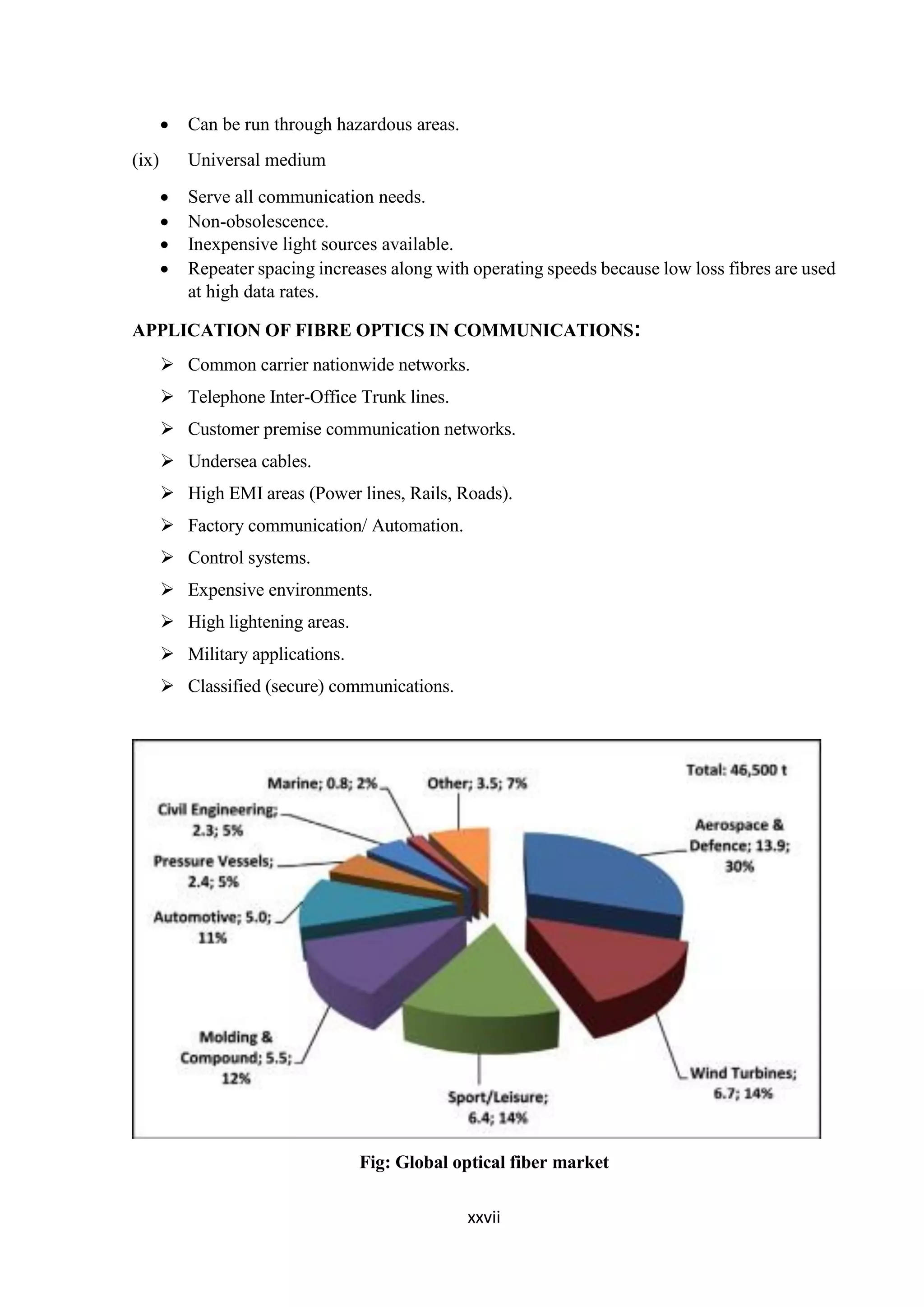
Fig: Global optical fiber market
xxviii
Transmission Sequence:
(1) Information is Encoded into Electrical Signals.
(2) Electrical Signals are Coverted into light Signals.
(3) Light Travels Down the Fiber.
(4) A Detector Changes the Light Signals into Electrical Signals.
(5) Electrical Signals are Decoded into Information.
Principle of Operation - Theory: Total Internal Reflection - The Reflection that Occurs when a
Light Ray Traveling in One Material Hits a Different Material and Reflects Back into the Original
Material without any Loss of Light.
PROPAGATION OF LIGHT THROUGH FIBRE:
The optical fibre has two concentric layers called the core and the cladding. The inner core is
the light carrying part. The surrounding cladding provides the difference refractive index that
allows total internal reflection of light through the core. The index of the cladding is less than
1%, lower than that of the core. Typical values for example are a core refractive index of 1.47
and a cladding index of 1.46. Fibre manufacturers control this difference to obtain desired
optical fibre characteristics.
xxix
The specific characteristics of light propagation through a fibre depends on many factors,
including
 The size of the fibre.
 The composition of the fibre.
 The light injected into the fibre.
FIBRE GEOMETRY:
An Optical fibre consists of a core of optically transparent material usually silica or borosilicate
glass surrounded by a cladding of the same material but a slightly lower refractive index.
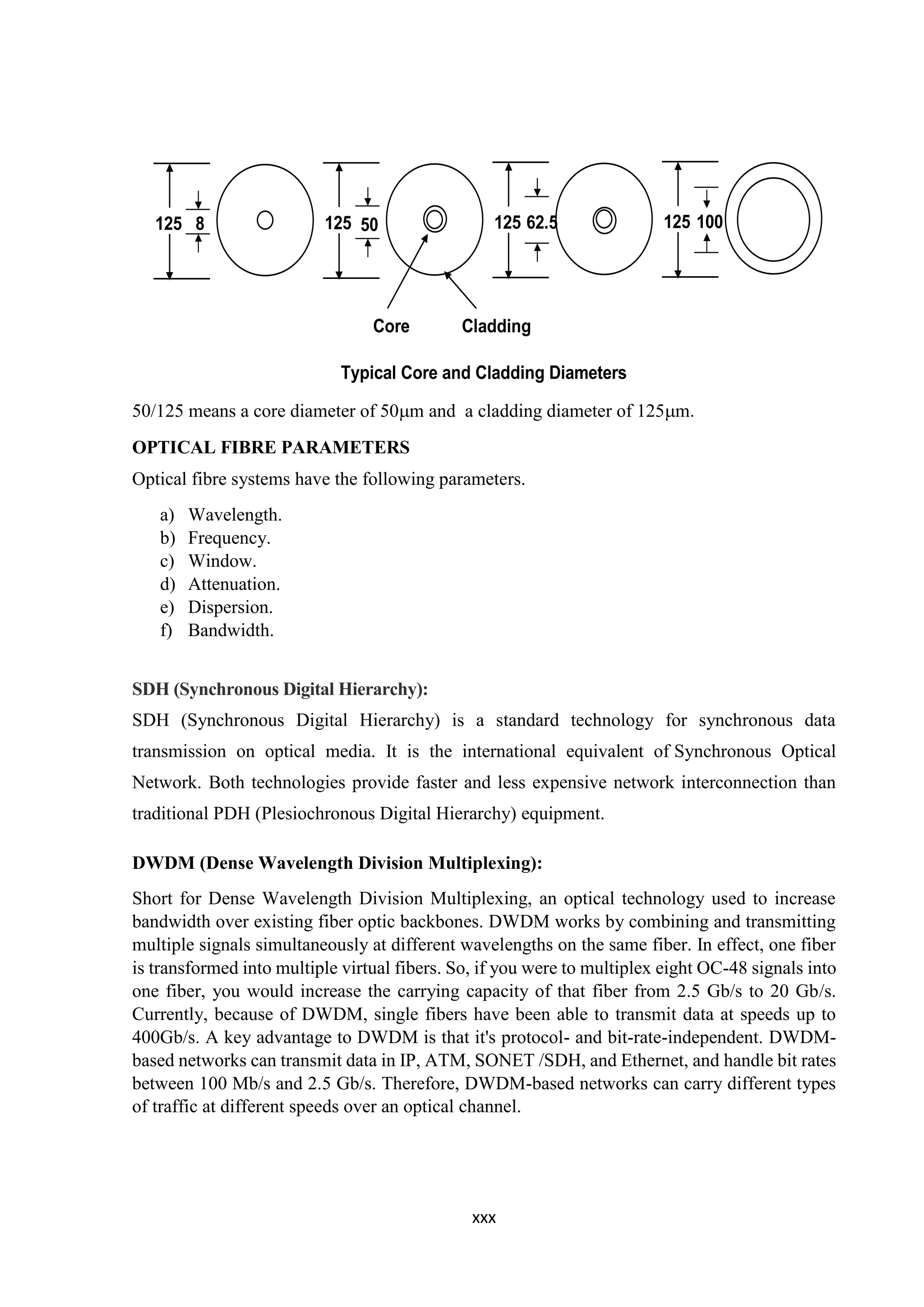
Fibre themselves have exceedingly small diameters. Figure shows cross section of the core and
cladding diameters of commonly used fibres. The diameters of the core and cladding are as
follows.
Core (m) Cladding ( m)
8 125
50 125
62.5 125
100 140
Jacket
Cladding
Core
Cladding
Angle of
reflection
Angle of
incidence
Light at less than
critical angle is
absorbed in jacket
Jacket
Light is propagated by
total internal reflection
Jacket
Cladding
Core
(n2)
(n2)
Fig. Total Internal Reflection in an optical Fibre
xxx
Fibre sizes are usually expressed by first giving the core size followed by the cladding size. Thus
50/125 means a core diameter of 50m and a cladding diameter of 125m.
OPTICAL FIBRE PARAMETERS
Optical fibre systems have the following parameters.
a) Wavelength.
b) Frequency.
c) Window.
d) Attenuation.
e) Dispersion.
f) Bandwidth.
SDH (Synchronous Digital Hierarchy):
SDH (Synchronous Digital Hierarchy) is a standard technology for synchronous data
transmission on optical media. It is the international equivalent of Synchronous Optical
Network. Both technologies provide faster and less expensive network interconnection than
traditional PDH (Plesiochronous Digital Hierarchy) equipment.
DWDM (Dense Wavelength Division Multiplexing):
Short for Dense Wavelength Division Multiplexing, an optical technology used to increase
bandwidth over existing fiber optic backbones. DWDM works by combining and transmitting
multiple signals simultaneously at different wavelengths on the same fiber. In effect, one fiber
is transformed into multiple virtual fibers. So, if you were to multiplex eight OC-48 signals into
one fiber, you would increase the carrying capacity of that fiber from 2.5 Gb/s to 20 Gb/s.
Currently, because of DWDM, single fibers have been able to transmit data at speeds up to
400Gb/s. A key advantage to DWDM is that it's protocol- and bit-rate-independent. DWDM-
based networks can transmit data in IP, ATM, SONET /SDH, and Ethernet, and handle bit rates
between 100 Mb/s and 2.5 Gb/s. Therefore, DWDM-based networks can carry different types
of traffic at different speeds over an optical channel.
125 8 125 50 125 62.5 125 100
Core Cladding
Typical Core and Cladding Diameters
xxxi
Mobile Communication Principles
Principles of Mobile Communication provides an authoritative treatment of the fundamentals
of mobile communications, one of the fastest growing areas of the modern telecommunications
industry. This book stresses the fundamentals of mobile communications engineering that are
important for the design of any mobile system. Less emphasis is placed on the description of
existing and proposed wireless standards. This focus on fundamental issues should be of benefit
not only to students taking formal instruction but also to practicing engineers who are likely to
already have a detailed familiarity with the standards and are seeking to deepen their knowledge
of this important field. Principles of Mobile Communication stresses mathematical modelling
and analysis, rather than providing a qualitative overview. It has been specifically developed as
a textbook for graduate level instruction and a reference book for practicing engineers and those
seeking to pursue research in the area. Principles of Mobile Communication contains sufficient
background material for novice, yet enough advance material for a sequence of graduate level
courses. Wireless systems and services have undergone a remarkable development since the
first cellular system was introduced in the early 1980s. There have been quite a few books on
the topic since then. This book differs from others on the subject by focusing on mathematical
modelling and theoretical analysis. As the title suggests, the book stresses the fundamentals of
mobile communications engineering that are important to any mobile communication systems
rather than the systems or devices themselves.
Cellular Principles:
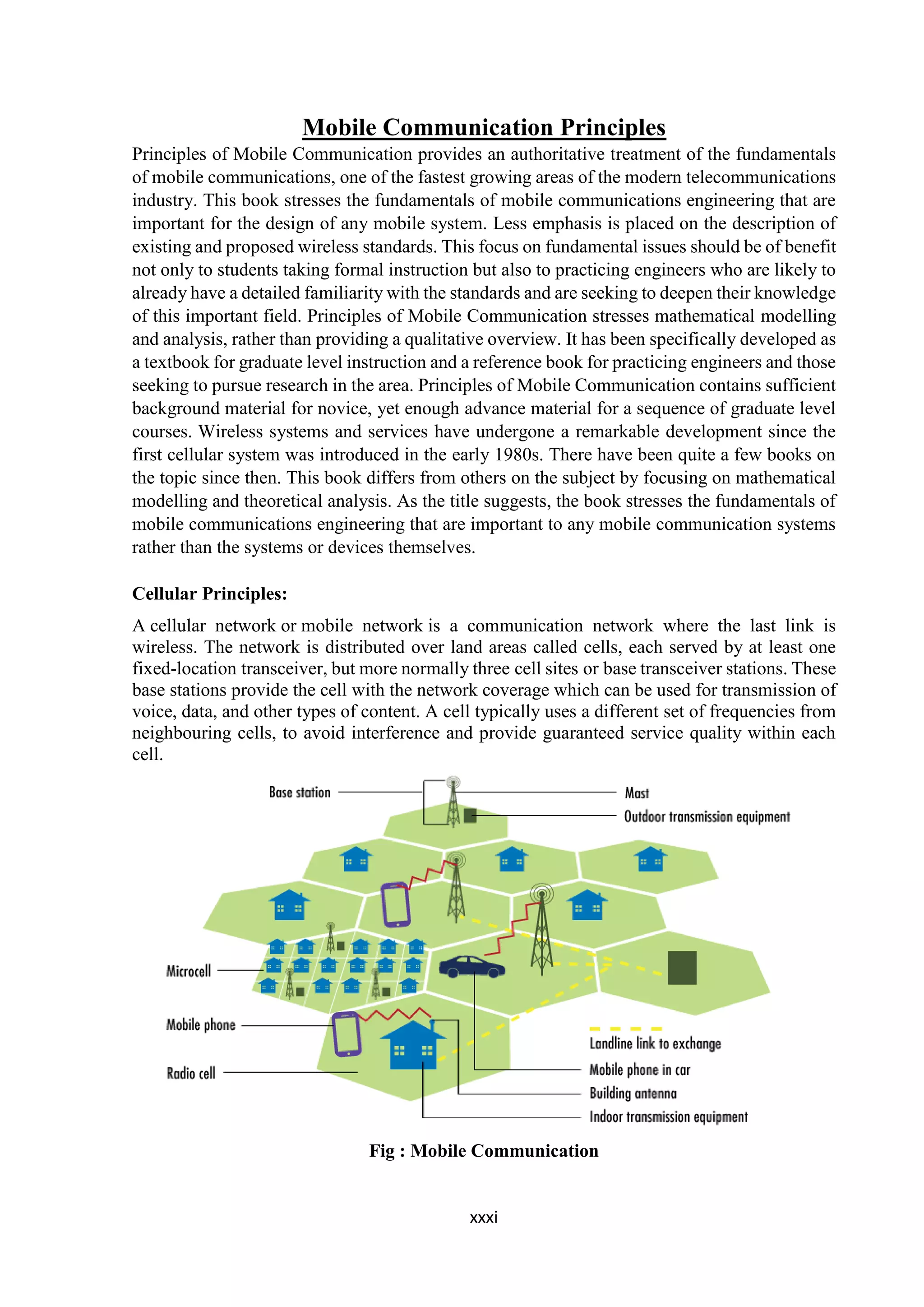
A cellular network or mobile network is a communication network where the last link is
wireless. The network is distributed over land areas called cells, each served by at least one
fixed-location transceiver, but more normally three cell sites or base transceiver stations. These
base stations provide the cell with the network coverage which can be used for transmission of
voice, data, and other types of content. A cell typically uses a different set of frequencies from
neighbouring cells, to avoid interference and provide guaranteed service quality within each
cell.
Fig : Mobile Communication
xxxii
When joined together, these cells provide radio coverage over a wide geographic area. This
enables a large number of portable transceivers (e.g., mobile phones, tablets and laptops
equipped with mobile broadband modems, pagers, etc.) to communicate with each other and
with fixed transceivers and telephones anywhere in the network, via base stations, even if some
of the transceivers are moving through more than one cell during transmission.
Fig: Network structure
Cellular networks offer a number of desirable features:
 More capacity than a single large transmitter, since the same frequency can be used for
multiple links as long as they are in different cells
 Mobile devices use less power than with a single transmitter or satellite since the cell
towers are closer
 Larger coverage area than a single terrestrial transmitter, since additional cell towers can
be added indefinitely and are not limited by the horizon
Major telecommunications providers have deployed voice and data cellular networks over most
of the inhabited land area of Earth. This allows mobile phones and mobile computing devices
to be connected to the public switched telephone network and public Internet. Private cellular
networks can be used for research[2]
or for large organizations and fleets, such as dispatch for
local public safety agencies or a taxicab company.
Concept: In a cellular radio system, a land area to be supplied with radio service is divided into
cells, in a pattern which depends on terrain and reception characteristics but which can consist
of roughly hexagonal, square, circular or some other regular shapes, although hexagonal cells
are conventional. Each of these cells is assigned with multiple frequencies (f1– f6) which have
corresponding radio base stations. The group of frequencies can be reused in other cells,
provided that the same frequencies are not reused in adjacent neighbouring cells as that would
cause interference. The increased capacity in a cellular network, compared with a network with
a single transmitter, comes from the mobile communication switching system developed
by Amos Joel of Bell Labs[4]
that permitted multiple callers in the same area to use the same
frequency by switching calls made using the same frequency to the nearest available cellular
xxxiii
tower having that frequency available and from the fact that the same radio frequency can be
reused in a different area for a completely different transmission. If there is a single plain
transmitter, only one transmission can be used on any given frequency.
Fig: Frequency reuse
Cell towers frequently use a directional signal to improve reception in higher-traffic areas. In
the United States, the FCC limits omnidirectional cell tower signals to 100 watts of power. If
the tower has directional antennas, the FCC allows the cell operator to broadcast up to 500 watts
of effective radiated power (ERP).
Although the original cell towers created an even, omnidirectional signal, were at the centers
of the cells and were omnidirectional, a cellular map can be redrawn with the cellular telephone
towers located at the corners of the hexagons where three cells converge.[9]
Each tower has
three sets of directional antennas aimed in three different directions with 120 degrees for each
cell (totaling 360 degrees) and receiving/transmitting into three different cells at different
frequencies.
The numbers in the illustration are channel numbers, which repeat every 3 cells. Large cells can
be subdivided into smaller cells for high volume areas.
Fig: Cellular telephone frequency reuse pattern
xxxiv
GSM (Global System for Mobile communications):
It is a standard developed by the European Telecommunications Standards Institute (ETSI) to
describe the protocols for second-generation digital cellular networks used by mobile
devices such as tablets. It was first deployed in Finland in December 1991. As of 2014, it has
become the global standard for mobile communications – with over 90% market share,
operating in over 193 countries and territories.
2G networks developed as a replacement for first generation (1G) analog cellular networks, and
the GSM standard originally described a digital, circuit-switched network optimized for full
duplex voice telephony. This expanded over time to include data communications, first by
circuit-switched transport, then by packet data transport via GPRS (General Packet Radio
Services) and EDGE (Enhanced Data rates for GSM Evolution, or EGPRS).
Subsequently, the 3GPP developed third-generation (3G) UMTS standards, followed by
fourth-generation (4G) LTE Advanced standards, which do not form part of the ETSI GSM
standard.
"GSM" is a trademark owned by the GSM Association. It may also refer to the (initially) most
common voice codec used, Full Rate.
Fig: GSM logo
Working: :
GSM is combination of TDMA (Time Division Multiple Access), FDMA (Frequency Division
Multiple Access) and Frequency hopping. Initially, GSM use two frequency bands of 25 MHz
width: 890 to 915 MHz frequency band for up-link and 935 to 960 MHz frequency for down-
link. Later on, two 75 MHz band were added. 1710 to 1785 MHz for up-link and 1805 to 1880
MHz for down-link. up-link is the link from ground station to a satellite and down-link is the
link from a satellite down to one or more ground stations or receivers. GSM divides the 25 MHz
band into 124 channels each having 200 KHz width and remaining 200 KHz is left unused as a
guard band to avoid interference.
Control channels: These are main control channels in GSM:
1. BCH (Broadcast Channel): It is for down-link only. It has following types –
xxxv
1. BCCH (Broadcast Control Channel): It broadcasts information about the serving
cell.
2. SCH (Synchronization channel): Carries information like frame number and BSIC
(Base Station Identity Code) for frame synchronization.
3. FCCH (Frequency Correction Channel): Enable MS to synchronize to frequency.
2. CCCH (Common Control Channel): It has following types –
1. RACH (Random Access Channel): Used by MS when making its first access to
network. It is for up-link only.
2. AGCH (Access Grant Channel): Used for acknowledgement of the access attempt
sent on RACH. It is for down-link only.
3. PCH (Paging Channel): Network page the MS, if there is an incoming call or a short
message. It is for down-link only.
3. DCCH (Dedicated Control Channel): It is for both up-link and down-link. It has following
types –
1. SDCCH (Stand-alone Dedicated Control Channel): It is used for call setup,
authentication, ciphering location update and SMS.
2. SACCH (Slow Associated Control Channel): Used to transfer signal while MS have
ongoing conversation on topic or while SDCCH is being used.
3. FACCH (Fast Associated Control Channel): It is used to send fast message like hand
over message.
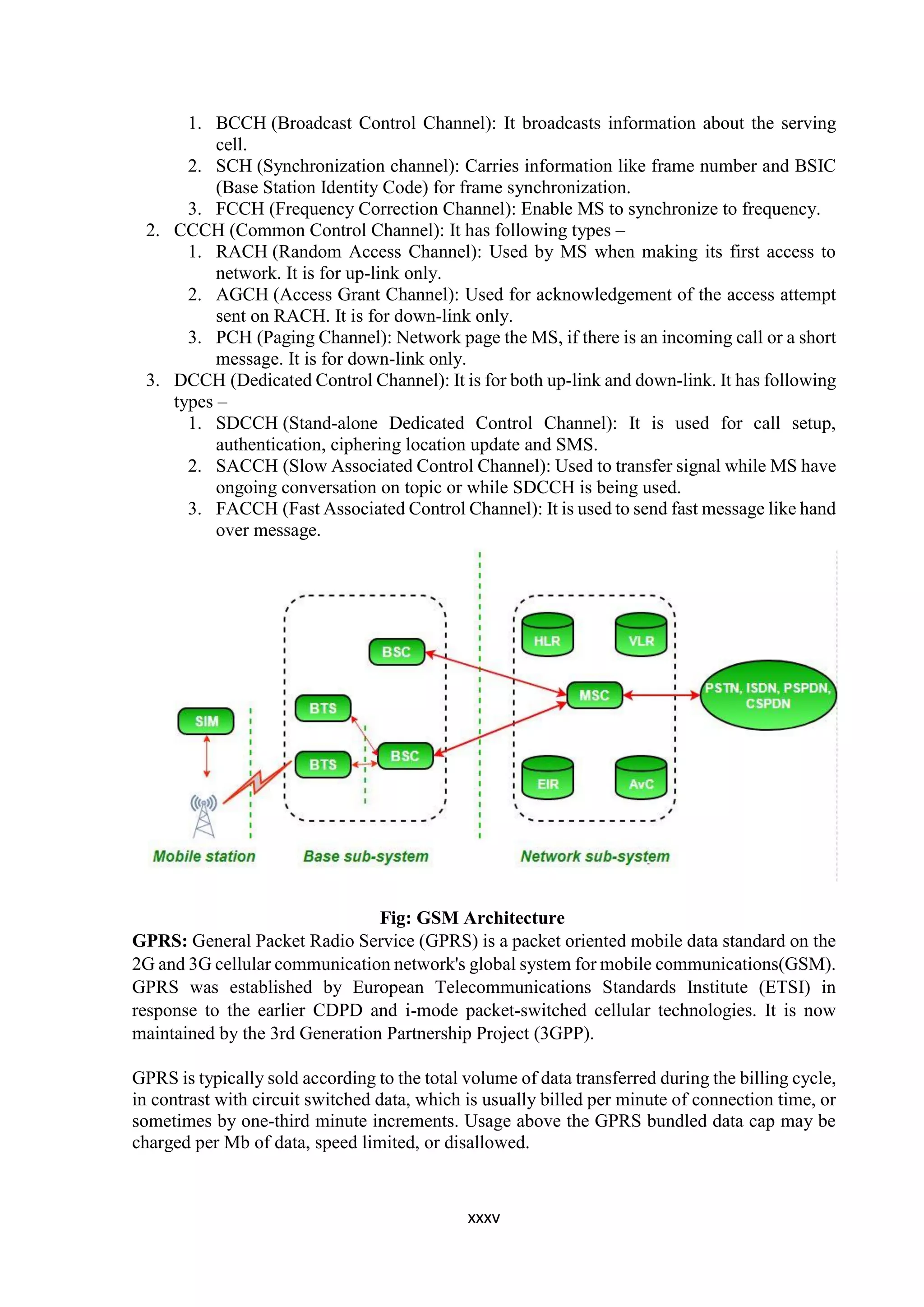
Fig: GSM Architecture
GPRS: General Packet Radio Service (GPRS) is a packet oriented mobile data standard on the
2G and 3G cellular communication network's global system for mobile communications(GSM).
GPRS was established by European Telecommunications Standards Institute (ETSI) in
response to the earlier CDPD and i-mode packet-switched cellular technologies. It is now
maintained by the 3rd Generation Partnership Project (3GPP).
GPRS is typically sold according to the total volume of data transferred during the billing cycle,
in contrast with circuit switched data, which is usually billed per minute of connection time, or
sometimes by one-third minute increments. Usage above the GPRS bundled data cap may be
charged per Mb of data, speed limited, or disallowed.
xxxvi
GPRS is a best-effort service, implying variable throughput and latency that depend on the
number of other users sharing the service concurrently, as opposed to circuit switching, where
a certain quality of service (QoS) is guaranteed during the connection. In 2G systems, GPRS
provides data rates of 56–114 kbit/sec. 2G cellular technology combined with GPRS is
sometimes described as 2.5G, that is, a technology between the second (2G) and third (3G)
generations of mobile telephony.[4] It provides moderate-speed data transfer, by using unused
time division multiple access (TDMA) channels in, for example, the GSM system. GPRS is
integrated into GSM Release 97 and newer releases.
EDGE: It is a data system used on top of GSM networks. It provides nearly three times faster
speeds than the outdated GPRS system. The theoretical maximum speed is 473 kbps for 8
timeslots but it is typically limited to 135 kbps in order to conserve spectrum resources. Both
phone and network must support EDGE, otherwise the phone will revert automatically to
GPRS.
EDGE meets the requirements for a 3G network but is usually classified as 2.75G.
Enhanced Data rates for GSM Evolution (EDGE) (also known as Enhanced GPRS (EGPRS),
or IMT Single Carrier (IMT-SC), or Enhanced Data rates for Global Evolution) is a
digital mobile phone technology that allows improved data transmission rates as a backward-
compatible extension of GSM. EDGE is considered a pre-3G radio technology and is part
of ITU's 3G definition.[1]
EDGE was deployed on GSM networks beginning in 2003 – initially
by Cingular(now AT&T) in the United States.
EDGE is standardized also by 3GPP as part of the GSM family. A variant, so called Compact-
EDGE, was developed for use in a portion of Digital AMPSnetwork spectrum.
Through the introduction of sophisticated methods of coding and transmitting data, EDGE
delivers higher bit-rates per radio channel, resulting in a threefold increase in capacity and
performance compared with an ordinary GSM/GPRS connection.
EDGE can be used for any packet switched application, such as an Internet connection.
Evolved EDGE continues in Release 7 of the 3GPP standard providing reduced latency and
more than doubled performance e.g. to complement High-Speed Packet Access (HSPA). Peak
bit-rates of up to 1 Mbit/s and typical bit-rates of 400 kbit/s can be expected.
CDMA: Code-division multiple access (CDMA) is a channel access method used by
various radio communication technologies.
CDMA is an example of multiple access, where several transmitters can send information
simultaneously over a single communication channel. This allows several users to share a band
of frequencies (see bandwidth). To permit this without undue interference between the users,
CDMA employs spread spectrum technology and a special coding scheme (where each
transmitter is assigned a code).
CDMA is used as the access method in many mobile phone standards. IS-95, also called
"cdmaOne", and its 3G evolution CDMA2000, are often simply referred to as "CDMA",
but UMTS, the 3G standard used by GSM carriers, also uses "wideband CDMA", or W-
CDMA, as well as TD-CDMA and TD-SCDMA, as its radio technologies.
xxxvii
Working:
CDMA allows up to 61 concurrent users in a 1.2288 MHz channel by processing each voice
packet with two PN codes. There are 64 Walsh codes available to differentiate between calls
and theoretical limits. Operational limits and quality issues will reduce the maximum number
of calls somewhat lower than this value.
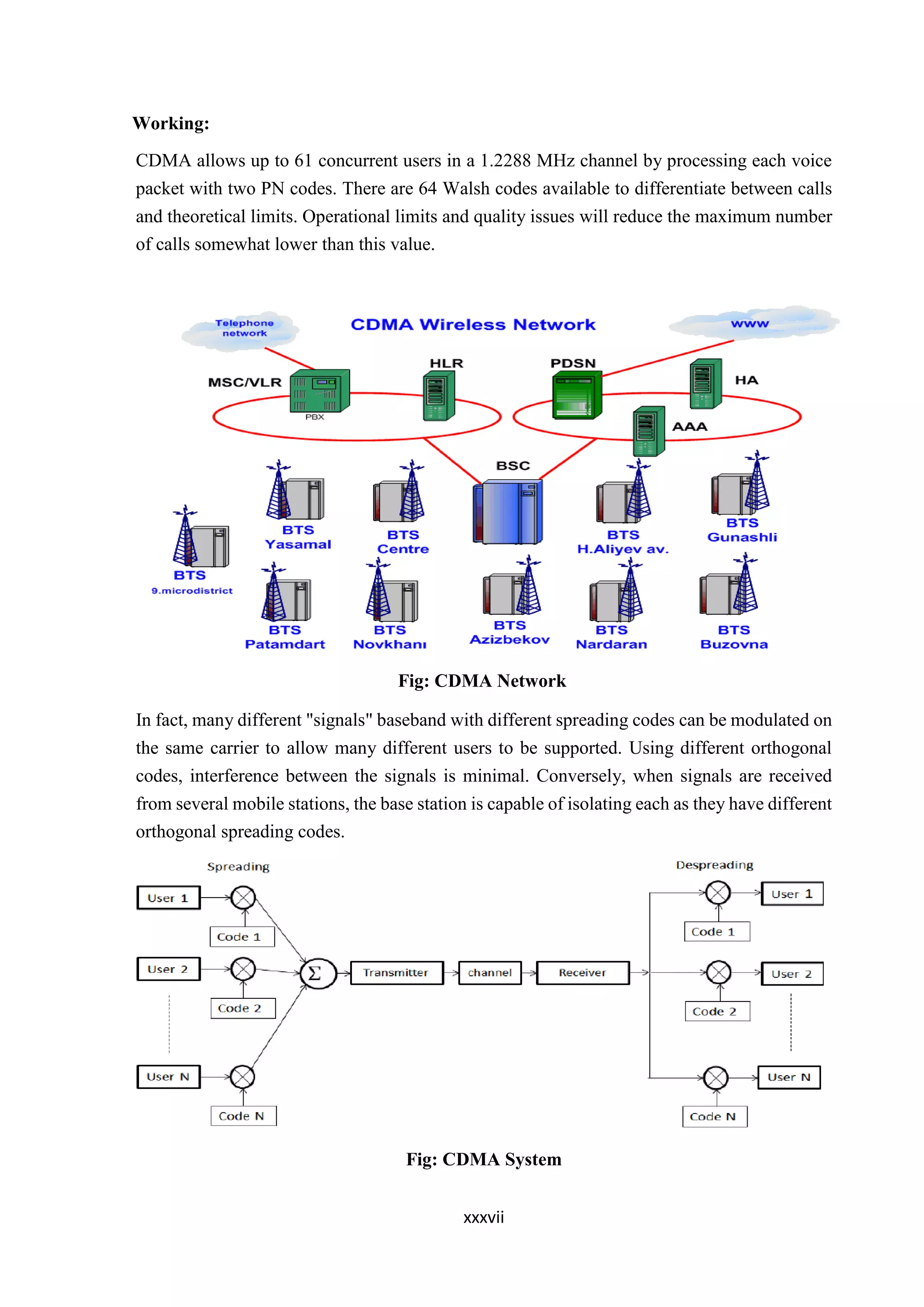
Fig: CDMA Network
In fact, many different "signals" baseband with different spreading codes can be modulated on
the same carrier to allow many different users to be supported. Using different orthogonal
codes, interference between the signals is minimal. Conversely, when signals are received
from several mobile stations, the base station is capable of isolating each as they have different
orthogonal spreading codes.
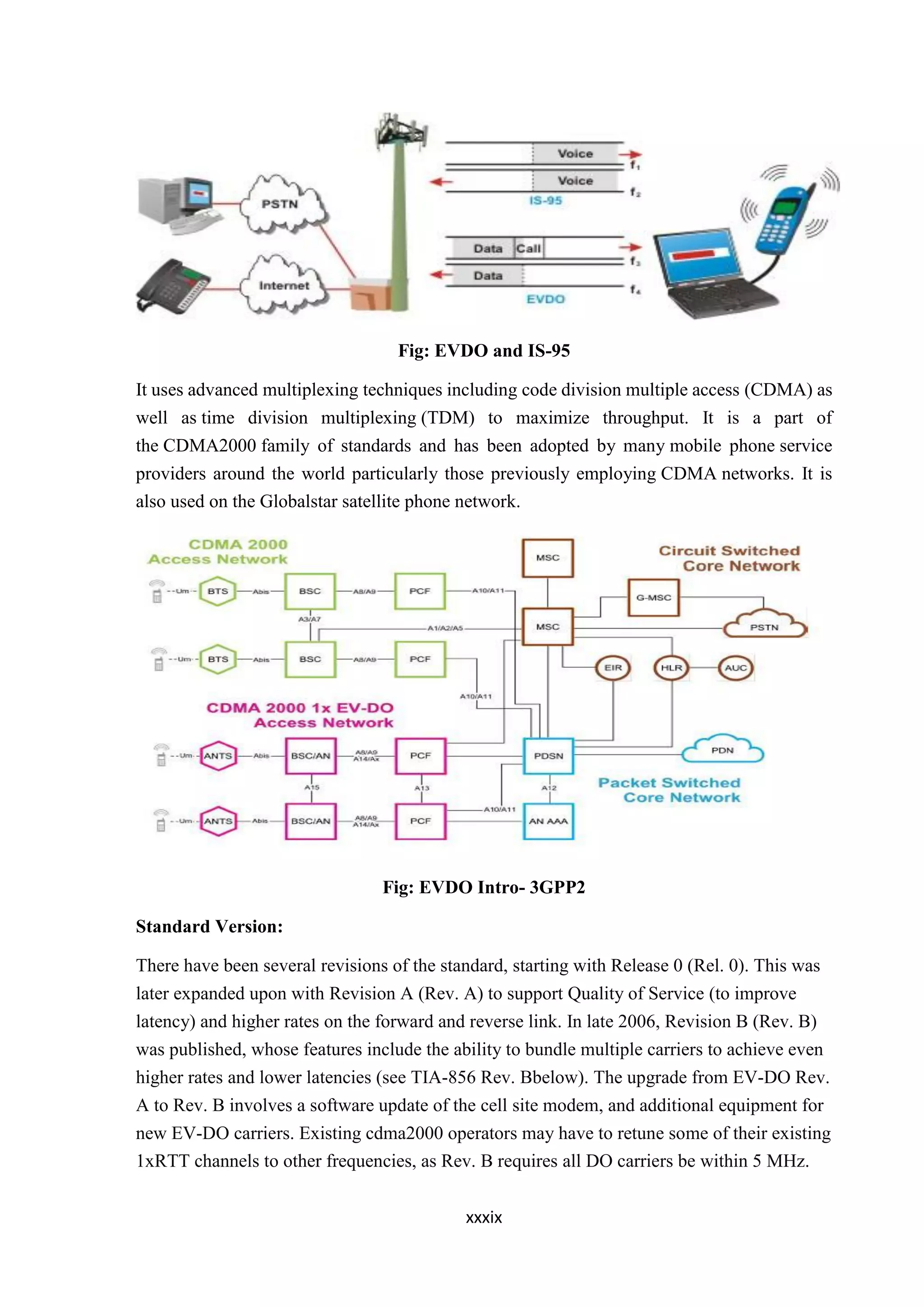
Fig: CDMA System
xxxviii
The following figure shows the technicality of the CDMA system. During the propagation, we
mixed the signals of all users, but by that you use the same code as the code that was used at
the time of sending the receiving side. You can take out only the signal of each user.
Processing gain:
CDMA is a spread spectrum technique. Each data bit is spread by a code sequence. This means,
energy per bit is also increased. This means that we get a gain of this.
P (gain) = 10log (W/R)
W is Spread Rate
R is Data Rate
For CDMA P (gain) = 10 log (1228800/9600) = 21dB
This is a gain factor and the actual data propagation rate. On an average, a typical transmission
condition requires a signal to the noise ratio of 7 dB for the adequate quality of voice.
Translated into a ratio, signal must be five times stronger than noise.
Actual processing gain = P (gain) – SNR
= 21 – 7 = 14dB
CDMA uses variable rate coder
The Voice Activity Factor of 0.4 is considered = -4dB.
Hence, CDMA has 100% frequency reuse. Use of same frequency in surrounding cells causes
some additional interference.
In CDMA frequency, reuse efficiency is 0.67 (70% eff.) = -1.73dB
Evolution-Data Optimized (EV-DO, EVDO):
It is a telecommunications standard for the wireless transmission of data through radio signals,
typically for broadband Internet access. EV-DO is an evolution of the CDMA2000 (IS-2000)
standard which supports high data rates and can be deployed alongside a wireless carrier's
voice services.
An EV-DO channel has a bandwidth of 1.25 MHz, the same bandwidth size that IS-95A (IS-
95) and IS-2000 (1xRTT) use,[3]
though the channel structure is very different. The back-end
network is entirely packet-based, and is not constrained by restrictions typically present on
a circuit switched network.
xxxix
Fig: EVDO and IS-95
It uses advanced multiplexing techniques including code division multiple access (CDMA) as
well as time division multiplexing (TDM) to maximize throughput. It is a part of
the CDMA2000 family of standards and has been adopted by many mobile phone service
providers around the world particularly those previously employing CDMA networks. It is
also used on the Globalstar satellite phone network.
Fig: EVDO Intro- 3GPP2
Standard Version:
There have been several revisions of the standard, starting with Release 0 (Rel. 0). This was
later expanded upon with Revision A (Rev. A) to support Quality of Service (to improve
latency) and higher rates on the forward and reverse link. In late 2006, Revision B (Rev. B)
was published, whose features include the ability to bundle multiple carriers to achieve even
higher rates and lower latencies (see TIA-856 Rev. Bbelow). The upgrade from EV-DO Rev.
A to Rev. B involves a software update of the cell site modem, and additional equipment for
new EV-DO carriers. Existing cdma2000 operators may have to retune some of their existing
1xRTT channels to other frequencies, as Rev. B requires all DO carriers be within 5 MHz.
xl
Broadband DSL Technologies
Digital subscriber line (DSL; originally digital subscriber loop) is a family of technologies that
are used to transmit digital data over telephone lines. In telecommunications marketing, the
term DSL is widely understood to mean asymmetric digital subscriber line(ADSL), the most
commonly installed DSL technology, for Internet access.
DSL service can be delivered simultaneously with wired telephone service on the same
telephone line since DSL uses higher frequency bands for data. On the customer premises,
a DSL filter on each non-DSL outlet blocks any high-frequency interference to enable
simultaneous use of the voice and DSL services.
Fig: DSL Modem schematics
The bit rate of consumer DSL services typically ranges from 256 kbit/s to over 100 Mbit/s in
the direction to the customer (downstream), depending on DSL technology, line conditions, and
service-level implementation. Bit rates of 1 Gbit/s have been reached.
In ADSL, the data throughput in the upstream direction (the direction to the service provider)
is lower, hence the designation of asymmetric service. In symmetric digital subscriber
line (SDSL) services, the downstream and upstream data rates are equal. Researchers at Bell
Labs have reached speeds over 1 Gbit/s for symmetrical broadband access services using
traditional copper telephone lines. These higher speeds are lab results, however.
Fig: DSL setup
xli
Principles Network Architecture of DSL:
This chapter provides a brief overview of available asymmetric DSL (ADSL) architecture
options. A typical ADSL service architecture is illustrated in Fig. In the architecture illustrated,
the network consists of Customer Premise Equipment (CPE), the Network Access Provider
(NAP) and the Network Service Provider (NSP). CPE refers to an end-user workstation (such
as a PC) together with an ADSL modem or ADSL terminating unit router (ATU-R). The NAP
provides ADSL line termination by using DSL access multiplexers (DSLAMs). The DSLAM
forwards traffic to the local access concentrator, which is used for Point-to-Point Protocol (PPP)
tunnelling and Layer 3 termination. From the Layer 2 Tunnelling Protocol Access Concentrator
(LAC), services extend over the ATM core to the NSP.
Fig: Overview of a DSL network deployment including CPE, NAP and NSP components
DSL Broadband Services:
VARIOUS TYPES OF DSL BOARDBAND INTERNET CONNECTIONS
There are a variety of flavors when it comes to Digital Subscriber Line (DSL) broadband
Internet connection. DSL is a technology that brings high bandwidth Internet connection to
homes and businesses over ordinary copper telephone lines. DSL technology allows data
transmission at speeds much faster than the best available analog and digital modems. We'll
explain a few of the variety of DSL connections below.
DSL is a generic term used for a family of related technologies, including RADSL, ADSL,
SDSL, IDSL, and others. The leading DSL technologies being deployed today include:
RADSL - (Rate Adaptive Digital Subscriber Line)
xlii
Most robust business DSL available today;
Developed to overcome line impediments;
Automatically adjusts for environmental conditions; - Because RADSL is a type of SDSL, it
supports symmetric (equal downstream and upstream) data transmissions up to 768K.
ADSL - Asymmetrical Digital Subscriber Line
ADSL supports a range of asymmetric (higher downstream than upstream) data speeds that can
reach up to 7 mbps downstream and 1.5 mbps upstream. ADSL can deliver simultaneous high-
speed data and telephone service over the same line.
ADSL Lite (or G.lite)
This is a lower speed version of ADSL and provides downstream speeds of up to 1Mbps and
upstream speeds of 512 kbps, at a distance of 18,000 feet from the service provider’s premises.
It is intended to simplify DSL installation at the user’s end.
R-ADSL - Rate-Adapative Digital Subscriber Line
The R-ADSL provides the same transmission rates as ADSL, but an R-ADSL modem can
dynamically adjust the speed of the connection depending on the length and quality of the line.
HDSL - Hight Bit-Rate Digital Subscriber Line
The HDSL provides a symmetric connection, that is, upstream speeds and downstream speeds
are the same, and range from 1.544 Mbps to 2.048 Mbps at a distance of 12,000–15,000 feet.
Symmetric connections are more useful in applications like videoconferencing, where data sent
upstream is as heavy as data sent downstream. HDSL-II, which will provide the same
transmission rates but over a single copper-pair wire, is also round the block.
xliii
IDSL - ISDN Digital Subscriber Line
The ISDN Digital Subscriber Line provides up to 144 kbps transmission speeds at a distance of
18,000 feet (can be extended), and uses the same techniques to transfer data as ISDN lines. The
advantage is that, unlike ISDN, this is an ‘always on’ connection.
SDSL - Symmetric Digital Subscriber Line
SDSL supports symmetric (equal downstream and upstream) data transmissions up to 1.54
mbps.
VDSL - Very High Bit-rate Digital Subscriber Line
VDSL is the fastest of all xDSL flavors and provides transmission rates of 13–52 Mbps
downstream and 1.5–2.3 Mbps upstream over a single copper-pair wire, at a distance of 1,000–
4,500 feet from the service provider’s premises.
Data Network Concepts & IP Fundamentals:
On the customer side, the DSL transceiver, or ATU-R, or more commonly known as a DSL
modem, is hooked up to a phone line. The telephone company connects the other end of the line
to a DSLAM, which concentrates a large number of individual DSL connections into a single
box. The location of the DSLAM depends on the telco, but it cannot be located too far from the
user because of attenuation between the DSLAM and the user's DSL modem. It is common for
a few residential blocks to be connected to one DSLAM.
The accompanying figure is a schematic of a simple DSL connection (in blue). The right side
shows a DSLAM residing in the telephone company's central office. The left side shows the
customer premises equipment with an optional router. The router manages a local area network
(LAN) which connects PCs and other local devices. With many service providers, the customer
may opt for a modem which contains both a router and wireless access. This option (within the
dashed bubble) often simplifies the connection.
DSL modem initialization:
When the DSL modem powers up it goes through a series of steps to establish connections. The
actual process varies from modem to modem but generally involves the following steps:
1. The DSL transceiver performs a self-test, including image load and activation.
2. The DSL transceiver then attempts to synchronize with the DSLAM. Data can only
come into the computer when the DSLAM and the modem are synchronized. The
synchronization process is relatively quick (in the range of seconds) but is very
complex, involving extensive tests that allow both sides of the connection to optimize
the performance for line characteristics including noise and error handling. External, or
standalone modem units have an indicator labeled "CD", "DSL", or "LINK", which can
be used to tell if the modem is synchronized. During synchronization the light flashes;
when synchronized, the light stays lit, usually green.
3. If supported, the DSL transceiver establishes a gateway internet connection.
4. The DSL transceiver establishes a connection with the router or computer. For
residential variations of DSL, this is usually the Ethernet (RJ-45) port or a USB port;
in rare models, a FireWire port is used. Older DSL modems sported a native ATM
interface (usually, a 25 Mbit/s serial interface). Also, some variations of DSL (such as
SDSL) use synchronous serial connections.
xliv
Modern DSL gateways often integrate routing and other functionality. Their initialization is
very similar to a PC boot up. The system image is loaded from the flash storage; the system
boots, synchronizes the DSL connection and finally establishes the internet IP services and
connection between the local network and the service provider, using protocols such
as DHCP or PPPoE. According to Implementation and Applications of DSL
Technology (2007), the PPPoE method far outweighed DHCP in terms of deployment on DSLs,
and PAP was the predominant form of subscriber authentication used in such circumstances.
The system image can usually be updated to correct bugs, or to add new functionality.
Protocols and configurations:
Many DSL technologies implement an asynchronous transfer mode (ATM) layer over the low-
level bitstream layer to enable the adaptation of a number of different technologies over the
same link.
Fig: Part of DSL Network
DSL implementations may create bridged or routed networks. In a bridged configuration, the
group of subscriber computers effectively connect into a single subnet. The earliest
implementations used DHCP to provide network details such as the IP address to the subscriber
equipment, with authentication via MAC address or an assigned host name. Later
implementations often use Point-to-Point Protocol (PPP) to authenticate with a user ID and
password, and to provide network details (Point-to-Point Protocol over Ethernet (PPPoE) or
Point-to-Point Protocol over ATM (PPPoA)).
xlv
Intelligent Network
The Intelligent Network (IN) is the standard network architecture specified in the ITU-T
Q.1200 series recommendations. It is intended for fixed as well as mobile telecomnetworks. It
allows operators to differentiate themselves by providing value-added services in addition to
the standard telecom services such as PSTN, ISDN on fixed networks, and GSM
services on mobile phones or other mobile devices.
The intelligence is provided by network nodes on the service layer, distinct from
the switching layer of the core network, as opposed to solutions based on intelligence in the
core switches or equipment. The IN nodes are typically owned by telecommunications service
providers such as a telephone company or mobile phone operator.
IN is supported by the Signaling System #7 (SS7) protocol between network switching centers
and other network nodes owned by network operators.
Fig: Intelligent Network
Network Architecture:
The main concepts (functional view) surrounding IN services or architecture are connected
with SS7 architecture:
 Service Switching Function (SSF) or Service Switching Point (SSP) is co-located with the
telephone exchange, and acts as the trigger point for further services to be invoked during
a call. The SSP implements the Basic Call State Machine (BCSM) which is a Finite state
machine that represents an abstract view of a call from beginning to end (off hook, dialing,
answer, no answer, busy, hang up, etc.). As each state is traversed, the exchange
encounters Detection Points (DPs) at which the SSP may invoke a query to the SCP to wait
for further instructions on how to proceed. This query is usually called a trigger. Trigger
criteria are defined by the operator and might include the subscriber calling number or the
dialed number. The SSF is responsible for controlling calls requiring value added services.
 Service Control Function (SCF) or Service Control Point (SCP) is a separate set of
platforms that receive queries from the SSP. The SCP contains service logic which
implements the behaviour desired by the operator, i.e., the services. During service logic
processing, additional data required to process the call may be obtained from the SDF. The
logic on the SCP is created using the SCE.
xlvi
 Service Data Function (SDF) or Service Data Point (SDP) is a database that contains
additional subscriber data, or other data required to process a call. For example, the
subscriber's remaining prepaid credit may be stored in the SDF to be queried in real-time
during the call. The SDF may be a separate platform or co-located with the SCP.
 Service Management Function (SMF) or Service Management Point (SMP) is a platform
or cluster of platforms that operators use to monitor and manage the IN services. It contains
the management database which stores the services' configuration, collects the statistics and
alarms, and stores the Call Data Reports and Event Data Reports.
 Service Creation Environment (SCE) is the development environment used to create the
services present on the SCP. Although the standards permit any type of environment, it is
fairly rare to see low level languages like C used. Instead, proprietary graphical languages
are used to enable telecom engineers to create services directly. The languages are usually
of the fourth-generation type, and the engineer may use a graphical interface to build or
change a service.
 Specialized Resource Function (SRF) or Intelligent Peripheral (IP) is a node which can
connect to both the SSP and the SCP and deliver special resources into the call, mostly
related to voice communication, for example to play voice announcements or
collect DTMF tones from the user.
Fig: IN services or architecture with ss7
IN is a way of implementing services in nodes separate from exchanges:
INAP = IN Application Part = main protocol
CCF – Call Control Function
SSF - Service Switching Function maintains call state with CCF
SCF - Service Control Function implements service logic
SRF - Special Resource Function processes in-band signals
SDF - Service Data Function is a database
xlvii
SCE - Service Creation Environment for creating new service logic
SMP - Service Management Point implements mgt functions
Fig : IN with exchange
Features of the IN architecture: -
BCSM - Basic Call State Model is a standardized state machine in SSP - couples/ de-couples
IN service logic from connection resources.
BCSM states (detection points) can be programmed to trigger queries on conditions to an SCF
concerning a certain call.
BCSM architectural issue is that a call is also a service and therefore the architecture is service
dependent.
INAP messages are independent of voice channel connections.
IN Service: TRAI sent its recommendations on “Provision of Calling Cards by Long Distance
Operators” to the Department of Telecommunications (“DOT”) that license conditions of the
NLD and ILD license may be amended to allow NLDOs and ILDOs to have direct access to
consumers, through calling cards, for provision of national and international voice telephony
services, respectively. These recommendations were adopted, subsequent to which the NLDOs
and ILDO became eligible to issue calling cards for NLD (STD) calls and ILD (ISD) calls.
TRAI noted that Intelligent Network Services in Multi-Operator Multi Service Scenario
Regulations, 2006 issued on November 27, 2006 (“IN regulations”) to facilitate the subscribers
of an access provider to access the IN Services provided by any other service provider requires
amendment. Accordingly, the Intelligent Network Services in Multi-Operator and Multi-
Network Scenario (Amendment) Regulations, 2010 was issued. Regulations 10(2), (4) and (6)
of the IN regulations give the provisions relating to time period of entering into agreement and
submission of the same to the Authority. It has been noted that there is no specific time frame
in the IN regulations for the service providers who become eligible to provide IN services
subsequent to the date of issue of IN regulations.
Example of IN service:
 Televoting
 Call screening
 Local number portability
xlviii
 Toll-free calls/Freephone
 Prepaid calling
 Account card calling
 Virtual private networks (such as family group calling)
 Centrex service (Virtual PBX)
 Private-number plans (with numbers remaining unpublished in directories)
 Universal Personal Telecommunications service (a universal personal telephone number)
 Mass-calling service
 Prefix free dialling from cell phones abroad
 Seamless MMS message access from abroad
 Reverse charging
 Home Area Discount
 Premium Rate calls
 Call distribution based on various criteria associated with the call
 Location-based routing
 Time-based routing
 Proportional call distribution (such as between two or more call centres or offices)
 Call queueing
 Call transfer
ISDN and Mobile IN:
ISDN: Integrated Services Digital Network is a set of communication standards for
simultaneous digital transmission of voice, video, data, and other network services over the
traditional circuits of the public switched telephone network.The key feature of ISDN is that it
integrates speech and data on the same lines, adding features that were not available in
the classic telephone system. The ISDN standards define several kinds of access interfaces,
such as Basic Rate Interface (BRI), Primary Rate Interface (PRI), Narrowband ISDN (N-
ISDN), and Broadband ISDN (B-ISDN).
Fig: ISDN connection chart
xlix
ISDN is a circuit-switched telephone network system, which also provides access to packet
switched networks, designed to allow digital transmission of voice and data over
ordinary telephone copper wires, resulting in potentially better voice quality than an analog
phone can provide. It offers circuit-switched connections (for either voice or data), and packet-
switched connections (for data), in increments of 64 kilobit/s. In some countries, ISDN found
major market application for Internet access, in which ISDN typically provides a maximum of
128 kbit/s bandwidth in both upstream and downstream directions. Channel bonding can
achieve a greater data rate; typically the ISDN B-channels of three or four BRIs (six to eight 64
kbit/s channels) are bonded.
Fig: ISDN network
ISDN is employed as the network, data-link and physical layers in the context of the OSI model.
In common use, ISDN is often limited to usage to Q.931 and related protocols, which are a set
of signaling protocols establishing and breaking circuit-switched connections, and for
advanced calling features for the user. They were introduced in 1986.
Fig: ISDN Primary Rate Interface
l
In a videoconference, ISDN provides simultaneous voice, video, and text transmission between
individual desktop videoconferencing systems and group (room) videoconferencing systems.
Mobile IN: The IN is an extension to the existing telephone network. The network is organised
so that the telephone calls received by the IN are interrupted to query a database in order to
determine what to do with the call. The call can then be re-routed based on a number of pre-
defined conditions.
Users & providers of this Service:
 Network Provider -The company that is responsible for the telephony network planning
and maintenance
 Service Provider -The Company or institution that purchases IN services from the
network provider
 and provides it to Service subscribers. It is the organisation which creates, manages and
markets the service.
 Service subscriber -The company, institution or individual that purchases IN services
from the Service provider. One who subscribes for the service and registers with the
service provider
 Calling Subscriber-A Party or Calling party, the person who dials IN number
 Called Subscriber- B party or Called Party, the person who answers the IN call. Calling
and called party are collectively referred to as users
 User- One who uses the service. He does NOT require to subscribe to the service
Advantages to Network Provider:
 Additional network traffic-IN services stimulate the use of telephone network for new
applications.
 Higher call completion rates-IN services target calls to destinations where they are most
likely to be answered.
Advantages to Service Provider:
 Flexible and rapid deployment of new services - BSNL Internal Circulation Only
 Wide range of services
 New tariffed features.
Advantages to Service Subscriber
 Flexible charging.
 Call queuing.
 Flexibility in who maintains the database Advantages to IN user.
 Ease of access.
 Facilities of advanced services.
li
Next Generation Network
The next-generation network (NGN) is a body of key architectural changes
in telecommunication core and access networks. The general idea behind the NGN is that one
network transports all information and services (voice, data, and all sorts of media such as
video) by encapsulating these into IP packets, similar to those used on the Internet. NGNs are
commonly built around the Internet Protocol, and therefore the term all IP is also sometimes
used to describe the transformation of formerly telephone-centric networks toward NGN.
Fig: Next-generation networking
NGN is a different concept from Future Internet, which is more focused on the evolution of
Internet in terms of the variety and interactions of services offered.
Overview and Architecture:
The Next Generation Network (called NGN for short) with information sharing is based on all-
IP-based mobile network that merges fixed, mobile, wired, wireless network, and increases the
overlay network layer built on top of existing networks. The overlay network layer is the peer
- to - peer network deployed new software and new hardware on top of some IP edge router or
media Gateway nodes. It can realize information sharing and cooperative working and the
communication supposition of anytime, anywhere and anyone. The traditional telecom network
always makes use of telephone network that is composed of SPC (Stored Program Control)
exchangers based on circuit switching, whereas the NGN telecom network is based on packet
switching; the computer network is the Internet based on IPV4, whereas the NGN Internet is
based on wideband IPV6; the mobile communication, nowadays, takes GSM and 2.5G as the
typical networks, whereas the NGN mobile communication is the third generation mobile
communication system based on 3G and 4G; the broadcast television network is the analogous
network with broadcast mode or circuit switching, whereas the NGN broadcast network is the
digital network with broadcast mode or packet switching. On account of the historical reasons,
lii
the traditional network has many kinds, such as: telephone network, integrated service digital
network, local area network, the third generation mobile communication system, WLAN,
WATM, satellite communication system, virtual private network etc. The different networks
bear different services (including voice, data, video, image, fax etc.) and have their own
communication platform for bearing and multiple access technologies. In today's various
networks technologies, the trends in networking technology very much point to dominance of
Internet technology with all its flavors. IP is the key technology to enable the exchange of data
across various networks. There is, however, an increasing divergence in the network control
layer: different control environments are established to facilitate services like virtual private
networks, quality of service (QoS), mobility, security, multicast, network address translation,
and so on. For a multitude of services, data might still be handled by uniform Internet
networking [1], with the increase of the ratio of IP data service to telecom service, the
architecture of network is taking the essential changes. The network designed for voice and
narrowband must match in cross layers (protocol and network, channel and modulation) and
optimize (joint source and channel coding, QoS control, horizontal and vertical handover) and
normalize network behavior (Small world, Scale Free). And, it must modulate and control
network resource and behavior. We aid to increases the overlay network layer built on top of
existing networks, is called knowledge management layer. The overlay network layer is peer -
to - peer networks deployed new software and new hardware on top of IP edge router or media
Gateway. nodes in existing networks, to realize the information sharing and cooperation of
heterogeneous networks. This new view of network architecture has the effective management
of information sharing, cooperative working, all - IP-based mobility security, and network
composition by matching and control of the network state, behavior, and resource. Through
these measures, the network can adapt to the transmission demands of the stream medium with
wide band and All-IP, and make use of the IP frames to bear the stream medium services of
voice, data, image, video etc. So, it substitutes the mode that voice bears data and realizes the
reliable transmission of the stream medium of voice, data, video etc in based on all-IP-based
mobile network.
Fig : Flow monitoring in next-generation network
liii
CONCLUSION
Communication is essential for eo-operation, collaboration, co-ordination, monitoring,
managing and messaging. Without good communication, men cannot survive in this modern
world. Telecom is the basis for good communication, through which user can transmit voice,
data, and ultimately video.
Since all the three form of communication can be accommodated on this main hardware
telecom network structure, telecom has to be a part of an infrastructure required for the ever all
modernization process. As a result, people need to understand its rural applications and
implications. Telecom technology becomes a critical element for all information. Telecom is
considered to be the prime mover at least in the advanced countries for economy, commerce,
social and cultural development. The ultimate, benefit oftelecom is to distribute development
more equitably.
The history of relationship of telecommunication technology and telecommunication services
has been closely linked. It has been a history where key events have followed a generally
smooth parabolic curve commonly employed in technological projecting.
This curve is actually the connection of a series of successive curve represented by emerging
technologies and series. Just as one technology has begun slowing down and producing
marginal returns and just when service demand seemed to be outpacing the technology, the next
bright new technology has come right along on cue to herald a new golden era. What is so
unusual is that a continuing series of dramatic breakthroughs i.e., a doubling of capacity has
occurred in both new technologies and service demand for so long. Indeed, on the average,
digital communication capabilities have doubled about every 5years ever since 1850. Let’s face
it folks, the “Telecommunication revolution” are now a senior citizen. Indeed,
telecommunications technology has produced almost as many new generations as a lustful
rabbit colony.
Significant growth of many new service can be expected in the 1980s and 1990s in addition to
conventional telephone, television, radio, telex, telegraph, data service and conventional mobile
communications e.g., citizen band radios. These new services will most likely be both national
and international in scope, although certain services like broadcast TV and cable TV will be
primarily or exclusively national, while maritime mobile services will likely be largely
international in scope. Yet, advances in telecommunications in developing countries will occur.
Some new services, such as broadcast satellite service, could allow major leaps forward by
developing countries without them first establishing a broad national telecommunications
infrastructure. Such technological leap-forging may be vital, since a growing gap between
“Information and Telecommunication Rich” societies and “information and
telecommunications, poor” societies could be highly disruptive to the economic and political
stability of the world. This has become a serious concern of the ITU who in turn is attempting
to persuade the World Bank (IDRB) and the Un Development Programme (UNDP) to
incorporate telecommunications development as a priority goal for the 1980s.The key to rapid
progress in developing countries is of course maximum investment in telecommunications
services in the educational and economic sectors, while minimizing investment in
entertainment, consumer and luxury telecommunications service.
liv
Indians all know that Bharat Sanchar Nigam Limited (BSNL) is internationally famous for its
telecom operations. But only a very few would know that origin and development ofBSNL and
its environmental developments and the ups and downs of such a large Telecom Services, which
depends on a huge manpower, with having invest of capital through quite a few mechanized
processes engineering.
Today BSNL is the number one Telecommunication Company the largest public sector
undertaking of India with authorized share capital of $36oo million and net worth of $13.85
billion. In the modern society for the communication purpose the demand for BSNL land line
and mobile connection service expand from year to year and it has a network of ever 50 million
lines covering more than 5000 towns with ever 40 million telephones connections with digital
technology.
Circle Telecom Training Centre, Kolkata is a dedicated Training unit of Bharat Sanchar Nigam
Limited, West Bengal Telecom Circle for the officers/officials and new entrants of BSNL.
Through the years it had not only earned a reputation of its own, but also crossed over many
landmarks in the field of imparting quality training on the related field of Telecommunication.
Now, this training centre is one of the prominent and leading training centres to impart training
towards the engineering students, engineers and officers/officials of other reputed organizations
also.
Bibliography
 In-plant Study materials.
 www.bsnl.co.in
 Wikipedia
 www.slideshare.net
 Google

REPORT ON ADVANCED TELECOM

  • 1.
    i Industrial Training Report On ADVANCEDTELECOM Of MAKAUT UNIVERSITY by Ashish Nandan (EXAMATION ROLL NO.:14800315023) (UNIVERSITY REGISTRATION NO.:151480110208 of 2015-16) Under the Supervision of Mr. Subhabrata Banerjee Department of Electronics & Communication Engineering FUTURE INSTITUTE OF ENGINEERING AND MANAGEMENT KOLKATA, INDIA
  • 2.
    ii Acknowledgment This report isthe end of my journey after industrial training. This report has been kept on track and been through to completion with the support and encouragement of numerous people including my well-wishers, my friends, and teacher. First and foremost, I express my sincerest gratitude to my supervisor Mr. Subhabrata Banerjee, who has supported me throughout my report with patience and knowledge. Without him, this thesis world not has been a successful one. I would also like to thank Prof. Dipankar Ghosh, Head of the Department, Electronics and Communication Engineering, Future Institute of Engineering and Management for his continuous motivation and support. Finally, I thanks to my family members, without their support I didn’t reach this level. They always admire me, understand me. Place: Kolkata __________________________ Date: Ashish Nandan
  • 3.
  • 4.
  • 5.
    v CONTENTS 1. Introduction 2. Overviewof Telecommunication Networks a) Telecom Industry in India – Institutional Machanism & Role 3. Digital Switching Principles a) Telecom Network Architecture – Local & Trunk Network b) Call Routing c) PCM Principles & Multiplexing of Telecom signals d) Signalling – CAS and CCS7 e) Introduction to latest switches in Telecom Industry 4. Fiber Optics Communication Principles a) Characteristics of Optical Fiber b) OF transmission system and their features c) Concept of SDH and DWDM 5. Mobile Communication Principles a) Cellular Principles b) Principles of GSM, Network, Architecture, Call Processing, Handover, GPRS, EDGE c) CDMA – Principles, Network, Architecture, Call Processing, Handover, Power Control, EVDO 6. Broadband DSL Technologies a) Principles Network Architecture b) Broadband Services c) Data Network Concepts & IP Fundamentals 7. Intelligent Network a) Network Architecture b) IN Service c) ISDN and Mobile IN 8. Next Generation Network a) Overview and Architecture 9. Conclusion
  • 6.
    vi Introduction All industries operatein a specific environment which keeps changing and the firms in the business need to understand it to dynamically adjust their actions for best results. Like minded firms get together to form associations in order to protect their common interests. Other stake holders also develop a system to take care of their issues. Governments also need to intervene for ensuring fair competition and the best value for money for its citizens. This handout gives exposure on the Telecom Environment in India and also dwells on the role of international bodies in standardizing and promoting Telecom Growth in the world. Telecommunication is the transmission of signs, signals, messages, words, writings, images and sounds or information of any nature by wire, radio, optical or electromagnetic systems. Telecommunication occurs when the exchange of information between communication participants includes the use of technology. It is transmitted either electrically over physical media, such as cables, or via electromagnetic radiation. Such transmission paths are often divided into communication channels which afford the advantages of multiplexing. Since the Latin term communication is considered the social process of information exchange, the term telecommunications is often used in its plural form because it involves many different technologies. Early means of communicating over a distance included visual signals, such as beacons, smoke signals, semaphore telegraphs, signal flags, and optical heliographs. Other examples of pre- modern long-distance communication included audio messages such as coded drumbeats, lung- blown horns, and loud whistles. 20th- and 21st-century technologies for long-distance communication usually involve electrical and electromagnetic technologies, such as telegraph, telephone, and teleprinter, networks, radio, microwave transmission, fiber optics, and communications satellites. On 11 September 1940, George Stibitz transmitted problems for his Complex Number Calculator in New York using a teletype, and received the computed results back at Dartmouth College in New Hampshire. This configuration of a centralized computer (mainframe) with remote dumb terminals remained popular well into the 1970s. However, already in the 1960s, researchers started to investigate packet switching, a technology that sends a message in portions to its destination asynchronously without passing it through a centralized mainframe. A four-node network emerged on 5 December 1969, constituting the beginnings of the ARPANET, which by 1981 had grown to 213 nodes. ARPANET eventually merged with other networks to form the Internet. While Internet development was a focus of the Internet Engineering Task Force (IETF) who published a series of Request for Comment documents, other networking advancement occurred in industrial laboratories, such as the local area network (LAN) developments of Ethernet (1983) and the token ring protocol (1984). A revolution in wireless communication began in the first decade of the 20th century with the pioneering developments in radio communications by Guglielmo Marconi, who won the Nobel Prize in Physics in 1909, and other notable pioneering inventors and developers in the field of electrical and electronic telecommunications. These included Charles Wheatstone and Samuel Morse (inventors of the telegraph), Alexander Graham Bell (inventor of the telephone), Edwin Armstrong and Lee de Forest (inventors of radio), as well as Vladimir K. Zworykin, John Logie Baird and Philo Farnsworth (some of the inventors of television).
  • 7.
    vii Overview of TelecommunicationNetworks Institutional mechanism and role: Institutional Framework: It is defined as the systems of formal laws, regulations, and procedures, and informal conventions, customs, and norms, that broaden, mold, and restrain socio-economic activity and behaviour. In India, The Indian telegraph act of 1885 amended from time to time governs the telecommunications sector. Under this act, the government is in- charge of policymaking and was responsible for provisioning of services till the opening of telecom sector to private participation. The country has been divided into units called Circles, Metro Districts, Secondary Switching Areas (SSA), Long Distance Charging Area (LDCA) and Short Distance Charging Area (SDCA). Major changes in telecommunications in India began in the 1980s. The initial phase of telecom reforms began in 1984 with the creation of Center for Department of Telematics (C-DOT) for developing indigenous technologies and private manufacturing of customer premise equipment. Soon after, the Mahanagar Telephone Nigam Limited (MTNL) and Videsh Sanchar Nigam Limited (VSNL) were set up in 1986. The Telecom Commission was established in 1989. A crucial aspect of the institutional reform of the Indian telecom sector was setting up of an independent regulatory body in 1997 – the Telecom Regulatory Authority of India (TRAI), to assure investors that the sector would be regulated in a balanced and fair manner. In 2000, DoT corporatized its services wing and created Bharat Sanchar Nigam Limited. Further changes in the regulatory system took place with the TRAI Act of 2000 that aimed at restoring functional clarity and improving regulatory quality and a separate disputes settlement body was set up called Telecom Disputes Settlement and Appellate Tribunal (TDSAT) to fairly adjudicate any dispute between licensor and licensee, between service provider, between service provider and a group of consumers. In October 2003, Unified Access Service Licenses regime for basic and cellular services was introduced. This regime enabled services providers to offer fixed and mobile services under one license. Since then, Indian telecom has seen unprecedented customer growth crossing 600 million connections. India is the fourth largest telecom market in Asia after China, Japan and South Korea. The Indian telecom network is the eighth largest in the world and the second largest among emerging economies. A brief on telecom echo system and various key elements in institutional framework is given below: Department of Telecommunications: In India, DoT is the nodal agency for taking care of telecom sector on behalf of government. Its basic functions are:  Policy Formulation  Review of performance  Licensing  Wireless spectrum management  Administrative monitoring of PSUs  Research & Development  Standardization/Validation of Equipment  International Relations
  • 8.
    viii Main wings withinDoT:  Telecom Engineering Center (TEC)  USO Fund  Wireless Planning & Coordination Wing (WPC)  Telecom Enforcement, Resource and Monitoring (TERM) Cell  Telecom Centers of Excellence (TCOE) Public Sector Units:  Bharat Sanchar Nigam Limited(BSNL)  Indian Telephone Industries Limited (ITI)  Mahanagar Telephone Nigam Limited(MTNL)  Telecommunications Consultants India Limited(TCIL) R&D Unit  Center for development of Telematics (C-DoT) The other key governmental institutional units are TRAI & TDSAT. Important units are briefed below: Telecom Engineering Center (TEC): It is a technical body representing the interest of Department of Telecom, Government of India. Its main functions are:  Specification of common standards with regard to Telecom network equipment, services and interoperability.  Generic Requirements (GRs), Interface Requirements (IRs)  Issuing Interface Approvals and Service Approvals  Formulation of Standards and Fundamental Technical Plans  Interact with multilateral agencies like APT, ETSI and ITU etc. for standardisation  Develop expertise to imbibe the latest technologies and results of R&D  Provide technical support to DOT and technical advice to TRAI & TDSAT  Coordinate with C-DOT on the technological developments in the Telecom Sector for policy planning by DOT www.tec.gov.in Universal Service Obligation Fund (USO): This fund was created in 2002. This fund is managed by USO administrator. All telecom operators contribute to this fund as per government policy. The objective of this fund is to bridge the digital divide i.e. ensure equitable growth of telecom facilities in rural areas. Funds are allocated to operators who bid lowest for providing telecom facilities in the areas identified by USO administrator. WIRELESS PLANNING & COORDINATION (WPC) This unit was created in 1952 and is the National Radio Regulatory Authority responsible for Frequency Spectrum Management, including licensing and caters for the needs of all wireless users (Government and Private) in the country. It exercises the statutory functions of the Central Government and issues licenses to establish, maintain and operate wireless stations. WPC is divided into major sections like Licensing and Regulation (LR), New Technology Group (NTG) and Standing Advisory Committee on Radio Frequency Allocation (SACFA). SACFA makes the recommendations on major frequency allocation issues, formulation of the frequency allocation plan, making
  • 9.
    ix recommendations on thevarious issues related to International Telecom Union (ITU), to sort out problems referred to the committee by various wireless users, Siting clearance of all wireless installations in the country etc. Telecom Enforcement, Resource and Monitoring (TERM) Cell: In order to ensure that service providers adhere to the licence conditions and for taking care of telecom network security issues, DoT opened these cells in 2004 and at present 34 cells are operating in various Circles and big districts in the country. Key functions of these units are Inspection of premises of Telecom and Internet Service Providers, Curbing illegal activities in telecom services, Control over clandestine / illegal operation of telecom networks by vested interests having no license, To file FIR against culprits, pursue the cases, issue notices indicating violation of conditions of various Acts in force from time to time, Analysis of call/subscription/traffic data of various licensees, arrangement for lawful interception / monitoring of all communications passing through the licensee’s network, disaster management, network performance monitoring, Registration of OSPs and Telemarketers in License Service Areas etc.. Telecom Centers of Excellence (TCOE): The growth of Indian Telecommunications sector has been astounding, particularly in the last decade. This growth has been catalysed by telecommunications sector liberalization and reforms. Some of the areas needing immediate attention to consolidate and maintain the growth are:  Capacity building for industry talent pool  Continuous adaptation of the regulatory environment to facilitate induction/  adaptation of high potential new technologies and business models  Bridging of high rural - urban teledensity/digital divide  Faster deployment of broadband infrastructure across the country Centres of Excellence have been created to work on  Enhancing talent pool,  Technological innovation,  Secure information infrastructure and  Bridging of digital divide. These COEs are also expected to cater to requirements of South Asia as regional leaders. The main sponsor (one of the telecom operators), the academic institute where the Centers are located and the tentative field of excellence are enumerated in the table below: Field of Excellence in Telecom Associated Institute Sponsor Next Generation Network & Network Technology IIT, Kharagpur Vodafone Essar Telecom Technology & Management IIT, Delhi Bharti Airtel Technology Integration, Multimedia & Computational Maths IIT, Kanpur BSNL Telecom Policy, Regulation, Governance, Customer Care & Marketing IIM, Ahmedabad IDEA Cellular Telecom Infrastructure & Energy IIT, Chennai Reliance Disaster Management of Info systems Information Security IISc, Bangalore Aircel Rural Application IIT Mumbai Tata Telecom Spectrum Management (Proposed) WPC, Chennai Govt. with Industry consortium. Telecom Regulatory Authority of India (TRAI): TRAI was established under TRAI Act 1997 enacted on 28.03.1997. The act was amended in 2000. Its Organization setup consists of One Chairperson, Two full-time members & Two part-time members. Its primary role is to
  • 10.
    x deals with regulatoryaspects in Telecom Sector & Broadcasting and Cable services. TRAI has two types of functions as mentioned below: Mandatory Functions  Tariff policies  Interconnection policies  Quality of Service  Ensure implementation of terms and conditions of license Recommendatory Functions  New license policies  Spectrum policies  Opening of sector Key International Standardization Bodies for Telecom sector: ITU is the leading United Nations agency for information and communication technology issues, and the global focal point for governments and the private sector in developing networks and services. For nearly 145 years, ITU has coordinated the shared global use of the radio spectrum, promoted international cooperation in assigning satellite orbits, worked to improve telecommunication infrastructure in the developing world, established the worldwide standards that foster seamless interconnection of a vast range of communications systems and addressed the global challenges of our times, such as mitigating climate change and strengthening cybersecurity. Vast spectrum of its work area includes broadband Internet to latest-generation wireless technologies, from aeronautical and maritime navigation to radio astronomy and satellite-based meteorology, from convergence in fixed-mobile phone, Internet access, data, voice and TV broadcasting to next-generation networks. ITU also organizes worldwide and regional exhibitions and forums, such as ITU TELECOM WORLD, bringing together the most influential representatives of government and the telecommunications and ICT industry to exchange ideas, knowledge and technology for the benefit of the global community, and in particular the developing world. Asia Pacific Telecommunity: Headquartered at Bangkok, the APT is a unique organization of Governments, telecom service providers, manufactures of communication equipment, research & development organizations and other stake holders active in the field of communication and information technology. APT serves as the focal organization for communication and information technology in the Asia Pacific region. The APT has 34 Members, 4 Associate Members and 121 Affiliate Members. The objective of the Telecommunity is to faster the development of telecommunication services and information infrastructure throughout the region with a particular focus on the expansion thereof in less developed areas. APT has been conducting HRD Programme for developing the skills of APT Members to meet the objectives of APT. The topics include Information Communication Technologies (ICT), Network and Information Security, Finance and Budget, Telecommunication Management, Mobile Communications, Multimedia, Satellite Communication, Telecommunications and ICT Policy and Regulation, Broadband Technologies, e-Applications, Rural Telecommunications Technologies, IP Networks and Services, Customer Relations, etc. www.aptsec.org
  • 11.
    xi The European TelecommunicationsStandards Institute (ETSI) produces Globally applicable standards for Information and Communications Technologies (ICT), including fixed, mobile, radio, converged, broadcast and internet technologies. It is officially recognized by the European Union as a European Standards Organization. ETSI is a not-forprofit organization with more than 700 ETSI member organizations drawn from 62 countries across 5 continents world-wide. ETSI unites Manufacturers, Network operators, National Administrations, Service providers, Research bodies, User groups Consultancies. This cooperation has resulted in a steady stream of highly successful ICT standards in mobile, fixed, and radio communications and a range of other standards that cross these boundaries, including Security, Satellite, Broadcast, Human Factors, Testing & Protocols, Intelligent transport, Power-line telecoms, eHealth, Smart Cards, Emergency communications, GRID & Clouds, Aeronautical etc. ETSI is consensus-based and conducts its work through Technical Committees, which produce standards and specifications, with the ETSI General Assembly and Board. www.etsi.org BSNL: Bharat Sanchar Nigam Limited was formed in year 2000 and took over the service providers role from DoT. Today, BSNL has a customer base of over 9 crore and is the fourth largest integrated telecom operator in the country. BSNL is the market leader in Broadband, landline and national transmission network. BSNL is also the only operator covering over 5 lakh village with telecom connectivity. Area of operation of BSNL is all India except Delhi &Mumbai. MTNL: Mahanagar Telephone Nigam Limited, formed in 1984 is the market leader in landline and broadband in its area of operation. www.mtnl.net.in TCIL: TCIL, a prime engineering and consultancy company, is a wholly owned Government of India Public Sector Enterprise. TCIL was set up in 1978 for providing Indian telecom expertise in all fields of telecom, Civil and IT to developing countries around the world. It has its presence in over 70 countries. www.tcil-india.com ITI: Indian telephone Industries is the oldest manufacturing unit for telephone instruments. To keep pace with changing times, it has started taking up manufacturing of new technology equipment such as GSM, OFC equipment, Invertors, Power plants, Defence equipment, Currency counting machines etc. Centre for Development of Telematics (C DoT): This is the R&D unit under DoT setup in 1984. The biggest contribution of this centre to Indian telecom sector is the development of low capacity (128 port) Rural automatic Exchange (RAX) which enabled provisioning of telephone in even the smallest village. This was specially designed to suit Indian environment, capable of withstanding natural temperature and dusty conditions. Prominent Licenses provided by DoT: Access Service (CMTS & Unified Access Service): The Country is divided into 23 Service Areas consisting of 19 Telecom Circle Service Areas and 4 Metro Service Areas for providing Cellular Mobile Telephone Service (CMTS). Consequent upon announcement of guidelines for Unified Access (Basic& Cellular) Services licenses on 11.11.2003, some of the CMTS operators have been permitted to migrate from CMTS License to Unified Access Service License (UASL). No new CMTS and Basic service licenses are being awarded after issuing the
  • 12.
    xii guidelines for UnifiedAccess Service Licence(UASL). As on 31st March 2008, 39 CMTS and 240 UASL licenses operated. 3G & BWA (Broadband Wireless Access): Department of Telecom started the auction process for sale of spectrum for 3G and BWA (WiMAX) in April 2010 for 22 services areas in the country. BSNL & MTNL have already been given spectrum for 3G and BWA and they need to pay the highest bid amount as per auction results. BSNL & MTNL both are providing 3G services. BSNL has rolled out its BWA service by using WiMAX technology. Mobile Number Portability (MNP) Service: Licenses have been awarded to two operators to provide MNP in India. DoT is ensuring the readiness of all mobile operators and expects to start this service any time after June 2010. Infrastructure Provider: There are two categories IP-I and IP-II. For IP-I the applicant company is required to be registered only. No license is issued for IP-I. Companies registered as IP-I can provide assets such as Dark Fibre, Right of Way, Duct space and Tower. This was opened to private sector with effect from 13.08.2000. An IP-II license can lease / rent out /sell end to end bandwidth i.e. digital transmission capacity capable to carry a message. This was opened to private sector with effect from 13.08.2000. Issuance of IP-II Licence has been discontinued from. 14.12.05 INMARSAT: INMARSAT (International Maritime Satellite Organisation) operates a constellation of geo-stationary satellites designed to extend phone, fax and data communications all over the world. Videsh Sanchar Nigam Ltd (VSNL) is permitted to provide Inmarsat services in India under their International Long Distance(ILD) licence granted by Department of Telecommunications(DoT). VSNL has commissioned their new Land Earth Station (LES) at Dighi, Pune compatible with 4th generation INMARSAT Satellites (I-4) and INMARSAT-B, M, Mini-M & M-4 services are now being provided through this new LES after No Objection Certificate (NOC) is issued by DoT on case by case basis. National Long Distance: There is no limit on number of operators for this service and license is for 20 years. International Long Distance: This was opened to private sector on 1st April 2002 with no limit on number of operators. The license period is 20 years. Resale of IPLC: For promoting competition and affordability in International Private Leased Circuits (IPLC) Segment, Government permitted the “Resale of IPLC” by introducing a new category of License called as – “Resale of IPLC” Service License with effect from 24th September 2008. The Reseller can provide end-to-end IPLC between India and country of destination for any capacity denomination. For providing the IPLC service, the Reseller has to take the IPLC from International Long Distance (ILD) Service Providers licensed and permitted to enter into an arrangement for leased line with Access Providers, National Long Distance Service Providers and International Long Distance Service Providers for provision of IPLC to end customers. Sale of International Roaming SIM cards /Global Calling Cards in India: The cards being offered to Indian Customers will be for use only outside India. However, if it is essential to activate the card for making test calls/emergent calls before the departure of customer and /or
  • 13.
    xiii after the arrivalof the customer, the same shall be permitted for forty-eight (48) hours only prior to departure from India and twenty-four (24) hours after arrival in India. Internet without Telephony: The Internet Service Provider (ISP) Policy was announced in November, 98. ISP Licenses, which prohibit telephony on Internet, are being issued starting from 6.11.98 on non-exclusive basis. Three category of license exist namely A, B and C. A is all India, B is telecom Circles, Metro Districts and major districts where as C is SSA wide. Internet with Telephony: Only ISP licensees are permitted, within their service area, to offer Internet Telephony service. The calls allowed are PC to PC in India, PC in India to PC/Telephone outside India, IP based calls from India to other countries. VPN: Internet Service Providers (ISPs) can provide Virtual Private Network (VPN) Services. VPN shall be configured as Closed User Group(CUG) only and shall carry only the traffic meant for the internal use of CUG and no third party traffic shall be carried on the VPN. VPN shall not have any connectivity with PSTN / ISDN / PLMN except when the VPN has been set up using Internet access dial-up facility to the ISP node. Outward dialling facility from ISP node is not permitted. VSAT & Satellite Communication: There are two types of CUG VSAT licenses: (i) Commercial CUG VSAT license and (ii) Captive CUG VSAT license. The commercial VSAT service provider can offer the service on commercial basis to the subscribers by setting up a number of Closed User Groups (CUGs) whereas in the captive VSAT service only one CUG can be set up for the captive use of the licensee. The scope of the service is to provide data connectivity between various sites scattered within territorial boundary of India via INSAT Satellite System using Very Small Aperture Terminals (VSATs). However, these sites should form part of a Closed User Group (CUG). PSTN connectivity is not permitted. Radio Paging: The bids for the Radio Paging Service in 27 cities were invited in 1992,the licenses were signed in 1994 and the service was commissioned in 1995. There was a provision for a fixed license fee for first 3 years and review of the license fee afterwards. The license was for 10 years and in 2004 Govt offered a extended 10 years license with certain license fee waivers but with the wide spread use of mobile phones, this service has lost its utility. PMRTS: Public Mobile Radio Trunking service allows city wide connectivity through wireless means. This service is widely used by Radio Taxi operators and companies whose workforce is on the move and there is need to locate the present position of employee for best results. PSTN connectivity is permitted. INSAT MSS: INSAT Mobile Satellite System Reporting Service (INSAT MSS Reporting Service) is a one-way satellite based messaging service available through INSAT. The basic nature of this service is to provide a reporting channel via satellite to the group of people, who by virtue of their nature of work are operating from remote locations without any telecom facilities and need to send short textual message or short data occasionally to a central station. Voice Mail/ Audiotex/ UMS (Unified Messaging Service): Initially a separate license was issued for these services. For Unified Messaging Service, transport of Voice Mail Messages to other locations and subsequent retrieval by the subscriber must be on a nonreal time basis. For providing UMS under the licence, in addition to the licence for Voice Mail/Audiotex/UMS, the licensee must also have an ISP licence. The ISP licence as well as Voice Mail/Audiotex/ UMS
  • 14.
    xiv licence should befor the areas proposed to be covered by UMS service. Since start of NTP-99, all access provider i.e. CMTS, UASL, fixed service providers are also allowed to provide these services as Value Added Service (VAS) under their license conditions. Telemarketing: Companies intending to operate as Telemarketers need to obtain this license from DoT. Other Service Provider (including BPO): As per New Telecom Policy (NTP) 1999, Other Service Providers (OSP), such as tele-banking, tele-medicine, tele-trading, ecommerce, Network Operation Centres and Vehicle Tracking Systems etc are allowed to operate by using infrastructure provided by various access providers for non-telecom services. Telecom Operators: Interested companies obtain license for various services to get authorization to provide licensed telecom services in India. While hundreds of license holders exist in India for various services, major operators are BSNL, Bharti (Airtel), Vodafone, Reliance, Aircel, Idea and Tata etc. There is a stiff competition in the market and operators struggle to provide innovative services earlier than others, at rates lower than rivals, continuously find ways to extend better customer care and improve profit margins by managing costs. A typical diagram depicting various macro level activities performed by a telecom service provider is given below: In today’s fast growing customer base in telecom market, rising expectations of customers for prompt service support, very efficient & powerful software solutions are a must. For this purpose, over the years, OSS (Operations Support Systems) & BSS (Business Support Systems) software solutions have been developed to manage these activities. The term OSS most frequently describes "network systems" dealing with the telecom network itself, supporting processes such as maintaining network inventory, provisioning services, configuring network components, and managing faults. Business Support Systems or BSS typically refers to "business systems" dealing with customers, supporting processes such as taking orders, processing bills, and collecting payments. The two systems together are often abbreviated BSS/OSS or simply B/OSS. Many proprietary software solutions are available from different vendors. A standardization initiative has been taken up by Telecom Management forum, an international membership organization of communications service providers and suppliers to the communications industry. TM Forum is regarded as the most authoritative source for standards and frameworks in OSS. TM Forum has been active in proving a framework and discussion forum for advancements in OSS and BSS. A typical architecture of OSS/BSS application is given below: Optical-OFC, DWDM etc., Transport-SDH, PDH, ATM, PSTN, DSL etc., IP-MPLS, Internet, IP TV, Multicast etc., Fixed/Wireless-PSTN, GSM, CDMA, WiMax, 3G etc., System- Windows, Unix etc. Sector Specific industry associations: The Cellular Operators Association of India (COAI) was constituted in 1995 as a registered, non-profit, non-governmental society dedicated to the advancement of communication, particularly modern communication through Cellular Mobile Telephone Services. COAI represents Indian Cellular industry and on its behalf it interacts with the policy maker, the licensor, the regulator, the spectrum management agency and the industry (telecom /non- telecom) associations.
  • 15.
    xv Job opportunities inTelecom Sector Government sector: Every year UPSC conducts Indian Engineering Services exam for recruitment to fill up vacancies notified by various departments such as Broadcasting, Military Engineering Service, Indian Telecom Service, Indian Railways, Wireless Planning etc. Numbers of vacancies vary year to year. Entry level engineers with Telecom Operators: All operators recruit thousands on fresh engineers every year owing to the high growth in telecom market. BSNL recruits of the order of thousand fresh graduates every year at Junior Telecom Officer level. Sales Engineers: Many Telecom solutions are very sophisticated and technical. Such sales need to be handled by telecom engineers. Manufacturing Sector: Most of the MNCs have set up factories in India for manufacturing telecom network equipment as well as Customer premises equipment. There is enough job potential with these firms. Support jobs in Non-Telecom sector: In today’s scenario, all industries use many telecom facilities for faster and efficient communication. All such activities require maintenance professionals. Even in medical sector, growing use of telemedicine has created a new market for telecom professionals. Research & Development: Many MNCs have outsourced R & D in telecom to Indian firms. For example, Nokia has outsourced its product design to M/s TCS. All such deals create job opportunities for telecom engineers. IT sector: The core of BPO sector is the telecom network. IT sectors generates huge telecom jobs. Education sector: Government of India’s mission mode project on Education such as Sarva shiksha Abhiyan, connecting all libraries in India, providing broadband to all schools etc. requires telecom professionals to install and manage this huge network. National E-Governance Project: The ambitions plan of India to network each nook & corner of the country and provide a citizen centric, single window service counter requires creation of vast telecom network across the country. Each State is implementing State Wide Area Network (SWAN). All such projects create demand for telecom professionals. Research executives with Consultancy Firms: Telecom growth impacts a country’s economy. Many consultancy firms thrive on generating reports on business models, future potential and extending guidance to existing and new entrants in telecom market. There is a significant need for telecom professionals with such firms also.
  • 16.
    xvi Digital Switching Principles AboutTelephone Networks: As the number of telephones increases, so does the number of transmission lines used for calls between them, at a surprisingly large expense. Switching equipment is used to share these expensive transmission lines. A network consisting of at least one switching system (exchange) and accommodated transmission lines (optical fiber microwave) is referred to as a telephone network. Connections between few telephones Direct interconnections of many telephones require many transmission lines, leading to higher costs. An exchange that accommodates and switches telephones requires only as many transmission lines as the number of telephones. Connection Function: (1) When the calling party lifts the handset, the exchange detects this off-hook condition and identifies the caller. (2) The exchange returns a dial tone to the calling phone. (3) The exchange receives and stores the called party's telephone number sent from the calling phone. (4) The exchange sends the stored telephone number to the translator to convert it to information required for connecting the call and identify the location where the called phone has been accommodated. (5) The exchange sends a ringing tone to the called phone while returning a ring-back tone to the calling phone. (6) When the called party lifts the handset, the exchange detects the off-hook condition and connects the calling phone to the called one. (7) When either party hangs up the handset, the exchange detects the on-hook condition and disconnects the call to restore the phone to the original state. Alternate Routing Function: Multiple transmission lines are set up between the originating and terminating exchanges to maintain reliability of the communications system. When two exchanges have two transmission lines in between and transmission line (A) has heavy traffic, for example, the alternate routing function selects transmission line (B) to bypass transmission line (A).
  • 17.
    xvii PCM Principles &Multiplexing of Telecom Signals: A long distance or local telephone conversation between two persons could be provided by using a pair of open wire lines or underground cable as early as early as mid of 19th century. However, due to fast industrial development and increased telephone awareness, demand for trunk and local traffic went on increasing at a rapid rate. To cater to the increased demand of traffic between two stations or between two subscribers at the same station we resorted to the use of an increased number of pairs on either the open wire alignment, or in underground cable. This could solve the problem for some time only as there is a limit to the number of open wire pairs that can be installed on one alignment due to headway consideration and maintenance problems. Similarly increasing the number of open wire pairs that can be installed on one alignment due to headway consideration and maintenance problems. Similarly increasing the number of pairs to the underground cable is uneconomical and leads to maintenance problems. It, therefore, became imperative to think of new technical innovations which could exploit the available bandwidth of transmission media such as open wire lines or underground cables to provide more number of circuits on one pair. The technique used to provide a number of circuits using a single transmission link is called Multiplexing. MULTIPLEXING TECHNIQUES There are basically two types of multiplexing techniques i. Frequency Division Multiplexing (FDM) ii. Time Division Multiplexing (TDM) Frequency Division Multiplexing Techniques (FDM): The FDM techniques is the process of translating individual speech circuits (300-3400 Hz) into pre-assigned frequency slots within the bandwidth of the transmission medium. The frequency translation is done by amplitude modulation of the audio frequency with an appropriate carrier frequency. At the output of the modulator a filter network is connected to select either a lower or an upper side band. Since the intelligence is carried in either side band, single side band suppressed carrier mode of AM is used. This results in substantial saving of bandwidth mid also permits the use of low power amplifiers. Please refer Fig. 1. FDM techniques usually find their application in analogue transmission systems. An analogue transmission system is one which is used for transmitting continuously varying signals. Fig. 1 FDM Principle
  • 18.
    xviii Time Division Multiplexing(TDM): Basically, time division multiplexing involves nothing more than sharing a transmission medium by a number of circuits in time domain by establishing a sequence of time slots during which individual channels (circuits) can be transmitted. Thus the entire bandwidth is periodically available to each channel. Normally all- time slots are equal in length. Each channel is assigned a time slot with a specific common repetition period called a frame interval. This is illustrated in Fig. 2. Fig. 2 Time Division Multiplexing Each channel is sampled at a specified rate and transmitted for a fixed duration. All channels are sampled one by, the cycle is repeated again and again. The channels are connected to individual gates which are opened one by one in a fixed sequence. At the receiving end also similar gates are opened in unision with the gates at the transmitting end. The signal received at the receiving end will be in the form of discrete samples and these are combined to reproduce the original signal. Thus, at a given instant of time, only one channel is transmitted through the medium, and by sequential sampling a number of channels can be staggered in time as opposed to transmitting all the channel at the same time as in EDM systems. This staggering of channels in time sequence for transmission over a common medium is called Time Division Multiplexing (TDM). Pulse Code Modulation (PCM): It was only in 1938, Mr. A.M. Reaves (USA) developed a Pulse Code Modulation (PCM) system to transmit the spoken word in digital form. Since then digital speech transmission has become an alternative to the analogue systems. PCM systems use TDM technique to provide a number of circuits on the same transmission medium viz open wire or underground cable pair or a channel provided by carrier, coaxial, microwave or satellite system.
  • 19.
    xix Basic Requirements forPCM System To develop a PCM signal from several analogue signals, the following processing steps are required  Filtering  Sampling  Quantisation  Encoding  Line Coding FILTERING Filters are used to limit the speech signal to the frequency band 300-3400 Hz. SAMPLING It is the most basic requirement for TDM. Suppose we have an analogue signal Fig. 3 (b), which is applied across a resistor R through a switch S as shown in Fig. 3 (a) . Whenever switch S is closed, an output appears across R. The rate at which S is closed is called the sampling frequency because during the make periods of S, the samples of the analogue modulating signal appear across R. Fig. 3(d) is a stream of samples of the input signal which appear across R. The amplitude of the sample is depending upon the amplitude of the input signal at the instant of sampling. The duration of these sampled pulses is equal to the duration for which the switch S is closed. Minimum number of samples are to be sent for any band limited signal to get a good approximation of the original analogue signal and the same is defined by the sampling Theorem. Fig. 3: Sampling Process
  • 20.
    xx Sampling Theorem: Acomplex signal such as human speech has a wide range of frequency components with the amplitude of the signal being different at different frequencies. To put it in a different way, a complex signal will have certain amplitudes for all frequency components of which the signal is made. Let us say that these frequency components occupy a certain bandwidth B. If a signal does not have any value beyond this bandwidth B, then it is said to be band limited. The extent of B is determined by the highest frequency components of the signal. Sampling Theorem States: If a band limited signal is sampled at regular intervals of time and at a rate equal to or more than twice the highest signal frequency in the band, then the sample contains all the information of the original signal." Mathematically, if fH is the highest frequency in the signal to be sampled then the sampling frequency Fs needs to be greater than 2 fH. i.e. Fs>2fH Let us say our voice signals are band limited to 4 KHz and let sampling frequency be 8 KHz. Time period of sampling Ts = 1 sec 8000 or Ts = 125 micro seconds If we have just one channel, then this can be sampled every 125 microseconds and the resultant samples will represent the original signal. But, if we are to sample N channels one by one at the rate specified by the sampling theorem, then the time available for sampling each channel would be equal to Ts/N microseconds. FIG. 4: Sampling and combining Channels Fig. 4 shows how a number of channels can be sampled and combined. The channel gates (a, b ... n) correspond to the switch S in Fig. 3. These gates are opened by a series of pulses called "Clock pulses". These are called gates because, when closed these actually connect the channels to the transmission medium during the clock period and isolate them during the OFF periods of the clock pulses. The clock pulses are staggered so that only one pair of gates is open at any given instant and, therefore, only one channel is connected to the transmission
  • 21.
    xxi medium. The timeintervals during which the common transmission medium is allocated to a particular channel is called the Time Slot for that channel. The width of the time slot will depend, as stated above, upon the number of channels to be combined and the clock pulse frequency i.e. the sampling frequency. In a 30 channel PCM system. TS i.e. 125 microseconds are divided into 32 parts. That is 30 time slots are used for 30 speech signals, one time slot for signalling of all the 30 chl’s, and one time slot for synchronization between Transmitter & Receiver. The time available per channel would be Ts/N = 125/32 = 3.9 microseconds. Thus in a 30 channel PCM system, time slot is 3.9 microseconds and time period of sampling i.e. The interval between 2 consecutive samples of a channel is 125 microseconds. This duration i.e. 125 microseconds is called Time Frame. The signals on the common medium (also called the common highway) of a TDM system will consist of a series of pulses, the amplitudes of which are proportional to the amplitudes of the individual channels at their respective sampling instants. This is illustrated in Fig. 5 i Fig 5 : PAM Output Signals The original signal for each channel can be recovered at the receive end by applying gate pulses at appropriate instants and passing the signals through low pass filters. (Refer Fig. 6). Fig. 6: Reconstruction of Original Signal Digital signaling: This class of signaling is normally used in digital media of transmission of telecom network. It is of two types. i. Channel Associated signaling (CAS) ii. Common Channel Signaling (CCS)
  • 22.
    xxii Channel Associated Signaling:A signaling system is called CAS when the location of the signaling information is related directly to the user voice/data or in the 30 channel PCM link (also called 2Mb link), a frame consists of 32 timeslots. Of the 32 timeslots, 30 channels are used to transport user voice/ data, one channel (timeslot 0) is used for timing, status and synchronization. One channel (timeslot 16) is used to carry signaling information Every timeslot consists of 8 bits. CCS (Common Channel Signaling)#7: When a Channel is common for sending all signals of a number of users, that signaling system is called CCS. In this case also TS16 is normally used as common channel i.e. signaling link. All 8 bits are used for signal/control. CCS only requires one signalling channel for up to 1000 traffic channels. Difference between CAS and CCS#7 CAS 1. Low bit rate(2kbps) 2. Not internationally standardized 3. Shared signaling 4. Uses 4 bits so 2^4=16 types of signaling possible 5. Less reliable/less fast Introduction to latest switches in Telecom Industry: In telecommunications, an electronic switching system (ESS) is a telephone switch that uses digital electronics and computerized control to interconnect telephone circuits for the purpose of establishing telephone calls. The generations of telephone switches before the advent of electronic switching in the 1950s used purely electro-mechanical relay systems and analog voice paths. These early machines typically utilized the step-by-step technique. The first generation of electronic switching systems in the 1960s were not entirely digital in nature, but used reed relay-operated metallic paths or crossbar switches operated by stored program control (SPC) systems. Later electronic switching systems implemented the digital representation of the electrical audio signals on subscriber loops by digitizing the analog signals and processing the resulting data for transmission between central offices. Time-division multiplexing (TDM) technology permitted the simultaneous transmission of multiple telephone calls on a single wire connection between central offices or other electronic switches, resulting in dramatic capacity improvements of the telephone network. With the advances of digital electronics starting in the 1960s telephone switches employed semiconductor device components in increasing measure. In the late 20th century most telephone exchanges without TDM processing were eliminated and the term electronic switching system became largely a historical distinction for the older SPC systems. CCS#7 1.High bit rate (64kbps) 2.Internationally standardized 3. Dedicated signaling 4. Uses 8 bits so 2^8= 256 types of signaling possible. 5. Highly reliable/faster.
  • 23.
    xxiii Fiber Optics CommunicationPrinciples An optical fiber is a cylindrical dielectric waveguide (nonconducting waveguide) that transmits light along its axis, by the process of total internal reflection. The fiber consists of a core surrounded by a cladding layer, both of which are made of dielectric materials. To confine the optical signal in the core, the refractive index of the core must be greater than that of the cladding. The boundary between the core and cladding may either be abrupt, in step- index fiber, or gradual, in graded-index fiber. Optical Fiber is new medium, in which information (voice, Data or Video) is transmitted through a glass or plastic fibre, in the form of light, following the transmission sequence give below:  Information is encoded into electrical signals.  Electrical signals are converted into light signals.  Light travels down the fibre.  A detector changes the light signals into electrical signals.  Electrical signals are decoded into information. Index of refraction: The index of refraction (or refractive index) is a way of measuring the speed of light in a material. Light travels fastest in a vacuum, such as in outer space. The speed of light in a vacuum is about 300,000 kilometers (186,000 miles) per second. The refractive index of a medium is calculated by dividing the speed of light in a vacuum by the speed of light in that medium. The refractive index of a vacuum is therefore 1, by definition. A typical singlemode fiber used for telecommunications has a cladding made of pure silica, with an index of 1.444 at 1500 nm, and a core of doped silica with an index around 1.4475. The larger the index of refraction, the slower light travels in that medium. Total internal reflection: When light traveling in an optically dense medium hits a boundary at a steep angle (larger than the critical angle for the boundary), the light is completely reflected. This is called total internal reflection. This effect is used in optical fibers to confine light in the core. Light travels through the fiber core, bouncing back and forth off the boundary between the core and cladding. Because the light must strike the boundary with an angle greater than the critical angle, only light that enters the fiber within a certain range of angles can travel down the fiber without leaking out. This range of angles is called the acceptance cone of the fiber. The size of this acceptance cone is a function of the refractive index difference between the fiber's core and cladding. FIBRE TYPES: The refractive Index profile describes the relation between the indices of the core and cladding. Two main relationship exists: 1) Step Index 2) Graded Index The step index fibre has a core with uniform index throughout. The profile shows a sharp step at the junction of the core and cladding. In contrast, the graded index has a non-uniform core. The Index is highest at the center and gradually decreases until it matches with that of the cladding. There is no sharp break in indices between the core and the cladding.
  • 24.
    xxiv By this classificationthere are three types of fibres: 1) Multimode Step Index fibre (Step Index fibre) 2) Multimode graded Index fibre (Graded Index fibre) 3) Single- Mode Step Index fibre (Single Mode Fibre Multi-mode fiber: Fiber with large core diameter (greater than 10 micrometers) may be analyzed by geometrical optics. Such fiber is called multi-mode fiber, from the electromagnetic analysis (see below). In a step-index multi-mode fiber, rays of light are guided along the fiber core by total internal reflection. Rays that meet the core-cladding boundary at a high angle (measured relative to a line normal to the boundary), greater than the critical angle for this boundary, are completely reflected. The critical angle (minimum angle for total internal reflection) is determined by the difference in index of refraction between the core and cladding materials. Rays that meet the boundary at a low angle are refracted from the core into the cladding, and do not convey light and hence information along the fiber. The critical angle determines the acceptance angle of the fiber, often reported as a numerical aperture. A high numerical aperture allows light to propagate down the fiber in rays both close to the axis and at various angles, allowing efficient coupling of light into the fiber. However, this high numerical aperture increases the amount of dispersion as rays at different angles have different path lengths and therefore take different times to traverse the fiber. Fig-Multi-mode fiber Single-mode fiber: Fiber with a core diameter less than about ten times the wavelength of the propagating light cannot be modeled using geometric optics. Instead, it must be analyzed as an electromagnetic structure, by solution of Maxwell's equations as reduced to the electromagnetic wave equation. The electromagnetic analysis may also be required to understand behaviors such as speckle that occur when coherent light propagates in multi-mode fiber. As an optical waveguide, the fiber supports one or more confined transverse modes by which light can propagate along the fiber. Fiber supporting only one mode is called single- mode or mono-mode fiber. The behavior of larger-core multi-mode fiber can also be modeled using the wave equation, which shows that such fiber supports more than one mode of propagation (hence the name). The results of such modeling of multi-mode fiber approximately agree with the predictions of geometric optics, if the fiber core is large enough to support more
  • 25.
    xxv than a fewmodes. The waveguide analysis shows that the light energy in the fiber is not completely confined in the core. Instead, especially in single-mode fibers, a significant fraction of the energy in the bound mode travels in the cladding as an evanescent wave. Fig: Modes of Fiber Fig: Modes of Fiber
  • 26.
    xxvi Special-purpose fiber: Somespecial-purpose optical fiber is constructed with a non- cylindrical core and/or cladding layer, usually with an elliptical or rectangular cross-section. These include polarization-maintaining fiber and fiber designed to suppress whispering gallery mode propagation. Polarization-maintaining fiber is a unique type of fiber that is commonly used in fiber optic sensors due to its ability to maintain the polarization of the light inserted into it. ADVANTAGES OF FIBRE OPTICS: Fibre Optics has the following advantages: (I) Optical Fibres are nonconductive (Dielectrics)  Grounding and surge suppression not required.  Cables can be all dielectric. (II) Electromagnetic Immunity:  Immune to electromagnetic interference (EMI)  No radiated energy.  Unauthorised tapping difficult. (III) Large Bandwidth (> 5.0 GHz for 1 km length) :  Future upgradability.  Maximum utilization of cable right of way.  One-time cable installation costs. (IV) Low Loss (5 dB/km to < 0.25 dB/km typical):  Loss is low and same at all operating speeds within the fibre's specified bandwidth long, unrepeated links (>70km is operation). (i) Small, Lightweight cables.  Easy installation and Handling.  Efficient use of space. (vi) Available in Long lengths (> 12 kms)  Less splice points. (vii) Security  Extremely difficult to tap a fibre as it does not radiate energy that can be received by a nearby antenna.  Highly secure transmission medium. (viii) Security  Being a dielectric  It cannot cause fire.  Does not carry electricity.
  • 27.
    xxvii  Can berun through hazardous areas. (ix) Universal medium  Serve all communication needs.  Non-obsolescence.  Inexpensive light sources available.  Repeater spacing increases along with operating speeds because low loss fibres are used at high data rates. APPLICATION OF FIBRE OPTICS IN COMMUNICATIONS:  Common carrier nationwide networks.  Telephone Inter-Office Trunk lines.  Customer premise communication networks.  Undersea cables.  High EMI areas (Power lines, Rails, Roads).  Factory communication/ Automation.  Control systems.  Expensive environments.  High lightening areas.  Military applications.  Classified (secure) communications. Fig: Global optical fiber market
  • 28.
    xxviii Transmission Sequence: (1) Informationis Encoded into Electrical Signals. (2) Electrical Signals are Coverted into light Signals. (3) Light Travels Down the Fiber. (4) A Detector Changes the Light Signals into Electrical Signals. (5) Electrical Signals are Decoded into Information. Principle of Operation - Theory: Total Internal Reflection - The Reflection that Occurs when a Light Ray Traveling in One Material Hits a Different Material and Reflects Back into the Original Material without any Loss of Light. PROPAGATION OF LIGHT THROUGH FIBRE: The optical fibre has two concentric layers called the core and the cladding. The inner core is the light carrying part. The surrounding cladding provides the difference refractive index that allows total internal reflection of light through the core. The index of the cladding is less than 1%, lower than that of the core. Typical values for example are a core refractive index of 1.47 and a cladding index of 1.46. Fibre manufacturers control this difference to obtain desired optical fibre characteristics.
  • 29.
    xxix The specific characteristicsof light propagation through a fibre depends on many factors, including  The size of the fibre.  The composition of the fibre.  The light injected into the fibre. FIBRE GEOMETRY: An Optical fibre consists of a core of optically transparent material usually silica or borosilicate glass surrounded by a cladding of the same material but a slightly lower refractive index. Fibre themselves have exceedingly small diameters. Figure shows cross section of the core and cladding diameters of commonly used fibres. The diameters of the core and cladding are as follows. Core (m) Cladding ( m) 8 125 50 125 62.5 125 100 140 Jacket Cladding Core Cladding Angle of reflection Angle of incidence Light at less than critical angle is absorbed in jacket Jacket Light is propagated by total internal reflection Jacket Cladding Core (n2) (n2) Fig. Total Internal Reflection in an optical Fibre
  • 30.
    xxx Fibre sizes areusually expressed by first giving the core size followed by the cladding size. Thus 50/125 means a core diameter of 50m and a cladding diameter of 125m. OPTICAL FIBRE PARAMETERS Optical fibre systems have the following parameters. a) Wavelength. b) Frequency. c) Window. d) Attenuation. e) Dispersion. f) Bandwidth. SDH (Synchronous Digital Hierarchy): SDH (Synchronous Digital Hierarchy) is a standard technology for synchronous data transmission on optical media. It is the international equivalent of Synchronous Optical Network. Both technologies provide faster and less expensive network interconnection than traditional PDH (Plesiochronous Digital Hierarchy) equipment. DWDM (Dense Wavelength Division Multiplexing): Short for Dense Wavelength Division Multiplexing, an optical technology used to increase bandwidth over existing fiber optic backbones. DWDM works by combining and transmitting multiple signals simultaneously at different wavelengths on the same fiber. In effect, one fiber is transformed into multiple virtual fibers. So, if you were to multiplex eight OC-48 signals into one fiber, you would increase the carrying capacity of that fiber from 2.5 Gb/s to 20 Gb/s. Currently, because of DWDM, single fibers have been able to transmit data at speeds up to 400Gb/s. A key advantage to DWDM is that it's protocol- and bit-rate-independent. DWDM- based networks can transmit data in IP, ATM, SONET /SDH, and Ethernet, and handle bit rates between 100 Mb/s and 2.5 Gb/s. Therefore, DWDM-based networks can carry different types of traffic at different speeds over an optical channel. 125 8 125 50 125 62.5 125 100 Core Cladding Typical Core and Cladding Diameters
  • 31.
    xxxi Mobile Communication Principles Principlesof Mobile Communication provides an authoritative treatment of the fundamentals of mobile communications, one of the fastest growing areas of the modern telecommunications industry. This book stresses the fundamentals of mobile communications engineering that are important for the design of any mobile system. Less emphasis is placed on the description of existing and proposed wireless standards. This focus on fundamental issues should be of benefit not only to students taking formal instruction but also to practicing engineers who are likely to already have a detailed familiarity with the standards and are seeking to deepen their knowledge of this important field. Principles of Mobile Communication stresses mathematical modelling and analysis, rather than providing a qualitative overview. It has been specifically developed as a textbook for graduate level instruction and a reference book for practicing engineers and those seeking to pursue research in the area. Principles of Mobile Communication contains sufficient background material for novice, yet enough advance material for a sequence of graduate level courses. Wireless systems and services have undergone a remarkable development since the first cellular system was introduced in the early 1980s. There have been quite a few books on the topic since then. This book differs from others on the subject by focusing on mathematical modelling and theoretical analysis. As the title suggests, the book stresses the fundamentals of mobile communications engineering that are important to any mobile communication systems rather than the systems or devices themselves. Cellular Principles: A cellular network or mobile network is a communication network where the last link is wireless. The network is distributed over land areas called cells, each served by at least one fixed-location transceiver, but more normally three cell sites or base transceiver stations. These base stations provide the cell with the network coverage which can be used for transmission of voice, data, and other types of content. A cell typically uses a different set of frequencies from neighbouring cells, to avoid interference and provide guaranteed service quality within each cell. Fig : Mobile Communication
  • 32.
    xxxii When joined together,these cells provide radio coverage over a wide geographic area. This enables a large number of portable transceivers (e.g., mobile phones, tablets and laptops equipped with mobile broadband modems, pagers, etc.) to communicate with each other and with fixed transceivers and telephones anywhere in the network, via base stations, even if some of the transceivers are moving through more than one cell during transmission. Fig: Network structure Cellular networks offer a number of desirable features:  More capacity than a single large transmitter, since the same frequency can be used for multiple links as long as they are in different cells  Mobile devices use less power than with a single transmitter or satellite since the cell towers are closer  Larger coverage area than a single terrestrial transmitter, since additional cell towers can be added indefinitely and are not limited by the horizon Major telecommunications providers have deployed voice and data cellular networks over most of the inhabited land area of Earth. This allows mobile phones and mobile computing devices to be connected to the public switched telephone network and public Internet. Private cellular networks can be used for research[2] or for large organizations and fleets, such as dispatch for local public safety agencies or a taxicab company. Concept: In a cellular radio system, a land area to be supplied with radio service is divided into cells, in a pattern which depends on terrain and reception characteristics but which can consist of roughly hexagonal, square, circular or some other regular shapes, although hexagonal cells are conventional. Each of these cells is assigned with multiple frequencies (f1– f6) which have corresponding radio base stations. The group of frequencies can be reused in other cells, provided that the same frequencies are not reused in adjacent neighbouring cells as that would cause interference. The increased capacity in a cellular network, compared with a network with a single transmitter, comes from the mobile communication switching system developed by Amos Joel of Bell Labs[4] that permitted multiple callers in the same area to use the same frequency by switching calls made using the same frequency to the nearest available cellular
  • 33.
    xxxiii tower having thatfrequency available and from the fact that the same radio frequency can be reused in a different area for a completely different transmission. If there is a single plain transmitter, only one transmission can be used on any given frequency. Fig: Frequency reuse Cell towers frequently use a directional signal to improve reception in higher-traffic areas. In the United States, the FCC limits omnidirectional cell tower signals to 100 watts of power. If the tower has directional antennas, the FCC allows the cell operator to broadcast up to 500 watts of effective radiated power (ERP). Although the original cell towers created an even, omnidirectional signal, were at the centers of the cells and were omnidirectional, a cellular map can be redrawn with the cellular telephone towers located at the corners of the hexagons where three cells converge.[9] Each tower has three sets of directional antennas aimed in three different directions with 120 degrees for each cell (totaling 360 degrees) and receiving/transmitting into three different cells at different frequencies. The numbers in the illustration are channel numbers, which repeat every 3 cells. Large cells can be subdivided into smaller cells for high volume areas. Fig: Cellular telephone frequency reuse pattern
  • 34.
    xxxiv GSM (Global Systemfor Mobile communications): It is a standard developed by the European Telecommunications Standards Institute (ETSI) to describe the protocols for second-generation digital cellular networks used by mobile devices such as tablets. It was first deployed in Finland in December 1991. As of 2014, it has become the global standard for mobile communications – with over 90% market share, operating in over 193 countries and territories. 2G networks developed as a replacement for first generation (1G) analog cellular networks, and the GSM standard originally described a digital, circuit-switched network optimized for full duplex voice telephony. This expanded over time to include data communications, first by circuit-switched transport, then by packet data transport via GPRS (General Packet Radio Services) and EDGE (Enhanced Data rates for GSM Evolution, or EGPRS). Subsequently, the 3GPP developed third-generation (3G) UMTS standards, followed by fourth-generation (4G) LTE Advanced standards, which do not form part of the ETSI GSM standard. "GSM" is a trademark owned by the GSM Association. It may also refer to the (initially) most common voice codec used, Full Rate. Fig: GSM logo Working: : GSM is combination of TDMA (Time Division Multiple Access), FDMA (Frequency Division Multiple Access) and Frequency hopping. Initially, GSM use two frequency bands of 25 MHz width: 890 to 915 MHz frequency band for up-link and 935 to 960 MHz frequency for down- link. Later on, two 75 MHz band were added. 1710 to 1785 MHz for up-link and 1805 to 1880 MHz for down-link. up-link is the link from ground station to a satellite and down-link is the link from a satellite down to one or more ground stations or receivers. GSM divides the 25 MHz band into 124 channels each having 200 KHz width and remaining 200 KHz is left unused as a guard band to avoid interference. Control channels: These are main control channels in GSM: 1. BCH (Broadcast Channel): It is for down-link only. It has following types –
  • 35.
    xxxv 1. BCCH (BroadcastControl Channel): It broadcasts information about the serving cell. 2. SCH (Synchronization channel): Carries information like frame number and BSIC (Base Station Identity Code) for frame synchronization. 3. FCCH (Frequency Correction Channel): Enable MS to synchronize to frequency. 2. CCCH (Common Control Channel): It has following types – 1. RACH (Random Access Channel): Used by MS when making its first access to network. It is for up-link only. 2. AGCH (Access Grant Channel): Used for acknowledgement of the access attempt sent on RACH. It is for down-link only. 3. PCH (Paging Channel): Network page the MS, if there is an incoming call or a short message. It is for down-link only. 3. DCCH (Dedicated Control Channel): It is for both up-link and down-link. It has following types – 1. SDCCH (Stand-alone Dedicated Control Channel): It is used for call setup, authentication, ciphering location update and SMS. 2. SACCH (Slow Associated Control Channel): Used to transfer signal while MS have ongoing conversation on topic or while SDCCH is being used. 3. FACCH (Fast Associated Control Channel): It is used to send fast message like hand over message. Fig: GSM Architecture GPRS: General Packet Radio Service (GPRS) is a packet oriented mobile data standard on the 2G and 3G cellular communication network's global system for mobile communications(GSM). GPRS was established by European Telecommunications Standards Institute (ETSI) in response to the earlier CDPD and i-mode packet-switched cellular technologies. It is now maintained by the 3rd Generation Partnership Project (3GPP). GPRS is typically sold according to the total volume of data transferred during the billing cycle, in contrast with circuit switched data, which is usually billed per minute of connection time, or sometimes by one-third minute increments. Usage above the GPRS bundled data cap may be charged per Mb of data, speed limited, or disallowed.
  • 36.
    xxxvi GPRS is abest-effort service, implying variable throughput and latency that depend on the number of other users sharing the service concurrently, as opposed to circuit switching, where a certain quality of service (QoS) is guaranteed during the connection. In 2G systems, GPRS provides data rates of 56–114 kbit/sec. 2G cellular technology combined with GPRS is sometimes described as 2.5G, that is, a technology between the second (2G) and third (3G) generations of mobile telephony.[4] It provides moderate-speed data transfer, by using unused time division multiple access (TDMA) channels in, for example, the GSM system. GPRS is integrated into GSM Release 97 and newer releases. EDGE: It is a data system used on top of GSM networks. It provides nearly three times faster speeds than the outdated GPRS system. The theoretical maximum speed is 473 kbps for 8 timeslots but it is typically limited to 135 kbps in order to conserve spectrum resources. Both phone and network must support EDGE, otherwise the phone will revert automatically to GPRS. EDGE meets the requirements for a 3G network but is usually classified as 2.75G. Enhanced Data rates for GSM Evolution (EDGE) (also known as Enhanced GPRS (EGPRS), or IMT Single Carrier (IMT-SC), or Enhanced Data rates for Global Evolution) is a digital mobile phone technology that allows improved data transmission rates as a backward- compatible extension of GSM. EDGE is considered a pre-3G radio technology and is part of ITU's 3G definition.[1] EDGE was deployed on GSM networks beginning in 2003 – initially by Cingular(now AT&T) in the United States. EDGE is standardized also by 3GPP as part of the GSM family. A variant, so called Compact- EDGE, was developed for use in a portion of Digital AMPSnetwork spectrum. Through the introduction of sophisticated methods of coding and transmitting data, EDGE delivers higher bit-rates per radio channel, resulting in a threefold increase in capacity and performance compared with an ordinary GSM/GPRS connection. EDGE can be used for any packet switched application, such as an Internet connection. Evolved EDGE continues in Release 7 of the 3GPP standard providing reduced latency and more than doubled performance e.g. to complement High-Speed Packet Access (HSPA). Peak bit-rates of up to 1 Mbit/s and typical bit-rates of 400 kbit/s can be expected. CDMA: Code-division multiple access (CDMA) is a channel access method used by various radio communication technologies. CDMA is an example of multiple access, where several transmitters can send information simultaneously over a single communication channel. This allows several users to share a band of frequencies (see bandwidth). To permit this without undue interference between the users, CDMA employs spread spectrum technology and a special coding scheme (where each transmitter is assigned a code). CDMA is used as the access method in many mobile phone standards. IS-95, also called "cdmaOne", and its 3G evolution CDMA2000, are often simply referred to as "CDMA", but UMTS, the 3G standard used by GSM carriers, also uses "wideband CDMA", or W- CDMA, as well as TD-CDMA and TD-SCDMA, as its radio technologies.
  • 37.
    xxxvii Working: CDMA allows upto 61 concurrent users in a 1.2288 MHz channel by processing each voice packet with two PN codes. There are 64 Walsh codes available to differentiate between calls and theoretical limits. Operational limits and quality issues will reduce the maximum number of calls somewhat lower than this value. Fig: CDMA Network In fact, many different "signals" baseband with different spreading codes can be modulated on the same carrier to allow many different users to be supported. Using different orthogonal codes, interference between the signals is minimal. Conversely, when signals are received from several mobile stations, the base station is capable of isolating each as they have different orthogonal spreading codes. Fig: CDMA System
  • 38.
    xxxviii The following figureshows the technicality of the CDMA system. During the propagation, we mixed the signals of all users, but by that you use the same code as the code that was used at the time of sending the receiving side. You can take out only the signal of each user. Processing gain: CDMA is a spread spectrum technique. Each data bit is spread by a code sequence. This means, energy per bit is also increased. This means that we get a gain of this. P (gain) = 10log (W/R) W is Spread Rate R is Data Rate For CDMA P (gain) = 10 log (1228800/9600) = 21dB This is a gain factor and the actual data propagation rate. On an average, a typical transmission condition requires a signal to the noise ratio of 7 dB for the adequate quality of voice. Translated into a ratio, signal must be five times stronger than noise. Actual processing gain = P (gain) – SNR = 21 – 7 = 14dB CDMA uses variable rate coder The Voice Activity Factor of 0.4 is considered = -4dB. Hence, CDMA has 100% frequency reuse. Use of same frequency in surrounding cells causes some additional interference. In CDMA frequency, reuse efficiency is 0.67 (70% eff.) = -1.73dB Evolution-Data Optimized (EV-DO, EVDO): It is a telecommunications standard for the wireless transmission of data through radio signals, typically for broadband Internet access. EV-DO is an evolution of the CDMA2000 (IS-2000) standard which supports high data rates and can be deployed alongside a wireless carrier's voice services. An EV-DO channel has a bandwidth of 1.25 MHz, the same bandwidth size that IS-95A (IS- 95) and IS-2000 (1xRTT) use,[3] though the channel structure is very different. The back-end network is entirely packet-based, and is not constrained by restrictions typically present on a circuit switched network.
  • 39.
    xxxix Fig: EVDO andIS-95 It uses advanced multiplexing techniques including code division multiple access (CDMA) as well as time division multiplexing (TDM) to maximize throughput. It is a part of the CDMA2000 family of standards and has been adopted by many mobile phone service providers around the world particularly those previously employing CDMA networks. It is also used on the Globalstar satellite phone network. Fig: EVDO Intro- 3GPP2 Standard Version: There have been several revisions of the standard, starting with Release 0 (Rel. 0). This was later expanded upon with Revision A (Rev. A) to support Quality of Service (to improve latency) and higher rates on the forward and reverse link. In late 2006, Revision B (Rev. B) was published, whose features include the ability to bundle multiple carriers to achieve even higher rates and lower latencies (see TIA-856 Rev. Bbelow). The upgrade from EV-DO Rev. A to Rev. B involves a software update of the cell site modem, and additional equipment for new EV-DO carriers. Existing cdma2000 operators may have to retune some of their existing 1xRTT channels to other frequencies, as Rev. B requires all DO carriers be within 5 MHz.
  • 40.
    xl Broadband DSL Technologies Digitalsubscriber line (DSL; originally digital subscriber loop) is a family of technologies that are used to transmit digital data over telephone lines. In telecommunications marketing, the term DSL is widely understood to mean asymmetric digital subscriber line(ADSL), the most commonly installed DSL technology, for Internet access. DSL service can be delivered simultaneously with wired telephone service on the same telephone line since DSL uses higher frequency bands for data. On the customer premises, a DSL filter on each non-DSL outlet blocks any high-frequency interference to enable simultaneous use of the voice and DSL services. Fig: DSL Modem schematics The bit rate of consumer DSL services typically ranges from 256 kbit/s to over 100 Mbit/s in the direction to the customer (downstream), depending on DSL technology, line conditions, and service-level implementation. Bit rates of 1 Gbit/s have been reached. In ADSL, the data throughput in the upstream direction (the direction to the service provider) is lower, hence the designation of asymmetric service. In symmetric digital subscriber line (SDSL) services, the downstream and upstream data rates are equal. Researchers at Bell Labs have reached speeds over 1 Gbit/s for symmetrical broadband access services using traditional copper telephone lines. These higher speeds are lab results, however. Fig: DSL setup
  • 41.
    xli Principles Network Architectureof DSL: This chapter provides a brief overview of available asymmetric DSL (ADSL) architecture options. A typical ADSL service architecture is illustrated in Fig. In the architecture illustrated, the network consists of Customer Premise Equipment (CPE), the Network Access Provider (NAP) and the Network Service Provider (NSP). CPE refers to an end-user workstation (such as a PC) together with an ADSL modem or ADSL terminating unit router (ATU-R). The NAP provides ADSL line termination by using DSL access multiplexers (DSLAMs). The DSLAM forwards traffic to the local access concentrator, which is used for Point-to-Point Protocol (PPP) tunnelling and Layer 3 termination. From the Layer 2 Tunnelling Protocol Access Concentrator (LAC), services extend over the ATM core to the NSP. Fig: Overview of a DSL network deployment including CPE, NAP and NSP components DSL Broadband Services: VARIOUS TYPES OF DSL BOARDBAND INTERNET CONNECTIONS There are a variety of flavors when it comes to Digital Subscriber Line (DSL) broadband Internet connection. DSL is a technology that brings high bandwidth Internet connection to homes and businesses over ordinary copper telephone lines. DSL technology allows data transmission at speeds much faster than the best available analog and digital modems. We'll explain a few of the variety of DSL connections below. DSL is a generic term used for a family of related technologies, including RADSL, ADSL, SDSL, IDSL, and others. The leading DSL technologies being deployed today include: RADSL - (Rate Adaptive Digital Subscriber Line)
  • 42.
    xlii Most robust businessDSL available today; Developed to overcome line impediments; Automatically adjusts for environmental conditions; - Because RADSL is a type of SDSL, it supports symmetric (equal downstream and upstream) data transmissions up to 768K. ADSL - Asymmetrical Digital Subscriber Line ADSL supports a range of asymmetric (higher downstream than upstream) data speeds that can reach up to 7 mbps downstream and 1.5 mbps upstream. ADSL can deliver simultaneous high- speed data and telephone service over the same line. ADSL Lite (or G.lite) This is a lower speed version of ADSL and provides downstream speeds of up to 1Mbps and upstream speeds of 512 kbps, at a distance of 18,000 feet from the service provider’s premises. It is intended to simplify DSL installation at the user’s end. R-ADSL - Rate-Adapative Digital Subscriber Line The R-ADSL provides the same transmission rates as ADSL, but an R-ADSL modem can dynamically adjust the speed of the connection depending on the length and quality of the line. HDSL - Hight Bit-Rate Digital Subscriber Line The HDSL provides a symmetric connection, that is, upstream speeds and downstream speeds are the same, and range from 1.544 Mbps to 2.048 Mbps at a distance of 12,000–15,000 feet. Symmetric connections are more useful in applications like videoconferencing, where data sent upstream is as heavy as data sent downstream. HDSL-II, which will provide the same transmission rates but over a single copper-pair wire, is also round the block.
  • 43.
    xliii IDSL - ISDNDigital Subscriber Line The ISDN Digital Subscriber Line provides up to 144 kbps transmission speeds at a distance of 18,000 feet (can be extended), and uses the same techniques to transfer data as ISDN lines. The advantage is that, unlike ISDN, this is an ‘always on’ connection. SDSL - Symmetric Digital Subscriber Line SDSL supports symmetric (equal downstream and upstream) data transmissions up to 1.54 mbps. VDSL - Very High Bit-rate Digital Subscriber Line VDSL is the fastest of all xDSL flavors and provides transmission rates of 13–52 Mbps downstream and 1.5–2.3 Mbps upstream over a single copper-pair wire, at a distance of 1,000– 4,500 feet from the service provider’s premises. Data Network Concepts & IP Fundamentals: On the customer side, the DSL transceiver, or ATU-R, or more commonly known as a DSL modem, is hooked up to a phone line. The telephone company connects the other end of the line to a DSLAM, which concentrates a large number of individual DSL connections into a single box. The location of the DSLAM depends on the telco, but it cannot be located too far from the user because of attenuation between the DSLAM and the user's DSL modem. It is common for a few residential blocks to be connected to one DSLAM. The accompanying figure is a schematic of a simple DSL connection (in blue). The right side shows a DSLAM residing in the telephone company's central office. The left side shows the customer premises equipment with an optional router. The router manages a local area network (LAN) which connects PCs and other local devices. With many service providers, the customer may opt for a modem which contains both a router and wireless access. This option (within the dashed bubble) often simplifies the connection. DSL modem initialization: When the DSL modem powers up it goes through a series of steps to establish connections. The actual process varies from modem to modem but generally involves the following steps: 1. The DSL transceiver performs a self-test, including image load and activation. 2. The DSL transceiver then attempts to synchronize with the DSLAM. Data can only come into the computer when the DSLAM and the modem are synchronized. The synchronization process is relatively quick (in the range of seconds) but is very complex, involving extensive tests that allow both sides of the connection to optimize the performance for line characteristics including noise and error handling. External, or standalone modem units have an indicator labeled "CD", "DSL", or "LINK", which can be used to tell if the modem is synchronized. During synchronization the light flashes; when synchronized, the light stays lit, usually green. 3. If supported, the DSL transceiver establishes a gateway internet connection. 4. The DSL transceiver establishes a connection with the router or computer. For residential variations of DSL, this is usually the Ethernet (RJ-45) port or a USB port; in rare models, a FireWire port is used. Older DSL modems sported a native ATM interface (usually, a 25 Mbit/s serial interface). Also, some variations of DSL (such as SDSL) use synchronous serial connections.
  • 44.
    xliv Modern DSL gatewaysoften integrate routing and other functionality. Their initialization is very similar to a PC boot up. The system image is loaded from the flash storage; the system boots, synchronizes the DSL connection and finally establishes the internet IP services and connection between the local network and the service provider, using protocols such as DHCP or PPPoE. According to Implementation and Applications of DSL Technology (2007), the PPPoE method far outweighed DHCP in terms of deployment on DSLs, and PAP was the predominant form of subscriber authentication used in such circumstances. The system image can usually be updated to correct bugs, or to add new functionality. Protocols and configurations: Many DSL technologies implement an asynchronous transfer mode (ATM) layer over the low- level bitstream layer to enable the adaptation of a number of different technologies over the same link. Fig: Part of DSL Network DSL implementations may create bridged or routed networks. In a bridged configuration, the group of subscriber computers effectively connect into a single subnet. The earliest implementations used DHCP to provide network details such as the IP address to the subscriber equipment, with authentication via MAC address or an assigned host name. Later implementations often use Point-to-Point Protocol (PPP) to authenticate with a user ID and password, and to provide network details (Point-to-Point Protocol over Ethernet (PPPoE) or Point-to-Point Protocol over ATM (PPPoA)).
  • 45.
    xlv Intelligent Network The IntelligentNetwork (IN) is the standard network architecture specified in the ITU-T Q.1200 series recommendations. It is intended for fixed as well as mobile telecomnetworks. It allows operators to differentiate themselves by providing value-added services in addition to the standard telecom services such as PSTN, ISDN on fixed networks, and GSM services on mobile phones or other mobile devices. The intelligence is provided by network nodes on the service layer, distinct from the switching layer of the core network, as opposed to solutions based on intelligence in the core switches or equipment. The IN nodes are typically owned by telecommunications service providers such as a telephone company or mobile phone operator. IN is supported by the Signaling System #7 (SS7) protocol between network switching centers and other network nodes owned by network operators. Fig: Intelligent Network Network Architecture: The main concepts (functional view) surrounding IN services or architecture are connected with SS7 architecture:  Service Switching Function (SSF) or Service Switching Point (SSP) is co-located with the telephone exchange, and acts as the trigger point for further services to be invoked during a call. The SSP implements the Basic Call State Machine (BCSM) which is a Finite state machine that represents an abstract view of a call from beginning to end (off hook, dialing, answer, no answer, busy, hang up, etc.). As each state is traversed, the exchange encounters Detection Points (DPs) at which the SSP may invoke a query to the SCP to wait for further instructions on how to proceed. This query is usually called a trigger. Trigger criteria are defined by the operator and might include the subscriber calling number or the dialed number. The SSF is responsible for controlling calls requiring value added services.  Service Control Function (SCF) or Service Control Point (SCP) is a separate set of platforms that receive queries from the SSP. The SCP contains service logic which implements the behaviour desired by the operator, i.e., the services. During service logic processing, additional data required to process the call may be obtained from the SDF. The logic on the SCP is created using the SCE.
  • 46.
    xlvi  Service DataFunction (SDF) or Service Data Point (SDP) is a database that contains additional subscriber data, or other data required to process a call. For example, the subscriber's remaining prepaid credit may be stored in the SDF to be queried in real-time during the call. The SDF may be a separate platform or co-located with the SCP.  Service Management Function (SMF) or Service Management Point (SMP) is a platform or cluster of platforms that operators use to monitor and manage the IN services. It contains the management database which stores the services' configuration, collects the statistics and alarms, and stores the Call Data Reports and Event Data Reports.  Service Creation Environment (SCE) is the development environment used to create the services present on the SCP. Although the standards permit any type of environment, it is fairly rare to see low level languages like C used. Instead, proprietary graphical languages are used to enable telecom engineers to create services directly. The languages are usually of the fourth-generation type, and the engineer may use a graphical interface to build or change a service.  Specialized Resource Function (SRF) or Intelligent Peripheral (IP) is a node which can connect to both the SSP and the SCP and deliver special resources into the call, mostly related to voice communication, for example to play voice announcements or collect DTMF tones from the user. Fig: IN services or architecture with ss7 IN is a way of implementing services in nodes separate from exchanges: INAP = IN Application Part = main protocol CCF – Call Control Function SSF - Service Switching Function maintains call state with CCF SCF - Service Control Function implements service logic SRF - Special Resource Function processes in-band signals SDF - Service Data Function is a database
  • 47.
    xlvii SCE - ServiceCreation Environment for creating new service logic SMP - Service Management Point implements mgt functions Fig : IN with exchange Features of the IN architecture: - BCSM - Basic Call State Model is a standardized state machine in SSP - couples/ de-couples IN service logic from connection resources. BCSM states (detection points) can be programmed to trigger queries on conditions to an SCF concerning a certain call. BCSM architectural issue is that a call is also a service and therefore the architecture is service dependent. INAP messages are independent of voice channel connections. IN Service: TRAI sent its recommendations on “Provision of Calling Cards by Long Distance Operators” to the Department of Telecommunications (“DOT”) that license conditions of the NLD and ILD license may be amended to allow NLDOs and ILDOs to have direct access to consumers, through calling cards, for provision of national and international voice telephony services, respectively. These recommendations were adopted, subsequent to which the NLDOs and ILDO became eligible to issue calling cards for NLD (STD) calls and ILD (ISD) calls. TRAI noted that Intelligent Network Services in Multi-Operator Multi Service Scenario Regulations, 2006 issued on November 27, 2006 (“IN regulations”) to facilitate the subscribers of an access provider to access the IN Services provided by any other service provider requires amendment. Accordingly, the Intelligent Network Services in Multi-Operator and Multi- Network Scenario (Amendment) Regulations, 2010 was issued. Regulations 10(2), (4) and (6) of the IN regulations give the provisions relating to time period of entering into agreement and submission of the same to the Authority. It has been noted that there is no specific time frame in the IN regulations for the service providers who become eligible to provide IN services subsequent to the date of issue of IN regulations. Example of IN service:  Televoting  Call screening  Local number portability
  • 48.
    xlviii  Toll-free calls/Freephone Prepaid calling  Account card calling  Virtual private networks (such as family group calling)  Centrex service (Virtual PBX)  Private-number plans (with numbers remaining unpublished in directories)  Universal Personal Telecommunications service (a universal personal telephone number)  Mass-calling service  Prefix free dialling from cell phones abroad  Seamless MMS message access from abroad  Reverse charging  Home Area Discount  Premium Rate calls  Call distribution based on various criteria associated with the call  Location-based routing  Time-based routing  Proportional call distribution (such as between two or more call centres or offices)  Call queueing  Call transfer ISDN and Mobile IN: ISDN: Integrated Services Digital Network is a set of communication standards for simultaneous digital transmission of voice, video, data, and other network services over the traditional circuits of the public switched telephone network.The key feature of ISDN is that it integrates speech and data on the same lines, adding features that were not available in the classic telephone system. The ISDN standards define several kinds of access interfaces, such as Basic Rate Interface (BRI), Primary Rate Interface (PRI), Narrowband ISDN (N- ISDN), and Broadband ISDN (B-ISDN). Fig: ISDN connection chart
  • 49.
    xlix ISDN is acircuit-switched telephone network system, which also provides access to packet switched networks, designed to allow digital transmission of voice and data over ordinary telephone copper wires, resulting in potentially better voice quality than an analog phone can provide. It offers circuit-switched connections (for either voice or data), and packet- switched connections (for data), in increments of 64 kilobit/s. In some countries, ISDN found major market application for Internet access, in which ISDN typically provides a maximum of 128 kbit/s bandwidth in both upstream and downstream directions. Channel bonding can achieve a greater data rate; typically the ISDN B-channels of three or four BRIs (six to eight 64 kbit/s channels) are bonded. Fig: ISDN network ISDN is employed as the network, data-link and physical layers in the context of the OSI model. In common use, ISDN is often limited to usage to Q.931 and related protocols, which are a set of signaling protocols establishing and breaking circuit-switched connections, and for advanced calling features for the user. They were introduced in 1986. Fig: ISDN Primary Rate Interface
  • 50.
    l In a videoconference,ISDN provides simultaneous voice, video, and text transmission between individual desktop videoconferencing systems and group (room) videoconferencing systems. Mobile IN: The IN is an extension to the existing telephone network. The network is organised so that the telephone calls received by the IN are interrupted to query a database in order to determine what to do with the call. The call can then be re-routed based on a number of pre- defined conditions. Users & providers of this Service:  Network Provider -The company that is responsible for the telephony network planning and maintenance  Service Provider -The Company or institution that purchases IN services from the network provider  and provides it to Service subscribers. It is the organisation which creates, manages and markets the service.  Service subscriber -The company, institution or individual that purchases IN services from the Service provider. One who subscribes for the service and registers with the service provider  Calling Subscriber-A Party or Calling party, the person who dials IN number  Called Subscriber- B party or Called Party, the person who answers the IN call. Calling and called party are collectively referred to as users  User- One who uses the service. He does NOT require to subscribe to the service Advantages to Network Provider:  Additional network traffic-IN services stimulate the use of telephone network for new applications.  Higher call completion rates-IN services target calls to destinations where they are most likely to be answered. Advantages to Service Provider:  Flexible and rapid deployment of new services - BSNL Internal Circulation Only  Wide range of services  New tariffed features. Advantages to Service Subscriber  Flexible charging.  Call queuing.  Flexibility in who maintains the database Advantages to IN user.  Ease of access.  Facilities of advanced services.
  • 51.
    li Next Generation Network Thenext-generation network (NGN) is a body of key architectural changes in telecommunication core and access networks. The general idea behind the NGN is that one network transports all information and services (voice, data, and all sorts of media such as video) by encapsulating these into IP packets, similar to those used on the Internet. NGNs are commonly built around the Internet Protocol, and therefore the term all IP is also sometimes used to describe the transformation of formerly telephone-centric networks toward NGN. Fig: Next-generation networking NGN is a different concept from Future Internet, which is more focused on the evolution of Internet in terms of the variety and interactions of services offered. Overview and Architecture: The Next Generation Network (called NGN for short) with information sharing is based on all- IP-based mobile network that merges fixed, mobile, wired, wireless network, and increases the overlay network layer built on top of existing networks. The overlay network layer is the peer - to - peer network deployed new software and new hardware on top of some IP edge router or media Gateway nodes. It can realize information sharing and cooperative working and the communication supposition of anytime, anywhere and anyone. The traditional telecom network always makes use of telephone network that is composed of SPC (Stored Program Control) exchangers based on circuit switching, whereas the NGN telecom network is based on packet switching; the computer network is the Internet based on IPV4, whereas the NGN Internet is based on wideband IPV6; the mobile communication, nowadays, takes GSM and 2.5G as the typical networks, whereas the NGN mobile communication is the third generation mobile communication system based on 3G and 4G; the broadcast television network is the analogous network with broadcast mode or circuit switching, whereas the NGN broadcast network is the digital network with broadcast mode or packet switching. On account of the historical reasons,
  • 52.
    lii the traditional networkhas many kinds, such as: telephone network, integrated service digital network, local area network, the third generation mobile communication system, WLAN, WATM, satellite communication system, virtual private network etc. The different networks bear different services (including voice, data, video, image, fax etc.) and have their own communication platform for bearing and multiple access technologies. In today's various networks technologies, the trends in networking technology very much point to dominance of Internet technology with all its flavors. IP is the key technology to enable the exchange of data across various networks. There is, however, an increasing divergence in the network control layer: different control environments are established to facilitate services like virtual private networks, quality of service (QoS), mobility, security, multicast, network address translation, and so on. For a multitude of services, data might still be handled by uniform Internet networking [1], with the increase of the ratio of IP data service to telecom service, the architecture of network is taking the essential changes. The network designed for voice and narrowband must match in cross layers (protocol and network, channel and modulation) and optimize (joint source and channel coding, QoS control, horizontal and vertical handover) and normalize network behavior (Small world, Scale Free). And, it must modulate and control network resource and behavior. We aid to increases the overlay network layer built on top of existing networks, is called knowledge management layer. The overlay network layer is peer - to - peer networks deployed new software and new hardware on top of IP edge router or media Gateway. nodes in existing networks, to realize the information sharing and cooperation of heterogeneous networks. This new view of network architecture has the effective management of information sharing, cooperative working, all - IP-based mobility security, and network composition by matching and control of the network state, behavior, and resource. Through these measures, the network can adapt to the transmission demands of the stream medium with wide band and All-IP, and make use of the IP frames to bear the stream medium services of voice, data, image, video etc. So, it substitutes the mode that voice bears data and realizes the reliable transmission of the stream medium of voice, data, video etc in based on all-IP-based mobile network. Fig : Flow monitoring in next-generation network
  • 53.
    liii CONCLUSION Communication is essentialfor eo-operation, collaboration, co-ordination, monitoring, managing and messaging. Without good communication, men cannot survive in this modern world. Telecom is the basis for good communication, through which user can transmit voice, data, and ultimately video. Since all the three form of communication can be accommodated on this main hardware telecom network structure, telecom has to be a part of an infrastructure required for the ever all modernization process. As a result, people need to understand its rural applications and implications. Telecom technology becomes a critical element for all information. Telecom is considered to be the prime mover at least in the advanced countries for economy, commerce, social and cultural development. The ultimate, benefit oftelecom is to distribute development more equitably. The history of relationship of telecommunication technology and telecommunication services has been closely linked. It has been a history where key events have followed a generally smooth parabolic curve commonly employed in technological projecting. This curve is actually the connection of a series of successive curve represented by emerging technologies and series. Just as one technology has begun slowing down and producing marginal returns and just when service demand seemed to be outpacing the technology, the next bright new technology has come right along on cue to herald a new golden era. What is so unusual is that a continuing series of dramatic breakthroughs i.e., a doubling of capacity has occurred in both new technologies and service demand for so long. Indeed, on the average, digital communication capabilities have doubled about every 5years ever since 1850. Let’s face it folks, the “Telecommunication revolution” are now a senior citizen. Indeed, telecommunications technology has produced almost as many new generations as a lustful rabbit colony. Significant growth of many new service can be expected in the 1980s and 1990s in addition to conventional telephone, television, radio, telex, telegraph, data service and conventional mobile communications e.g., citizen band radios. These new services will most likely be both national and international in scope, although certain services like broadcast TV and cable TV will be primarily or exclusively national, while maritime mobile services will likely be largely international in scope. Yet, advances in telecommunications in developing countries will occur. Some new services, such as broadcast satellite service, could allow major leaps forward by developing countries without them first establishing a broad national telecommunications infrastructure. Such technological leap-forging may be vital, since a growing gap between “Information and Telecommunication Rich” societies and “information and telecommunications, poor” societies could be highly disruptive to the economic and political stability of the world. This has become a serious concern of the ITU who in turn is attempting to persuade the World Bank (IDRB) and the Un Development Programme (UNDP) to incorporate telecommunications development as a priority goal for the 1980s.The key to rapid progress in developing countries is of course maximum investment in telecommunications services in the educational and economic sectors, while minimizing investment in entertainment, consumer and luxury telecommunications service.
  • 54.
    liv Indians all knowthat Bharat Sanchar Nigam Limited (BSNL) is internationally famous for its telecom operations. But only a very few would know that origin and development ofBSNL and its environmental developments and the ups and downs of such a large Telecom Services, which depends on a huge manpower, with having invest of capital through quite a few mechanized processes engineering. Today BSNL is the number one Telecommunication Company the largest public sector undertaking of India with authorized share capital of $36oo million and net worth of $13.85 billion. In the modern society for the communication purpose the demand for BSNL land line and mobile connection service expand from year to year and it has a network of ever 50 million lines covering more than 5000 towns with ever 40 million telephones connections with digital technology. Circle Telecom Training Centre, Kolkata is a dedicated Training unit of Bharat Sanchar Nigam Limited, West Bengal Telecom Circle for the officers/officials and new entrants of BSNL. Through the years it had not only earned a reputation of its own, but also crossed over many landmarks in the field of imparting quality training on the related field of Telecommunication. Now, this training centre is one of the prominent and leading training centres to impart training towards the engineering students, engineers and officers/officials of other reputed organizations also. Bibliography  In-plant Study materials.  www.bsnl.co.in  Wikipedia  www.slideshare.net  Google