Submitted to
Md. Mosiqur Rahman
Senior lecturer & Coordinator
Department of Pharmacy
Submission Date:16/05/2018
Submitted by
Md. Rakibul Islam
ID.2016000300008 Btach:27 Sec: “A”
Course Code:BPH-3013
Course Title: Pharmacology-II
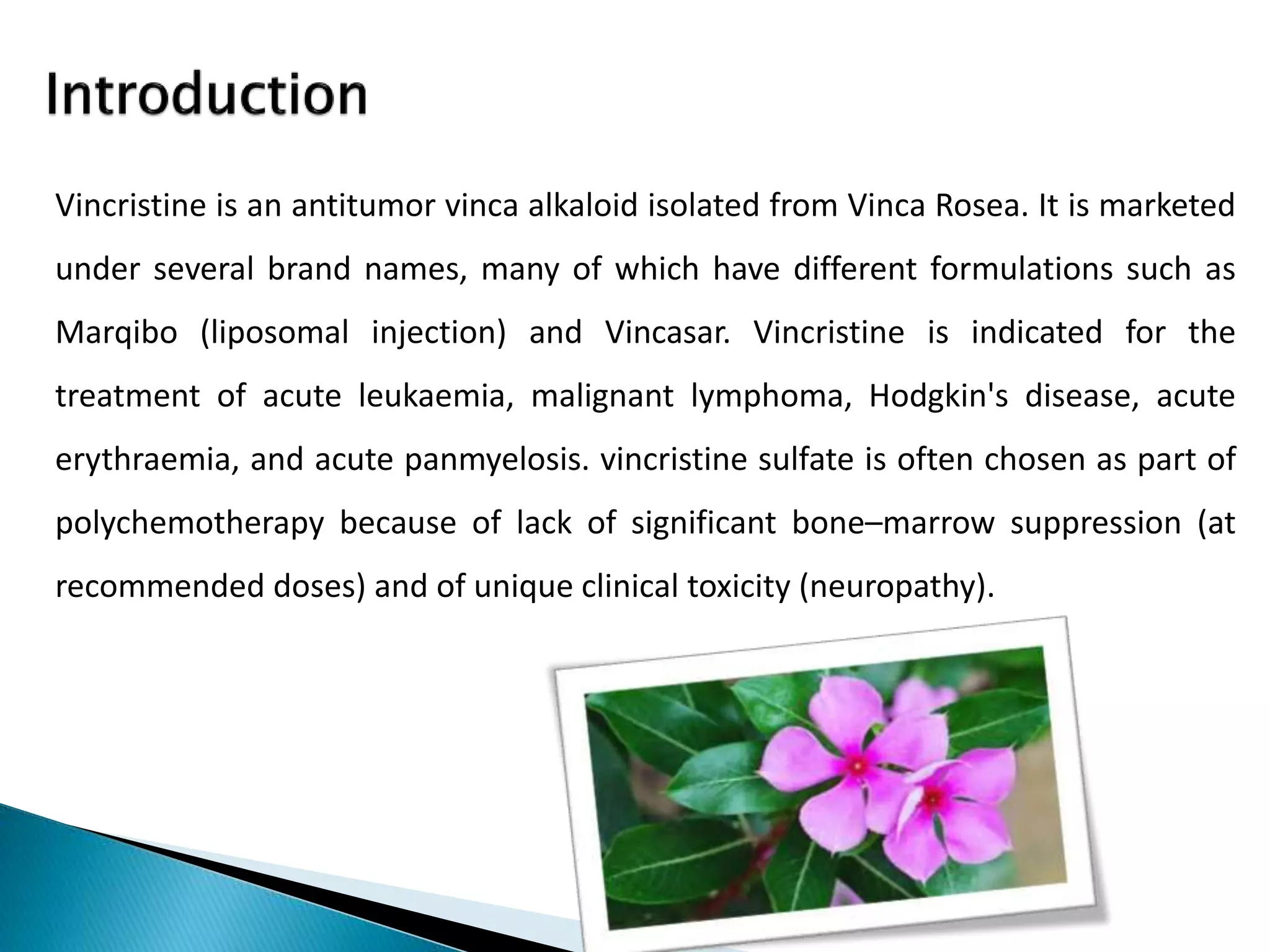
Vincristine is an antitumor vinca alkaloid isolated from Vinca Rosea. It is marketed
under several brand names, many of which have different formulations such as
Marqibo (liposomal injection) and Vincasar. Vincristine is indicated for the
treatment of acute leukaemia, malignant lymphoma, Hodgkin's disease, acute
erythraemia, and acute panmyelosis. vincristine sulfate is often chosen as part of
polychemotherapy because of lack of significant bone–marrow suppression (at
recommended doses) and of unique clinical toxicity (neuropathy).
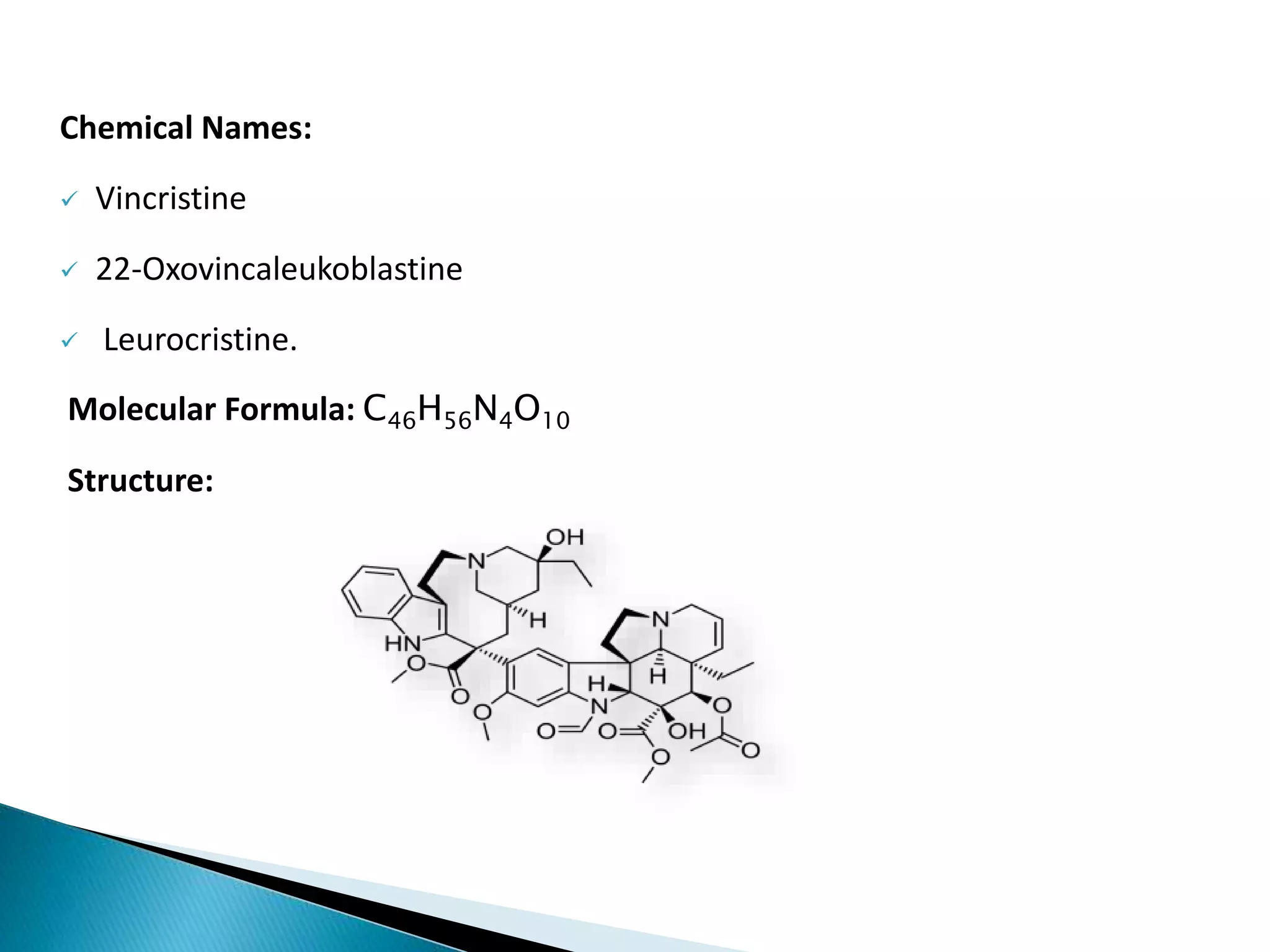
Chemical Names:
 Vincristine
 22-Oxovincaleukoblastine
 Leurocristine.
Molecular Formula: C46H56N4O10
Structure:
Oncovin Vincasar PFS
vincristine pch
Treatment of acute lymphocytic leukemia (ALL), Hodgkin
lymphoma, non-Hodgkin lymphomas, Wilms' tumor,
neuroblastoma, rhabdomyosarcoma. Liposomal vincristine is
indicated for the treatment of relapsed Philadelphia
chromosome-negative (Ph-) acute lymphoblastic leukemia
(ALL).
Vincristine is a vinca alkaloid antineoplastic agent used as a
treatment for various cancers including breast cancer, Hodgkin's
disease, Kaposi's sarcoma, and testicular cancer. The vinca
alkaloids are structurally similar compounds comprised of 2
multiringed units, vindoline and catharanthine. The vinca
alkaloids have become clinically useful since the discovery of
their antitumour properties in 1959.
Initially, extracts of the periwinkle plant (Catharanthus roseus)
were investigated because of putative hypoglycemic
properties, but were noted to cause marrow suppression in
rats and antileukemic effects in vitro. Vincristine binds to the
microtubular proteins of the mitotic spindle, leading to
crystallization of the microtubule and mitotic arrest or cell
death. Vincristine has some immunosuppressant effect. The
vinca alkaloids are considered to be cell cycle phase-specific.
The antitumor activity of Vincristine is thought to be due primarily to
inhibition of mitosis at metaphase through its interaction with
tubulin. Like other vinca alkaloids, Vincristine may also interfere
with:
1) amino acid, cyclic AMP, and glutathione metabolism,
2) calmodulin-dependent Ca2+-transport ATPase activity,
3) cellular respiration, and
4) nucleic acid and lipid biosynthesis.
 Volume of distribution: Within 15 to 30 minutes after injection,
over 90% of the drug is distributed from the blood into tissue,
where it remains tightly, but not irreversibly, bound.
 Metabolism: Hepatic. Cytochrome P450 isoenzymes of the
CYP3A subfamily facilitate the metabolism of vincristine.
 Route of elimination: The liver is the major excretory organ in
humans and animals. 80% of an injected dose of vincristine
sulfate is excreted via feces. 10 - 20% is excreted via urine.
When intravenously injected into cancer patients, a triphasic
serum decay patten was observed. The initial, middle, and
terminal half-lives are 5 minutes, 2.3 hours, 85 hours
respectively.
 Common side effects:
 Increased risk of getting an infection
 Mouth sores and ulcers
 Red or pink urine
 Hair Loss
 Tiredness and weakness
 Nerve problems
 Skin sensitivity to the sun
 Watery eyes
 Heart problems
 Allergic reaction
 Reddening of the skin
 Changes in blood sugar levels
 Taste changes
 Black or brown discoloration in the skin creases
 Swelling around drip site
 www.drugbank.ca
 pubchem.ncbi.nlm.nih.gov
 www.drugs.com
 chemocare.com
Vincristine

Vincristine

  • 1.
    Submitted to Md. MosiqurRahman Senior lecturer & Coordinator Department of Pharmacy Submission Date:16/05/2018 Submitted by Md. Rakibul Islam ID.2016000300008 Btach:27 Sec: “A” Course Code:BPH-3013 Course Title: Pharmacology-II
  • 2.
    Vincristine is anantitumor vinca alkaloid isolated from Vinca Rosea. It is marketed under several brand names, many of which have different formulations such as Marqibo (liposomal injection) and Vincasar. Vincristine is indicated for the treatment of acute leukaemia, malignant lymphoma, Hodgkin's disease, acute erythraemia, and acute panmyelosis. vincristine sulfate is often chosen as part of polychemotherapy because of lack of significant bone–marrow suppression (at recommended doses) and of unique clinical toxicity (neuropathy).
  • 3.
    Chemical Names:  Vincristine 22-Oxovincaleukoblastine  Leurocristine. Molecular Formula: C46H56N4O10 Structure:
  • 4.
  • 5.
    Treatment of acutelymphocytic leukemia (ALL), Hodgkin lymphoma, non-Hodgkin lymphomas, Wilms' tumor, neuroblastoma, rhabdomyosarcoma. Liposomal vincristine is indicated for the treatment of relapsed Philadelphia chromosome-negative (Ph-) acute lymphoblastic leukemia (ALL).
  • 6.
    Vincristine is avinca alkaloid antineoplastic agent used as a treatment for various cancers including breast cancer, Hodgkin's disease, Kaposi's sarcoma, and testicular cancer. The vinca alkaloids are structurally similar compounds comprised of 2 multiringed units, vindoline and catharanthine. The vinca alkaloids have become clinically useful since the discovery of their antitumour properties in 1959.
  • 7.
    Initially, extracts ofthe periwinkle plant (Catharanthus roseus) were investigated because of putative hypoglycemic properties, but were noted to cause marrow suppression in rats and antileukemic effects in vitro. Vincristine binds to the microtubular proteins of the mitotic spindle, leading to crystallization of the microtubule and mitotic arrest or cell death. Vincristine has some immunosuppressant effect. The vinca alkaloids are considered to be cell cycle phase-specific.
  • 8.
    The antitumor activityof Vincristine is thought to be due primarily to inhibition of mitosis at metaphase through its interaction with tubulin. Like other vinca alkaloids, Vincristine may also interfere with: 1) amino acid, cyclic AMP, and glutathione metabolism, 2) calmodulin-dependent Ca2+-transport ATPase activity, 3) cellular respiration, and 4) nucleic acid and lipid biosynthesis.
  • 9.
     Volume ofdistribution: Within 15 to 30 minutes after injection, over 90% of the drug is distributed from the blood into tissue, where it remains tightly, but not irreversibly, bound.  Metabolism: Hepatic. Cytochrome P450 isoenzymes of the CYP3A subfamily facilitate the metabolism of vincristine.  Route of elimination: The liver is the major excretory organ in humans and animals. 80% of an injected dose of vincristine sulfate is excreted via feces. 10 - 20% is excreted via urine.
  • 10.
    When intravenously injectedinto cancer patients, a triphasic serum decay patten was observed. The initial, middle, and terminal half-lives are 5 minutes, 2.3 hours, 85 hours respectively.
  • 11.
     Common sideeffects:  Increased risk of getting an infection  Mouth sores and ulcers  Red or pink urine  Hair Loss  Tiredness and weakness  Nerve problems  Skin sensitivity to the sun  Watery eyes
  • 12.
     Heart problems Allergic reaction  Reddening of the skin  Changes in blood sugar levels  Taste changes  Black or brown discoloration in the skin creases  Swelling around drip site
  • 13.