
Anticancer
Alkylating agents
Dr. S. Parasuraman
Faculty of Pharmacy, AIMST.
Alkylating agents
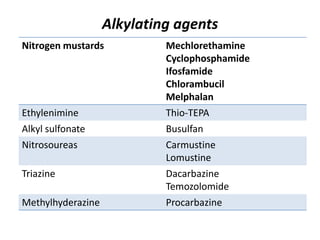
Nitrogen mustards

Ethylenimine
Alkyl sulfonate
Nitrosoureas
Triazine
Methylhyderazine

Mechlorethamine
Cyclophosphamide
Ifosfamide
Chlorambucil
Melphalan
Thio-TEPA
Busulfan
Carmustine
Lomustine
Dacarbazine
Temozolomide
Procarbazine
Alkylating agents
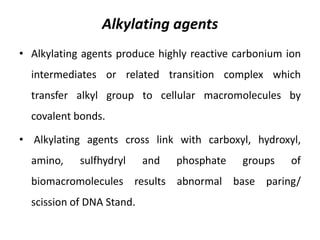
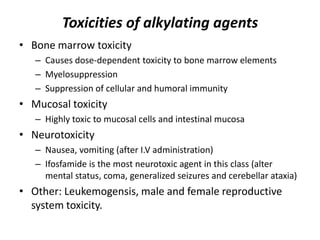
• Alkylating agents produce highly reactive carbonium ion
intermediates or related transition complex which
transfer alkyl group to cellular macromolecules by
covalent bonds.

• Alkylating agents cross link with carboxyl, hydroxyl,
amino,

sulfhydryl

and

phosphate

groups

of

biomacromolecules results abnormal base paring/
scission of DNA Stand.
Alkylating agents
MOA & SAR:

The chemotherapeutic
and cytotoxic effects
are directly related to
the alkylation of DNA.
The 7th nitrogen atom
of guanine is suitable
for
formation
of
covalent bond with
bifunctional alkylating
agent.
Pharmacological actions
• Cytotoxic actions:
– Interfere with DNA integrity and functions to induce cell

death in rapidly proliferating tissues.
– Lethality of DNA alkylation depends on the recognition of
the adduct, the creation of DNA stand breaks by repair

enzymes.
– In nondividing cells, DNA damage activation depends on the
presence of p53 gene. Malignant cells with mutant/ absent

p53 gene fail to suspend cell-cycle progression (don’t cause
apoptosis) and exhibit resistance to alkylating agents.
Toxicities of alkylating agents
• Bone marrow toxicity
– Causes dose-dependent toxicity to bone marrow elements
– Myelosuppression
– Suppression of cellular and humoral immunity

• Mucosal toxicity
– Highly toxic to mucosal cells and intestinal mucosa

• Neurotoxicity
– Nausea, vomiting (after I.V administration)
– Ifosfamide is the most neurotoxic agent in this class (alter
mental status, coma, generalized seizures and cerebellar ataxia)

• Other: Leukemogensis, male and female reproductive
system toxicity.
• Mechlorethamine
–
–
–
–
–

First nitrogen mustard; most reactive
Slow I.V. injection may cause sloughing
Used for Hodgkin and non-Hodgkin lymphomas
Largely replaced by cyclophosphamide and melphalan.
Dose: 0.1 mg/kg i.v. daily X 4 days (courses may be
repeated at suitable intervals)
– It is also used topically for treatment of cutaneous T-cell
lymphoma
– Toxicity: Block reproductive functions, produce menstrual
irregularities or premature ovarian failure in women and
oligospermia in men. First trimester of pregnancy and later
stage of pregnancy it should not be used.
• Cyclophosphosphamide
– Inactive as such
– Transformed to active metabolites in liver:
(aldophosphamide, phosphoramide mustard)
– Chloramphenicol retards the metabolism of
cyclophosphamide.
– It is well absorbed orally, activated by CYP2B.
– Cyclophosphamide is potent immunosuppressive agent, it
has been used to prevent organ rejection after
transplantation.
– Dose: 2-3 mg/kg/ day oral; 10-15 mg/kg i.v.
• Ifosfamide
– Analog of cyclophosphamide has a longer dose-dependent
t1/2 and it also activated by hydroxylation in the liver.
– Used in bronchogenic, breast, testicular, bladder, head and
neck carcinomas, oeseogenic sarcoma and some lymphomas.
– Approved for germ cell testicular cancer
– Produce dose limiting toxicity – haemorrhagic cystitis. Sever
urinary tract and CNS toxicity
– Toxicity can be reduced by administering mesna (-SH
compound). mesna inactivates the vasicotoxic metabolites of
ifosfamide and cyclophosphamide.
– Ifosfamide causes less alopecia and is less emetogenic than
cyclophosphamide.
– Dose: 0.1 g inj.
• Chlorambucil
– Slow acting alkylating agent
– Active against lymphoid, myeloid tissue cancers
– It is the drug of choice for the long-term maintenance
therapy for chronic lymphatic leukaemia, non-Hodgkin
lymphoma and few solid tumours.
– It has immunosuppressant property
– Dose: 4-10 mg daily for 3-6 weeks, then 2 mg/kg daily for
maintenance
• Melphalan
– The pharmacological and cytotoxic properties of
melphalan is similar to mechlorethamine. The drug is not a
vesicant
– Effective in multiple myeloma and advanced ovarian
cancer
– Toxicity: Bone marrow toxicity
– Dose: 10 mg daily for 7 days or 6 mg/ day for 2-3 weeks-----------4 weeks gap--------- 2 to 4 mg/day for maintenance
orally.
• Thio-TEPA
–
–
–
–

It is an ethylenimine
Highly toxic
Used in ovarian and bladder cancer
Dose: 0.3-0.4 mg/kg i.v. at 1-4 weeks intervels
• Busulfan
– Highly specific for myeloid elements and granulocyte
– Toxicity: hyperuricaemia is common; pulmonary fibrosis
and skin pigmentation are specific adverse effects.
– Drug of choice for chronic myeloid leukaemia
– Dose: 2-6 mg/ day, orally
• Nitrosoureas
– It is lipid soluble alkylating agents with a wide range of
antitumour activity.
– Cross BBM
– Effective in meningeal leukaemias and brain cancer
– Toxicity: Nausea, vomiting are common; CNS toxicity, bone
marrow depression (delayed effect; will take 6 weeks to
develop), visceral fibrosis and renal damage can occur
– Dose: 100-130 mg/m2 BSA single oral dose every 6 weeks.
• Dacarbazine (DTIC)
– After activation in liver, the active metabolite methylate
the DNA and interfere with its function.
– Used for malignant melanoma, Hodgkin’s disease
– Toxicity: Nausea, vomiting, flu-like symptoms, neuropathy
and myelosuppression
– Dose: 3.5 mg/kg/day i.v. for 10 days, repeated after 4
weeks
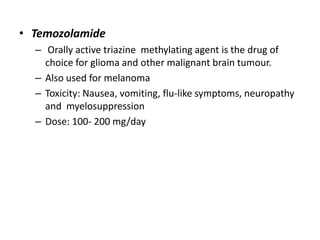
• Temozolamide
– Orally active triazine methylating agent is the drug of
choice for glioma and other malignant brain tumour.
– Also used for melanoma
– Toxicity: Nausea, vomiting, flu-like symptoms, neuropathy
and myelosuppression
– Dose: 100- 200 mg/day
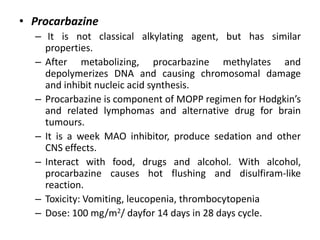
• Procarbazine
– It is not classical alkylating agent, but has similar
properties.
– After metabolizing, procarbazine methylates and
depolymerizes DNA and causing chromosomal damage
and inhibit nucleic acid synthesis.
– Procarbazine is component of MOPP regimen for Hodgkin’s
and related lymphomas and alternative drug for brain
tumours.
– It is a week MAO inhibitor, produce sedation and other
CNS effects.
– Interact with food, drugs and alcohol. With alcohol,
procarbazine causes hot flushing and disulfiram-like
reaction.
– Toxicity: Vomiting, leucopenia, thrombocytopenia
– Dose: 100 mg/m2/ dayfor 14 days in 28 days cycle.
Thank you

Anticancer drugs 2 alkylating agents

  • 1.
    Anticancer Alkylating agents Dr. S.Parasuraman Faculty of Pharmacy, AIMST.
  • 2.
    Alkylating agents Nitrogen mustards Ethylenimine Alkylsulfonate Nitrosoureas Triazine Methylhyderazine Mechlorethamine Cyclophosphamide Ifosfamide Chlorambucil Melphalan Thio-TEPA Busulfan Carmustine Lomustine Dacarbazine Temozolomide Procarbazine
  • 3.
    Alkylating agents • Alkylatingagents produce highly reactive carbonium ion intermediates or related transition complex which transfer alkyl group to cellular macromolecules by covalent bonds. • Alkylating agents cross link with carboxyl, hydroxyl, amino, sulfhydryl and phosphate groups of biomacromolecules results abnormal base paring/ scission of DNA Stand.
  • 4.
    Alkylating agents MOA &SAR: The chemotherapeutic and cytotoxic effects are directly related to the alkylation of DNA. The 7th nitrogen atom of guanine is suitable for formation of covalent bond with bifunctional alkylating agent.
  • 5.
    Pharmacological actions • Cytotoxicactions: – Interfere with DNA integrity and functions to induce cell death in rapidly proliferating tissues. – Lethality of DNA alkylation depends on the recognition of the adduct, the creation of DNA stand breaks by repair enzymes. – In nondividing cells, DNA damage activation depends on the presence of p53 gene. Malignant cells with mutant/ absent p53 gene fail to suspend cell-cycle progression (don’t cause apoptosis) and exhibit resistance to alkylating agents.
  • 6.
    Toxicities of alkylatingagents • Bone marrow toxicity – Causes dose-dependent toxicity to bone marrow elements – Myelosuppression – Suppression of cellular and humoral immunity • Mucosal toxicity – Highly toxic to mucosal cells and intestinal mucosa • Neurotoxicity – Nausea, vomiting (after I.V administration) – Ifosfamide is the most neurotoxic agent in this class (alter mental status, coma, generalized seizures and cerebellar ataxia) • Other: Leukemogensis, male and female reproductive system toxicity.
  • 7.
    • Mechlorethamine – – – – – First nitrogenmustard; most reactive Slow I.V. injection may cause sloughing Used for Hodgkin and non-Hodgkin lymphomas Largely replaced by cyclophosphamide and melphalan. Dose: 0.1 mg/kg i.v. daily X 4 days (courses may be repeated at suitable intervals) – It is also used topically for treatment of cutaneous T-cell lymphoma – Toxicity: Block reproductive functions, produce menstrual irregularities or premature ovarian failure in women and oligospermia in men. First trimester of pregnancy and later stage of pregnancy it should not be used.
  • 8.
    • Cyclophosphosphamide – Inactiveas such – Transformed to active metabolites in liver: (aldophosphamide, phosphoramide mustard) – Chloramphenicol retards the metabolism of cyclophosphamide. – It is well absorbed orally, activated by CYP2B. – Cyclophosphamide is potent immunosuppressive agent, it has been used to prevent organ rejection after transplantation. – Dose: 2-3 mg/kg/ day oral; 10-15 mg/kg i.v.
  • 9.
    • Ifosfamide – Analogof cyclophosphamide has a longer dose-dependent t1/2 and it also activated by hydroxylation in the liver. – Used in bronchogenic, breast, testicular, bladder, head and neck carcinomas, oeseogenic sarcoma and some lymphomas. – Approved for germ cell testicular cancer – Produce dose limiting toxicity – haemorrhagic cystitis. Sever urinary tract and CNS toxicity – Toxicity can be reduced by administering mesna (-SH compound). mesna inactivates the vasicotoxic metabolites of ifosfamide and cyclophosphamide. – Ifosfamide causes less alopecia and is less emetogenic than cyclophosphamide. – Dose: 0.1 g inj.
  • 10.
    • Chlorambucil – Slowacting alkylating agent – Active against lymphoid, myeloid tissue cancers – It is the drug of choice for the long-term maintenance therapy for chronic lymphatic leukaemia, non-Hodgkin lymphoma and few solid tumours. – It has immunosuppressant property – Dose: 4-10 mg daily for 3-6 weeks, then 2 mg/kg daily for maintenance
  • 11.
    • Melphalan – Thepharmacological and cytotoxic properties of melphalan is similar to mechlorethamine. The drug is not a vesicant – Effective in multiple myeloma and advanced ovarian cancer – Toxicity: Bone marrow toxicity – Dose: 10 mg daily for 7 days or 6 mg/ day for 2-3 weeks-----------4 weeks gap--------- 2 to 4 mg/day for maintenance orally.
  • 12.
    • Thio-TEPA – – – – It isan ethylenimine Highly toxic Used in ovarian and bladder cancer Dose: 0.3-0.4 mg/kg i.v. at 1-4 weeks intervels
  • 13.
    • Busulfan – Highlyspecific for myeloid elements and granulocyte – Toxicity: hyperuricaemia is common; pulmonary fibrosis and skin pigmentation are specific adverse effects. – Drug of choice for chronic myeloid leukaemia – Dose: 2-6 mg/ day, orally
  • 14.
    • Nitrosoureas – Itis lipid soluble alkylating agents with a wide range of antitumour activity. – Cross BBM – Effective in meningeal leukaemias and brain cancer – Toxicity: Nausea, vomiting are common; CNS toxicity, bone marrow depression (delayed effect; will take 6 weeks to develop), visceral fibrosis and renal damage can occur – Dose: 100-130 mg/m2 BSA single oral dose every 6 weeks.
  • 15.
    • Dacarbazine (DTIC) –After activation in liver, the active metabolite methylate the DNA and interfere with its function. – Used for malignant melanoma, Hodgkin’s disease – Toxicity: Nausea, vomiting, flu-like symptoms, neuropathy and myelosuppression – Dose: 3.5 mg/kg/day i.v. for 10 days, repeated after 4 weeks
  • 16.
    • Temozolamide – Orallyactive triazine methylating agent is the drug of choice for glioma and other malignant brain tumour. – Also used for melanoma – Toxicity: Nausea, vomiting, flu-like symptoms, neuropathy and myelosuppression – Dose: 100- 200 mg/day
  • 17.
    • Procarbazine – Itis not classical alkylating agent, but has similar properties. – After metabolizing, procarbazine methylates and depolymerizes DNA and causing chromosomal damage and inhibit nucleic acid synthesis. – Procarbazine is component of MOPP regimen for Hodgkin’s and related lymphomas and alternative drug for brain tumours. – It is a week MAO inhibitor, produce sedation and other CNS effects. – Interact with food, drugs and alcohol. With alcohol, procarbazine causes hot flushing and disulfiram-like reaction. – Toxicity: Vomiting, leucopenia, thrombocytopenia – Dose: 100 mg/m2/ dayfor 14 days in 28 days cycle.
  • 18.

Editor's Notes

  • #18 MOPP is a combination chemotherapy regimen used to treat Hodgkin's disease. The acronym is derived from the component drugs of the regimen:Mustargen (also known as mechlorethamine, mustine, nitrogen mustard, or MSD)Oncovin (also known as Vincristine or VCR)Procarbazine (also known as Matulane or Natulan) Prednisone (also known as Deltasone or Orasone)