naming
discipleship
Forming
Intentional
Disciples
discipleship
an introduction to Sherry Weddell’s
Forming Intentional Disciples
Colleen Vermeulen, M.Div.
Twitter: @EvangelToolbox
Website: http://practicalevangelization.wordpress.com/
Created Feb 2014
Feel free to re-use any slide, but please attribute. 
what is discipleship?
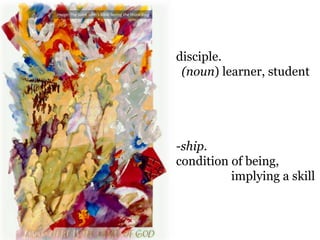
disciple.
(noun) learner, student
-ship.
condition of being,
implying a skill
Image: The Saint John’s Bible Seeing the Word Blog
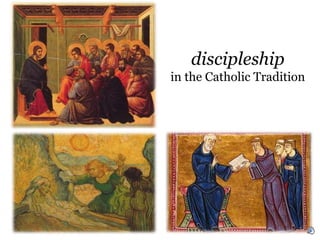
discipleship
in the Catholic Tradition
• Profess, spread, and live the faith
of the Church (§1816)
• Establish habits befitting a
disciple of Christ (§1494)
• Are initiated and nourished by
the Eucharist (§1275)
• Respond to Jesus’ invitation to
enter His kingdom (§546)
using the language of the Catechism of the Catholic Church, disciples:
• Pray (§2601, 2612)
• Abide in the Word (§2466)
• Witness to Christ and work using
the gifts received from God, in
ecclesial and temporal affairs
(§1319, 2427)
• Imitate Jesus (§2347, §2470)
discipleship as transmitted by the Church is:
• an active response
• for everyone
• personal (yet in community)
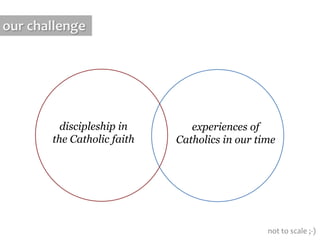
discipleship in
the Catholic faith
experiences of
Catholics in our time
not to scale ;-)
our challenge
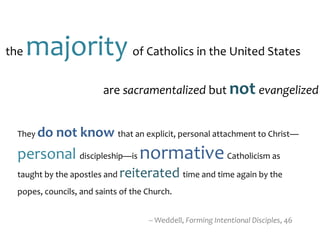
the majority of Catholics in the United States
-- Weddell, Forming Intentional Disciples, 46
are sacramentalized but not evangelized
They do not know that an explicit, personal attachment to Christ—
personal discipleship—is normativeCatholicism as
taught by the apostles and reiterated time and time again by the
popes, councils, and saints of the Church.
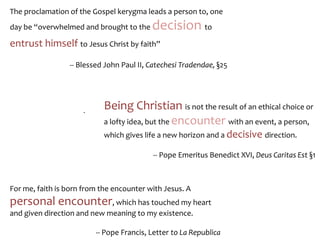
For me, faith is born from the encounter with Jesus. A
personal encounter, which has touched my heart
and given direction and new meaning to my existence.
-- Pope Francis, Letter to La Republica
Being Christian is not the result of an ethical choice or
a lofty idea, but the encounter with an event, a person,
which gives life a new horizon and a decisive direction.
-- Pope Emeritus Benedict XVI, Deus Caritas Est §1
.
The proclamation of the Gospel kerygma leads a person to, one
day be “overwhelmed and brought to the decision to
entrust himself to Jesus Christ by faith”
-- Blessed John Paul II, Catechesi Tradendae, §25
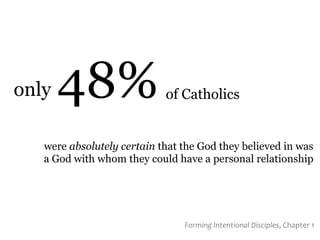
of Catholicsonly 48%
were absolutely certain that the God they believed in was
a God with whom they could have a personal relationship
Forming Intentional Disciples, Chapter 1
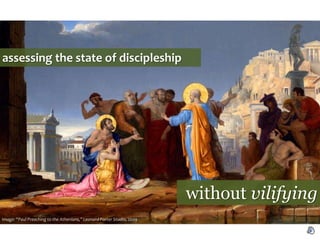
assessing the state of discipleship
without vilifying
Image: “Paul Preaching to the Athenians,” Leonard Porter Studio, 2009
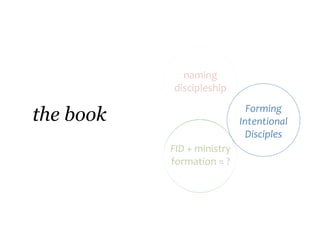
naming
discipleship
Forming
Intentional
Disciples
FID + ministry
formation = ?
the book
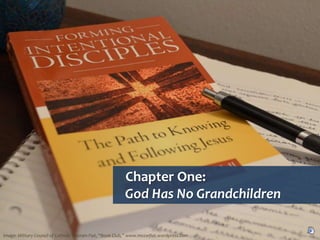
Chapter One:
God Has No Grandchildren
Image: Military Council of Catholic Women Fiat, “Book Club,” www.mccwfiat.wordpress.com
in review: there were lots of statistics
The spiritual winds blow both ways in our postmodern world:
into and out of the Church.
Our spiritual climate provides us with real opportunities
…and very definite threats
if we do not adjust our evangelizing, catechetical, and pastoral
practice to the unique challenges
of the times in which we live.
-- Weddell, Forming Intentional Disciples, 18
key
point1
the origin of intentional discipleship
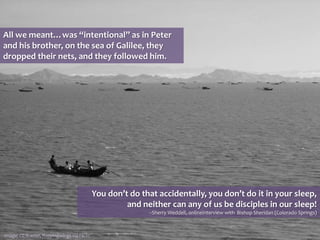
All we meant…was “intentional” as in Peter
and his brother, on the sea of Galilee, they
dropped their nets, and they followed him.
You don’t do that accidentally, you don’t do it in your sleep,
and neither can any of us be disciples in our sleep!
--Sherry Weddell, onlineinterview with Bishop Sheridan (Colorado Springs)
Image: CC license, flappingwings via Flickr
of course, “unintentional discipleship” is impossible,
but using explicit language like “intentional discipleship”
seemed to break the mysterious spell
that makes it difficult for many Catholics to think and speak of
discipleship in meaningful, real-life ways
-- Weddell, Forming Intentional Disciples, 65
key
point2
characterizing intentional discipleship
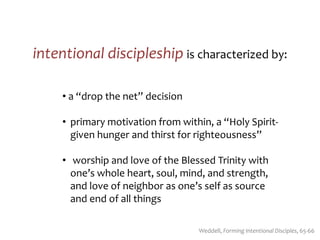
intentional discipleship is characterized by:
• a “drop the net” decision
• primary motivation from within, a “Holy Spirit-
given hunger and thirst for righteousness”
• worship and love of the Blessed Trinity with
one’s whole heart, soul, mind, and strength,
and love of neighbor as one’s self as source
and end of all things
Weddell, Forming Intentional Disciples, 65-66
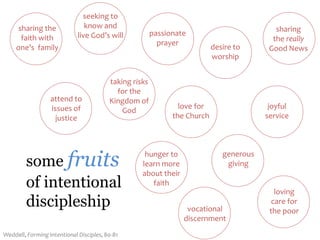
some fruits
of intentional
discipleship
passionate
prayer
desire to
worship
love for
the Church
joyful
service
generous
giving
hunger to
learn more
about their
faith
vocational
discernment
loving
care for
the poor
seeking to
know and
live God’s will
sharing
the really
Good News
sharing the
faith with
one’s family
taking risks
for the
Kingdom of
God
attend to
issues of
justice
Weddell, Forming Intentional Disciples, 80-81
key
point3
intentional discipleship is ecclesial
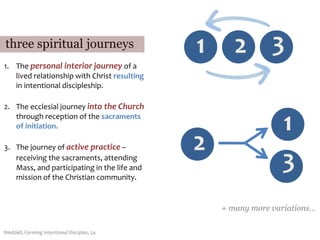
1. The personal interior journey of a
lived relationship with Christ resulting
in intentional discipleship.
2. The ecclesial journey into the Church
through reception of the sacraments
of initiation.
3. The journey of active practice –
receiving the sacraments, attending
Mass, and participating in the life and
mission of the Christian community.
three spiritual journeys 1 2 3
2
1
3
+ many more variations…
Weddell, Forming Intentional Disciples, 54
key
point4
discipleship matters for everyone
As we listened to Catholics talk about their spiritual journey, we began to
realize that many assumed there were two basic spiritual “tracks”:
“ordinary Catholic” and “saint.”
We discovered that many Catholics, including some pastoral leaders…have
no imaginative category for one who is an intentional follower of
Jesus “on the way” yet not a saint.
There is a strong tendency to account for those who try to live as
disciples by labeling them “extraordinary,” either positively, as called to
priestly or religious life, or negatively, as pretenders to sanctity.
-- Weddell, Forming Intentional Disciples, 63
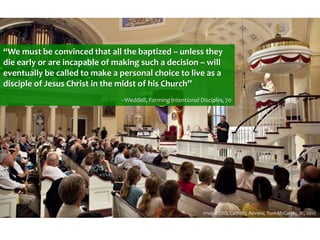
“We must be convinced that all the baptized – unless they
die early or are incapable of making such a decision – will
eventually be called to make a personal choice to live as a
disciple of Jesus Christ in the midst of his Church”
--Weddell, Forming Intentional Disciples, 70
Image: CNS, Catholic Review, Tom McCarthy Jr., 2012
key
point5
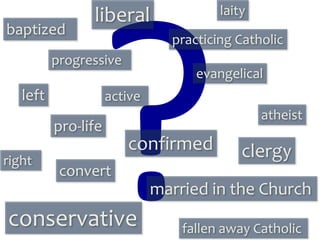
seek stories, not labels
baptized
liberal
confirmed
atheist
left
married in the Church
conservative
evangelical
right
progressive
practicing Catholic
fallen away Catholic
pro-life
convert
clergy
laity
active
key
point6
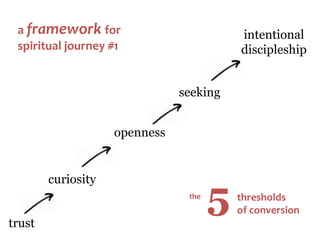
offering a framework for the
[often overlooked] Spiritual Journey #1
trust
curiosity
openness
seeking
intentional
discipleship
5 thresholds
of conversion
the
a framework for
spiritual journey #1
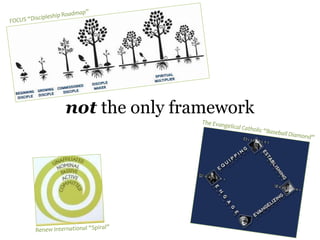
not the only framework
key
point7
expect charisms (spiritual gifts) and grace
You and I have no right to judge another’s internal disposition,
nor can we see justification happen in an individuals’ soul.
But this does notmean that no fruits of personal faith are
observable from the outside.
-- Weddell, Forming Intentional Disciples, 122
And it certainly does notmean that a dramatic and
widespread absence of these fruits in the community
overall cannot be recognized and addressed.
Arlington • Baltimore • Boise • Boston • Charleston, SC • Chicago • Cleveland • Colorado
Springs • Denver •Detroit • Fargo • Fort Worth, TX •Fort Wayne – South Bend • Green Bay
•Dubuque, IA • Joliet, IL • Knoxville • La Crosse, WI • Lansing, MI •Lexington, KY • Los
Angeles • Madison, WI • Manchester, H • Milwaukee •New York • Newark • Oakland, CA •
Ogdensburgh, NY • Oklahoma City • Omaha • Orange, CA • Richmond • San Antonio • San
Francisco • San Jose, CA• Scranton, PA• Seattle • Springfield, IL
at least 91 dioceses in the U.S. are deliberately engaging with the ideas in
Forming Intentional Disciples:
[+ dioceses in the United Kingdom, Canada, Australia, Ireland, and 4 other countries]
since 1997, over 65,000 lay, religious, and ordained Catholics have
participated in the Catherine of Siena Institute programs that inspired the book
The book has made a splash.
• in the Amazon Top 5000 nearly continuously since publication
• still breaking into the hourly Amazon Top 20 “Catholicism” best sellers
what next?
naming
discipleship
Forming
Intentional
Disciples
?
Study the book.
Talk about it in your parish or ministry
setting.
Reflect on:
 if/how your parish or ministry deliberately
allows space for spiritual journey #1
 ways to be sensitive to and discern the
many thresholds and complex conversion
processes of those who are not yet disciples
Check out additional resources at:
http://practicalevangelization.wordpress.com/tag/r
esources-for-intentional-discipleship/

Intentional discipleship

  • 1.
    naming discipleship Forming Intentional Disciples discipleship an introduction toSherry Weddell’s Forming Intentional Disciples Colleen Vermeulen, M.Div. Twitter: @EvangelToolbox Website: http://practicalevangelization.wordpress.com/ Created Feb 2014 Feel free to re-use any slide, but please attribute. 
  • 2.
  • 3.
    disciple. (noun) learner, student -ship. conditionof being, implying a skill Image: The Saint John’s Bible Seeing the Word Blog
  • 4.
  • 5.
    • Profess, spread,and live the faith of the Church (§1816) • Establish habits befitting a disciple of Christ (§1494) • Are initiated and nourished by the Eucharist (§1275) • Respond to Jesus’ invitation to enter His kingdom (§546) using the language of the Catechism of the Catholic Church, disciples: • Pray (§2601, 2612) • Abide in the Word (§2466) • Witness to Christ and work using the gifts received from God, in ecclesial and temporal affairs (§1319, 2427) • Imitate Jesus (§2347, §2470)
  • 6.
    discipleship as transmittedby the Church is: • an active response • for everyone • personal (yet in community)
  • 7.
    discipleship in the Catholicfaith experiences of Catholics in our time not to scale ;-) our challenge
  • 8.
    the majority ofCatholics in the United States -- Weddell, Forming Intentional Disciples, 46 are sacramentalized but not evangelized They do not know that an explicit, personal attachment to Christ— personal discipleship—is normativeCatholicism as taught by the apostles and reiterated time and time again by the popes, councils, and saints of the Church.
  • 9.
    For me, faithis born from the encounter with Jesus. A personal encounter, which has touched my heart and given direction and new meaning to my existence. -- Pope Francis, Letter to La Republica Being Christian is not the result of an ethical choice or a lofty idea, but the encounter with an event, a person, which gives life a new horizon and a decisive direction. -- Pope Emeritus Benedict XVI, Deus Caritas Est §1 . The proclamation of the Gospel kerygma leads a person to, one day be “overwhelmed and brought to the decision to entrust himself to Jesus Christ by faith” -- Blessed John Paul II, Catechesi Tradendae, §25
  • 10.
    of Catholicsonly 48% wereabsolutely certain that the God they believed in was a God with whom they could have a personal relationship Forming Intentional Disciples, Chapter 1
  • 11.
    assessing the stateof discipleship without vilifying Image: “Paul Preaching to the Athenians,” Leonard Porter Studio, 2009
  • 12.
  • 13.
    Chapter One: God HasNo Grandchildren Image: Military Council of Catholic Women Fiat, “Book Club,” www.mccwfiat.wordpress.com
  • 14.
    in review: therewere lots of statistics
  • 15.
    The spiritual windsblow both ways in our postmodern world: into and out of the Church. Our spiritual climate provides us with real opportunities …and very definite threats if we do not adjust our evangelizing, catechetical, and pastoral practice to the unique challenges of the times in which we live. -- Weddell, Forming Intentional Disciples, 18
  • 16.
    key point1 the origin ofintentional discipleship
  • 17.
    All we meant…was“intentional” as in Peter and his brother, on the sea of Galilee, they dropped their nets, and they followed him. You don’t do that accidentally, you don’t do it in your sleep, and neither can any of us be disciples in our sleep! --Sherry Weddell, onlineinterview with Bishop Sheridan (Colorado Springs) Image: CC license, flappingwings via Flickr
  • 18.
    of course, “unintentionaldiscipleship” is impossible, but using explicit language like “intentional discipleship” seemed to break the mysterious spell that makes it difficult for many Catholics to think and speak of discipleship in meaningful, real-life ways -- Weddell, Forming Intentional Disciples, 65
  • 19.
  • 20.
    intentional discipleship ischaracterized by: • a “drop the net” decision • primary motivation from within, a “Holy Spirit- given hunger and thirst for righteousness” • worship and love of the Blessed Trinity with one’s whole heart, soul, mind, and strength, and love of neighbor as one’s self as source and end of all things Weddell, Forming Intentional Disciples, 65-66
  • 21.
    some fruits of intentional discipleship passionate prayer desireto worship love for the Church joyful service generous giving hunger to learn more about their faith vocational discernment loving care for the poor seeking to know and live God’s will sharing the really Good News sharing the faith with one’s family taking risks for the Kingdom of God attend to issues of justice Weddell, Forming Intentional Disciples, 80-81
  • 22.
  • 23.
    1. The personalinterior journey of a lived relationship with Christ resulting in intentional discipleship. 2. The ecclesial journey into the Church through reception of the sacraments of initiation. 3. The journey of active practice – receiving the sacraments, attending Mass, and participating in the life and mission of the Christian community. three spiritual journeys 1 2 3 2 1 3 + many more variations… Weddell, Forming Intentional Disciples, 54
  • 24.
  • 25.
    As we listenedto Catholics talk about their spiritual journey, we began to realize that many assumed there were two basic spiritual “tracks”: “ordinary Catholic” and “saint.” We discovered that many Catholics, including some pastoral leaders…have no imaginative category for one who is an intentional follower of Jesus “on the way” yet not a saint. There is a strong tendency to account for those who try to live as disciples by labeling them “extraordinary,” either positively, as called to priestly or religious life, or negatively, as pretenders to sanctity. -- Weddell, Forming Intentional Disciples, 63
  • 26.
    “We must beconvinced that all the baptized – unless they die early or are incapable of making such a decision – will eventually be called to make a personal choice to live as a disciple of Jesus Christ in the midst of his Church” --Weddell, Forming Intentional Disciples, 70 Image: CNS, Catholic Review, Tom McCarthy Jr., 2012
  • 27.
  • 28.
    baptized liberal confirmed atheist left married in theChurch conservative evangelical right progressive practicing Catholic fallen away Catholic pro-life convert clergy laity active
  • 29.
    key point6 offering a frameworkfor the [often overlooked] Spiritual Journey #1
  • 30.
  • 31.
    not the onlyframework
  • 32.
  • 33.
    You and Ihave no right to judge another’s internal disposition, nor can we see justification happen in an individuals’ soul. But this does notmean that no fruits of personal faith are observable from the outside. -- Weddell, Forming Intentional Disciples, 122 And it certainly does notmean that a dramatic and widespread absence of these fruits in the community overall cannot be recognized and addressed.
  • 34.
    Arlington • Baltimore• Boise • Boston • Charleston, SC • Chicago • Cleveland • Colorado Springs • Denver •Detroit • Fargo • Fort Worth, TX •Fort Wayne – South Bend • Green Bay •Dubuque, IA • Joliet, IL • Knoxville • La Crosse, WI • Lansing, MI •Lexington, KY • Los Angeles • Madison, WI • Manchester, H • Milwaukee •New York • Newark • Oakland, CA • Ogdensburgh, NY • Oklahoma City • Omaha • Orange, CA • Richmond • San Antonio • San Francisco • San Jose, CA• Scranton, PA• Seattle • Springfield, IL at least 91 dioceses in the U.S. are deliberately engaging with the ideas in Forming Intentional Disciples: [+ dioceses in the United Kingdom, Canada, Australia, Ireland, and 4 other countries] since 1997, over 65,000 lay, religious, and ordained Catholics have participated in the Catherine of Siena Institute programs that inspired the book The book has made a splash. • in the Amazon Top 5000 nearly continuously since publication • still breaking into the hourly Amazon Top 20 “Catholicism” best sellers
  • 35.
    what next? naming discipleship Forming Intentional Disciples ? Study thebook. Talk about it in your parish or ministry setting. Reflect on:  if/how your parish or ministry deliberately allows space for spiritual journey #1  ways to be sensitive to and discern the many thresholds and complex conversion processes of those who are not yet disciples Check out additional resources at: http://practicalevangelization.wordpress.com/tag/r esources-for-intentional-discipleship/

Editor's Notes

  • #5 Mvm’t from being followers of Jesus in an immediate, physical/earthly sense, to encountering the resurrected Jesus, to disciples discipling others, like St. Benedict’s vision for his monastery
  • #7 Not possible to do unconsciously. Not ust for monks, priests, canonized saints Can’t have the community w/o those individual decisions.
  • #9 End up here. For example
  • #10 Reiteration, really clear that faith is more than just a vague communal belief
  • #11 and each one of us here can probably think of other examples—it’s clear from our Tradition that the way of a disciple includes a response in worship, in Eucharist…and yet only 18% of Catholics attend Mass weekly;
  • #12 So without vilifying, condemning, blaming, or name-calling, we can look around and say whatever were doing isn’t suited for the current setting here in the United States. This is not about playing armchair quarterback on the past, or looking down from an elite position at any other person. It’s just this--our ways of making disciples are not actually making disciples. And since we’re supposed to make disciples, that’s a problem. The biggest problem. The root problem. The issue that underlies anything else we can look around and want to see more of—vocations, confession, social justice, engagement with culture, sacrificial giving, participation in the liturgy, faith filled marriages—anything.
  • #15 Which one stood out to you and why?
  • #16 Not all gloom and doom. Not us vs. them or a “Christ against culture” scenario.
  • #18 Elitist? Judgmental?
  • #19 Bottom line: we can read this book without debating language. Call it a committed disciple. I think what Weddell reveals is that “disciple”—a theologically powerful word—had lost its meaning.
  • #21 resonates w/ the Tradition and our experience – CCC notes, saints in history, and probably the saints in our lives, the people who live as intentional disciples
  • #22 Not required reading When I pause to think about this list and assess if it’s true based on my experience, the first thing that comes to mind are the intentional disciples I met here in the M.Div. program. And anecdotally, it seems to be true. I haven’t encountered anyone in the M.Div. program who is all for some of these fruits but not others…so I think discipleship produces a fullness of fruits. It’s not that problems go away. But I’m sure each of you can think of a small group, a ministry, or just a group of friends where almost everyone was an intentional disciple—and did these fruits manifest themselves?
  • #23 Forming Intentional Disciples talks a lot about personal relationship with God. An individual’s consciousness. And, this is definitely rooted in the language of recent popes. But is it too much “me and Jesus” spirituality?
  • #24 Foundational concept, lynchpin for understanding her message, most underrated passage in the obok… Dyad discussions on this. Going to look slightly different for just about every person. And it’s not just yes/no on a spiritual journey, there are stages, phases, different levels of enthusiasim, etc. The point is, there’s an incompleteness without all three in place, not a mature Christian w/o all three. And so FID as a book is really about Journey #1, since she believes this is the journey that we’re most silent about in our current setting, and is critically important in our society of seekers, “nones,” and the like. Spiral of Silence ad Don’t Ask Don’t Tell are another way of saying that journey #1 is the elephant in the room. Overlooked. Not talked about. Not resourced. Not even consciously considered by many. Sacramental theology in chapter 4 is in one sense an apologetic towards those who might think that emphasizing #1 has nothing to do with #2 The 5 Thresholods are a practical framework for cultivating #1 in our society
  • #28 Labels don’t work.
  • #29 What is FID? Pause: What other labels might you add?
  • #30 No book is going to answer every challenge we face. In her “solution” portion, Weddell offers up a detailed framework for addressing Spiritual Journey #1.
  • #31 Not rigid, sometimes a different order, repeat phases, etc. But it’s a framework. I really remember my seeking threshold twice…
  • #32 What other frameworks come to mind? Weddell’s stands out to me as the one that really digs into the beginning, evangelizing, or unafilliated phase. These build on that. Pay attention to where your different frameworks intersect.
  • #33 And be concerned when they are absent. “The sacrament will take care of it” and the “church will provide” are incomplete theologically. And we all know this. Liturgical movement. Sacraments “work” with cooperation. Now this can put us in a very uncomfortable spot.
  • #34 Can’t just let it go, unchecked. As you may have discussed in your dyads earlier this year, the absence of communal fruit is a real sadness. The fruits and charisms of the baptized aren’t just extras. These are the lifeblood of the Church. God pouring out his Spirit and blessings within us.
  • #35 Remains in Amazon’s Top 5000 bestsellers and Top 20 of Catholicism books. Pop bloggers Lawnchair Catechism; National CEA Twitter discussion Reception: Remaking the Church as evangelical Protestantism; Spiritual elite; Judging; My mom