--Biblical Theology--
Intertestamental Period
Transition from Old to New
By Dr. Robert Munson
Maranatha Biblical College
Baguio City, Philippines
The Intertestamental Period is not normally
viewed as part of Old Testament Theology
However, it will be covered here because:
 There are many things that occur during this
period that make the transition from the Old
Testament to the New Testament “make sense.”
 There are theological developments that are
also critical to the theological development into
the New Testament.
Intertestamental Periods
 Persian Era (continuation of the period of the
Old Testament that is Post-Exile)
 Greek Era (including the invasion of Alexander
the Great, and the Ptolemaic, and Seleucid
periods)
 Hasmonean Era (independent Jewish State)
 Roman Era (that brings us into the New
Testament)
Hellenism
 Around 330BC, Alexander the Great, of
Macedonia began the rapid expansion of his
empire, replacing the Persians as rulers in
Judah.
 His goal was military as well as cultural...
seeking to spread the Greek Language and
Culture.
 Soon, he was dead and his empire divided
among his generals.
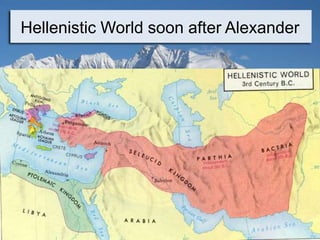
Hellenistic World soon after Alexander
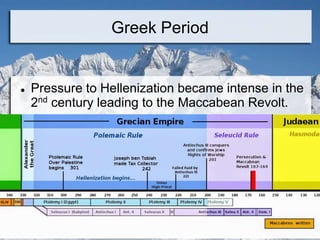
Greek Period
 Pressure to Hellenization became intense in the
2nd century leading to the Maccabean Revolt.
Maccabean Revolt
 The Maccabees... term describing a family of
priests who led a successful revolt against the
Seleucids. Judas Macabbeus and others in the
family became the ideal of a Messiah-- a
righteous warrior.
 This led to many others seeking to be the next
military leader to free the Jewish people from
outside occupation.
Revolting against the Status Quo
 Many during the Hasmonean Era, and later,
were deeply concerned about the worldliness of
the priests/sadducees, as well as foreign
domination and Jews who collaborated with
them. This led to several groups forming:
 Essenes
 Zealots and Sicarii
 Pharisees
Diaspora
 Hellenized Jews. Many Jews lived outside of
Judea. Many Jews lived in cultures that were
more Hellenized--- speaking Greek and
embracing many aspects of Greek culture while
still being Jews.
 God-fearers. Many Gentiles found the high
moral beliefs and views of God appealing. They
might even go to synagogue, but were not
prepared to be proselytes.
New Religious Structures
 Sanhedrin: Great assembly of religious leaders and
teachers of the Law. Established during this period, to
make top decisions regarding the Jewish faith.
 Synagogue: Place of assembly for worship. Probably
first developed during the Babylonian captivity, but
grew in prominence during the Inter-testamental
period. Churches were modeled of of the synagogue.
 Rabbi: A rabbi is a teacher of the torah... with the
decline of prophets and priests during this period, the
rabbi gained in prominence.
LXX and the Translatability of Scripture
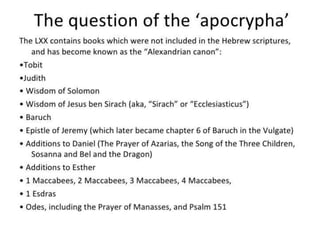
 The Septuagint was the Hebrew Bible (and
Apocrypha) translated into Greek.
 It was translated by Jews who lived in
Alexandria Egypt... a place where there were
many Diaspora Jews, but where Greek, rather
than Hebrew or Aramaic was the dominant
language.
LXX and the Translatability of Scripture
 This established the precedent that God's Word
is translatable. God's Word is still God's Word
even when translated into a different language.
 This is a major decision. Many religions believe
that their holy scriptures or only true in their
original languages. Even Christians have been
tempted to embrace the idea of “Sacred
Language.”
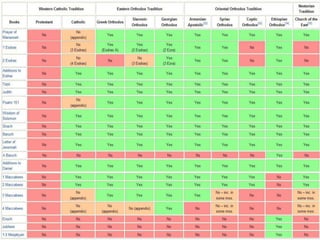
Apocrypha
 Apocalyptic Writings
 Apocrypha
Typically...
 The Jewish scholars, and the church for much
of its history, viewed the Apocrypha as either
non-canonical (not authoritative) or
deuterocanonical (authoritative but not as
authoritative as the rest of the Hebrew Bible.
 After the Protestant Reformation, the Catholic
church formally embraced the view that some
of the Apocrypha are canonical... equal with the
Hebrew Bible.
Further notes
 Not all books of the Apocrypha are considered
canonical... and different denominations of the
“Ancient Faiths” disagree on which ones should be
viewed as canonical.
 There are many other writings at that time as well. The
Apocrypha are just ones that were in the LXX.
 All of the denominations accept the Hebrew Bible.
Some denominations accept books that are neither in
the Apocrypha nor the Hebrew Bible.
Canon and Prophecy
 With the decline of prophecy--- there was an
increase in the emphasis in the written word.
This also meant that there was greater
importance placed on determining what was
canon or mikra... that which is to be read as
authoritative.
 However, Malachi noted that Elijah (or one of
the spirit of Elijah) would come prior to the
Messiah, suggesting the return of prophecy.
The Romans
 Pompey conquered Palestine in 66BC.
 They held onto the region either as Provinces
of the Empire, or as Client States, such as the
Herodian Kingdom.
 The Roman Empire gave freedom to Jews to
practice their faith as they wish... with some
limitations.
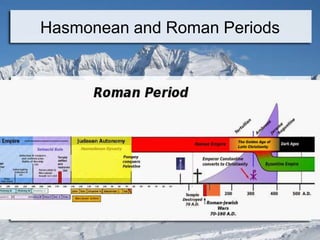
Hasmonean and Roman Periods
On to the NT
There is a lot of history between the Old and New
Testaments. As Christians, it is our history as
well. It should be studied rigorously by
seminarians as part of our faith history, and as
foundation for our NT Studies, and the context
of our Biblical Theology.

Biblical Theology--- Between the Testaments

  • 1.
    --Biblical Theology-- Intertestamental Period Transitionfrom Old to New By Dr. Robert Munson Maranatha Biblical College Baguio City, Philippines
  • 2.
    The Intertestamental Periodis not normally viewed as part of Old Testament Theology However, it will be covered here because:  There are many things that occur during this period that make the transition from the Old Testament to the New Testament “make sense.”  There are theological developments that are also critical to the theological development into the New Testament.
  • 3.
    Intertestamental Periods  PersianEra (continuation of the period of the Old Testament that is Post-Exile)  Greek Era (including the invasion of Alexander the Great, and the Ptolemaic, and Seleucid periods)  Hasmonean Era (independent Jewish State)  Roman Era (that brings us into the New Testament)
  • 5.
    Hellenism  Around 330BC,Alexander the Great, of Macedonia began the rapid expansion of his empire, replacing the Persians as rulers in Judah.  His goal was military as well as cultural... seeking to spread the Greek Language and Culture.  Soon, he was dead and his empire divided among his generals.
  • 6.
    Hellenistic World soonafter Alexander
  • 7.
    Greek Period  Pressureto Hellenization became intense in the 2nd century leading to the Maccabean Revolt.
  • 8.
    Maccabean Revolt  TheMaccabees... term describing a family of priests who led a successful revolt against the Seleucids. Judas Macabbeus and others in the family became the ideal of a Messiah-- a righteous warrior.  This led to many others seeking to be the next military leader to free the Jewish people from outside occupation.
  • 9.
    Revolting against theStatus Quo  Many during the Hasmonean Era, and later, were deeply concerned about the worldliness of the priests/sadducees, as well as foreign domination and Jews who collaborated with them. This led to several groups forming:  Essenes  Zealots and Sicarii  Pharisees
  • 10.
    Diaspora  Hellenized Jews.Many Jews lived outside of Judea. Many Jews lived in cultures that were more Hellenized--- speaking Greek and embracing many aspects of Greek culture while still being Jews.  God-fearers. Many Gentiles found the high moral beliefs and views of God appealing. They might even go to synagogue, but were not prepared to be proselytes.
  • 11.
    New Religious Structures Sanhedrin: Great assembly of religious leaders and teachers of the Law. Established during this period, to make top decisions regarding the Jewish faith.  Synagogue: Place of assembly for worship. Probably first developed during the Babylonian captivity, but grew in prominence during the Inter-testamental period. Churches were modeled of of the synagogue.  Rabbi: A rabbi is a teacher of the torah... with the decline of prophets and priests during this period, the rabbi gained in prominence.
  • 12.
    LXX and theTranslatability of Scripture  The Septuagint was the Hebrew Bible (and Apocrypha) translated into Greek.  It was translated by Jews who lived in Alexandria Egypt... a place where there were many Diaspora Jews, but where Greek, rather than Hebrew or Aramaic was the dominant language.
  • 13.
    LXX and theTranslatability of Scripture  This established the precedent that God's Word is translatable. God's Word is still God's Word even when translated into a different language.  This is a major decision. Many religions believe that their holy scriptures or only true in their original languages. Even Christians have been tempted to embrace the idea of “Sacred Language.”
  • 14.
  • 15.
    Typically...  The Jewishscholars, and the church for much of its history, viewed the Apocrypha as either non-canonical (not authoritative) or deuterocanonical (authoritative but not as authoritative as the rest of the Hebrew Bible.  After the Protestant Reformation, the Catholic church formally embraced the view that some of the Apocrypha are canonical... equal with the Hebrew Bible.
  • 16.
    Further notes  Notall books of the Apocrypha are considered canonical... and different denominations of the “Ancient Faiths” disagree on which ones should be viewed as canonical.  There are many other writings at that time as well. The Apocrypha are just ones that were in the LXX.  All of the denominations accept the Hebrew Bible. Some denominations accept books that are neither in the Apocrypha nor the Hebrew Bible.
  • 18.
    Canon and Prophecy With the decline of prophecy--- there was an increase in the emphasis in the written word. This also meant that there was greater importance placed on determining what was canon or mikra... that which is to be read as authoritative.  However, Malachi noted that Elijah (or one of the spirit of Elijah) would come prior to the Messiah, suggesting the return of prophecy.
  • 19.
    The Romans  Pompeyconquered Palestine in 66BC.  They held onto the region either as Provinces of the Empire, or as Client States, such as the Herodian Kingdom.  The Roman Empire gave freedom to Jews to practice their faith as they wish... with some limitations.
  • 20.
  • 21.
    On to theNT There is a lot of history between the Old and New Testaments. As Christians, it is our history as well. It should be studied rigorously by seminarians as part of our faith history, and as foundation for our NT Studies, and the context of our Biblical Theology.