Missionary Member Care Models
www.munsonmissions.org
2020
Background
 Missionary Member Care is a form of ministry
associated with Pastoral Theology (a form of
practical theology).
 Pastoral Theology is “The study of how and
why Christians care.” (Margaret Whipp, Pastoral
Theology, SCM, 2015)
 The application of Pastoral Theology to
Missionaries is Missionary Member Care.
 Missionary Member Care is the practice of
ministry for caring for the needs of
Missionaries.
Of course it is much more
complicated than that
 The care of missionaries is tied to their effectivity. What is
necessary for missionaries to make missionaries
effective (“successful”) in their work.
 However, effectivity is not the whole matter. Missionaries
are human beings tied to others through families. The
goal also is to help their families (even extended
families).
 Care is holistic (or “wholistic” if you prefer) and so seeks
to address physical, psychoemotional, social, spiritual,
economic, and professional needs.
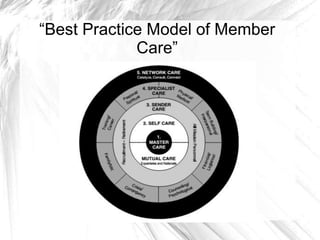
“Best Practice Model of Member
Care”
Best Practice Model of Member
Care
 This model is described in “Doing Member
Care Well” edited by Kelly O'Donnell
 It describes a, perhaps idealized,
comprehensive system of member care
 The center is “Master Care” meaning the care
that God provides to missionaries
 Care moves outward from the center to self
care, care from mutual friends, to sender care,
to the ministry work of specialists.
Values of this Model
 The shape suggests priority and frequency.
God has the highest priority in care and is a
form of constant care.
 Moving outward from the center shows less
frequent and less critical care.
 Additionally, a value of this model is that it is
pretty comprehenisive.
 On the other hand, it is a bit... busy.
“Pyramid of Care”
(Harry Hoffmann, Global Member Care Network)
Pyramid of Care
 This model looks at the missionary in the center of
the base of a pyramid.
 The base shows the human support system.
 The apex shows the spiritual side of the support
system.
 The human support system is divided into four
categories: church, friends/family, people helpers,
and professionals.
 The greater the distance between recipient and the
specific corner indicates the GREATER the
relationship (and care).
Pyramid of Care
 This model has the advantage (and disadvantage) of
being simpler than the previous model, and is more
visually memorable.
 It may also have the advantage of specifically showing
church support as well as “people helper” (like an
accountability and prayer partner).
 The model suggests that the greater the volume of the
pyramid points to the greater care or capacity to handle
struggles.
 On the other hand, it doesn't necessary point towards
priority of types of care or relationships.
 Additionally, it addresses sender care more indirectly.
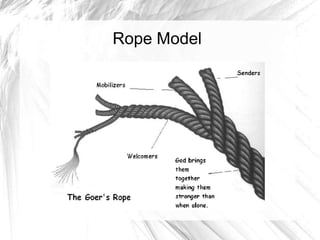
Rope Model
Rope Model
 This model brings together Welcomers,
Senders, and Mobilizers by God into a support
for the Goer (Missionary)
 The rope links to Ecclesiastes 4:12 “Though
one may be overpowered, two can defend
themselves. A cord of three strands is not quickly
broken.”
 Rope is also used in the well-known story of
William Carey describing himself, as it were,
descending into a mine/cave and needs his
supporters to “hold the rope.”
Rope Model
 The big advantages to this model are that it is
simple, it is visual, it is memorable, and it links
to the Bible and Mission history.
 However, the model is much more limited,
failing to give much detail of how member care
works. (Arguably, it may be better to say that
the Rope is more of an Illustration than a full
model.)
Web of Care
Web of Care
 The missionary (goer) is seen as being part of
a web or relationships to carry out missions,
but this also suggests how care works.
 God can be put in the middle to show His
centrality. However, doing that removes the
direct connection between the Goer and
Sender, as well as the Welcomer and
Mobilizer.
Web of Care
 Negatively, this model is too simple.
 On the other hand, a major advantage is that it
shows that each of the groups are in
relationship to each other, not just to the
missionary. It also emphasizes that missions is
a “team sport” not just the activity of a
missionary with some people supporting them.
“Octahedron” of Care
Octahedron of Care
 This is somewhat like the Pyramid of Care.
The big difference is that it focuses on types of
care or support, rather than categories of
people. As such, Self-care becomes its own
point.
 Like the Pyramid of Care, the greater the type
of care, the greater the distance from the
geometric center.
Octahedron of Care
 An advantage it has is emphasizing the
importance of Self Care. Other things are like
the Pyramid of Care.
 The greater the volume of the prism, the
greater the capacity to handle stressors.
 A disadvantage is that this model doesn't
prioritize forms of care, and also is starting to
get a bit complicated.
Closing
Member Care Models are not critical. Ultimately,
each model (as well as models not shown
here) have advantages and disadvantages.
Models always have limits. If you find one or
more of them useful, use them.
References
 “Doing Member Care Well: Perspectives and
Practices from Around the World,” book, editor Kelly
O'Donnell
 “Member Care Foundations,” online course, led by
Harry Hoffmann, Global Member Care Network.
 “Philosophy of Missions,” training course, Daniel
Russell, Philippine Baptist Theological Seminary
 “Pastoral Theology,” book, Margaret Whipp
 “Dynamics in Pastoral Counseling and Training,”
book, Robert and Celia Munson

Missionary Member Care Models

  • 1.
    Missionary Member CareModels www.munsonmissions.org 2020
  • 2.
    Background  Missionary MemberCare is a form of ministry associated with Pastoral Theology (a form of practical theology).  Pastoral Theology is “The study of how and why Christians care.” (Margaret Whipp, Pastoral Theology, SCM, 2015)  The application of Pastoral Theology to Missionaries is Missionary Member Care.  Missionary Member Care is the practice of ministry for caring for the needs of Missionaries.
  • 3.
    Of course itis much more complicated than that  The care of missionaries is tied to their effectivity. What is necessary for missionaries to make missionaries effective (“successful”) in their work.  However, effectivity is not the whole matter. Missionaries are human beings tied to others through families. The goal also is to help their families (even extended families).  Care is holistic (or “wholistic” if you prefer) and so seeks to address physical, psychoemotional, social, spiritual, economic, and professional needs.
  • 4.
    “Best Practice Modelof Member Care”
  • 5.
    Best Practice Modelof Member Care  This model is described in “Doing Member Care Well” edited by Kelly O'Donnell  It describes a, perhaps idealized, comprehensive system of member care  The center is “Master Care” meaning the care that God provides to missionaries  Care moves outward from the center to self care, care from mutual friends, to sender care, to the ministry work of specialists.
  • 6.
    Values of thisModel  The shape suggests priority and frequency. God has the highest priority in care and is a form of constant care.  Moving outward from the center shows less frequent and less critical care.  Additionally, a value of this model is that it is pretty comprehenisive.  On the other hand, it is a bit... busy.
  • 7.
    “Pyramid of Care” (HarryHoffmann, Global Member Care Network)
  • 8.
    Pyramid of Care This model looks at the missionary in the center of the base of a pyramid.  The base shows the human support system.  The apex shows the spiritual side of the support system.  The human support system is divided into four categories: church, friends/family, people helpers, and professionals.  The greater the distance between recipient and the specific corner indicates the GREATER the relationship (and care).
  • 9.
    Pyramid of Care This model has the advantage (and disadvantage) of being simpler than the previous model, and is more visually memorable.  It may also have the advantage of specifically showing church support as well as “people helper” (like an accountability and prayer partner).  The model suggests that the greater the volume of the pyramid points to the greater care or capacity to handle struggles.  On the other hand, it doesn't necessary point towards priority of types of care or relationships.  Additionally, it addresses sender care more indirectly.
  • 10.
  • 11.
    Rope Model  Thismodel brings together Welcomers, Senders, and Mobilizers by God into a support for the Goer (Missionary)  The rope links to Ecclesiastes 4:12 “Though one may be overpowered, two can defend themselves. A cord of three strands is not quickly broken.”  Rope is also used in the well-known story of William Carey describing himself, as it were, descending into a mine/cave and needs his supporters to “hold the rope.”
  • 12.
    Rope Model  Thebig advantages to this model are that it is simple, it is visual, it is memorable, and it links to the Bible and Mission history.  However, the model is much more limited, failing to give much detail of how member care works. (Arguably, it may be better to say that the Rope is more of an Illustration than a full model.)
  • 13.
  • 14.
    Web of Care The missionary (goer) is seen as being part of a web or relationships to carry out missions, but this also suggests how care works.  God can be put in the middle to show His centrality. However, doing that removes the direct connection between the Goer and Sender, as well as the Welcomer and Mobilizer.
  • 15.
    Web of Care Negatively, this model is too simple.  On the other hand, a major advantage is that it shows that each of the groups are in relationship to each other, not just to the missionary. It also emphasizes that missions is a “team sport” not just the activity of a missionary with some people supporting them.
  • 16.
  • 17.
    Octahedron of Care This is somewhat like the Pyramid of Care. The big difference is that it focuses on types of care or support, rather than categories of people. As such, Self-care becomes its own point.  Like the Pyramid of Care, the greater the type of care, the greater the distance from the geometric center.
  • 18.
    Octahedron of Care An advantage it has is emphasizing the importance of Self Care. Other things are like the Pyramid of Care.  The greater the volume of the prism, the greater the capacity to handle stressors.  A disadvantage is that this model doesn't prioritize forms of care, and also is starting to get a bit complicated.
  • 19.
    Closing Member Care Modelsare not critical. Ultimately, each model (as well as models not shown here) have advantages and disadvantages. Models always have limits. If you find one or more of them useful, use them.
  • 20.
    References  “Doing MemberCare Well: Perspectives and Practices from Around the World,” book, editor Kelly O'Donnell  “Member Care Foundations,” online course, led by Harry Hoffmann, Global Member Care Network.  “Philosophy of Missions,” training course, Daniel Russell, Philippine Baptist Theological Seminary  “Pastoral Theology,” book, Margaret Whipp  “Dynamics in Pastoral Counseling and Training,” book, Robert and Celia Munson