Contemporary Homiletics
Contextual Preaching
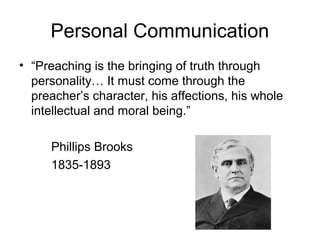
Personal Communication
• “Preaching is the bringing of truth through
personality… It must come through the
preacher’s character, his affections, his whole
intellectual and moral being.”
Phillips Brooks
1835-1893
Personal Consistency
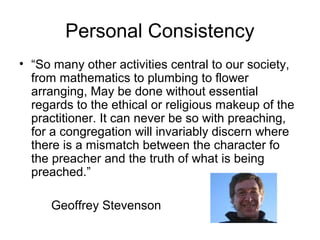
• “So many other activities central to our society,
from mathematics to plumbing to flower
arranging, May be done without essential
regards to the ethical or religious makeup of the
practitioner. It can never be so with preaching,
for a congregation will invariably discern where
there is a mismatch between the character fo
the preacher and the truth of what is being
preached.”
Geoffrey Stevenson
Personal Consecration
• David Day – “Embodying the Word”
• Stephen Olford – “Consecration”
• Robert Murray McCheyne – “The greatest need of the
congregation is my personal holiness.”
• John Piper – “All genuine preaching is rooted in a feeling
of desperation.”
• John Oliver ”[a friend, priest, and youth work trainer] –
“Some sort of consistent Christian lifestyle”
Personal Conviction
• “Proclamation is human speech in and by which God
himself speaks like a king through the mouth of his
herald, and which is meant to be heard and accepted as
speech in and by which God himself speaks.”
• “It is a decisive part of the insight of all true prophecy
that man as such has no possibility of uttering the Word
of God.”
• “What acknowledgement of God’s Word in our
experience is not unmasked and convicted by the Word
of God even as it takes place, convicted not of its
imperfection and inadequacy but of its total corruption
and futility.”
Karl Barth
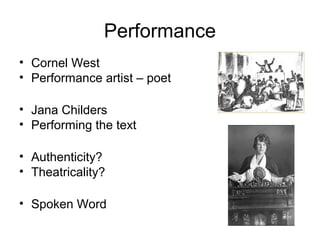
Performance
• Cornel West
• Performance artist – poet
• Jana Childers
• Performing the text
• Authenticity?
• Theatricality?
• Spoken Word
The ‘New Homiletic’
• Fred Craddock
• Heidegger
• Language
• Evocative
• Non-propositional
• Re-presentational
• As one without authority
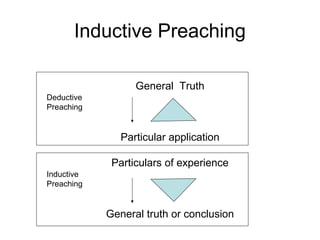
• Inductive rather than deductive
Inductive Preaching
General Truth
Particular application
Particulars of experience
General truth or conclusion
Deductive
Preaching
Inductive
Preaching
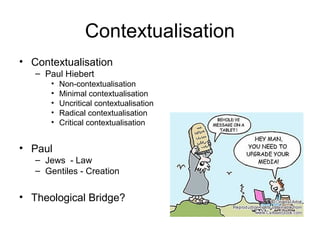
Contextualisation
• Contextualisation
– Paul Hiebert
• Non-contextualisation
• Minimal contextualisation
• Uncritical contextualisation
• Radical contextualisation
• Critical contextualisation
• Paul
– Jews - Law
– Gentiles - Creation
• Theological Bridge?
Postmodernity
• Metanarratives
• No truth
• No absolutes
• Sceptical of authority
• Fluid identity
• Relativism
• Pluralism
• Media
• Internet
• Oral-Aural
• Relational
• Right brain
• Storytelling
• Metaphor
• Spirituality
• Participation
• Dialogue
• Environment
• Listening
• Cool-Hot
Urban Preaching
• Geography
• What do you see out of the window in the morning?
• Urban - Rural
• “Without the primary emphasis on social transformation
through prophetic preaching, we will not see strong
communities in our urban areas.”
Roger Sainsbury
• “In this age of secularism and relativism, or urbanisation
and ghettoization in an ironic way, the future of God is in
the hands of preachers.”
Olin Moyd
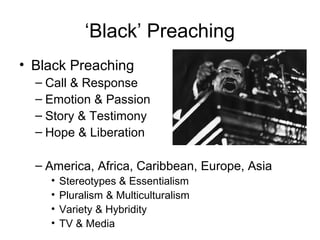
‘Black’ Preaching
• Black Preaching
– Call & Response
– Emotion & Passion
– Story & Testimony
– Hope & Liberation
– America, Africa, Caribbean, Europe, Asia
• Stereotypes & Essentialism
• Pluralism & Multiculturalism
• Variety & Hybridity
• TV & Media
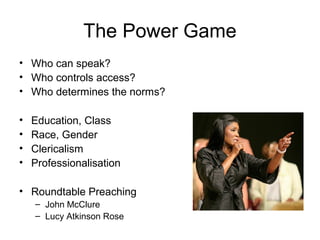
The Power Game
• Who can speak?
• Who controls access?
• Who determines the norms?
• Education, Class
• Race, Gender
• Clericalism
• Professionalisation
• Roundtable Preaching
– John McClure
– Lucy Atkinson Rose
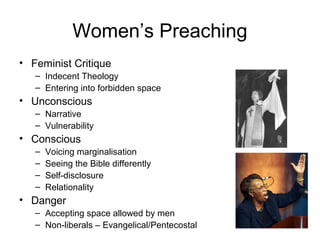
Women’s Preaching
• Feminist Critique
– Indecent Theology
– Entering into forbidden space
• Unconscious
– Narrative
– Vulnerability
• Conscious
– Voicing marginalisation
– Seeing the Bible differently
– Self-disclosure
– Relationality
• Danger
– Accepting space allowed by men
– Non-liberals – Evangelical/Pentecostal
Notes – with or without?
“Preaching is public address before it is anything
else, and if one expects one’s sermon to be
interesting, even compelling or captivating, then
one’s preaching must follow the basic rule of all
effective public speaking – the ironclad rule of
every Speech 101 class – is that one cannot
read a manuscript to one’s audience.”
Joseph M. Webb
Improv
• Memorised
• Extempore
• Improvisational
• Improv stand-up comedy
• Maximise connectedness
• Maximise participation
• Reflect authentic witness
• Intimacy
• Spontaneity
• Energy
• Dialogue

Contextual Preaching

  • 1.
  • 3.
    Personal Communication • “Preachingis the bringing of truth through personality… It must come through the preacher’s character, his affections, his whole intellectual and moral being.” Phillips Brooks 1835-1893
  • 4.
    Personal Consistency • “Somany other activities central to our society, from mathematics to plumbing to flower arranging, May be done without essential regards to the ethical or religious makeup of the practitioner. It can never be so with preaching, for a congregation will invariably discern where there is a mismatch between the character fo the preacher and the truth of what is being preached.” Geoffrey Stevenson
  • 5.
    Personal Consecration • DavidDay – “Embodying the Word” • Stephen Olford – “Consecration” • Robert Murray McCheyne – “The greatest need of the congregation is my personal holiness.” • John Piper – “All genuine preaching is rooted in a feeling of desperation.” • John Oliver ”[a friend, priest, and youth work trainer] – “Some sort of consistent Christian lifestyle”
  • 6.
    Personal Conviction • “Proclamationis human speech in and by which God himself speaks like a king through the mouth of his herald, and which is meant to be heard and accepted as speech in and by which God himself speaks.” • “It is a decisive part of the insight of all true prophecy that man as such has no possibility of uttering the Word of God.” • “What acknowledgement of God’s Word in our experience is not unmasked and convicted by the Word of God even as it takes place, convicted not of its imperfection and inadequacy but of its total corruption and futility.” Karl Barth
  • 7.
    Performance • Cornel West •Performance artist – poet • Jana Childers • Performing the text • Authenticity? • Theatricality? • Spoken Word
  • 9.
    The ‘New Homiletic’ •Fred Craddock • Heidegger • Language • Evocative • Non-propositional • Re-presentational • As one without authority • Inductive rather than deductive
  • 10.
    Inductive Preaching General Truth Particularapplication Particulars of experience General truth or conclusion Deductive Preaching Inductive Preaching
  • 11.
    Contextualisation • Contextualisation – PaulHiebert • Non-contextualisation • Minimal contextualisation • Uncritical contextualisation • Radical contextualisation • Critical contextualisation • Paul – Jews - Law – Gentiles - Creation • Theological Bridge?
  • 12.
    Postmodernity • Metanarratives • Notruth • No absolutes • Sceptical of authority • Fluid identity • Relativism • Pluralism • Media • Internet • Oral-Aural • Relational • Right brain • Storytelling • Metaphor • Spirituality • Participation • Dialogue • Environment • Listening • Cool-Hot
  • 13.
    Urban Preaching • Geography •What do you see out of the window in the morning? • Urban - Rural • “Without the primary emphasis on social transformation through prophetic preaching, we will not see strong communities in our urban areas.” Roger Sainsbury • “In this age of secularism and relativism, or urbanisation and ghettoization in an ironic way, the future of God is in the hands of preachers.” Olin Moyd
  • 14.
    ‘Black’ Preaching • BlackPreaching – Call & Response – Emotion & Passion – Story & Testimony – Hope & Liberation – America, Africa, Caribbean, Europe, Asia • Stereotypes & Essentialism • Pluralism & Multiculturalism • Variety & Hybridity • TV & Media
  • 15.
    The Power Game •Who can speak? • Who controls access? • Who determines the norms? • Education, Class • Race, Gender • Clericalism • Professionalisation • Roundtable Preaching – John McClure – Lucy Atkinson Rose
  • 16.
    Women’s Preaching • FeministCritique – Indecent Theology – Entering into forbidden space • Unconscious – Narrative – Vulnerability • Conscious – Voicing marginalisation – Seeing the Bible differently – Self-disclosure – Relationality • Danger – Accepting space allowed by men – Non-liberals – Evangelical/Pentecostal
  • 17.
    Notes – withor without? “Preaching is public address before it is anything else, and if one expects one’s sermon to be interesting, even compelling or captivating, then one’s preaching must follow the basic rule of all effective public speaking – the ironclad rule of every Speech 101 class – is that one cannot read a manuscript to one’s audience.” Joseph M. Webb
  • 18.
    Improv • Memorised • Extempore •Improvisational • Improv stand-up comedy • Maximise connectedness • Maximise participation • Reflect authentic witness • Intimacy • Spontaneity • Energy • Dialogue