









Spiritual Formation Overview
        Dr. Kenneth Boa and Bill Ibsen


       © Dr. Kenneth Boa & Bill Ibsen 2008.  All Rights Reserved.
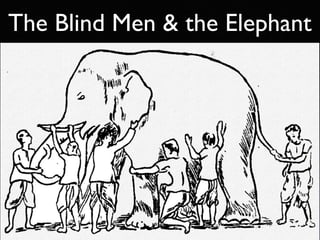
The Blind Men & the Elephant
A Variety of Approaches

• Body of Christ is extremely diverse
A Variety of Approaches

• Body of Christ is extremely diverse
• Each approach claimed as “best available”
A Variety of Approaches

• Body of Christ is extremely diverse
• Each approach claimed as “best available”
  • “Be-all and end-all” approach
A Variety of Approaches

• Body of Christ is extremely diverse
• Each approach claimed as “best available”
  • “Be-all and end-all” approach
  • No quick-fix, one-size-fits-all
A Variety of Approaches

• Body of Christ is extremely diverse
• Each approach claimed as “best available”
  • “Be-all and end-all” approach
  • No quick-fix, one-size-fits-all
• Pursuit of God is greatest adventure of all
Goals of This Synthetic and
Comprehensive Approach
Goals of This Synthetic and
   Comprehensive Approach
• Appreciation for your uniqueness in Christ
Goals of This Synthetic and
   Comprehensive Approach
• Appreciation for your uniqueness in Christ
• Exposure to options for your spiritual journey
Goals of This Synthetic and
   Comprehensive Approach
• Appreciation for your uniqueness in Christ
• Exposure to options for your spiritual journey
• Get out of a spiritual rut
Goals of This Synthetic and
   Comprehensive Approach
• Appreciation for your uniqueness in Christ
• Exposure to options for your spiritual journey
• Get out of a spiritual rut
• Experiment with other facets
Goals of This Synthetic and
   Comprehensive Approach
• Appreciation for your uniqueness in Christ
• Exposure to options for your spiritual journey
• Get out of a spiritual rut
• Experiment with other facets
• Expand your horizons and comfort zone
Goals of This Synthetic and
   Comprehensive Approach
• Appreciation for your uniqueness in Christ
• Exposure to options for your spiritual journey
• Get out of a spiritual rut
• Experiment with other facets
• Expand your horizons and comfort zone
• Instill greater passion for Christ in your life
Goals of This Synthetic and
   Comprehensive Approach
• Appreciation for your uniqueness in Christ
• Exposure to options for your spiritual journey
• Get out of a spiritual rut
• Experiment with other facets
• Expand your horizons and comfort zone
• Instill greater passion for Christ in your life
• Appreciation/unity with the Body of Christ
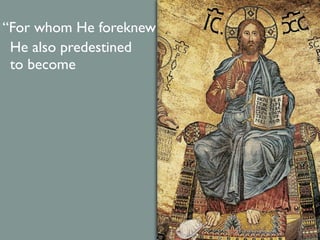
“For whom He foreknew
 He also predestined
 to become
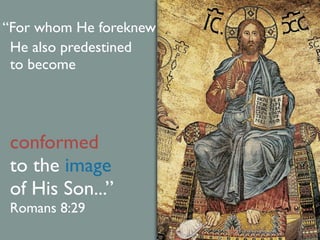
“For whom He foreknew
 He also predestined
 to become


 conformed
 to the image
 of His Son...”
 Romans 8:29
Overview
Overview

• The Current Hunger for Spirituality
Overview

• The Current Hunger for Spirituality
• A Journey and a Pilgrimage
Overview

• The Current Hunger for Spirituality
• A Journey and a Pilgrimage
• Twelve Facets of Spirituality
Overview

• The Current Hunger for Spirituality
• A Journey and a Pilgrimage
• Twelve Facets of Spirituality
• Unity in Diversity
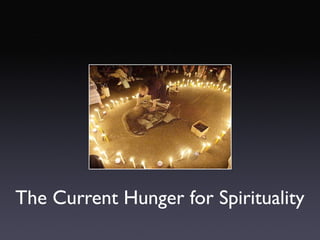
The Current Hunger for Spirituality
RELIGION
SPIRITUALITY
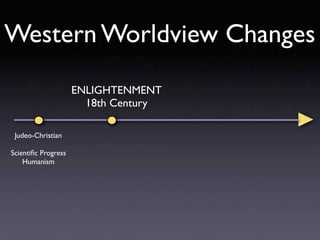
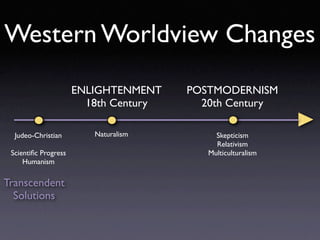
Western Worldview Changes


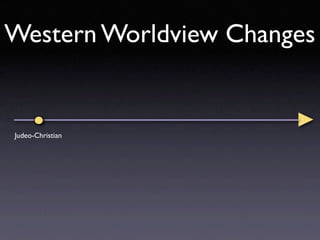
Judeo-Christian
Western Worldview Changes


 Judeo-Christian

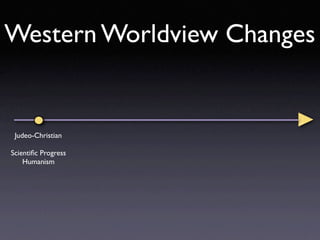
Scientific Progress
    Humanism
Western Worldview Changes
                     ENLIGHTENMENT
                       18th Century

 Judeo-Christian

Scientific Progress
    Humanism
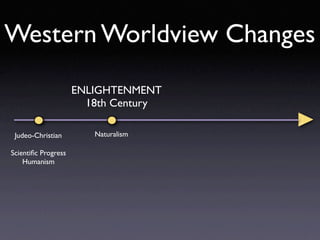
Western Worldview Changes
                     ENLIGHTENMENT
                       18th Century

 Judeo-Christian        Naturalism

Scientific Progress
    Humanism
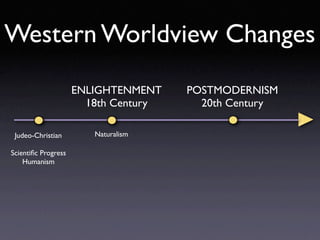
Western Worldview Changes
                     ENLIGHTENMENT    POSTMODERNISM
                       18th Century     20th Century

 Judeo-Christian        Naturalism

Scientific Progress
    Humanism
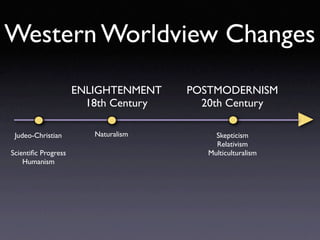
Western Worldview Changes
                     ENLIGHTENMENT    POSTMODERNISM
                       18th Century     20th Century

 Judeo-Christian        Naturalism         Skepticism
                                           Relativism
Scientific Progress                       Multiculturalism
    Humanism
Western Worldview Changes
                      ENLIGHTENMENT    POSTMODERNISM
                        18th Century     20th Century

  Judeo-Christian        Naturalism         Skepticism
                                            Relativism
 Scientific Progress                       Multiculturalism
     Humanism

Transcendent
  Solutions
Western Worldview Changes
                      ENLIGHTENMENT    POSTMODERNISM
                        18th Century     20th Century

  Judeo-Christian        Naturalism         Skepticism
                                            Relativism
 Scientific Progress                       Multiculturalism
     Humanism

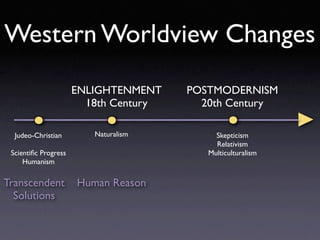
Transcendent          Human Reason
  Solutions
Western Worldview Changes
                      ENLIGHTENMENT    POSTMODERNISM
                        18th Century     20th Century

  Judeo-Christian        Naturalism         Skepticism
                                            Relativism
 Scientific Progress                       Multiculturalism
     Humanism

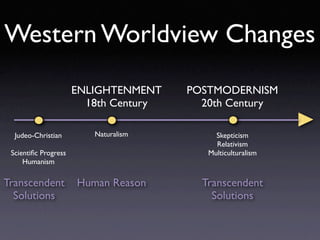
Transcendent          Human Reason       Transcendent
  Solutions                                Solutions
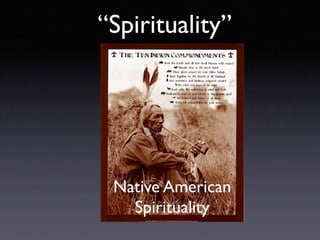
“Spirituality”


 Native American
   Spirituality
“Spirituality”
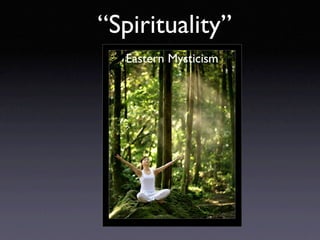
  Eastern Mysticism
“Spirituality”


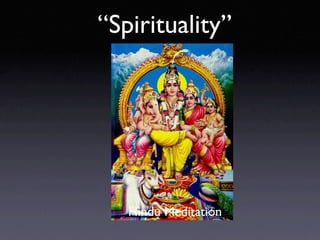
   Hindu Meditation
“Spirituality”

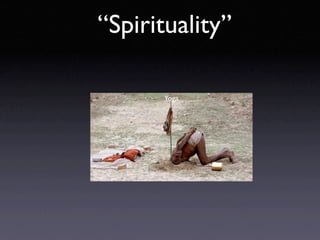
      Yoga
“Spirituality”
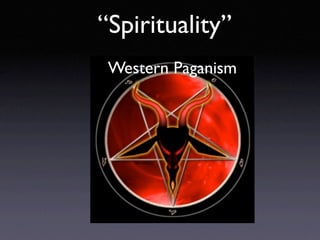
 Western Paganism
“Spirituality”

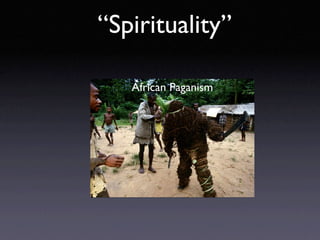
   African Paganism
“Spirituality”


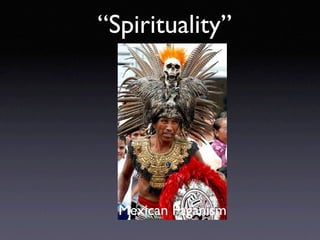
  Mexican Paganism
“Spirituality”


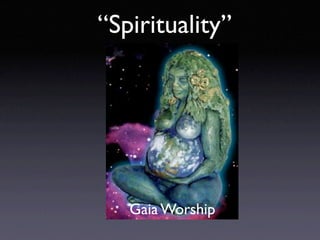
   Gaia Worship
“Spirituality”
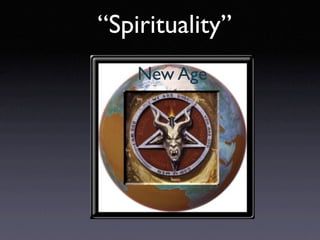
    New Age
“Spirituality”
    New Age
Biblical Spirituality


Authentic, biblically orthodox
approaches to the spiritual life
Why Christians are
   Hungering
Why Christians are
       Hungering

• Ambient cultural interest in spirituality
Why Christians are
       Hungering

• Ambient cultural interest in spirituality
• Dissatisfaction with Christian subculture
Why Christians are
       Hungering

• Ambient cultural interest in spirituality
• Dissatisfaction with Christian subculture
• Quest for meaning, purpose, significance
Why Christians are
       Hungering

• Ambient cultural interest in spirituality
• Dissatisfaction with Christian subculture
• Quest for meaning, purpose, significance
• Greater exposure to classics of spirituality
Why Christians are
      Hungering

• Ambient cultural interest in spirituality
• Dissatisfaction with Christian subculture
• Quest for meaning, purpose, significance
• Greater exposure to classics of spirituality
• Movement toward accountability/discipleship
A Journey and a Pilgrimage
Journey of the Spirit

• Begins with forgiveness
Journey of the Spirit

• Begins with forgiveness
• Progresses through faith and obedience
Journey of the Spirit

• Begins with forgiveness
• Progresses through faith and obedience
• Journey with Christ, not to Christ
Journey of the Spirit

• Begins with forgiveness
• Progresses through faith and obedience
• Journey with Christ, not to Christ
• Never arrive on earth
Spiritual Pilgrimage


• Sojourners and aliens (Hebrews 11:13)
Spiritual Pilgrimage


• Sojourners and aliens (Hebrews 11:13)
• No earthly happiness can satisfy our God-
  given longings
Spiritual Pilgrimage


• Sojourners and aliens (Hebrews 11:13)
• No earthly happiness can satisfy our God-
  given longings

• Changing terrain
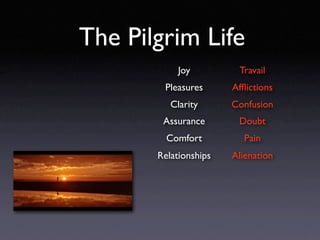
The Pilgrim Life
The Pilgrim Life
         Joy   Travail
The Pilgrim Life
           Joy       Travail
        Pleasures   Afflictions
The Pilgrim Life
           Joy       Travail
        Pleasures   Afflictions
         Clarity    Confusion
The Pilgrim Life
           Joy       Travail
        Pleasures   Afflictions
         Clarity    Confusion
        Assurance    Doubt
The Pilgrim Life
           Joy       Travail
        Pleasures   Afflictions
         Clarity    Confusion
        Assurance    Doubt
        Comfort       Pain
The Pilgrim Life
            Joy         Travail
        Pleasures      Afflictions
          Clarity      Confusion
        Assurance       Doubt
         Comfort         Pain
       Relationships   Alienation
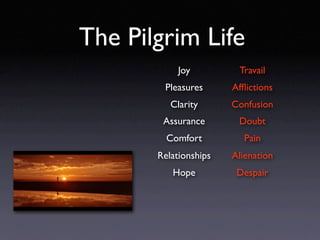
The Pilgrim Life
            Joy         Travail
        Pleasures      Afflictions
          Clarity      Confusion
        Assurance       Doubt
         Comfort         Pain
       Relationships   Alienation
          Hope          Despair
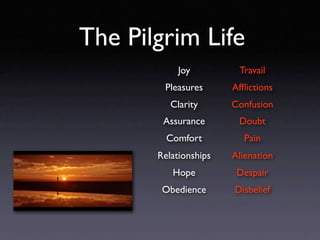
The Pilgrim Life
            Joy         Travail
        Pleasures      Afflictions
          Clarity      Confusion
        Assurance       Doubt
         Comfort         Pain
       Relationships   Alienation
          Hope          Despair
        Obedience      Disbelief
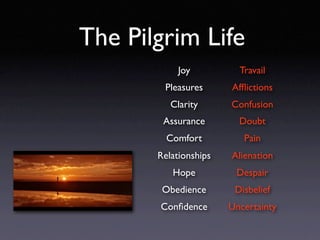
The Pilgrim Life
            Joy          Travail
        Pleasures      Afflictions
          Clarity      Confusion
        Assurance        Doubt
         Comfort          Pain
       Relationships   Alienation
          Hope          Despair
        Obedience       Disbelief
       Confidence       Uncertainty
Two Key Truths
for Our Journey
Two Key Truths
for Our Journey

            1. Others have preceded us
Two Key Truths
for Our Journey

            1. Others have preceded us
             • Some have left maps
Two Key Truths
for Our Journey

            1. Others have preceded us
             • Some have left maps
            2. God has equipped us
               with His resources
Twelve Facets of Spirituality
Diverse Approaches
Diverse Approaches


• Common Error: Mistake part for the whole
Diverse Approaches


• Common Error: Mistake part for the whole
• Be suspicious of single approach or formula
Diverse Approaches


• Common Error: Mistake part for the whole
• Be suspicious of single approach or formula
  • Gospels: different aspects of Christ’s life;
    resists neat categorization
Diverse Approaches


• Common Error: Mistake part for the whole
• Be suspicious of single approach or formula
  • Gospels: different aspects of Christ’s life;
    resists neat categorization

  • We will present a variety of pathways
1. Relational Spirituality

• Loving God completely
1. Relational Spirituality

• Loving God completely
• Loving ourselves correctly
1. Relational Spirituality

• Loving God completely
• Loving ourselves correctly
• Loving others compassionately
2. Paradigm Spirituality


• Cultivating an eternal versus a temporal
  perspective
2. Paradigm Spirituality


• Cultivating an eternal versus a temporal
  perspective

• Paradigm shift from cultural to biblical view
2. Paradigm Spirituality


• Cultivating an eternal versus a temporal
  perspective

• Paradigm shift from cultural to biblical view
• Transfers our hope
2. Paradigm Spirituality


• Cultivating an eternal versus a temporal
  perspective

• Paradigm shift from cultural to biblical view
• Transfers our hope
• Preciousness of the present
3. Disciplined Spirituality


• Engaging in the historic spiritual disciplines
3. Disciplined Spirituality


• Engaging in the historic spiritual disciplines
• Benefits of various disciplines
3. Disciplined Spirituality


• Engaging in the historic spiritual disciplines
• Benefits of various disciplines
• Tension between dependence and discipline
4. Exchanged Life Spirituality

   • Grasping our true identity in Christ
4. Exchanged Life Spirituality

   • Grasping our true identity in Christ
   • Our old life in Adam has been exchanged
     for new life in Christ
4. Exchanged Life Spirituality

   • Grasping our true identity in Christ
   • Our old life in Adam has been exchanged
     for new life in Christ

   • Move from a works to grace orientation
5. Motivated Spirituality
• A set of biblical incentives
5. Motivated Spirituality
• A set of biblical incentives
• Looking to Christ to meet our needs
5. Motivated Spirituality
• A set of biblical incentives
• Looking to Christ to meet our needs
• Biblical motivators such as fear, love and
  gratitude, rewards, identity, purpose, and
  hope, longing for God
6. Devotional Spirituality


• Falling in love with God
6. Devotional Spirituality


• Falling in love with God
• Cultivating growing intimacy with God
6. Devotional Spirituality
“The worth and excellency of a soul is to be measured
      by the object of its love.” -Henry Scougal

 • Falling in love with God
 • Cultivating growing intimacy with God
6. Devotional Spirituality


• Falling in love with God
• Cultivating growing intimacy with God
6. Devotional Spirituality


• Falling in love with God
• Cultivating growing intimacy with God
• Becoming conformed to what we
  most love and admire
7. Holistic Spirituality

• Every component under the lordship of Christ
7. Holistic Spirituality

• Every component under the lordship of Christ
• Secular/Sacred dichotomy
7. Holistic Spirituality

• Every component under the lordship of Christ
• Secular/Sacred dichotomy
• Christ’s lordship over every aspect of life
  - including the mundane
8. Process Spirituality
• Process versus product, being versus doing
8. Process Spirituality
• Process versus product, being versus doing
• Becoming faithful to the process
8. Process Spirituality
• Process versus product, being versus doing
• Becoming faithful to the process
• Not living from product to product
8. Process Spirituality
• Process versus product, being versus doing
• Becoming faithful to the process
• Not living from product to product
• Abiding in Christ
8. Process Spirituality
• Process versus product, being versus doing
• Becoming faithful to the process
• Not living from product to product
• Abiding in Christ
• Practicing His presence
9. Spirit-filled Spirituality

 • Walking in the power of the spirit
9. Spirit-filled Spirituality

 • Walking in the power of the spirit
 • Role of the Holy Spirit as a central dynamic
9. Spirit-filled Spirituality

 • Walking in the power of the spirit
 • Role of the Holy Spirit as a central dynamic
 • Holy Spirit as personal, not just a “force”
10. Warfare Spirituality

• Spiritual warfare is not optional for believers
10. Warfare Spirituality

• Spiritual warfare is not optional for believers
• The world, the flesh, and the devil
10. Warfare Spirituality

• Spiritual warfare is not optional for believers
• The world, the flesh, and the devil
• Presents a biblical strategy for dealing with
  these barriers to spiritual growth
11. Nurturing Spirituality

 • A lifestyle of evangelism and discipleship
11. Nurturing Spirituality

 • A lifestyle of evangelism and discipleship
 • Reproduction is believer's highest call
11. Nurturing Spirituality

 • A lifestyle of evangelism and discipleship
 • Reproduction is believer's highest call
 • Philosophy of E²
12. Corporate Spirituality

 • Encouragement, accountability, and worship
12. Corporate Spirituality

 • Encouragement, accountability, and worship
 • Need for community
12. Corporate Spirituality

 • Encouragement, accountability, and worship
 • Need for community
 • Nature and purpose of the Church
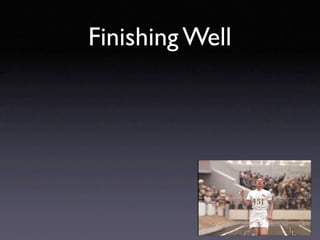
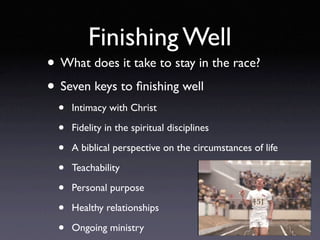
Finishing Well
Finishing Well
• What does it take to stay in the race?
Finishing Well
• What does it take to stay in the race?
• Seven keys to finishing well
Finishing Well
• What does it take to stay in the race?
• Seven keys to finishing well
  •   Intimacy with Christ
Finishing Well
• What does it take to stay in the race?
• Seven keys to finishing well
  •   Intimacy with Christ

  •   Fidelity in the spiritual disciplines
Finishing Well
• What does it take to stay in the race?
• Seven keys to finishing well
  •   Intimacy with Christ

  •   Fidelity in the spiritual disciplines

  •   A biblical perspective on the circumstances of life
Finishing Well
• What does it take to stay in the race?
• Seven keys to finishing well
  •   Intimacy with Christ

  •   Fidelity in the spiritual disciplines

  •   A biblical perspective on the circumstances of life

  •   Teachability
Finishing Well
• What does it take to stay in the race?
• Seven keys to finishing well
  •   Intimacy with Christ

  •   Fidelity in the spiritual disciplines

  •   A biblical perspective on the circumstances of life

  •   Teachability

  •   Personal purpose
Finishing Well
• What does it take to stay in the race?
• Seven keys to finishing well
  •   Intimacy with Christ

  •   Fidelity in the spiritual disciplines

  •   A biblical perspective on the circumstances of life

  •   Teachability

  •   Personal purpose

  •   Healthy relationships
Finishing Well
• What does it take to stay in the race?
• Seven keys to finishing well
  •   Intimacy with Christ

  •   Fidelity in the spiritual disciplines

  •   A biblical perspective on the circumstances of life

  •   Teachability

  •   Personal purpose

  •   Healthy relationships

  •   Ongoing ministry
Unity in Diversity
Unity in Diversity
Unity in Diversity

• Body of Christ is a
  diverse and composite
  unity (1 Corinthians 12-14)
Unity in Diversity

• Body of Christ is a
  diverse and composite
  unity (1 Corinthians 12-14)

  • Designed for
     interdependence
Unity in Diversity

• Body of Christ is a
  diverse and composite
  unity (1 Corinthians 12-14)

  • Designed for
     interdependence

• God has always used
  dissimilar people
Unity in Diversity
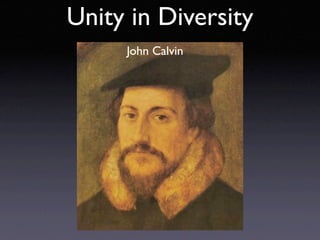
     John Calvin
Unity in Diversity
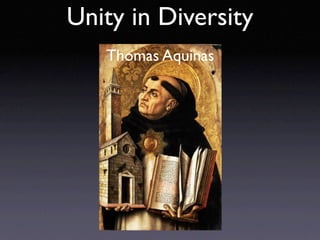
   Thomas Aquinas
Unity in Diversity


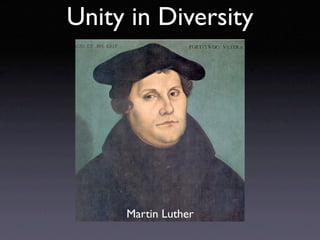
     Martin Luther
Unity in Diversity


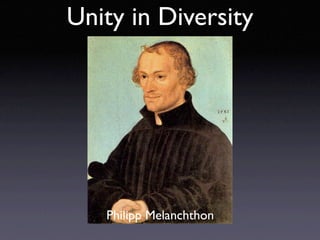
   Philipp Melanchthon
Unity in Diversity
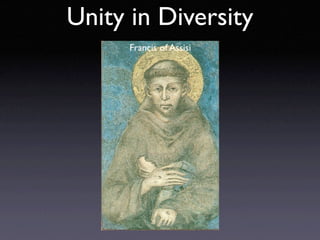
      Francis of Assisi
Unity in Diversity
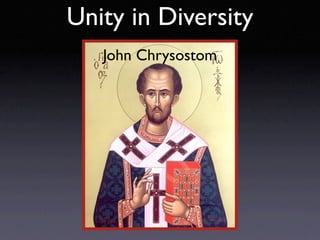
   John Chrysostom
Unity in Diversity
Unity in Diversity

• We are free to be
  drawn to the diversity
  of approaches to
  spiritual formation
Unity in Diversity

• We are free to be
  drawn to the diversity
  of approaches to
  spiritual formation

• It is good to expose
  ourselves to facets we
  find less attractive
The End
Kenboa.org
Kenboa.org
Kenboa.org
    KenBoa.org website – Daily
 growth email and free text and audio
              resources
Kenboa.org
    KenBoa.org website – Daily
 growth email and free text and audio
              resources
    Reflections – A free monthly
           teaching letter
DVD SERIES
DVD SERIES
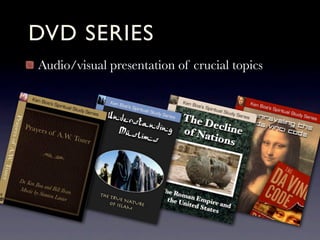
Audio/visual presentation of crucial topics
DVD SERIES
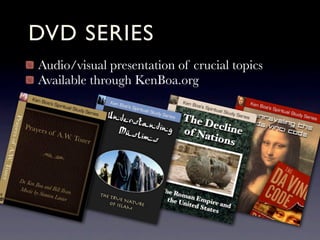
Audio/visual presentation of crucial topics
Available through KenBoa.org
KENBOA.ORG


 KenBoa.org

 ken_boa

     Kenneth Boa

Spiritual Formation Overview

Editor's Notes

  • #2 \n
  • #3 Once upon a time, there lived six blind men in a village. One day the villagers told them, "Hey, there is an elephant in the village today."\nThey had no idea what an elephant is. They decided, "Even though we would not be able to see it, let us go and feel it anyway." All of them went where the elephant was. Everyone of them touched the elephant.\n"Hey, the elephant is a pillar," said the first man who touched his leg.\n"Oh, no! it is like a rope," said the second man who touched the tail.\n"Oh, no! it is like a thick branch of a tree," said the third man who touched the trunk of the elephant.\n"It is like a big hand fan" said the fourth man who touched the ear of the elephant.\n"It is like a huge wall," said the fifth man who touched the belly of the elephant.\n"It is like a solid pipe," Said the sixth man who touched the tusk of the elephant.\nThey began to argue about the elephant and everyone of them insisted that he was right. It looked like they were getting agitated. A wise man was passing by and he saw this. He stopped and asked them, "What is the matter?" They said, "We cannot agree to what the elephant is like." Each one of them told what he thought the elephant was like. The wise man calmly explained to them, "All of you are right. The reason every one of you is telling it differently because each one of you touched the different part of the elephant. So, actually the elephant has all those features what you all said."\n"Oh!" everyone said. There was no more fight. They felt happy that they were all right.\nThe moral of the story is that there may be some truth to what someone says. Sometimes we can see that truth and sometimes not because they may have different perspective which we may not agree too. \n
  • #4 1. The body of Christ is extremely diverse, and through my experiences with so many facets of the spiritual life in my own journey of faith, I have discovered an appreciation for the unique merits of each.\n\n2. There are a wide variety of approaches to spiritual formation and discipleship. Particularly fascinating is how each approach was presented with a certain finality by its proponents, who claimed that their spirituality is the best available. Each time I discovered another set of useful tools, but the toolbox never seemed to be complete.\n\n3. My quests for a quick-fix, a one-size-fits all, or a controllable technique have all failed.\n\n4. We can hardly scratch the surface of all that God has for us and that there are always new surprises. Seen this way, the pursuit of God becomes the greatest adventure of all.\n
  • #5 1. The body of Christ is extremely diverse, and through my experiences with so many facets of the spiritual life in my own journey of faith, I have discovered an appreciation for the unique merits of each.\n\n2. There are a wide variety of approaches to spiritual formation and discipleship. Particularly fascinating is how each approach was presented with a certain finality by its proponents, who claimed that their spirituality is the best available. Each time I discovered another set of useful tools, but the toolbox never seemed to be complete.\n\n3. My quests for a quick-fix, a one-size-fits all, or a controllable technique have all failed.\n\n4. We can hardly scratch the surface of all that God has for us and that there are always new surprises. Seen this way, the pursuit of God becomes the greatest adventure of all.\n
  • #6 1. The body of Christ is extremely diverse, and through my experiences with so many facets of the spiritual life in my own journey of faith, I have discovered an appreciation for the unique merits of each.\n\n2. There are a wide variety of approaches to spiritual formation and discipleship. Particularly fascinating is how each approach was presented with a certain finality by its proponents, who claimed that their spirituality is the best available. Each time I discovered another set of useful tools, but the toolbox never seemed to be complete.\n\n3. My quests for a quick-fix, a one-size-fits all, or a controllable technique have all failed.\n\n4. We can hardly scratch the surface of all that God has for us and that there are always new surprises. Seen this way, the pursuit of God becomes the greatest adventure of all.\n
  • #7 1. The body of Christ is extremely diverse, and through my experiences with so many facets of the spiritual life in my own journey of faith, I have discovered an appreciation for the unique merits of each.\n\n2. There are a wide variety of approaches to spiritual formation and discipleship. Particularly fascinating is how each approach was presented with a certain finality by its proponents, who claimed that their spirituality is the best available. Each time I discovered another set of useful tools, but the toolbox never seemed to be complete.\n\n3. My quests for a quick-fix, a one-size-fits all, or a controllable technique have all failed.\n\n4. We can hardly scratch the surface of all that God has for us and that there are always new surprises. Seen this way, the pursuit of God becomes the greatest adventure of all.\n
  • #8 1. The body of Christ is extremely diverse, and through my experiences with so many facets of the spiritual life in my own journey of faith, I have discovered an appreciation for the unique merits of each.\n\n2. There are a wide variety of approaches to spiritual formation and discipleship. Particularly fascinating is how each approach was presented with a certain finality by its proponents, who claimed that their spirituality is the best available. Each time I discovered another set of useful tools, but the toolbox never seemed to be complete.\n\n3. My quests for a quick-fix, a one-size-fits all, or a controllable technique have all failed.\n\n4. We can hardly scratch the surface of all that God has for us and that there are always new surprises. Seen this way, the pursuit of God becomes the greatest adventure of all.\n
  • #9 In Conformed to His Image, I want to present a synthetic and comprehensive approach to the spiritual life that will expose you to a number of beneficial facets, each of which has value as part of a greater whole.\n\nIt is my hope that this presentation will stretch your thinking and encourage you to “press on toward the goal for the prize of the upward call of God in Christ Jesus” (Phil. 3:14).\n
  • #10 In Conformed to His Image, I want to present a synthetic and comprehensive approach to the spiritual life that will expose you to a number of beneficial facets, each of which has value as part of a greater whole.\n\nIt is my hope that this presentation will stretch your thinking and encourage you to “press on toward the goal for the prize of the upward call of God in Christ Jesus” (Phil. 3:14).\n
  • #11 In Conformed to His Image, I want to present a synthetic and comprehensive approach to the spiritual life that will expose you to a number of beneficial facets, each of which has value as part of a greater whole.\n\nIt is my hope that this presentation will stretch your thinking and encourage you to “press on toward the goal for the prize of the upward call of God in Christ Jesus” (Phil. 3:14).\n
  • #12 In Conformed to His Image, I want to present a synthetic and comprehensive approach to the spiritual life that will expose you to a number of beneficial facets, each of which has value as part of a greater whole.\n\nIt is my hope that this presentation will stretch your thinking and encourage you to “press on toward the goal for the prize of the upward call of God in Christ Jesus” (Phil. 3:14).\n
  • #13 In Conformed to His Image, I want to present a synthetic and comprehensive approach to the spiritual life that will expose you to a number of beneficial facets, each of which has value as part of a greater whole.\n\nIt is my hope that this presentation will stretch your thinking and encourage you to “press on toward the goal for the prize of the upward call of God in Christ Jesus” (Phil. 3:14).\n
  • #14 In Conformed to His Image, I want to present a synthetic and comprehensive approach to the spiritual life that will expose you to a number of beneficial facets, each of which has value as part of a greater whole.\n\nIt is my hope that this presentation will stretch your thinking and encourage you to “press on toward the goal for the prize of the upward call of God in Christ Jesus” (Phil. 3:14).\n
  • #15 In Conformed to His Image, I want to present a synthetic and comprehensive approach to the spiritual life that will expose you to a number of beneficial facets, each of which has value as part of a greater whole.\n\nIt is my hope that this presentation will stretch your thinking and encourage you to “press on toward the goal for the prize of the upward call of God in Christ Jesus” (Phil. 3:14).\n
  • #16 Romans 8:29 gives us the most concise revelation of God’s ultimate intention for His people. His purpose is nothing less than that we become “conformed to the image of His Son.” This process of growing conformity to Christ was conceived before the foundation of the world, it is being realized as a divine-human process in the present, and it will be fulfilled when we stand in the presence of His glory, “blameless with great joy” (Jude 24).\n
  • #17 Romans 8:29 gives us the most concise revelation of God’s ultimate intention for His people. His purpose is nothing less than that we become “conformed to the image of His Son.” This process of growing conformity to Christ was conceived before the foundation of the world, it is being realized as a divine-human process in the present, and it will be fulfilled when we stand in the presence of His glory, “blameless with great joy” (Jude 24).\n
  • #18 Romans 8:29 gives us the most concise revelation of God’s ultimate intention for His people. His purpose is nothing less than that we become “conformed to the image of His Son.” This process of growing conformity to Christ was conceived before the foundation of the world, it is being realized as a divine-human process in the present, and it will be fulfilled when we stand in the presence of His glory, “blameless with great joy” (Jude 24).\n
  • #19 The introduction describes the current hunger for spirituality in our time and offers several reasons for this growing interest. The spiritual life is portrayed as a journey in which pilgrims can use a variety of approaches. This presentation (and others on individual facets) develops twelve facets of Christian spirituality that relate to practical experience on a personal and corporate level, and these facets are briefly summarized. It is natural to be attracted to some of these approaches more than others, but it is also beneficial to be exposed to all of them.\n
  • #20 The introduction describes the current hunger for spirituality in our time and offers several reasons for this growing interest. The spiritual life is portrayed as a journey in which pilgrims can use a variety of approaches. This presentation (and others on individual facets) develops twelve facets of Christian spirituality that relate to practical experience on a personal and corporate level, and these facets are briefly summarized. It is natural to be attracted to some of these approaches more than others, but it is also beneficial to be exposed to all of them.\n
  • #21 The introduction describes the current hunger for spirituality in our time and offers several reasons for this growing interest. The spiritual life is portrayed as a journey in which pilgrims can use a variety of approaches. This presentation (and others on individual facets) develops twelve facets of Christian spirituality that relate to practical experience on a personal and corporate level, and these facets are briefly summarized. It is natural to be attracted to some of these approaches more than others, but it is also beneficial to be exposed to all of them.\n
  • #22 The introduction describes the current hunger for spirituality in our time and offers several reasons for this growing interest. The spiritual life is portrayed as a journey in which pilgrims can use a variety of approaches. This presentation (and others on individual facets) develops twelve facets of Christian spirituality that relate to practical experience on a personal and corporate level, and these facets are briefly summarized. It is natural to be attracted to some of these approaches more than others, but it is also beneficial to be exposed to all of them.\n
  • #23 \n
  • #24 These days, religion is out but spirituality is in. There has been a remarkable hunger and quest for spiritual answers to the big questions of life in the last three decades.\n\nTaking their cue from education and the media, people are becoming more antagonistic to any authority that appears to be external or traditionally based. Thus, religion is on the way out while spiritualites that appeal to inner subjective and experiential authentication are on the way in. As the former Soviet Union shows, humans cannot live in an ideological vacuum; when one ideology is abandoned, people quickly embrace another, whether for weal or for woe. \n\n\n
  • #25 These days, religion is out but spirituality is in. There has been a remarkable hunger and quest for spiritual answers to the big questions of life in the last three decades.\n\nTaking their cue from education and the media, people are becoming more antagonistic to any authority that appears to be external or traditionally based. Thus, religion is on the way out while spiritualites that appeal to inner subjective and experiential authentication are on the way in. As the former Soviet Union shows, humans cannot live in an ideological vacuum; when one ideology is abandoned, people quickly embrace another, whether for weal or for woe. \n\n\n
  • #26 1. In the past, there was a general moral consensus in the Western world that was loosely based on a Judeo-Christian worldview, but this was accompanied by a growing tendency to secularize culture by marginalizing religion and replacing it with a popular faith in scientific progress and humanistic inquiry.\n\n2. But pure naturalism corrodes by the acids of its own assumptions. As the Enlightenment project of arriving at final answers and solutions to the human condition by means of unaided human reason began to totter and crumble, the quest for transcendent solutions became more appealing.\n\n3. In an increasingly postmodern world, there is a new skepticism about the quest for objective truth, a new relativism concerning moral standards, and a new multiculturalism that encourages us to pick and choose ideological options This smorgasbord mentality has led to a frightening lack of discernment and an uncritical openness to pantheistic spiritualities and New Age philosophies and techniques.\n\n“Postmodernism”: A post-Enlightenment approach to the world that relativizes truth, morality, and aesthetics as socially conditioned constructs.\n
  • #27 1. In the past, there was a general moral consensus in the Western world that was loosely based on a Judeo-Christian worldview, but this was accompanied by a growing tendency to secularize culture by marginalizing religion and replacing it with a popular faith in scientific progress and humanistic inquiry.\n\n2. But pure naturalism corrodes by the acids of its own assumptions. As the Enlightenment project of arriving at final answers and solutions to the human condition by means of unaided human reason began to totter and crumble, the quest for transcendent solutions became more appealing.\n\n3. In an increasingly postmodern world, there is a new skepticism about the quest for objective truth, a new relativism concerning moral standards, and a new multiculturalism that encourages us to pick and choose ideological options This smorgasbord mentality has led to a frightening lack of discernment and an uncritical openness to pantheistic spiritualities and New Age philosophies and techniques.\n\n“Postmodernism”: A post-Enlightenment approach to the world that relativizes truth, morality, and aesthetics as socially conditioned constructs.\n
  • #28 1. In the past, there was a general moral consensus in the Western world that was loosely based on a Judeo-Christian worldview, but this was accompanied by a growing tendency to secularize culture by marginalizing religion and replacing it with a popular faith in scientific progress and humanistic inquiry.\n\n2. But pure naturalism corrodes by the acids of its own assumptions. As the Enlightenment project of arriving at final answers and solutions to the human condition by means of unaided human reason began to totter and crumble, the quest for transcendent solutions became more appealing.\n\n3. In an increasingly postmodern world, there is a new skepticism about the quest for objective truth, a new relativism concerning moral standards, and a new multiculturalism that encourages us to pick and choose ideological options This smorgasbord mentality has led to a frightening lack of discernment and an uncritical openness to pantheistic spiritualities and New Age philosophies and techniques.\n\n“Postmodernism”: A post-Enlightenment approach to the world that relativizes truth, morality, and aesthetics as socially conditioned constructs.\n
  • #29 1. In the past, there was a general moral consensus in the Western world that was loosely based on a Judeo-Christian worldview, but this was accompanied by a growing tendency to secularize culture by marginalizing religion and replacing it with a popular faith in scientific progress and humanistic inquiry.\n\n2. But pure naturalism corrodes by the acids of its own assumptions. As the Enlightenment project of arriving at final answers and solutions to the human condition by means of unaided human reason began to totter and crumble, the quest for transcendent solutions became more appealing.\n\n3. In an increasingly postmodern world, there is a new skepticism about the quest for objective truth, a new relativism concerning moral standards, and a new multiculturalism that encourages us to pick and choose ideological options This smorgasbord mentality has led to a frightening lack of discernment and an uncritical openness to pantheistic spiritualities and New Age philosophies and techniques.\n\n“Postmodernism”: A post-Enlightenment approach to the world that relativizes truth, morality, and aesthetics as socially conditioned constructs.\n
  • #30 1. In the past, there was a general moral consensus in the Western world that was loosely based on a Judeo-Christian worldview, but this was accompanied by a growing tendency to secularize culture by marginalizing religion and replacing it with a popular faith in scientific progress and humanistic inquiry.\n\n2. But pure naturalism corrodes by the acids of its own assumptions. As the Enlightenment project of arriving at final answers and solutions to the human condition by means of unaided human reason began to totter and crumble, the quest for transcendent solutions became more appealing.\n\n3. In an increasingly postmodern world, there is a new skepticism about the quest for objective truth, a new relativism concerning moral standards, and a new multiculturalism that encourages us to pick and choose ideological options This smorgasbord mentality has led to a frightening lack of discernment and an uncritical openness to pantheistic spiritualities and New Age philosophies and techniques.\n\n“Postmodernism”: A post-Enlightenment approach to the world that relativizes truth, morality, and aesthetics as socially conditioned constructs.\n
  • #31 1. In the past, there was a general moral consensus in the Western world that was loosely based on a Judeo-Christian worldview, but this was accompanied by a growing tendency to secularize culture by marginalizing religion and replacing it with a popular faith in scientific progress and humanistic inquiry.\n\n2. But pure naturalism corrodes by the acids of its own assumptions. As the Enlightenment project of arriving at final answers and solutions to the human condition by means of unaided human reason began to totter and crumble, the quest for transcendent solutions became more appealing.\n\n3. In an increasingly postmodern world, there is a new skepticism about the quest for objective truth, a new relativism concerning moral standards, and a new multiculturalism that encourages us to pick and choose ideological options This smorgasbord mentality has led to a frightening lack of discernment and an uncritical openness to pantheistic spiritualities and New Age philosophies and techniques.\n\n“Postmodernism”: A post-Enlightenment approach to the world that relativizes truth, morality, and aesthetics as socially conditioned constructs.\n
  • #32 1. In the past, there was a general moral consensus in the Western world that was loosely based on a Judeo-Christian worldview, but this was accompanied by a growing tendency to secularize culture by marginalizing religion and replacing it with a popular faith in scientific progress and humanistic inquiry.\n\n2. But pure naturalism corrodes by the acids of its own assumptions. As the Enlightenment project of arriving at final answers and solutions to the human condition by means of unaided human reason began to totter and crumble, the quest for transcendent solutions became more appealing.\n\n3. In an increasingly postmodern world, there is a new skepticism about the quest for objective truth, a new relativism concerning moral standards, and a new multiculturalism that encourages us to pick and choose ideological options This smorgasbord mentality has led to a frightening lack of discernment and an uncritical openness to pantheistic spiritualities and New Age philosophies and techniques.\n\n“Postmodernism”: A post-Enlightenment approach to the world that relativizes truth, morality, and aesthetics as socially conditioned constructs.\n
  • #33 1. In the past, there was a general moral consensus in the Western world that was loosely based on a Judeo-Christian worldview, but this was accompanied by a growing tendency to secularize culture by marginalizing religion and replacing it with a popular faith in scientific progress and humanistic inquiry.\n\n2. But pure naturalism corrodes by the acids of its own assumptions. As the Enlightenment project of arriving at final answers and solutions to the human condition by means of unaided human reason began to totter and crumble, the quest for transcendent solutions became more appealing.\n\n3. In an increasingly postmodern world, there is a new skepticism about the quest for objective truth, a new relativism concerning moral standards, and a new multiculturalism that encourages us to pick and choose ideological options This smorgasbord mentality has led to a frightening lack of discernment and an uncritical openness to pantheistic spiritualities and New Age philosophies and techniques.\n\n“Postmodernism”: A post-Enlightenment approach to the world that relativizes truth, morality, and aesthetics as socially conditioned constructs.\n
  • #34 1. In the past, there was a general moral consensus in the Western world that was loosely based on a Judeo-Christian worldview, but this was accompanied by a growing tendency to secularize culture by marginalizing religion and replacing it with a popular faith in scientific progress and humanistic inquiry.\n\n2. But pure naturalism corrodes by the acids of its own assumptions. As the Enlightenment project of arriving at final answers and solutions to the human condition by means of unaided human reason began to totter and crumble, the quest for transcendent solutions became more appealing.\n\n3. In an increasingly postmodern world, there is a new skepticism about the quest for objective truth, a new relativism concerning moral standards, and a new multiculturalism that encourages us to pick and choose ideological options This smorgasbord mentality has led to a frightening lack of discernment and an uncritical openness to pantheistic spiritualities and New Age philosophies and techniques.\n\n“Postmodernism”: A post-Enlightenment approach to the world that relativizes truth, morality, and aesthetics as socially conditioned constructs.\n
  • #35 This smorgasbord mentality of popular culture has led to a frightening lack of discernment and an uncritical openness to pantheistic spiritualities and New Age philosophies and techniques. In our time, one can freely promote Native American spirituality, Eastern mysticism, Western European paganism, shamanic medicine, techniques for achieving cosmic consciousness, or any form of yoga without fear of public criticism.\nParalleling this growing popular interest in spirituality, there has been a pronounced increase in the church’s appetite for spiritual renewal. The problem here is that many, especially certain leaders in mainline denominations, have failed to discern “the spirit of truth and the spirit of error” (1 John 4:6). Reimaging of God in radical feminist categories (e.g., the worship of Sophia and Gaia), Buddhist tantrism, Hinduistic meditative techniques, and pagan symbolism have been surfacing more frequently in churches that have moved away from the authority of Scripture to espouse liberal theologies. Nevertheless, there are authentic, biblically orthodox, and time-tested approaches to the spiritual life that have been taking hold in many communities of believers, and this is what this book means when it uses the term, “spirituality.” \n\n\n
  • #36 This smorgasbord mentality of popular culture has led to a frightening lack of discernment and an uncritical openness to pantheistic spiritualities and New Age philosophies and techniques. In our time, one can freely promote Native American spirituality, Eastern mysticism, Western European paganism, shamanic medicine, techniques for achieving cosmic consciousness, or any form of yoga without fear of public criticism.\nParalleling this growing popular interest in spirituality, there has been a pronounced increase in the church’s appetite for spiritual renewal. The problem here is that many, especially certain leaders in mainline denominations, have failed to discern “the spirit of truth and the spirit of error” (1 John 4:6). Reimaging of God in radical feminist categories (e.g., the worship of Sophia and Gaia), Buddhist tantrism, Hinduistic meditative techniques, and pagan symbolism have been surfacing more frequently in churches that have moved away from the authority of Scripture to espouse liberal theologies. Nevertheless, there are authentic, biblically orthodox, and time-tested approaches to the spiritual life that have been taking hold in many communities of believers, and this is what this book means when it uses the term, “spirituality.” \n\n\n
  • #37 This smorgasbord mentality of popular culture has led to a frightening lack of discernment and an uncritical openness to pantheistic spiritualities and New Age philosophies and techniques. In our time, one can freely promote Native American spirituality, Eastern mysticism, Western European paganism, shamanic medicine, techniques for achieving cosmic consciousness, or any form of yoga without fear of public criticism.\nParalleling this growing popular interest in spirituality, there has been a pronounced increase in the church’s appetite for spiritual renewal. The problem here is that many, especially certain leaders in mainline denominations, have failed to discern “the spirit of truth and the spirit of error” (1 John 4:6). Reimaging of God in radical feminist categories (e.g., the worship of Sophia and Gaia), Buddhist tantrism, Hinduistic meditative techniques, and pagan symbolism have been surfacing more frequently in churches that have moved away from the authority of Scripture to espouse liberal theologies. Nevertheless, there are authentic, biblically orthodox, and time-tested approaches to the spiritual life that have been taking hold in many communities of believers, and this is what this book means when it uses the term, “spirituality.” \n\n\n
  • #38 This smorgasbord mentality of popular culture has led to a frightening lack of discernment and an uncritical openness to pantheistic spiritualities and New Age philosophies and techniques. In our time, one can freely promote Native American spirituality, Eastern mysticism, Western European paganism, shamanic medicine, techniques for achieving cosmic consciousness, or any form of yoga without fear of public criticism.\nParalleling this growing popular interest in spirituality, there has been a pronounced increase in the church’s appetite for spiritual renewal. The problem here is that many, especially certain leaders in mainline denominations, have failed to discern “the spirit of truth and the spirit of error” (1 John 4:6). Reimaging of God in radical feminist categories (e.g., the worship of Sophia and Gaia), Buddhist tantrism, Hinduistic meditative techniques, and pagan symbolism have been surfacing more frequently in churches that have moved away from the authority of Scripture to espouse liberal theologies. Nevertheless, there are authentic, biblically orthodox, and time-tested approaches to the spiritual life that have been taking hold in many communities of believers, and this is what this book means when it uses the term, “spirituality.” \n\n\n
  • #39 This smorgasbord mentality of popular culture has led to a frightening lack of discernment and an uncritical openness to pantheistic spiritualities and New Age philosophies and techniques. In our time, one can freely promote Native American spirituality, Eastern mysticism, Western European paganism, shamanic medicine, techniques for achieving cosmic consciousness, or any form of yoga without fear of public criticism.\nParalleling this growing popular interest in spirituality, there has been a pronounced increase in the church’s appetite for spiritual renewal. The problem here is that many, especially certain leaders in mainline denominations, have failed to discern “the spirit of truth and the spirit of error” (1 John 4:6). Reimaging of God in radical feminist categories (e.g., the worship of Sophia and Gaia), Buddhist tantrism, Hinduistic meditative techniques, and pagan symbolism have been surfacing more frequently in churches that have moved away from the authority of Scripture to espouse liberal theologies. Nevertheless, there are authentic, biblically orthodox, and time-tested approaches to the spiritual life that have been taking hold in many communities of believers, and this is what this book means when it uses the term, “spirituality.” \n\n\n
  • #40 This smorgasbord mentality of popular culture has led to a frightening lack of discernment and an uncritical openness to pantheistic spiritualities and New Age philosophies and techniques. In our time, one can freely promote Native American spirituality, Eastern mysticism, Western European paganism, shamanic medicine, techniques for achieving cosmic consciousness, or any form of yoga without fear of public criticism.\nParalleling this growing popular interest in spirituality, there has been a pronounced increase in the church’s appetite for spiritual renewal. The problem here is that many, especially certain leaders in mainline denominations, have failed to discern “the spirit of truth and the spirit of error” (1 John 4:6). Reimaging of God in radical feminist categories (e.g., the worship of Sophia and Gaia), Buddhist tantrism, Hinduistic meditative techniques, and pagan symbolism have been surfacing more frequently in churches that have moved away from the authority of Scripture to espouse liberal theologies. Nevertheless, there are authentic, biblically orthodox, and time-tested approaches to the spiritual life that have been taking hold in many communities of believers, and this is what this book means when it uses the term, “spirituality.” \n\n\n
  • #41 This smorgasbord mentality of popular culture has led to a frightening lack of discernment and an uncritical openness to pantheistic spiritualities and New Age philosophies and techniques. In our time, one can freely promote Native American spirituality, Eastern mysticism, Western European paganism, shamanic medicine, techniques for achieving cosmic consciousness, or any form of yoga without fear of public criticism.\nParalleling this growing popular interest in spirituality, there has been a pronounced increase in the church’s appetite for spiritual renewal. The problem here is that many, especially certain leaders in mainline denominations, have failed to discern “the spirit of truth and the spirit of error” (1 John 4:6). Reimaging of God in radical feminist categories (e.g., the worship of Sophia and Gaia), Buddhist tantrism, Hinduistic meditative techniques, and pagan symbolism have been surfacing more frequently in churches that have moved away from the authority of Scripture to espouse liberal theologies. Nevertheless, there are authentic, biblically orthodox, and time-tested approaches to the spiritual life that have been taking hold in many communities of believers, and this is what this book means when it uses the term, “spirituality.” \n\n\n
  • #42 This smorgasbord mentality of popular culture has led to a frightening lack of discernment and an uncritical openness to pantheistic spiritualities and New Age philosophies and techniques. In our time, one can freely promote Native American spirituality, Eastern mysticism, Western European paganism, shamanic medicine, techniques for achieving cosmic consciousness, or any form of yoga without fear of public criticism.\nParalleling this growing popular interest in spirituality, there has been a pronounced increase in the church’s appetite for spiritual renewal. The problem here is that many, especially certain leaders in mainline denominations, have failed to discern “the spirit of truth and the spirit of error” (1 John 4:6). Reimaging of God in radical feminist categories (e.g., the worship of Sophia and Gaia), Buddhist tantrism, Hinduistic meditative techniques, and pagan symbolism have been surfacing more frequently in churches that have moved away from the authority of Scripture to espouse liberal theologies. Nevertheless, there are authentic, biblically orthodox, and time-tested approaches to the spiritual life that have been taking hold in many communities of believers, and this is what this book means when it uses the term, “spirituality.” \n\n\n
  • #43 This smorgasbord mentality of popular culture has led to a frightening lack of discernment and an uncritical openness to pantheistic spiritualities and New Age philosophies and techniques. In our time, one can freely promote Native American spirituality, Eastern mysticism, Western European paganism, shamanic medicine, techniques for achieving cosmic consciousness, or any form of yoga without fear of public criticism.\nParalleling this growing popular interest in spirituality, there has been a pronounced increase in the church’s appetite for spiritual renewal. The problem here is that many, especially certain leaders in mainline denominations, have failed to discern “the spirit of truth and the spirit of error” (1 John 4:6). Reimaging of God in radical feminist categories (e.g., the worship of Sophia and Gaia), Buddhist tantrism, Hinduistic meditative techniques, and pagan symbolism have been surfacing more frequently in churches that have moved away from the authority of Scripture to espouse liberal theologies. Nevertheless, there are authentic, biblically orthodox, and time-tested approaches to the spiritual life that have been taking hold in many communities of believers, and this is what this book means when it uses the term, “spirituality.” \n\n\n
  • #44  Nevertheless, there are authentic, biblically orthodox, and time-tested approaches to the spiritual life that have been taking hold in many communities of believers, and this is what this book means when it uses the term, “spirituality.” \n\n\n
  • #45 From a human standpoint, there are a number of reasons for the growing awareness of spirituality among followers of Christ. Here are a few:\n• the influence of the ambient cultural interest in spirituality\n• growing dissatisfaction with the shallowness and sterility of the \n Christian subculture\n• a more serious quest for meaning, purpose, and significance among \n followers of Christ\n• greater availability and exposure to the classics of spirituality\n• a more intense movement toward accountability and discipleship\n• influential writers and teachers who have become committed to \n communicating these truths\n\n
  • #46 From a human standpoint, there are a number of reasons for the growing awareness of spirituality among followers of Christ. Here are a few:\n• the influence of the ambient cultural interest in spirituality\n• growing dissatisfaction with the shallowness and sterility of the \n Christian subculture\n• a more serious quest for meaning, purpose, and significance among \n followers of Christ\n• greater availability and exposure to the classics of spirituality\n• a more intense movement toward accountability and discipleship\n• influential writers and teachers who have become committed to \n communicating these truths\n\n
  • #47 From a human standpoint, there are a number of reasons for the growing awareness of spirituality among followers of Christ. Here are a few:\n• the influence of the ambient cultural interest in spirituality\n• growing dissatisfaction with the shallowness and sterility of the \n Christian subculture\n• a more serious quest for meaning, purpose, and significance among \n followers of Christ\n• greater availability and exposure to the classics of spirituality\n• a more intense movement toward accountability and discipleship\n• influential writers and teachers who have become committed to \n communicating these truths\n\n
  • #48 From a human standpoint, there are a number of reasons for the growing awareness of spirituality among followers of Christ. Here are a few:\n• the influence of the ambient cultural interest in spirituality\n• growing dissatisfaction with the shallowness and sterility of the \n Christian subculture\n• a more serious quest for meaning, purpose, and significance among \n followers of Christ\n• greater availability and exposure to the classics of spirituality\n• a more intense movement toward accountability and discipleship\n• influential writers and teachers who have become committed to \n communicating these truths\n\n
  • #49 From a human standpoint, there are a number of reasons for the growing awareness of spirituality among followers of Christ. Here are a few:\n• the influence of the ambient cultural interest in spirituality\n• growing dissatisfaction with the shallowness and sterility of the \n Christian subculture\n• a more serious quest for meaning, purpose, and significance among \n followers of Christ\n• greater availability and exposure to the classics of spirituality\n• a more intense movement toward accountability and discipleship\n• influential writers and teachers who have become committed to \n communicating these truths\n\n
  • #50 The concepts in this presentation describe a journey into spirituality. The spiritual life is an all-encompassing, lifelong response to God’s gracious initiatives in the lives of those whose trust is centered in the person and work of Jesus Christ. Biblical spirituality is a Christ-centered orientation to every component of life through the mediating power of the indwelling Holy Spirit. \n
  • #51 1/2. Biblical spirituality is a journey of the spirit that begins with the gift of forgiveness and life in Christ and progresses through faith and obedience. \n\n3. Since it is based on a present relationship, it is a journey with Christ, rather than a journey to Christ.\n\n4. As long as we are on this earth we never arrive; the journey is not complete until the day of our resurrection, when the Lord brings us into complete conformity with Himself.\n
  • #52 1/2. Biblical spirituality is a journey of the spirit that begins with the gift of forgiveness and life in Christ and progresses through faith and obedience. \n\n3. Since it is based on a present relationship, it is a journey with Christ, rather than a journey to Christ.\n\n4. As long as we are on this earth we never arrive; the journey is not complete until the day of our resurrection, when the Lord brings us into complete conformity with Himself.\n
  • #53 1/2. Biblical spirituality is a journey of the spirit that begins with the gift of forgiveness and life in Christ and progresses through faith and obedience. \n\n3. Since it is based on a present relationship, it is a journey with Christ, rather than a journey to Christ.\n\n4. As long as we are on this earth we never arrive; the journey is not complete until the day of our resurrection, when the Lord brings us into complete conformity with Himself.\n
  • #54 1/2. Biblical spirituality is a journey of the spirit that begins with the gift of forgiveness and life in Christ and progresses through faith and obedience. \n\n3. Since it is based on a present relationship, it is a journey with Christ, rather than a journey to Christ.\n\n4. As long as we are on this earth we never arrive; the journey is not complete until the day of our resurrection, when the Lord brings us into complete conformity with Himself.\n
  • #55 This journey with Jesus is a spiritual pilgrimage in that we have confessed that we are “strangers and exiles on the earth” (Heb. 11:13).\n\n1. Once we are in Christ, we become sojourners and aliens on this planet; our citizenship has been changed from earth to heaven (Phil. 3:20), and\n\n2. We must grow in the realization that no earth-bound felicity can fully satisfy the deepest God-given longings of our hearts.\n\n3. During this brief pilgrimage, the terrain we encounter varies from grassy meadows to deserts and treacherous mountains. \n
  • #56 This journey with Jesus is a spiritual pilgrimage in that we have confessed that we are “strangers and exiles on the earth” (Heb. 11:13).\n\n1. Once we are in Christ, we become sojourners and aliens on this planet; our citizenship has been changed from earth to heaven (Phil. 3:20), and\n\n2. We must grow in the realization that no earth-bound felicity can fully satisfy the deepest God-given longings of our hearts.\n\n3. During this brief pilgrimage, the terrain we encounter varies from grassy meadows to deserts and treacherous mountains. \n
  • #57 This journey with Jesus is a spiritual pilgrimage in that we have confessed that we are “strangers and exiles on the earth” (Heb. 11:13).\n\n1. Once we are in Christ, we become sojourners and aliens on this planet; our citizenship has been changed from earth to heaven (Phil. 3:20), and\n\n2. We must grow in the realization that no earth-bound felicity can fully satisfy the deepest God-given longings of our hearts.\n\n3. During this brief pilgrimage, the terrain we encounter varies from grassy meadows to deserts and treacherous mountains. \n
  • #58 This pilgrim-life is filled with joy and travail, with pleasures and afflictions, with clarity and confusion, with assurance and doubt, with comfort and pain, with relationships and alienation, with hope and despair, with obedience and disbeleif, with confidence and uncertainty.\n
  • #59 This pilgrim-life is filled with joy and travail, with pleasures and afflictions, with clarity and confusion, with assurance and doubt, with comfort and pain, with relationships and alienation, with hope and despair, with obedience and disbeleif, with confidence and uncertainty.\n
  • #60 This pilgrim-life is filled with joy and travail, with pleasures and afflictions, with clarity and confusion, with assurance and doubt, with comfort and pain, with relationships and alienation, with hope and despair, with obedience and disbeleif, with confidence and uncertainty.\n
  • #61 This pilgrim-life is filled with joy and travail, with pleasures and afflictions, with clarity and confusion, with assurance and doubt, with comfort and pain, with relationships and alienation, with hope and despair, with obedience and disbeleif, with confidence and uncertainty.\n
  • #62 This pilgrim-life is filled with joy and travail, with pleasures and afflictions, with clarity and confusion, with assurance and doubt, with comfort and pain, with relationships and alienation, with hope and despair, with obedience and disbeleif, with confidence and uncertainty.\n
  • #63 This pilgrim-life is filled with joy and travail, with pleasures and afflictions, with clarity and confusion, with assurance and doubt, with comfort and pain, with relationships and alienation, with hope and despair, with obedience and disbeleif, with confidence and uncertainty.\n
  • #64 This pilgrim-life is filled with joy and travail, with pleasures and afflictions, with clarity and confusion, with assurance and doubt, with comfort and pain, with relationships and alienation, with hope and despair, with obedience and disbeleif, with confidence and uncertainty.\n
  • #65 This pilgrim-life is filled with joy and travail, with pleasures and afflictions, with clarity and confusion, with assurance and doubt, with comfort and pain, with relationships and alienation, with hope and despair, with obedience and disbeleif, with confidence and uncertainty.\n
  • #66 This pilgrim-life is filled with joy and travail, with pleasures and afflictions, with clarity and confusion, with assurance and doubt, with comfort and pain, with relationships and alienation, with hope and despair, with obedience and disbeleif, with confidence and uncertainty.\n
  • #67 But there are two critical truths to bear in mind when our surroundings become precarious: \n\n1. Others have preceded us in this journey\n\n2. Some have left maps along the way to guide us through the territory ahead\n\n3. God has equipped us with the spiritual resources He knows we will need throughout the journey.\n
  • #68 But there are two critical truths to bear in mind when our surroundings become precarious: \n\n1. Others have preceded us in this journey\n\n2. Some have left maps along the way to guide us through the territory ahead\n\n3. God has equipped us with the spiritual resources He knows we will need throughout the journey.\n
  • #69 But there are two critical truths to bear in mind when our surroundings become precarious: \n\n1. Others have preceded us in this journey\n\n2. Some have left maps along the way to guide us through the territory ahead\n\n3. God has equipped us with the spiritual resources He knows we will need throughout the journey.\n
  • #70 There are a variety of approaches to the spiritual life, but these are facets of a larger gem that is greater than the sum of its parts. \n
  • #71 The diversity and complexity of the spiritual paths that have been taken by godly pilgrims of previous centuries is rich and impressive. Some of these paths were blazed through courage and suffering and through reciprocity with complex historical, social, and cultural rhythms, but most followers of the Way have ignored the topographical maps that have been left behind or have torn off all the parts that are unfamiliar to them.\n\n1. The most common stumbling stone is to mistake part for the whole. Like the blind men who feel different parts of an elephant, one assumes that the spiritual life is a trunk, another takes it to be a tail, and a third concludes it is a leg.\n\n2. Anyone who studies the four Gospels should be suspicious of an approach that reduces the nuances of the spiritual life into a single formula or method.\n\n3. The Gospels are not biographies but highly selective thematic portraits that reveal different aspects of Christ’s life that should stand in dynamic tension with one another. The synergism of this tensioned interplay resists neat categorization, and so it is with the dynamics of a Spirit-led journey with Christ.\n\n4. This presentation will attempt to offer a more comprehensive, balanced, and applicable approach to what it means to know Christ. We will present not one or two but a variety of pathways in the spiritual life and showing how each of these pathways can contribute to the dynamic process of spiritual growth. We will look at several facets of the gem of the spiritual life and see how each can contribute to the larger whole.\n
  • #72 The diversity and complexity of the spiritual paths that have been taken by godly pilgrims of previous centuries is rich and impressive. Some of these paths were blazed through courage and suffering and through reciprocity with complex historical, social, and cultural rhythms, but most followers of the Way have ignored the topographical maps that have been left behind or have torn off all the parts that are unfamiliar to them.\n\n1. The most common stumbling stone is to mistake part for the whole. Like the blind men who feel different parts of an elephant, one assumes that the spiritual life is a trunk, another takes it to be a tail, and a third concludes it is a leg.\n\n2. Anyone who studies the four Gospels should be suspicious of an approach that reduces the nuances of the spiritual life into a single formula or method.\n\n3. The Gospels are not biographies but highly selective thematic portraits that reveal different aspects of Christ’s life that should stand in dynamic tension with one another. The synergism of this tensioned interplay resists neat categorization, and so it is with the dynamics of a Spirit-led journey with Christ.\n\n4. This presentation will attempt to offer a more comprehensive, balanced, and applicable approach to what it means to know Christ. We will present not one or two but a variety of pathways in the spiritual life and showing how each of these pathways can contribute to the dynamic process of spiritual growth. We will look at several facets of the gem of the spiritual life and see how each can contribute to the larger whole.\n
  • #73 The diversity and complexity of the spiritual paths that have been taken by godly pilgrims of previous centuries is rich and impressive. Some of these paths were blazed through courage and suffering and through reciprocity with complex historical, social, and cultural rhythms, but most followers of the Way have ignored the topographical maps that have been left behind or have torn off all the parts that are unfamiliar to them.\n\n1. The most common stumbling stone is to mistake part for the whole. Like the blind men who feel different parts of an elephant, one assumes that the spiritual life is a trunk, another takes it to be a tail, and a third concludes it is a leg.\n\n2. Anyone who studies the four Gospels should be suspicious of an approach that reduces the nuances of the spiritual life into a single formula or method.\n\n3. The Gospels are not biographies but highly selective thematic portraits that reveal different aspects of Christ’s life that should stand in dynamic tension with one another. The synergism of this tensioned interplay resists neat categorization, and so it is with the dynamics of a Spirit-led journey with Christ.\n\n4. This presentation will attempt to offer a more comprehensive, balanced, and applicable approach to what it means to know Christ. We will present not one or two but a variety of pathways in the spiritual life and showing how each of these pathways can contribute to the dynamic process of spiritual growth. We will look at several facets of the gem of the spiritual life and see how each can contribute to the larger whole.\n
  • #74 The diversity and complexity of the spiritual paths that have been taken by godly pilgrims of previous centuries is rich and impressive. Some of these paths were blazed through courage and suffering and through reciprocity with complex historical, social, and cultural rhythms, but most followers of the Way have ignored the topographical maps that have been left behind or have torn off all the parts that are unfamiliar to them.\n\n1. The most common stumbling stone is to mistake part for the whole. Like the blind men who feel different parts of an elephant, one assumes that the spiritual life is a trunk, another takes it to be a tail, and a third concludes it is a leg.\n\n2. Anyone who studies the four Gospels should be suspicious of an approach that reduces the nuances of the spiritual life into a single formula or method.\n\n3. The Gospels are not biographies but highly selective thematic portraits that reveal different aspects of Christ’s life that should stand in dynamic tension with one another. The synergism of this tensioned interplay resists neat categorization, and so it is with the dynamics of a Spirit-led journey with Christ.\n\n4. This presentation will attempt to offer a more comprehensive, balanced, and applicable approach to what it means to know Christ. We will present not one or two but a variety of pathways in the spiritual life and showing how each of these pathways can contribute to the dynamic process of spiritual growth. We will look at several facets of the gem of the spiritual life and see how each can contribute to the larger whole.\n
  • #75 As a communion of three persons, God is a relational being. He originates a personal relationship with us, and our high and holy calling is to respond to His loving initiatives. \n\n1/2/3. By loving God completely, we discover who and whose we are as we come to see ourselves as God sees us. In this way, we become secure enough to become others-centered rather than self-centered, and this enables us to become givers rather than grabbers.\n
  • #76 As a communion of three persons, God is a relational being. He originates a personal relationship with us, and our high and holy calling is to respond to His loving initiatives. \n\n1/2/3. By loving God completely, we discover who and whose we are as we come to see ourselves as God sees us. In this way, we become secure enough to become others-centered rather than self-centered, and this enables us to become givers rather than grabbers.\n
  • #77 As a communion of three persons, God is a relational being. He originates a personal relationship with us, and our high and holy calling is to respond to His loving initiatives. \n\n1/2/3. By loving God completely, we discover who and whose we are as we come to see ourselves as God sees us. In this way, we become secure enough to become others-centered rather than self-centered, and this enables us to become givers rather than grabbers.\n
  • #78 1. Paradigm spirituality contrasts the temporal and eternal value systems and \n\n2. emphasizes the need for a paradigm shift from a cultural to a biblical way of seeing life. \n\n3. The experience of our mortality can help us transfer our hope from the seen to the unseen and realize the preciousness of present opportunities. Our presuppositions shape our perspective, our perspective shapes our priorities, and our priorities shape our practice.\n
  • #79 1. Paradigm spirituality contrasts the temporal and eternal value systems and \n\n2. emphasizes the need for a paradigm shift from a cultural to a biblical way of seeing life. \n\n3. The experience of our mortality can help us transfer our hope from the seen to the unseen and realize the preciousness of present opportunities. Our presuppositions shape our perspective, our perspective shapes our priorities, and our priorities shape our practice.\n
  • #80 1. Paradigm spirituality contrasts the temporal and eternal value systems and \n\n2. emphasizes the need for a paradigm shift from a cultural to a biblical way of seeing life. \n\n3. The experience of our mortality can help us transfer our hope from the seen to the unseen and realize the preciousness of present opportunities. Our presuppositions shape our perspective, our perspective shapes our priorities, and our priorities shape our practice.\n
  • #81 1. Paradigm spirituality contrasts the temporal and eternal value systems and \n\n2. emphasizes the need for a paradigm shift from a cultural to a biblical way of seeing life. \n\n3. The experience of our mortality can help us transfer our hope from the seen to the unseen and realize the preciousness of present opportunities. Our presuppositions shape our perspective, our perspective shapes our priorities, and our priorities shape our practice.\n
  • #82 1. There has been a resurgence of interest in the classical disciplines of the spiritual life, \n\n2. and this section looks at the reasons for this trend and the benefits of the various disciplines. \n\n3. It also focuses on the needed balance between radical dependence on God and personal discipline and discusses the dynamic of obedience and application.\n
  • #83 1. There has been a resurgence of interest in the classical disciplines of the spiritual life, \n\n2. and this section looks at the reasons for this trend and the benefits of the various disciplines. \n\n3. It also focuses on the needed balance between radical dependence on God and personal discipline and discusses the dynamic of obedience and application.\n
  • #84 1. There has been a resurgence of interest in the classical disciplines of the spiritual life, \n\n2. and this section looks at the reasons for this trend and the benefits of the various disciplines. \n\n3. It also focuses on the needed balance between radical dependence on God and personal discipline and discusses the dynamic of obedience and application.\n
  • #85 1. The nineteenth and twentieth centuries saw the growth of an experiential approach to the spiritual life that is based on the believer’s new identity in Christ. \n\n2. Identification with Christ in His crucifixion and resurrection (Rom.6; Gal. 2:20) means that our old life has been exchanged for the life of Christ. \n\n3. This approach to spirituality moves from a works to a grace orientation and from legalism to liberty because it centers on our acknowledgment that Christ’s life is our life.\n
  • #86 1. The nineteenth and twentieth centuries saw the growth of an experiential approach to the spiritual life that is based on the believer’s new identity in Christ. \n\n2. Identification with Christ in His crucifixion and resurrection (Rom.6; Gal. 2:20) means that our old life has been exchanged for the life of Christ. \n\n3. This approach to spirituality moves from a works to a grace orientation and from legalism to liberty because it centers on our acknowledgment that Christ’s life is our life.\n
  • #87 1. The nineteenth and twentieth centuries saw the growth of an experiential approach to the spiritual life that is based on the believer’s new identity in Christ. \n\n2. Identification with Christ in His crucifixion and resurrection (Rom.6; Gal. 2:20) means that our old life has been exchanged for the life of Christ. \n\n3. This approach to spirituality moves from a works to a grace orientation and from legalism to liberty because it centers on our acknowledgment that Christ’s life is our life.\n
  • #88 People are motivated to satisfy their needs for security, significance, and fulfillment, but they turn to the wrong places to have their needs met.\n\n2. Motivated Spirituality presents the option of looking to Christ rather than the world to meet our needs.\n\n3. A study of scripture reveals a number of biblical motivators: these include fear, love and gratitude, rewards, identity, purpose and hope, and longing for God. Our task is to be more motivated by the things God declares to be important than by the things the world says are important.\n
  • #89 People are motivated to satisfy their needs for security, significance, and fulfillment, but they turn to the wrong places to have their needs met.\n\n2. Motivated Spirituality presents the option of looking to Christ rather than the world to meet our needs.\n\n3. A study of scripture reveals a number of biblical motivators: these include fear, love and gratitude, rewards, identity, purpose and hope, and longing for God. Our task is to be more motivated by the things God declares to be important than by the things the world says are important.\n
  • #90 People are motivated to satisfy their needs for security, significance, and fulfillment, but they turn to the wrong places to have their needs met.\n\n2. Motivated Spirituality presents the option of looking to Christ rather than the world to meet our needs.\n\n3. A study of scripture reveals a number of biblical motivators: these include fear, love and gratitude, rewards, identity, purpose and hope, and longing for God. Our task is to be more motivated by the things God declares to be important than by the things the world says are important.\n
  • #91 1/2. What are the keys to loving God, and how can we cultivate a growing intimacy with Him? Devotional Spirituality explores what it means to enjoy God and to trust in Him. \n\n3. Henry Scougal observed that “the worth and excellency of a soul is to be measured by the object of its love.” We are most satisfied when we seek God’s pleasure above our own, and we gradually become conformed to what we most love and admire.\n
  • #92 1/2. What are the keys to loving God, and how can we cultivate a growing intimacy with Him? Devotional Spirituality explores what it means to enjoy God and to trust in Him. \n\n3. Henry Scougal observed that “the worth and excellency of a soul is to be measured by the object of its love.” We are most satisfied when we seek God’s pleasure above our own, and we gradually become conformed to what we most love and admire.\n
  • #93 1/2. What are the keys to loving God, and how can we cultivate a growing intimacy with Him? Devotional Spirituality explores what it means to enjoy God and to trust in Him. \n\n3. Henry Scougal observed that “the worth and excellency of a soul is to be measured by the object of its love.” We are most satisfied when we seek God’s pleasure above our own, and we gradually become conformed to what we most love and admire.\n
  • #94 1/2. What are the keys to loving God, and how can we cultivate a growing intimacy with Him? Devotional Spirituality explores what it means to enjoy God and to trust in Him. \n\n3. Henry Scougal observed that “the worth and excellency of a soul is to be measured by the object of its love.” We are most satisfied when we seek God’s pleasure above our own, and we gradually become conformed to what we most love and admire.\n
  • #95 1/2. What are the keys to loving God, and how can we cultivate a growing intimacy with Him? Devotional Spirituality explores what it means to enjoy God and to trust in Him. \n\n3. Henry Scougal observed that “the worth and excellency of a soul is to be measured by the object of its love.” We are most satisfied when we seek God’s pleasure above our own, and we gradually become conformed to what we most love and admire.\n
  • #96 1/2/3. There is a general tendency to treat Christianity as a component of life along with other components such as family, work, and finances. This compartmentalization fosters a dichotomy between the secular and the spiritual. The biblical alternative is to understand the implications of Christ’s lordship over every aspect of life in such a way that even the most mundane components of life can become expressions of the life of Christ in us.\n
  • #97 1/2/3. There is a general tendency to treat Christianity as a component of life along with other components such as family, work, and finances. This compartmentalization fosters a dichotomy between the secular and the spiritual. The biblical alternative is to understand the implications of Christ’s lordship over every aspect of life in such a way that even the most mundane components of life can become expressions of the life of Christ in us.\n
  • #98 1/2/3. There is a general tendency to treat Christianity as a component of life along with other components such as family, work, and finances. This compartmentalization fosters a dichotomy between the secular and the spiritual. The biblical alternative is to understand the implications of Christ’s lordship over every aspect of life in such a way that even the most mundane components of life can become expressions of the life of Christ in us.\n
  • #99 In our culture, we increasingly tend to be human doings instead of human beings. The world tells us that what we achieve and accomplish determines who we are, but the Scriptures teach that who we are in Christ should be the basis for what we do. The dynamics of growth are inside out rather than outside in. Process Spirituality talks about becoming faithful to the process of life rather than living from one product to the next. It also focuses on what it means to abide in Christ and to practice His presence.\n
  • #100 In our culture, we increasingly tend to be human doings instead of human beings. The world tells us that what we achieve and accomplish determines who we are, but the Scriptures teach that who we are in Christ should be the basis for what we do. The dynamics of growth are inside out rather than outside in. Process Spirituality talks about becoming faithful to the process of life rather than living from one product to the next. It also focuses on what it means to abide in Christ and to practice His presence.\n
  • #101 In our culture, we increasingly tend to be human doings instead of human beings. The world tells us that what we achieve and accomplish determines who we are, but the Scriptures teach that who we are in Christ should be the basis for what we do. The dynamics of growth are inside out rather than outside in. Process Spirituality talks about becoming faithful to the process of life rather than living from one product to the next. It also focuses on what it means to abide in Christ and to practice His presence.\n
  • #102 In our culture, we increasingly tend to be human doings instead of human beings. The world tells us that what we achieve and accomplish determines who we are, but the Scriptures teach that who we are in Christ should be the basis for what we do. The dynamics of growth are inside out rather than outside in. Process Spirituality talks about becoming faithful to the process of life rather than living from one product to the next. It also focuses on what it means to abide in Christ and to practice His presence.\n
  • #103 In our culture, we increasingly tend to be human doings instead of human beings. The world tells us that what we achieve and accomplish determines who we are, but the Scriptures teach that who we are in Christ should be the basis for what we do. The dynamics of growth are inside out rather than outside in. Process Spirituality talks about becoming faithful to the process of life rather than living from one product to the next. It also focuses on what it means to abide in Christ and to practice His presence.\n
  • #104 Although there are divergent views of spiritual gifts, Spirit-centered believers and Word-centered believers agree that until recently, the role of the Holy Spirit has been somewhat neglected as a central dynamic of the spiritual life. Spirit-filled Spirituality considers how to appropriate the love, wisdom, and power of the Spirit and stresses the biblical implications of the Holy Spirit as a personal presence rather than as a mere force.\n
  • #105 Although there are divergent views of spiritual gifts, Spirit-centered believers and Word-centered believers agree that until recently, the role of the Holy Spirit has been somewhat neglected as a central dynamic of the spiritual life. Spirit-filled Spirituality considers how to appropriate the love, wisdom, and power of the Spirit and stresses the biblical implications of the Holy Spirit as a personal presence rather than as a mere force.\n
  • #106 Although there are divergent views of spiritual gifts, Spirit-centered believers and Word-centered believers agree that until recently, the role of the Holy Spirit has been somewhat neglected as a central dynamic of the spiritual life. Spirit-filled Spirituality considers how to appropriate the love, wisdom, and power of the Spirit and stresses the biblical implications of the Holy Spirit as a personal presence rather than as a mere force.\n
  • #107 1/2. Spiritual warfare is not optional for believers in Christ. Scripture teaches and illustrates the dynamics of this warfare on the three fronts of the world, the flesh, and the devil. The worldly and demonic systems are external to the believer, but they entice and provide opportunities for the flesh, which is the capacity for sin within the believer. \n\n3. Warfare Spirituality outlines a biblical strategy for dealing with each of these barriers to spiritual growth.\n
  • #108 1/2. Spiritual warfare is not optional for believers in Christ. Scripture teaches and illustrates the dynamics of this warfare on the three fronts of the world, the flesh, and the devil. The worldly and demonic systems are external to the believer, but they entice and provide opportunities for the flesh, which is the capacity for sin within the believer. \n\n3. Warfare Spirituality outlines a biblical strategy for dealing with each of these barriers to spiritual growth.\n
  • #109 1/2. Spiritual warfare is not optional for believers in Christ. Scripture teaches and illustrates the dynamics of this warfare on the three fronts of the world, the flesh, and the devil. The worldly and demonic systems are external to the believer, but they entice and provide opportunities for the flesh, which is the capacity for sin within the believer. \n\n3. Warfare Spirituality outlines a biblical strategy for dealing with each of these barriers to spiritual growth.\n
  • #110 1/2. The believer’s highest call in ministry is to reproduce the life of Christ in others. Reproduction takes the form of evangelism for those who do not know Christ and edification for those who do. \n\n3. Nurturing Spirituality develops a philosophy of discipleship and evangelism and looks at edification and evangelism as a way of life; lifestyle discipleship and evangelism are the most effective and realistic approaches to unbelievers and believers within our sphere of influence.\n
  • #111 1/2. The believer’s highest call in ministry is to reproduce the life of Christ in others. Reproduction takes the form of evangelism for those who do not know Christ and edification for those who do. \n\n3. Nurturing Spirituality develops a philosophy of discipleship and evangelism and looks at edification and evangelism as a way of life; lifestyle discipleship and evangelism are the most effective and realistic approaches to unbelievers and believers within our sphere of influence.\n
  • #112 1/2. The believer’s highest call in ministry is to reproduce the life of Christ in others. Reproduction takes the form of evangelism for those who do not know Christ and edification for those who do. \n\n3. Nurturing Spirituality develops a philosophy of discipleship and evangelism and looks at edification and evangelism as a way of life; lifestyle discipleship and evangelism are the most effective and realistic approaches to unbelievers and believers within our sphere of influence.\n
  • #113 1/2.We come to faith as individuals, but we grow in community. \n\n3. Corporate Spirituality discusses the need for community, challenges and creators of community, the nature and the purpose of the church, soul care, servant leadership, accountability, and renewal.\n
  • #114 1/2.We come to faith as individuals, but we grow in community. \n\n3. Corporate Spirituality discusses the need for community, challenges and creators of community, the nature and the purpose of the church, soul care, servant leadership, accountability, and renewal.\n
  • #115 1/2.We come to faith as individuals, but we grow in community. \n\n3. Corporate Spirituality discusses the need for community, challenges and creators of community, the nature and the purpose of the church, soul care, servant leadership, accountability, and renewal.\n
  • #116 What does it take to stay in the race? This concluding presentation considers a variety of issues related to finishing well, including:\n* Intimacy with Christ\n* Fidelity in the spiritual disciplines\n* A biblical perspective on the circumstances of life\n* Teachability\n* Personal purpose\n* Healthy relationships \n* Ongoing ministry\n
  • #117 What does it take to stay in the race? This concluding presentation considers a variety of issues related to finishing well, including:\n* Intimacy with Christ\n* Fidelity in the spiritual disciplines\n* A biblical perspective on the circumstances of life\n* Teachability\n* Personal purpose\n* Healthy relationships \n* Ongoing ministry\n
  • #118 What does it take to stay in the race? This concluding presentation considers a variety of issues related to finishing well, including:\n* Intimacy with Christ\n* Fidelity in the spiritual disciplines\n* A biblical perspective on the circumstances of life\n* Teachability\n* Personal purpose\n* Healthy relationships \n* Ongoing ministry\n
  • #119 What does it take to stay in the race? This concluding presentation considers a variety of issues related to finishing well, including:\n* Intimacy with Christ\n* Fidelity in the spiritual disciplines\n* A biblical perspective on the circumstances of life\n* Teachability\n* Personal purpose\n* Healthy relationships \n* Ongoing ministry\n
  • #120 What does it take to stay in the race? This concluding presentation considers a variety of issues related to finishing well, including:\n* Intimacy with Christ\n* Fidelity in the spiritual disciplines\n* A biblical perspective on the circumstances of life\n* Teachability\n* Personal purpose\n* Healthy relationships \n* Ongoing ministry\n
  • #121 What does it take to stay in the race? This concluding presentation considers a variety of issues related to finishing well, including:\n* Intimacy with Christ\n* Fidelity in the spiritual disciplines\n* A biblical perspective on the circumstances of life\n* Teachability\n* Personal purpose\n* Healthy relationships \n* Ongoing ministry\n
  • #122 What does it take to stay in the race? This concluding presentation considers a variety of issues related to finishing well, including:\n* Intimacy with Christ\n* Fidelity in the spiritual disciplines\n* A biblical perspective on the circumstances of life\n* Teachability\n* Personal purpose\n* Healthy relationships \n* Ongoing ministry\n
  • #123 What does it take to stay in the race? This concluding presentation considers a variety of issues related to finishing well, including:\n* Intimacy with Christ\n* Fidelity in the spiritual disciplines\n* A biblical perspective on the circumstances of life\n* Teachability\n* Personal purpose\n* Healthy relationships \n* Ongoing ministry\n
  • #124 What does it take to stay in the race? This concluding presentation considers a variety of issues related to finishing well, including:\n* Intimacy with Christ\n* Fidelity in the spiritual disciplines\n* A biblical perspective on the circumstances of life\n* Teachability\n* Personal purpose\n* Healthy relationships \n* Ongoing ministry\n
  • #125 \n
  • #126 1. As Paul puts it so beautifully in 1 Cor. 12-14, the body of Christ is a diverse and composite unity in which the members exhibit different gifts and different ministries.\n\n2. It is good that we are different and that we need each other to grow into fully functioning maturity, because no component in the body can be complete without the others.\n\n3. It can be liberating to discover that because of our unique temperaments and circumstances, we are free not to be drawn to some approaches to spirituality.\n\n4. We shouldn’t be ashamed of our differences. We can see how God has used dissimilar people throughout the history of the ancient, medieval, and modern church. From intellectuals like John Calvin to Thomas Aquinas, to Martin Luther versus co-worker Philipp Melanchthon; to Francis of Assissi, who called the church to change in very different ways than did John Chrysostom.\n
  • #127 1. As Paul puts it so beautifully in 1 Cor. 12-14, the body of Christ is a diverse and composite unity in which the members exhibit different gifts and different ministries.\n\n2. It is good that we are different and that we need each other to grow into fully functioning maturity, because no component in the body can be complete without the others.\n\n3. It can be liberating to discover that because of our unique temperaments and circumstances, we are free not to be drawn to some approaches to spirituality.\n\n4. We shouldn’t be ashamed of our differences. We can see how God has used dissimilar people throughout the history of the ancient, medieval, and modern church. From intellectuals like John Calvin to Thomas Aquinas, to Martin Luther versus co-worker Philipp Melanchthon; to Francis of Assissi, who called the church to change in very different ways than did John Chrysostom.\n
  • #128 1. As Paul puts it so beautifully in 1 Cor. 12-14, the body of Christ is a diverse and composite unity in which the members exhibit different gifts and different ministries.\n\n2. It is good that we are different and that we need each other to grow into fully functioning maturity, because no component in the body can be complete without the others.\n\n3. It can be liberating to discover that because of our unique temperaments and circumstances, we are free not to be drawn to some approaches to spirituality.\n\n4. We shouldn’t be ashamed of our differences. We can see how God has used dissimilar people throughout the history of the ancient, medieval, and modern church. From intellectuals like John Calvin to Thomas Aquinas, to Martin Luther versus co-worker Philipp Melanchthon; to Francis of Assissi, who called the church to change in very different ways than did John Chrysostom.\n
  • #129 4. We shouldn’t be ashamed of our differences. We can see how God has used dissimilar people throughout the history of the ancient, medieval, and modern church. From intellectuals like John Calvin to Thomas Aquinas, to Martin Luther versus co-worker Philipp Melanchthon; to Francis of Assissi, who called the church to change in very different ways than did John Chrysostom.\n
  • #130 4. We shouldn’t be ashamed of our differences. We can see how God has used dissimilar people throughout the history of the ancient, medieval, and modern church. From intellectuals like John Calvin to Thomas Aquinas, to Martin Luther versus co-worker Philipp Melanchthon; to Francis of Assissi, who called the church to change in very different ways than did John Chrysostom.\n
  • #131 4. We shouldn’t be ashamed of our differences. We can see how God has used dissimilar people throughout the history of the ancient, medieval, and modern church. From intellectuals like John Calvin to Thomas Aquinas, to Martin Luther versus co-worker Philipp Melanchthon; to Francis of Assissi, who called the church to change in very different ways than did John Chrysostom.\n
  • #132 4. We shouldn’t be ashamed of our differences. We can see how God has used dissimilar people throughout the history of the ancient, medieval, and modern church. From intellectuals like John Calvin to Thomas Aquinas, to Martin Luther versus co-worker Philipp Melanchthon; to Francis of Assissi, who called the church to change in very different ways than did John Chrysostom.\n
  • #133 4. We shouldn’t be ashamed of our differences. We can see how God has used dissimilar people throughout the history of the ancient, medieval, and modern church. From intellectuals like John Calvin to Thomas Aquinas, to Martin Luther versus co-worker Philipp Melanchthon; to Francis of Assissi, who called the church to change in very different ways than did John Chrysostom.\n
  • #134 \n3. It can be liberating to discover that because of our unique temperaments and circumstances, we are free not to be drawn to some approaches to spirituality.\n\n\n
  • #135 \n3. It can be liberating to discover that because of our unique temperaments and circumstances, we are free not to be drawn to some approaches to spirituality.\n\n\n
  • #136 \n
  • #137 \n
  • #138 \n
  • #139 \n
  • #140 \n
  • #141 \n
  • #142 \n