
Is Jesus the Only Savior?


Ray Bohlin, Ph.D.
rbohlin@probe.org
Christian Voices from Africa
   Is Christ the only way? Our traditional faith,
   after all, also knew a Creator God. Does
   Islam not also contain moments of truth? My
   lecturer says that these three religions are
   only different paths up the same mountain –
   at the top of the mountain (eternal life) they all
   converge. What do you say? Is the Christian
   faith unique? How could I be sure about this?
   A student in Religious Studies, Ghana
Is Jesus the only Savior?


 Aren’t all religions
   basically the same?
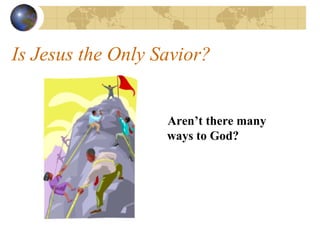
Is Jesus the Only Savior?


                   Aren’t there many
                   ways to God?
Is Jesus the Only Savior?


   If Jesus is the only
   way to God, what
   about those who have
   never heard?
Religious Pluralism
   Religious Pluralism is the view that all
   religions are equally valid as ways to
   God. Pluralists often refer to the fact
   that just as there are many paths up Mt.
   Fuji, so there are many paths to God.
   Differences among the religions are
   superficial.
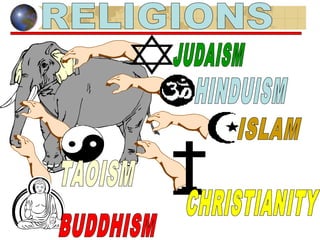
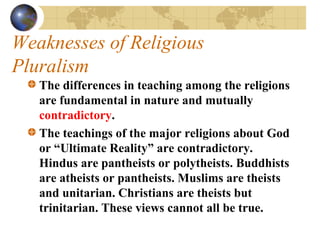
The pluralist
    believes
everyone is blind
    but him!
Weaknesses of Religious
Pluralism
   The differences in teaching among the religions
   are fundamental in nature and mutually
   contradictory.
   The teachings of the major religions about God
   or “Ultimate Reality” are contradictory.
   Hindus are pantheists or polytheists. Buddhists
   are atheists or pantheists. Muslims are theists
   and unitarian. Christians are theists but
   trinitarian. These views cannot all be true.
Weaknesses of Religious
Pluralism
   The teachings of the major religions about man
   and salvation are contradictory.
   Hindus see man as fundamentally divine, but
   trapped in this world due to ignorance and bad
   karma. Deliverance comes from changing our
   beliefs about reality and our true identity.
    Buddhists see man as trapped in this world of
   suffering due to selfish desire. Deliverance from
   this world comes from extinguishing desire, or
   seeking the aid of supernatural beings in doing
   so.
Weaknesses of Religious
Pluralism
   Muslims believe man is weak but not sinful in
   nature, and under God’s judgment for his
   disobedience to His laws. Salvation comes
   through submitting to the laws of God.
   Christians believe that man is alienated from
   God and under His judgment due to his sinful
   rebellion against Him. But salvation can only
   come as a result of trusting in what He has
   graciously done by providing His Son Jesus as
   an atoning sacrifice for our sin, and by His
   Spirit changing us from within.
Weaknesses of Religious
Pluralism
   The contention that what matters is not
   objective teaching but moral and
   spiritual transformation, is untenable.
    Again, how do we really know this is the
   case? On what authority do we believe
   this is so?
Weakness of Religious Pluralism
   It is impossible to believe that all
   religions are true without radically
   altering our defintion of “truth.”
Weaknesses of Religious
Pluralism
   The fact that there may appear to be
   similarities in some of the effects in the lives of
   followers of various religions is no proof that
   they are identical. Jesus drew a strong
   distinction between external morality and piety,
   and true internal spirituality (Matt. 5–7).
   The belief that all religions are true in the sense
   that they all bring us to God requires that we
   believe they are all false in what they
   objectively teach!
Weaknesses of Religious
Pluralism
   It seems improbable
   that that which is    False
   false could be the
   means of helping us   But
   experience that
   which is “true”!      True?
Weaknesses of Religious
Pluralism
   Religious Pluralism is untenable for the
   orthodox Christian, because it demands that he
   deny the most important teachings of
   Scripture. 
   Religious Pluralism requires that we abandon
   belief in the uniqueness of Christ. His claims to
   deity, and the biblical teaching about His
   atoning death and resurrection cannot be true,
   if Religious Pluralism is true.
Weaknesses of Religious
Pluralism
   But if these teachings of Scripture are false,
   then Religious Pluralism must provide a better
   explanation for the wealth of evidence, which
   has led so many to conclude that they are true.
   The evidence cannot be simply swept away!

   However, if the evidence is convincing that
   these teachings are true, then Religious
   Pluralism must be false!
Buddhists in Heaven?
   Christian Inclusivism is the view that
   though Jesus is the exclusive Savior,
   nonetheless many are included in His
   salvation who have never explicitly
   trusted in Him, nor perhaps even heard
   of Him.
Buddhists in Heaven?
   Inclusivists believe that God accepts an
   “implicit” faith in lieu of explicit faith in
   Christ. This may be in the form of a
   response to God’s general revelation
   through creation or conscience, or
   through truth in other religions . . . or
   through some other means. Most
   inclusivists believe that Scripture
   supports their view.
Biblical Inclusivism?
   Melchizedek (Gen. 14:18ff) and Jethro (Exod.
   2–3) are referred to as priests of the true God,
   outside of Israel.
   But it must be pointed out that these men lived
   and served as priests before the founding of the
   nation Israel, and that they are described as
   believing in the same God as Abraham and
   Moses (cf. Gen. 14:19,22).
Biblical Inclusivism?
   Naaman the Syrian is cited as an example of an
   “implicit” believer outside of Israel (2 Kings 5).
   But it is clear that he came to an explicit faith
   in the God of Israel (cf. 2 Kings 5:15,17).
   The repentant Ninevites are often cited as
   believers outside Israel (the book of Jonah). But
   it is clear that they came to an explicit faith in
   the God whom Jonah preached (Jonah 3:5),
   just as Naaman had.
Biblical Inclusivism?
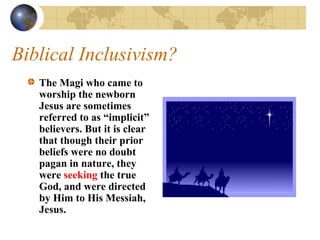
   The Magi who came to
   worship the newborn
   Jesus are sometimes
   referred to as “implicit”
   believers. But it is clear
   that though their prior
   beliefs were no doubt
   pagan in nature, they
   were seeking the true
   God, and were directed
   by Him to His Messiah,
   Jesus.
Biblical Inclusivism?
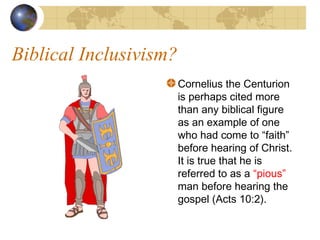
                        Cornelius the Centurion
                        is perhaps cited more
                        than any biblical figure
                        as an example of one
                        who had come to “faith”
                        before hearing of Christ.
                        It is true that he is
                        referred to as a “pious”
                        man before hearing the
                        gospel (Acts 10:2).
Biblical Inclusivism?
   But though he was in touch with the true
   God, he did not receive salvation until
   he heard the message about Christ
   through Peter. The angel who prepared
   Cornelius for Peter’s visit told him that
   he would bring him the message
   through which he would be saved (Acts
   11:13–14). This is exactly what
   occurred (Acts 10:43–44).
Biblical Inclusivism?
                        Malachi 1:11
                        Acts 10:34-35
                        Acts 14:16-17
                        Acts 17:23
                        Romans 1:18-23
                        Romans 2:14-16
                        Acts 20:24-26
Exclusive Statements of the Bible
   Everyone who believes in Him [Jesus]
   receives forgiveness of sins” (Acts 10:43).
    “God is now declaring to men that all
   everywhere should repent” (Acts 17:30).
   “For there is one God, and one mediator
   also between God and men, the man
   Christ Jesus, who gave Himself as a
   ransom for all” (1 Tim. 2:5–6).
Exclusive Statements of the Bible
   “He who has the son has the life; he who does
   not have the son of God does not have the life”
   (1 John 5:12).
     “So faith comes from hearing, and hearing by
   the word of [or about] Christ” (Rom. 10:17).
  We must conclude, then, that the voice of
   Scripture affirms that for one to come to
   salvation, he must hear and place his faith in
   the message about that salvation which God
   reveals to him.
Some Remaining Questions
    If Christianity is exclusively true, are
   other religions totally false?
   What about parallels to Christianity in
   other religions, like incarnations of God,
   and sacrifices to God?
   What, then, is the source of other
   religions?
Some Remaining Questions
   If salvation comes only through hearing
   and believing the gospel, what about
   those who have never heard of Christ?
   Is there no hope for them?
   A text that gives us some guidance in
   this area is Luke 8:18
   Cornelius, Acts 10:2.
Those who haven’t heard
   We sin with or without the Law, Rom. 2:12-15
   None are innocent, Rom. 3:10-12, 23
   Are those who ”live well” saved by works?
   “Seek and you will find,” He will send a –
   missionary, Acts 8:26-40, Acts 10 – a Bible,
   Ps. 119:130 – a vision, Dan 2:7 – an angel,
   Rev. 14
Some Remaining Questions
   No one will be in heaven apart from the fact
   that the person and work of Christ made it
   possible. Acts 4:10-12
   Jesus is within reach of all of us.
   “From one man he made every nation
   of men, that they should inhabit the
   whole earth; and he determined the
   times set for them and the exact places
   where they should live. God did this so
   that men would seek him and perhaps
   reach out for him and find him, though
   he is not far from each one of us. (Acts
Some Remaining Questions
   Sincerity is not salvation
   All other faiths operate by works

   “I have never had a problem knowing
   what is right and wrong in most
   situations; what I have lacked is the will
   to do what is right.”
Conclusion
 “I have traveled the world. I have searched high
    and low. I have found nothing that satisfies
    my mind, my heart, and the deepest longing
    of my soul like Jesus does. He is not only the
    way, the truth and the life; he is personal to
    me. He is my way, and my truth, and my life –
    just as he can be for anyone who reaches out
    to him.” (Ravi Zacharias, The Case for Faith,
    p. 166)

Jesus Only Savior

  • 1.
    Is Jesus theOnly Savior? Ray Bohlin, Ph.D. rbohlin@probe.org
  • 2.
    Christian Voices fromAfrica Is Christ the only way? Our traditional faith, after all, also knew a Creator God. Does Islam not also contain moments of truth? My lecturer says that these three religions are only different paths up the same mountain – at the top of the mountain (eternal life) they all converge. What do you say? Is the Christian faith unique? How could I be sure about this? A student in Religious Studies, Ghana
  • 3.
    Is Jesus theonly Savior? Aren’t all religions basically the same?
  • 4.
    Is Jesus theOnly Savior? Aren’t there many ways to God?
  • 5.
    Is Jesus theOnly Savior? If Jesus is the only way to God, what about those who have never heard?
  • 6.
    Religious Pluralism Religious Pluralism is the view that all religions are equally valid as ways to God. Pluralists often refer to the fact that just as there are many paths up Mt. Fuji, so there are many paths to God. Differences among the religions are superficial.
  • 9.
    The pluralist believes everyone is blind but him!
  • 10.
    Weaknesses of Religious Pluralism The differences in teaching among the religions are fundamental in nature and mutually contradictory. The teachings of the major religions about God or “Ultimate Reality” are contradictory. Hindus are pantheists or polytheists. Buddhists are atheists or pantheists. Muslims are theists and unitarian. Christians are theists but trinitarian. These views cannot all be true.
  • 11.
    Weaknesses of Religious Pluralism The teachings of the major religions about man and salvation are contradictory. Hindus see man as fundamentally divine, but trapped in this world due to ignorance and bad karma. Deliverance comes from changing our beliefs about reality and our true identity. Buddhists see man as trapped in this world of suffering due to selfish desire. Deliverance from this world comes from extinguishing desire, or seeking the aid of supernatural beings in doing so.
  • 12.
    Weaknesses of Religious Pluralism Muslims believe man is weak but not sinful in nature, and under God’s judgment for his disobedience to His laws. Salvation comes through submitting to the laws of God. Christians believe that man is alienated from God and under His judgment due to his sinful rebellion against Him. But salvation can only come as a result of trusting in what He has graciously done by providing His Son Jesus as an atoning sacrifice for our sin, and by His Spirit changing us from within.
  • 13.
    Weaknesses of Religious Pluralism The contention that what matters is not objective teaching but moral and spiritual transformation, is untenable. Again, how do we really know this is the case? On what authority do we believe this is so?
  • 14.
    Weakness of ReligiousPluralism It is impossible to believe that all religions are true without radically altering our defintion of “truth.”
  • 15.
    Weaknesses of Religious Pluralism The fact that there may appear to be similarities in some of the effects in the lives of followers of various religions is no proof that they are identical. Jesus drew a strong distinction between external morality and piety, and true internal spirituality (Matt. 5–7). The belief that all religions are true in the sense that they all bring us to God requires that we believe they are all false in what they objectively teach!
  • 16.
    Weaknesses of Religious Pluralism It seems improbable that that which is False false could be the means of helping us But experience that which is “true”! True?
  • 17.
    Weaknesses of Religious Pluralism Religious Pluralism is untenable for the orthodox Christian, because it demands that he deny the most important teachings of Scripture.  Religious Pluralism requires that we abandon belief in the uniqueness of Christ. His claims to deity, and the biblical teaching about His atoning death and resurrection cannot be true, if Religious Pluralism is true.
  • 18.
    Weaknesses of Religious Pluralism But if these teachings of Scripture are false, then Religious Pluralism must provide a better explanation for the wealth of evidence, which has led so many to conclude that they are true. The evidence cannot be simply swept away! However, if the evidence is convincing that these teachings are true, then Religious Pluralism must be false!
  • 19.
    Buddhists in Heaven? Christian Inclusivism is the view that though Jesus is the exclusive Savior, nonetheless many are included in His salvation who have never explicitly trusted in Him, nor perhaps even heard of Him.
  • 20.
    Buddhists in Heaven? Inclusivists believe that God accepts an “implicit” faith in lieu of explicit faith in Christ. This may be in the form of a response to God’s general revelation through creation or conscience, or through truth in other religions . . . or through some other means. Most inclusivists believe that Scripture supports their view.
  • 21.
    Biblical Inclusivism? Melchizedek (Gen. 14:18ff) and Jethro (Exod. 2–3) are referred to as priests of the true God, outside of Israel. But it must be pointed out that these men lived and served as priests before the founding of the nation Israel, and that they are described as believing in the same God as Abraham and Moses (cf. Gen. 14:19,22).
  • 22.
    Biblical Inclusivism? Naaman the Syrian is cited as an example of an “implicit” believer outside of Israel (2 Kings 5). But it is clear that he came to an explicit faith in the God of Israel (cf. 2 Kings 5:15,17). The repentant Ninevites are often cited as believers outside Israel (the book of Jonah). But it is clear that they came to an explicit faith in the God whom Jonah preached (Jonah 3:5), just as Naaman had.
  • 23.
    Biblical Inclusivism? The Magi who came to worship the newborn Jesus are sometimes referred to as “implicit” believers. But it is clear that though their prior beliefs were no doubt pagan in nature, they were seeking the true God, and were directed by Him to His Messiah, Jesus.
  • 24.
    Biblical Inclusivism? Cornelius the Centurion is perhaps cited more than any biblical figure as an example of one who had come to “faith” before hearing of Christ. It is true that he is referred to as a “pious” man before hearing the gospel (Acts 10:2).
  • 25.
    Biblical Inclusivism? But though he was in touch with the true God, he did not receive salvation until he heard the message about Christ through Peter. The angel who prepared Cornelius for Peter’s visit told him that he would bring him the message through which he would be saved (Acts 11:13–14). This is exactly what occurred (Acts 10:43–44).
  • 26.
    Biblical Inclusivism? Malachi 1:11 Acts 10:34-35 Acts 14:16-17 Acts 17:23 Romans 1:18-23 Romans 2:14-16 Acts 20:24-26
  • 27.
    Exclusive Statements ofthe Bible Everyone who believes in Him [Jesus] receives forgiveness of sins” (Acts 10:43). “God is now declaring to men that all everywhere should repent” (Acts 17:30). “For there is one God, and one mediator also between God and men, the man Christ Jesus, who gave Himself as a ransom for all” (1 Tim. 2:5–6).
  • 28.
    Exclusive Statements ofthe Bible “He who has the son has the life; he who does not have the son of God does not have the life” (1 John 5:12). “So faith comes from hearing, and hearing by the word of [or about] Christ” (Rom. 10:17). We must conclude, then, that the voice of Scripture affirms that for one to come to salvation, he must hear and place his faith in the message about that salvation which God reveals to him.
  • 29.
    Some Remaining Questions If Christianity is exclusively true, are other religions totally false? What about parallels to Christianity in other religions, like incarnations of God, and sacrifices to God? What, then, is the source of other religions?
  • 30.
    Some Remaining Questions If salvation comes only through hearing and believing the gospel, what about those who have never heard of Christ? Is there no hope for them? A text that gives us some guidance in this area is Luke 8:18 Cornelius, Acts 10:2.
  • 31.
    Those who haven’theard We sin with or without the Law, Rom. 2:12-15 None are innocent, Rom. 3:10-12, 23 Are those who ”live well” saved by works? “Seek and you will find,” He will send a – missionary, Acts 8:26-40, Acts 10 – a Bible, Ps. 119:130 – a vision, Dan 2:7 – an angel, Rev. 14
  • 32.
    Some Remaining Questions No one will be in heaven apart from the fact that the person and work of Christ made it possible. Acts 4:10-12 Jesus is within reach of all of us. “From one man he made every nation of men, that they should inhabit the whole earth; and he determined the times set for them and the exact places where they should live. God did this so that men would seek him and perhaps reach out for him and find him, though he is not far from each one of us. (Acts
  • 33.
    Some Remaining Questions Sincerity is not salvation All other faiths operate by works “I have never had a problem knowing what is right and wrong in most situations; what I have lacked is the will to do what is right.”
  • 34.
    Conclusion “I havetraveled the world. I have searched high and low. I have found nothing that satisfies my mind, my heart, and the deepest longing of my soul like Jesus does. He is not only the way, the truth and the life; he is personal to me. He is my way, and my truth, and my life – just as he can be for anyone who reaches out to him.” (Ravi Zacharias, The Case for Faith, p. 166)