Worldview
By Ryan Bush
Worldview
1.What is worldview?
2.How is worldview formed?
3.How is worldview transformed?
What is worldview?
Every human seeks to make sense
of the world by answering four
fundamental questions:
1. Who am I?

2. Where am I?
3. What has gone wrong?

4. What can be done to fix it?
What is worldview?
Humans answer these questions
with a meta-narrative that explains
origin, purpose, suffering, and future
hope.
What is worldview?
It is from this meta-narrative (and
the smaller narratives which are
embedded within it) that humans
derive an understanding of the
world and their place in it, their
worldview.
What is worldview?
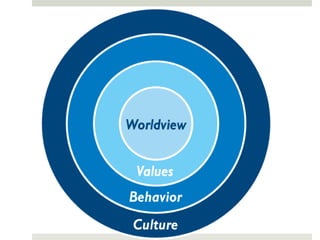
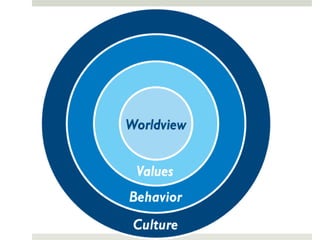
From worldview spring beliefs,
values, and behaviors.
From worldview springs culture.
What is worldview?
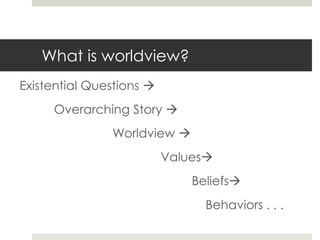
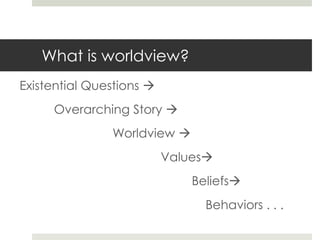
Existential Questions 
Overarching Story 
Worldview 

Values
Beliefs
Behaviors . . .
Discussion Questions:

Which circle should
Christians be concerned
with impacting? Why?
Does your ministry reflect
this reality?
What is Worldview?

“If missionaries wish to
produce lasting change,
they must focus on
worldview
transformation.”
Stan May, Cultures and Worldviews, 387.
What are the elements of a
worldview?
What is worldview?

“Worldview is the way a
people characteristically look
outward upon the universe. . . It
is the way we see ourselves in
relation to all else.”
Robert Redfield, The Primitive World and Its Transformations
(Ithaca, NY: Cornell University Press, 1957), 85-86.
What is worldview?

“The worldview of a people is
their way of looking at reality.”
Michael Kearney, World View (Novato, CA: Chandler and
Sharp, 1984), 41.
What is worldview?

A person’s view of reality.
What is worldview?

Paul Hiebert described
worldview as, “the basic
assumptions about reality
which lie behind the beliefs and
behavior of a culture.”
Paul Hiebert, Anthropological Insights for Missionaries (Grand
Rapids: 1985), 45
What is worldview?
Charles Kraft wrote, “A people’s
worldview includes the most basic
assumptions, values and
allegiances of that people. This
deep level of culture affects and
underlies all surface level
behavior.”
Charles Kraft, “Worldview for Christian Witness” (Unpublished
Manuscript)
What is worldview?

Stan May wrote that worldview
is a, “set of underlying
assumptions and allegiances
that interprets existence.”
Stan May, “Cultures and Worldviews”, 381.
What is worldview?

James Sire wrote, “Our groundfloor assumptions—ones that
are so basic that none more
basic can be conceived—
compose our world view.”
James W. Sire, How to Read Slowly: Reading for
Comprehension (Wheaton: Harold Shaw Publishers, 1978),
39.
What is worldview?

A person’s assumptions about
reality.
What is worldview?

What does worldview do?
What is worldview?
Orville Boyd Jenkins described
worldview as, “a coherent
thought-system that helps make
sense of [shared] experiences and
maintain the values developed
over the history of that group.”
Orville Boyd Jenkins, Dealing with Differences: Contrasting
African and European World Views (Nairobi: Communication
Press, 1991), 13.
What is worldview?

“[W]orldview binds people
together and provides the
basic mental and cultural
framework by which individuals
and groups understand and
respond to reality.”
May, “Cultures and Worldviews”, 381.
What is worldview?

Norman Geisler said, “It is the
framework through which or by
which one makes sense of the
data of life.”
Norman L. Geisler, Baker Encyclopedia of Christian
Apologetics, Baker Reference Library (Grand Rapids: Baker
Books, 1999), 785
What is worldview?

Worldview provides people
with a means by which to
understand and respond to
reality.
What is worldview?
Worldview is:
(1)the way people see the world,
(2)based on assumptions about
the world,
(3)which gives them a means to
understand and respond to the
world.
Formation & Reinforcement of
Worldview
Worldview (and culture) is learned.
One’s perspective and interpretation of
reality is completely dependent upon
the environment in which one is reared.
“One comes to perceive the world—
God, man, nature, history, values, and
so forth—in a way prescribed by one’s
own culture and/or subculture.”
Hesselgrave, from World Mission, “Putting on Worldview Glasses”, 13-12.
Formation & Reinforcement of
Worldview

How are worldviews formed?
What is the vehicle by which
worldview is transmitted and
reinforced?
Formation & Reinforcement of
Worldview
Hesselgrave contends that worldviews
are formed and reinforced, “by the
telling of a story (and stories within a
story) and drawing inferences from it.
That’s why all peoples have their story
(myth, legend, history—in one sense it
makes little difference) and draw upon
it to sustain their values.”
David J. Hesselgrave, Scripture and Strategy: The Use of the Bible in PostModern Church and Mission (Pasadena: William Carey Library, 1994), 50.
Formation & Reinforcement of
Worldview

LaNette W. Thompson wrote,
“When people experience life
together—sharing life stories—their
worldviews are similar. Schemata
are created through personal
experience, by hearing others’
stories, and by fantasizing.”
LaNette Thompson, Tell His Story so that All Might Worship, 394.
Formation & Reinforcement of
Worldview

“A culture houses its central
convictions in its fundamental
narrative, whether its narrative is
implicit or explicit. The ancient
mythologies that we find in
cultures around the world are
explicit examples of this.”
Lovejoy, Making Disciples of Oral Learners, 33.
What is worldview?
Existential Questions 
Overarching Story 
Worldview 

Values
Beliefs
Behaviors . . .
Formation & Reinforcement of
Worldview
Hiebert said that worldview provides
people with their basic framework for
understanding reality. Further, religion
provides the specific content of this reality.
It provides them with, “things in the
people’s model of the universe and with
relationships between these things.” He
contended, “people express their religious
beliefs in creeds and stories and in ritual
behavior.”
Paul G. Hiebert, Cultural Anthropology (Grand Rapids: Baker Book House, 1983), 371.
Formation & Reinforcement of
Worldview

The oral tradition of a people
serves not only to form worldview,
but to reinforce worldview. Kraft
indicated seven ways in which this
occurs:
Formation & Reinforcement of
Worldview
 . . . provides a basis of common origins and
identity.
 . . . answers questions about human destiny and
what may help or alter it.
 . . . reinforces basic assumptions of authority,
respect, and rights to land or other material
possessions.
 . . . clearly pictures who are to be included and
who are to be excluded, who are the “we” and
who are the “they.”
Formation & Reinforcement of
Worldview
. . . teaches and reinforces moral
values.

. . . serves to illustrate ideal and subideal behavior and the rewards and
punishments that go along with either.
. . . serves as encouragement in times of
difficulty and uncertainty.
Kraft, Unpublished Manuscript, 13:7-8
Formation & Reinforcement of
Worldview

Tom Steffen wrote, “Worldview . . .
finds its foundational meaning in
myths and stories. . . To survive,
any worldview required the
recitation of myths and stories.”
Tom Steffen, Reconnecting God’s Story to Ministry: Crosscultural Storytelling at Home and Abroad (La Habra, CA:
Center for Organizational and Ministry Development, 1996),
31-32.
Discussion Questions:
Why is it important to determine
whether or not worldview can be
transformed?
How does determining the manner in
which worldview is formed help us
develop strategies for worldview
transformation?
Worldview Transformation
Stories constitute the core of every culture’s
worldview. (N.T. Wright) N.T. Wright said,
“[Stories] are, in fact, one key element
within the total construction of worldview.
Stories thus provide a vital framework for
experiencing the world. They also provide a
means by which views of the world may be
challenged.”
N.T. Wright, The New Testament and the People of God (Minneapolis, MN:
Fortress Press, 1992), 39.
Worldview Transformation
“A culture houses its central convictions
in its fundamental narrative, whether its
narrative is implicit or explicit. The
ancient mythologies that we find in
cultures around the world are explicit
examples of this. Those stories answer
four fundamental worldview questions:
Who am I? Where am I? What has gone
wrong? What can be done about it?”
Grant Lovejoy, Making Disciples of Oral Learners, 33.
Worldview Transformation
“Christianity has its own distinctive
answers to those worldview
questions. In order to influence the
worldviews of disciples, we need to
tell biblical stories that offer
alternative answers to the
fundamental worldview questions.”
Lovejoy, Making Disciples of Oral Leaners, 33.
Worldview Transformation
“When we tell biblical stories
chronologically, we are offering a
powerful alternative worldview from the
very beginning of our presentation.
Biblical stories and the view of the world
embedded in them, can replace or
refine the cultural stories and the
worldview embedded in them.”
Lovejoy, Making Disciples of Oral Leaners, 34.
Worldview Transformation

This is why Jesus so often told
stories, particularly parables.
Jesus intended to challenge the
existing Jewish worldview and to
provide an alternative picture of
reality that he called “the
kingdom of God” or “kingdom of
heaven.”
Worldview Transformation
“Stories are, actually, particularly good at
modifying or subverting other stories and
their worldviews. Where head-on attack
would certainly fail, the parable hides the
wisdom of the serpent behind the
innocence of the dove, gaining
entrance and favor which can then be
used to change assumptions which the
hearer would otherwise keep hidden
away for safety.”
N.T. Wright, The New Testament and the People of God, (Minneapolis: Fortress Press, 1992),
40.
Worldview Transformation
Stories do, however, come into conflict with
each other because the worldviews they
characterize are in sharp disagreement
about what is true. People perceive these
alternative understandings of reality at a
threat. The only way to adequately deal
with the clash between opposing narratives
is to tell yet another narrative that
corroborates and explains how the
evidence for the challenging story is in fact
deceptive.
Worldview Transformation
“If stories anchor people’s existing
perspective on the world, then the
best thing Christians can do in
order to displace that perspective
is to tell better stories, and we
have them!”
Lovejoy, Making Disciples of Oral Leaners, 35.
Worldview Transformation

Our narratives must provide
adequate (biblical) answers to
the essential questions of
existence.
Worldview Transformation
“The more biblical stories people
know and can fit into a single
comprehensive story of God’s
saving work, the more
completely they are able to
embrace a biblical worldview.”
Lovejoy, Making Disciples of Oral Leaners, 35.
Worldview Transformation

Stories lie at the core of
worldview. Formal belief
statements, including
propositional and theological
statements, grow out of those
stories.
Worldview Transformation

Thus discipleship that offers only
propositional teaching does
not reach to the center of the
worldview.
Worldview Transformation
If we give only propositional teaching and
do not present biblical stories to challenge
existing worldview stories, we run the risk of
syncretism. The cultural stories will continue
to comprise the heart of the worldview
and discipleship will deal only with the
dimensions of the person’s life represented
in the outer circles in the diagram.
Worldview Transformation
How are conversion and worldview
transformation related?
As missionaries seek to transform
worldviews, is it more important to
practice sound
missiology/anthropology or to
depend on the Holy Spirit?
Practical Application
Study oral tradition of your culture.
Know the Biblical worldview and the
stories which comprise it.
Become fluent in telling Biblical stories to
tell in everyday situations in order to deal
with worldview issues instead of just
surface issues.
 Robert Redfield, The Primitive World and Its Transformations. Ithaca, NY: Cornell
University Press, 1957.
 Michael Kearney, World View. Novato, CA: Chandler and Sharp, 1984.
 Paul Hiebert, Anthropological Insights for Missionaries. Grand Rapids: 1985.
 David J. Hesselgrave, Scripture and Strategy: The Use of the Bible in PostModern Church and Mission (Pasadena: William Carey Library, 1994), 50.
 LaNette Thompson, Tell His Story so that All Might Worship, 394.
 Paul G. Hiebert, Cultural Anthropology. Grand Rapids: Baker Book House, 1983.
 Dorji Penjore, “Folktales and Education: Role of Bhutanese Folktales in Value
Transmission,” Journal of Buhtan Studies, Vol. 12 (Summer 2005). Thimpju: The
Center for Bhutan Studies.), 54. [47-74]
 Tom Steffen, Reconnecting God’s Story to Ministry: Cross-cultural Storytelling at
Home and Abroad. La Habra, CA: Center for Organizational and Ministry
Development, 1996.
 N.T. Wright, The New Testament and the People of God. Minneapolis, MN:
Fortress Press, 1992.
 Grant Lovejoy, Making Disciples of Oral Learners,

Worldview

  • 1.
  • 2.
    Worldview 1.What is worldview? 2.Howis worldview formed? 3.How is worldview transformed?
  • 3.
    What is worldview? Everyhuman seeks to make sense of the world by answering four fundamental questions: 1. Who am I? 2. Where am I? 3. What has gone wrong? 4. What can be done to fix it?
  • 4.
    What is worldview? Humansanswer these questions with a meta-narrative that explains origin, purpose, suffering, and future hope.
  • 5.
    What is worldview? Itis from this meta-narrative (and the smaller narratives which are embedded within it) that humans derive an understanding of the world and their place in it, their worldview.
  • 6.
    What is worldview? Fromworldview spring beliefs, values, and behaviors. From worldview springs culture.
  • 7.
    What is worldview? ExistentialQuestions  Overarching Story  Worldview  Values Beliefs Behaviors . . .
  • 9.
    Discussion Questions: Which circleshould Christians be concerned with impacting? Why? Does your ministry reflect this reality?
  • 10.
    What is Worldview? “Ifmissionaries wish to produce lasting change, they must focus on worldview transformation.” Stan May, Cultures and Worldviews, 387.
  • 13.
    What are theelements of a worldview?
  • 14.
    What is worldview? “Worldviewis the way a people characteristically look outward upon the universe. . . It is the way we see ourselves in relation to all else.” Robert Redfield, The Primitive World and Its Transformations (Ithaca, NY: Cornell University Press, 1957), 85-86.
  • 15.
    What is worldview? “Theworldview of a people is their way of looking at reality.” Michael Kearney, World View (Novato, CA: Chandler and Sharp, 1984), 41.
  • 16.
    What is worldview? Aperson’s view of reality.
  • 17.
    What is worldview? PaulHiebert described worldview as, “the basic assumptions about reality which lie behind the beliefs and behavior of a culture.” Paul Hiebert, Anthropological Insights for Missionaries (Grand Rapids: 1985), 45
  • 18.
    What is worldview? CharlesKraft wrote, “A people’s worldview includes the most basic assumptions, values and allegiances of that people. This deep level of culture affects and underlies all surface level behavior.” Charles Kraft, “Worldview for Christian Witness” (Unpublished Manuscript)
  • 19.
    What is worldview? StanMay wrote that worldview is a, “set of underlying assumptions and allegiances that interprets existence.” Stan May, “Cultures and Worldviews”, 381.
  • 20.
    What is worldview? JamesSire wrote, “Our groundfloor assumptions—ones that are so basic that none more basic can be conceived— compose our world view.” James W. Sire, How to Read Slowly: Reading for Comprehension (Wheaton: Harold Shaw Publishers, 1978), 39.
  • 21.
    What is worldview? Aperson’s assumptions about reality.
  • 22.
    What is worldview? Whatdoes worldview do?
  • 23.
    What is worldview? OrvilleBoyd Jenkins described worldview as, “a coherent thought-system that helps make sense of [shared] experiences and maintain the values developed over the history of that group.” Orville Boyd Jenkins, Dealing with Differences: Contrasting African and European World Views (Nairobi: Communication Press, 1991), 13.
  • 24.
    What is worldview? “[W]orldviewbinds people together and provides the basic mental and cultural framework by which individuals and groups understand and respond to reality.” May, “Cultures and Worldviews”, 381.
  • 25.
    What is worldview? NormanGeisler said, “It is the framework through which or by which one makes sense of the data of life.” Norman L. Geisler, Baker Encyclopedia of Christian Apologetics, Baker Reference Library (Grand Rapids: Baker Books, 1999), 785
  • 26.
    What is worldview? Worldviewprovides people with a means by which to understand and respond to reality.
  • 27.
    What is worldview? Worldviewis: (1)the way people see the world, (2)based on assumptions about the world, (3)which gives them a means to understand and respond to the world.
  • 30.
    Formation & Reinforcementof Worldview Worldview (and culture) is learned. One’s perspective and interpretation of reality is completely dependent upon the environment in which one is reared. “One comes to perceive the world— God, man, nature, history, values, and so forth—in a way prescribed by one’s own culture and/or subculture.” Hesselgrave, from World Mission, “Putting on Worldview Glasses”, 13-12.
  • 31.
    Formation & Reinforcementof Worldview How are worldviews formed? What is the vehicle by which worldview is transmitted and reinforced?
  • 32.
    Formation & Reinforcementof Worldview Hesselgrave contends that worldviews are formed and reinforced, “by the telling of a story (and stories within a story) and drawing inferences from it. That’s why all peoples have their story (myth, legend, history—in one sense it makes little difference) and draw upon it to sustain their values.” David J. Hesselgrave, Scripture and Strategy: The Use of the Bible in PostModern Church and Mission (Pasadena: William Carey Library, 1994), 50.
  • 33.
    Formation & Reinforcementof Worldview LaNette W. Thompson wrote, “When people experience life together—sharing life stories—their worldviews are similar. Schemata are created through personal experience, by hearing others’ stories, and by fantasizing.” LaNette Thompson, Tell His Story so that All Might Worship, 394.
  • 34.
    Formation & Reinforcementof Worldview “A culture houses its central convictions in its fundamental narrative, whether its narrative is implicit or explicit. The ancient mythologies that we find in cultures around the world are explicit examples of this.” Lovejoy, Making Disciples of Oral Learners, 33.
  • 35.
    What is worldview? ExistentialQuestions  Overarching Story  Worldview  Values Beliefs Behaviors . . .
  • 37.
    Formation & Reinforcementof Worldview Hiebert said that worldview provides people with their basic framework for understanding reality. Further, religion provides the specific content of this reality. It provides them with, “things in the people’s model of the universe and with relationships between these things.” He contended, “people express their religious beliefs in creeds and stories and in ritual behavior.” Paul G. Hiebert, Cultural Anthropology (Grand Rapids: Baker Book House, 1983), 371.
  • 38.
    Formation & Reinforcementof Worldview The oral tradition of a people serves not only to form worldview, but to reinforce worldview. Kraft indicated seven ways in which this occurs:
  • 39.
    Formation & Reinforcementof Worldview  . . . provides a basis of common origins and identity.  . . . answers questions about human destiny and what may help or alter it.  . . . reinforces basic assumptions of authority, respect, and rights to land or other material possessions.  . . . clearly pictures who are to be included and who are to be excluded, who are the “we” and who are the “they.”
  • 40.
    Formation & Reinforcementof Worldview . . . teaches and reinforces moral values. . . . serves to illustrate ideal and subideal behavior and the rewards and punishments that go along with either. . . . serves as encouragement in times of difficulty and uncertainty. Kraft, Unpublished Manuscript, 13:7-8
  • 41.
    Formation & Reinforcementof Worldview Tom Steffen wrote, “Worldview . . . finds its foundational meaning in myths and stories. . . To survive, any worldview required the recitation of myths and stories.” Tom Steffen, Reconnecting God’s Story to Ministry: Crosscultural Storytelling at Home and Abroad (La Habra, CA: Center for Organizational and Ministry Development, 1996), 31-32.
  • 42.
    Discussion Questions: Why isit important to determine whether or not worldview can be transformed? How does determining the manner in which worldview is formed help us develop strategies for worldview transformation?
  • 43.
    Worldview Transformation Stories constitutethe core of every culture’s worldview. (N.T. Wright) N.T. Wright said, “[Stories] are, in fact, one key element within the total construction of worldview. Stories thus provide a vital framework for experiencing the world. They also provide a means by which views of the world may be challenged.” N.T. Wright, The New Testament and the People of God (Minneapolis, MN: Fortress Press, 1992), 39.
  • 44.
    Worldview Transformation “A culturehouses its central convictions in its fundamental narrative, whether its narrative is implicit or explicit. The ancient mythologies that we find in cultures around the world are explicit examples of this. Those stories answer four fundamental worldview questions: Who am I? Where am I? What has gone wrong? What can be done about it?” Grant Lovejoy, Making Disciples of Oral Learners, 33.
  • 45.
    Worldview Transformation “Christianity hasits own distinctive answers to those worldview questions. In order to influence the worldviews of disciples, we need to tell biblical stories that offer alternative answers to the fundamental worldview questions.” Lovejoy, Making Disciples of Oral Leaners, 33.
  • 46.
    Worldview Transformation “When wetell biblical stories chronologically, we are offering a powerful alternative worldview from the very beginning of our presentation. Biblical stories and the view of the world embedded in them, can replace or refine the cultural stories and the worldview embedded in them.” Lovejoy, Making Disciples of Oral Leaners, 34.
  • 47.
    Worldview Transformation This iswhy Jesus so often told stories, particularly parables. Jesus intended to challenge the existing Jewish worldview and to provide an alternative picture of reality that he called “the kingdom of God” or “kingdom of heaven.”
  • 48.
    Worldview Transformation “Stories are,actually, particularly good at modifying or subverting other stories and their worldviews. Where head-on attack would certainly fail, the parable hides the wisdom of the serpent behind the innocence of the dove, gaining entrance and favor which can then be used to change assumptions which the hearer would otherwise keep hidden away for safety.” N.T. Wright, The New Testament and the People of God, (Minneapolis: Fortress Press, 1992), 40.
  • 49.
    Worldview Transformation Stories do,however, come into conflict with each other because the worldviews they characterize are in sharp disagreement about what is true. People perceive these alternative understandings of reality at a threat. The only way to adequately deal with the clash between opposing narratives is to tell yet another narrative that corroborates and explains how the evidence for the challenging story is in fact deceptive.
  • 50.
    Worldview Transformation “If storiesanchor people’s existing perspective on the world, then the best thing Christians can do in order to displace that perspective is to tell better stories, and we have them!” Lovejoy, Making Disciples of Oral Leaners, 35.
  • 51.
    Worldview Transformation Our narrativesmust provide adequate (biblical) answers to the essential questions of existence.
  • 52.
    Worldview Transformation “The morebiblical stories people know and can fit into a single comprehensive story of God’s saving work, the more completely they are able to embrace a biblical worldview.” Lovejoy, Making Disciples of Oral Leaners, 35.
  • 53.
    Worldview Transformation Stories lieat the core of worldview. Formal belief statements, including propositional and theological statements, grow out of those stories.
  • 54.
    Worldview Transformation Thus discipleshipthat offers only propositional teaching does not reach to the center of the worldview.
  • 55.
    Worldview Transformation If wegive only propositional teaching and do not present biblical stories to challenge existing worldview stories, we run the risk of syncretism. The cultural stories will continue to comprise the heart of the worldview and discipleship will deal only with the dimensions of the person’s life represented in the outer circles in the diagram.
  • 57.
    Worldview Transformation How areconversion and worldview transformation related? As missionaries seek to transform worldviews, is it more important to practice sound missiology/anthropology or to depend on the Holy Spirit?
  • 58.
    Practical Application Study oraltradition of your culture. Know the Biblical worldview and the stories which comprise it. Become fluent in telling Biblical stories to tell in everyday situations in order to deal with worldview issues instead of just surface issues.
  • 59.
     Robert Redfield,The Primitive World and Its Transformations. Ithaca, NY: Cornell University Press, 1957.  Michael Kearney, World View. Novato, CA: Chandler and Sharp, 1984.  Paul Hiebert, Anthropological Insights for Missionaries. Grand Rapids: 1985.  David J. Hesselgrave, Scripture and Strategy: The Use of the Bible in PostModern Church and Mission (Pasadena: William Carey Library, 1994), 50.  LaNette Thompson, Tell His Story so that All Might Worship, 394.  Paul G. Hiebert, Cultural Anthropology. Grand Rapids: Baker Book House, 1983.  Dorji Penjore, “Folktales and Education: Role of Bhutanese Folktales in Value Transmission,” Journal of Buhtan Studies, Vol. 12 (Summer 2005). Thimpju: The Center for Bhutan Studies.), 54. [47-74]  Tom Steffen, Reconnecting God’s Story to Ministry: Cross-cultural Storytelling at Home and Abroad. La Habra, CA: Center for Organizational and Ministry Development, 1996.  N.T. Wright, The New Testament and the People of God. Minneapolis, MN: Fortress Press, 1992.  Grant Lovejoy, Making Disciples of Oral Learners,