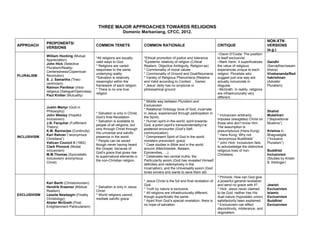
THREE MAJOR APPROACHES TOWARDS RELIGIONS
Domenic Marbaniang, CFCC, 2012.
APPROACH

PROPONENTS/
VERSIONS

COMMON TENETS

COMMON RATIONALE

PLURALISM

William Hocking (Mutual
Appreciation)
John Hick (Selective
Pluralism/RealityCenteredness/Copernican
Revolution)
S. J. Samartha (Theocentricism)
Raimon Panikkar (Intrareligious Dialogue/Openness)
Paul Knitter (Mutuality)

*All religions are equally
valid ways to God.
* Religions are varied
responses to the same
underlying reality
*Salvation is relatively
meaningful within the
framework of each religion
* There is no one true
religion

*Ethical promotion of justice and tolerance
*Epistemic relativity of religion (Critical
Realism, Objective Ambiguity, Religion-as)
* Commonality of moral values
* Commonality of Ground and Goal/Noumena
* Variety of Religious Phenomena (Relative
and Valid according to Context… Game)
* Jesus’ deity has no scriptural or
philosophical ground

INCLUSIVISM

EXCLUSIVISM

Justin Martyr (God in
Philosophy)
John Wesley (Hopeful
Inclusivism)
J.N. Farquhar (Fulfillment
Theory)
K.M. Bannerjee (Continuity)
Karl Rahner (“anonymous
Christians”)
Vatican Council II (1962)
Clark Pinnock (Modal
Inclusivism)
M.M.Thomas (Syncretistic
Inclusivism/ anonymous
Christ)

Karl Barth (Christomonism)
Hendrik Kraemer (Biblical
Realism)
Lesslie Newbegin (Finality
Christology)
Alister McGrath (PostEnlightenment Particularism)

* Salvation is only in Christ,
God’s final Revelation
* Salvation is available to
people of all religions, but
only through Christ through
His universal and salvific
presence in the world.
* People can be saved
though never having heard
the Gospel, because of
God’s grace that gives rise
to supernatural elements in
the non-Christian religion.

* Middle way between Pluralism and
Exclusivism
* Relational Ontology (love of God, incarnate
in Jesus, experienced through participation in
the Spirit).
* Human spirit-in-the-world; spirit-towardsGod; a priori (spirit’s transcendentality)+a
posteriori encounter (God’s Selfcommunication)
* Omnipresent Spirit of God in the world
ministers prevenient grace
* Case studies in Bible and in the world
around (Melchizedek, Balaam,
Epimendies,….)
* Celebrates two central truths: the
Particularity axiom (God has revealed Himself
definitely and redemptively in the
Incarnation), and the Universality axiom (God
loves sinners and wants to save them all)

* Salvation is only in Jesus
Christ
* World religions cannot
mediate salvific grace

* Jesus Christ is the full and final revelation of
God.
* Truth by nature is exclusive.
* All religions are infrastructurally different,
though superficially the same.
* Apart from God’s special revelation, there is
no hope of salvation.

CRITIQUE
~Gavin D’Costa: The position
is itself exclusivist.
~Mark Heim: It superficializes
the value of religious
experiences unique to each
religion. Pluralists who
suggest just one way are
actually inclusivists in
disguise.
~McGrath: In reality, religions
are infrastructurally very
different.

* Inclusivism arbitrarily
imposes (eisogetes) Christ on
those who don’t know Him.
The assumption is
presumptuous (Hans Kung)
* Hans Kung: Why not
“anonymous Buddhists”
* John Hick: Inclusivism fails
to acknowledge the distinctive
religious lives of nonChristians.

* Pinnock: How can God give
a powerful general revelation
and send no grace with it?
* Hick: Jesus never claimed
to be God, neither has His
dual-nature (hypostatic union)
satisfactorily been explained
* Exclusivism can effect
discontinuity, intolerance, and
dogmatism.

NON-XTN
VERSIONS
(e.g.)
Gandhi
(Sarvadharmasam
bhava)
Vivekananda/Rad
hakrishnan
(Advaitic
Pluralism)

Shahid
Mutahhari
(“dispositional
Muslims”)
Krishna in
Bhagvadgita
(“Inclusive
Pluralism”)
Buddhist
Inclusivism
(Studies by Kristin
B. Kiblinger)

Jewish
Exclusivism
Islamic
Exclusivism
Buddhist
Exclusivism

Three major approaches towards religions

  • 1.
    THREE MAJOR APPROACHESTOWARDS RELIGIONS Domenic Marbaniang, CFCC, 2012. APPROACH PROPONENTS/ VERSIONS COMMON TENETS COMMON RATIONALE PLURALISM William Hocking (Mutual Appreciation) John Hick (Selective Pluralism/RealityCenteredness/Copernican Revolution) S. J. Samartha (Theocentricism) Raimon Panikkar (Intrareligious Dialogue/Openness) Paul Knitter (Mutuality) *All religions are equally valid ways to God. * Religions are varied responses to the same underlying reality *Salvation is relatively meaningful within the framework of each religion * There is no one true religion *Ethical promotion of justice and tolerance *Epistemic relativity of religion (Critical Realism, Objective Ambiguity, Religion-as) * Commonality of moral values * Commonality of Ground and Goal/Noumena * Variety of Religious Phenomena (Relative and Valid according to Context… Game) * Jesus’ deity has no scriptural or philosophical ground INCLUSIVISM EXCLUSIVISM Justin Martyr (God in Philosophy) John Wesley (Hopeful Inclusivism) J.N. Farquhar (Fulfillment Theory) K.M. Bannerjee (Continuity) Karl Rahner (“anonymous Christians”) Vatican Council II (1962) Clark Pinnock (Modal Inclusivism) M.M.Thomas (Syncretistic Inclusivism/ anonymous Christ) Karl Barth (Christomonism) Hendrik Kraemer (Biblical Realism) Lesslie Newbegin (Finality Christology) Alister McGrath (PostEnlightenment Particularism) * Salvation is only in Christ, God’s final Revelation * Salvation is available to people of all religions, but only through Christ through His universal and salvific presence in the world. * People can be saved though never having heard the Gospel, because of God’s grace that gives rise to supernatural elements in the non-Christian religion. * Middle way between Pluralism and Exclusivism * Relational Ontology (love of God, incarnate in Jesus, experienced through participation in the Spirit). * Human spirit-in-the-world; spirit-towardsGod; a priori (spirit’s transcendentality)+a posteriori encounter (God’s Selfcommunication) * Omnipresent Spirit of God in the world ministers prevenient grace * Case studies in Bible and in the world around (Melchizedek, Balaam, Epimendies,….) * Celebrates two central truths: the Particularity axiom (God has revealed Himself definitely and redemptively in the Incarnation), and the Universality axiom (God loves sinners and wants to save them all) * Salvation is only in Jesus Christ * World religions cannot mediate salvific grace * Jesus Christ is the full and final revelation of God. * Truth by nature is exclusive. * All religions are infrastructurally different, though superficially the same. * Apart from God’s special revelation, there is no hope of salvation. CRITIQUE ~Gavin D’Costa: The position is itself exclusivist. ~Mark Heim: It superficializes the value of religious experiences unique to each religion. Pluralists who suggest just one way are actually inclusivists in disguise. ~McGrath: In reality, religions are infrastructurally very different. * Inclusivism arbitrarily imposes (eisogetes) Christ on those who don’t know Him. The assumption is presumptuous (Hans Kung) * Hans Kung: Why not “anonymous Buddhists” * John Hick: Inclusivism fails to acknowledge the distinctive religious lives of nonChristians. * Pinnock: How can God give a powerful general revelation and send no grace with it? * Hick: Jesus never claimed to be God, neither has His dual-nature (hypostatic union) satisfactorily been explained * Exclusivism can effect discontinuity, intolerance, and dogmatism. NON-XTN VERSIONS (e.g.) Gandhi (Sarvadharmasam bhava) Vivekananda/Rad hakrishnan (Advaitic Pluralism) Shahid Mutahhari (“dispositional Muslims”) Krishna in Bhagvadgita (“Inclusive Pluralism”) Buddhist Inclusivism (Studies by Kristin B. Kiblinger) Jewish Exclusivism Islamic Exclusivism Buddhist Exclusivism