Reverse Engineering & Scanner 3D
Cos'è uno scanner 3D 
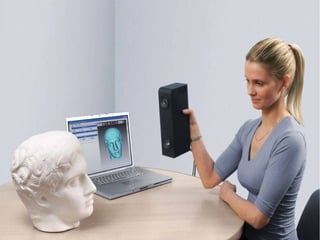
un dispositivo che analizza gli oggetti o gli 
ambienti del mondo reale per collezionare dati 
sulle loro forme o sul loro aspetto, e per 
costruire modelli tridimensionali digitali
Intro / storia 1 
Misurare 
Primi tentativi per standardizzare le misure: 2600 AC nella valle 
dell'Indo 
240 AC Erastotene stimò la circonferenza della Terra al solstizio 
d'estate misurando l'altezza del sole a Alexandria e Siene 
1750 / 1850 Rivoluzione Industriale – la misura delle cose 
divenne fondamentale 
Primi metodi di misura per contatto diretto: calibri e metri 
Pantografi per replicare gli oggetti 
La rivoluzione c'è stata con le misure non invasive e a 
distanza.
Intro / storia 2 
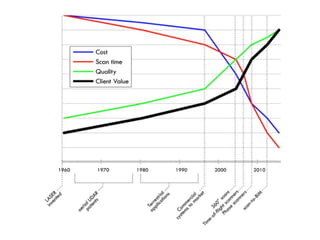
Laser ranging systems have been in use in a variety of 
industries for decades, with the first patented instruments 
appearing as early as the late 1980’s. 
3D scanning was first applied in the Architecture, 
Engineering, and Construction industry in the 1990’s with 
the market debut of the first integrated commercial 
systems for 3D scanning
Applicazioni / 1 
A cosa serve? Quali applicazioni? 
Product inspection – per vedere se un prodotto è uscito come 
previsto (si misurano parti e rilevano difetti) 
Medicina – si rilevano parti in 3D per creare protesi su misura. 
Negl interventi la scansione è proiettata sul paziente 
Product design
Applicazioni / 2 
Edilizia – verifica che l'edificio sia uscito come previsto 
Clothes fitting – misurazione del corpo – es esercito USA ha un 
sistema di misurazione automatico 
Art history 
Sculptures & interesting objects to look at 
Art: studying working techniques 
Art history 
Cultural heritage preservation 
High-visibility project 
Archaeology 
Ricostruzione di parti e ricombinazione frammenti 
Ricostruzione oggetti in 3D per evitare di toccarli
Applicazioni / 3 
Computer graphics 
Cinema 
Giochi (hanno un fatturato maggiore del cinema) 
Robot navigation
Possibilità tecnologiche 
Contatto 
Sonde a contatto 
Trasmissive 
Magnetic Resonance Imaging (MRI) 
Ultrasuoni 
Raggi X 
Suoni e Vibrazioni 
Riflessione 
Ottica 
Non ottica (radar e sonar)
Tecnologie ottiche 
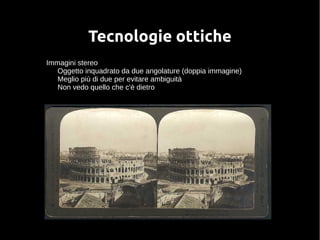
Immagini stereo 
Oggetto inquadrato da due angolature (doppia immagine) 
Meglio più di due per evitare ambiguità 
Non vedo quello che c'è dietro
Tecnologie ottiche 
Shape from motion 
Da analisi di una sequenza di immagini, ricavo l'oggetto in 3d 
Shape from shading 
Si evidenziano le forme illuminando l'oggetto da diversi punti
Tecnologie ottiche 
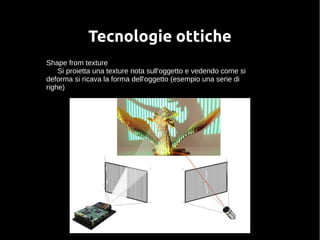
Shape from texture 
Si proietta una texture nota sull'oggetto e vedendo come si 
deforma si ricava la forma dell'oggetto (esempio una serie di 
righe)
Tecnologie ottiche 
Shape from focus/defocus 
Si determinano distanze e forme vedendo come e dove si 
mette a fuoco l'immagine – la messa a fuoco dipende dalla 
distanza 
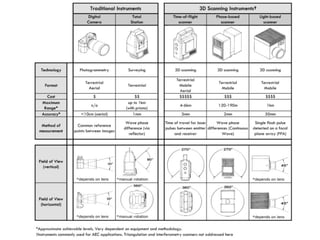
Tempo di volo del laser 
Opera su grandi volumi (lati da 100m) 
Precisione grossolana – 5mm 
Per scavi archeologici, edifici, stanze
Tecnologie ottiche 
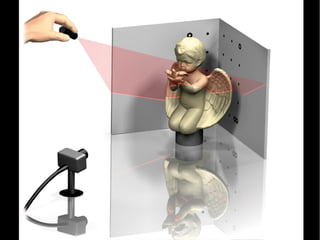
Triangolazione 
Una lama laser che scorre sull'oggetto 
Laser e camera posti a triangolo con l'obj 
Se camera e laser si muovono indipedentemente, è difficile 
poi ricostruire con precisione. Molti scanner hanno camera e laser 
fissi. 
Per grandi oggetti si usano sistemi che muovono il gruppo di 
scansione e gli fanno coprire delle piccole regioni (moto su tilt e 
pan)
MakerScanner
Distanze e colori 
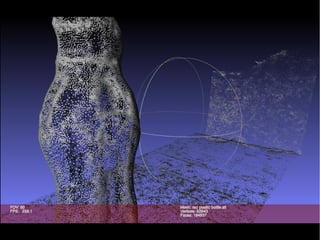
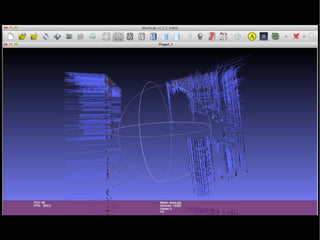
Misura della distanza e nuvola di punti 
Scanning systems primarily capture the physical position of a 
target object, represented as a series of points (forming a “point 
cloud”) typically in Cartesian coordinates (XYZ). This is 
accomplished by comparing the emitted and returned light pulse, 
and determining the value of the target object in relation to the 
position of the scanning instrument 
Colori 
determine the colour of the each point by using a camera (can be 
built-in or seperate), which is represented by the commonly used 
RGB (red, green, blue) value scale. Because scanners are optical 
systems, only what the scanner can “see” is captured,
Precisione, Risoluzione, Accuratezza 
Risoluzione: densità della nuvola di punti 
Accuratezza: differenza tra misura e valore reale 
Precisione: indica la correttezza della misura (posso avere un 
point set preciso ma inaccurato – es se offset iniziale e non mi 
accorgo) 
Peggiorano con: 
Distanza 
Superficie riflettente 
Velocità di scansione 
Si va da qualche millimetro (5 mm) fino a freazioni di millimetro 
(0,3 mm)
Formato file 
Lo scanner raccoglie una nuvola di punti che poi è raccolta in un 
file 
ASTM E57 File Format (XYX I RGB) questo rappresenta la 
nuvola di punti 
Questi formati derivano dal mondo grafico: 
OBJ (con colori) 
STL 
VRML (con colori)
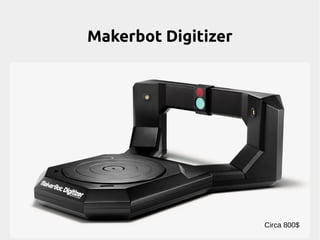
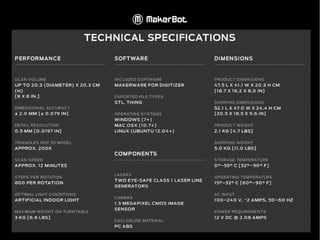
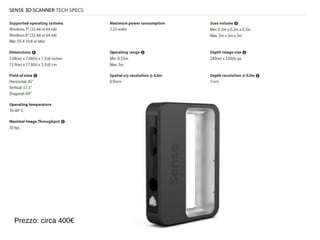
Scanner professionali
Makerbot Digitizer 
Circa 800$
P rezzo: circa 400€
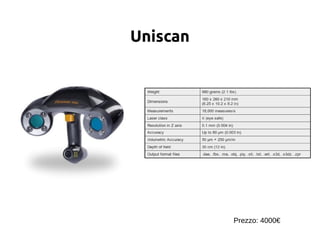
Uniscan 
Prezzo: 4000€
Scanner low cost
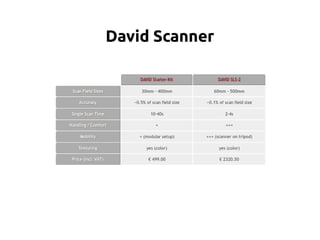
David Scanner 
A starter kit of the David Scanner is available for 399 €. 
360 scans are possible, although the user needs to turn the 
object manually between multiple scans. 
The software is proprietary and runs only on Windows. 
Minimal equipment is needed, such as a line laser, a camera and 
a calibration pattern which can be printed out. 
Using the DAVID- Shapefusion software the user can manually 
merge multiple point-clouds from different scans and convert 
them to a surface mesh by-hand.
David Scanner
David Scanner
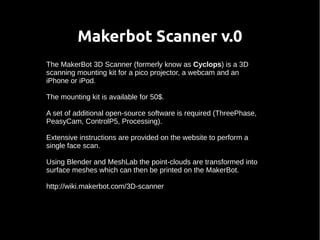
Makerbot Scanner v.0 
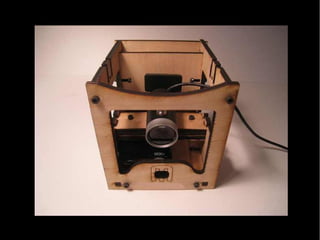
The MakerBot 3D Scanner (formerly know as Cyclops) is a 3D 
scanning mounting kit for a pico projector, a webcam and an 
iPhone or iPod. 
The mounting kit is available for 50$. 
A set of additional open-source software is required (ThreePhase, 
PeasyCam, ControlP5, Processing). 
Extensive instructions are provided on the website to perform a 
single face scan. 
Using Blender and MeshLab the point-clouds are transformed into 
surface meshes which can then be printed on the MakerBot. 
http://wiki.makerbot.com/3D-scanner
Makerbot Scanner v.0
3D Photograpy on your desk 
This project requires very little hardware: a camera, a desk- lamp, 
a pencil and a checkerboard. 
The checkerboard is used for calibration. 
The pencil is waved between the lamp and the object to be 
scanned, casting a shadow on the object. 
The 3D shape of the object is extracted from the spatial and 
temporal location of the observed shadow. 
Several implementations of this technique are available on the 
project’s website. 
http://www.vision.caltech.edu/bouguetj/ICCV98/
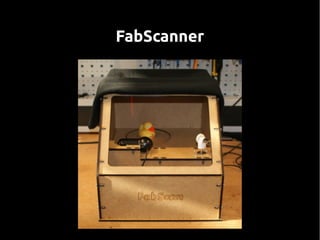
FabScanner 
Fabscanner http://hci.rwth-aachen.de/fabscan 
Un progetto simile: 
Scanner con arduino e mathlab 
http://makezine.com/projects/diy-3d-laser-scanner-using-arduino/
FabScanner
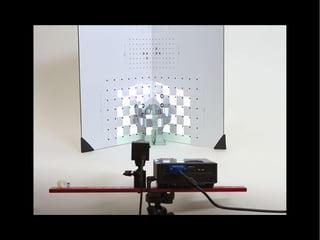
MakerScanner 
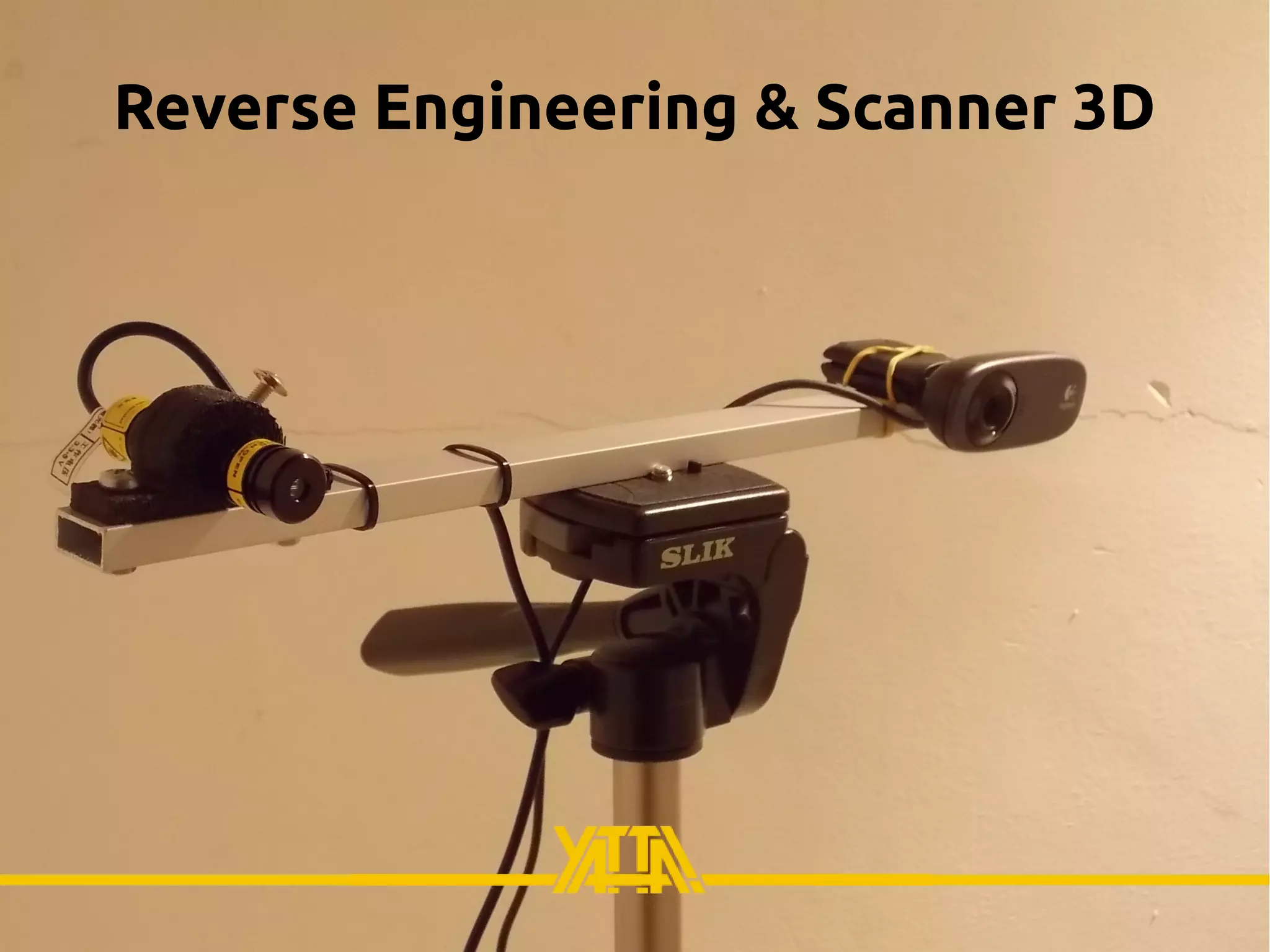
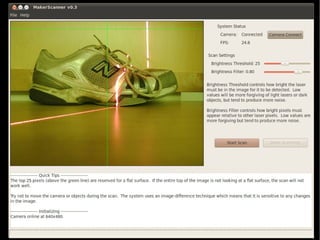
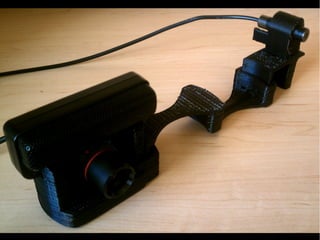
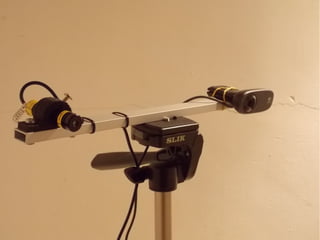
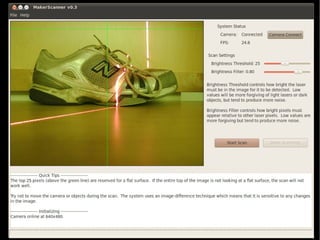
Scanner con webcam fissa e laser lineare da muovere a mano 
Il software è disponibile per Windows, Linux e come sorgenti.
MakerScanner
MakerScanner
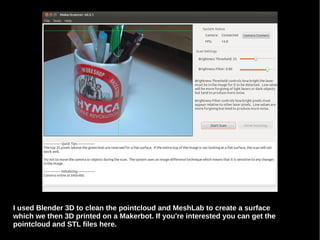
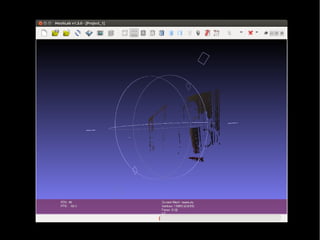
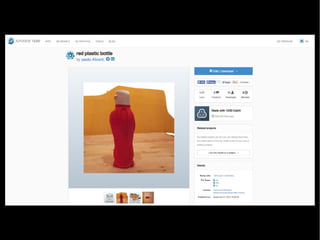
I used Blender 3D to clean the pointcloud and MeshLab to create a surface 
which we then 3D printed on a Makerbot. If you're interested you can get the 
pointcloud and STL files here.
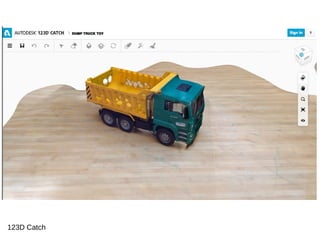
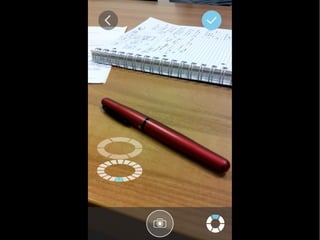
123D Catch 
Download e demo
123D Catch
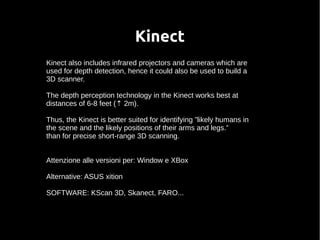
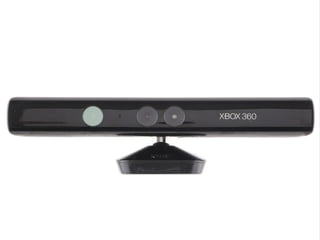
Kinect 
Kinect also includes infrared projectors and cameras which are 
used for depth detection, hence it could also be used to build a 
3D scanner. 
The depth perception technology in the Kinect works best at 
distances of 6-8 feet (⇡ 2m). 
Thus, the Kinect is better suited for identifying ”likely humans in 
the scene and the likely positions of their arms and legs.” 
than for precise short-range 3D scanning. 
Attenzione alle versioni per: Window e XBox 
Alternative: ASUS xition 
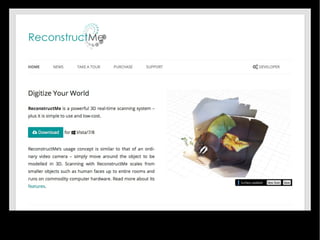
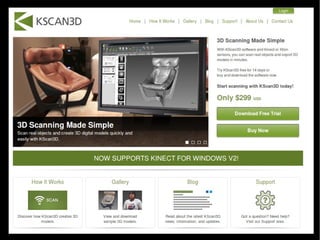
SOFTWARE: KScan 3D, Skanect, FARO...
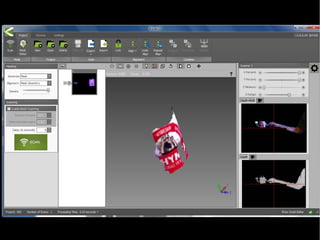
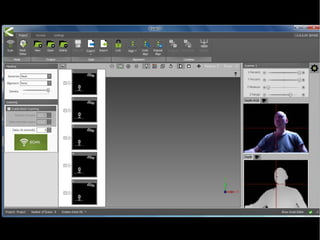
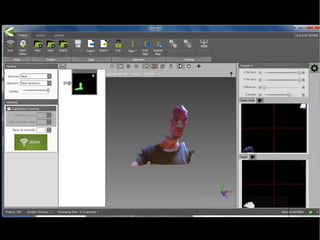
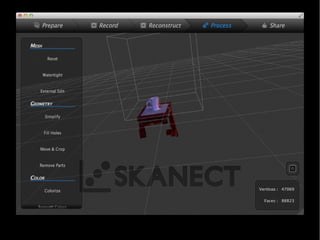
Skanect 
Per Windows e Mac 
Limitato a 5000 facce in versione free 
E' molto facile da usare 
Spiegazione programma e demo scansione
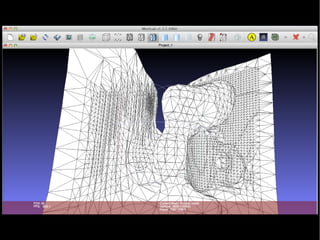
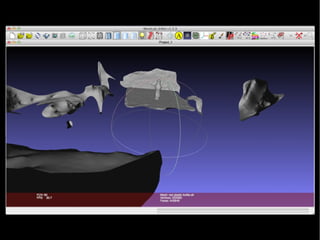
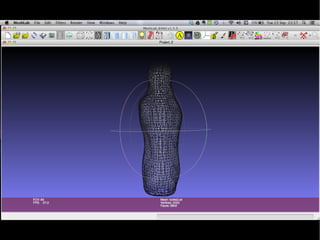
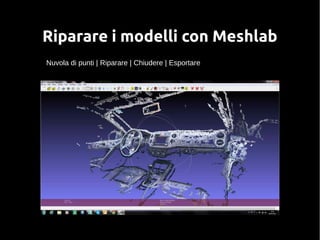
Riparare i modelli con Meshlab 
Nuvola di punti | Riparare | Chiudere | Esportare
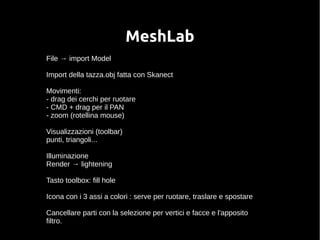
MeshLab 
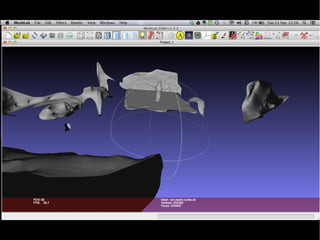
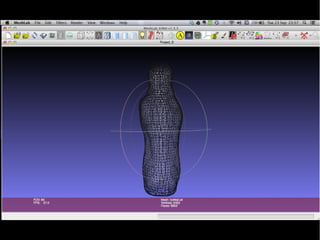
File → import Model 
Import della tazza.obj fatta con Skanect 
Movimenti: 
- drag dei cerchi per ruotare 
- CMD + drag per il PAN 
- zoom (rotellina mouse) 
Visualizzazioni (toolbar) 
punti, triangoli... 
Illuminazione 
Render → lightening 
Tasto toolbox: fill hole 
Icona con i 3 assi a colori : serve per ruotare, traslare e spostare 
Cancellare parti con la selezione per vertici e facce e l'apposito 
filtro.
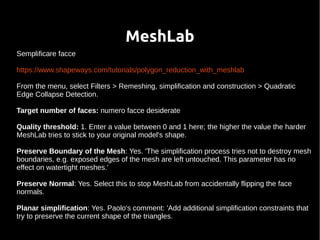
MeshLab 
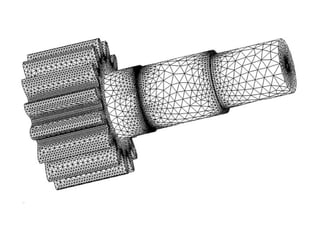
Semplificare facce 
https://www.shapeways.com/tutorials/polygon_reduction_with_meshlab 
From the menu, select Filters > Remeshing, simplification and construction > Quadratic 
Edge Collapse Detection. 
Target number of faces: numero facce desiderate 
Quality threshold: 1. Enter a value between 0 and 1 here; the higher the value the harder 
MeshLab tries to stick to your original model's shape. 
Preserve Boundary of the Mesh: Yes. 'The simplification process tries not to destroy mesh 
boundaries, e.g. exposed edges of the mesh are left untouched. This parameter has no 
effect on watertight meshes.' 
Preserve Normal: Yes. Select this to stop MeshLab from accidentally flipping the face 
normals. 
Planar simplification: Yes. Paolo's comment: 'Add additional simplification constraints that 
try to preserve the current shape of the triangles.
Link dei tutorial 
cleaning: http://abarry.org/makerscanner/4-makerscanner-post-processing.html 
meshing: http://abarry.org/makerscanner/5-makerscanner-meshing.html
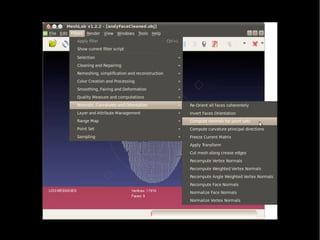
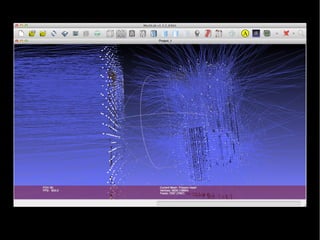
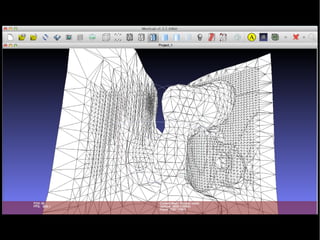
● Filters -> Normal, Curvatures and Orientation -> Compute normal for 
points set 
● Filters -> Remeshing, Simplification and Reconstruction -> Surface 
Reconstruction Poisson 
● Filters -> Normals, Curvatures and Orientation-> Re-Orient All Faces 
Coherently
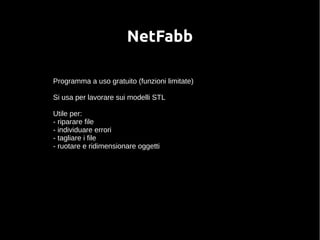
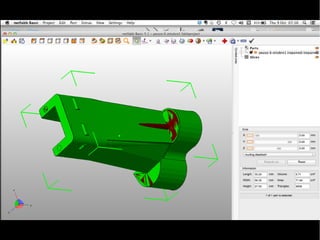
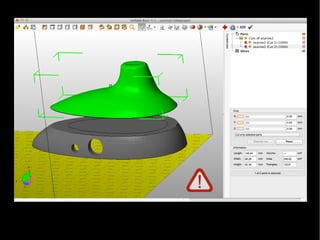
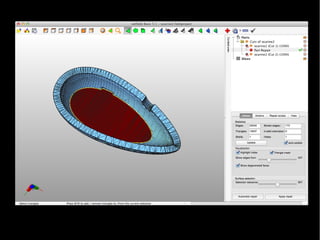
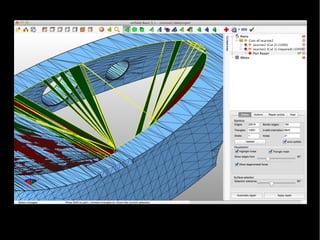
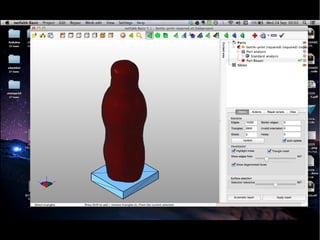
NetFabb 
Programma a uso gratuito (funzioni limitate) 
Si usa per lavorare sui modelli STL 
Utile per: 
- riparare file 
- individuare errori 
- tagliare i file 
- ruotare e ridimensionare oggetti
NetFabb
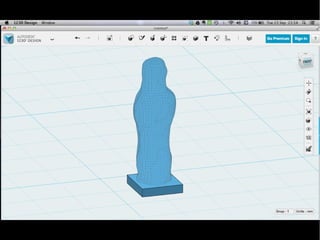
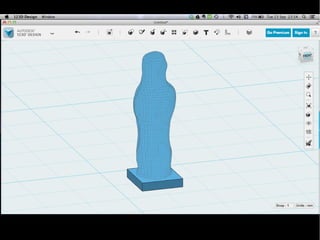
Editare l'stl con 123D design 
Importare e aggiungere una base 
Oppure scritte in svg...
Altre fonti 
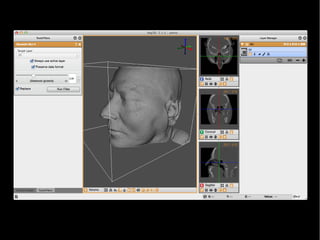
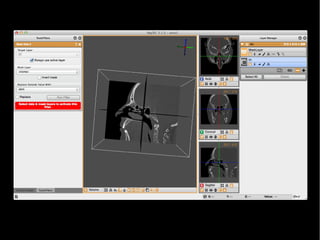
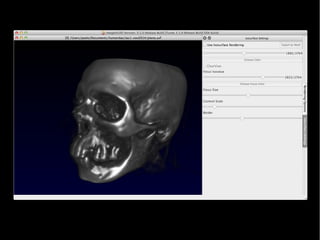
DICOM 
Seg3d v2.1 + imagevis 
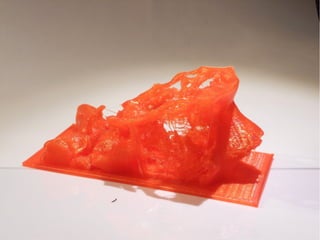
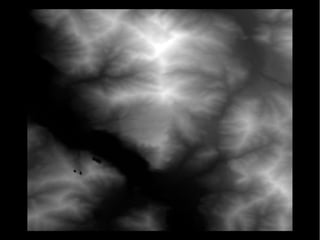
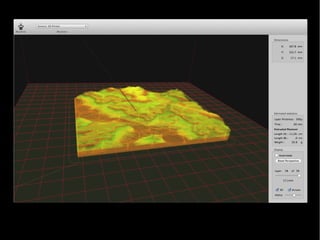
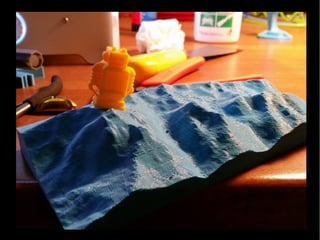
Aerial - planimetry
Grazie! 
Paolo Aliverti 
@zeppelinmaker 
www.zeppelinmaker.it

Scanner 3D e reverse Engineering

  • 1.
  • 2.
    Cos'è uno scanner3D un dispositivo che analizza gli oggetti o gli ambienti del mondo reale per collezionare dati sulle loro forme o sul loro aspetto, e per costruire modelli tridimensionali digitali
  • 4.
    Intro / storia1 Misurare Primi tentativi per standardizzare le misure: 2600 AC nella valle dell'Indo 240 AC Erastotene stimò la circonferenza della Terra al solstizio d'estate misurando l'altezza del sole a Alexandria e Siene 1750 / 1850 Rivoluzione Industriale – la misura delle cose divenne fondamentale Primi metodi di misura per contatto diretto: calibri e metri Pantografi per replicare gli oggetti La rivoluzione c'è stata con le misure non invasive e a distanza.
  • 5.
    Intro / storia2 Laser ranging systems have been in use in a variety of industries for decades, with the first patented instruments appearing as early as the late 1980’s. 3D scanning was first applied in the Architecture, Engineering, and Construction industry in the 1990’s with the market debut of the first integrated commercial systems for 3D scanning
  • 7.
    Applicazioni / 1 A cosa serve? Quali applicazioni? Product inspection – per vedere se un prodotto è uscito come previsto (si misurano parti e rilevano difetti) Medicina – si rilevano parti in 3D per creare protesi su misura. Negl interventi la scansione è proiettata sul paziente Product design
  • 8.
    Applicazioni / 2 Edilizia – verifica che l'edificio sia uscito come previsto Clothes fitting – misurazione del corpo – es esercito USA ha un sistema di misurazione automatico Art history Sculptures & interesting objects to look at Art: studying working techniques Art history Cultural heritage preservation High-visibility project Archaeology Ricostruzione di parti e ricombinazione frammenti Ricostruzione oggetti in 3D per evitare di toccarli
  • 9.
    Applicazioni / 3 Computer graphics Cinema Giochi (hanno un fatturato maggiore del cinema) Robot navigation
  • 10.
    Possibilità tecnologiche Contatto Sonde a contatto Trasmissive Magnetic Resonance Imaging (MRI) Ultrasuoni Raggi X Suoni e Vibrazioni Riflessione Ottica Non ottica (radar e sonar)
  • 11.
    Tecnologie ottiche Immaginistereo Oggetto inquadrato da due angolature (doppia immagine) Meglio più di due per evitare ambiguità Non vedo quello che c'è dietro
  • 12.
    Tecnologie ottiche Shapefrom motion Da analisi di una sequenza di immagini, ricavo l'oggetto in 3d Shape from shading Si evidenziano le forme illuminando l'oggetto da diversi punti
  • 13.
    Tecnologie ottiche Shapefrom texture Si proietta una texture nota sull'oggetto e vedendo come si deforma si ricava la forma dell'oggetto (esempio una serie di righe)
  • 14.
    Tecnologie ottiche Shapefrom focus/defocus Si determinano distanze e forme vedendo come e dove si mette a fuoco l'immagine – la messa a fuoco dipende dalla distanza Tempo di volo del laser Opera su grandi volumi (lati da 100m) Precisione grossolana – 5mm Per scavi archeologici, edifici, stanze
  • 15.
    Tecnologie ottiche Triangolazione Una lama laser che scorre sull'oggetto Laser e camera posti a triangolo con l'obj Se camera e laser si muovono indipedentemente, è difficile poi ricostruire con precisione. Molti scanner hanno camera e laser fissi. Per grandi oggetti si usano sistemi che muovono il gruppo di scansione e gli fanno coprire delle piccole regioni (moto su tilt e pan)
  • 16.
  • 17.
    Distanze e colori Misura della distanza e nuvola di punti Scanning systems primarily capture the physical position of a target object, represented as a series of points (forming a “point cloud”) typically in Cartesian coordinates (XYZ). This is accomplished by comparing the emitted and returned light pulse, and determining the value of the target object in relation to the position of the scanning instrument Colori determine the colour of the each point by using a camera (can be built-in or seperate), which is represented by the commonly used RGB (red, green, blue) value scale. Because scanners are optical systems, only what the scanner can “see” is captured,
  • 18.
    Precisione, Risoluzione, Accuratezza Risoluzione: densità della nuvola di punti Accuratezza: differenza tra misura e valore reale Precisione: indica la correttezza della misura (posso avere un point set preciso ma inaccurato – es se offset iniziale e non mi accorgo) Peggiorano con: Distanza Superficie riflettente Velocità di scansione Si va da qualche millimetro (5 mm) fino a freazioni di millimetro (0,3 mm)
  • 20.
    Formato file Loscanner raccoglie una nuvola di punti che poi è raccolta in un file ASTM E57 File Format (XYX I RGB) questo rappresenta la nuvola di punti Questi formati derivano dal mondo grafico: OBJ (con colori) STL VRML (con colori)
  • 24.
  • 25.
  • 27.
  • 28.
  • 29.
  • 30.
    David Scanner Astarter kit of the David Scanner is available for 399 €. 360 scans are possible, although the user needs to turn the object manually between multiple scans. The software is proprietary and runs only on Windows. Minimal equipment is needed, such as a line laser, a camera and a calibration pattern which can be printed out. Using the DAVID- Shapefusion software the user can manually merge multiple point-clouds from different scans and convert them to a surface mesh by-hand.
  • 31.
  • 32.
  • 34.
    Makerbot Scanner v.0 The MakerBot 3D Scanner (formerly know as Cyclops) is a 3D scanning mounting kit for a pico projector, a webcam and an iPhone or iPod. The mounting kit is available for 50$. A set of additional open-source software is required (ThreePhase, PeasyCam, ControlP5, Processing). Extensive instructions are provided on the website to perform a single face scan. Using Blender and MeshLab the point-clouds are transformed into surface meshes which can then be printed on the MakerBot. http://wiki.makerbot.com/3D-scanner
  • 35.
  • 36.
    3D Photograpy onyour desk This project requires very little hardware: a camera, a desk- lamp, a pencil and a checkerboard. The checkerboard is used for calibration. The pencil is waved between the lamp and the object to be scanned, casting a shadow on the object. The 3D shape of the object is extracted from the spatial and temporal location of the observed shadow. Several implementations of this technique are available on the project’s website. http://www.vision.caltech.edu/bouguetj/ICCV98/
  • 37.
    FabScanner Fabscanner http://hci.rwth-aachen.de/fabscan Un progetto simile: Scanner con arduino e mathlab http://makezine.com/projects/diy-3d-laser-scanner-using-arduino/
  • 38.
  • 39.
    MakerScanner Scanner conwebcam fissa e laser lineare da muovere a mano Il software è disponibile per Windows, Linux e come sorgenti.
  • 40.
  • 42.
  • 43.
    I used Blender3D to clean the pointcloud and MeshLab to create a surface which we then 3D printed on a Makerbot. If you're interested you can get the pointcloud and STL files here.
  • 46.
  • 47.
  • 53.
    Kinect Kinect alsoincludes infrared projectors and cameras which are used for depth detection, hence it could also be used to build a 3D scanner. The depth perception technology in the Kinect works best at distances of 6-8 feet (⇡ 2m). Thus, the Kinect is better suited for identifying ”likely humans in the scene and the likely positions of their arms and legs.” than for precise short-range 3D scanning. Attenzione alle versioni per: Window e XBox Alternative: ASUS xition SOFTWARE: KScan 3D, Skanect, FARO...
  • 60.
    Skanect Per Windowse Mac Limitato a 5000 facce in versione free E' molto facile da usare Spiegazione programma e demo scansione
  • 62.
    Riparare i modellicon Meshlab Nuvola di punti | Riparare | Chiudere | Esportare
  • 63.
    MeshLab File →import Model Import della tazza.obj fatta con Skanect Movimenti: - drag dei cerchi per ruotare - CMD + drag per il PAN - zoom (rotellina mouse) Visualizzazioni (toolbar) punti, triangoli... Illuminazione Render → lightening Tasto toolbox: fill hole Icona con i 3 assi a colori : serve per ruotare, traslare e spostare Cancellare parti con la selezione per vertici e facce e l'apposito filtro.
  • 64.
    MeshLab Semplificare facce https://www.shapeways.com/tutorials/polygon_reduction_with_meshlab From the menu, select Filters > Remeshing, simplification and construction > Quadratic Edge Collapse Detection. Target number of faces: numero facce desiderate Quality threshold: 1. Enter a value between 0 and 1 here; the higher the value the harder MeshLab tries to stick to your original model's shape. Preserve Boundary of the Mesh: Yes. 'The simplification process tries not to destroy mesh boundaries, e.g. exposed edges of the mesh are left untouched. This parameter has no effect on watertight meshes.' Preserve Normal: Yes. Select this to stop MeshLab from accidentally flipping the face normals. Planar simplification: Yes. Paolo's comment: 'Add additional simplification constraints that try to preserve the current shape of the triangles.
  • 71.
    Link dei tutorial cleaning: http://abarry.org/makerscanner/4-makerscanner-post-processing.html meshing: http://abarry.org/makerscanner/5-makerscanner-meshing.html
  • 72.
    ● Filters ->Normal, Curvatures and Orientation -> Compute normal for points set ● Filters -> Remeshing, Simplification and Reconstruction -> Surface Reconstruction Poisson ● Filters -> Normals, Curvatures and Orientation-> Re-Orient All Faces Coherently
  • 73.
    NetFabb Programma auso gratuito (funzioni limitate) Si usa per lavorare sui modelli STL Utile per: - riparare file - individuare errori - tagliare i file - ruotare e ridimensionare oggetti
  • 74.
  • 79.
    Editare l'stl con123D design Importare e aggiungere una base Oppure scritte in svg...
  • 81.
    Altre fonti DICOM Seg3d v2.1 + imagevis Aerial - planimetry
  • 90.
    Grazie! Paolo Aliverti @zeppelinmaker www.zeppelinmaker.it