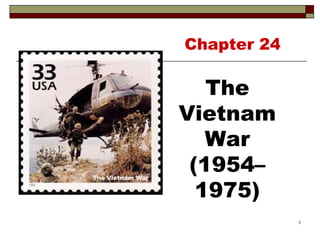
Chapter 24 The Vietnam War (1954–1975)
Section 1:  War Unfolds Section 2:  Fighting the War Section 3:  Political Divisions Section 4:  The End of the War Section 5:  The Counterculture
 
Section One: The War Unfolds Pages 792-796
The War Unfolds What events led to the war between North Vietnam and South Vietnam? What were the Vietnam policies of President Kennedy and Robert McNamara? How did President Johnson change the course of the war?
  South Vietnam North Vietnam   United States The Players in Vietnam
American Foreign Policy Rationale  Domino theory   if one Southeast Asian nation fell to communism, others  would soon follow.
French Indochina Historically, the French had controlled Vietnam and much of southeast Asia. During WWII, the French lost Vietnam and after the war they wanted to regain their lost colony.
Ho Chi Minh, a pro-Communist leader in Vietnam.  Led a group called the  Vietminh  against French control of his nation before, during, and after World War II.
 
Dien Bien Phu   the Vietminh successfully defeated the French (1954). Geneva Accords  divided Vietnam into Communist North Vietnam and anti-Communist South Vietnam.  The country would be divided at the 17 th  parallel.
 
The Siege of  Dien Bien Phu Describe the images that you see. How many French soldiers were left at the end of the battle? How many soldiers did the Vietminh lose?
4.  Who is helping the French? 5.  Who is helping the Vietminh? 6.  What is the “prize”? 7.  What did the French commander order his men to do?
Ho Chi Minh led  North Vietnam. Ngo Dinh Diem led  South Vietnam.
Truman and Ike’s Vietnam Policies
Truman began providing economic aid to the French in Vietnam in 1950.  In 1960, Eisenhower sent hundreds of military advisors to help South Vietnam’s struggle against the North.
JFK’s Vietnam Policies
Diem’s Downfall During the early 1960s, Ngo Dinh Diem’s policies lost him the support of his people. Diem was a Catholic controlling a Buddhist nation. Political corruption. Political favors for families
President Kennedy told South Vietnamese military leaders that the United States would not object to Diem’s overthrow. In November 1963, military leaders seized control of South Vietnam and assassinated Diem. United States was upset over the assassination of Diem.
 
McNamara’s Role Robert McNamara, President Kennedy’s Secretary of Defense,  Influential in shaping American policy toward Vietnam  (chief architect).
McNamara used his strong business background to cut costs while modernizing the armed forces. In the coming years, McNamara would push for direct American involvement in Vietnam.
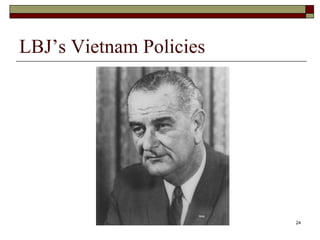
LBJ’s Vietnam Policies
Shortly after Diem’s assassination in November 1963, President Kennedy was assassinated, and Vice President Johnson assumed the presidency.
In South Vietnam, the military leaders who had taken over the government were unsuccessful and unpopular.  As a result, Communist guerrillas in South Vietnam, known as the  Viet Cong , made gains in both territory and loyalty.
The  Viet Cong’s  political wing was known as the  National Liberation Front .
Expanding Presidential Power The Gulf of Tonkin Resolution In August 1964, Johnson announced that North Vietnamese torpedo boats had attacked American destroyers in the Gulf of Tonkin. Gulf of Tonkin Resolution    Gave Johnson authority to send troops to Vietnam.
Under the resolution, the President had authority to “take all necessary measures to repel any armed attack against the forces of the United States and to prevent further aggression.”
Map of Vietnam   Old Text 620 New Text 802

Vietnam War [Section One]

  • 1.
    Chapter 24 TheVietnam War (1954–1975)
  • 2.
    Section 1: War Unfolds Section 2: Fighting the War Section 3: Political Divisions Section 4: The End of the War Section 5: The Counterculture
  • 3.
  • 4.
    Section One: TheWar Unfolds Pages 792-796
  • 5.
    The War UnfoldsWhat events led to the war between North Vietnam and South Vietnam? What were the Vietnam policies of President Kennedy and Robert McNamara? How did President Johnson change the course of the war?
  • 6.
    SouthVietnam North Vietnam United States The Players in Vietnam
  • 7.
    American Foreign PolicyRationale Domino theory  if one Southeast Asian nation fell to communism, others would soon follow.
  • 8.
    French Indochina Historically,the French had controlled Vietnam and much of southeast Asia. During WWII, the French lost Vietnam and after the war they wanted to regain their lost colony.
  • 9.
    Ho Chi Minh,a pro-Communist leader in Vietnam. Led a group called the Vietminh against French control of his nation before, during, and after World War II.
  • 10.
  • 11.
    Dien Bien Phu the Vietminh successfully defeated the French (1954). Geneva Accords divided Vietnam into Communist North Vietnam and anti-Communist South Vietnam. The country would be divided at the 17 th parallel.
  • 12.
  • 13.
    The Siege of Dien Bien Phu Describe the images that you see. How many French soldiers were left at the end of the battle? How many soldiers did the Vietminh lose?
  • 14.
    4. Whois helping the French? 5. Who is helping the Vietminh? 6. What is the “prize”? 7. What did the French commander order his men to do?
  • 15.
    Ho Chi Minhled North Vietnam. Ngo Dinh Diem led South Vietnam.
  • 16.
    Truman and Ike’sVietnam Policies
  • 17.
    Truman began providingeconomic aid to the French in Vietnam in 1950. In 1960, Eisenhower sent hundreds of military advisors to help South Vietnam’s struggle against the North.
  • 18.
  • 19.
    Diem’s Downfall Duringthe early 1960s, Ngo Dinh Diem’s policies lost him the support of his people. Diem was a Catholic controlling a Buddhist nation. Political corruption. Political favors for families
  • 20.
    President Kennedy toldSouth Vietnamese military leaders that the United States would not object to Diem’s overthrow. In November 1963, military leaders seized control of South Vietnam and assassinated Diem. United States was upset over the assassination of Diem.
  • 21.
  • 22.
    McNamara’s Role RobertMcNamara, President Kennedy’s Secretary of Defense, Influential in shaping American policy toward Vietnam (chief architect).
  • 23.
    McNamara used hisstrong business background to cut costs while modernizing the armed forces. In the coming years, McNamara would push for direct American involvement in Vietnam.
  • 24.
  • 25.
    Shortly after Diem’sassassination in November 1963, President Kennedy was assassinated, and Vice President Johnson assumed the presidency.
  • 26.
    In South Vietnam,the military leaders who had taken over the government were unsuccessful and unpopular. As a result, Communist guerrillas in South Vietnam, known as the Viet Cong , made gains in both territory and loyalty.
  • 27.
    The VietCong’s political wing was known as the National Liberation Front .
  • 28.
    Expanding Presidential PowerThe Gulf of Tonkin Resolution In August 1964, Johnson announced that North Vietnamese torpedo boats had attacked American destroyers in the Gulf of Tonkin. Gulf of Tonkin Resolution  Gave Johnson authority to send troops to Vietnam.
  • 29.
    Under the resolution,the President had authority to “take all necessary measures to repel any armed attack against the forces of the United States and to prevent further aggression.”
  • 30.
    Map of Vietnam Old Text 620 New Text 802