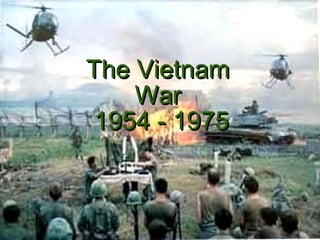
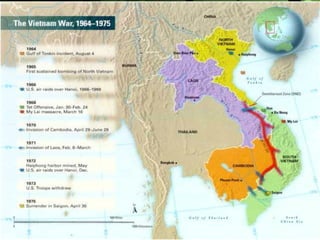
The Vietnam  War  1954 - 1975
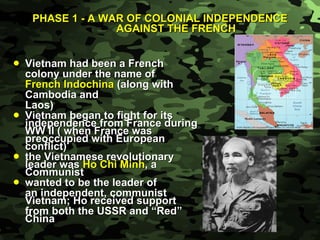
PHASE 1 - A WAR OF COLONIAL INDEPENDENCE AGAINST THE FRENCH Vietnam had been a French  colony under the name of  French Indochina  (along with Cambodia and  Laos) Vietnam began to fight for its independence from France during WW II ( when France was preoccupied with European conflict) the Vietnamese revolutionary leader was  Ho Chi Minh , a Communist wanted to be the leader of an independent, communist Vietnam; Ho received support  from both the USSR and “Red” China
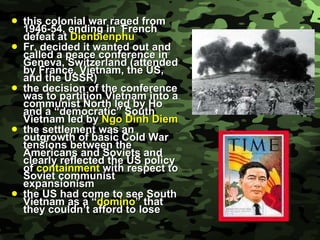
this colonial war raged from 1946-54, ending in  French defeat at  Dienbienphu Fr. decided it wanted out and called a peace conference in Geneva, Switzerland (attended by France, Vietnam, the US, and the USSR) the decision of the conference was to partition Vietnam into a communist North led by Ho and a “democratic” South Vietnam led by  Ngo Dinh Diem the settlement was an outgrowth of basic Cold War tensions between the Americans and Soviets and clearly reflected the US policy of  containment  with respect to Soviet communist expansionism the US had come to see South Vietnam as a “ domino ” that they couldn’t afford to lose
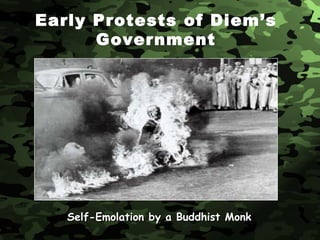
Early Protests of Diem’s Government Self-Emolation by a Buddhist Monk
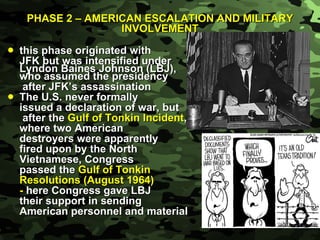
PHASE 2 – AMERICAN ESCALATION AND MILITARY INVOLVEMENT this phase originated with  JFK but was intensified under Lyndon Baines Johnson (LBJ), who assumed the presidency   after JFK’s assassination The U.S. never formally  issued a declaration of war, but   after the  Gulf of Tonkin Incident ,  where two American destroyers were apparently  fired upon by the North  Vietnamese, Congress  passed the  Gulf of Tonkin  Resolutions (August 1964) -  here   Congress gave LBJ  their support in sending  American personnel and material
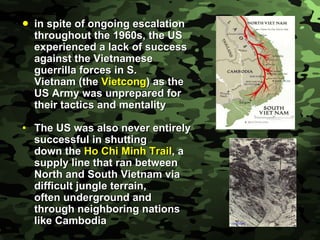
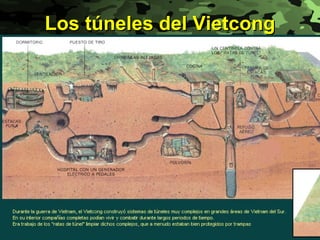
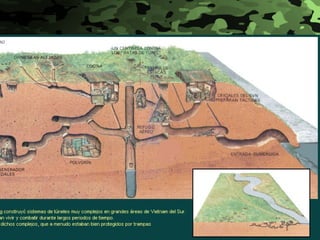
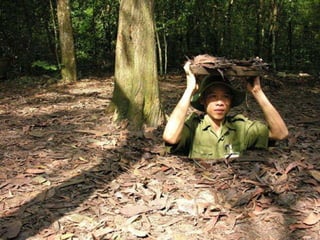
in spite of ongoing escalation  throughout the 1960s, the US experienced a lack of success against the Vietnamese  guerrilla forces in S. Vietnam (the  Vietcong ) as the US Army was unprepared for their tactics and mentality  The US was also never entirely  successful in shutting down the  Ho Chi Minh Trail , a supply line that ran between North and South Vietnam via difficult jungle terrain,  often underground and  through neighboring nations like Cambodia
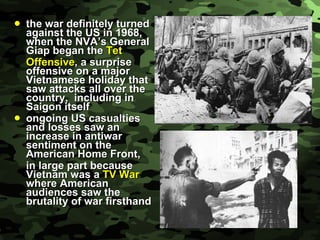
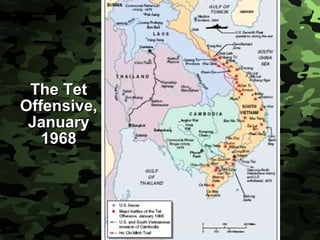
the war definitely turned against the US in 1968, when the NVA’s General Giap began the  Tet  Offensive , a surprise offensive on a major Vietnamese holiday that saw attacks all over the country,  including in Saigon itself ongoing US casualties and losses saw an increase in antiwar sentiment on the American Home Front, in large part because Vietnam was a  TV War  where American audiences saw the brutality of war firsthand
Los túneles del Vietcong
 
 
The Tet Offensive, January 1968
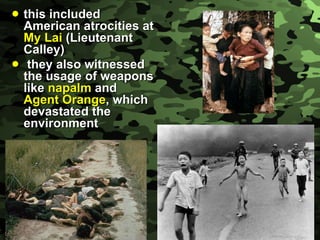
this included American atrocities at  My Lai  (Lieutenant Calley) they also witnessed the usage of weapons like  napalm  and  Agent Orange , which devastated the environment
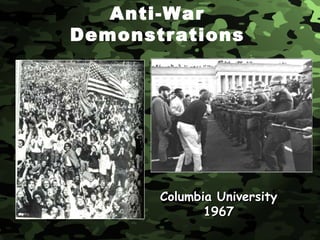
Anti-War Demonstrations Columbia University 1967
 
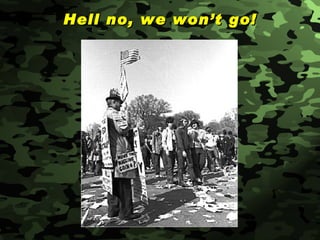
Hell no, we won’t go!
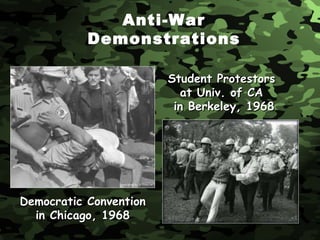
Democratic Convention in Chicago, 1968 Student Protestors  at Univ. of CA  in Berkeley, 1968 Anti-War Demonstrations
“ Hanoi Jane” Jane Fonda:  Traitor?
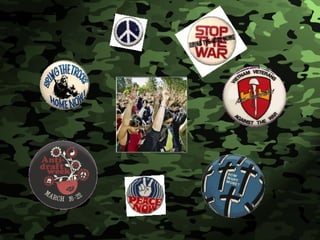
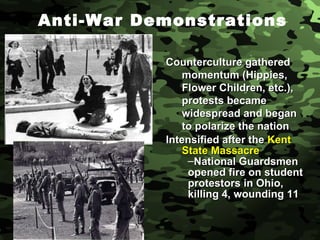
Anti-War Demonstrations Counterculture gathered momentum (Hippies, Flower Children, etc.), protests became widespread and began to polarize the nation Intensified after the  Kent State Massacre National Guardsmen opened fire on student protestors in Ohio, killing 4, wounding 11
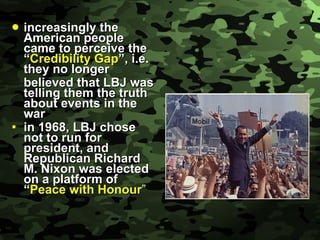
increasingly the American people came to perceive the “ Credibility Gap ”, i.e. they no longer believed that LBJ was telling them the truth about events in the war in 1968, LBJ chose not to run for president, and Republican Richard M. Nixon was elected on a platform of “ Peace with Honour ”
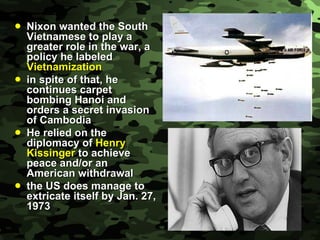
Nixon wanted the South Vietnamese to play a greater role in the war, a policy he labeled  Vietnamization in spite of that, he continues carpet bombing Hanoi and orders a secret invasion of Cambodia He relied on the diplomacy of  Henry Kissinger  to achieve peace and/or an American withdrawal the US does manage to extricate itself by Jan. 27, 1973
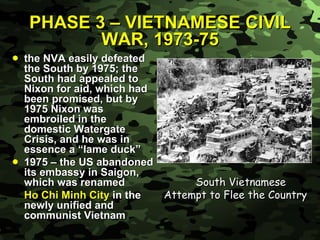
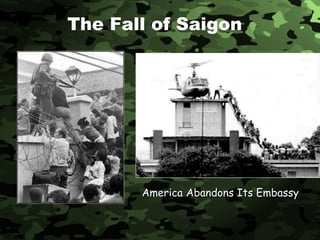
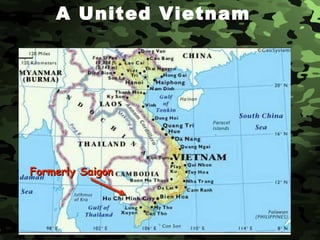
PHASE 3 – VIETNAMESE CIVIL WAR, 1973-75 the NVA easily defeated the South by 1975; the South had appealed to Nixon for aid, which had been promised, but by 1975 Nixon was embroiled in the domestic Watergate Crisis, and he was in essence a “lame duck” 1975 – the US abandoned its embassy in Saigon, which was renamed  Ho Chi Minh City  in the newly unified and communist Vietnam South Vietnamese  Attempt to Flee the Country
The Fall of Saigon America Abandons Its Embassy
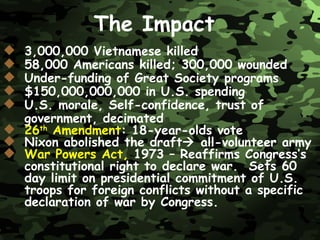
3,000,000 Vietnamese killed 58,000 Americans killed; 300,000 wounded Under-funding of Great Society programs $150,000,000,000 in U.S. spending U.S. morale, Self-confidence, trust of government, decimated 26 th  Amendment : 18-year-olds vote Nixon abolished the draft   all-volunteer army War Powers Act,   1973   – Reaffirms Congress’s constitutional right to declare war.  Sets 60 day limit on presidential commitment of U.S. troops for foreign conflicts without a specific declaration of war by Congress. The Impact
Wars must be of short duration. Wars must yield few American casualties. Restrict media access to battlefields. Develop and maintain Congressional and public support. Set clear, winnable goals. Set deadline for troop withdrawals. Lessons for Future American   Presidents
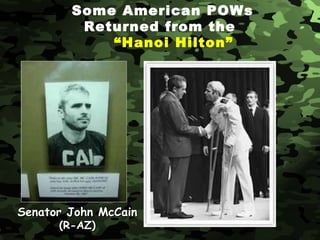
Some American POWs Returned from the     “Hanoi Hilton” Senator John McCain (R-AZ)
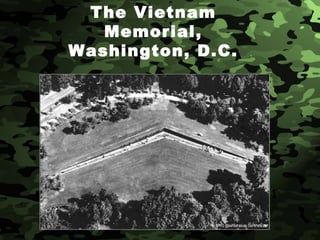
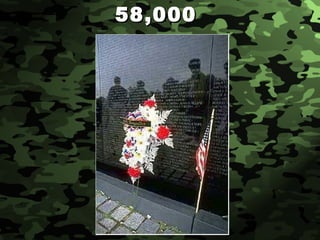
The Vietnam Memorial, Washington, D.C.
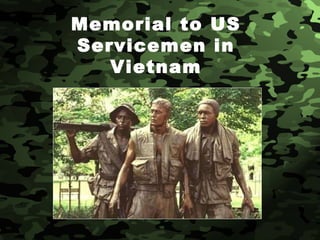
Memorial to US Servicemen in Vietnam
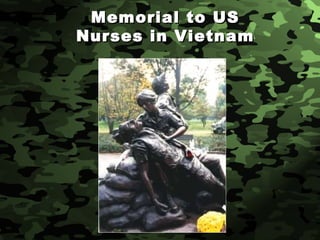
Memorial to US Nurses in Vietnam
58,000
President Clinton formally recognized Vietnam on  July 11, 1995
Formerly Saigon A United Vietnam

Vietnam War

  • 1.
    The Vietnam War 1954 - 1975
  • 2.
    PHASE 1 -A WAR OF COLONIAL INDEPENDENCE AGAINST THE FRENCH Vietnam had been a French colony under the name of French Indochina (along with Cambodia and Laos) Vietnam began to fight for its independence from France during WW II ( when France was preoccupied with European conflict) the Vietnamese revolutionary leader was Ho Chi Minh , a Communist wanted to be the leader of an independent, communist Vietnam; Ho received support from both the USSR and “Red” China
  • 3.
    this colonial warraged from 1946-54, ending in French defeat at Dienbienphu Fr. decided it wanted out and called a peace conference in Geneva, Switzerland (attended by France, Vietnam, the US, and the USSR) the decision of the conference was to partition Vietnam into a communist North led by Ho and a “democratic” South Vietnam led by Ngo Dinh Diem the settlement was an outgrowth of basic Cold War tensions between the Americans and Soviets and clearly reflected the US policy of containment with respect to Soviet communist expansionism the US had come to see South Vietnam as a “ domino ” that they couldn’t afford to lose
  • 4.
    Early Protests ofDiem’s Government Self-Emolation by a Buddhist Monk
  • 5.
    PHASE 2 –AMERICAN ESCALATION AND MILITARY INVOLVEMENT this phase originated with JFK but was intensified under Lyndon Baines Johnson (LBJ), who assumed the presidency after JFK’s assassination The U.S. never formally issued a declaration of war, but after the Gulf of Tonkin Incident , where two American destroyers were apparently fired upon by the North Vietnamese, Congress passed the Gulf of Tonkin Resolutions (August 1964) - here Congress gave LBJ their support in sending American personnel and material
  • 6.
    in spite ofongoing escalation throughout the 1960s, the US experienced a lack of success against the Vietnamese guerrilla forces in S. Vietnam (the Vietcong ) as the US Army was unprepared for their tactics and mentality The US was also never entirely successful in shutting down the Ho Chi Minh Trail , a supply line that ran between North and South Vietnam via difficult jungle terrain, often underground and through neighboring nations like Cambodia
  • 7.
    the war definitelyturned against the US in 1968, when the NVA’s General Giap began the Tet Offensive , a surprise offensive on a major Vietnamese holiday that saw attacks all over the country, including in Saigon itself ongoing US casualties and losses saw an increase in antiwar sentiment on the American Home Front, in large part because Vietnam was a TV War where American audiences saw the brutality of war firsthand
  • 8.
  • 9.
  • 10.
  • 11.
    The Tet Offensive,January 1968
  • 12.
    this included Americanatrocities at My Lai (Lieutenant Calley) they also witnessed the usage of weapons like napalm and Agent Orange , which devastated the environment
  • 13.
  • 14.
  • 15.
    Hell no, wewon’t go!
  • 16.
    Democratic Convention inChicago, 1968 Student Protestors at Univ. of CA in Berkeley, 1968 Anti-War Demonstrations
  • 17.
    “ Hanoi Jane”Jane Fonda: Traitor?
  • 18.
    Anti-War Demonstrations Counterculturegathered momentum (Hippies, Flower Children, etc.), protests became widespread and began to polarize the nation Intensified after the Kent State Massacre National Guardsmen opened fire on student protestors in Ohio, killing 4, wounding 11
  • 19.
    increasingly the Americanpeople came to perceive the “ Credibility Gap ”, i.e. they no longer believed that LBJ was telling them the truth about events in the war in 1968, LBJ chose not to run for president, and Republican Richard M. Nixon was elected on a platform of “ Peace with Honour ”
  • 20.
    Nixon wanted theSouth Vietnamese to play a greater role in the war, a policy he labeled Vietnamization in spite of that, he continues carpet bombing Hanoi and orders a secret invasion of Cambodia He relied on the diplomacy of Henry Kissinger to achieve peace and/or an American withdrawal the US does manage to extricate itself by Jan. 27, 1973
  • 21.
    PHASE 3 –VIETNAMESE CIVIL WAR, 1973-75 the NVA easily defeated the South by 1975; the South had appealed to Nixon for aid, which had been promised, but by 1975 Nixon was embroiled in the domestic Watergate Crisis, and he was in essence a “lame duck” 1975 – the US abandoned its embassy in Saigon, which was renamed Ho Chi Minh City in the newly unified and communist Vietnam South Vietnamese Attempt to Flee the Country
  • 22.
    The Fall ofSaigon America Abandons Its Embassy
  • 23.
    3,000,000 Vietnamese killed58,000 Americans killed; 300,000 wounded Under-funding of Great Society programs $150,000,000,000 in U.S. spending U.S. morale, Self-confidence, trust of government, decimated 26 th Amendment : 18-year-olds vote Nixon abolished the draft  all-volunteer army War Powers Act, 1973 – Reaffirms Congress’s constitutional right to declare war. Sets 60 day limit on presidential commitment of U.S. troops for foreign conflicts without a specific declaration of war by Congress. The Impact
  • 24.
    Wars must beof short duration. Wars must yield few American casualties. Restrict media access to battlefields. Develop and maintain Congressional and public support. Set clear, winnable goals. Set deadline for troop withdrawals. Lessons for Future American Presidents
  • 25.
    Some American POWsReturned from the “Hanoi Hilton” Senator John McCain (R-AZ)
  • 26.
    The Vietnam Memorial,Washington, D.C.
  • 27.
    Memorial to USServicemen in Vietnam
  • 28.
    Memorial to USNurses in Vietnam
  • 29.
  • 30.
    President Clinton formallyrecognized Vietnam on July 11, 1995
  • 31.
    Formerly Saigon AUnited Vietnam