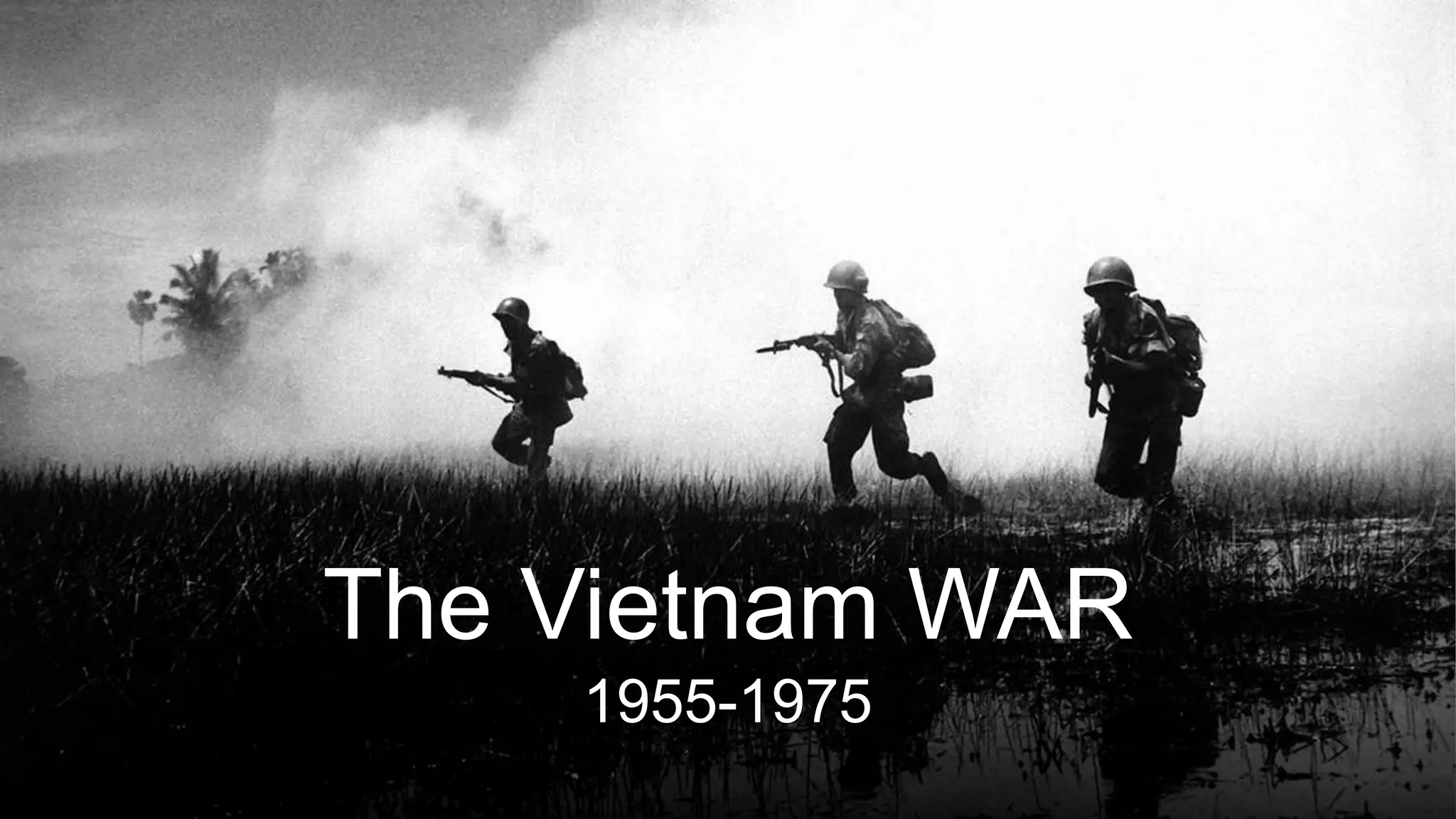
The Vietnam WAR
1955-1975
Overview
Background (1858-
1954)
• French Occupation &
WWII
• Viet Minh and
Independence
• First French-
Indochina War
• Geneva Conference
and Vietnamese
Partition
Escalation (1954-
1964)
• Nationwide Elections
• Life in North vs
South
• Ho Chi Minh’s
Attempts to Re-Unify
• Increasing US
involvement
• Fall of Diem
US Military Involvement
(1964-1975)
• Gulf of Tonkin Incident /
Resolution
• Operation Rolling
Thunder
• Fighting tactics
• Tet Offensive
• Nixon’s Secret War
• Anti-war Movement and
the Fulbright Hearings
BACKGROUND
1858-1954
French Occupation and WWII
• Long history of colonisation (e.g. by China for >1000
years)
• Independent until France invaded in the 1800s and
occupied Southeast Asia (and south of Vietnam)
• French colony for 100 years: They tried to convert the
Buddhist Vietnamese to Catholicism
• WWII
• Japan invaded and occupied Vietnam until being forced out by
Vietnamese and Allied forces
Viet minh and independence
• Viet Minh
• Founded by Ho Chi Minh
• Coalition that wanted a
communist and independent
Vietnam
• During WWII, fought with Allied
forces against Japan
• Became known for Guerrilla
Tactics in battle
• Independence
• 1945, Ho Chi Minh established a
• Ho Chi Minh
• Born 1890
• Called for
Vietnamese
independence
• In 1918 appealed
directly to
Woodrow Wilson
for support citing
the Declaration of
Independence as
his inspiration but
was rejected
First French-Indochina War
(1946-1954)
• Fighting began in 1946
• Viet Minh benefitted from mass recruitment
• Official declaration of war by Ho Chi Minh in March 1947
• Ho Chi Minh worked with General Ngo Diem Giap; both had
studied Guerrilla Warfare (small groups ambushing enemies
and then disappearing quickly)
• Built an extensive guerrilla network in the south to destabilise the
French
• French morale low compared to Viet Minh
• Breaking point: Dien Bien Phu
• France began withdrawing, immediately recognising independence
Geneva Conference (1954)
• Began April 1954
• Countries involved: US, Britain, France, USSR, Vietnam
• Discussed wars in Korea and Indochina
• Results
• Signed 21st July 1954
• Divided Vietnam at 17th parallel; Viet Minh to control north;
Republic of Vietnam established in the south
• Intended to be temporary
• Civilians given 200 days to choose north or south
• Nationwide elections to be held in 1956 to unite the 2 Vietnams
ESCALATION
1954–1964
Nationwide Elections
• Part of the Geneva Accords
• Both US and South Vietnam rejected the idea
• US supported the South because it was anti-communist;
refused to allow elections to unite Vietnam
• Eisenhower knew Ho Chi Minh would win
• Idea of 2 permanent separate Vietnams adopted
• US used South Vietnam as a vehicle to try to stop the
Domino Theory
Life in North vs South
• North (Democratic Republic of Vietnam)
• Land Reforms (Goal of collectivisation)
• Confiscation of land belonging to landlords and enemies of the state;
redistribution with priority of Vietminh fighters and families
• Carried out with violence; rioting and protests suppressed
• South (Republic of Vietnam)
• Eisenhower administration helped create the Republic of Vietnam in 1955,
using SEATO (Southeast Asia Treaty Organisation; aimed to prevent
communism) for cover
• Ngo Dinh Diem, staunch anti-communist and catholic, won a dubious
election in 1956 and became president
• Used help of CIA (through Operation Phoenix) to identify enemies
(communists); law passed that legalised holding suspected Communists in
jail without formal charges
• Conservative/discriminatory laws: divorce and abortion banned;
Ho Chi Minh’s Attempts to re-
UNify
• National Liberation Front
• Founded 1960
• Brought together communists and non-communists under one
organisation that opposed Ngo Dinh Diem and wanted to
reunify Vietnam
• Became known as the Viet Cong
• Ho Chi Minh Trail
• Existed for centuries as primitive footpaths
• Expanded by Vietminh in First Indochina War
• Developed to allow infiltration into South Vietnam (to supply
Increasing US Involvement
• JFK sent a team to Vietnam to report on conditions in the
South
• Report: ‘December 1961 White Paper’ called for increased military,
technical and economic aid
• Kennedy sent in special forces – ’Green Berets’ – to train
villages to protect themselves from the VC (failed as VC
often snuck in at night and convinced villagers to join).
Green Berets worked with ARVN.
• Advisers split between arguing for large-scale military build-
up and a negotiated settlement (and withdrawal)
Fall of Diem
• Diem struggling in 1961
• Faced widespread organised communist rebellion; Viet Cong
(NLF) stepped up anti-Diem action; recruitment increased
• Relationship with US struggling, esp. since US didn’t inform
Diem of a coup in 1960 which he blamed the US for
• Buddhist monk protests; Diem blamed communists and
arrested the monks
• JFK shocked and appalled; US began reconsidering Diem’s role; US
ambassador took hardliner against Diem and supported the Buddhists
• JFK administration eventually supported a coup
US Military
Involvement
1964–1975
Gulf of Tonkin Incident (1964)
Lead-up to Gulf of Tonkin:
• LBJ convinced he needed to
intervene to prevent a
communist takeover
• South Vietnam’s instability: 10
changes in government Nov. ‘63
to June ’65`
• 1964 Election – LBJ pledged not to
send troops; won a landslide
• Northern escalation
• North Vietnamese Army (NVA) moving
south; prepared population for all-out
war; worked to improve Ho Chi Minh
Trail; anti-aircraft defences being built,
underground barracks
The incident:
• 2nd August – Destroyer USS
Maddox confronts North Vietnam
patrol boats, fired a warning
short
• NV boats attacked with torpedoes
• 4th August – Maddox wrongly
reported being attacked again
after opening fire on radar
returns .Soon reported doubts,
but LBJ admin. used wrongly
interpreted National Security
Agency communications to
Operation Rolling Thunder
• 2nd March 1965 to 2nd November
1968
• Gradual and sustained aerial
bombing campaign against North
Vietnam
• Aimed to break morale of Hanoi’s
leaders and cut the flow of troops
and supplies – neither goal was
achieved
Timeline: 1965-1967
• 1965
• 8th March – First US troops land in South Vietnam at Da Nang
• 9th March – LBJ approves use of napalm
• April – Allied forces from Korea and Australia join US
• July – Monthly draft calls doubled to 35,000 (burning draft cards illegalised
August)
• August – Operation Starlite: First major US ground operation
• November – Battle of la Drang: First major battle between USA
and NVA (heavy casualties on both sides)
• War has 80% approval rating in US
• End of 1966
• US had >400,000 forces
• 6000+ Americans killed, 30,000 wounded
Timeline: 1965-1967
• 1967
• January – Operation Cedar Falls: Largest combined
offensive (30,000 US and ARVN) clearing out Viet Cong
from Northwest of Saigon
• Viet Cong didn’t fight, melted away into the jungle. US
uncovers extensive network of tunnels. ‘Tunnel rats’
explored the maze of the tunnels
• End of 1967
• US soldiers killed in action exceeds 9,000
US Fighting Tactics
• Geography of Vietnam made troop movements difficult – fighting in the jungles
• Resorted to chemical weapons
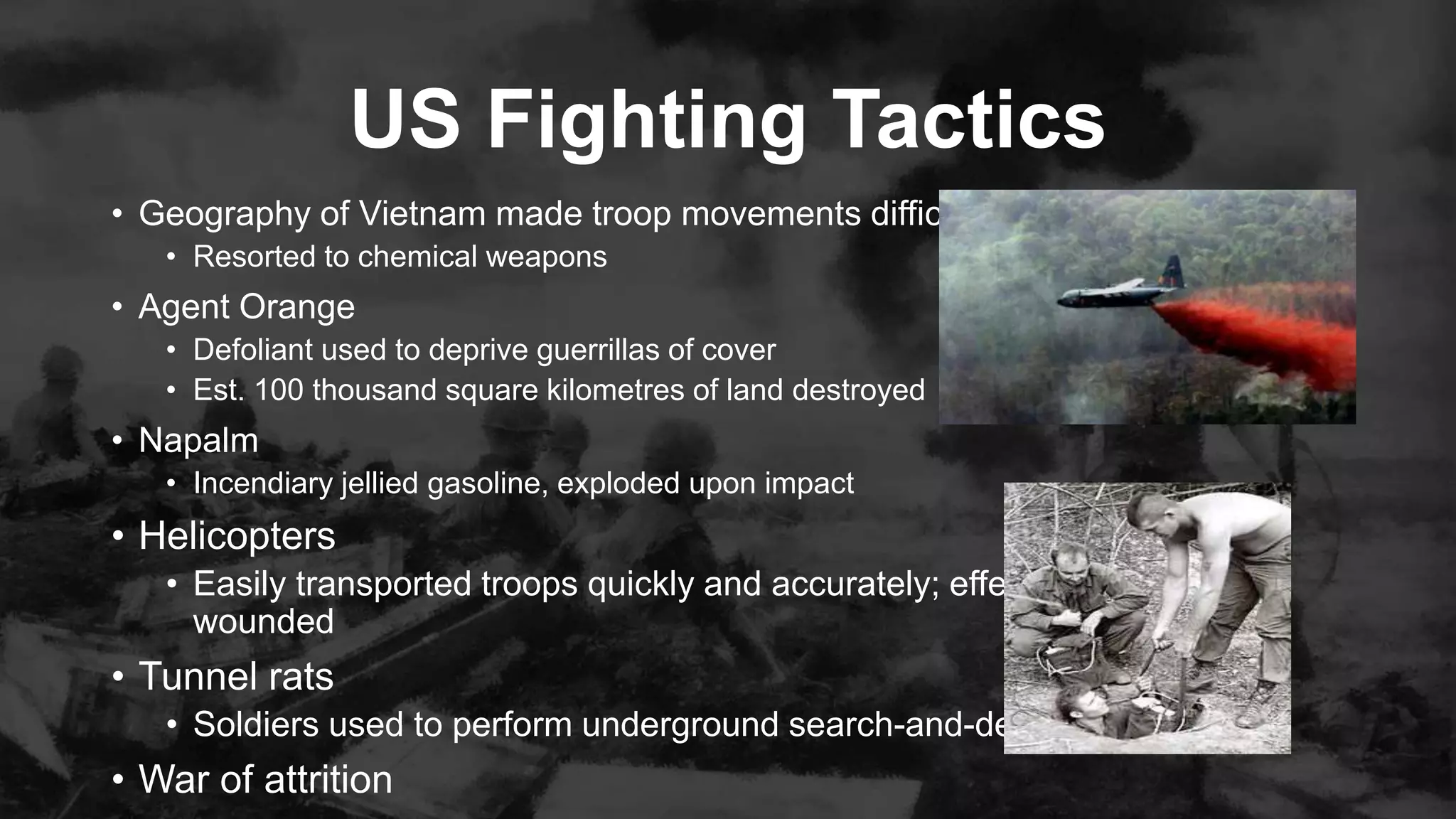
• Agent Orange
• Defoliant used to deprive guerrillas of cover
• Est. 100 thousand square kilometres of land destroyed
• Napalm
• Incendiary jellied gasoline, exploded upon impact
• Helicopters
• Easily transported troops quickly and accurately; effective at removing
wounded
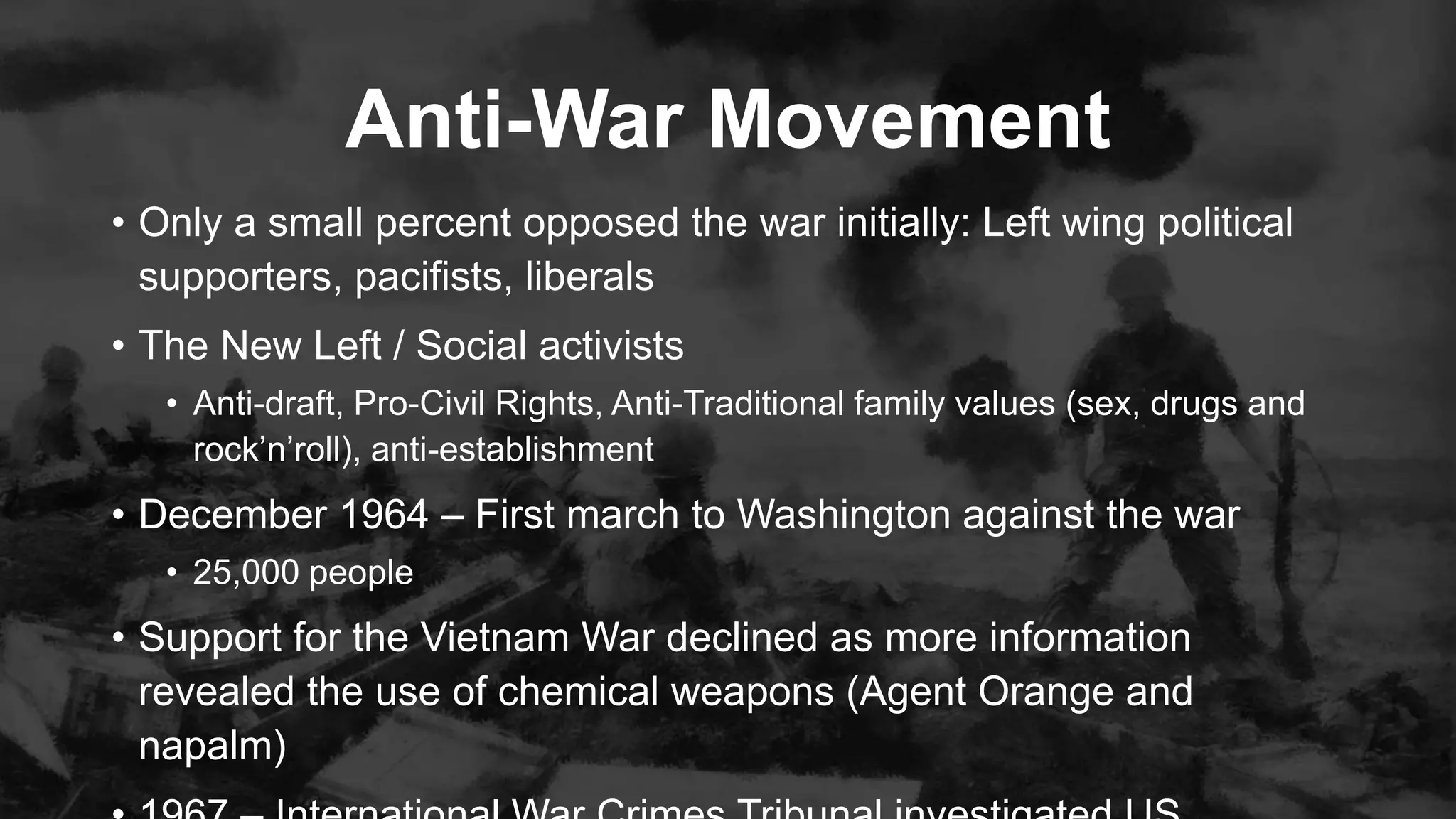
• Tunnel rats
• Soldiers used to perform underground search-and-destroy missions
• War of attrition
US Non-Fighting Tactics
• Operation Phoenix
• Designed to identify and destroy the VC via infiltration, torture,
capture, interrogation etc.
• ”Neutralised” >80,000 people suspected of VC membership;
26,000 of whom were killed
• Criticisms arose about the unknown number of innocent
civilians killed and the use of torture
• Hearts and Minds (Pacification)
• Strategy by US and SV to win popular support of the
Vietnamese people and help defeat the VC
th
Viet Cong and NVA Fighting
Tactics
• NVA and Viet Cong had no aircraft or tanks
so had to rely on their strengths
• Ability to hide
• Tunnel system stretching hundreds of miles
• Viet Cong darted out of tunnels and bunkers to
ambush US patrols
• Booby traps – grenades, trip wires and
spikes
• NVA operated with VC; VC – small scale
attacks, NVA – main force assaults
• Used Ho Chi Minh trail to transport
• Advantages
• Home field advantage
• Motivation
• Fast rebuilding of damaged
roads and rail lines
• Difficult for US to distinguish
Tet Offensive (1968)
• 21st January – Khe Sanh
• 20,000 NVA troops (under General Giap’s command)
attack an isolated American air base, 14 miles from the
northern border
• US Marines and ARVN surrounded by a siege that
lasted 77 days; US mounts counterattack to push NVA
back
• Giap’s plan: Khe Sanh was a diversion (US would
think Tet was the diversion); knew there were protests
in the US; break US morale
• Tet Holiday Truce – Lunar New Year, most
important holiday in Vietnam
• Temporary ceasefire called for the holiday
• NVA and VC began sneaking into southern cities with
smuggled weapons
• 31st January – Tet Offensive begins
Tet Offensive (1968)
• Battle for Saigon
• US and ARVN able to keep Saigon from being
taken
• 31st January – VC soldiers blew their way into
embassy; attack failed as all 19 VC were killed by
Marine guards
• Battle for Hue
• 12,000 NVA and VC storm into an under defended
city; heaviest fighting of the Tet Offensive
• Massacre in Hue
• >3,000 “enemies of people” executed by VC and NVA;
mass graves found
Tet Offensive – Impact and
significance
• Turning point of the war
• Military / statistical victory for US but psychological
victory for NVA and VC
• “Credibility gap”
• Americans were told that the US was winning the war;
Tet showed differently
• Americans didn’t trust LBJ or General Westmoreland
• “Living room war”
• People watched the war in their homes and saw the
threat of the assault on the embassy in Saigon
• Walter Cronkite – respected anchorman for CBS
• 31st March, 1968 – LBJ announced he wouldn’t
My Lai Massacre
• My Lai – small village in South Vietnam
• US soldiers of Charlie Company told by captain that VC
troops were coming through the area and that My Lai
residents were all VC members or sympathisers
• 16th March 1968
• Soldiers rounded up hundreds of civilians
• Many were beaten, tortured or raped and then killed
• >340 killed; many were children
• Event covered up until September 1969 (brought to
public’s attention in November)
• Photos taken were key evidence in the Army’s investigation
• 26 soldiers were charged; Lieutenant Calley sentenced to life
in prison (109 accounts of murder) but only served 4.5 months
(reduced to 20 years by Nixon, who later pardoned Calley in
1974)
• Led to increase in demand to withdraw from war
Anti-War Movement
• Only a small percent opposed the war initially: Left wing political
supporters, pacifists, liberals
• The New Left / Social activists
• Anti-draft, Pro-Civil Rights, Anti-Traditional family values (sex, drugs and
rock’n’roll), anti-establishment
• December 1964 – First march to Washington against the war
• 25,000 people
• Support for the Vietnam War declined as more information
revealed the use of chemical weapons (Agent Orange and
napalm)
Anti-War Movement
• Cost of the war
• By 1968, it was costing $66 million a day
• LBJ had to increase income taxes and cut back on the Great
Society program; made LBJ unpopular
• MLK: “America would never invest the necessary funds or
energies in rehabilitation of its poor as long as Vietnam
continued to draw men and skills and money like some
demonic, destructive suction tube.”
• November 1965 – Norman Morrison, Quaker, replicated the
actions of Buddhists in SV; burnt himself to death in New York
Anti-War Movement
• 1967 – Vietnam Veterans Against the War formed
• Demonstrated across the US; threw away their medals on TV
• Media coverage of Vietnam highlighted the controversy
• Protests
• 17th April 1965 – Staged by Students for a Democratic Society
• 16,000 people outside the White House; 4 arrests
• 21st October 1967 – March on the Pentagon
• Organised by the National Mobilisation Committee to End the War in Vietnam;
Leaders of the yippies announced they would ‘exorcise’ the Pentagon
• 681 arrested
• 15th November 1969 – Moratorium Rally
• Biggest US anti-war demonstration – 250,000-500,000 protestors present; mostly
peaceful; 135 arrests
Anti-War Movement
• May 1970 – Kent State
• Demonstrations begin on the College, last for several days
• National Guard set up camp on the campus, used tear gas and
arrested protestors
• 4th May – Day Four
• National Guard opened fire on the crowd: 4 dead, 9 wounded
• 1971 – Pentagon Papers (history of US involvement in Vietnam
from 1945-1967) released by Daniel Ellsberg (who worked on the
study) and brought to public’s attention on the front page of the
New York Times –
• Revealed that the US had secretly enlarged the scope of its actions in
Fulbright Hearings
• 1966-1971 – US Senate Foreign Relations Committee hearings on
Vietnam
• April 1971, series of 22 hearings began “Legislative Proposals
Relating to the War in Southeast Asia”
• Hearings included testimony and debate from several members of
Congress as well as pro-war and ant—war representatives
• Future Democratic Senator and Secretary of State John Kerry testified
• Hearings helped begin a shift in public opinion
• In the four weeks that spanned the hearings, Nixon’s ratings dropped from
63 to 49 percent
Peace Negotiations
• Paris peace talks would last more
than four years
• First meetings marred by disputes
over legitimacy
• Hanoi and VC delegates refused
to recognise legitimacy of the
South Vietnamese government
• Debates over structure of talks,
even over furniture
• By 1969 autumn, talks fell into a
monotonous and unproductive
Peace Negotiations
• Nixon determined to achieve “peace with honour”
• 1964 to 1972 saw at least 5 significant peace proposals
• Different approaches
• US – peace talks as a way of extricating themselves from Vietnam while avoiding
humiliation of defeat
• North Vietnam – peace talks as a military tactic to obtain breathing space while denying
and frustrating the enemy
• 1965 – First major proposal by North Vietnam
• Proposed return to Geneva Accords along with withdrawal of US troops. US couldn’t
accept provision that the internal affairs of South Vietnam must be settled by the South
Vietnamese people without foreign interference
• May 1968 – Paris peace talks – informal meeting between US and NV
• NV called for US to halt bombing; US wanted de-escalation of VC activities in SV
• LBJ agreed to halt bombing five months later
Nixon’s Secret War
• Cambodia’s Prince Sihanouk proclaimed neutrality since 1955, but
tolerated NLF using Cambodian soil as a base
• Policy changed in 1969 under pressure from Washington; NLF no
longer welcome
• Operation Menu – Nixon took opportunity and launched a massive
secret bombing campaign against sanctuaries along the border; didn’t
inform the public
• Violated long succession of pronouncements from Washington supporting
Cambodian neutrality; failed to make significant impact
• 1970 – Prince Sihanouk deposed by pro-American Gen. Lon Nol.
Borders closed
• US and ARVN launched incursions into Cambodia to attack NLF bases and buy
time for SV
• Coup against Sihanouk and US bombing destabilised Cambodia – Invasion of
Vietnamisation
• May 1969 – Battle for Hamburger Hill; last big battle for the US; brutal
reminder of VC determination
• 8th June 1969 – Nixon announces Vietnamisation policy
• Gradual withdrawal of US troops from SV and speedup of training of ARVN so
they can help themselves
• Nixon knew ARVN couldn’t manage themselves but had to do it due to anti-war
feeling at home
• Further peace talks
• US and NV meet in Feb. 1970, first of many more that will lead to the Paris Peace
Accords (1973); Kissinger proposed a ceasefire until an agreement
was reached, but neither side willing to negotiate
• Fighting continued despite ‘standstill ceasefire’
• Continued bombing of Cambodia and Laos pushed VC further into the two
Vietnamisation
• South Vietnamese struggled due to reduced US troops
• After several ceasefires (many of which were broken), peace
negotiations reignited and another ceasefire was agreed upon
• Nixon withdrew troops along with nearly 600 prisoners
• June 1973, Congress stopped funding US involvement in
Indochina
• Case-Church Amendment approved by Congress that prohibited further
US military activity in Vietnam, Laos and Cambodia
• Nixon turned to the Watergate Crisis, but claimed “peace with
honour” had been achieved
Secret Peace Talks
• August 1969 – Henry Kissinger (National Security Advisor and Sec. of
State) met with Le Duc Tho (de facto head of NV negotiating team).
Separate from previous peace talks; did not include SV or US military
allies in Vietnam
• Compromises and concessions from both sides
• Formed an agreement that became the Paris Peace Accords, signed
1973
• Kissinger and Tho hailed as negotiators and ‘peace makers’ – both
were awarded the Nobel Peace Prize for 1973, but Tho refused to
accept while the war was still going on
• 27 Jan. 1973 – Paris Peace Accords signed
• Ceasefire declared, though NV forces allowed to remain in SV; US POWs
released
Fall of Saigon
• Nixon put through a billion dollar aid package to SV, but Congress
reduced it to 700 million
• He resigned soon after due to Watergate; Ford now president, and unwilling to
increase US involvement
• Dec. 1974 – Foreign Assistance Act: “after June 30, 1976, no military assistance
shall be furnished to South Vietnam unless authorised under the Foreign
Assistance Act of 1961 or the Foreign Military Sales Act”
• NVA continued moving south as southern defences weakened
(dwindling US support)
• Late 1974, NV launched offensive from Cambodia into Phuoc Long
province: tested reaction of Saigon forces and determine whether US
would return to help (US did not); led NV to reassess strategy now that
US was out of the picture
Fall of Saigon
• Final offensive – Ho Chi Minh Campaign called for
capture of Saigon before 1st May
• 21st April – President Thieu resigned, declaring the
US had betrayed SV
• ARVN collapsed on all fronts by the end of April
• 23rd April – Ford’s televised speech declared an end
to the Vietnam War and all US aid
• End of April – 100,000 NV troops encircled Saigon,
which was defended by 30,000 ARVN troops
• North shelled the airport in Saigon to stir up panic –
many civilians lost their way to escape
• 29th April - Operation Frequent Wind launched
• Largest helicopter evacuation in history; evacuated
American civilians as NV troops closed in Helicopters being pushed off aircraft carriers to m
Aftermath of the Vietnam War
• 2nd July 1976 – Reunification
• The two Vietnams reunified as the Socialist Republic of Vietnam with its capital in
Hanoi
• Saigon was renamed to Ho Chi Minh City (Ho Chi Minh passed away during the
war in 1969)
• US-Vietnam relations did not recover until the mid-1990s
• 500,000 of the 3 million troops who served in Vietnam suffered from PTSD
• Rates of divorce, suicide, alcoholism and drug addiction higher among veteran
• Congress replaced the military draft with an all-volunteer force; voting age
reduced to 18
• Inspired Congress to attack the ‘imperial presidency’ through the War
Powers Act (1973), restricting the president’s ability to send US forces into
combat without explicit Congressional support
• US economy was damaged; LBJ’s refusal to raise taxes unleashed a cycle
of inflation

The Vietnam War – A Detailed Overview

  • 1.
  • 2.
    Overview Background (1858- 1954) • FrenchOccupation & WWII • Viet Minh and Independence • First French- Indochina War • Geneva Conference and Vietnamese Partition Escalation (1954- 1964) • Nationwide Elections • Life in North vs South • Ho Chi Minh’s Attempts to Re-Unify • Increasing US involvement • Fall of Diem US Military Involvement (1964-1975) • Gulf of Tonkin Incident / Resolution • Operation Rolling Thunder • Fighting tactics • Tet Offensive • Nixon’s Secret War • Anti-war Movement and the Fulbright Hearings
  • 3.
  • 4.
    French Occupation andWWII • Long history of colonisation (e.g. by China for >1000 years) • Independent until France invaded in the 1800s and occupied Southeast Asia (and south of Vietnam) • French colony for 100 years: They tried to convert the Buddhist Vietnamese to Catholicism • WWII • Japan invaded and occupied Vietnam until being forced out by Vietnamese and Allied forces
  • 5.
    Viet minh andindependence • Viet Minh • Founded by Ho Chi Minh • Coalition that wanted a communist and independent Vietnam • During WWII, fought with Allied forces against Japan • Became known for Guerrilla Tactics in battle • Independence • 1945, Ho Chi Minh established a • Ho Chi Minh • Born 1890 • Called for Vietnamese independence • In 1918 appealed directly to Woodrow Wilson for support citing the Declaration of Independence as his inspiration but was rejected
  • 6.
    First French-Indochina War (1946-1954) •Fighting began in 1946 • Viet Minh benefitted from mass recruitment • Official declaration of war by Ho Chi Minh in March 1947 • Ho Chi Minh worked with General Ngo Diem Giap; both had studied Guerrilla Warfare (small groups ambushing enemies and then disappearing quickly) • Built an extensive guerrilla network in the south to destabilise the French • French morale low compared to Viet Minh • Breaking point: Dien Bien Phu • France began withdrawing, immediately recognising independence
  • 7.
    Geneva Conference (1954) •Began April 1954 • Countries involved: US, Britain, France, USSR, Vietnam • Discussed wars in Korea and Indochina • Results • Signed 21st July 1954 • Divided Vietnam at 17th parallel; Viet Minh to control north; Republic of Vietnam established in the south • Intended to be temporary • Civilians given 200 days to choose north or south • Nationwide elections to be held in 1956 to unite the 2 Vietnams
  • 8.
  • 9.
    Nationwide Elections • Partof the Geneva Accords • Both US and South Vietnam rejected the idea • US supported the South because it was anti-communist; refused to allow elections to unite Vietnam • Eisenhower knew Ho Chi Minh would win • Idea of 2 permanent separate Vietnams adopted • US used South Vietnam as a vehicle to try to stop the Domino Theory
  • 10.
    Life in Northvs South • North (Democratic Republic of Vietnam) • Land Reforms (Goal of collectivisation) • Confiscation of land belonging to landlords and enemies of the state; redistribution with priority of Vietminh fighters and families • Carried out with violence; rioting and protests suppressed • South (Republic of Vietnam) • Eisenhower administration helped create the Republic of Vietnam in 1955, using SEATO (Southeast Asia Treaty Organisation; aimed to prevent communism) for cover • Ngo Dinh Diem, staunch anti-communist and catholic, won a dubious election in 1956 and became president • Used help of CIA (through Operation Phoenix) to identify enemies (communists); law passed that legalised holding suspected Communists in jail without formal charges • Conservative/discriminatory laws: divorce and abortion banned;
  • 12.
    Ho Chi Minh’sAttempts to re- UNify • National Liberation Front • Founded 1960 • Brought together communists and non-communists under one organisation that opposed Ngo Dinh Diem and wanted to reunify Vietnam • Became known as the Viet Cong • Ho Chi Minh Trail • Existed for centuries as primitive footpaths • Expanded by Vietminh in First Indochina War • Developed to allow infiltration into South Vietnam (to supply
  • 13.
    Increasing US Involvement •JFK sent a team to Vietnam to report on conditions in the South • Report: ‘December 1961 White Paper’ called for increased military, technical and economic aid • Kennedy sent in special forces – ’Green Berets’ – to train villages to protect themselves from the VC (failed as VC often snuck in at night and convinced villagers to join). Green Berets worked with ARVN. • Advisers split between arguing for large-scale military build- up and a negotiated settlement (and withdrawal)
  • 14.
    Fall of Diem •Diem struggling in 1961 • Faced widespread organised communist rebellion; Viet Cong (NLF) stepped up anti-Diem action; recruitment increased • Relationship with US struggling, esp. since US didn’t inform Diem of a coup in 1960 which he blamed the US for • Buddhist monk protests; Diem blamed communists and arrested the monks • JFK shocked and appalled; US began reconsidering Diem’s role; US ambassador took hardliner against Diem and supported the Buddhists • JFK administration eventually supported a coup
  • 15.
  • 16.
    Gulf of TonkinIncident (1964) Lead-up to Gulf of Tonkin: • LBJ convinced he needed to intervene to prevent a communist takeover • South Vietnam’s instability: 10 changes in government Nov. ‘63 to June ’65` • 1964 Election – LBJ pledged not to send troops; won a landslide • Northern escalation • North Vietnamese Army (NVA) moving south; prepared population for all-out war; worked to improve Ho Chi Minh Trail; anti-aircraft defences being built, underground barracks The incident: • 2nd August – Destroyer USS Maddox confronts North Vietnam patrol boats, fired a warning short • NV boats attacked with torpedoes • 4th August – Maddox wrongly reported being attacked again after opening fire on radar returns .Soon reported doubts, but LBJ admin. used wrongly interpreted National Security Agency communications to
  • 17.
    Operation Rolling Thunder •2nd March 1965 to 2nd November 1968 • Gradual and sustained aerial bombing campaign against North Vietnam • Aimed to break morale of Hanoi’s leaders and cut the flow of troops and supplies – neither goal was achieved
  • 18.
    Timeline: 1965-1967 • 1965 •8th March – First US troops land in South Vietnam at Da Nang • 9th March – LBJ approves use of napalm • April – Allied forces from Korea and Australia join US • July – Monthly draft calls doubled to 35,000 (burning draft cards illegalised August) • August – Operation Starlite: First major US ground operation • November – Battle of la Drang: First major battle between USA and NVA (heavy casualties on both sides) • War has 80% approval rating in US • End of 1966 • US had >400,000 forces • 6000+ Americans killed, 30,000 wounded
  • 19.
    Timeline: 1965-1967 • 1967 •January – Operation Cedar Falls: Largest combined offensive (30,000 US and ARVN) clearing out Viet Cong from Northwest of Saigon • Viet Cong didn’t fight, melted away into the jungle. US uncovers extensive network of tunnels. ‘Tunnel rats’ explored the maze of the tunnels • End of 1967 • US soldiers killed in action exceeds 9,000
  • 20.
    US Fighting Tactics •Geography of Vietnam made troop movements difficult – fighting in the jungles • Resorted to chemical weapons • Agent Orange • Defoliant used to deprive guerrillas of cover • Est. 100 thousand square kilometres of land destroyed • Napalm • Incendiary jellied gasoline, exploded upon impact • Helicopters • Easily transported troops quickly and accurately; effective at removing wounded • Tunnel rats • Soldiers used to perform underground search-and-destroy missions • War of attrition
  • 21.
    US Non-Fighting Tactics •Operation Phoenix • Designed to identify and destroy the VC via infiltration, torture, capture, interrogation etc. • ”Neutralised” >80,000 people suspected of VC membership; 26,000 of whom were killed • Criticisms arose about the unknown number of innocent civilians killed and the use of torture • Hearts and Minds (Pacification) • Strategy by US and SV to win popular support of the Vietnamese people and help defeat the VC th
  • 22.
    Viet Cong andNVA Fighting Tactics • NVA and Viet Cong had no aircraft or tanks so had to rely on their strengths • Ability to hide • Tunnel system stretching hundreds of miles • Viet Cong darted out of tunnels and bunkers to ambush US patrols • Booby traps – grenades, trip wires and spikes • NVA operated with VC; VC – small scale attacks, NVA – main force assaults • Used Ho Chi Minh trail to transport • Advantages • Home field advantage • Motivation • Fast rebuilding of damaged roads and rail lines • Difficult for US to distinguish
  • 23.
    Tet Offensive (1968) •21st January – Khe Sanh • 20,000 NVA troops (under General Giap’s command) attack an isolated American air base, 14 miles from the northern border • US Marines and ARVN surrounded by a siege that lasted 77 days; US mounts counterattack to push NVA back • Giap’s plan: Khe Sanh was a diversion (US would think Tet was the diversion); knew there were protests in the US; break US morale • Tet Holiday Truce – Lunar New Year, most important holiday in Vietnam • Temporary ceasefire called for the holiday • NVA and VC began sneaking into southern cities with smuggled weapons • 31st January – Tet Offensive begins
  • 24.
    Tet Offensive (1968) •Battle for Saigon • US and ARVN able to keep Saigon from being taken • 31st January – VC soldiers blew their way into embassy; attack failed as all 19 VC were killed by Marine guards • Battle for Hue • 12,000 NVA and VC storm into an under defended city; heaviest fighting of the Tet Offensive • Massacre in Hue • >3,000 “enemies of people” executed by VC and NVA; mass graves found
  • 25.
    Tet Offensive –Impact and significance • Turning point of the war • Military / statistical victory for US but psychological victory for NVA and VC • “Credibility gap” • Americans were told that the US was winning the war; Tet showed differently • Americans didn’t trust LBJ or General Westmoreland • “Living room war” • People watched the war in their homes and saw the threat of the assault on the embassy in Saigon • Walter Cronkite – respected anchorman for CBS • 31st March, 1968 – LBJ announced he wouldn’t
  • 26.
    My Lai Massacre •My Lai – small village in South Vietnam • US soldiers of Charlie Company told by captain that VC troops were coming through the area and that My Lai residents were all VC members or sympathisers • 16th March 1968 • Soldiers rounded up hundreds of civilians • Many were beaten, tortured or raped and then killed • >340 killed; many were children • Event covered up until September 1969 (brought to public’s attention in November) • Photos taken were key evidence in the Army’s investigation • 26 soldiers were charged; Lieutenant Calley sentenced to life in prison (109 accounts of murder) but only served 4.5 months (reduced to 20 years by Nixon, who later pardoned Calley in 1974) • Led to increase in demand to withdraw from war
  • 27.
    Anti-War Movement • Onlya small percent opposed the war initially: Left wing political supporters, pacifists, liberals • The New Left / Social activists • Anti-draft, Pro-Civil Rights, Anti-Traditional family values (sex, drugs and rock’n’roll), anti-establishment • December 1964 – First march to Washington against the war • 25,000 people • Support for the Vietnam War declined as more information revealed the use of chemical weapons (Agent Orange and napalm)
  • 28.
    Anti-War Movement • Costof the war • By 1968, it was costing $66 million a day • LBJ had to increase income taxes and cut back on the Great Society program; made LBJ unpopular • MLK: “America would never invest the necessary funds or energies in rehabilitation of its poor as long as Vietnam continued to draw men and skills and money like some demonic, destructive suction tube.” • November 1965 – Norman Morrison, Quaker, replicated the actions of Buddhists in SV; burnt himself to death in New York
  • 29.
    Anti-War Movement • 1967– Vietnam Veterans Against the War formed • Demonstrated across the US; threw away their medals on TV • Media coverage of Vietnam highlighted the controversy • Protests • 17th April 1965 – Staged by Students for a Democratic Society • 16,000 people outside the White House; 4 arrests • 21st October 1967 – March on the Pentagon • Organised by the National Mobilisation Committee to End the War in Vietnam; Leaders of the yippies announced they would ‘exorcise’ the Pentagon • 681 arrested • 15th November 1969 – Moratorium Rally • Biggest US anti-war demonstration – 250,000-500,000 protestors present; mostly peaceful; 135 arrests
  • 30.
    Anti-War Movement • May1970 – Kent State • Demonstrations begin on the College, last for several days • National Guard set up camp on the campus, used tear gas and arrested protestors • 4th May – Day Four • National Guard opened fire on the crowd: 4 dead, 9 wounded • 1971 – Pentagon Papers (history of US involvement in Vietnam from 1945-1967) released by Daniel Ellsberg (who worked on the study) and brought to public’s attention on the front page of the New York Times – • Revealed that the US had secretly enlarged the scope of its actions in
  • 31.
    Fulbright Hearings • 1966-1971– US Senate Foreign Relations Committee hearings on Vietnam • April 1971, series of 22 hearings began “Legislative Proposals Relating to the War in Southeast Asia” • Hearings included testimony and debate from several members of Congress as well as pro-war and ant—war representatives • Future Democratic Senator and Secretary of State John Kerry testified • Hearings helped begin a shift in public opinion • In the four weeks that spanned the hearings, Nixon’s ratings dropped from 63 to 49 percent
  • 32.
    Peace Negotiations • Parispeace talks would last more than four years • First meetings marred by disputes over legitimacy • Hanoi and VC delegates refused to recognise legitimacy of the South Vietnamese government • Debates over structure of talks, even over furniture • By 1969 autumn, talks fell into a monotonous and unproductive
  • 33.
    Peace Negotiations • Nixondetermined to achieve “peace with honour” • 1964 to 1972 saw at least 5 significant peace proposals • Different approaches • US – peace talks as a way of extricating themselves from Vietnam while avoiding humiliation of defeat • North Vietnam – peace talks as a military tactic to obtain breathing space while denying and frustrating the enemy • 1965 – First major proposal by North Vietnam • Proposed return to Geneva Accords along with withdrawal of US troops. US couldn’t accept provision that the internal affairs of South Vietnam must be settled by the South Vietnamese people without foreign interference • May 1968 – Paris peace talks – informal meeting between US and NV • NV called for US to halt bombing; US wanted de-escalation of VC activities in SV • LBJ agreed to halt bombing five months later
  • 34.
    Nixon’s Secret War •Cambodia’s Prince Sihanouk proclaimed neutrality since 1955, but tolerated NLF using Cambodian soil as a base • Policy changed in 1969 under pressure from Washington; NLF no longer welcome • Operation Menu – Nixon took opportunity and launched a massive secret bombing campaign against sanctuaries along the border; didn’t inform the public • Violated long succession of pronouncements from Washington supporting Cambodian neutrality; failed to make significant impact • 1970 – Prince Sihanouk deposed by pro-American Gen. Lon Nol. Borders closed • US and ARVN launched incursions into Cambodia to attack NLF bases and buy time for SV • Coup against Sihanouk and US bombing destabilised Cambodia – Invasion of
  • 35.
    Vietnamisation • May 1969– Battle for Hamburger Hill; last big battle for the US; brutal reminder of VC determination • 8th June 1969 – Nixon announces Vietnamisation policy • Gradual withdrawal of US troops from SV and speedup of training of ARVN so they can help themselves • Nixon knew ARVN couldn’t manage themselves but had to do it due to anti-war feeling at home • Further peace talks • US and NV meet in Feb. 1970, first of many more that will lead to the Paris Peace Accords (1973); Kissinger proposed a ceasefire until an agreement was reached, but neither side willing to negotiate • Fighting continued despite ‘standstill ceasefire’ • Continued bombing of Cambodia and Laos pushed VC further into the two
  • 36.
    Vietnamisation • South Vietnamesestruggled due to reduced US troops • After several ceasefires (many of which were broken), peace negotiations reignited and another ceasefire was agreed upon • Nixon withdrew troops along with nearly 600 prisoners • June 1973, Congress stopped funding US involvement in Indochina • Case-Church Amendment approved by Congress that prohibited further US military activity in Vietnam, Laos and Cambodia • Nixon turned to the Watergate Crisis, but claimed “peace with honour” had been achieved
  • 37.
    Secret Peace Talks •August 1969 – Henry Kissinger (National Security Advisor and Sec. of State) met with Le Duc Tho (de facto head of NV negotiating team). Separate from previous peace talks; did not include SV or US military allies in Vietnam • Compromises and concessions from both sides • Formed an agreement that became the Paris Peace Accords, signed 1973 • Kissinger and Tho hailed as negotiators and ‘peace makers’ – both were awarded the Nobel Peace Prize for 1973, but Tho refused to accept while the war was still going on • 27 Jan. 1973 – Paris Peace Accords signed • Ceasefire declared, though NV forces allowed to remain in SV; US POWs released
  • 38.
    Fall of Saigon •Nixon put through a billion dollar aid package to SV, but Congress reduced it to 700 million • He resigned soon after due to Watergate; Ford now president, and unwilling to increase US involvement • Dec. 1974 – Foreign Assistance Act: “after June 30, 1976, no military assistance shall be furnished to South Vietnam unless authorised under the Foreign Assistance Act of 1961 or the Foreign Military Sales Act” • NVA continued moving south as southern defences weakened (dwindling US support) • Late 1974, NV launched offensive from Cambodia into Phuoc Long province: tested reaction of Saigon forces and determine whether US would return to help (US did not); led NV to reassess strategy now that US was out of the picture
  • 39.
    Fall of Saigon •Final offensive – Ho Chi Minh Campaign called for capture of Saigon before 1st May • 21st April – President Thieu resigned, declaring the US had betrayed SV • ARVN collapsed on all fronts by the end of April • 23rd April – Ford’s televised speech declared an end to the Vietnam War and all US aid • End of April – 100,000 NV troops encircled Saigon, which was defended by 30,000 ARVN troops • North shelled the airport in Saigon to stir up panic – many civilians lost their way to escape • 29th April - Operation Frequent Wind launched • Largest helicopter evacuation in history; evacuated American civilians as NV troops closed in Helicopters being pushed off aircraft carriers to m
  • 40.
    Aftermath of theVietnam War • 2nd July 1976 – Reunification • The two Vietnams reunified as the Socialist Republic of Vietnam with its capital in Hanoi • Saigon was renamed to Ho Chi Minh City (Ho Chi Minh passed away during the war in 1969) • US-Vietnam relations did not recover until the mid-1990s • 500,000 of the 3 million troops who served in Vietnam suffered from PTSD • Rates of divorce, suicide, alcoholism and drug addiction higher among veteran • Congress replaced the military draft with an all-volunteer force; voting age reduced to 18 • Inspired Congress to attack the ‘imperial presidency’ through the War Powers Act (1973), restricting the president’s ability to send US forces into combat without explicit Congressional support • US economy was damaged; LBJ’s refusal to raise taxes unleashed a cycle of inflation