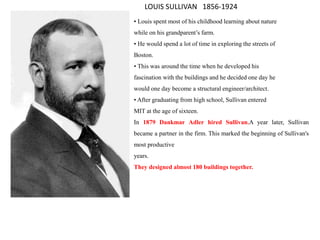
• Louis spent most of his childhood learning about nature
while on his grandparent’s farm.
• He would spend a lot of time in exploring the streets of
Boston.
• This was around the time when he developed his
fascination with the buildings and he decided one day he
would one day become a structural engineer/architect.
• After graduating from high school, Sullivan entered
MIT at the age of sixteen.
In 1879 Dankmar Adler hired Sullivan.A year later, Sullivan
became a partner in the firm. This marked the beginning of Sullivan's
most productive
years.
They designed almost 180 buildings together.
1856-1924LOUIS SULLIVAN
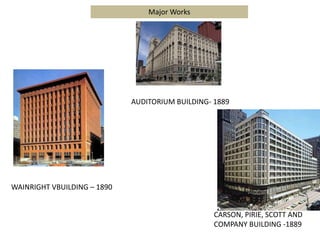
Major Works
AUDITORIUM BUILDING- 1889
WAINRIGHT VBUILDING – 1890
CARSON, PIRIE, SCOTT AND
COMPANY BUILDING -1889
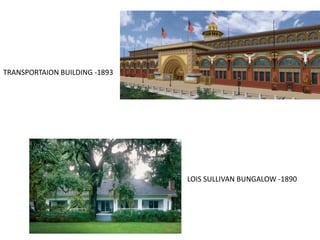
LOIS SULLIVAN BUNGALOW -1890
TRANSPORTAION BUILDING -1893
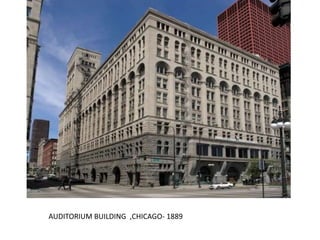
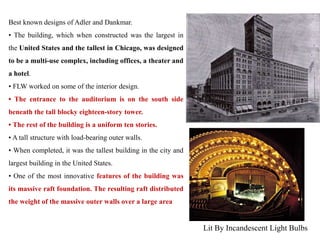
AUDITORIUM BUILDING ,CHICAGO- 1889
Best known designs of Adler and Dankmar.
• The building, which when constructed was the largest in
the United States and the tallest in Chicago, was designed
to be a multi-use complex, including offices, a theater and
a hotel.
• FLW worked on some of the interior design.
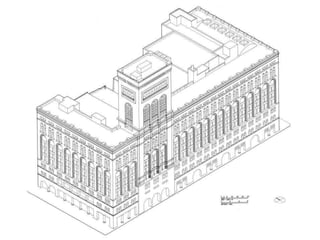
• The entrance to the auditorium is on the south side
beneath the tall blocky eighteen-story tower.
• The rest of the building is a uniform ten stories.
• A tall structure with load-bearing outer walls.
• When completed, it was the tallest building in the city and
largest building in the United States.
• One of the most innovative features of the building was
its massive raft foundation. The resulting raft distributed
the weight of the massive outer walls over a large area
Lit By Incandescent Light Bulbs
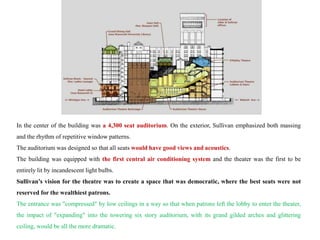
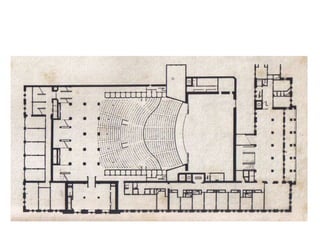
In the center of the building was a 4,300 seat auditorium. On the exterior, Sullivan emphasized both massing
and the rhythm of repetitive window patterns.
The auditorium was designed so that all seats would have good views and acoustics.
The building was equipped with the first central air conditioning system and the theater was the first to be
entirely lit by incandescent light bulbs.
Sullivan’s vision for the theatre was to create a space that was democratic, where the best seats were not
reserved for the wealthiest patrons.
The entrance was "compressed" by low ceilings in a way so that when patrons left the lobby to enter the theater,
the impact of "expanding" into the towering six story auditorium, with its grand gilded arches and glittering
ceiling, would be all the more dramatic.
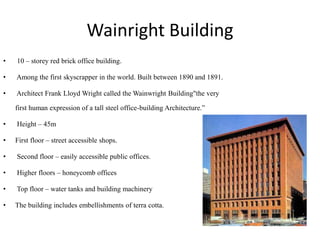
Wainright Building
• 10 – storey red brick office building.
• Among the first skyscrapper in the world. Built between 1890 and 1891.
• Architect Frank Lloyd Wright called the Wainwright Building"the very
first human expression of a tall steel office-building Architecture.”
• Height – 45m
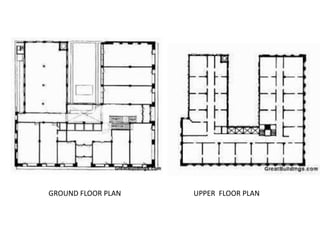
• First floor – street accessible shops.
• Second floor – easily accessible public offices.
• Higher floors – honeycomb offices
• Top floor – water tanks and building machinery
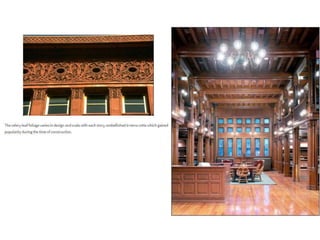
• The building includes embellishments of terra cotta.
GROUND FLOOR PLAN UPPER FLOOR PLAN
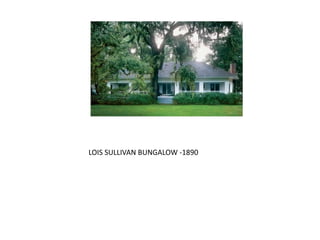
LOIS SULLIVAN BUNGALOW -1890
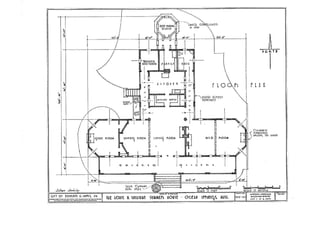
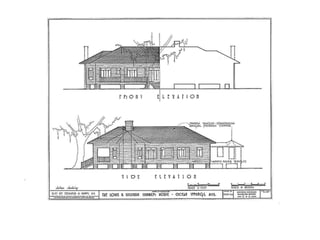
• The Louis Sullivan Bungalow was a vacation home for noted architect Louis
Sullivan on the Gulf Coast in Ocean Springs, Mississippi.
• One storey bungalow
• It was built in the early 1890s
• Bungalow plan has a full width verandh facing south to davis bayou
• The main entry opens to a living room and a master bed room each with its
own fireplace.
• To accommodate a kitchen , this plan is extended into a t beyond the living
room
• Down the stem of t is a butler’s pantry with verandhas on either side , servants
quarters and kitchen pantry.
• Along the front to the left is the spacious guests’ room.
• The wing of this portion terminates in an octagonal tower formerly used for the
tank water-supply (later converted to library )
• The verandhas with their extension eaves provides shade on the south east
and west
• The Sullivan House was destroyed completely by Hurricane Katrina.
• Louis Henri Sullivan (born September 3, 1856) is widely considered America's
first truly modern architect. Although born in Boston, Massachusetts, Sullivan is
best known as a major player in what is known as the Chicago School and the
birth of the modern skyscraper. He was an architect based in Chicago, Illinois,
yet what many consider Sullivan's most famous building is located in St. Louis,
Missouri — the 1891 Wainwright Building, one of America's most historic
high-rise buildings.
• The tripartite design of skyscrapers is known as Sullivanesque Style.
• "Form Follows Function"
Louis Sullivan believed that the exterior of a tall office building should reflect its
interior functions. Ornamentation, where it was used, must be derived from
nature, instead of from the Classical Greek and Roman architectural forms.
Louis Sullivans contribution to American architecture

Louis sullivan

  • 1.
    • Louis spentmost of his childhood learning about nature while on his grandparent’s farm. • He would spend a lot of time in exploring the streets of Boston. • This was around the time when he developed his fascination with the buildings and he decided one day he would one day become a structural engineer/architect. • After graduating from high school, Sullivan entered MIT at the age of sixteen. In 1879 Dankmar Adler hired Sullivan.A year later, Sullivan became a partner in the firm. This marked the beginning of Sullivan's most productive years. They designed almost 180 buildings together. 1856-1924LOUIS SULLIVAN
  • 2.
    Major Works AUDITORIUM BUILDING-1889 WAINRIGHT VBUILDING – 1890 CARSON, PIRIE, SCOTT AND COMPANY BUILDING -1889
  • 3.
    LOIS SULLIVAN BUNGALOW-1890 TRANSPORTAION BUILDING -1893
  • 4.
  • 5.
    Best known designsof Adler and Dankmar. • The building, which when constructed was the largest in the United States and the tallest in Chicago, was designed to be a multi-use complex, including offices, a theater and a hotel. • FLW worked on some of the interior design. • The entrance to the auditorium is on the south side beneath the tall blocky eighteen-story tower. • The rest of the building is a uniform ten stories. • A tall structure with load-bearing outer walls. • When completed, it was the tallest building in the city and largest building in the United States. • One of the most innovative features of the building was its massive raft foundation. The resulting raft distributed the weight of the massive outer walls over a large area Lit By Incandescent Light Bulbs
  • 6.
    In the centerof the building was a 4,300 seat auditorium. On the exterior, Sullivan emphasized both massing and the rhythm of repetitive window patterns. The auditorium was designed so that all seats would have good views and acoustics. The building was equipped with the first central air conditioning system and the theater was the first to be entirely lit by incandescent light bulbs. Sullivan’s vision for the theatre was to create a space that was democratic, where the best seats were not reserved for the wealthiest patrons. The entrance was "compressed" by low ceilings in a way so that when patrons left the lobby to enter the theater, the impact of "expanding" into the towering six story auditorium, with its grand gilded arches and glittering ceiling, would be all the more dramatic.
  • 9.
    Wainright Building • 10– storey red brick office building. • Among the first skyscrapper in the world. Built between 1890 and 1891. • Architect Frank Lloyd Wright called the Wainwright Building"the very first human expression of a tall steel office-building Architecture.” • Height – 45m • First floor – street accessible shops. • Second floor – easily accessible public offices. • Higher floors – honeycomb offices • Top floor – water tanks and building machinery • The building includes embellishments of terra cotta.
  • 10.
    GROUND FLOOR PLANUPPER FLOOR PLAN
  • 12.
  • 13.
    • The LouisSullivan Bungalow was a vacation home for noted architect Louis Sullivan on the Gulf Coast in Ocean Springs, Mississippi. • One storey bungalow • It was built in the early 1890s • Bungalow plan has a full width verandh facing south to davis bayou • The main entry opens to a living room and a master bed room each with its own fireplace. • To accommodate a kitchen , this plan is extended into a t beyond the living room • Down the stem of t is a butler’s pantry with verandhas on either side , servants quarters and kitchen pantry. • Along the front to the left is the spacious guests’ room. • The wing of this portion terminates in an octagonal tower formerly used for the tank water-supply (later converted to library ) • The verandhas with their extension eaves provides shade on the south east and west • The Sullivan House was destroyed completely by Hurricane Katrina.
  • 16.
    • Louis HenriSullivan (born September 3, 1856) is widely considered America's first truly modern architect. Although born in Boston, Massachusetts, Sullivan is best known as a major player in what is known as the Chicago School and the birth of the modern skyscraper. He was an architect based in Chicago, Illinois, yet what many consider Sullivan's most famous building is located in St. Louis, Missouri — the 1891 Wainwright Building, one of America's most historic high-rise buildings. • The tripartite design of skyscrapers is known as Sullivanesque Style. • "Form Follows Function" Louis Sullivan believed that the exterior of a tall office building should reflect its interior functions. Ornamentation, where it was used, must be derived from nature, instead of from the Classical Greek and Roman architectural forms. Louis Sullivans contribution to American architecture