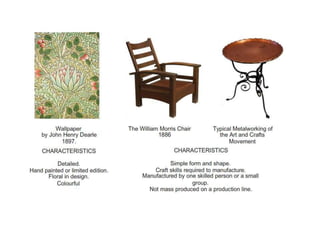
• Arts and Crafts: Popular in the mid-19th century; handcrafted and artisan-made
wood, pottery, tile and stained glass; nature motifs done simply; rectilinear forms.
Think William Morris and bungalow style.
Products were to be manufactured by individuals or small groups rather than on
a mass production line.
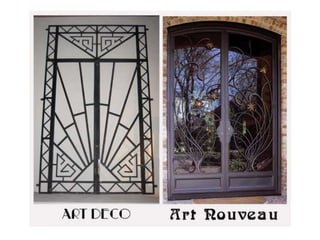
• Art nouveau: Popular in the late 19th century; whiplash curves; nature-inspired
designs; finely crafted metal and wood. Think Rivendell or signs for the Paris
Metro. Some artists used new low-cost materials and mass production methods
while others used more expensive materials and valued high craftsmanship
• Art deco: Popular in the 1920s and 1930s; zigzags, sharp angles and stepped
designs; influenced by skyscrapers..
Art and Crafts Movement
(1860-1920)
The founders of the Arts & Crafts Movement were some of the first major critics of the
Industrial Revolution
The practitioners of the movement strongly believed that the connection forged between the
artist and his work through handcraft was the key to producing both human fulfillment and
beautiful items that would be useful on an everyday basis; as a result, Arts & Crafts artists
are largely associated with the vast range of the decorative arts and architecture as opposed
to the "high" arts of painting and sculpture.
The Arts & Crafts aesthetic varied greatly depending on the media and location involved,
but it was influenced most prominently by both the imagery of nature and the forms of
medieval art, particularly the Gothic style, which enjoyed a revival in Europe and North
America during the mid-19th century.
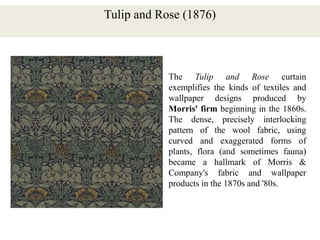
Tulip and Rose (1876)
The Tulip and Rose curtain
exemplifies the kinds of textiles and
wallpaper designs produced by
Morris' firm beginning in the 1860s.
The dense, precisely interlocking
pattern of the wool fabric, using
curved and exaggerated forms of
plants, flora (and sometimes fauna)
became a hallmark of Morris &
Company's fabric and wallpaper
products in the 1870s and '80s.
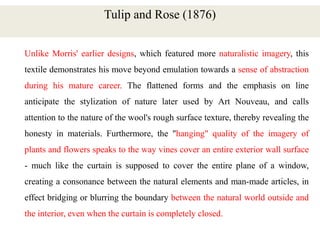
Tulip and Rose (1876)
Unlike Morris' earlier designs, which featured more naturalistic imagery, this
textile demonstrates his move beyond emulation towards a sense of abstraction
during his mature career. The flattened forms and the emphasis on line
anticipate the stylization of nature later used by Art Nouveau, and calls
attention to the nature of the wool's rough surface texture, thereby revealing the
honesty in materials. Furthermore, the "hanging" quality of the imagery of
plants and flowers speaks to the way vines cover an entire exterior wall surface
- much like the curtain is supposed to cover the entire plane of a window,
creating a consonance between the natural elements and man-made articles, in
effect bridging or blurring the boundary between the natural world outside and
the interior, even when the curtain is completely closed.
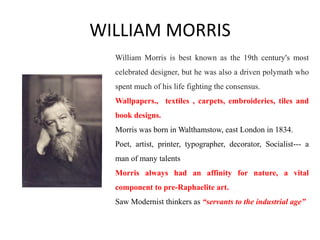
WILLIAM MORRIS
William Morris is best known as the 19th century's most
celebrated designer, but he was also a driven polymath who
spent much of his life fighting the consensus.
Wallpapers., textiles , carpets, embroideries, tiles and
book designs.
Morris was born in Walthamstow, east London in 1834.
Poet, artist, printer, typographer, decorator, Socialist--- a
man of many talents
Morris always had an affinity for nature, a vital
component to pre-Raphaelite art.
Saw Modernist thinkers as “servants to the industrial age”
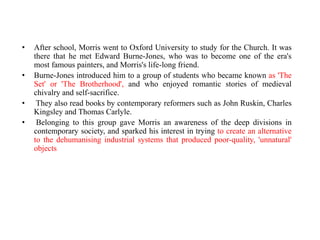
• After school, Morris went to Oxford University to study for the Church. It was
there that he met Edward Burne-Jones, who was to become one of the era's
most famous painters, and Morris's life-long friend.
• Burne-Jones introduced him to a group of students who became known as 'The
Set' or 'The Brotherhood', and who enjoyed romantic stories of medieval
chivalry and self-sacrifice.
• They also read books by contemporary reformers such as John Ruskin, Charles
Kingsley and Thomas Carlyle.
• Belonging to this group gave Morris an awareness of the deep divisions in
contemporary society, and sparked his interest in trying to create an alternative
to the dehumanising industrial systems that produced poor-quality, 'unnatural'
objects
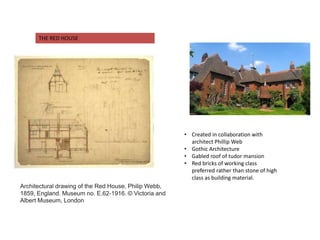
THE RED HOUSE
Architectural drawing of the Red House, Philip Webb,
1859, England. Museum no. E.62-1916. © Victoria and
Albert Museum, London
• Created in collaboration with
architect Phillip Web
• Gothic Architecture
• Gabled roof of tudor mansion
• Red bricks of working class
preferred rather than stone of high
class as building material.
THE RED HOUSE
THE RED HOUSE
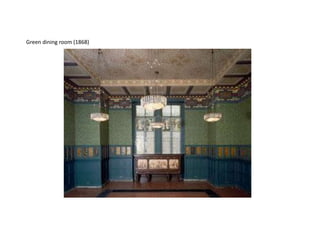
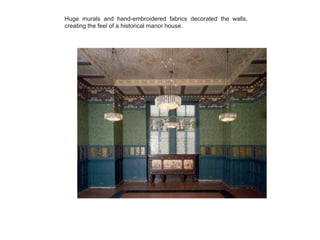
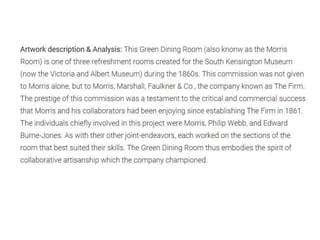
Green dining room (1868)
Huge murals and hand-embroidered fabrics decorated the walls,
creating the feel of a historical manor house.
Art Nouveau
(1890-1905)
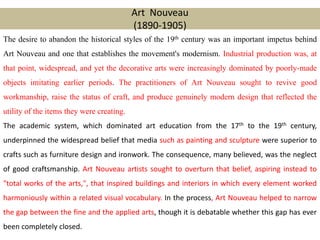
The desire to abandon the historical styles of the 19th century was an important impetus behind
Art Nouveau and one that establishes the movement's modernism. Industrial production was, at
that point, widespread, and yet the decorative arts were increasingly dominated by poorly-made
objects imitating earlier periods. The practitioners of Art Nouveau sought to revive good
workmanship, raise the status of craft, and produce genuinely modern design that reflected the
utility of the items they were creating.
The academic system, which dominated art education from the 17th to the 19th century,
underpinned the widespread belief that media such as painting and sculpture were superior to
crafts such as furniture design and ironwork. The consequence, many believed, was the neglect
of good craftsmanship. Art Nouveau artists sought to overturn that belief, aspiring instead to
"total works of the arts,", that inspired buildings and interiors in which every element worked
harmoniously within a related visual vocabulary. In the process, Art Nouveau helped to narrow
the gap between the fine and the applied arts, though it is debatable whether this gap has ever
been completely closed.
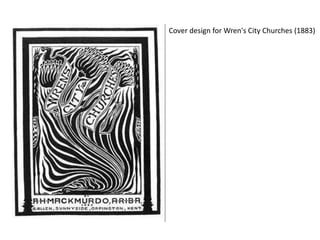
Cover design for Wren's City Churches (1883)
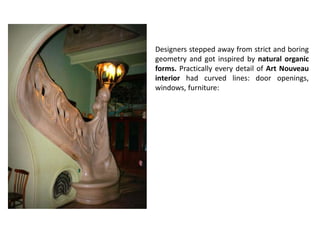
Designers stepped away from strict and boring
geometry and got inspired by natural organic
forms. Practically every detail of Art Nouveau
interior had curved lines: door openings,
windows, furniture:
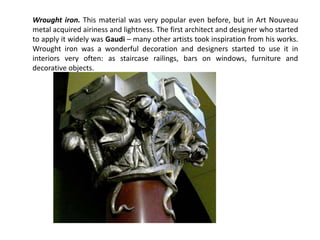
Wrought iron. This material was very popular even before, but in Art Nouveau
metal acquired airiness and lightness. The first architect and designer who started
to apply it widely was Gaudi – many other artists took inspiration from his works.
Wrought iron was a wonderful decoration and designers started to use it in
interiors very often: as staircase railings, bars on windows, furniture and
decorative objects.
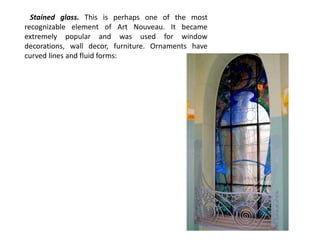
Stained glass. This is perhaps one of the most
recognizable element of Art Nouveau. It became
extremely popular and was used for window
decorations, wall decor, furniture. Ornaments have
curved lines and fluid forms:
(1) Art Nouveau philosophy was in favour of applying artistic designs to everyday objects,
in order to make beautiful things available to everyone. No object was too utilitarian to
be "beautified".
(2) Art Nouveau saw no separation in principle between fine art (painting and sculpture)
and applied or decorative arts (ceramics, furniture, and other practical objects).
(3) Art Nouveau remains something of an umbrella term which embraces a variety of
stylistic interpretations: some artists used new low-cost materials and mass production
methods while others used more expensive materials and valued high craftsmanship.
• Art Deco, similar to Art Nouveau, is a modern art style that attempts to infuse
functional objects with artistic touches. This movement is different from the
fine arts (painting and sculpture) where the art object has no practical purpose
or use beyond providing interesting viewing.
• With the advent of large-scale manufacturing, artists and designers wished to
enhance the appearance of mass-produced functional objects - everything
from clocks and ashtrays to cars and buildings. Art Deco's pursuit of beauty in
all aspects of life was directly reflective of the relative newness and mass
usage of machine-age technology rather than traditional crafting methods to
produce many objects.
Art Deco
(1900-1945)
Art Deco owed something to several of the major art styles of
the early 20th century. These formative influences include
the geometric forms of Cubism (note: Art Deco has been
called "Cubism Tamed"), the machine-style forms of
Constructivism and Futurism, and the unifying approach
of Art Nouveau
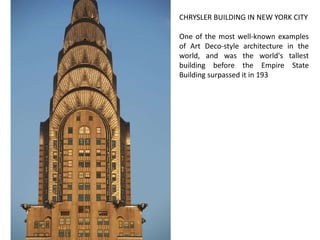
CHRYSLER BUILDING IN NEW YORK CITY
One of the most well-known examples
of Art Deco-style architecture in the
world, and was the world's tallest
building before the Empire State
Building surpassed it in 193

Art noveau

  • 1.
    • Arts andCrafts: Popular in the mid-19th century; handcrafted and artisan-made wood, pottery, tile and stained glass; nature motifs done simply; rectilinear forms. Think William Morris and bungalow style. Products were to be manufactured by individuals or small groups rather than on a mass production line. • Art nouveau: Popular in the late 19th century; whiplash curves; nature-inspired designs; finely crafted metal and wood. Think Rivendell or signs for the Paris Metro. Some artists used new low-cost materials and mass production methods while others used more expensive materials and valued high craftsmanship • Art deco: Popular in the 1920s and 1930s; zigzags, sharp angles and stepped designs; influenced by skyscrapers..
  • 2.
    Art and CraftsMovement (1860-1920) The founders of the Arts & Crafts Movement were some of the first major critics of the Industrial Revolution The practitioners of the movement strongly believed that the connection forged between the artist and his work through handcraft was the key to producing both human fulfillment and beautiful items that would be useful on an everyday basis; as a result, Arts & Crafts artists are largely associated with the vast range of the decorative arts and architecture as opposed to the "high" arts of painting and sculpture. The Arts & Crafts aesthetic varied greatly depending on the media and location involved, but it was influenced most prominently by both the imagery of nature and the forms of medieval art, particularly the Gothic style, which enjoyed a revival in Europe and North America during the mid-19th century.
  • 3.
    Tulip and Rose(1876) The Tulip and Rose curtain exemplifies the kinds of textiles and wallpaper designs produced by Morris' firm beginning in the 1860s. The dense, precisely interlocking pattern of the wool fabric, using curved and exaggerated forms of plants, flora (and sometimes fauna) became a hallmark of Morris & Company's fabric and wallpaper products in the 1870s and '80s.
  • 4.
    Tulip and Rose(1876) Unlike Morris' earlier designs, which featured more naturalistic imagery, this textile demonstrates his move beyond emulation towards a sense of abstraction during his mature career. The flattened forms and the emphasis on line anticipate the stylization of nature later used by Art Nouveau, and calls attention to the nature of the wool's rough surface texture, thereby revealing the honesty in materials. Furthermore, the "hanging" quality of the imagery of plants and flowers speaks to the way vines cover an entire exterior wall surface - much like the curtain is supposed to cover the entire plane of a window, creating a consonance between the natural elements and man-made articles, in effect bridging or blurring the boundary between the natural world outside and the interior, even when the curtain is completely closed.
  • 6.
    WILLIAM MORRIS William Morrisis best known as the 19th century's most celebrated designer, but he was also a driven polymath who spent much of his life fighting the consensus. Wallpapers., textiles , carpets, embroideries, tiles and book designs. Morris was born in Walthamstow, east London in 1834. Poet, artist, printer, typographer, decorator, Socialist--- a man of many talents Morris always had an affinity for nature, a vital component to pre-Raphaelite art. Saw Modernist thinkers as “servants to the industrial age”
  • 7.
    • After school,Morris went to Oxford University to study for the Church. It was there that he met Edward Burne-Jones, who was to become one of the era's most famous painters, and Morris's life-long friend. • Burne-Jones introduced him to a group of students who became known as 'The Set' or 'The Brotherhood', and who enjoyed romantic stories of medieval chivalry and self-sacrifice. • They also read books by contemporary reformers such as John Ruskin, Charles Kingsley and Thomas Carlyle. • Belonging to this group gave Morris an awareness of the deep divisions in contemporary society, and sparked his interest in trying to create an alternative to the dehumanising industrial systems that produced poor-quality, 'unnatural' objects
  • 8.
    THE RED HOUSE Architecturaldrawing of the Red House, Philip Webb, 1859, England. Museum no. E.62-1916. © Victoria and Albert Museum, London • Created in collaboration with architect Phillip Web • Gothic Architecture • Gabled roof of tudor mansion • Red bricks of working class preferred rather than stone of high class as building material.
  • 9.
  • 10.
  • 11.
  • 12.
    Huge murals andhand-embroidered fabrics decorated the walls, creating the feel of a historical manor house.
  • 14.
    Art Nouveau (1890-1905) The desireto abandon the historical styles of the 19th century was an important impetus behind Art Nouveau and one that establishes the movement's modernism. Industrial production was, at that point, widespread, and yet the decorative arts were increasingly dominated by poorly-made objects imitating earlier periods. The practitioners of Art Nouveau sought to revive good workmanship, raise the status of craft, and produce genuinely modern design that reflected the utility of the items they were creating. The academic system, which dominated art education from the 17th to the 19th century, underpinned the widespread belief that media such as painting and sculpture were superior to crafts such as furniture design and ironwork. The consequence, many believed, was the neglect of good craftsmanship. Art Nouveau artists sought to overturn that belief, aspiring instead to "total works of the arts,", that inspired buildings and interiors in which every element worked harmoniously within a related visual vocabulary. In the process, Art Nouveau helped to narrow the gap between the fine and the applied arts, though it is debatable whether this gap has ever been completely closed.
  • 15.
    Cover design forWren's City Churches (1883)
  • 16.
    Designers stepped awayfrom strict and boring geometry and got inspired by natural organic forms. Practically every detail of Art Nouveau interior had curved lines: door openings, windows, furniture:
  • 17.
    Wrought iron. Thismaterial was very popular even before, but in Art Nouveau metal acquired airiness and lightness. The first architect and designer who started to apply it widely was Gaudi – many other artists took inspiration from his works. Wrought iron was a wonderful decoration and designers started to use it in interiors very often: as staircase railings, bars on windows, furniture and decorative objects.
  • 18.
    Stained glass. Thisis perhaps one of the most recognizable element of Art Nouveau. It became extremely popular and was used for window decorations, wall decor, furniture. Ornaments have curved lines and fluid forms:
  • 19.
    (1) Art Nouveauphilosophy was in favour of applying artistic designs to everyday objects, in order to make beautiful things available to everyone. No object was too utilitarian to be "beautified". (2) Art Nouveau saw no separation in principle between fine art (painting and sculpture) and applied or decorative arts (ceramics, furniture, and other practical objects). (3) Art Nouveau remains something of an umbrella term which embraces a variety of stylistic interpretations: some artists used new low-cost materials and mass production methods while others used more expensive materials and valued high craftsmanship.
  • 21.
    • Art Deco,similar to Art Nouveau, is a modern art style that attempts to infuse functional objects with artistic touches. This movement is different from the fine arts (painting and sculpture) where the art object has no practical purpose or use beyond providing interesting viewing. • With the advent of large-scale manufacturing, artists and designers wished to enhance the appearance of mass-produced functional objects - everything from clocks and ashtrays to cars and buildings. Art Deco's pursuit of beauty in all aspects of life was directly reflective of the relative newness and mass usage of machine-age technology rather than traditional crafting methods to produce many objects. Art Deco (1900-1945)
  • 22.
    Art Deco owedsomething to several of the major art styles of the early 20th century. These formative influences include the geometric forms of Cubism (note: Art Deco has been called "Cubism Tamed"), the machine-style forms of Constructivism and Futurism, and the unifying approach of Art Nouveau
  • 23.
    CHRYSLER BUILDING INNEW YORK CITY One of the most well-known examples of Art Deco-style architecture in the world, and was the world's tallest building before the Empire State Building surpassed it in 193