VIBRATION MEASUREMENT
SYSTEM
Davalsab.M.L
M.Tech (Reva University )
Daval.techno@gmail.com
Cell : 8904567449
What is Vibrometers
The instruments or equipments which are used for measure the displacement, velocity,
frequency, phase distortion and acceleration of a vibrating g body are called vibration
measuring instruments named as vibrometers.
How it works
Vibration measuring devices having mass , spring , dashpot etc are called seismic
instruments .the quantity which is measure by the instruments are displayed on the
screen in the form of electric signal which can be readily amplified and recorded. The
output of electric signal of the instrument is proportional to the quantity which is
measured. The input is reproduced as output very precisely.
Types of vibration measuring device
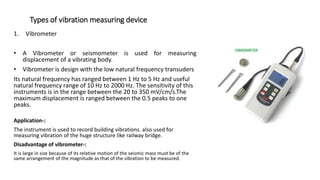
1. Vibrometer
• A Vibrometer or seismometer is used for measuring
displacement of a vibrating body.
• Vibrometer is design with the low natural frequency transuders
Its natural frequency has ranged between 1 Hz to 5 Hz and useful
natural frequency range of 10 Hz to 2000 Hz. The sensitivity of this
instruments is in the range between the 20 to 350 mV/cm/s.The
maximum displacement is ranged between the 0.5 peaks to one
peaks.
Application-:
The instrument is used to record building vibrations. also used for
measuring vibration of the huge structure like railway bridge.
Disadvantage of vibrometer-:
It is large in size because of its relative motion of the seismic mass must be of the
same arrangement of the magnitude as that of the vibration to be measured.
Accelerometer
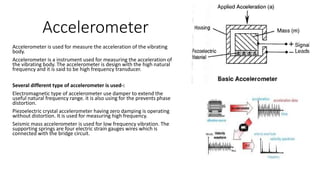
Accelerometer is used for measure the acceleration of the vibrating
body.
Accelerometer is a instrument used for measuring the acceleration of
the vibrating body. The accelerometer is design with the high natural
frequency and it is said to be high frequency transducer.
Several different type of accelerometer is used-:
Electromagnetic type of accelerometer use damper to extend the
useful natural frequency range. it is also using for the prevents phase
distortion.
Piezoelectric crystal accelerometer having zero damping is operating
without distortion. It is used for measuring high frequency.
Seismic mass accelerometer is used for low frequency vibration. The
supporting springs are four electric strain gauges wires which is
connected with the bridge circuit.
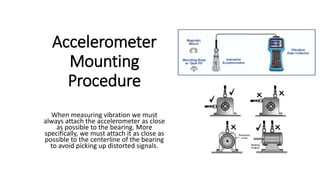
Accelerometer
Mounting
Procedure
When measuring vibration we must
always attach the accelerometer as close
as possible to the bearing. More
specifically, we must attach it as close as
possible to the centerline of the bearing
to avoid picking up distorted signals.
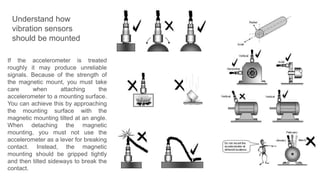
If the accelerometer is treated
roughly it may produce unreliable
signals. Because of the strength of
the magnetic mount, you must take
care when attaching the
accelerometer to a mounting surface.
You can achieve this by approaching
the mounting surface with the
magnetic mounting tilted at an angle.
When detaching the magnetic
mounting, you must not use the
accelerometer as a lever for breaking
contact. Instead, the magnetic
mounting should be gripped tightly
and then tilted sideways to break the
contact.
Understand how
vibration sensors
should be mounted
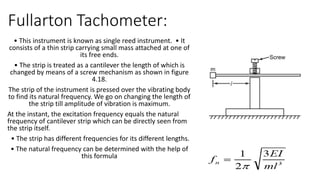
Fullarton Tachometer:
• This instrument is known as single reed instrument. • It
consists of a thin strip carrying small mass attached at one of
its free ends.
• The strip is treated as a cantilever the length of which is
changed by means of a screw mechanism as shown in figure
4.18.
The strip of the instrument is pressed over the vibrating body
to find its natural frequency. We go on changing the length of
the strip till amplitude of vibration is maximum.
At the instant, the excitation frequency equals the natural
frequency of cantilever strip which can be directly seen from
the strip itself.
• The strip has different frequencies for its different lengths.
• The natural frequency can be determined with the help of
this formula
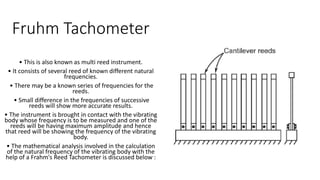
Fruhm Tachometer
• This is also known as multi reed instrument.
• It consists of several reed of known different natural
frequencies.
• There may be a known series of frequencies for the
reeds.
• Small difference in the frequencies of successive
reeds will show more accurate results.
• The instrument is brought in contact with the vibrating
body whose frequency is to be measured and one of the
reeds will be having maximum amplitude and hence
that reed will be showing the frequency of the vibrating
body.
• The mathematical analysis involved in the calculation
of the natural frequency of the vibrating body with the
help of a Frahm's Reed Tachometer is discussed below :
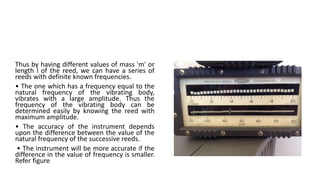
Thus by having different values of mass 'm' or
length l of the reed, we can have a series of
reeds with definite known frequencies.
• The one which has a frequency equal to the
natural frequency of the vibrating body,
vibrates with a large amplitude. Thus the
frequency of the vibrating body can be
determined easily by knowing the reed with
maximum amplitude.
• The accuracy of the instrument depends
upon the difference between the value of the
natural frequency of the successive reeds.
• The instrument will be more accurate if the
difference in the value of frequency is smaller.
Refer figure

Vibration measuring instrument

  • 1.
    VIBRATION MEASUREMENT SYSTEM Davalsab.M.L M.Tech (RevaUniversity ) Daval.techno@gmail.com Cell : 8904567449
  • 2.
    What is Vibrometers Theinstruments or equipments which are used for measure the displacement, velocity, frequency, phase distortion and acceleration of a vibrating g body are called vibration measuring instruments named as vibrometers. How it works Vibration measuring devices having mass , spring , dashpot etc are called seismic instruments .the quantity which is measure by the instruments are displayed on the screen in the form of electric signal which can be readily amplified and recorded. The output of electric signal of the instrument is proportional to the quantity which is measured. The input is reproduced as output very precisely.
  • 3.
    Types of vibrationmeasuring device 1. Vibrometer • A Vibrometer or seismometer is used for measuring displacement of a vibrating body. • Vibrometer is design with the low natural frequency transuders Its natural frequency has ranged between 1 Hz to 5 Hz and useful natural frequency range of 10 Hz to 2000 Hz. The sensitivity of this instruments is in the range between the 20 to 350 mV/cm/s.The maximum displacement is ranged between the 0.5 peaks to one peaks. Application-: The instrument is used to record building vibrations. also used for measuring vibration of the huge structure like railway bridge. Disadvantage of vibrometer-: It is large in size because of its relative motion of the seismic mass must be of the same arrangement of the magnitude as that of the vibration to be measured.
  • 4.
    Accelerometer Accelerometer is usedfor measure the acceleration of the vibrating body. Accelerometer is a instrument used for measuring the acceleration of the vibrating body. The accelerometer is design with the high natural frequency and it is said to be high frequency transducer. Several different type of accelerometer is used-: Electromagnetic type of accelerometer use damper to extend the useful natural frequency range. it is also using for the prevents phase distortion. Piezoelectric crystal accelerometer having zero damping is operating without distortion. It is used for measuring high frequency. Seismic mass accelerometer is used for low frequency vibration. The supporting springs are four electric strain gauges wires which is connected with the bridge circuit.
  • 5.
    Accelerometer Mounting Procedure When measuring vibrationwe must always attach the accelerometer as close as possible to the bearing. More specifically, we must attach it as close as possible to the centerline of the bearing to avoid picking up distorted signals.
  • 6.
    If the accelerometeris treated roughly it may produce unreliable signals. Because of the strength of the magnetic mount, you must take care when attaching the accelerometer to a mounting surface. You can achieve this by approaching the mounting surface with the magnetic mounting tilted at an angle. When detaching the magnetic mounting, you must not use the accelerometer as a lever for breaking contact. Instead, the magnetic mounting should be gripped tightly and then tilted sideways to break the contact. Understand how vibration sensors should be mounted
  • 7.
    Fullarton Tachometer: • Thisinstrument is known as single reed instrument. • It consists of a thin strip carrying small mass attached at one of its free ends. • The strip is treated as a cantilever the length of which is changed by means of a screw mechanism as shown in figure 4.18. The strip of the instrument is pressed over the vibrating body to find its natural frequency. We go on changing the length of the strip till amplitude of vibration is maximum. At the instant, the excitation frequency equals the natural frequency of cantilever strip which can be directly seen from the strip itself. • The strip has different frequencies for its different lengths. • The natural frequency can be determined with the help of this formula
  • 8.
    Fruhm Tachometer • Thisis also known as multi reed instrument. • It consists of several reed of known different natural frequencies. • There may be a known series of frequencies for the reeds. • Small difference in the frequencies of successive reeds will show more accurate results. • The instrument is brought in contact with the vibrating body whose frequency is to be measured and one of the reeds will be having maximum amplitude and hence that reed will be showing the frequency of the vibrating body. • The mathematical analysis involved in the calculation of the natural frequency of the vibrating body with the help of a Frahm's Reed Tachometer is discussed below :
  • 9.
    Thus by havingdifferent values of mass 'm' or length l of the reed, we can have a series of reeds with definite known frequencies. • The one which has a frequency equal to the natural frequency of the vibrating body, vibrates with a large amplitude. Thus the frequency of the vibrating body can be determined easily by knowing the reed with maximum amplitude. • The accuracy of the instrument depends upon the difference between the value of the natural frequency of the successive reeds. • The instrument will be more accurate if the difference in the value of frequency is smaller. Refer figure