Vibration Analysis of
Common Problems
IIPM 2
Vibration Analysis
Unbalance
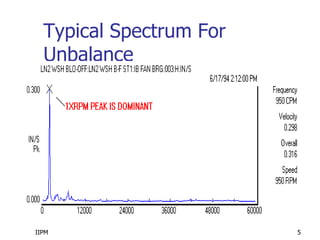
 Amplitude proportional to the amount
of unbalance
 Vibration high normally in radial
direction (may be also in axial direction
incase of overhung and flexible rotors ).
 1* RPM vibration is greater than 80%
(normally) of the overall reading.
IIPM 3
Vibration Analysis
Unbalance
 Horizontal and vertical 1* RPM
amplitude should be nearly same,
although it also depends on system
rigidity on the particular direction.
 Other frequency peaks may be less
than 5% of the 1*RPM amplitude
 Phase shift of 90 deg. When sensor
moves from horizontal to vertical.
IIPM 4
UNBALANCE
 Operating conditions such as load, flow
condition and temperature effect
unbalance
 Balance under normal operating conditions
 Changes in track and pitch angle of fan
blades can result in “Aerodynamic
Unbalance”
IIPM 5
Typical Spectrum For
Unbalance
IIPM 6
MISALIGNMENT
 BIGGEST PROBLEM INITIALLY
 Operating temperature can affect
alignment
 Machines aligned cold can go out when
warm
 Bases or foundations can settle
 Grouting can shrink or deteriorate
 Increases energy demands
IIPM 7
MISALIGNMENT
 Forces shared by driver and driven (not
localized)
 Level of misalignment severity is
determined by the machines ability to
withstand the misalignment
 If coupling is stronger than bearing the
bearing can fail with little damage to the
coupling
IIPM 8
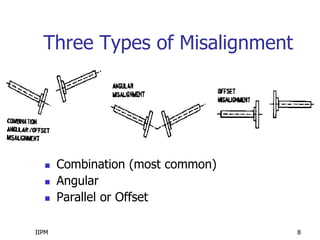
Three Types of Misalignment
 Combination (most common)
 Angular
 Parallel or Offset
IIPM 9
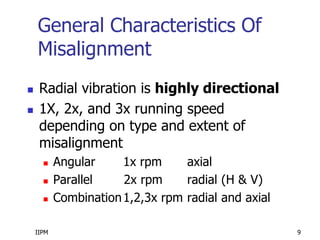
General Characteristics Of
Misalignment
 Radial vibration is highly directional
 1X, 2x, and 3x running speed
depending on type and extent of
misalignment
 Angular 1x rpm axial
 Parallel 2x rpm radial (H & V)
 Combination1,2,3x rpm radial and axial
IIPM 10
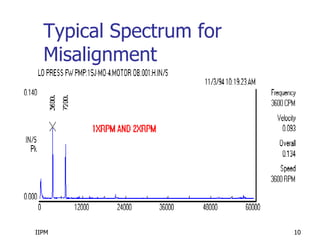
Typical Spectrum for
Misalignment
IIPM 11
Vibration Analysis
Misalignment
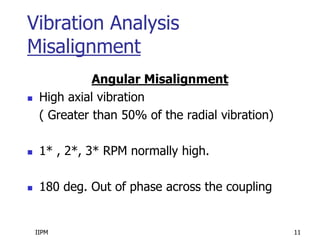
Angular Misalignment
 High axial vibration
( Greater than 50% of the radial vibration)
 1* , 2*, 3* RPM normally high.
 180 deg. Out of phase across the coupling
IIPM 12
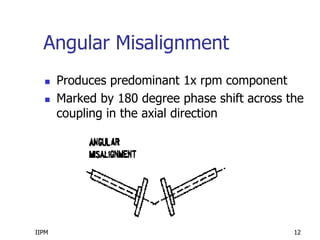
Angular Misalignment
 Produces predominant 1x rpm component
 Marked by 180 degree phase shift across the
coupling in the axial direction
IIPM 13
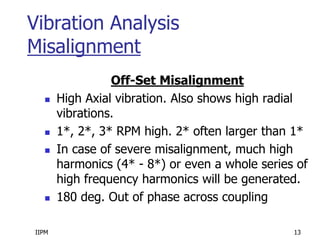
Vibration Analysis
Misalignment
Off-Set Misalignment
 High Axial vibration. Also shows high radial
vibrations.
 1*, 2*, 3* RPM high. 2* often larger than 1*
 In case of severe misalignment, much high
harmonics (4* - 8*) or even a whole series of
high frequency harmonics will be generated.
 180 deg. Out of phase across coupling
IIPM 14
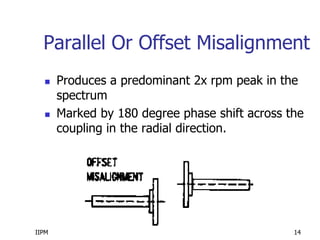
Parallel Or Offset Misalignment
 Produces a predominant 2x rpm peak in the
spectrum
 Marked by 180 degree phase shift across the
coupling in the radial direction.
IIPM 15
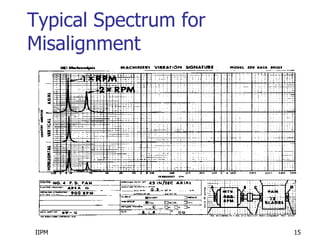
Typical Spectrum for
Misalignment
IIPM 16
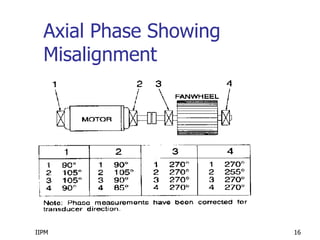
Axial Phase Showing
Misalignment
IIPM 17
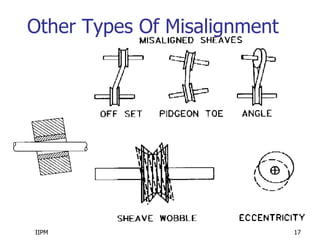
Other Types Of Misalignment
IIPM 18
Vibration Analysis
Mechanical Looseness
Caused by structured looseness / weakness of
machine feet, base plate or foundation; also
by deteriorated grouting, loose base bolts
and distortion of the frame or base.
 Radial vibration high
 2* RPM & 1* RPM dominant
 180 deg. Phase differences between
mating surfaces which have looseness
between them.
IIPM 19
Looseness
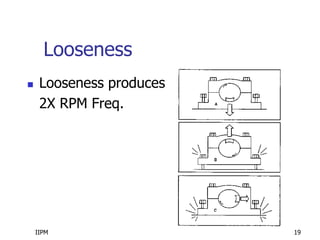
 Looseness produces
2X RPM Freq.
IIPM 20
Vibration Analysis
Mechanical Looseness
Caused by looseness in bearing housing bolts
and cracks in the frame structure.
 Radial vibration high
 2* RPM normally dominant. 0.5*, 1* and 3*
RPM may also be present
 Substantial Phase difference between mating
surfaces which have looseness between them
IIPM 21
LOOSENESS
 Not an exciting force
 Allows exciting frequencies already
present to exhibit much higher
amplitudes
 Loss or reduction in normal stiffness
 Caused by:
 loose mounting bolts
 deterioration of grouting
 cracked welds
IIPM 22
Two Types Of Looseness
 Looseness of Rotating Components
 Loose Rotors
 Bearings Loose on the Shaft or in Housing
 Excessive Sleeve Bearing Clearances
 Looseness of Support System
 Loose Mounting Bolts
 Grouting Deterioration
 Cracks
 Poor Support
 Frame Distortion
IIPM 23
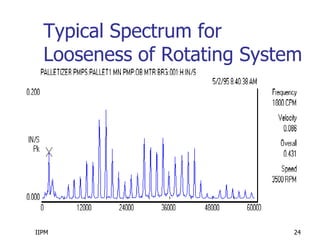
Looseness Of Rotating System
 Rattling condition cause impacts due to
excessive clearance in a rolling element
or sleeve bearing
 Impacts cause multiple running speed
harmonics to appear in the spectra
 Identified by:
 multiple harmonics
 unstable phase
 highly directional radial vibration
IIPM 24
Typical Spectrum for
Looseness of Rotating System
IIPM 25
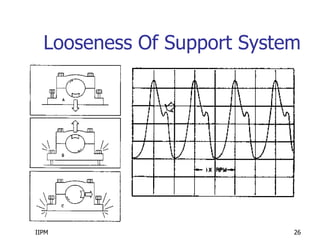
Looseness Of Support System
 FFT readings show 1x rpm, 2x rpm, and 3x
rpm components
 Structural looseness / weakness will cause
high 1xrpm peak in FFT
 Identified by
 Highly directional radial vibration
 Bouncing
 Taking comparative phase readings across
interfaces and look for amplitude variation
 Typically loose in vertical direction
IIPM 26
Looseness Of Support System
IIPM 27
Notes

Vibration Analysis Part - 1.ppt

  • 1.
  • 2.
    IIPM 2 Vibration Analysis Unbalance Amplitude proportional to the amount of unbalance  Vibration high normally in radial direction (may be also in axial direction incase of overhung and flexible rotors ).  1* RPM vibration is greater than 80% (normally) of the overall reading.
  • 3.
    IIPM 3 Vibration Analysis Unbalance Horizontal and vertical 1* RPM amplitude should be nearly same, although it also depends on system rigidity on the particular direction.  Other frequency peaks may be less than 5% of the 1*RPM amplitude  Phase shift of 90 deg. When sensor moves from horizontal to vertical.
  • 4.
    IIPM 4 UNBALANCE  Operatingconditions such as load, flow condition and temperature effect unbalance  Balance under normal operating conditions  Changes in track and pitch angle of fan blades can result in “Aerodynamic Unbalance”
  • 5.
  • 6.
    IIPM 6 MISALIGNMENT  BIGGESTPROBLEM INITIALLY  Operating temperature can affect alignment  Machines aligned cold can go out when warm  Bases or foundations can settle  Grouting can shrink or deteriorate  Increases energy demands
  • 7.
    IIPM 7 MISALIGNMENT  Forcesshared by driver and driven (not localized)  Level of misalignment severity is determined by the machines ability to withstand the misalignment  If coupling is stronger than bearing the bearing can fail with little damage to the coupling
  • 8.
    IIPM 8 Three Typesof Misalignment  Combination (most common)  Angular  Parallel or Offset
  • 9.
    IIPM 9 General CharacteristicsOf Misalignment  Radial vibration is highly directional  1X, 2x, and 3x running speed depending on type and extent of misalignment  Angular 1x rpm axial  Parallel 2x rpm radial (H & V)  Combination1,2,3x rpm radial and axial
  • 10.
    IIPM 10 Typical Spectrumfor Misalignment
  • 11.
    IIPM 11 Vibration Analysis Misalignment AngularMisalignment  High axial vibration ( Greater than 50% of the radial vibration)  1* , 2*, 3* RPM normally high.  180 deg. Out of phase across the coupling
  • 12.
    IIPM 12 Angular Misalignment Produces predominant 1x rpm component  Marked by 180 degree phase shift across the coupling in the axial direction
  • 13.
    IIPM 13 Vibration Analysis Misalignment Off-SetMisalignment  High Axial vibration. Also shows high radial vibrations.  1*, 2*, 3* RPM high. 2* often larger than 1*  In case of severe misalignment, much high harmonics (4* - 8*) or even a whole series of high frequency harmonics will be generated.  180 deg. Out of phase across coupling
  • 14.
    IIPM 14 Parallel OrOffset Misalignment  Produces a predominant 2x rpm peak in the spectrum  Marked by 180 degree phase shift across the coupling in the radial direction.
  • 15.
    IIPM 15 Typical Spectrumfor Misalignment
  • 16.
    IIPM 16 Axial PhaseShowing Misalignment
  • 17.
    IIPM 17 Other TypesOf Misalignment
  • 18.
    IIPM 18 Vibration Analysis MechanicalLooseness Caused by structured looseness / weakness of machine feet, base plate or foundation; also by deteriorated grouting, loose base bolts and distortion of the frame or base.  Radial vibration high  2* RPM & 1* RPM dominant  180 deg. Phase differences between mating surfaces which have looseness between them.
  • 19.
    IIPM 19 Looseness  Loosenessproduces 2X RPM Freq.
  • 20.
    IIPM 20 Vibration Analysis MechanicalLooseness Caused by looseness in bearing housing bolts and cracks in the frame structure.  Radial vibration high  2* RPM normally dominant. 0.5*, 1* and 3* RPM may also be present  Substantial Phase difference between mating surfaces which have looseness between them
  • 21.
    IIPM 21 LOOSENESS  Notan exciting force  Allows exciting frequencies already present to exhibit much higher amplitudes  Loss or reduction in normal stiffness  Caused by:  loose mounting bolts  deterioration of grouting  cracked welds
  • 22.
    IIPM 22 Two TypesOf Looseness  Looseness of Rotating Components  Loose Rotors  Bearings Loose on the Shaft or in Housing  Excessive Sleeve Bearing Clearances  Looseness of Support System  Loose Mounting Bolts  Grouting Deterioration  Cracks  Poor Support  Frame Distortion
  • 23.
    IIPM 23 Looseness OfRotating System  Rattling condition cause impacts due to excessive clearance in a rolling element or sleeve bearing  Impacts cause multiple running speed harmonics to appear in the spectra  Identified by:  multiple harmonics  unstable phase  highly directional radial vibration
  • 24.
    IIPM 24 Typical Spectrumfor Looseness of Rotating System
  • 25.
    IIPM 25 Looseness OfSupport System  FFT readings show 1x rpm, 2x rpm, and 3x rpm components  Structural looseness / weakness will cause high 1xrpm peak in FFT  Identified by  Highly directional radial vibration  Bouncing  Taking comparative phase readings across interfaces and look for amplitude variation  Typically loose in vertical direction
  • 26.
    IIPM 26 Looseness OfSupport System
  • 27.

Editor's Notes