Perpindahan Kalor dan Massa 2
Mechanical Looseness Vibration
Dosen : Indarto, , Ir., DEA., Dr., Prof.
email : teguh.pp@ugm.ac.id
Anggota Kelompok
1. Marhala Pandamana S(15/43902/TK/385240)
2. Moses Gregory (15/385253/TK/43905)
3. Monang Eleazar (15/385242/TK/43904)
4. Riva Yudha Abriyant (15/385256/TK/43918)
Mechanical Looseness
Mechanical looseness is the improper between component parts, is generally characterized by a long
string of harmonics of running frequency with abnormally high amplitudes. In some machines vibration levels
may be excessive as a consequence of components being assembled too loosely, for example in the case of a
bearing, which is not properly secured.
Types of Mechanical Looseness
Based on the causes, there are two types of mechanical looseness. There are:
1. Non Rotating looseness Non rotating looseness is looseness that caused by
the distance between two stationary parts is too big.
2. Rotating looseness Rotating looseness is looseness that caused by too much
room between rotating and stationary elements in the machine. Both types
generate extensive vibrations at 1X harmonics in all three directions.
1. Non Rotating Looseness
Non rotating looseness causes the highest vibrations in the direction where the
stiffness is the smallest. The stiffness is usually least in the horizontal direction, but it
depends on the physical layout of the machine. Loose foundation can be causes by
loose bolts, rust or cracks. There are two types in non rotating looseness:
1. Type ‘A’
2. Type ‘B’
1. Non Rotating Looseness
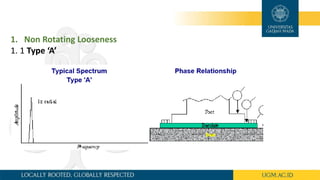
1. 1 Type ‘A’
1. Non Rotating Looseness
1. 1 Type ‘A’
Type 'A' is caused by structural looseness/weakness of machine feet, base plate
or foundation, also by deteriorated grouting, loose hold-down bolts at the base and
distortion of the frame or base (i.e Soft Foot). Phase analysis may reveal approx. 180°
phase difference between vertical measurements on the machine foot, base plate and
base itself.
1. Non Rotating Looseness
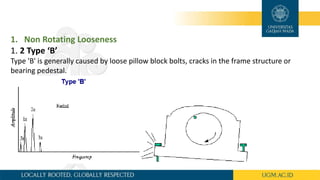
1. 2 Type ‘B’
Type 'B' is generally caused by loose pillow block bolts, cracks in the frame structure or
bearing pedestal.
2. Rotating Looseness
Type 'C' is normally generated by improper fit between component parts which
will cause many harmonics due to non linear response of loose parts to dynamic forces
from the rotor. Causes a truncation of time waveform. Type 'C' is often caused by a
bearing liner loose in its cap, excessive clearance in either a sleeve or rolling element
bearing or a loose impeller on a shaft. Type 'C' phase is often unstable and may vary
widely from one measurement to the next, particularly if the rotor shifts position on
the shaft from one start-up to the next.
2. Rotating Looseness
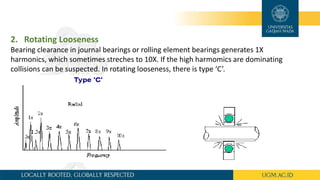
Bearing clearance in journal bearings or rolling element bearings generates 1X
harmonics, which sometimes streches to 10X. If the high harmomics are dominating
collisions can be suspected. In rotating looseness, there is type ‘C’.
2. Rotating Looseness
Type 'C' is normally generated by improper fit between component
parts which will cause many harmonics due to non linear response of loose
parts to dynamic forces from the rotor. Causes a truncation of time
waveform. Type 'C' is often caused by a bearing liner loose in its cap,
excessive clearance in either a sleeve or rolling element bearing or a loose
impeller on a shaft. Type 'C' phase is often unstable and may vary widely
from one measurement to the next, particularly if the rotor shifts position
on the shaft from one start-up to the next.
What causes looseness?
Possible causes of wear/looseness are:
• The machine has come loose from its mounting
• A machine component has come loose
• The bearing has developed a fault that has worn down the bearing elements or the
bearing seat
The effects of looseness
• If the looseness is bearing related, the effects are the same as imbalance, only more
severe
• If looseness is generated from a component (for example, a fan blade), there is a
possibility the part will become detached, causing secondary damage.
Mechanical Looseness Vibration Spectrum
1. Caused By Misalignment (Jason, 2013)
Mechanical Looseness Vibration Spectrum
2. Caused By Unbalanced (Jason, 2013)
Mechanical Looseness Vibration Spectrum
3. The Overall Looseness (Jason,2013)
References
1. http://www.iitg.ernet.in/scifac/qip/public_html/cd_cell/chapters/rtiwari_
rotor_bearing_system/rt_chapter17.pdf
2. http://www.vtab.se/training/vibration-school/mechanical-
looseness/?lang=en
3. http://vlabs.iitkgp.ernet.in/rmfs/exp5/pdf/Mechanical_Looseness.pdf
4. http://www.skf.com/binary/tcm:12113997/CM5118%20EN%20Spectrum
%20Analysis.pdf

Mechanical looseness vibration(mechanical engineering ugm)

  • 1.
    Perpindahan Kalor danMassa 2 Mechanical Looseness Vibration Dosen : Indarto, , Ir., DEA., Dr., Prof. email : teguh.pp@ugm.ac.id
  • 2.
    Anggota Kelompok 1. MarhalaPandamana S(15/43902/TK/385240) 2. Moses Gregory (15/385253/TK/43905) 3. Monang Eleazar (15/385242/TK/43904) 4. Riva Yudha Abriyant (15/385256/TK/43918)
  • 3.
    Mechanical Looseness Mechanical loosenessis the improper between component parts, is generally characterized by a long string of harmonics of running frequency with abnormally high amplitudes. In some machines vibration levels may be excessive as a consequence of components being assembled too loosely, for example in the case of a bearing, which is not properly secured.
  • 4.
    Types of MechanicalLooseness Based on the causes, there are two types of mechanical looseness. There are: 1. Non Rotating looseness Non rotating looseness is looseness that caused by the distance between two stationary parts is too big. 2. Rotating looseness Rotating looseness is looseness that caused by too much room between rotating and stationary elements in the machine. Both types generate extensive vibrations at 1X harmonics in all three directions.
  • 5.
    1. Non RotatingLooseness Non rotating looseness causes the highest vibrations in the direction where the stiffness is the smallest. The stiffness is usually least in the horizontal direction, but it depends on the physical layout of the machine. Loose foundation can be causes by loose bolts, rust or cracks. There are two types in non rotating looseness: 1. Type ‘A’ 2. Type ‘B’
  • 6.
    1. Non RotatingLooseness 1. 1 Type ‘A’
  • 7.
    1. Non RotatingLooseness 1. 1 Type ‘A’ Type 'A' is caused by structural looseness/weakness of machine feet, base plate or foundation, also by deteriorated grouting, loose hold-down bolts at the base and distortion of the frame or base (i.e Soft Foot). Phase analysis may reveal approx. 180° phase difference between vertical measurements on the machine foot, base plate and base itself.
  • 8.
    1. Non RotatingLooseness 1. 2 Type ‘B’ Type 'B' is generally caused by loose pillow block bolts, cracks in the frame structure or bearing pedestal.
  • 9.
    2. Rotating Looseness Type'C' is normally generated by improper fit between component parts which will cause many harmonics due to non linear response of loose parts to dynamic forces from the rotor. Causes a truncation of time waveform. Type 'C' is often caused by a bearing liner loose in its cap, excessive clearance in either a sleeve or rolling element bearing or a loose impeller on a shaft. Type 'C' phase is often unstable and may vary widely from one measurement to the next, particularly if the rotor shifts position on the shaft from one start-up to the next.
  • 10.
    2. Rotating Looseness Bearingclearance in journal bearings or rolling element bearings generates 1X harmonics, which sometimes streches to 10X. If the high harmomics are dominating collisions can be suspected. In rotating looseness, there is type ‘C’.
  • 11.
    2. Rotating Looseness Type'C' is normally generated by improper fit between component parts which will cause many harmonics due to non linear response of loose parts to dynamic forces from the rotor. Causes a truncation of time waveform. Type 'C' is often caused by a bearing liner loose in its cap, excessive clearance in either a sleeve or rolling element bearing or a loose impeller on a shaft. Type 'C' phase is often unstable and may vary widely from one measurement to the next, particularly if the rotor shifts position on the shaft from one start-up to the next.
  • 12.
    What causes looseness? Possiblecauses of wear/looseness are: • The machine has come loose from its mounting • A machine component has come loose • The bearing has developed a fault that has worn down the bearing elements or the bearing seat
  • 13.
    The effects oflooseness • If the looseness is bearing related, the effects are the same as imbalance, only more severe • If looseness is generated from a component (for example, a fan blade), there is a possibility the part will become detached, causing secondary damage.
  • 15.
    Mechanical Looseness VibrationSpectrum 1. Caused By Misalignment (Jason, 2013)
  • 16.
    Mechanical Looseness VibrationSpectrum 2. Caused By Unbalanced (Jason, 2013)
  • 17.
    Mechanical Looseness VibrationSpectrum 3. The Overall Looseness (Jason,2013)
  • 18.
    References 1. http://www.iitg.ernet.in/scifac/qip/public_html/cd_cell/chapters/rtiwari_ rotor_bearing_system/rt_chapter17.pdf 2. http://www.vtab.se/training/vibration-school/mechanical- looseness/?lang=en 3.http://vlabs.iitkgp.ernet.in/rmfs/exp5/pdf/Mechanical_Looseness.pdf 4. http://www.skf.com/binary/tcm:12113997/CM5118%20EN%20Spectrum %20Analysis.pdf