Presentation
on
Vibration Analysis
Contents
 Basics Of Vibration Analysis
 Machinery Problem Diagnostics
 Problems Of Electrical Machines
 Resonance
 General Tips For Maintenance
Basics Of Vibration Analysis
Mostly a machine maintenance crew is knowing only breakdown
maintenance. But now, in the changed Industrial scenario, the industries
have to adopt new methodologies and effective maintenance procedures
to enhance productivity and to reduce production cost.For this, they
should know about their machines and machines’ behavior.
Preventive maintenance and predictive maintenance are the two methods
which help maintenance people to know a health of their machines and
the medicine for the poor health also.
Vibration analysis of rotating machines is one of the most useful tools to
know the machine health.It gives utmost machine problem diagnostics.
Vibration analysis is useful to all the three basic Engineering branches
viz. Mechanical , Electrical and Civil.
Basics Of Vibration Analysis
The accurate measurement and correct interpretation of vibrations can
help diagnosing machinery problems during operation.Vibration is the
language of machines which if one can listen to and understand , is
enough to diagnose their complaints and ailments.
Source of Vibrations :
Vibrations are not useful to machine operation at all and all possible
efforts are to be taken to minimize vibrations.
If someone says that my machine is not vibrating , that means either the
machine health is exceptionally very good or the machine itself is not in
operation.
While designing a machine , all possible parameters are taken into
consideration to make the machine optimum .But while manufacturing
the machine parts, some inaccuracies and minor imperfections are
introduced as a part of machining process.
Basics Of Vibration Analysis
While installing the machines, human and technical errors cause
imperfect machine installation.Also during machine operations, wear
and tear of machine parts take place, which add to the vibrations.
In fact , in Engineering , there are tolerances and permissible limits etc.
to take care of all possible and unavoidable imperfections. There are
permissible limits of vibration level too.These limits depends on m/c
type , its speed , load, stress etc.
Important Vibration Characteristics :
• Displacement
• Velocity
• Acceleration
• Frequency
• Phase
Basics Of Vibration Analysis
Vibration Displacement :
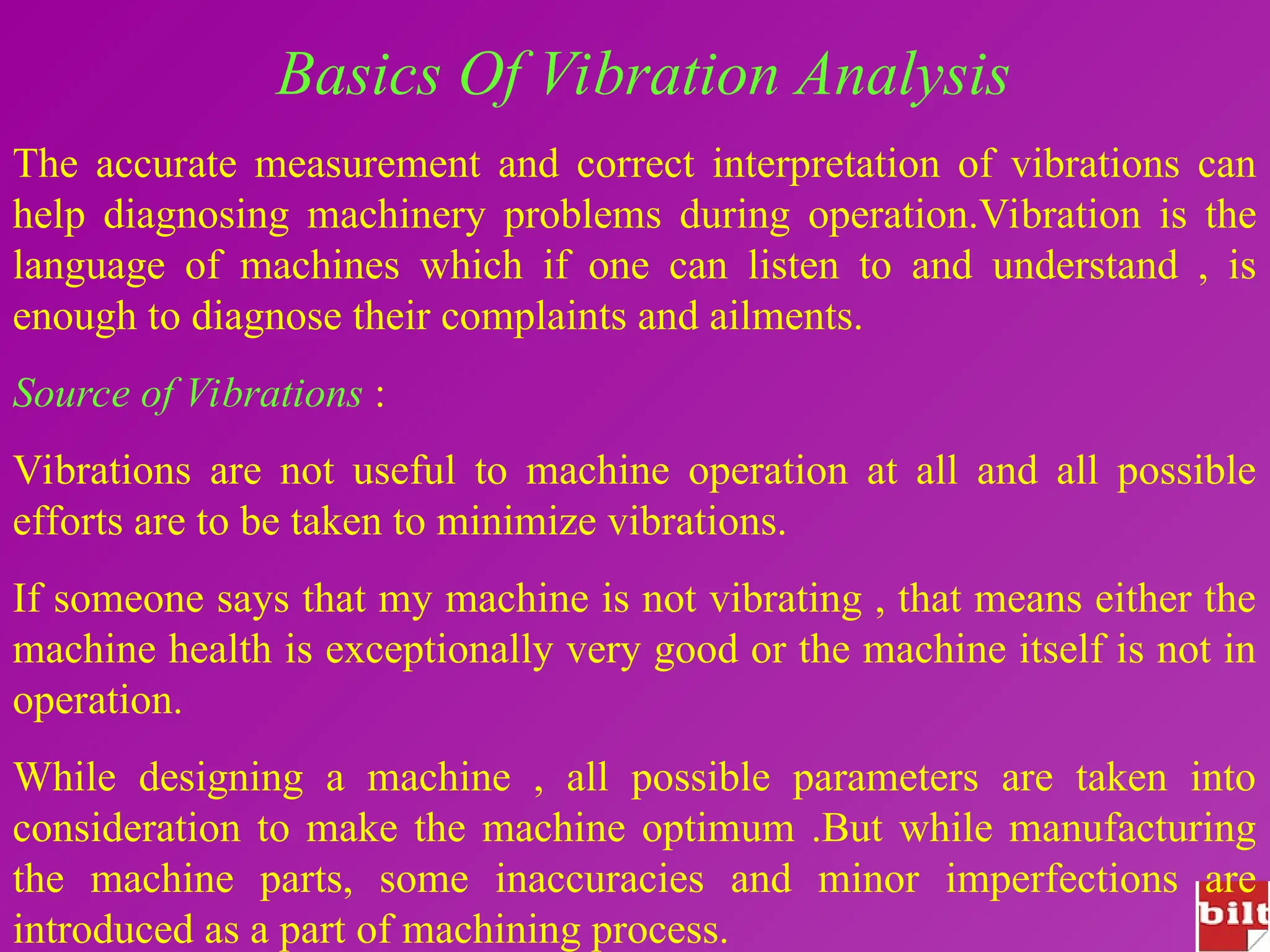
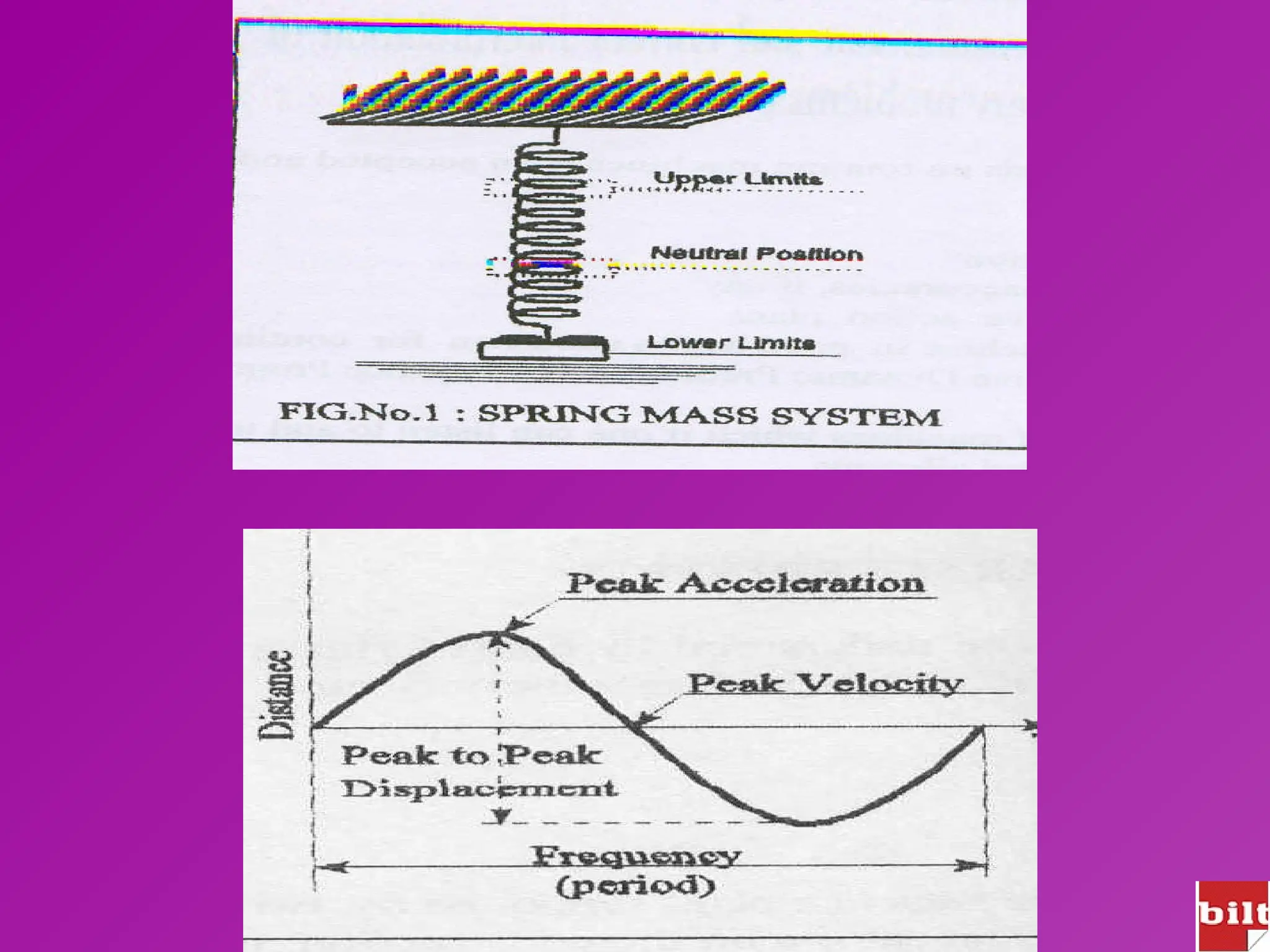
It is a total distance moved by a vibrating part from one extreme limit to
the other extreme limit. It is also called as ‘Peak to Peak Displacement’.
The displacement is measured in microns.
Vibration Velocity :
While the vibrating part moves up-down , it moves with some
speed ,which is continuously changing.At the top and bottom extreme
positions, the speed is zero ,while in the neutral position it is maximum.
The velocity is measured in mm/s.
What we measure in our plant with SPM instrument , is Root Mean
Square Velocity. It has direct relationship to the energy content in
vibration.
Basics Of Vibration Analysis
Vibration Acceleration :
As we see that the vibration velocity changes continuously , there is an
acceleration ( acceleration = rate of change of velocity ) .
Acceleration is maximum at the extreme limits and it is zero at neutral
position.
Acceleration is measured is measured in mm/s2.
Vibration Frequency :
The vibrating part moves from its neutral position to one extreme limit ,
returns to the neutral position and moves to the other extreme limit and
again moves to the neutral position. This complete process is called as a
cycle.
No. of cycles completed by the vibrating part is called as frequency.
It is measured in CPM ( cycles per minute).
Basics Of Vibration Analysis
Vibration Phase :
It can be defined as the instantaneous position of a vibrating part with
respect to a fixed reference point or to an another vibrating part.
The phase measurement is useful to compare one vibratory motion with
another. It can also be used identifying the relative position of one
vibratory part with reference to another vibratory part.
Significance of Vibration Characteristics :
Displacement,velocity& acceleration indicate Health
Frequency indicates Cause
Phase indicates Location
of defect
Machinery Problem Diagnostics
In today’s competitive industrial environment, it is very
essential to achieve maximum availability of the plant
machinery.The machines are subjected to rigorous operating
period and there is possibility of breaking down the machines
due to various problems.
Various problems in machines :
Main causes of vibrations :
• Unbalance
• Misalignment
• Mechanical looseness
• Eccentricity
• Distortion
Machinery Problem Diagnostics
Defects in Gears and Gear Boxes
• Defects in Belt Driven Machines
• Miscellaneous Defects :
# Inadequate foundation
# Loose foundation bolts
# Cracks in foundation
# Piping forces
# Resonance conditions
Machinery Problem Diagnostics
Electrical Defects :
 Non-uniform air gap between rotor & stator
 Magnetic center shift
 Unbalanced supply in three phases
 Winding defects
Unbalance
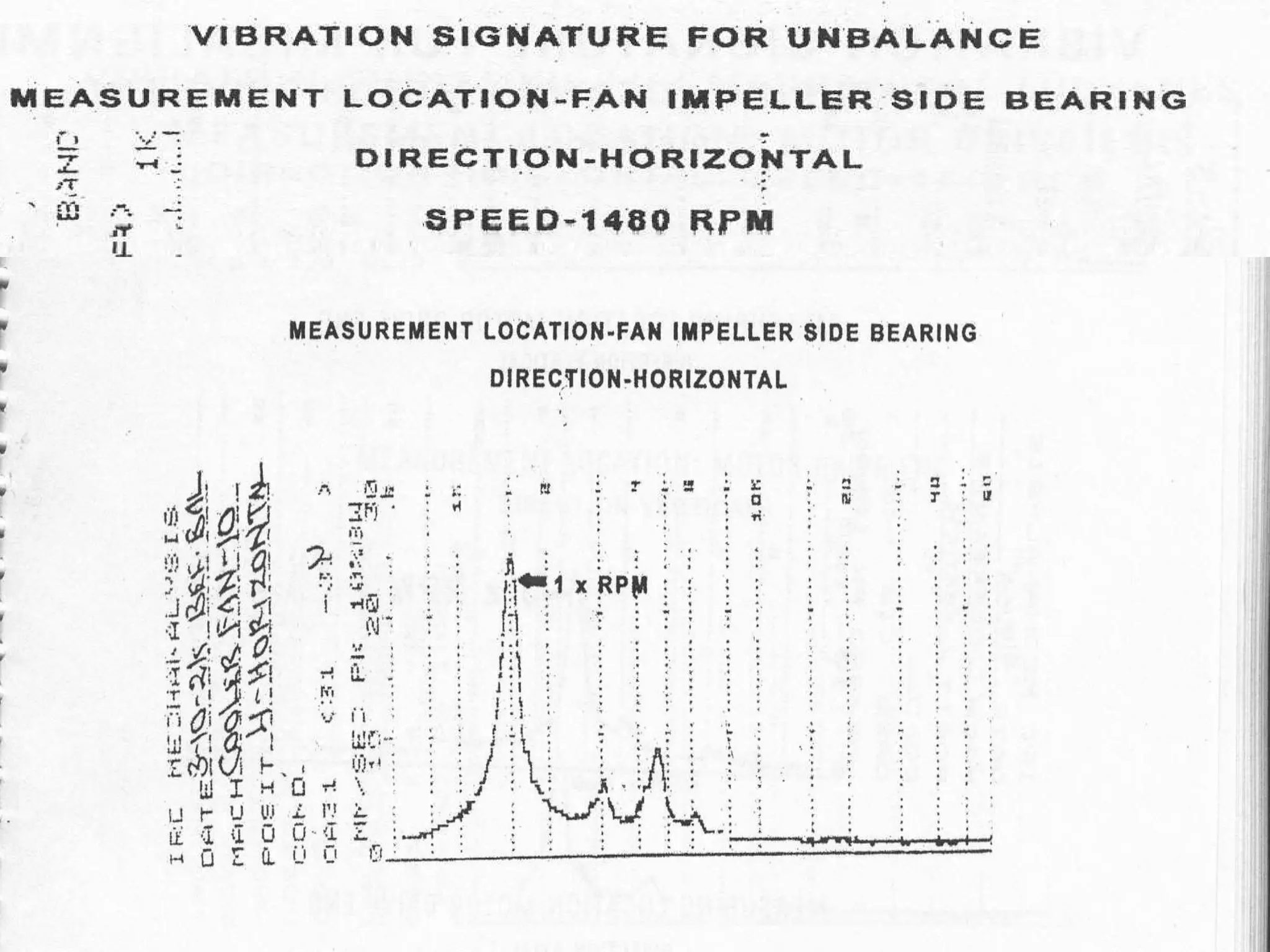
 Most common defect in rotating machines.
 Definition - Uneven distribution of masses in rotating machines.
 Produces vibrations at a frequency equal to the rotating speed of
the machine. i.e.Vibrating frequency , CPM=RPM of the machine
 Largest vibration amplitude - in radial direction (either vertical or
horizontal)
 Vibration phase - always steady
 Missing / lost or added /extra rotating part causes unbalance
Unbalance
Reasons of unbalance during operation -
a) Changes in mass , level , clearance
b) Centering inaccuracies
c) Deflections
Depending on the distribution of unbalanced mass w.r.t. the shaft axis
( SA ) and central principal axis ( CPA ) , the unbalance can be
classified as :
1) Static unbalance - CPA parallel to SA
2) Couple unbalance - CPA intersecting SA at center of gravity
3) Quasi-static unbalance - CPA intersecting SA away from center
of gravity
4) Dynamic unbalance - CPA & SA in different planes
Unbalance
Out of the four types of Unbalance , dynamic unbalance is
more complex . It is a combination of couple unbalance
and static unbalance which are not in direct line with each
other.
Dynamic balancing can be achieved by weight corrections
at required directions and planes of a rotor.
Methods of Dynamic Balancing
a) Three point method
b) Single plane vector method
These methods are being used in Balancing Centers .
Misalignment
Induces high vibration levels.
 Leads to premature failure of machine components.
 Also demands for increased energy.
 Leading cause of bearing failures.
 Types : a) Angular misalignment
b) Parallel misalignment
Misalignment
Angular misalignment generates high axial vibrations at 1 * and 2 * RPM.
• If amplitude of 2* or 3* RPM exceeds approx..30-50% of 1 * RPM in axial
direction <=> angular misalignment
• If phase difference across coupling is 180° in axial direction <=> angular
misalignment
• Parallel misalignment primarily affects radial(vertical/horizontal) vibrations.
• If phase difference across coupling is 180° in radial direction <=> parallel
misalignment
• If amplitude of 2 * RPM exceeds approx..50% of 1 * RPM in radial
direction <=> parallel misalignment
Mechanical Looseness
Can be detected either by high vibration at 2 * RPM or multiple running
speed harmonics.
• Three types of looseness
1. Type A - Structural frame / base looseness
2. Type B- Looseness due to rocking motion or cracked structure
3. Type C- Loose bearing in housing / improper fit between
components.
Each type has its own characteristic vibration spectra as well as phase
behavior.
Mechanical looseness alone is not a cause of vibrations.
Defects in Gears and Gear Boxes
Gear inaccuracies are major problems associated with industries with all
types of gear boxes.The normal inaccuracies are:
1) Cracked teeth
2) Gear tooth profile variations
3) Misaligned gears
4) Insufficient teeth contact
5) Gear centering inaccuracies
6) Improper backlash
7) Improper root clearances
The main vibration frequency will be equal to No.of gear teeth*RPM
and this is a high frequency vibration.
Defective Belt Driven System
Normal defects of belt driven systems are as:
 Improper matching of V-belts with the pulley groove
 Non-uniform tensioning of the belts
 Cracks or side wear of belts
 Damaged pulleys
 Misalignment of pulleys
 Eccentric pulleys
Vibration frequency shall be in multiples of belt RPM.
Direction of high vibration shall normally be radial . But if the
pulleys are misaligned , high axial vibrations will be observed.
Piping Forces
Piping forces are generated due to excessive tension created during
fixing. If suction and/or delivery manifolds of a rotating equipment
are connected to a system ,without eliminating tension , the piping
forces will act on the system.
Methods to eliminate -
a) To provide expansion bellows in the piping or ducting system.
b) To make sure that no residual force is created during mounting of
pipes or ducts.
•Vibration frequency shall be 1*RPM followed by 2*RPM and these
shall be simultaneously present.
•The direction of vibration will normally be axial while phase
difference shall be changing from time to time.
Problems of Electrical Machines
The pattern of vibrations in Electrical motors is different from
other rotating equipment because of the presence of
synchronously rotating magnetic field along with the
synchronously moving rotor.
Excitation forces causing vibrations :
Mechanical -1) Rotor imbalance
2) Loose rotating parts
3) Bent shafts
4) Misalignment at coupling
5) Damaged bearings
6) Dis-symmetry in shaft stiffness
Problems of Electrical Machines
Excitation forces causing vibrations :
Magnetic - 1) Non-uniform air gap between rotor and stator
2) Magnetic center deviation
3) Shorted stator turns
4) Broken rotor bars
5) Sorted rotor and stator laminations
6) Rotor eccentricity
Misc.- Unbalanced supply in three phases
Resonance
Resonance :
Every Mechanical system has a series of natural frequencies , each of
which has its own damping characteristics.These natural frequencies
lie ‘dormant’ in a system until they are excited by some external
influence.Vibration level greatly amplifies if a forcing function
happens to be within the range of a natural frequency. When such
forcing frequency coincides with a natural frequency ,it is called as
resonance.
If the resonance sustains over a long period , the effects are significant
and can range from premature wear to fatigue failure or complete
structural damage.
The resonance can be encountered not only at 1* RPM , but can be at a
series of frequencies like 2*RPM , 3*RPM etc.
Resonance
Natural Frequency :
Natural frequency is the frequency of free vibration of a system. The frequency at
which an undamped system with a single degree of freedom will oscillate upon
momentary displacement from its rest position.
For multiple degree-of-freedom system , as in practical , there are a number of
natural frequencies.A machine has natural frequencies is not a problem , but the
problem arises if one of these are excited.
Level of dynamic stresses go much-much higher if the excitation forces act at one or
more natural frequencies , than they would have acted at other than natural
frequencies. The aim should be to prevent such a situation.
RESONANCE
Critical Speed :
Problems related to the critical speed are special cases of resonance in which
the vibrating forces are caused by the rotation of the rotor.
The natural frequencies encountered in the critical speed are functions of
mass and stiffness depending on machine speed.
Generally , good design practices mandate that a machine should be designed
not to operate within 20% of a critical speed ( not 20% of any natural
frequency ).
Practically it is impossible to operate at least 20% away from any natural
frequency of a machine.Any structure has six different sets of natural
frequencies including those in horizontal,vertical,axial and three rocking
modes in each three directions.
Resonance
It is necessary to identify the locations of all possible resonance being
excited, how severe the resonant vibration is, and what is the duration for
which the m/c is subjected to resonance.
The influence force may be at different frequencies like-
Unbalance at 1*RPM
Misalignment possibly at 2*RPM
Gear problem at No.of teeth*RPM
Blade pass frequency at No.of blades*RPM etc.
The problem occurs when the frequency ratio f/fn = 1.0 . When this occurs ,
vibration can be amplified many times higher , often in the order of 10 or
even 50 times higher depending on the amount of damping within the system.
A lightly damped system will suffer a tremendous increase when vibrating at
natural frequency.
General Tips For Maintenance
Care during alignment :
• Make sure that coupling is not damaged , broken or cracked.
• Ensure that keys and key-ways are not protruding beyond the coupling.
• Ensure uniform size and length of coupling bolts.
• Ensure that uniform size of washers and nuts are used in coupling.
• Never allow any missing bolt in coupling.
• Ensure perfect horizontality of machine shafts before alignment.
• Never damage the coupling by hammering during mounting/dismounting.
• Ensure correct fit between the shaft and coupling halves.
• Make match marks on the coupling.
• Ensure that proper shims and packers are used during alignment.
General Tips For Maintenance
Care during bearing mounting/dismounting :
• Ensure correct fit between shaft and bearing inner race . The normal recommended fit
is ‘ interference’.
• Ensure that bearing axis and geometric axis of the shaft coincides.
• Eliminate clearance or improper fit between outer race and housing.
• Maintain the bearing clearance within the permissible limit.
• Eliminate even minor eccentricity in the shaft journal.
• Allow adequate axial expansion margins in bearings subjected to high operating
temperatures.
• Provide adequate locking in the ‘fixed bearing’.
General Tips For Maintenance
Care during repair of rotor parts :
• Ensure that uniform metal is deposited at diametrically opposite locations.
• Ensure that radius of weld material deposited is also equal in the diametrically
opposite locations.
• Do not cause and allow distortion of a rotor either by hammering or due to thermal
expansions.
Care during cleaning of rotor parts :
• Ensure that thorough cleaning is implemented in all parts of the rotor.
• Non-uniform cleaning will cause severe unbalance in the rotor.
General Tips For Maintenance
Care during maintenance of blowers :
• Before starting a blower, ensure that the impeller is completely balanced.
• Check the casing for any damage or bends etc.
• Inspect and clear all the projecting parts inside the casing.
• Ensure uniform clearance between the impeller and casing.
• Never allow any minor rubbing of these parts.
• Ensure that no loose material like pieces of used electrodes, washers, welding slag,
bolts or nuts are left inside the casing.
• While storing rotor parts like impellers , sufficient care should be taken to protect the
same from rusting.
• All machined surfaces are to be suitably protected.
PRESENTATION-VIBRATION oand their analysis with details

PRESENTATION-VIBRATION oand their analysis with details

  • 2.
  • 3.
    Contents  Basics OfVibration Analysis  Machinery Problem Diagnostics  Problems Of Electrical Machines  Resonance  General Tips For Maintenance
  • 4.
    Basics Of VibrationAnalysis Mostly a machine maintenance crew is knowing only breakdown maintenance. But now, in the changed Industrial scenario, the industries have to adopt new methodologies and effective maintenance procedures to enhance productivity and to reduce production cost.For this, they should know about their machines and machines’ behavior. Preventive maintenance and predictive maintenance are the two methods which help maintenance people to know a health of their machines and the medicine for the poor health also. Vibration analysis of rotating machines is one of the most useful tools to know the machine health.It gives utmost machine problem diagnostics. Vibration analysis is useful to all the three basic Engineering branches viz. Mechanical , Electrical and Civil.
  • 5.
    Basics Of VibrationAnalysis The accurate measurement and correct interpretation of vibrations can help diagnosing machinery problems during operation.Vibration is the language of machines which if one can listen to and understand , is enough to diagnose their complaints and ailments. Source of Vibrations : Vibrations are not useful to machine operation at all and all possible efforts are to be taken to minimize vibrations. If someone says that my machine is not vibrating , that means either the machine health is exceptionally very good or the machine itself is not in operation. While designing a machine , all possible parameters are taken into consideration to make the machine optimum .But while manufacturing the machine parts, some inaccuracies and minor imperfections are introduced as a part of machining process.
  • 6.
    Basics Of VibrationAnalysis While installing the machines, human and technical errors cause imperfect machine installation.Also during machine operations, wear and tear of machine parts take place, which add to the vibrations. In fact , in Engineering , there are tolerances and permissible limits etc. to take care of all possible and unavoidable imperfections. There are permissible limits of vibration level too.These limits depends on m/c type , its speed , load, stress etc. Important Vibration Characteristics : • Displacement • Velocity • Acceleration • Frequency • Phase
  • 8.
    Basics Of VibrationAnalysis Vibration Displacement : It is a total distance moved by a vibrating part from one extreme limit to the other extreme limit. It is also called as ‘Peak to Peak Displacement’. The displacement is measured in microns. Vibration Velocity : While the vibrating part moves up-down , it moves with some speed ,which is continuously changing.At the top and bottom extreme positions, the speed is zero ,while in the neutral position it is maximum. The velocity is measured in mm/s. What we measure in our plant with SPM instrument , is Root Mean Square Velocity. It has direct relationship to the energy content in vibration.
  • 9.
    Basics Of VibrationAnalysis Vibration Acceleration : As we see that the vibration velocity changes continuously , there is an acceleration ( acceleration = rate of change of velocity ) . Acceleration is maximum at the extreme limits and it is zero at neutral position. Acceleration is measured is measured in mm/s2. Vibration Frequency : The vibrating part moves from its neutral position to one extreme limit , returns to the neutral position and moves to the other extreme limit and again moves to the neutral position. This complete process is called as a cycle. No. of cycles completed by the vibrating part is called as frequency. It is measured in CPM ( cycles per minute).
  • 10.
    Basics Of VibrationAnalysis Vibration Phase : It can be defined as the instantaneous position of a vibrating part with respect to a fixed reference point or to an another vibrating part. The phase measurement is useful to compare one vibratory motion with another. It can also be used identifying the relative position of one vibratory part with reference to another vibratory part. Significance of Vibration Characteristics : Significance of Vibration Characteristics : Displacement,velocity& acceleration indicate Health Frequency indicates Cause Phase indicates Location of defect
  • 12.
    Machinery Problem Diagnostics Intoday’s competitive industrial environment, it is very essential to achieve maximum availability of the plant machinery.The machines are subjected to rigorous operating period and there is possibility of breaking down the machines due to various problems. Various problems in machines : Main causes of vibrations : • Unbalance • Misalignment • Mechanical looseness • Eccentricity • Distortion
  • 13.
    Machinery Problem Diagnostics Defectsin Gears and Gear Boxes • Defects in Belt Driven Machines • Miscellaneous Defects : # Inadequate foundation # Loose foundation bolts # Cracks in foundation # Piping forces # Resonance conditions
  • 14.
    Machinery Problem Diagnostics ElectricalDefects :  Non-uniform air gap between rotor & stator  Magnetic center shift  Unbalanced supply in three phases  Winding defects
  • 15.
    Unbalance  Most commondefect in rotating machines.  Definition - Uneven distribution of masses in rotating machines.  Produces vibrations at a frequency equal to the rotating speed of the machine. i.e.Vibrating frequency , CPM=RPM of the machine  Largest vibration amplitude - in radial direction (either vertical or horizontal)  Vibration phase - always steady  Missing / lost or added /extra rotating part causes unbalance
  • 16.
    Unbalance Reasons of unbalanceduring operation - a) Changes in mass , level , clearance b) Centering inaccuracies c) Deflections Depending on the distribution of unbalanced mass w.r.t. the shaft axis ( SA ) and central principal axis ( CPA ) , the unbalance can be classified as : 1) Static unbalance - CPA parallel to SA 2) Couple unbalance - CPA intersecting SA at center of gravity 3) Quasi-static unbalance - CPA intersecting SA away from center of gravity 4) Dynamic unbalance - CPA & SA in different planes
  • 17.
    Unbalance Out of thefour types of Unbalance , dynamic unbalance is more complex . It is a combination of couple unbalance and static unbalance which are not in direct line with each other. Dynamic balancing can be achieved by weight corrections at required directions and planes of a rotor. Methods of Dynamic Balancing a) Three point method b) Single plane vector method These methods are being used in Balancing Centers .
  • 18.
    Misalignment Induces high vibrationlevels.  Leads to premature failure of machine components.  Also demands for increased energy.  Leading cause of bearing failures.  Types : a) Angular misalignment b) Parallel misalignment
  • 19.
    Misalignment Angular misalignment generateshigh axial vibrations at 1 * and 2 * RPM. • If amplitude of 2* or 3* RPM exceeds approx..30-50% of 1 * RPM in axial direction <=> angular misalignment • If phase difference across coupling is 180° in axial direction <=> angular misalignment • Parallel misalignment primarily affects radial(vertical/horizontal) vibrations. • If phase difference across coupling is 180° in radial direction <=> parallel misalignment • If amplitude of 2 * RPM exceeds approx..50% of 1 * RPM in radial direction <=> parallel misalignment
  • 20.
    Mechanical Looseness Can bedetected either by high vibration at 2 * RPM or multiple running speed harmonics. • Three types of looseness 1. Type A - Structural frame / base looseness 2. Type B- Looseness due to rocking motion or cracked structure 3. Type C- Loose bearing in housing / improper fit between components. Each type has its own characteristic vibration spectra as well as phase behavior. Mechanical looseness alone is not a cause of vibrations.
  • 21.
    Defects in Gearsand Gear Boxes Gear inaccuracies are major problems associated with industries with all types of gear boxes.The normal inaccuracies are: 1) Cracked teeth 2) Gear tooth profile variations 3) Misaligned gears 4) Insufficient teeth contact 5) Gear centering inaccuracies 6) Improper backlash 7) Improper root clearances The main vibration frequency will be equal to No.of gear teeth*RPM and this is a high frequency vibration.
  • 22.
    Defective Belt DrivenSystem Normal defects of belt driven systems are as:  Improper matching of V-belts with the pulley groove  Non-uniform tensioning of the belts  Cracks or side wear of belts  Damaged pulleys  Misalignment of pulleys  Eccentric pulleys Vibration frequency shall be in multiples of belt RPM. Direction of high vibration shall normally be radial . But if the pulleys are misaligned , high axial vibrations will be observed.
  • 23.
    Piping Forces Piping forcesare generated due to excessive tension created during fixing. If suction and/or delivery manifolds of a rotating equipment are connected to a system ,without eliminating tension , the piping forces will act on the system. Methods to eliminate - a) To provide expansion bellows in the piping or ducting system. b) To make sure that no residual force is created during mounting of pipes or ducts. •Vibration frequency shall be 1*RPM followed by 2*RPM and these shall be simultaneously present. •The direction of vibration will normally be axial while phase difference shall be changing from time to time.
  • 24.
    Problems of ElectricalMachines The pattern of vibrations in Electrical motors is different from other rotating equipment because of the presence of synchronously rotating magnetic field along with the synchronously moving rotor. Excitation forces causing vibrations : Mechanical -1) Rotor imbalance 2) Loose rotating parts 3) Bent shafts 4) Misalignment at coupling 5) Damaged bearings 6) Dis-symmetry in shaft stiffness
  • 25.
    Problems of ElectricalMachines Excitation forces causing vibrations : Magnetic - 1) Non-uniform air gap between rotor and stator 2) Magnetic center deviation 3) Shorted stator turns 4) Broken rotor bars 5) Sorted rotor and stator laminations 6) Rotor eccentricity Misc.- Unbalanced supply in three phases
  • 26.
    Resonance Resonance : Every Mechanicalsystem has a series of natural frequencies , each of which has its own damping characteristics.These natural frequencies lie ‘dormant’ in a system until they are excited by some external influence.Vibration level greatly amplifies if a forcing function happens to be within the range of a natural frequency. When such forcing frequency coincides with a natural frequency ,it is called as resonance. If the resonance sustains over a long period , the effects are significant and can range from premature wear to fatigue failure or complete structural damage. The resonance can be encountered not only at 1* RPM , but can be at a series of frequencies like 2*RPM , 3*RPM etc.
  • 27.
    Resonance Natural Frequency : Naturalfrequency is the frequency of free vibration of a system. The frequency at which an undamped system with a single degree of freedom will oscillate upon momentary displacement from its rest position. For multiple degree-of-freedom system , as in practical , there are a number of natural frequencies.A machine has natural frequencies is not a problem , but the problem arises if one of these are excited. Level of dynamic stresses go much-much higher if the excitation forces act at one or more natural frequencies , than they would have acted at other than natural frequencies. The aim should be to prevent such a situation.
  • 28.
    RESONANCE Critical Speed : Problemsrelated to the critical speed are special cases of resonance in which the vibrating forces are caused by the rotation of the rotor. The natural frequencies encountered in the critical speed are functions of mass and stiffness depending on machine speed. Generally , good design practices mandate that a machine should be designed not to operate within 20% of a critical speed ( not 20% of any natural frequency ). Practically it is impossible to operate at least 20% away from any natural frequency of a machine.Any structure has six different sets of natural frequencies including those in horizontal,vertical,axial and three rocking modes in each three directions.
  • 29.
    Resonance It is necessaryto identify the locations of all possible resonance being excited, how severe the resonant vibration is, and what is the duration for which the m/c is subjected to resonance. The influence force may be at different frequencies like- Unbalance at 1*RPM Misalignment possibly at 2*RPM Gear problem at No.of teeth*RPM Blade pass frequency at No.of blades*RPM etc. The problem occurs when the frequency ratio f/fn = 1.0 . When this occurs , vibration can be amplified many times higher , often in the order of 10 or even 50 times higher depending on the amount of damping within the system. A lightly damped system will suffer a tremendous increase when vibrating at natural frequency.
  • 30.
    General Tips ForMaintenance Care during alignment : • Make sure that coupling is not damaged , broken or cracked. • Ensure that keys and key-ways are not protruding beyond the coupling. • Ensure uniform size and length of coupling bolts. • Ensure that uniform size of washers and nuts are used in coupling. • Never allow any missing bolt in coupling. • Ensure perfect horizontality of machine shafts before alignment. • Never damage the coupling by hammering during mounting/dismounting. • Ensure correct fit between the shaft and coupling halves. • Make match marks on the coupling. • Ensure that proper shims and packers are used during alignment.
  • 31.
    General Tips ForMaintenance Care during bearing mounting/dismounting : • Ensure correct fit between shaft and bearing inner race . The normal recommended fit is ‘ interference’. • Ensure that bearing axis and geometric axis of the shaft coincides. • Eliminate clearance or improper fit between outer race and housing. • Maintain the bearing clearance within the permissible limit. • Eliminate even minor eccentricity in the shaft journal. • Allow adequate axial expansion margins in bearings subjected to high operating temperatures. • Provide adequate locking in the ‘fixed bearing’.
  • 32.
    General Tips ForMaintenance Care during repair of rotor parts : • Ensure that uniform metal is deposited at diametrically opposite locations. • Ensure that radius of weld material deposited is also equal in the diametrically opposite locations. • Do not cause and allow distortion of a rotor either by hammering or due to thermal expansions. Care during cleaning of rotor parts : • Ensure that thorough cleaning is implemented in all parts of the rotor. • Non-uniform cleaning will cause severe unbalance in the rotor.
  • 33.
    General Tips ForMaintenance Care during maintenance of blowers : • Before starting a blower, ensure that the impeller is completely balanced. • Check the casing for any damage or bends etc. • Inspect and clear all the projecting parts inside the casing. • Ensure uniform clearance between the impeller and casing. • Never allow any minor rubbing of these parts. • Ensure that no loose material like pieces of used electrodes, washers, welding slag, bolts or nuts are left inside the casing. • While storing rotor parts like impellers , sufficient care should be taken to protect the same from rusting. • All machined surfaces are to be suitably protected.