
REFLEX ASSESSMENT
BY
DR. APOORVA SRIVASTAVA
ASSISTANT PROFESSOR
RAMA UNIVERSITY
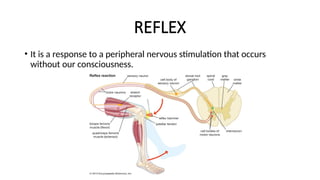
REFLEX
• It is a response to a peripheral nervous stimulation that occurs
without our consciousness.
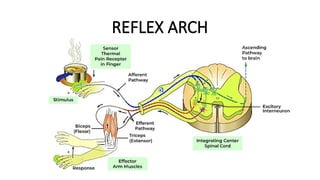
REFLEX ARCH
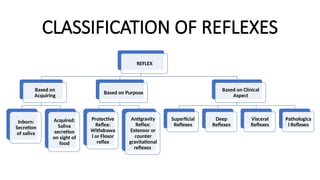
CLASSIFICATION OF REFLEXES
REFLEX
Based on
Acquiring
Inborn:
Secretion
of saliva
Acquired:
Saliva
secretion
on sight of
food
Based on Purpose
Protective
Reflex:
Withdrawa
l or Flexor
reflex
Antigravity
Reflex:
Extensor or
counter
gravitational
reflexes
Based on Clinical
Aspect
Superficial
Reflexes
Deep
Reflexes
Visceral
Reflexes
Pathologica
l Reflexes
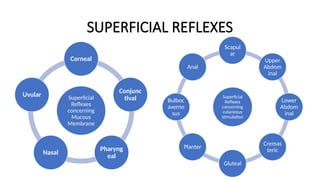
SUPERFICIAL REFLEXES
Superficial
Reflexes
concerning
Mucous
Membrane
Corneal
Conjunc
tival
Pharyng
eal
Nasal
Uvular Superficial
Reflexes
concerning
cutaneous
stimulation
Scapul
ar
Upper
Abdom
inal
Lower
Abdom
inal
Cremas
teric
Gluteal
Planter
Bulboc
averno
sus
Anal
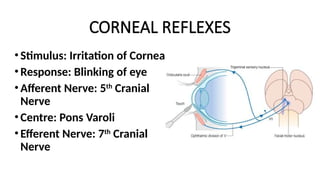
CORNEAL REFLEXES
•Stimulus: Irritation of Cornea
•Response: Blinking of eye
•Afferent Nerve: 5th
Cranial
Nerve
•Centre: Pons Varoli
•Efferent Nerve: 7th
Cranial
Nerve
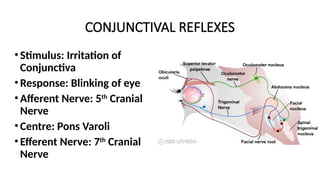
CONJUNCTIVAL REFLEXES
•Stimulus: Irritation of
Conjunctiva
•Response: Blinking of eye
•Afferent Nerve: 5th
Cranial
Nerve
•Centre: Pons Varoli
•Efferent Nerve: 7th
Cranial
Nerve
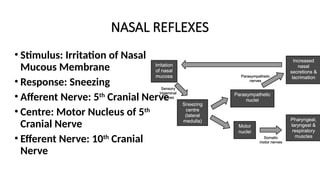
NASAL REFLEXES
• Stimulus: Irritation of Nasal
Mucous Membrane
• Response: Sneezing
• Afferent Nerve: 5th
Cranial Nerve
• Centre: Motor Nucleus of 5th
Cranial Nerve
• Efferent Nerve: 10th
Cranial
Nerve
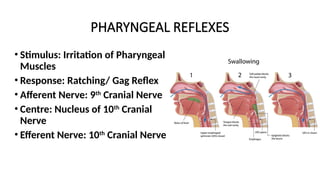
PHARYNGEAL REFLEXES
• Stimulus: Irritation of Pharyngeal
Muscles
• Response: Ratching/ Gag Reflex
• Afferent Nerve: 9th
Cranial Nerve
• Centre: Nucleus of 10th
Cranial
Nerve
• Efferent Nerve: 10th
Cranial Nerve
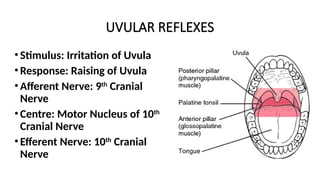
UVULAR REFLEXES
•Stimulus: Irritation of Uvula
•Response: Raising of Uvula
•Afferent Nerve: 9th
Cranial
Nerve
•Centre: Motor Nucleus of 10th
Cranial Nerve
•Efferent Nerve: 10th
Cranial
Nerve
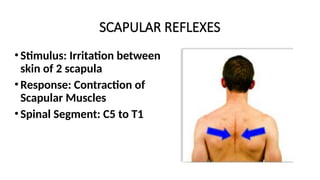
SCAPULAR REFLEXES
•Stimulus: Irritation between
skin of 2 scapula
•Response: Contraction of
Scapular Muscles
•Spinal Segment: C5 to T1
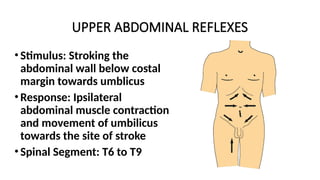
UPPER ABDOMINAL REFLEXES
• Stimulus: Stroking the
abdominal wall below costal
margin towards umblicus
• Response: Ipsilateral
abdominal muscle contraction
and movement of umbilicus
towards the site of stroke
• Spinal Segment: T6 to T9
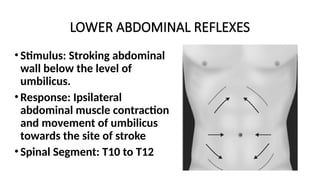
LOWER ABDOMINAL REFLEXES
• Stimulus: Stroking abdominal
wall below the level of
umbilicus.
• Response: Ipsilateral
abdominal muscle contraction
and movement of umbilicus
towards the site of stroke
• Spinal Segment: T10 to T12
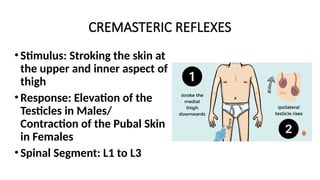
CREMASTERIC REFLEXES
•Stimulus: Stroking the skin at
the upper and inner aspect of
thigh
•Response: Elevation of the
Testicles in Males/
Contraction of the Pubal Skin
in Females
•Spinal Segment: L1 to L3
GLUTEAL REFLEXES
•Stimulus: Stroking the skin
over the gluteal muscles
•Response: Gluteal Muscle
Contraction
•Spinal Segment: L4, L5, S1, S2
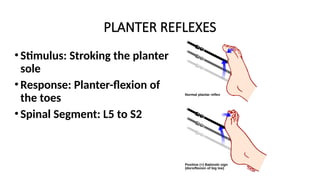
PLANTER REFLEXES
•Stimulus: Stroking the planter
sole
•Response: Planter-flexion of
the toes
•Spinal Segment: L5 to S2
BULBOCAVERNOUS REFLEXES
•Stimulus: Stroking the
dorsum of Glans Penis
•Response: Contraction of
Bulbocavernous Muscle
•Spinal Segment: S3 S4
ANAL REFLEXES
•Stimulus: Stroking the anal
region
•Response: Contraction of anal
sphincter
•Spinal Segment: S4 S5
DEEP REFLEXES
JAW JERK
BICEPS
JERK
TRICEPS
JERK
SUPINATOR
JERK
KNEE JERK ANKLE JERK
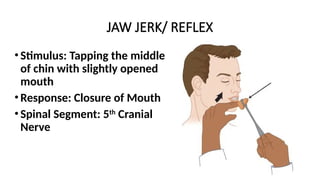
JAW JERK/ REFLEX
•Stimulus: Tapping the middle
of chin with slightly opened
mouth
•Response: Closure of Mouth
•Spinal Segment: 5th
Cranial
Nerve
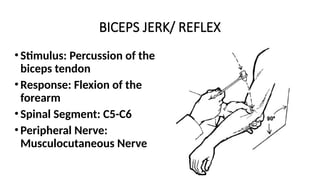
BICEPS JERK/ REFLEX
•Stimulus: Percussion of the
biceps tendon
•Response: Flexion of the
forearm
•Spinal Segment: C5-C6
•Peripheral Nerve:
Musculocutaneous Nerve
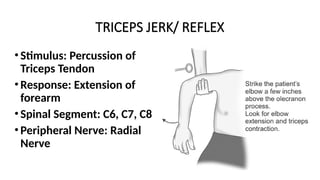
TRICEPS JERK/ REFLEX
•Stimulus: Percussion of
Triceps Tendon
•Response: Extension of
forearm
•Spinal Segment: C6, C7, C8
•Peripheral Nerve: Radial
Nerve
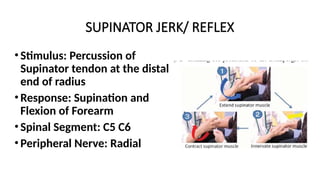
SUPINATOR JERK/ REFLEX
•Stimulus: Percussion of
Supinator tendon at the distal
end of radius
•Response: Supination and
Flexion of Forearm
•Spinal Segment: C5 C6
•Peripheral Nerve: Radial
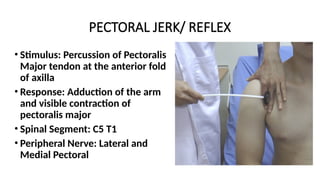
PECTORAL JERK/ REFLEX
• Stimulus: Percussion of Pectoralis
Major tendon at the anterior fold
of axilla
• Response: Adduction of the arm
and visible contraction of
pectoralis major
• Spinal Segment: C5 T1
• Peripheral Nerve: Lateral and
Medial Pectoral
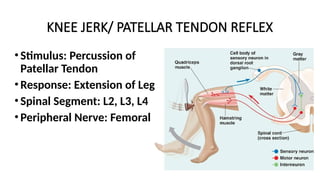
KNEE JERK/ PATELLAR TENDON REFLEX
•Stimulus: Percussion of
Patellar Tendon
•Response: Extension of Leg
•Spinal Segment: L2, L3, L4
•Peripheral Nerve: Femoral
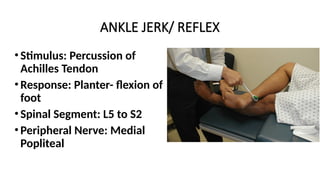
ANKLE JERK/ REFLEX
•Stimulus: Percussion of
Achilles Tendon
•Response: Planter- flexion of
foot
•Spinal Segment: L5 to S2
•Peripheral Nerve: Medial
Popliteal
PATHOLOGICAL REFLEXES
BABINSKI’S SIGN
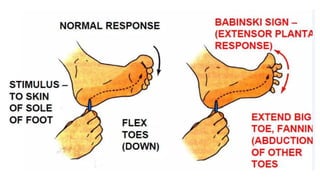
• Abnormal planter reflex
• In normal planter reflex the gentle scratch over the outer edge of the
sole causes planter flexion and adduction of the toes and dorsiflexion
and inversion of the foot
• When Babinski’s sign is positive there is dorsiflexion of great toe and
fanning of the other toes
• Usually positive when an individual sleep or in case of new born
babies
Clonus
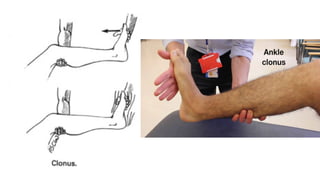
• Clonus is a series of rapid and repeated jerky movements which occur while
eliciting a deep reflex.
• It may be of two types: ankle clonus and patellar clonus
• Ankle Clonus: knee is slightly flexed and a sudden dorsiflexion of foot
causes rhythmic contraction of calf muscles. Results in rhythmic planter-
flexion at ankle joint
• Patellar Clonus: In this condition, patient’s leg is extended and patella is
suddenly pushed down towards the foot. Results in rhythmic contraction of
quadriceps muscle.
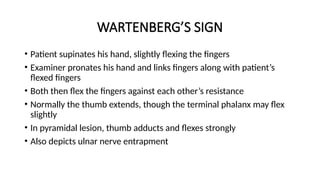
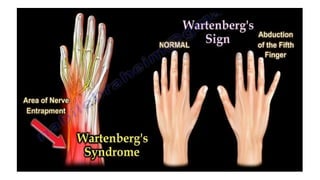
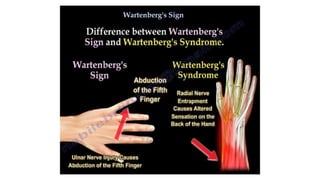
WARTENBERG’S SIGN
• Patient supinates his hand, slightly flexing the fingers
• Examiner pronates his hand and links fingers along with patient’s
flexed fingers
• Both then flex the fingers against each other’s resistance
• Normally the thumb extends, though the terminal phalanx may flex
slightly
• In pyramidal lesion, thumb adducts and flexes strongly
• Also depicts ulnar nerve entrapment
VISCERAL REFLEXES
• Pupillary Reflex: Direct Light reflex which causes constriction of the
pupil
• Accommodation Reflex: which causes the constriction of pupil
according to light sensation
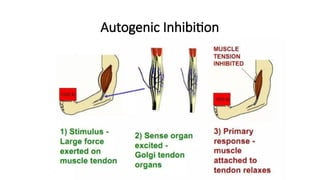
Autogenic Inhibition
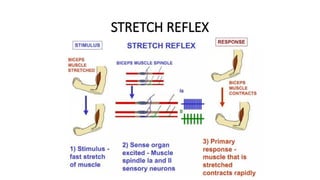
STRETCH REFLEX
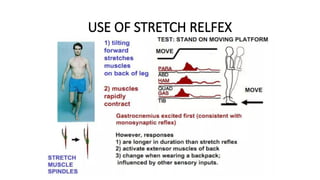
USE OF STRETCH RELFEX
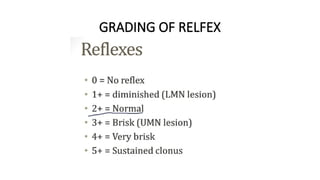
GRADING OF RELFEX
LESSIONS
• In Upper Motor Neuron lesion the superficial reflexes are lost and
deep tendon reflexes are exaggerated
REFLEX- ARC, GRADING AND ASSESSMENT.pptx

REFLEX- ARC, GRADING AND ASSESSMENT.pptx