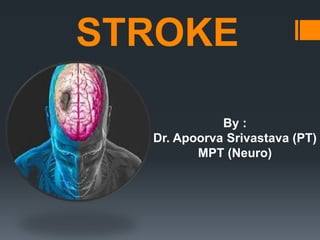

STROKE
By :
Dr. Apoorva Srivastava (PT)
MPT (Neuro)
INTRODUCTION
Acute loss of focal brain function with symptoms lasting more
than 24 hours or leading to death.
It is a rapidly developing clinical signs of focal disturbances of
cerebral functions or pre-assumed vascular origin and of more
than 24 hours of origin.
Primary causes include inadequate blood supply to a part of
brain or spontaneous hemorrhage into a part of brain or over
surface of brain.
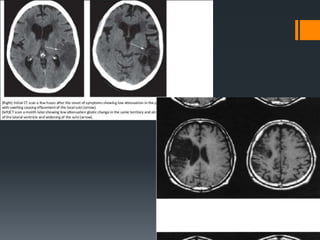
“It is defined as an episode of focal neurologic dysfunction in
which the autopsy, CT scan, or MRI Scan shows features
consistent with focal brain infections or hemorrhage.”-
American Stroke Association.
Also known as CVA or Cerebro-Vascular Accidents.
1. Gowrishankar potturi; physiotherapy in neurological conditions; CBS publishers.
2. Philip B gorelick.et.al; Hankey’s clinical neurology; 2nd edition.
3. Susan B. O’Sullivan.et.al; physical rehabilitation; th edition.
4. A.k.agarwal.et.al; recent concepts in stroke; indian college of physicians.
5. James F. toole.et.al; cerebrovascular disorders; 5th edition.
INCIDENCE
In 1972, out of total population of 100,000 15.2 % males and
10.8 % in females incidences were seen.
In 2012-2013 overall 3126 patients in India were identified
with stroke with an annual incidence rate of 140/100,000.
According to WHO, 15 million people suffer from stroke
worldwide each year.
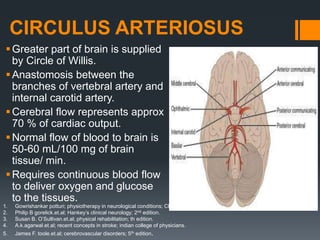
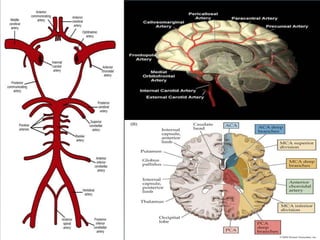
CIRCULUS ARTERIOSUS
Greater part of brain is supplied
by Circle of Willis.
Anastomosis between the
branches of vertebral artery and
internal carotid artery.
Cerebral flow represents approx
70 % of cardiac output.
Normal flow of blood to brain is
50-60 mL/100 mg of brain
tissue/ min.
Requires continuous blood flow
to deliver oxygen and glucose
to the tissues.
1. Gowrishankar potturi; physiotherapy in neurological conditions; CBS publishers.
2. Philip B gorelick.et.al; Hankey’s clinical neurology; 2nd edition.
3. Susan B. O’Sullivan.et.al; physical rehabilitation; th edition.
4. A.k.agarwal.et.al; recent concepts in stroke; indian college of physicians.
5. James F. toole.et.al; cerebrovascular disorders; 5th edition.
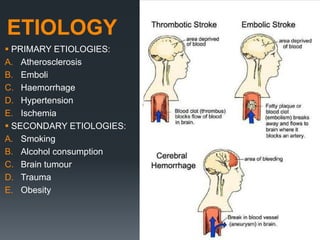
ETIOLOGY
 PRIMARY ETIOLOGIES:
A. Atherosclerosis
B. Emboli
C. Haemorrhage
D. Hypertension
E. Ischemia
 SECONDARY ETIOLOGIES:
A. Smoking
B. Alcohol consumption
C. Brain tumour
D. Trauma
E. Obesity
PATHOPHYSIOLOGY
Basic 2 mechanism causing brain damage in
stroke are ischemia and haemorrhage.
Ischemic stroke is when the blood supply is
decreased or ceased.
Haemorrhagic stroke is when there is
vascular compromise.
1. Gowrishankar potturi; physiotherapy in neurological conditions; CBS publishers.
2. Philip B gorelick.et.al; Hankey’s clinical neurology; 2nd edition.
3. Susan B. O’Sullivan.et.al; physical rehabilitation; th edition.
4. A.k.agarwal.et.al; recent concepts in stroke; indian college of physicians.
5. James F. toole.et.al; cerebrovascular disorders; 5th edition.
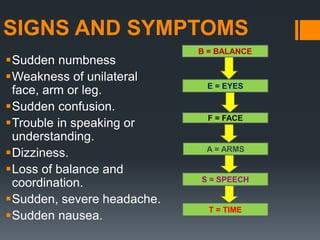
SIGNS AND SYMPTOMS
Sudden numbness
Weakness of unilateral
face, arm or leg.
Sudden confusion.
Trouble in speaking or
understanding.
Dizziness.
Loss of balance and
coordination.
Sudden, severe headache.
Sudden nausea.
B = BALANCE
E = EYES
F = FACE
A = ARMS
S = SPEECH
T = TIME
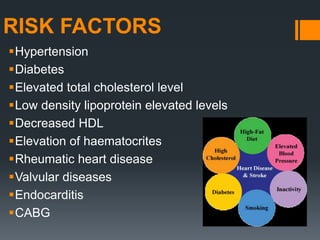
Hypertension
Diabetes
Elevated total cholesterol level
Low density lipoprotein elevated levels
Decreased HDL
Elevation of haematocrites
Rheumatic heart disease
Valvular diseases
Endocarditis
CABG
RISK FACTORS
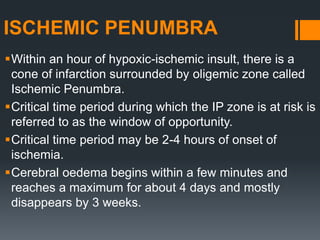
ISCHEMIC PENUMBRA
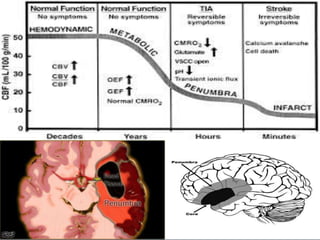
Within an hour of hypoxic-ischemic insult, there is a
cone of infarction surrounded by oligemic zone called
Ischemic Penumbra.
Critical time period during which the IP zone is at risk is
referred to as the window of opportunity.
Critical time period may be 2-4 hours of onset of
ischemia.
Cerebral oedema begins within a few minutes and
reaches a maximum for about 4 days and mostly
disappears by 3 weeks.
TYPES OF STROKE
According to etiology
According to management category
According to clinical category
1. Gowrishankar potturi; physiotherapy in neurological conditions; CBS publishers.
2. Philip B gorelick.et.al; Hankey’s clinical neurology; 2nd edition.
3. Susan B. O’Sullivan.et.al; physical rehabilitation; th edition.
4. A.k.agarwal.et.al; recent concepts in stroke; indian college of physicians.
5. James F. toole.et.al; cerebrovascular disorders; 5th edition.
ACCORDING
TO ETIOLOGY
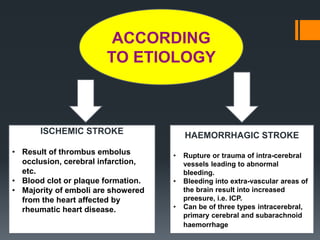
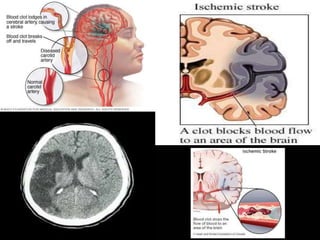
ISCHEMIC STROKE
• Result of thrombus embolus
occlusion, cerebral infarction,
etc.
• Blood clot or plaque formation.
• Majority of emboli are showered
from the heart affected by
rheumatic heart disease.
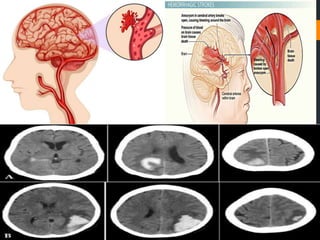
HAEMORRHAGIC STROKE
• Rupture or trauma of intra-cerebral
vessels leading to abnormal
bleeding.
• Bleeding into extra-vascular areas of
the brain result into increased
preesure, i.e. ICP.
• Can be of three types intracerebral,
primary cerebral and subarachnoid
haemorrhage.
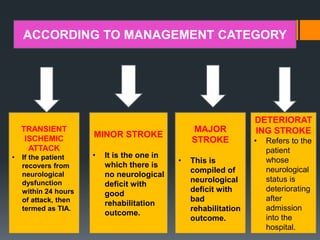
ACCORDING TO MANAGEMENT CATEGORY
TRANSIENT
ISCHEMIC
ATTACK
• If the patient
recovers from
neurological
dysfunction
within 24 hours
of attack, then
termed as TIA.
MINOR STROKE
• It is the one in
which there is
no neurological
deficit with
good
rehabilitation
outcome.
MAJOR
STROKE
• This is
compiled of
neurological
deficit with
bad
rehabilitation
outcome.
DETERIORAT
ING STROKE
• Refers to the
patient
whose
neurological
status is
deteriorating
after
admission
into the
hospital.
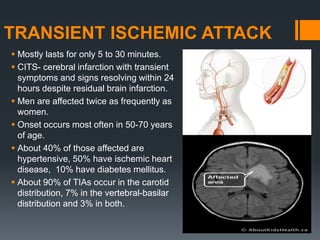
TRANSIENT ISCHEMIC ATTACK
 Mostly lasts for only 5 to 30 minutes.
 CITS- cerebral infarction with transient
symptoms and signs resolving within 24
hours despite residual brain infarction.
 Men are affected twice as frequently as
women.
 Onset occurs most often in 50-70 years
of age.
 About 40% of those affected are
hypertensive, 50% have ischemic heart
disease, 10% have diabetes mellitus.
 About 90% of TIAs occur in the carotid
distribution, 7% in the vertebral-basilar
distribution and 3% in both.
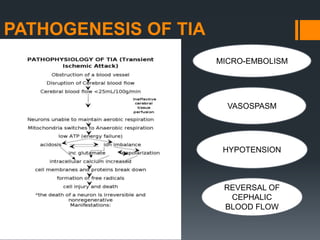
PATHOGENESIS OF TIA
MICRO-EMBOLISM
VASOSPASM
HYPOTENSION
REVERSAL OF
CEPHALIC
BLOOD FLOW
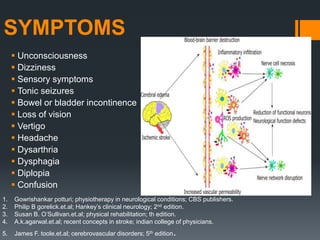
SYMPTOMS
 Unconsciousness
 Dizziness
 Sensory symptoms
 Tonic seizures
 Bowel or bladder incontinence
 Loss of vision
 Vertigo
 Headache
 Dysarthria
 Dysphagia
 Diplopia
 Confusion
1. Gowrishankar potturi; physiotherapy in neurological conditions; CBS publishers.
2. Philip B gorelick.et.al; Hankey’s clinical neurology; 2nd edition.
3. Susan B. O’Sullivan.et.al; physical rehabilitation; th edition.
4. A.k.agarwal.et.al; recent concepts in stroke; indian college of physicians.
5. James F. toole.et.al; cerebrovascular disorders; 5th edition.
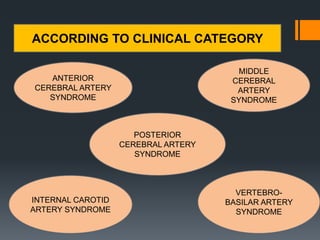
ACCORDING TO CLINICAL CATEGORY
ANTERIOR
CEREBRAL ARTERY
SYNDROME
MIDDLE
CEREBRAL
ARTERY
SYNDROME
INTERNAL CAROTID
ARTERY SYNDROME
VERTEBRO-
BASILAR ARTERY
SYNDROME
POSTERIOR
CEREBRAL ARTERY
SYNDROME
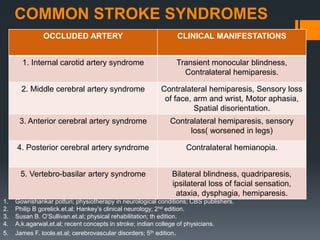
COMMON STROKE SYNDROMES
OCCLUDED ARTERY CLINICAL MANIFESTATIONS
1. Internal carotid artery syndrome Transient monocular blindness,
Contralateral hemiparesis.
2. Middle cerebral artery syndrome Contralateral hemiparesis, Sensory loss
of face, arm and wrist, Motor aphasia,
Spatial disorientation.
3. Anterior cerebral artery syndrome Contralateral hemiparesis, sensory
loss( worsened in legs)
4. Posterior cerebral artery syndrome Contralateral hemianopia.
5. Vertebro-basilar artery syndrome Bilateral blindness, quadriparesis,
ipsilateral loss of facial sensation,
ataxia, dysphagia, hemiparesis.
1. Gowrishankar potturi; physiotherapy in neurological conditions; CBS publishers.
2. Philip B gorelick.et.al; Hankey’s clinical neurology; 2nd edition.
3. Susan B. O’Sullivan.et.al; physical rehabilitation; th edition.
4. A.k.agarwal.et.al; recent concepts in stroke; indian college of physicians.
5. James F. toole.et.al; cerebrovascular disorders; 5th edition.
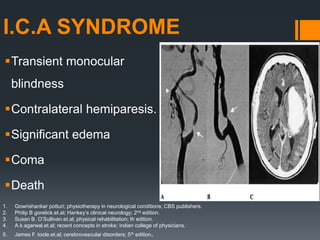
I.C.A SYNDROME
Transient monocular
blindness
Contralateral hemiparesis.
Significant edema
Coma
Death
1. Gowrishankar potturi; physiotherapy in neurological conditions; CBS publishers.
2. Philip B gorelick.et.al; Hankey’s clinical neurology; 2nd edition.
3. Susan B. O’Sullivan.et.al; physical rehabilitation; th edition.
4. A.k.agarwal.et.al; recent concepts in stroke; indian college of physicians.
5. James F. toole.et.al; cerebrovascular disorders; 5th edition.
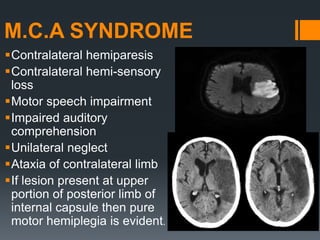
M.C.A SYNDROME
Contralateral hemiparesis
Contralateral hemi-sensory
loss
Motor speech impairment
Impaired auditory
comprehension
Unilateral neglect
Ataxia of contralateral limb
If lesion present at upper
portion of posterior limb of
internal capsule then pure
motor hemiplegia is evident.
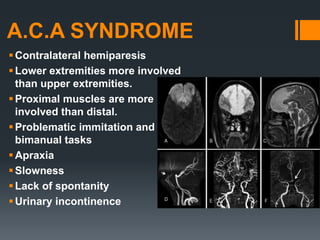
A.C.A SYNDROME
Contralateral hemiparesis
Lower extremities more involved
than upper extremities.
Proximal muscles are more
involved than distal.
Problematic immitation and
bimanual tasks
Apraxia
Slowness
Lack of spontanity
Urinary incontinence
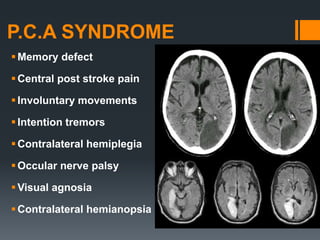
P.C.A SYNDROME
Memory defect
Central post stroke pain
Involuntary movements
Intention tremors
Contralateral hemiplegia
Occular nerve palsy
Visual agnosia
Contralateral hemianopsia
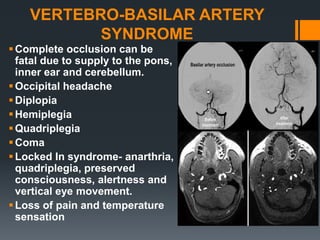
VERTEBRO-BASILAR ARTERY
SYNDROME
Complete occlusion can be
fatal due to supply to the pons,
inner ear and cerebellum.
Occipital headache
Diplopia
Hemiplegia
Quadriplegia
Coma
Locked In syndrome- anarthria,
quadriplegia, preserved
consciousness, alertness and
vertical eye movement.
Loss of pain and temperature
sensation
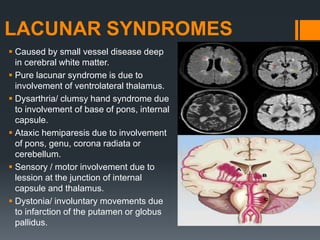
LACUNAR SYNDROMES
 Caused by small vessel disease deep
in cerebral white matter.
 Pure lacunar syndrome is due to
involvement of ventrolateral thalamus.
 Dysarthria/ clumsy hand syndrome due
to involvement of base of pons, internal
capsule.
 Ataxic hemiparesis due to involvement
of pons, genu, corona radiata or
cerebellum.
 Sensory / motor involvement due to
lession at the junction of internal
capsule and thalamus.
 Dystonia/ involuntary movements due
to infarction of the putamen or globus
pallidus.
PRIMARY IMPAIRMENTS
Altered consciousness.
Motor deficits.
Sensory deficits
Presence of abnormal
reflexes.
Cognitive dysfunctions.
Presence of language
disorders.
Perceptual problems.
Seizures
Bladder and bowel
dysfunction
1. Gowrishankar potturi; physiotherapy in neurological conditions; CBS publishers.
2. Philip B gorelick.et.al; Hankey’s clinical neurology; 2nd edition.
3. Susan B. O’Sullivan.et.al; physical rehabilitation; th edition.
4. A.k.agarwal.et.al; recent concepts in stroke; indian college of physicians.
5. James F. toole.et.al; cerebrovascular disorders; 5th edition.
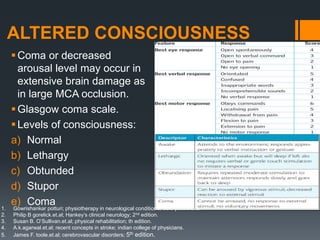
ALTERED CONSCIOUSNESS
Coma or decreased
arousal level may occur in
extensive brain damage as
in large MCA occlusion.
Glasgow coma scale.
Levels of consciousness:
a) Normal
b) Lethargy
c) Obtunded
d) Stupor
e) Coma
1. Gowrishankar potturi; physiotherapy in neurological conditions; CBS publishers.
2. Philip B gorelick.et.al; Hankey’s clinical neurology; 2nd edition.
3. Susan B. O’Sullivan.et.al; physical rehabilitation; th edition.
4. A.k.agarwal.et.al; recent concepts in stroke; indian college of physicians.
5. James F. toole.et.al; cerebrovascular disorders; 5th edition.
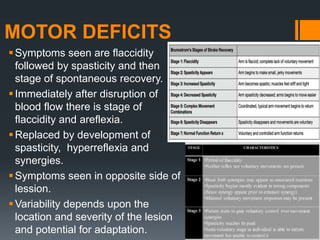
MOTOR DEFICITS
Symptoms seen are flaccidity
followed by spasticity and then
stage of spontaneous recovery.
Immediately after disruption of
blood flow there is stage of
flaccidity and areflexia.
Replaced by development of
spasticity, hyperreflexia and
synergies.
Symptoms seen in opposite side of
lession.
Variability depends upon the
location and severity of the lesion
and potential for adaptation.
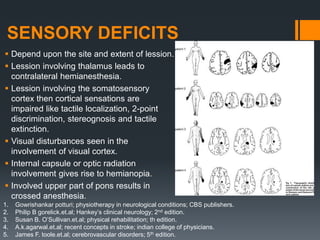
SENSORY DEFICITS
 Depend upon the site and extent of lession.
 Lession involving thalamus leads to
contralateral hemianesthesia.
 Lession involving the somatosensory
cortex then cortical sensations are
impaired like tactile localization, 2-point
discrimination, stereognosis and tactile
extinction.
 Visual disturbances seen in the
involvement of visual cortex.
 Internal capsule or optic radiation
involvement gives rise to hemianopia.
 Involved upper part of pons results in
crossed anesthesia.
1. Gowrishankar potturi; physiotherapy in neurological conditions; CBS publishers.
2. Philip B gorelick.et.al; Hankey’s clinical neurology; 2nd edition.
3. Susan B. O’Sullivan.et.al; physical rehabilitation; th edition.
4. A.k.agarwal.et.al; recent concepts in stroke; indian college of physicians.
5. James F. toole.et.al; cerebrovascular disorders; 5th edition.
ABNORMAL REFLEXES
 Initially all the deep tendon reflexes
absent or suppressed.
 Exaggerated deep tendon reflexes
on development of spasticity.
 Babinski positive with extensor
response.
 Superficial reflexes diminished or
absent.
1. Gowrishankar potturi; physiotherapy in neurological conditions; CBS publishers.
2. Philip B gorelick.et.al; Hankey’s clinical neurology; 2nd edition.
3. Susan B. O’Sullivan.et.al; physical rehabilitation; th edition.
4. A.k.agarwal.et.al; recent concepts in stroke; indian college of physicians.
5. James F. toole.et.al; cerebrovascular disorders; 5th edition.
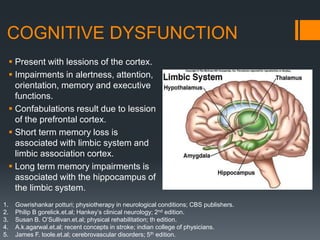
COGNITIVE DYSFUNCTION
 Present with lessions of the cortex.
 Impairments in alertness, attention,
orientation, memory and executive
functions.
 Confabulations result due to lession
of the prefrontal cortex.
 Short term memory loss is
associated with limbic system and
limbic association cortex.
 Long term memory impairments is
associated with the hippocampus of
the limbic system.
1. Gowrishankar potturi; physiotherapy in neurological conditions; CBS publishers.
2. Philip B gorelick.et.al; Hankey’s clinical neurology; 2nd edition.
3. Susan B. O’Sullivan.et.al; physical rehabilitation; th edition.
4. A.k.agarwal.et.al; recent concepts in stroke; indian college of physicians.
5. James F. toole.et.al; cerebrovascular disorders; 5th edition.
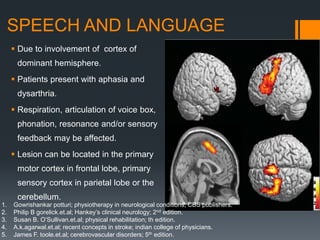
SPEECH AND LANGUAGE
 Due to involvement of cortex of
dominant hemisphere.
 Patients present with aphasia and
dysarthria.
 Respiration, articulation of voice box,
phonation, resonance and/or sensory
feedback may be affected.
 Lesion can be located in the primary
motor cortex in frontal lobe, primary
sensory cortex in parietal lobe or the
cerebellum.
1. Gowrishankar potturi; physiotherapy in neurological conditions; CBS publishers.
2. Philip B gorelick.et.al; Hankey’s clinical neurology; 2nd edition.
3. Susan B. O’Sullivan.et.al; physical rehabilitation; th edition.
4. A.k.agarwal.et.al; recent concepts in stroke; indian college of physicians.
5. James F. toole.et.al; cerebrovascular disorders; 5th edition.
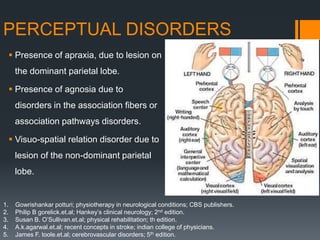
PERCEPTUAL DISORDERS
 Presence of apraxia, due to lesion on
the dominant parietal lobe.
 Presence of agnosia due to
disorders in the association fibers or
association pathways disorders.
 Visuo-spatial relation disorder due to
lesion of the non-dominant parietal
lobe.
1. Gowrishankar potturi; physiotherapy in neurological conditions; CBS publishers.
2. Philip B gorelick.et.al; Hankey’s clinical neurology; 2nd edition.
3. Susan B. O’Sullivan.et.al; physical rehabilitation; th edition.
4. A.k.agarwal.et.al; recent concepts in stroke; indian college of physicians.
5. James F. toole.et.al; cerebrovascular disorders; 5th edition.
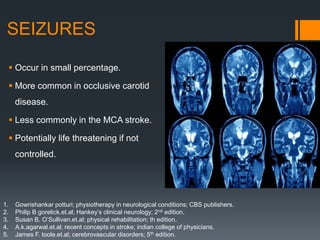
SEIZURES
 Occur in small percentage.
 More common in occlusive carotid
disease.
 Less commonly in the MCA stroke.
 Potentially life threatening if not
controlled.
1. Gowrishankar potturi; physiotherapy in neurological conditions; CBS publishers.
2. Philip B gorelick.et.al; Hankey’s clinical neurology; 2nd edition.
3. Susan B. O’Sullivan.et.al; physical rehabilitation; th edition.
4. A.k.agarwal.et.al; recent concepts in stroke; indian college of physicians.
5. James F. toole.et.al; cerebrovascular disorders; 5th edition.
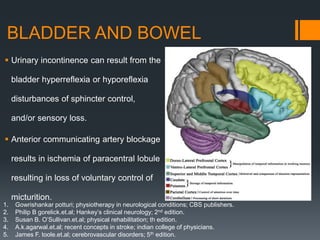
BLADDER AND BOWEL
 Urinary incontinence can result from the
bladder hyperreflexia or hyporeflexia
disturbances of sphincter control,
and/or sensory loss.
 Anterior communicating artery blockage
results in ischemia of paracentral lobule
resulting in loss of voluntary control of
micturition.
1. Gowrishankar potturi; physiotherapy in neurological conditions; CBS publishers.
2. Philip B gorelick.et.al; Hankey’s clinical neurology; 2nd edition.
3. Susan B. O’Sullivan.et.al; physical rehabilitation; th edition.
4. A.k.agarwal.et.al; recent concepts in stroke; indian college of physicians.
5. James F. toole.et.al; cerebrovascular disorders; 5th edition.
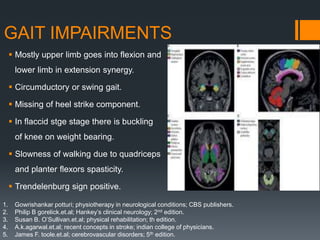
GAIT IMPAIRMENTS
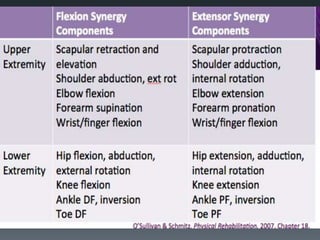
 Mostly upper limb goes into flexion and
lower limb in extension synergy.
 Circumductory or swing gait.
 Missing of heel strike component.
 In flaccid stge stage there is buckling
of knee on weight bearing.
 Slowness of walking due to quadriceps
and planter flexors spasticity.
 Trendelenburg sign positive.
1. Gowrishankar potturi; physiotherapy in neurological conditions; CBS publishers.
2. Philip B gorelick.et.al; Hankey’s clinical neurology; 2nd edition.
3. Susan B. O’Sullivan.et.al; physical rehabilitation; th edition.
4. A.k.agarwal.et.al; recent concepts in stroke; indian college of physicians.
5. James F. toole.et.al; cerebrovascular disorders; 5th edition.
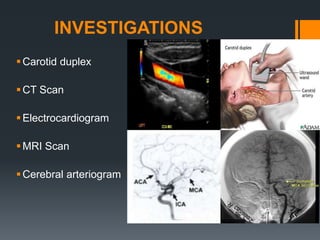
INVESTIGATIONS
Carotid duplex
CT Scan
Electrocardiogram
MRI Scan
Cerebral arteriogram
MEDICAL MANAGEMENT
 To re-establish circulation and
oxygenation.
 Maintain blood pressure.
 Maintain sufficient cardiac output.
 Control seizures and infections.
 Control oedema and intracranial
pressure.
 Maintain skin integrity and joint
integrity.
 Decrease the risk of complications
like DVT and Bed sores.
 Thrombolytic
 Anti-hypertensive agents
 Anti-coagulants
 Anti-convulsants
 Anticholestrol agents
 Antispastic
 Antidepressants
 Anti-platelet therapy
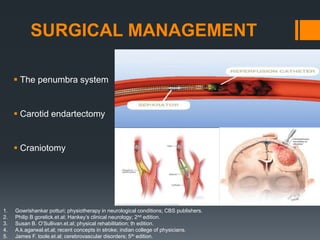
SURGICAL MANAGEMENT
 The penumbra system
 Carotid endartectomy
 Craniotomy
1. Gowrishankar potturi; physiotherapy in neurological conditions; CBS publishers.
2. Philip B gorelick.et.al; Hankey’s clinical neurology; 2nd edition.
3. Susan B. O’Sullivan.et.al; physical rehabilitation; th edition.
4. A.k.agarwal.et.al; recent concepts in stroke; indian college of physicians.
5. James F. toole.et.al; cerebrovascular disorders; 5th edition.
GOALS FOR PHYSIOTHERAPY
 SHORT TERM GOALS:
1) To provide psychological
support and develop good
rapport with patient.
2) To decrease the tendency of
developing abnormal
movement pattern.
3) To prevent complications of
prolonged bed rest.
4) To prevent joint contractures
and deformities.
5) To encourage early weight
bearing.
 Long term goals:
 To continue counselling of the
patient.
 To motivate patients to work and
cope with their condition as well as
encouraging them for regular
exercises.
 To normalize the tone.
 To maintain the cardiovascular
respiratory proficiency.
 Improve the functional capabilities.
 Vocational training.
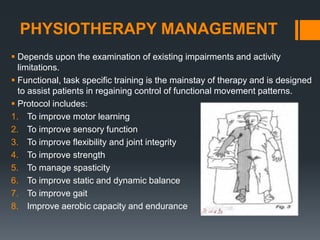
PHYSIOTHERAPY MANAGEMENT
 Depends upon the examination of existing impairments and activity
limitations.
 Functional, task specific training is the mainstay of therapy and is designed
to assist patients in regaining control of functional movement patterns.
 Protocol includes:
1. To improve motor learning
2. To improve sensory function
3. To improve flexibility and joint integrity
4. To improve strength
5. To manage spasticity
6. To improve static and dynamic balance
7. To improve gait
8. Improve aerobic capacity and endurance
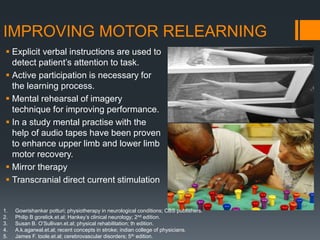
IMPROVING MOTOR RELEARNING
 Explicit verbal instructions are used to
detect patient’s attention to task.
 Active participation is necessary for
the learning process.
 Mental rehearsal of imagery
technique for improving performance.
 In a study mental practise with the
help of audio tapes have been proven
to enhance upper limb and lower limb
motor recovery.
 Mirror therapy
 Transcranial direct current stimulation
1. Gowrishankar potturi; physiotherapy in neurological conditions; CBS publishers.
2. Philip B gorelick.et.al; Hankey’s clinical neurology; 2nd edition.
3. Susan B. O’Sullivan.et.al; physical rehabilitation; th edition.
4. A.k.agarwal.et.al; recent concepts in stroke; indian college of physicians.
5. James F. toole.et.al; cerebrovascular disorders; 5th edition.
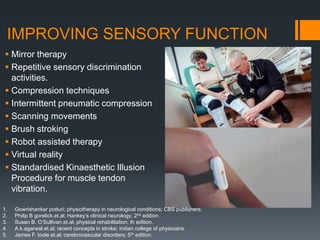
IMPROVING SENSORY FUNCTION
 Mirror therapy
 Repetitive sensory discrimination
activities.
 Compression techniques
 Intermittent pneumatic compression
 Scanning movements
 Brush stroking
 Robot assisted therapy
 Virtual reality
 Standardised Kinaesthetic Illusion
Procedure for muscle tendon
vibration.
1. Gowrishankar potturi; physiotherapy in neurological conditions; CBS publishers.
2. Philip B gorelick.et.al; Hankey’s clinical neurology; 2nd edition.
3. Susan B. O’Sullivan.et.al; physical rehabilitation; th edition.
4. A.k.agarwal.et.al; recent concepts in stroke; indian college of physicians.
5. James F. toole.et.al; cerebrovascular disorders; 5th edition.
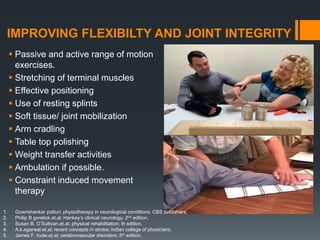
IMPROVING FLEXIBILTY AND JOINT INTEGRITY
 Passive and active range of motion
exercises.
 Stretching of terminal muscles
 Effective positioning
 Use of resting splints
 Soft tissue/ joint mobilization
 Arm cradling
 Table top polishing
 Weight transfer activities
 Ambulation if possible.
 Constraint induced movement
therapy
1. Gowrishankar potturi; physiotherapy in neurological conditions; CBS publishers.
2. Philip B gorelick.et.al; Hankey’s clinical neurology; 2nd edition.
3. Susan B. O’Sullivan.et.al; physical rehabilitation; th edition.
4. A.k.agarwal.et.al; recent concepts in stroke; indian college of physicians.
5. James F. toole.et.al; cerebrovascular disorders; 5th edition.
MANAGEMENT OF SPASTICITY
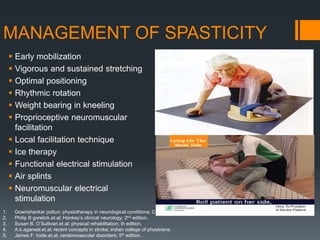
 Early mobilization
 Vigorous and sustained stretching
 Optimal positioning
 Rhythmic rotation
 Weight bearing in kneeling
 Proprioceptive neuromuscular
facilitation
 Local facilitation technique
 Ice therapy
 Functional electrical stimulation
 Air splints
 Neuromuscular electrical
stimulation
1. Gowrishankar potturi; physiotherapy in neurological conditions; CBS publishers.
2. Philip B gorelick.et.al; Hankey’s clinical neurology; 2nd edition.
3. Susan B. O’Sullivan.et.al; physical rehabilitation; th edition.
4. A.k.agarwal.et.al; recent concepts in stroke; indian college of physicians.
5. James F. toole.et.al; cerebrovascular disorders; 5th edition.
IMPROVING STRENGTH
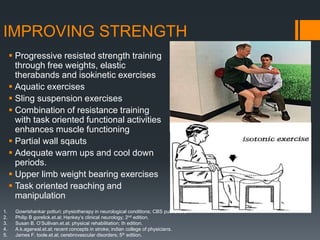
 Progressive resisted strength training
through free weights, elastic
therabands and isokinetic exercises
 Aquatic exercises
 Sling suspension exercises
 Combination of resistance training
with task oriented functional activities
enhances muscle functioning
 Partial wall sqauts
 Adequate warm ups and cool down
periods.
 Upper limb weight bearing exercises
 Task oriented reaching and
manipulation
1. Gowrishankar potturi; physiotherapy in neurological conditions; CBS publishers.
2. Philip B gorelick.et.al; Hankey’s clinical neurology; 2nd edition.
3. Susan B. O’Sullivan.et.al; physical rehabilitation; th edition.
4. A.k.agarwal.et.al; recent concepts in stroke; indian college of physicians.
5. James F. toole.et.al; cerebrovascular disorders; 5th edition.
IMPROVING STATIC AND DYNAMIC BALANCE
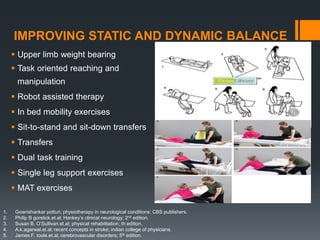
 Upper limb weight bearing
 Task oriented reaching and
manipulation
 Robot assisted therapy
 In bed mobility exercises
 Sit-to-stand and sit-down transfers
 Transfers
 Dual task training
 Single leg support exercises
 MAT exercises
1. Gowrishankar potturi; physiotherapy in neurological conditions; CBS publishers.
2. Philip B gorelick.et.al; Hankey’s clinical neurology; 2nd edition.
3. Susan B. O’Sullivan.et.al; physical rehabilitation; th edition.
4. A.k.agarwal.et.al; recent concepts in stroke; indian college of physicians.
5. James F. toole.et.al; cerebrovascular disorders; 5th edition.
IMPROVING GAIT
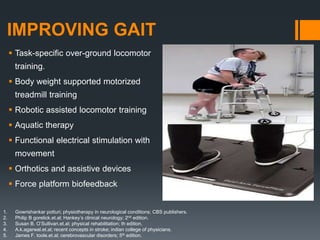
 Task-specific over-ground locomotor
training.
 Body weight supported motorized
treadmill training
 Robotic assisted locomotor training
 Aquatic therapy
 Functional electrical stimulation with
movement
 Orthotics and assistive devices
 Force platform biofeedback
1. Gowrishankar potturi; physiotherapy in neurological conditions; CBS publishers.
2. Philip B gorelick.et.al; Hankey’s clinical neurology; 2nd edition.
3. Susan B. O’Sullivan.et.al; physical rehabilitation; th edition.
4. A.k.agarwal.et.al; recent concepts in stroke; indian college of physicians.
5. James F. toole.et.al; cerebrovascular disorders; 5th edition.
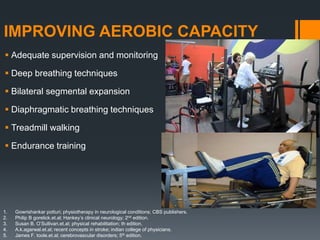
IMPROVING AEROBIC CAPACITY
 Adequate supervision and monitoring
 Deep breathing techniques
 Bilateral segmental expansion
 Diaphragmatic breathing techniques
 Treadmill walking
 Endurance training
1. Gowrishankar potturi; physiotherapy in neurological conditions; CBS publishers.
2. Philip B gorelick.et.al; Hankey’s clinical neurology; 2nd edition.
3. Susan B. O’Sullivan.et.al; physical rehabilitation; th edition.
4. A.k.agarwal.et.al; recent concepts in stroke; indian college of physicians.
5. James F. toole.et.al; cerebrovascular disorders; 5th edition.
Stroke

Stroke

  • 1.
    STROKE By : Dr. ApoorvaSrivastava (PT) MPT (Neuro)
  • 2.
    INTRODUCTION Acute loss offocal brain function with symptoms lasting more than 24 hours or leading to death. It is a rapidly developing clinical signs of focal disturbances of cerebral functions or pre-assumed vascular origin and of more than 24 hours of origin. Primary causes include inadequate blood supply to a part of brain or spontaneous hemorrhage into a part of brain or over surface of brain. “It is defined as an episode of focal neurologic dysfunction in which the autopsy, CT scan, or MRI Scan shows features consistent with focal brain infections or hemorrhage.”- American Stroke Association. Also known as CVA or Cerebro-Vascular Accidents. 1. Gowrishankar potturi; physiotherapy in neurological conditions; CBS publishers. 2. Philip B gorelick.et.al; Hankey’s clinical neurology; 2nd edition. 3. Susan B. O’Sullivan.et.al; physical rehabilitation; th edition. 4. A.k.agarwal.et.al; recent concepts in stroke; indian college of physicians. 5. James F. toole.et.al; cerebrovascular disorders; 5th edition.
  • 4.
    INCIDENCE In 1972, outof total population of 100,000 15.2 % males and 10.8 % in females incidences were seen. In 2012-2013 overall 3126 patients in India were identified with stroke with an annual incidence rate of 140/100,000. According to WHO, 15 million people suffer from stroke worldwide each year.
  • 5.
    CIRCULUS ARTERIOSUS Greater partof brain is supplied by Circle of Willis. Anastomosis between the branches of vertebral artery and internal carotid artery. Cerebral flow represents approx 70 % of cardiac output. Normal flow of blood to brain is 50-60 mL/100 mg of brain tissue/ min. Requires continuous blood flow to deliver oxygen and glucose to the tissues. 1. Gowrishankar potturi; physiotherapy in neurological conditions; CBS publishers. 2. Philip B gorelick.et.al; Hankey’s clinical neurology; 2nd edition. 3. Susan B. O’Sullivan.et.al; physical rehabilitation; th edition. 4. A.k.agarwal.et.al; recent concepts in stroke; indian college of physicians. 5. James F. toole.et.al; cerebrovascular disorders; 5th edition.
  • 7.
    ETIOLOGY  PRIMARY ETIOLOGIES: A.Atherosclerosis B. Emboli C. Haemorrhage D. Hypertension E. Ischemia  SECONDARY ETIOLOGIES: A. Smoking B. Alcohol consumption C. Brain tumour D. Trauma E. Obesity
  • 8.
    PATHOPHYSIOLOGY Basic 2 mechanismcausing brain damage in stroke are ischemia and haemorrhage. Ischemic stroke is when the blood supply is decreased or ceased. Haemorrhagic stroke is when there is vascular compromise. 1. Gowrishankar potturi; physiotherapy in neurological conditions; CBS publishers. 2. Philip B gorelick.et.al; Hankey’s clinical neurology; 2nd edition. 3. Susan B. O’Sullivan.et.al; physical rehabilitation; th edition. 4. A.k.agarwal.et.al; recent concepts in stroke; indian college of physicians. 5. James F. toole.et.al; cerebrovascular disorders; 5th edition.
  • 9.
    SIGNS AND SYMPTOMS Suddennumbness Weakness of unilateral face, arm or leg. Sudden confusion. Trouble in speaking or understanding. Dizziness. Loss of balance and coordination. Sudden, severe headache. Sudden nausea. B = BALANCE E = EYES F = FACE A = ARMS S = SPEECH T = TIME
  • 10.
    Hypertension Diabetes Elevated total cholesterollevel Low density lipoprotein elevated levels Decreased HDL Elevation of haematocrites Rheumatic heart disease Valvular diseases Endocarditis CABG RISK FACTORS
  • 11.
    ISCHEMIC PENUMBRA Within anhour of hypoxic-ischemic insult, there is a cone of infarction surrounded by oligemic zone called Ischemic Penumbra. Critical time period during which the IP zone is at risk is referred to as the window of opportunity. Critical time period may be 2-4 hours of onset of ischemia. Cerebral oedema begins within a few minutes and reaches a maximum for about 4 days and mostly disappears by 3 weeks.
  • 13.
    TYPES OF STROKE Accordingto etiology According to management category According to clinical category 1. Gowrishankar potturi; physiotherapy in neurological conditions; CBS publishers. 2. Philip B gorelick.et.al; Hankey’s clinical neurology; 2nd edition. 3. Susan B. O’Sullivan.et.al; physical rehabilitation; th edition. 4. A.k.agarwal.et.al; recent concepts in stroke; indian college of physicians. 5. James F. toole.et.al; cerebrovascular disorders; 5th edition.
  • 14.
    ACCORDING TO ETIOLOGY ISCHEMIC STROKE •Result of thrombus embolus occlusion, cerebral infarction, etc. • Blood clot or plaque formation. • Majority of emboli are showered from the heart affected by rheumatic heart disease. HAEMORRHAGIC STROKE • Rupture or trauma of intra-cerebral vessels leading to abnormal bleeding. • Bleeding into extra-vascular areas of the brain result into increased preesure, i.e. ICP. • Can be of three types intracerebral, primary cerebral and subarachnoid haemorrhage.
  • 17.
    ACCORDING TO MANAGEMENTCATEGORY TRANSIENT ISCHEMIC ATTACK • If the patient recovers from neurological dysfunction within 24 hours of attack, then termed as TIA. MINOR STROKE • It is the one in which there is no neurological deficit with good rehabilitation outcome. MAJOR STROKE • This is compiled of neurological deficit with bad rehabilitation outcome. DETERIORAT ING STROKE • Refers to the patient whose neurological status is deteriorating after admission into the hospital.
  • 18.
    TRANSIENT ISCHEMIC ATTACK Mostly lasts for only 5 to 30 minutes.  CITS- cerebral infarction with transient symptoms and signs resolving within 24 hours despite residual brain infarction.  Men are affected twice as frequently as women.  Onset occurs most often in 50-70 years of age.  About 40% of those affected are hypertensive, 50% have ischemic heart disease, 10% have diabetes mellitus.  About 90% of TIAs occur in the carotid distribution, 7% in the vertebral-basilar distribution and 3% in both.
  • 19.
  • 20.
    SYMPTOMS  Unconsciousness  Dizziness Sensory symptoms  Tonic seizures  Bowel or bladder incontinence  Loss of vision  Vertigo  Headache  Dysarthria  Dysphagia  Diplopia  Confusion 1. Gowrishankar potturi; physiotherapy in neurological conditions; CBS publishers. 2. Philip B gorelick.et.al; Hankey’s clinical neurology; 2nd edition. 3. Susan B. O’Sullivan.et.al; physical rehabilitation; th edition. 4. A.k.agarwal.et.al; recent concepts in stroke; indian college of physicians. 5. James F. toole.et.al; cerebrovascular disorders; 5th edition.
  • 21.
    ACCORDING TO CLINICALCATEGORY ANTERIOR CEREBRAL ARTERY SYNDROME MIDDLE CEREBRAL ARTERY SYNDROME INTERNAL CAROTID ARTERY SYNDROME VERTEBRO- BASILAR ARTERY SYNDROME POSTERIOR CEREBRAL ARTERY SYNDROME
  • 22.
    COMMON STROKE SYNDROMES OCCLUDEDARTERY CLINICAL MANIFESTATIONS 1. Internal carotid artery syndrome Transient monocular blindness, Contralateral hemiparesis. 2. Middle cerebral artery syndrome Contralateral hemiparesis, Sensory loss of face, arm and wrist, Motor aphasia, Spatial disorientation. 3. Anterior cerebral artery syndrome Contralateral hemiparesis, sensory loss( worsened in legs) 4. Posterior cerebral artery syndrome Contralateral hemianopia. 5. Vertebro-basilar artery syndrome Bilateral blindness, quadriparesis, ipsilateral loss of facial sensation, ataxia, dysphagia, hemiparesis. 1. Gowrishankar potturi; physiotherapy in neurological conditions; CBS publishers. 2. Philip B gorelick.et.al; Hankey’s clinical neurology; 2nd edition. 3. Susan B. O’Sullivan.et.al; physical rehabilitation; th edition. 4. A.k.agarwal.et.al; recent concepts in stroke; indian college of physicians. 5. James F. toole.et.al; cerebrovascular disorders; 5th edition.
  • 23.
    I.C.A SYNDROME Transient monocular blindness Contralateralhemiparesis. Significant edema Coma Death 1. Gowrishankar potturi; physiotherapy in neurological conditions; CBS publishers. 2. Philip B gorelick.et.al; Hankey’s clinical neurology; 2nd edition. 3. Susan B. O’Sullivan.et.al; physical rehabilitation; th edition. 4. A.k.agarwal.et.al; recent concepts in stroke; indian college of physicians. 5. James F. toole.et.al; cerebrovascular disorders; 5th edition.
  • 24.
    M.C.A SYNDROME Contralateral hemiparesis Contralateralhemi-sensory loss Motor speech impairment Impaired auditory comprehension Unilateral neglect Ataxia of contralateral limb If lesion present at upper portion of posterior limb of internal capsule then pure motor hemiplegia is evident.
  • 25.
    A.C.A SYNDROME Contralateral hemiparesis Lowerextremities more involved than upper extremities. Proximal muscles are more involved than distal. Problematic immitation and bimanual tasks Apraxia Slowness Lack of spontanity Urinary incontinence
  • 26.
    P.C.A SYNDROME Memory defect Centralpost stroke pain Involuntary movements Intention tremors Contralateral hemiplegia Occular nerve palsy Visual agnosia Contralateral hemianopsia
  • 27.
    VERTEBRO-BASILAR ARTERY SYNDROME Complete occlusioncan be fatal due to supply to the pons, inner ear and cerebellum. Occipital headache Diplopia Hemiplegia Quadriplegia Coma Locked In syndrome- anarthria, quadriplegia, preserved consciousness, alertness and vertical eye movement. Loss of pain and temperature sensation
  • 28.
    LACUNAR SYNDROMES  Causedby small vessel disease deep in cerebral white matter.  Pure lacunar syndrome is due to involvement of ventrolateral thalamus.  Dysarthria/ clumsy hand syndrome due to involvement of base of pons, internal capsule.  Ataxic hemiparesis due to involvement of pons, genu, corona radiata or cerebellum.  Sensory / motor involvement due to lession at the junction of internal capsule and thalamus.  Dystonia/ involuntary movements due to infarction of the putamen or globus pallidus.
  • 29.
    PRIMARY IMPAIRMENTS Altered consciousness. Motordeficits. Sensory deficits Presence of abnormal reflexes. Cognitive dysfunctions. Presence of language disorders. Perceptual problems. Seizures Bladder and bowel dysfunction 1. Gowrishankar potturi; physiotherapy in neurological conditions; CBS publishers. 2. Philip B gorelick.et.al; Hankey’s clinical neurology; 2nd edition. 3. Susan B. O’Sullivan.et.al; physical rehabilitation; th edition. 4. A.k.agarwal.et.al; recent concepts in stroke; indian college of physicians. 5. James F. toole.et.al; cerebrovascular disorders; 5th edition.
  • 30.
    ALTERED CONSCIOUSNESS Coma ordecreased arousal level may occur in extensive brain damage as in large MCA occlusion. Glasgow coma scale. Levels of consciousness: a) Normal b) Lethargy c) Obtunded d) Stupor e) Coma 1. Gowrishankar potturi; physiotherapy in neurological conditions; CBS publishers. 2. Philip B gorelick.et.al; Hankey’s clinical neurology; 2nd edition. 3. Susan B. O’Sullivan.et.al; physical rehabilitation; th edition. 4. A.k.agarwal.et.al; recent concepts in stroke; indian college of physicians. 5. James F. toole.et.al; cerebrovascular disorders; 5th edition.
  • 31.
    MOTOR DEFICITS Symptoms seenare flaccidity followed by spasticity and then stage of spontaneous recovery. Immediately after disruption of blood flow there is stage of flaccidity and areflexia. Replaced by development of spasticity, hyperreflexia and synergies. Symptoms seen in opposite side of lession. Variability depends upon the location and severity of the lesion and potential for adaptation.
  • 33.
    SENSORY DEFICITS  Dependupon the site and extent of lession.  Lession involving thalamus leads to contralateral hemianesthesia.  Lession involving the somatosensory cortex then cortical sensations are impaired like tactile localization, 2-point discrimination, stereognosis and tactile extinction.  Visual disturbances seen in the involvement of visual cortex.  Internal capsule or optic radiation involvement gives rise to hemianopia.  Involved upper part of pons results in crossed anesthesia. 1. Gowrishankar potturi; physiotherapy in neurological conditions; CBS publishers. 2. Philip B gorelick.et.al; Hankey’s clinical neurology; 2nd edition. 3. Susan B. O’Sullivan.et.al; physical rehabilitation; th edition. 4. A.k.agarwal.et.al; recent concepts in stroke; indian college of physicians. 5. James F. toole.et.al; cerebrovascular disorders; 5th edition.
  • 34.
    ABNORMAL REFLEXES  Initiallyall the deep tendon reflexes absent or suppressed.  Exaggerated deep tendon reflexes on development of spasticity.  Babinski positive with extensor response.  Superficial reflexes diminished or absent. 1. Gowrishankar potturi; physiotherapy in neurological conditions; CBS publishers. 2. Philip B gorelick.et.al; Hankey’s clinical neurology; 2nd edition. 3. Susan B. O’Sullivan.et.al; physical rehabilitation; th edition. 4. A.k.agarwal.et.al; recent concepts in stroke; indian college of physicians. 5. James F. toole.et.al; cerebrovascular disorders; 5th edition.
  • 35.
    COGNITIVE DYSFUNCTION  Presentwith lessions of the cortex.  Impairments in alertness, attention, orientation, memory and executive functions.  Confabulations result due to lession of the prefrontal cortex.  Short term memory loss is associated with limbic system and limbic association cortex.  Long term memory impairments is associated with the hippocampus of the limbic system. 1. Gowrishankar potturi; physiotherapy in neurological conditions; CBS publishers. 2. Philip B gorelick.et.al; Hankey’s clinical neurology; 2nd edition. 3. Susan B. O’Sullivan.et.al; physical rehabilitation; th edition. 4. A.k.agarwal.et.al; recent concepts in stroke; indian college of physicians. 5. James F. toole.et.al; cerebrovascular disorders; 5th edition.
  • 36.
    SPEECH AND LANGUAGE Due to involvement of cortex of dominant hemisphere.  Patients present with aphasia and dysarthria.  Respiration, articulation of voice box, phonation, resonance and/or sensory feedback may be affected.  Lesion can be located in the primary motor cortex in frontal lobe, primary sensory cortex in parietal lobe or the cerebellum. 1. Gowrishankar potturi; physiotherapy in neurological conditions; CBS publishers. 2. Philip B gorelick.et.al; Hankey’s clinical neurology; 2nd edition. 3. Susan B. O’Sullivan.et.al; physical rehabilitation; th edition. 4. A.k.agarwal.et.al; recent concepts in stroke; indian college of physicians. 5. James F. toole.et.al; cerebrovascular disorders; 5th edition.
  • 37.
    PERCEPTUAL DISORDERS  Presenceof apraxia, due to lesion on the dominant parietal lobe.  Presence of agnosia due to disorders in the association fibers or association pathways disorders.  Visuo-spatial relation disorder due to lesion of the non-dominant parietal lobe. 1. Gowrishankar potturi; physiotherapy in neurological conditions; CBS publishers. 2. Philip B gorelick.et.al; Hankey’s clinical neurology; 2nd edition. 3. Susan B. O’Sullivan.et.al; physical rehabilitation; th edition. 4. A.k.agarwal.et.al; recent concepts in stroke; indian college of physicians. 5. James F. toole.et.al; cerebrovascular disorders; 5th edition.
  • 38.
    SEIZURES  Occur insmall percentage.  More common in occlusive carotid disease.  Less commonly in the MCA stroke.  Potentially life threatening if not controlled. 1. Gowrishankar potturi; physiotherapy in neurological conditions; CBS publishers. 2. Philip B gorelick.et.al; Hankey’s clinical neurology; 2nd edition. 3. Susan B. O’Sullivan.et.al; physical rehabilitation; th edition. 4. A.k.agarwal.et.al; recent concepts in stroke; indian college of physicians. 5. James F. toole.et.al; cerebrovascular disorders; 5th edition.
  • 39.
    BLADDER AND BOWEL Urinary incontinence can result from the bladder hyperreflexia or hyporeflexia disturbances of sphincter control, and/or sensory loss.  Anterior communicating artery blockage results in ischemia of paracentral lobule resulting in loss of voluntary control of micturition. 1. Gowrishankar potturi; physiotherapy in neurological conditions; CBS publishers. 2. Philip B gorelick.et.al; Hankey’s clinical neurology; 2nd edition. 3. Susan B. O’Sullivan.et.al; physical rehabilitation; th edition. 4. A.k.agarwal.et.al; recent concepts in stroke; indian college of physicians. 5. James F. toole.et.al; cerebrovascular disorders; 5th edition.
  • 40.
    GAIT IMPAIRMENTS  Mostlyupper limb goes into flexion and lower limb in extension synergy.  Circumductory or swing gait.  Missing of heel strike component.  In flaccid stge stage there is buckling of knee on weight bearing.  Slowness of walking due to quadriceps and planter flexors spasticity.  Trendelenburg sign positive. 1. Gowrishankar potturi; physiotherapy in neurological conditions; CBS publishers. 2. Philip B gorelick.et.al; Hankey’s clinical neurology; 2nd edition. 3. Susan B. O’Sullivan.et.al; physical rehabilitation; th edition. 4. A.k.agarwal.et.al; recent concepts in stroke; indian college of physicians. 5. James F. toole.et.al; cerebrovascular disorders; 5th edition.
  • 41.
  • 42.
    MEDICAL MANAGEMENT  Tore-establish circulation and oxygenation.  Maintain blood pressure.  Maintain sufficient cardiac output.  Control seizures and infections.  Control oedema and intracranial pressure.  Maintain skin integrity and joint integrity.  Decrease the risk of complications like DVT and Bed sores.  Thrombolytic  Anti-hypertensive agents  Anti-coagulants  Anti-convulsants  Anticholestrol agents  Antispastic  Antidepressants  Anti-platelet therapy
  • 43.
    SURGICAL MANAGEMENT  Thepenumbra system  Carotid endartectomy  Craniotomy 1. Gowrishankar potturi; physiotherapy in neurological conditions; CBS publishers. 2. Philip B gorelick.et.al; Hankey’s clinical neurology; 2nd edition. 3. Susan B. O’Sullivan.et.al; physical rehabilitation; th edition. 4. A.k.agarwal.et.al; recent concepts in stroke; indian college of physicians. 5. James F. toole.et.al; cerebrovascular disorders; 5th edition.
  • 44.
    GOALS FOR PHYSIOTHERAPY SHORT TERM GOALS: 1) To provide psychological support and develop good rapport with patient. 2) To decrease the tendency of developing abnormal movement pattern. 3) To prevent complications of prolonged bed rest. 4) To prevent joint contractures and deformities. 5) To encourage early weight bearing.  Long term goals:  To continue counselling of the patient.  To motivate patients to work and cope with their condition as well as encouraging them for regular exercises.  To normalize the tone.  To maintain the cardiovascular respiratory proficiency.  Improve the functional capabilities.  Vocational training.
  • 45.
    PHYSIOTHERAPY MANAGEMENT  Dependsupon the examination of existing impairments and activity limitations.  Functional, task specific training is the mainstay of therapy and is designed to assist patients in regaining control of functional movement patterns.  Protocol includes: 1. To improve motor learning 2. To improve sensory function 3. To improve flexibility and joint integrity 4. To improve strength 5. To manage spasticity 6. To improve static and dynamic balance 7. To improve gait 8. Improve aerobic capacity and endurance
  • 46.
    IMPROVING MOTOR RELEARNING Explicit verbal instructions are used to detect patient’s attention to task.  Active participation is necessary for the learning process.  Mental rehearsal of imagery technique for improving performance.  In a study mental practise with the help of audio tapes have been proven to enhance upper limb and lower limb motor recovery.  Mirror therapy  Transcranial direct current stimulation 1. Gowrishankar potturi; physiotherapy in neurological conditions; CBS publishers. 2. Philip B gorelick.et.al; Hankey’s clinical neurology; 2nd edition. 3. Susan B. O’Sullivan.et.al; physical rehabilitation; th edition. 4. A.k.agarwal.et.al; recent concepts in stroke; indian college of physicians. 5. James F. toole.et.al; cerebrovascular disorders; 5th edition.
  • 47.
    IMPROVING SENSORY FUNCTION Mirror therapy  Repetitive sensory discrimination activities.  Compression techniques  Intermittent pneumatic compression  Scanning movements  Brush stroking  Robot assisted therapy  Virtual reality  Standardised Kinaesthetic Illusion Procedure for muscle tendon vibration. 1. Gowrishankar potturi; physiotherapy in neurological conditions; CBS publishers. 2. Philip B gorelick.et.al; Hankey’s clinical neurology; 2nd edition. 3. Susan B. O’Sullivan.et.al; physical rehabilitation; th edition. 4. A.k.agarwal.et.al; recent concepts in stroke; indian college of physicians. 5. James F. toole.et.al; cerebrovascular disorders; 5th edition.
  • 48.
    IMPROVING FLEXIBILTY ANDJOINT INTEGRITY  Passive and active range of motion exercises.  Stretching of terminal muscles  Effective positioning  Use of resting splints  Soft tissue/ joint mobilization  Arm cradling  Table top polishing  Weight transfer activities  Ambulation if possible.  Constraint induced movement therapy 1. Gowrishankar potturi; physiotherapy in neurological conditions; CBS publishers. 2. Philip B gorelick.et.al; Hankey’s clinical neurology; 2nd edition. 3. Susan B. O’Sullivan.et.al; physical rehabilitation; th edition. 4. A.k.agarwal.et.al; recent concepts in stroke; indian college of physicians. 5. James F. toole.et.al; cerebrovascular disorders; 5th edition.
  • 49.
    MANAGEMENT OF SPASTICITY Early mobilization  Vigorous and sustained stretching  Optimal positioning  Rhythmic rotation  Weight bearing in kneeling  Proprioceptive neuromuscular facilitation  Local facilitation technique  Ice therapy  Functional electrical stimulation  Air splints  Neuromuscular electrical stimulation 1. Gowrishankar potturi; physiotherapy in neurological conditions; CBS publishers. 2. Philip B gorelick.et.al; Hankey’s clinical neurology; 2nd edition. 3. Susan B. O’Sullivan.et.al; physical rehabilitation; th edition. 4. A.k.agarwal.et.al; recent concepts in stroke; indian college of physicians. 5. James F. toole.et.al; cerebrovascular disorders; 5th edition.
  • 50.
    IMPROVING STRENGTH  Progressiveresisted strength training through free weights, elastic therabands and isokinetic exercises  Aquatic exercises  Sling suspension exercises  Combination of resistance training with task oriented functional activities enhances muscle functioning  Partial wall sqauts  Adequate warm ups and cool down periods.  Upper limb weight bearing exercises  Task oriented reaching and manipulation 1. Gowrishankar potturi; physiotherapy in neurological conditions; CBS publishers. 2. Philip B gorelick.et.al; Hankey’s clinical neurology; 2nd edition. 3. Susan B. O’Sullivan.et.al; physical rehabilitation; th edition. 4. A.k.agarwal.et.al; recent concepts in stroke; indian college of physicians. 5. James F. toole.et.al; cerebrovascular disorders; 5th edition.
  • 51.
    IMPROVING STATIC ANDDYNAMIC BALANCE  Upper limb weight bearing  Task oriented reaching and manipulation  Robot assisted therapy  In bed mobility exercises  Sit-to-stand and sit-down transfers  Transfers  Dual task training  Single leg support exercises  MAT exercises 1. Gowrishankar potturi; physiotherapy in neurological conditions; CBS publishers. 2. Philip B gorelick.et.al; Hankey’s clinical neurology; 2nd edition. 3. Susan B. O’Sullivan.et.al; physical rehabilitation; th edition. 4. A.k.agarwal.et.al; recent concepts in stroke; indian college of physicians. 5. James F. toole.et.al; cerebrovascular disorders; 5th edition.
  • 52.
    IMPROVING GAIT  Task-specificover-ground locomotor training.  Body weight supported motorized treadmill training  Robotic assisted locomotor training  Aquatic therapy  Functional electrical stimulation with movement  Orthotics and assistive devices  Force platform biofeedback 1. Gowrishankar potturi; physiotherapy in neurological conditions; CBS publishers. 2. Philip B gorelick.et.al; Hankey’s clinical neurology; 2nd edition. 3. Susan B. O’Sullivan.et.al; physical rehabilitation; th edition. 4. A.k.agarwal.et.al; recent concepts in stroke; indian college of physicians. 5. James F. toole.et.al; cerebrovascular disorders; 5th edition.
  • 53.
    IMPROVING AEROBIC CAPACITY Adequate supervision and monitoring  Deep breathing techniques  Bilateral segmental expansion  Diaphragmatic breathing techniques  Treadmill walking  Endurance training 1. Gowrishankar potturi; physiotherapy in neurological conditions; CBS publishers. 2. Philip B gorelick.et.al; Hankey’s clinical neurology; 2nd edition. 3. Susan B. O’Sullivan.et.al; physical rehabilitation; th edition. 4. A.k.agarwal.et.al; recent concepts in stroke; indian college of physicians. 5. James F. toole.et.al; cerebrovascular disorders; 5th edition.