COMMUNICATION
By
Meera Krishnan
What is communication?
 The word communication has originated from
a Latin word “Commutes” which means
something common.
 Communication is a process of exchanging
information ,ideas ,thoughts, feeling and
emotions through speech signals ,writing or
behaviour .In communication process , a
sender encodes a message and then using a
medium and send it to appropriate feedback
using a medium.
Importance of communication
 Express thoughts, ideas and feelings
 Creating awareness
 To full fill a goal
 Avoid isolated
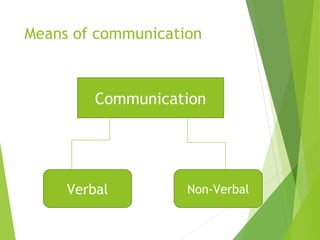
Means of communication
Communication
Verbal Non-Verbal
Verbal communication
Verbal communication is refers to the
form of communication in which message is
transmitted verbally, communication is
done by word, mouth and a piece of
writing.
Objectives of every communication is to
have people understand what we are trying
to convey.
 In verbal communication remember the
acronym KISS (keep it short and simple)
 When we talk to others, we assume that
others understand what we are saying. But
this not the case. Usually people bring their
own attitude ,emotion and thoughts about
the topic and hence creates barrier in
delivering the right meaning.
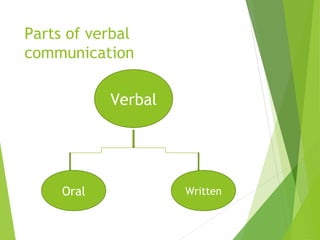
Parts of verbal
communication
Verbal
Oral Written
Oral communication
 In Oral communication spoken words are
used.
 It includes face-to-face conversations,
speech, telephonic conversations ,video
radio, television, voice over internet.
 In oral communication, communication is
influence by pitch , volume , speed and
clarity of speaking.
Advantages of communication
 It brings quick feedback.
 In face-to-face conversation ,by reading
facial expression and body language one
can guess whether he/she should trust
what’s being said or not.
Disadvantages of
communication
 In face –to-face discussion, user is unable to
deeply think about what he is delivering .
 In oral communication ,message are difficult
to record, so it is impossible to preserve the
message for future.
Written communication
 In written communication, written signs or
symbols are used to communicate.
 A written message may be printed or hand
written. In written communication message
can be transmitted via email, letter, report,
memo etc.
 Message, in written communication, is
influenced by the vocabulary & grammar
used, writing style, precision and clarity of
the language used.
Advantages of written
communication
 Message can be edited and revised many time
before it is actually sent.
 Written communication provide record for
every message sent and can be saved for later
study.
 A written message enables receiver to fully
understand it and send appropriate feedback.
Disadvantages of written
communication
 Unlike oral communication, written
communication doesn’t bring instant
feedback
 It make more time in composing a written
message as compared to word-of-mouth
and number of people struggles for
writing ability.
Non-verbal communication
 Non-Verbal communication is the sending
or receiving of wordless messages.
 Gesture, body language , posture, tone of
voice or facial expressions ,is called
nonverbal communication.
 Non-verbal communication is all about the
body language of speaker.
 Through sings and symbols.
 Non-verbal communication can go
without verbal communication.
 Verbal communication can’t go
without non-verbal communication.
Types of non-verbal
communication
Body language (kinesics)
Gestures
Posture
Facial expressions
Human behavior
Touch (Haptics)
 Dress and Grooming
 Proxemics (space language)
 Signs and Symbols
 Chart ,Maps and Graphs
 Posters
 Colors
 Silence
Body language
 Everyone has a personality who is
communicated by his body language, by
the way he walks, smiles and carries
himself in general.
 If a person laugh or change his voice
quality while talking are the examples of
Communication by body language
Body language
Gestures
 The natural movement in any part of the human
body ,particular head ,hand ,and neck are called
gestures.
 When the sender or receiver exchange any
thought, feelings or idea with the help of the
normal movements of head or neck any other part
of the human body is called communication by
gestures.
posture
 Posture means the position of the body. The
way we stand, sit or recline and walk reflect
our attitude, thoughts and feelings.
 Posture constitutes an important feature of
body language. A person's posture tells us
whether he is feeling diffident, confident or
over-confident.
Facial expressions
 Communication by Facial Expressions, face is
the mirror of human character, whatever
happens in our heart goes into our mind and
appears on our face.
 Facial expressions are one can express
friendliness, affection, dislike, anger, suspicion,
anxiety, etc. through facial expressions.
 Communication can be further divided
into two,
 One -way communication
 Two- way communication
ONE –WAY COMMUNICATION
 In one-way communication there is no
feedback from the receiver to the
sender .For instance ,the news reader
reading news on TV or radio ,the speaker
reading out a pre-planned message to the
audience.
Two -way communication
 In two-way communication there is active
feedback from the receiver to the sender.
Here the receiver has understood this
same meaning which the sender intended
to convey.
Thank you

Communication

  • 1.
  • 2.
    What is communication? The word communication has originated from a Latin word “Commutes” which means something common.  Communication is a process of exchanging information ,ideas ,thoughts, feeling and emotions through speech signals ,writing or behaviour .In communication process , a sender encodes a message and then using a medium and send it to appropriate feedback using a medium.
  • 3.
    Importance of communication Express thoughts, ideas and feelings  Creating awareness  To full fill a goal  Avoid isolated
  • 4.
  • 5.
    Verbal communication Verbal communicationis refers to the form of communication in which message is transmitted verbally, communication is done by word, mouth and a piece of writing. Objectives of every communication is to have people understand what we are trying to convey.
  • 6.
     In verbalcommunication remember the acronym KISS (keep it short and simple)  When we talk to others, we assume that others understand what we are saying. But this not the case. Usually people bring their own attitude ,emotion and thoughts about the topic and hence creates barrier in delivering the right meaning.
  • 7.
  • 8.
    Oral communication  InOral communication spoken words are used.  It includes face-to-face conversations, speech, telephonic conversations ,video radio, television, voice over internet.  In oral communication, communication is influence by pitch , volume , speed and clarity of speaking.
  • 9.
    Advantages of communication It brings quick feedback.  In face-to-face conversation ,by reading facial expression and body language one can guess whether he/she should trust what’s being said or not.
  • 10.
    Disadvantages of communication  Inface –to-face discussion, user is unable to deeply think about what he is delivering .  In oral communication ,message are difficult to record, so it is impossible to preserve the message for future.
  • 11.
    Written communication  Inwritten communication, written signs or symbols are used to communicate.  A written message may be printed or hand written. In written communication message can be transmitted via email, letter, report, memo etc.  Message, in written communication, is influenced by the vocabulary & grammar used, writing style, precision and clarity of the language used.
  • 12.
    Advantages of written communication Message can be edited and revised many time before it is actually sent.  Written communication provide record for every message sent and can be saved for later study.  A written message enables receiver to fully understand it and send appropriate feedback.
  • 13.
    Disadvantages of written communication Unlike oral communication, written communication doesn’t bring instant feedback  It make more time in composing a written message as compared to word-of-mouth and number of people struggles for writing ability.
  • 14.
    Non-verbal communication  Non-Verbalcommunication is the sending or receiving of wordless messages.  Gesture, body language , posture, tone of voice or facial expressions ,is called nonverbal communication.  Non-verbal communication is all about the body language of speaker.
  • 15.
     Through singsand symbols.  Non-verbal communication can go without verbal communication.  Verbal communication can’t go without non-verbal communication.
  • 16.
    Types of non-verbal communication Bodylanguage (kinesics) Gestures Posture Facial expressions Human behavior Touch (Haptics)
  • 17.
     Dress andGrooming  Proxemics (space language)  Signs and Symbols  Chart ,Maps and Graphs  Posters  Colors  Silence
  • 18.
    Body language  Everyonehas a personality who is communicated by his body language, by the way he walks, smiles and carries himself in general.  If a person laugh or change his voice quality while talking are the examples of Communication by body language
  • 19.
  • 20.
  • 21.
     The naturalmovement in any part of the human body ,particular head ,hand ,and neck are called gestures.  When the sender or receiver exchange any thought, feelings or idea with the help of the normal movements of head or neck any other part of the human body is called communication by gestures.
  • 22.
    posture  Posture meansthe position of the body. The way we stand, sit or recline and walk reflect our attitude, thoughts and feelings.  Posture constitutes an important feature of body language. A person's posture tells us whether he is feeling diffident, confident or over-confident.
  • 24.
    Facial expressions  Communicationby Facial Expressions, face is the mirror of human character, whatever happens in our heart goes into our mind and appears on our face.  Facial expressions are one can express friendliness, affection, dislike, anger, suspicion, anxiety, etc. through facial expressions.
  • 26.
     Communication canbe further divided into two,  One -way communication  Two- way communication
  • 27.
    ONE –WAY COMMUNICATION In one-way communication there is no feedback from the receiver to the sender .For instance ,the news reader reading news on TV or radio ,the speaker reading out a pre-planned message to the audience.
  • 28.
    Two -way communication In two-way communication there is active feedback from the receiver to the sender. Here the receiver has understood this same meaning which the sender intended to convey.
  • 29.