Verb – Notes
Definition of Verb:
The verb is a word that expresses some action, feeling or existence. Verbs are also
known as Action Words.
It tells us something about the subject. For example,
 Lions roar. (action)
 Boys fly kites. (action)
 I feel sorry. (feeling)
 Ashoka was a great king. (existence)
All the verbs – as shown in above examples - ‘roar’, ‘fly’, ‘feel’, and ‘was’, are limited by the
number and person of their subjects.
Therefore, ‘roar’, ‘fly’, ‘feel’, and ‘was’, are Main Verbs.
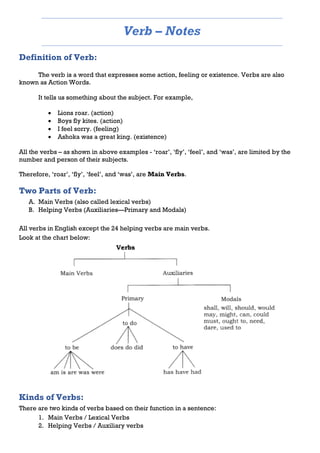
Two Parts of Verb:
A. Main Verbs (also called lexical verbs)
B. Helping Verbs (Auxiliaries—Primary and Modals)
All verbs in English except the 24 helping verbs are main verbs.
Look at the chart below:
Kinds of Verbs:
There are two kinds of verbs based on their function in a sentence:
1. Main Verbs / Lexical Verbs
2. Helping Verbs / Auxiliary verbs
There are two kinds of verbs based on their structure:
1. Strong / Irregular Verbs
2. Weak / Regular Verbs
 Main Verbs: Main verbs or lexical verbs have a meaning of their own. They express a full
action or a feeling.
Main verbs are further classified into two categories according to their usage:
1. Finite verbs
2. Non-finite verbs
Finite verbs are again classified into two categories:
1. Transitive verbs
2. Intransitive verbs
Transitive verbs: it is a verb that denotes an action which passes from the subject to the
object (something or somebody) of the verb. The verb must have a ‘doer’ and a ‘receiver’. A
transitive verb makes no complete sense without an object. In short, transitive verbs are those
which take an object to make a complete meaning. For example,
 Arnav reads newspaper.
Intransitive verbs: a verb that does not take an object in order to complete its sense is
called an intransitive verb. The action is limited to the subject only.
The verbs like – play, read, write, watch, show, cook, start, etc are transitive verbs.
The verbs like – sleep, run, cry, weep, smile, laugh, go, walk, come, tire, etc are intransitive
verbs.
However, some transitive verbs can sometimes be used intransitively and vice-versa.
Compare the following sentences to understand this.
Verbs used Transitively Verbs used Intransitively
She sang a nice song. She sang melodiously.
Dr. Gupta runs an organization for old people. He runs very fast.
Gauri is reading a comic. Gauri is reading loudly.
Deepanita wrote many articles. Deepanita wrote very precisely.
 Helping Verbs: A helping verb or an auxiliary verb is a verb that gives further information
about a main or full verb. It is used in compound sentences, Passive voice, etc.
There are 24 auxiliaries in English language. These are further classified as:
 Primary Auxiliaries
 Modal auxiliaries
Primary Auxiliaries (Verbs): Verbs such as am, is, are, was, were, do, did, have, etc are
used with other ordinary (or main) verbs to form tenses, passive voice, questions, negative
sentences etc.
e.g.
 Radha does not trust Krishna.
 They have worked for an hour.
Modal Auxiliaries (Verbs): Verbs will, shall, would, can, could, might etc are the modal
verbs or modals. They are used with main verbs to form sentences expressing permissions,
orders, obligations, requests etc.
e.g.
 Radha will not go to school tomorrow.
 It might rain today.
Forms of Verbs (Conjugation of Verbs):
Verbs have three principal forms. Forming these three forms is called conjugation of verbs. The
three forms of verbs are:
1. Present Tense (Original form)
2. Past Tense
3. Past Participle Tense
Verbs of Complete and Incomplete Predication:
Complete Predication: Intransitive verbs that make complete sense are called verbs of complete
predication.
Incomplete Predication: Intransitive verbs that require some other words to complete the
predicate are called verbs of incomplete predication.

Verb notes

  • 1.
    Verb – Notes Definitionof Verb: The verb is a word that expresses some action, feeling or existence. Verbs are also known as Action Words. It tells us something about the subject. For example,  Lions roar. (action)  Boys fly kites. (action)  I feel sorry. (feeling)  Ashoka was a great king. (existence) All the verbs – as shown in above examples - ‘roar’, ‘fly’, ‘feel’, and ‘was’, are limited by the number and person of their subjects. Therefore, ‘roar’, ‘fly’, ‘feel’, and ‘was’, are Main Verbs. Two Parts of Verb: A. Main Verbs (also called lexical verbs) B. Helping Verbs (Auxiliaries—Primary and Modals) All verbs in English except the 24 helping verbs are main verbs. Look at the chart below: Kinds of Verbs: There are two kinds of verbs based on their function in a sentence: 1. Main Verbs / Lexical Verbs 2. Helping Verbs / Auxiliary verbs
  • 2.
    There are twokinds of verbs based on their structure: 1. Strong / Irregular Verbs 2. Weak / Regular Verbs  Main Verbs: Main verbs or lexical verbs have a meaning of their own. They express a full action or a feeling. Main verbs are further classified into two categories according to their usage: 1. Finite verbs 2. Non-finite verbs Finite verbs are again classified into two categories: 1. Transitive verbs 2. Intransitive verbs Transitive verbs: it is a verb that denotes an action which passes from the subject to the object (something or somebody) of the verb. The verb must have a ‘doer’ and a ‘receiver’. A transitive verb makes no complete sense without an object. In short, transitive verbs are those which take an object to make a complete meaning. For example,  Arnav reads newspaper. Intransitive verbs: a verb that does not take an object in order to complete its sense is called an intransitive verb. The action is limited to the subject only. The verbs like – play, read, write, watch, show, cook, start, etc are transitive verbs. The verbs like – sleep, run, cry, weep, smile, laugh, go, walk, come, tire, etc are intransitive verbs. However, some transitive verbs can sometimes be used intransitively and vice-versa. Compare the following sentences to understand this. Verbs used Transitively Verbs used Intransitively She sang a nice song. She sang melodiously. Dr. Gupta runs an organization for old people. He runs very fast. Gauri is reading a comic. Gauri is reading loudly. Deepanita wrote many articles. Deepanita wrote very precisely.  Helping Verbs: A helping verb or an auxiliary verb is a verb that gives further information about a main or full verb. It is used in compound sentences, Passive voice, etc. There are 24 auxiliaries in English language. These are further classified as:  Primary Auxiliaries  Modal auxiliaries Primary Auxiliaries (Verbs): Verbs such as am, is, are, was, were, do, did, have, etc are used with other ordinary (or main) verbs to form tenses, passive voice, questions, negative
  • 3.
    sentences etc. e.g.  Radhadoes not trust Krishna.  They have worked for an hour. Modal Auxiliaries (Verbs): Verbs will, shall, would, can, could, might etc are the modal verbs or modals. They are used with main verbs to form sentences expressing permissions, orders, obligations, requests etc. e.g.  Radha will not go to school tomorrow.  It might rain today. Forms of Verbs (Conjugation of Verbs): Verbs have three principal forms. Forming these three forms is called conjugation of verbs. The three forms of verbs are: 1. Present Tense (Original form) 2. Past Tense 3. Past Participle Tense Verbs of Complete and Incomplete Predication: Complete Predication: Intransitive verbs that make complete sense are called verbs of complete predication. Incomplete Predication: Intransitive verbs that require some other words to complete the predicate are called verbs of incomplete predication.