Adverb
Definition, Types, Examples
• Adverb of Time
• Adverb of Frequency
• Adverb of Place
• Adverb of Manner
• Adverb of Degree or Quantity
• Adverb of Affirmation
• Adverb of Negation
• Adverb of Reason
• The Interrogative Adverbs
Dist. Osmanabad, MS, India
Prepared By
Dr Sudhir Mathpati
Assistant Professor, Dept. of English
Adarsh Mahavidyalaya, Omerga
Adverb: Definition, Types, Examples
Dr Sudhir Mathpati
• Definition:
• The Adverbs are the words which are used to describe Verbs and
modify adjectives.
• An Adverb is one of the important element of Parts of Speech which
describes Verb, Adjective, another Adverb, a Phrase, a Clause or a
sentence.
Examples: Quickly, Slowly, Badly, Sadly, Sweetly, etc.
Every adverb does not end up with ‘ly’
Examples:
She ran swiftly
A remarkably tall person came before me.
She ran very swiftly
Adverb: Definition, Types, Examples
Dr Sudhir Mathpati
• Types:
• Adverb of Time
• Adverb of Frequency
• Adverb of Place
• Adverb of Manner
• Adverb of Degree or Quantity
• Adverb of Affirmation
• Adverb of Negation
• Adverb of Reason
• The Interrogative Adverbs
Adverb: Definition, Types, Examples
Dr Sudhir Mathpati
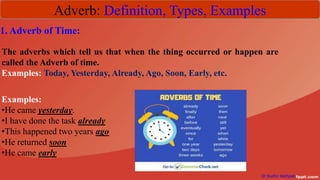
1. Adverb of Time:
The adverbs which tell us that when the thing occurred or happen are
called the Adverb of time.
Examples: Today, Yesterday, Already, Ago, Soon, Early, etc.
Examples:
•He came yesterday.
•I have done the task already
•This happened two years ago
•He returned soon
•He came early
Adverb: Definition, Types, Examples
Dr Sudhir MathpatiDr Sudhir Mathpati
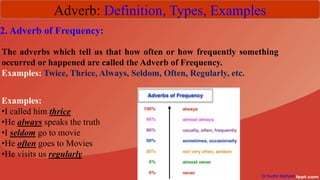
2. Adverb of Frequency:
The adverbs which tell us that how often or how frequently something
occurred or happened are called the Adverb of Frequency.
Examples: Twice, Thrice, Always, Seldom, Often, Regularly, etc.
Examples:
•I called him thrice
•He always speaks the truth
•I seldom go to movie
•He often goes to Movies
•He visits us regularly
Adverb: Definition, Types, Examples
Dr Sudhir Mathpati
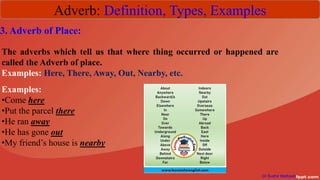
3. Adverb of Place:
The adverbs which tell us that where thing occurred or happened are
called the Adverb of place.
Examples: Here, There, Away, Out, Nearby, etc.
Examples:
•Come here
•Put the parcel there
•He ran away
•He has gone out
•My friend’s house is nearby
Adverb: Definition, Types, Examples
Dr Sudhir Mathpati
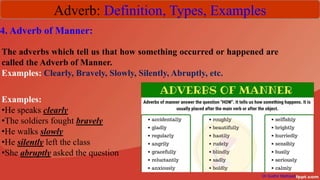
4. Adverb of Manner:
The adverbs which tell us that how something occurred or happened are
called the Adverb of Manner.
Examples: Clearly, Bravely, Slowly, Silently, Abruptly, etc.
Examples:
•He speaks clearly
•The soldiers fought bravely
•He walks slowly
•He silently left the class
•She abruptly asked the question
Adverb: Definition, Types, Examples
Dr Sudhir Mathpati
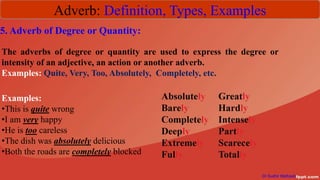
5. Adverb of Degree or Quantity:
The adverbs of degree or quantity are used to express the degree or
intensity of an adjective, an action or another adverb.
Examples: Quite, Very, Too, Absolutely, Completely, etc.
Examples:
•This is quite wrong
•I am very happy
•He is too careless
•The dish was absolutely delicious
•Both the roads are completely blocked
Adverb: Definition, Types, Examples
Dr Sudhir Mathpati
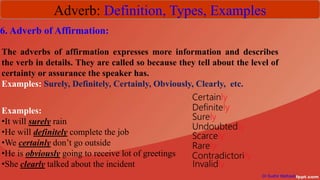
6. Adverb of Affirmation:
The adverbs of affirmation expresses more information and describes
the verb in details. They are called so because they tell about the level of
certainty or assurance the speaker has.
Examples: Surely, Definitely, Certainly, Obviously, Clearly, etc.
Examples:
•It will surely rain
•He will definitely complete the job
•We certainly don’t go outside
•He is obviously going to receive lot of greetings
•She clearly talked about the incident
Adverb: Definition, Types, Examples
Dr Sudhir Mathpati
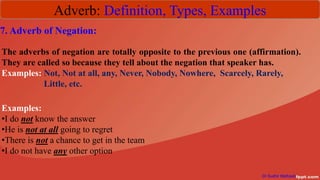
7. Adverb of Negation:
The adverbs of negation are totally opposite to the previous one (affirmation).
They are called so because they tell about the negation that speaker has.
Examples: Not, Not at all, any, Never, Nobody, Nowhere, Scarcely, Rarely,
Little, etc.
Examples:
•I do not know the answer
•He is not at all going to regret
•There is not a chance to get in the team
•I do not have any other option
Adverb: Definition, Types, Examples
Dr Sudhir Mathpati
8. Adverb of Reason:
The adverbs of reason are also called as the Adverbs of Purpose. These
adverbs tell us the reason behind happening or occurring something.
Examples: Hence, Therefore, So that, Because, etc.
Examples:
•I was not good, hence left early
•I therefore, hate him
•I started running so that I did not miss the bus.
•He left because he was late.
Adverb: Definition, Types, Examples
Dr Sudhir Mathpati
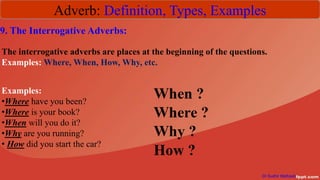
9. The Interrogative Adverbs:
The interrogative adverbs are places at the beginning of the questions.
Examples: Where, When, How, Why, etc.
Examples:
•Where have you been?
•Where is your book?
•When will you do it?
•Why are you running?
• How did you start the car?
Thank you !
Dr Sudhir Mathpati
(M.A.,B.Ed.,M.Phil.,Ph.D.,NET)
Assistant Professor
Department of English
Adarsh Mahavidyalaya, Omerga, Dist.
Osmanabad, MS, India
Dr Sudhir Mathpati

Adverb

  • 1.
    Adverb Definition, Types, Examples •Adverb of Time • Adverb of Frequency • Adverb of Place • Adverb of Manner • Adverb of Degree or Quantity • Adverb of Affirmation • Adverb of Negation • Adverb of Reason • The Interrogative Adverbs Dist. Osmanabad, MS, India Prepared By Dr Sudhir Mathpati Assistant Professor, Dept. of English Adarsh Mahavidyalaya, Omerga
  • 2.
    Adverb: Definition, Types,Examples Dr Sudhir Mathpati • Definition: • The Adverbs are the words which are used to describe Verbs and modify adjectives. • An Adverb is one of the important element of Parts of Speech which describes Verb, Adjective, another Adverb, a Phrase, a Clause or a sentence. Examples: Quickly, Slowly, Badly, Sadly, Sweetly, etc. Every adverb does not end up with ‘ly’ Examples: She ran swiftly A remarkably tall person came before me. She ran very swiftly
  • 3.
    Adverb: Definition, Types,Examples Dr Sudhir Mathpati • Types: • Adverb of Time • Adverb of Frequency • Adverb of Place • Adverb of Manner • Adverb of Degree or Quantity • Adverb of Affirmation • Adverb of Negation • Adverb of Reason • The Interrogative Adverbs
  • 4.
    Adverb: Definition, Types,Examples Dr Sudhir Mathpati 1. Adverb of Time: The adverbs which tell us that when the thing occurred or happen are called the Adverb of time. Examples: Today, Yesterday, Already, Ago, Soon, Early, etc. Examples: •He came yesterday. •I have done the task already •This happened two years ago •He returned soon •He came early
  • 5.
    Adverb: Definition, Types,Examples Dr Sudhir MathpatiDr Sudhir Mathpati 2. Adverb of Frequency: The adverbs which tell us that how often or how frequently something occurred or happened are called the Adverb of Frequency. Examples: Twice, Thrice, Always, Seldom, Often, Regularly, etc. Examples: •I called him thrice •He always speaks the truth •I seldom go to movie •He often goes to Movies •He visits us regularly
  • 6.
    Adverb: Definition, Types,Examples Dr Sudhir Mathpati 3. Adverb of Place: The adverbs which tell us that where thing occurred or happened are called the Adverb of place. Examples: Here, There, Away, Out, Nearby, etc. Examples: •Come here •Put the parcel there •He ran away •He has gone out •My friend’s house is nearby
  • 7.
    Adverb: Definition, Types,Examples Dr Sudhir Mathpati 4. Adverb of Manner: The adverbs which tell us that how something occurred or happened are called the Adverb of Manner. Examples: Clearly, Bravely, Slowly, Silently, Abruptly, etc. Examples: •He speaks clearly •The soldiers fought bravely •He walks slowly •He silently left the class •She abruptly asked the question
  • 8.
    Adverb: Definition, Types,Examples Dr Sudhir Mathpati 5. Adverb of Degree or Quantity: The adverbs of degree or quantity are used to express the degree or intensity of an adjective, an action or another adverb. Examples: Quite, Very, Too, Absolutely, Completely, etc. Examples: •This is quite wrong •I am very happy •He is too careless •The dish was absolutely delicious •Both the roads are completely blocked
  • 9.
    Adverb: Definition, Types,Examples Dr Sudhir Mathpati 6. Adverb of Affirmation: The adverbs of affirmation expresses more information and describes the verb in details. They are called so because they tell about the level of certainty or assurance the speaker has. Examples: Surely, Definitely, Certainly, Obviously, Clearly, etc. Examples: •It will surely rain •He will definitely complete the job •We certainly don’t go outside •He is obviously going to receive lot of greetings •She clearly talked about the incident
  • 10.
    Adverb: Definition, Types,Examples Dr Sudhir Mathpati 7. Adverb of Negation: The adverbs of negation are totally opposite to the previous one (affirmation). They are called so because they tell about the negation that speaker has. Examples: Not, Not at all, any, Never, Nobody, Nowhere, Scarcely, Rarely, Little, etc. Examples: •I do not know the answer •He is not at all going to regret •There is not a chance to get in the team •I do not have any other option
  • 11.
    Adverb: Definition, Types,Examples Dr Sudhir Mathpati 8. Adverb of Reason: The adverbs of reason are also called as the Adverbs of Purpose. These adverbs tell us the reason behind happening or occurring something. Examples: Hence, Therefore, So that, Because, etc. Examples: •I was not good, hence left early •I therefore, hate him •I started running so that I did not miss the bus. •He left because he was late.
  • 12.
    Adverb: Definition, Types,Examples Dr Sudhir Mathpati 9. The Interrogative Adverbs: The interrogative adverbs are places at the beginning of the questions. Examples: Where, When, How, Why, etc. Examples: •Where have you been? •Where is your book? •When will you do it? •Why are you running? • How did you start the car?
  • 13.
    Thank you ! DrSudhir Mathpati (M.A.,B.Ed.,M.Phil.,Ph.D.,NET) Assistant Professor Department of English Adarsh Mahavidyalaya, Omerga, Dist. Osmanabad, MS, India Dr Sudhir Mathpati