




TEAM 6
VENTURE CAPITAL
AND
SOCIAL ENTREPRENEURSHIP
T H E N E X T B I G E N G I N E P A V I N G E C O N O M I C
G R O W T H
VENTURE CAPITAL FUNDING
VENTURE CAPITAL
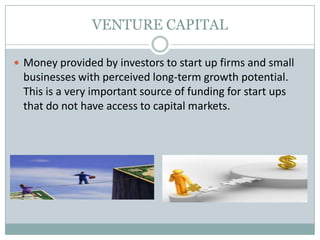
 Money provided by investors to start up firms and small
businesses with perceived long-term growth potential.
This is a very important source of funding for start ups
that do not have access to capital markets.
UNIQUE FEATURES
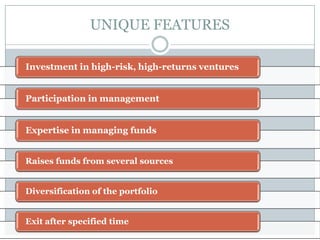
Investment in high-risk, high-returns ventures
Participation in management
Expertise in managing funds
Raises funds from several sources
Diversification of the portfolio
Exit after specified time
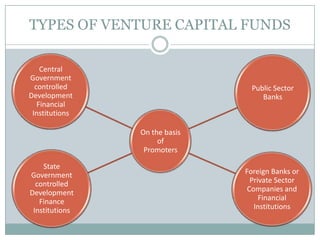
TYPES OF VENTURE CAPITAL FUNDS
On the basis
of
Promoters
Central
Government
controlled
Development
Financial
Institutions
Public Sector
Banks
Foreign Banks or
Private Sector
Companies and
Financial
Institutions
State
Government
controlled
Development
Finance
Institutions
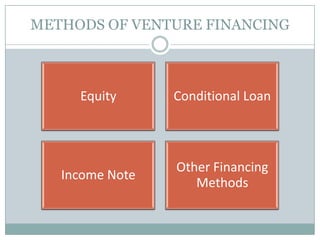
METHODS OF VENTURE FINANCING
Equity Conditional Loan
Income Note
Other Financing
Methods
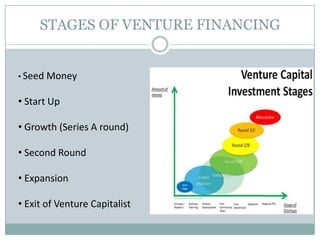
STAGES OF VENTURE FINANCING
• Seed Money
• Start Up
• Growth (Series A round)
• Second Round
• Expansion
• Exit of Venture Capitalist
WHAT DO VENTURE CAPITALISTS LOOK FOR?
Business Potential
Company Background
Core Plan
Promoter Details
Management
Business Model
Valuation Expectation
Return Expected
HOW IS A BUSINESS PLAN PRESENTED?
*
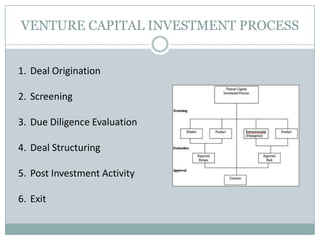
VENTURE CAPITAL INVESTMENT PROCESS
1. Deal Origination
2. Screening
3. Due Diligence Evaluation
4. Deal Structuring
5. Post Investment Activity
6. Exit
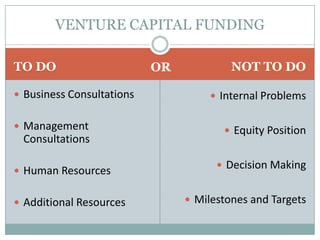
TO DO NOT TO DO
 Business Consultations
 Management
Consultations
 Human Resources
 Additional Resources
 Internal Problems
 Equity Position
 Decision Making
 Milestones and Targets
VENTURE CAPITAL FUNDING
OR
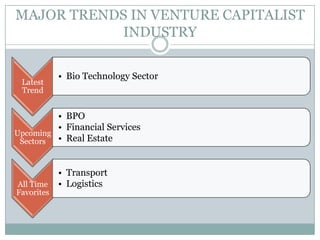
MAJOR TRENDS IN VENTURE CAPITALIST
INDUSTRY
Latest
Trend
• Bio Technology Sector
Upcoming
Sectors
• BPO
• Financial Services
• Real Estate
All Time
Favorites
• Transport
• Logistics
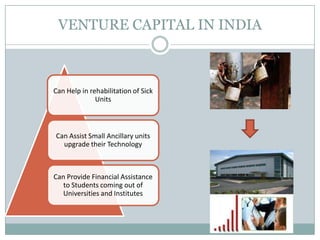
VENTURE CAPITAL IN INDIA
Can Help in rehabilitation of Sick
Units
Can Assist Small Ancillary units
upgrade their Technology
Can Provide Financial Assistance
to Students coming out of
Universities and Institutes
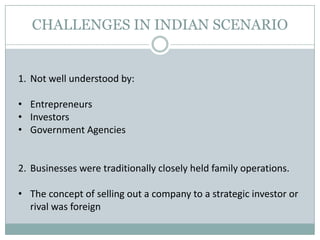
CHALLENGES IN INDIAN SCENARIO
1. Not well understood by:
• Entrepreneurs
• Investors
• Government Agencies
2. Businesses were traditionally closely held family operations.
• The concept of selling out a company to a strategic investor or
rival was foreign
CONTINUED…
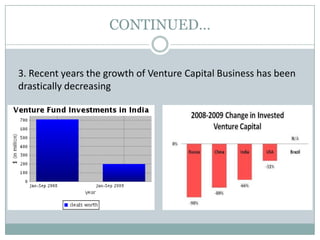
3. Recent years the growth of Venture Capital Business has been
drastically decreasing
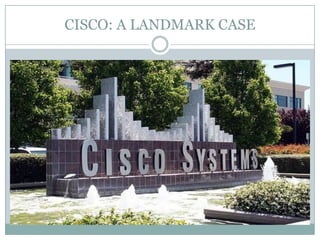
CISCO: A LANDMARK CASE
 An American
multinational corporation
headquartered in San
Jose, California, United
States
 The world's leading
manufacturer, designer and
supplier of computer
networking products
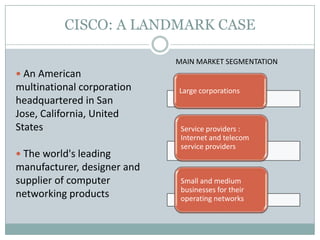
Large corporations
Service providers :
Internet and telecom
service providers
Small and medium
businesses for their
operating networks
MAIN MARKET SEGMENTATION
TRACING THE JOURNEY
 1984
Established on a very tight budget.
 Late 1980’s
The commercial market for internetworking began to develop,
CISCO's reasonably priced, high-performance routers gained
recognition.
High rate of sales growth, but company was still short of cash.
Turned to a venture capitalist, Donald T. Valentine of Sequoia
Capital.
CONTINUED…
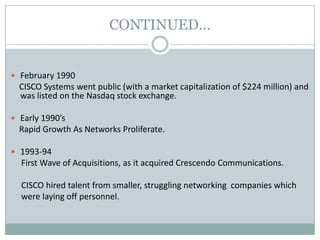
 February 1990
CISCO Systems went public (with a market capitalization of $224 million) and
was listed on the Nasdaq stock exchange.
 Early 1990’s
Rapid Growth As Networks Proliferate.
 1993-94
First Wave of Acquisitions, as it acquired Crescendo Communications.
CISCO hired talent from smaller, struggling networking companies which
were laying off personnel.
CONTINUED…
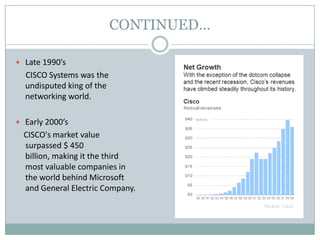
 Late 1990’s
CISCO Systems was the
undisputed king of the
networking world.
 Early 2000’s
CISCO's market value
surpassed $ 450
billion, making it the third
most valuable companies in
the world behind Microsoft
and General Electric Company.
THE OTHER SIDE OF THE COIN
 The VC however, required that the owners surrender to him a controlling
stake in the company.
 Mr. Valentine, thus, became chairperson and then hired an outsider, John
Morgridge, as the company's new president and chief executive officer.
 The new CEO also replaced the friends of the couple who were the back bone
of CISCO.
 Under the new CEO, the husband was given the title of chief scientist and the
wife was made head of customer services.
 However, later the wife did not get along well with the new CEO and so, she
was fired from her own company and the husband also quit.
VENTURE CAPITAL CONCLUSION
• Venture capital entrepreneurship and innovation have been closely
connected
• Though most of venture funds state that high technology is their priority only
firms started by experienced persons find support by VCFs.
• Capability for assessing venture projects continues to be a weak area
because of the lack of prior experience.
B E Y O N D C S R
SOCIAL ENTREPRENEURSHIP
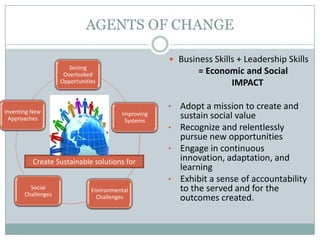
AGENTS OF CHANGE
 Business Skills + Leadership Skills
= Economic and Social
IMPACT
• Adopt a mission to create and
sustain social value
• Recognize and relentlessly
pursue new opportunities
• Engage in continuous
innovation, adaptation, and
learning
• Exhibit a sense of accountability
to the served and for the
outcomes created.
Seizing
Overlooked
Opportunities
Improving
Systems
Environmental
Challenges
Social
Challenges
Inventing New
Approaches
Create Sustainable solutions for
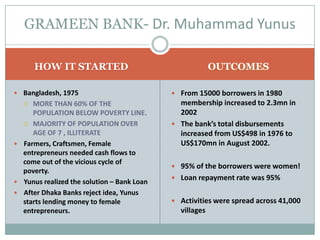
GRAMEEN BANK
Dr. Muhammad Yunus
HOW IT STARTED OUTCOMES
 Bangladesh, 1975
 MORE THAN 60% OF THE
POPULATION BELOW POVERTY LINE.
 MAJORITY OF POPULATION OVER
AGE OF 7 , ILLITERATE
 Farmers, Craftsmen, Female
entrepreneurs needed cash flows to
come out of the vicious cycle of
poverty.
 Yunus realized the solution – Bank Loan
 After Dhaka Banks reject idea, Yunus
starts lending money to female
entrepreneurs.
 From 15000 borrowers in 1980
membership increased to 2.3mn in
2002
 The bank’s total disbursements
increased from US$498 in 1976 to
US$170mn in August 2002.
 95% of the borrowers were women!
 Loan repayment rate was 95%
 Activities were spread across 41,000
villages
GRAMEEN BANK- Dr. Muhammad Yunus
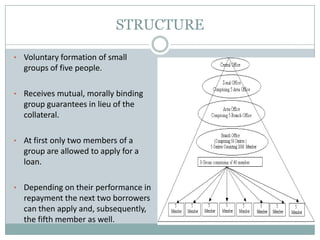
STRUCTURE
• Voluntary formation of small
groups of five people.
• Receives mutual, morally binding
group guarantees in lieu of the
collateral.
• At first only two members of a
group are allowed to apply for a
loan.
• Depending on their performance in
repayment the next two borrowers
can then apply and, subsequently,
the fifth member as well.
TAKE AWAYS…
 The bank as True Educator
 Women given equal access to
the schemes, proved not only
reliable borrowers but astute
entrepreneurs.
 Helped women raise their
status, lessen their dependency
on their husbands and improve
their the nutritional standards
of their family.
 Empowering people through
self employment and
entrepreneurship to eradicate
poverty.
“I OBSERVE THE POLICY OF THE COMMERCIAL BANKS
AND DO EXACTLY THE CONTRARY.
I BELIEVE ALL HUMAN BEINGS ARE POTENTIAL
ENTREPRENEURS”
-MUHAMMAD YUNUS,
NOBEL PRICE LAURETE
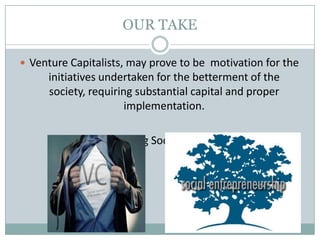
OUR TAKE
 Venture Capitalists, may prove to be motivation for the
initiatives undertaken for the betterment of the
society, requiring substantial capital and proper
implementation.
 Thus, nurturing Social Entrepreneurs.
REFERENCE
 www.rediff.com/money/2007/may/08vc.htm
 www.indianmba.com/faculty_column/fc159/fc159.html
 www.mbaskool.com/business-articles/finance/267-venture-
capital-funding-pros-and-cons.html
 www.antiventurecapital.com/venturecapital.html
CREDITS
 Anuj Khadria 09
 Arjun Sharma 11
 Ayush Wahi 12
 Esha Sharma 32
 Niharika Sareen 24
 Susanna Puthooran 47
 Vaani Malik 50

Venture capital

  • 1.
  • 2.
    T H EN E X T B I G E N G I N E P A V I N G E C O N O M I C G R O W T H VENTURE CAPITAL FUNDING
  • 3.
    VENTURE CAPITAL  Moneyprovided by investors to start up firms and small businesses with perceived long-term growth potential. This is a very important source of funding for start ups that do not have access to capital markets.
  • 4.
    UNIQUE FEATURES Investment inhigh-risk, high-returns ventures Participation in management Expertise in managing funds Raises funds from several sources Diversification of the portfolio Exit after specified time
  • 5.
    TYPES OF VENTURECAPITAL FUNDS On the basis of Promoters Central Government controlled Development Financial Institutions Public Sector Banks Foreign Banks or Private Sector Companies and Financial Institutions State Government controlled Development Finance Institutions
  • 6.
    METHODS OF VENTUREFINANCING Equity Conditional Loan Income Note Other Financing Methods
  • 7.
    STAGES OF VENTUREFINANCING • Seed Money • Start Up • Growth (Series A round) • Second Round • Expansion • Exit of Venture Capitalist
  • 8.
    WHAT DO VENTURECAPITALISTS LOOK FOR? Business Potential Company Background Core Plan Promoter Details Management Business Model Valuation Expectation Return Expected
  • 9.
    HOW IS ABUSINESS PLAN PRESENTED? *
  • 10.
    VENTURE CAPITAL INVESTMENTPROCESS 1. Deal Origination 2. Screening 3. Due Diligence Evaluation 4. Deal Structuring 5. Post Investment Activity 6. Exit
  • 11.
    TO DO NOTTO DO  Business Consultations  Management Consultations  Human Resources  Additional Resources  Internal Problems  Equity Position  Decision Making  Milestones and Targets VENTURE CAPITAL FUNDING OR
  • 12.
    MAJOR TRENDS INVENTURE CAPITALIST INDUSTRY Latest Trend • Bio Technology Sector Upcoming Sectors • BPO • Financial Services • Real Estate All Time Favorites • Transport • Logistics
  • 13.
    VENTURE CAPITAL ININDIA Can Help in rehabilitation of Sick Units Can Assist Small Ancillary units upgrade their Technology Can Provide Financial Assistance to Students coming out of Universities and Institutes
  • 14.
    CHALLENGES IN INDIANSCENARIO 1. Not well understood by: • Entrepreneurs • Investors • Government Agencies 2. Businesses were traditionally closely held family operations. • The concept of selling out a company to a strategic investor or rival was foreign
  • 15.
    CONTINUED… 3. Recent yearsthe growth of Venture Capital Business has been drastically decreasing
  • 16.
  • 17.
    CISCO: A LANDMARKCASE  An American multinational corporation headquartered in San Jose, California, United States  The world's leading manufacturer, designer and supplier of computer networking products Large corporations Service providers : Internet and telecom service providers Small and medium businesses for their operating networks MAIN MARKET SEGMENTATION
  • 18.
    TRACING THE JOURNEY 1984 Established on a very tight budget.  Late 1980’s The commercial market for internetworking began to develop, CISCO's reasonably priced, high-performance routers gained recognition. High rate of sales growth, but company was still short of cash. Turned to a venture capitalist, Donald T. Valentine of Sequoia Capital.
  • 19.
    CONTINUED…  February 1990 CISCOSystems went public (with a market capitalization of $224 million) and was listed on the Nasdaq stock exchange.  Early 1990’s Rapid Growth As Networks Proliferate.  1993-94 First Wave of Acquisitions, as it acquired Crescendo Communications. CISCO hired talent from smaller, struggling networking companies which were laying off personnel.
  • 20.
    CONTINUED…  Late 1990’s CISCOSystems was the undisputed king of the networking world.  Early 2000’s CISCO's market value surpassed $ 450 billion, making it the third most valuable companies in the world behind Microsoft and General Electric Company.
  • 21.
    THE OTHER SIDEOF THE COIN  The VC however, required that the owners surrender to him a controlling stake in the company.  Mr. Valentine, thus, became chairperson and then hired an outsider, John Morgridge, as the company's new president and chief executive officer.  The new CEO also replaced the friends of the couple who were the back bone of CISCO.  Under the new CEO, the husband was given the title of chief scientist and the wife was made head of customer services.  However, later the wife did not get along well with the new CEO and so, she was fired from her own company and the husband also quit.
  • 22.
    VENTURE CAPITAL CONCLUSION •Venture capital entrepreneurship and innovation have been closely connected • Though most of venture funds state that high technology is their priority only firms started by experienced persons find support by VCFs. • Capability for assessing venture projects continues to be a weak area because of the lack of prior experience.
  • 23.
    B E YO N D C S R SOCIAL ENTREPRENEURSHIP
  • 24.
    AGENTS OF CHANGE Business Skills + Leadership Skills = Economic and Social IMPACT • Adopt a mission to create and sustain social value • Recognize and relentlessly pursue new opportunities • Engage in continuous innovation, adaptation, and learning • Exhibit a sense of accountability to the served and for the outcomes created. Seizing Overlooked Opportunities Improving Systems Environmental Challenges Social Challenges Inventing New Approaches Create Sustainable solutions for
  • 25.
  • 26.
    HOW IT STARTEDOUTCOMES  Bangladesh, 1975  MORE THAN 60% OF THE POPULATION BELOW POVERTY LINE.  MAJORITY OF POPULATION OVER AGE OF 7 , ILLITERATE  Farmers, Craftsmen, Female entrepreneurs needed cash flows to come out of the vicious cycle of poverty.  Yunus realized the solution – Bank Loan  After Dhaka Banks reject idea, Yunus starts lending money to female entrepreneurs.  From 15000 borrowers in 1980 membership increased to 2.3mn in 2002  The bank’s total disbursements increased from US$498 in 1976 to US$170mn in August 2002.  95% of the borrowers were women!  Loan repayment rate was 95%  Activities were spread across 41,000 villages GRAMEEN BANK- Dr. Muhammad Yunus
  • 27.
    STRUCTURE • Voluntary formationof small groups of five people. • Receives mutual, morally binding group guarantees in lieu of the collateral. • At first only two members of a group are allowed to apply for a loan. • Depending on their performance in repayment the next two borrowers can then apply and, subsequently, the fifth member as well.
  • 28.
    TAKE AWAYS…  Thebank as True Educator  Women given equal access to the schemes, proved not only reliable borrowers but astute entrepreneurs.  Helped women raise their status, lessen their dependency on their husbands and improve their the nutritional standards of their family.  Empowering people through self employment and entrepreneurship to eradicate poverty. “I OBSERVE THE POLICY OF THE COMMERCIAL BANKS AND DO EXACTLY THE CONTRARY. I BELIEVE ALL HUMAN BEINGS ARE POTENTIAL ENTREPRENEURS” -MUHAMMAD YUNUS, NOBEL PRICE LAURETE
  • 29.
    OUR TAKE  VentureCapitalists, may prove to be motivation for the initiatives undertaken for the betterment of the society, requiring substantial capital and proper implementation.  Thus, nurturing Social Entrepreneurs.
  • 30.
    REFERENCE  www.rediff.com/money/2007/may/08vc.htm  www.indianmba.com/faculty_column/fc159/fc159.html www.mbaskool.com/business-articles/finance/267-venture- capital-funding-pros-and-cons.html  www.antiventurecapital.com/venturecapital.html
  • 31.
    CREDITS  Anuj Khadria09  Arjun Sharma 11  Ayush Wahi 12  Esha Sharma 32  Niharika Sareen 24  Susanna Puthooran 47  Vaani Malik 50