1
LEARNING OBJECTIVES
 Entrepreneur Vs. Businessman
 Entrepreneurship

 Factors Motivating Entrepreneurship

 Entrepreneurship Process

 Availability of Resources

 Contribution towards Economy

 Education, Innovation and Entrepreneurship

 Problems of an Entrepreneur

 21st Century Trend in Entrepreneurship Research

 Why Become an Entrepreneur ?
                                                    2
 Some Cases
THE EVOLUTION OF ENTREPRENEURSHIP
   Entrepreneur is derived from the French
    entreprendre, meaning “to undertake.”
       The entrepreneur is one who undertakes to organize,
        manage, and assume the risks of a business.
       Although no single definition of entrepreneur exists and
        no one profile can represent today‟s entrepreneur,
        research is providing an increasingly sharper focus on
        the subject.


                                                                   3
ENTREPRENEUR
“The initiative and voluntary act of
  managing risk and assuming
  responsibility in transforming
  creativity and innovation to
  unique product for the purpose
  of providing effective and
  efficient solutions to consumers,
  while      achieving     long-term
  profitability and contributing
  growth to the economy as a
                                       4
  whole. ”
QUALITIES

   Initiative
   Voluntarism
   Risk Management and Responsibility
   Creativity and Innovation
   Passion to win
   Providing Effective Consumer Solution
   Long Term Profitability
   Contributing Growth To Economy          5
ENTREPRENEUR VS. BUSINESSMAN


                               6
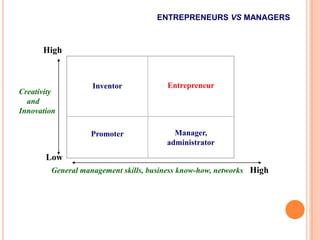
ENTREPRENEURS VS MANAGERS


      High


                   Inventor            Entrepreneur
Creativity
  and
Innovation

                  Promoter               Manager,
                                       administrator
       Low
        General management skills, business know-how, networks High
ENTREPRENEURSHIP

“Entrepreneurship is an act of being an entrepreneur
  which can be precisely defined as "one who
  undertakes innovation, finance and business acumen
  in an order to transform innovations into economic
  goods”

It is a mind set that is:
 Opportunity focused

 Innovative

 Growth oriented

                                                       8
FACTORS MOTIVATING ENTREPRENEURSHIP
    Personal attributes:-
1.    Higher internal locus of control

2.    Desire for financial success

3.    Desire to achieve self-realization

4.    Joy of innovation

5.    Risk Tolerance


                                           9
    Environmental Factors:-
1.    Local, Regional, or National attitudes towards
      entrepreneurship

2.    Social and cultural pressures for or against risk taking
      and entrepreneurship

3.    Access to entrepreneurial role models

4.    Responsibilities to family and community

5.    General Govt. facilities

                                                                 10
ENTREPRENEURIAL PROCESS:-

   Identifying opportunity

   Assess and acquire necessary resources

   Execution

     -producing the product or service

     -Marketing

     -designing and building a company

     -responding to the environment
                                             11
AVAILABILITY OF EARLY STAGE FINANCE
   Self financing
    -own saving
    -family business
    -borrowed from family and friends
   Bank finance
   Angel investor
   Venture capital
   Private equity                      12
13
BANK FINANCE
 Traditional bank financing- Adequate collateral   to
  judge credit-worthiness.
 Difficult at the start-up stage

  Comparatively easy at the growth stage.


                                                         14
ANGEL INVESTOR
 Angel investors are typically high-net-worth
  individuals (HNIs) who have often been successful
  entrepreneurs themselves.
 Institutional seed funds

 They invest in new-idea enterprises and help to
  bring these ideas to market
 take significant risks


                                                      15
VENTURE CAPITAL
 Venture capital funding provides funds for early stage
  companies once they have passed the seed stage and
  report some returns.
 developing, launching and expanding new products or
  services.
 lesser degrees of risk

 invest more money.


                                                           16
17
PRIVATE EQUITY
 Private Equity (PE) funds are among the largest
  sources of funding for enterprises.
 Requiring significantly large funds for expansion
  and growth.


                                                     18
ENCOURAGING ENTREPRENEURSHIP IN INDIA
 A transparent rating system for SMEs formed,
  where the cost of credit is linked to the credit rating
  of the enterprise.
 Credit Information Bureau (India) Limited (CIBIL),
  Dun & Bradstreet Information Services India Private
  Limited (D&B), SIDBI, and a few other banks have
  together set up SMERA (SME Rating Agency)
 Banks have also reported reduction in interest rate
  by 25 to 100 basis points for „SMERA rated
  companies.

                                                            19
MICRO SMALL AND MEDIUM ENTERPRISES
DEVELOPMENT ACT (MSME ACT):
 Key aim is to facilitate access to finance and
  incentivize efficient use of funds by entrepreneurs.
 Bring about greater growth in numbers and overall
  competitiveness.


                                                         20
MUTUAL CREDIT GUARANTEE
 First MGAs appeared in Europe in the 1940s
 In India, the Indian Institute of Rural Development
  (IIRD), with support from UNIDO, launched the
  Mutual Credit Guarantee Fund Scheme (MCGFS)
  in 2000.
 To help hand block printing textile clusters &
  overcome the difficulty in accessing credit arising
  from the inability to offer traditional forms of
  collateral.
 ALEAP Credit Guarantee Association (ACGA)
  agreement with Andhra Bank and CGTSI for
  implementation of MCGS in the state of Andhra
  Pradesh .                                             21
CONTRIBUTION TOWARDS ECONOMY

   New combination of means of production,

   New industry formation,

   Increasing opportunities for employment,

   Additional wealth creation,

   Introduction and dissemination of new methods &
    technology,

   Overall economic growth.
                                                      22
The Entrepreneurial Ecosystem


Facilitators
               Idea
Government
               Risk                       Deliverables
Family         aptitude
                                            Jobs
               Skills     Entrepreneurs
Education                                   Wealth
               Finance
Finance
community      Space


                                                     23
FIGURE 1.2: ENTREPRENEURSHIP AND
TECHNOLOGICAL CHANGE


                                   24
AN INTEGRATIVE MODEL OF ENTREPRENEURIAL
INPUTS AND OUTCOMES


                                          25
Education, Innovation and Entrepreneurship

   Education is indispensable for skill development and
    fundamental to Entrepreneurship and innovation.

   Innovation catalyzes Entrepreneurship by providing
    ideas that can be converted into wealth (through goods
    and services).

   An entrepreneurial culture drives creation of wealth from
    knowledge and generates impetus for further innovation.


                                                             26
27
EDUCATION--SKILL DEVELOPMENT & F.E--
CREATING INNOVATION

   Higher and Professional Education

   Vocational Education & Training- (Skill Development)
        96% in Korea
        75% in Germany

        80% in Japan

        68% in United Kingdom


          05% in India


                                                           28
PROBLEM OF AN ENTREPRENEUR
 Infrastructure
 Legal system

 Labour laws

 Corruptions

 Information

 Taxation

 Licensing


                             29
30
31
21ST CENTURY TRENDS IN ENTREPRENEURSHIP


                             Venture
                            Financing

         Corporate                               Social
      Entrepreneurship                      Entrepreneurship


                             Trends in
 Entrepreneurial                                      Women
   Cognition
                         Entrepreneurship          Entrepreneurs
                             Research


           Global
                                            Entrepreneurial
       Entrepreneurial
                                              Education
         Movement
                             Family
                           Businesses

                                                                   32
You will be an entrepreneur..
              or
Work for an entrepreneur…..?


                                33
WHY BECOME ENTREPRENEUR……..?

   Be your own Boss.

   To create jobs than search for a job

   To get financial reward

   To involve in total process of the business

   Prestige


                                                  34
STEVE JOBS
              Founded Apple Computers- 1976
              Former Chairman-cum-CEO

              Pioneer of the PC Revolution

              Product- i pod, i phone, i pad, PCs


                                                35
BABA RAMDEV
 Founder- Divya Yoga Trust &
            Patanjali yoga trust
 Product- Daily consumer products

          Ayurvedic Medicines
 Brand- Patanjali, Divya


                                     36
DR. ACHYUTA SAMANTA

 Founder- KIIT & KIIS
 KIIT- Established 1992

 Awarded- Deemed university status in 2004

 Awards

-Nominated for UK-India Business Awards-2009
-Asia‟s Best Social Entrepreneur - 2010 by the World HRD
  Congress
-The Times of India Orissa Icon 2011 Awards (Social
  Service)

                                                       37
SHAHRUKH KHAN AS AN ENTREPRENEUR

o   Founded RED CHILLIES
    ENTERTAINMENT in 2002 .
o   Now the turn over of this company
    in 2011-12 financial year is 150+
    crore
o   Successful movies made under
    this banner are:-
   Chalte chalte(2003)
   Main hoon na(2004)
   Paheli (2005)
   Om Shanti Om (2007)
   Ra.one(2011)                        38
BIBLIOGRAFY

 www.google.com
 National Knowledge Commission Survey

 Entrepreneur Magazine


                                         39
40

Entreprenuership: An Overview

  • 1.
  • 2.
    LEARNING OBJECTIVES  EntrepreneurVs. Businessman  Entrepreneurship  Factors Motivating Entrepreneurship  Entrepreneurship Process  Availability of Resources  Contribution towards Economy  Education, Innovation and Entrepreneurship  Problems of an Entrepreneur  21st Century Trend in Entrepreneurship Research  Why Become an Entrepreneur ? 2  Some Cases
  • 3.
    THE EVOLUTION OFENTREPRENEURSHIP  Entrepreneur is derived from the French entreprendre, meaning “to undertake.”  The entrepreneur is one who undertakes to organize, manage, and assume the risks of a business.  Although no single definition of entrepreneur exists and no one profile can represent today‟s entrepreneur, research is providing an increasingly sharper focus on the subject. 3
  • 4.
    ENTREPRENEUR “The initiative andvoluntary act of managing risk and assuming responsibility in transforming creativity and innovation to unique product for the purpose of providing effective and efficient solutions to consumers, while achieving long-term profitability and contributing growth to the economy as a 4 whole. ”
  • 5.
    QUALITIES  Initiative  Voluntarism  Risk Management and Responsibility  Creativity and Innovation  Passion to win  Providing Effective Consumer Solution  Long Term Profitability  Contributing Growth To Economy 5
  • 6.
  • 7.
    ENTREPRENEURS VS MANAGERS High Inventor Entrepreneur Creativity and Innovation Promoter Manager, administrator Low General management skills, business know-how, networks High
  • 8.
    ENTREPRENEURSHIP “Entrepreneurship is anact of being an entrepreneur which can be precisely defined as "one who undertakes innovation, finance and business acumen in an order to transform innovations into economic goods” It is a mind set that is:  Opportunity focused  Innovative  Growth oriented 8
  • 9.
    FACTORS MOTIVATING ENTREPRENEURSHIP  Personal attributes:- 1. Higher internal locus of control 2. Desire for financial success 3. Desire to achieve self-realization 4. Joy of innovation 5. Risk Tolerance 9
  • 10.
    Environmental Factors:- 1. Local, Regional, or National attitudes towards entrepreneurship 2. Social and cultural pressures for or against risk taking and entrepreneurship 3. Access to entrepreneurial role models 4. Responsibilities to family and community 5. General Govt. facilities 10
  • 11.
    ENTREPRENEURIAL PROCESS:-  Identifying opportunity  Assess and acquire necessary resources  Execution -producing the product or service -Marketing -designing and building a company -responding to the environment 11
  • 12.
    AVAILABILITY OF EARLYSTAGE FINANCE  Self financing -own saving -family business -borrowed from family and friends  Bank finance  Angel investor  Venture capital  Private equity 12
  • 13.
  • 14.
    BANK FINANCE  Traditionalbank financing- Adequate collateral to judge credit-worthiness.  Difficult at the start-up stage Comparatively easy at the growth stage. 14
  • 15.
    ANGEL INVESTOR  Angelinvestors are typically high-net-worth individuals (HNIs) who have often been successful entrepreneurs themselves.  Institutional seed funds  They invest in new-idea enterprises and help to bring these ideas to market  take significant risks 15
  • 16.
    VENTURE CAPITAL  Venturecapital funding provides funds for early stage companies once they have passed the seed stage and report some returns.  developing, launching and expanding new products or services.  lesser degrees of risk  invest more money. 16
  • 17.
  • 18.
    PRIVATE EQUITY  PrivateEquity (PE) funds are among the largest sources of funding for enterprises.  Requiring significantly large funds for expansion and growth. 18
  • 19.
    ENCOURAGING ENTREPRENEURSHIP ININDIA  A transparent rating system for SMEs formed, where the cost of credit is linked to the credit rating of the enterprise.  Credit Information Bureau (India) Limited (CIBIL), Dun & Bradstreet Information Services India Private Limited (D&B), SIDBI, and a few other banks have together set up SMERA (SME Rating Agency)  Banks have also reported reduction in interest rate by 25 to 100 basis points for „SMERA rated companies. 19
  • 20.
    MICRO SMALL ANDMEDIUM ENTERPRISES DEVELOPMENT ACT (MSME ACT):  Key aim is to facilitate access to finance and incentivize efficient use of funds by entrepreneurs.  Bring about greater growth in numbers and overall competitiveness. 20
  • 21.
    MUTUAL CREDIT GUARANTEE First MGAs appeared in Europe in the 1940s  In India, the Indian Institute of Rural Development (IIRD), with support from UNIDO, launched the Mutual Credit Guarantee Fund Scheme (MCGFS) in 2000.  To help hand block printing textile clusters & overcome the difficulty in accessing credit arising from the inability to offer traditional forms of collateral.  ALEAP Credit Guarantee Association (ACGA) agreement with Andhra Bank and CGTSI for implementation of MCGS in the state of Andhra Pradesh . 21
  • 22.
    CONTRIBUTION TOWARDS ECONOMY  New combination of means of production,  New industry formation,  Increasing opportunities for employment,  Additional wealth creation,  Introduction and dissemination of new methods & technology,  Overall economic growth. 22
  • 23.
    The Entrepreneurial Ecosystem Facilitators Idea Government Risk Deliverables Family aptitude Jobs Skills Entrepreneurs Education Wealth Finance Finance community Space 23
  • 24.
    FIGURE 1.2: ENTREPRENEURSHIPAND TECHNOLOGICAL CHANGE 24
  • 25.
    AN INTEGRATIVE MODELOF ENTREPRENEURIAL INPUTS AND OUTCOMES 25
  • 26.
    Education, Innovation andEntrepreneurship  Education is indispensable for skill development and fundamental to Entrepreneurship and innovation.  Innovation catalyzes Entrepreneurship by providing ideas that can be converted into wealth (through goods and services).  An entrepreneurial culture drives creation of wealth from knowledge and generates impetus for further innovation. 26
  • 27.
  • 28.
    EDUCATION--SKILL DEVELOPMENT &F.E-- CREATING INNOVATION  Higher and Professional Education  Vocational Education & Training- (Skill Development)  96% in Korea  75% in Germany  80% in Japan  68% in United Kingdom  05% in India 28
  • 29.
    PROBLEM OF ANENTREPRENEUR  Infrastructure  Legal system  Labour laws  Corruptions  Information  Taxation  Licensing 29
  • 30.
  • 31.
  • 32.
    21ST CENTURY TRENDSIN ENTREPRENEURSHIP Venture Financing Corporate Social Entrepreneurship Entrepreneurship Trends in Entrepreneurial Women Cognition Entrepreneurship Entrepreneurs Research Global Entrepreneurial Entrepreneurial Education Movement Family Businesses 32
  • 33.
    You will bean entrepreneur.. or Work for an entrepreneur…..? 33
  • 34.
    WHY BECOME ENTREPRENEUR……..?  Be your own Boss.  To create jobs than search for a job  To get financial reward  To involve in total process of the business  Prestige 34
  • 35.
    STEVE JOBS  Founded Apple Computers- 1976  Former Chairman-cum-CEO  Pioneer of the PC Revolution  Product- i pod, i phone, i pad, PCs 35
  • 36.
    BABA RAMDEV  Founder-Divya Yoga Trust & Patanjali yoga trust  Product- Daily consumer products Ayurvedic Medicines  Brand- Patanjali, Divya 36
  • 37.
    DR. ACHYUTA SAMANTA Founder- KIIT & KIIS  KIIT- Established 1992  Awarded- Deemed university status in 2004  Awards -Nominated for UK-India Business Awards-2009 -Asia‟s Best Social Entrepreneur - 2010 by the World HRD Congress -The Times of India Orissa Icon 2011 Awards (Social Service) 37
  • 38.
    SHAHRUKH KHAN ASAN ENTREPRENEUR o Founded RED CHILLIES ENTERTAINMENT in 2002 . o Now the turn over of this company in 2011-12 financial year is 150+ crore o Successful movies made under this banner are:-  Chalte chalte(2003)  Main hoon na(2004)  Paheli (2005)  Om Shanti Om (2007)  Ra.one(2011) 38
  • 39.
    BIBLIOGRAFY  www.google.com  NationalKnowledge Commission Survey  Entrepreneur Magazine 39
  • 40.