Surgical treatment of
complication of acute MI
Dr .HIRALAL PAWAR
2
Post MI Complications
“ACT RAPID”
• Arrhythmias
• Congestive Heart Failure
• Tamponade / Thromboembolic disorder
• Rupture (Ventricle, septum, papillary muscle)
• Aneurysm (Ventricle)
• Pericarditis
• Infection
• Death / Dressler’s Syndrome
3
Rupture of the Interventricular
Septum
• In 1847 Lathem first described a post
MI VSD at autopsy
• In 1923 Brann made diagnosis
clinically
• In 1957 Cooly first reported the
surgical repair of VSD
4
Natural history
• Early death occurs frequently in
patient with post infarct VSD:
Only about 75% survived the first 24
hour
50% the first week
Less than 30% in 2 week
Only 10-20% more than 4 week
5
• ruptured interventricular septum
is characterized by the
appearance of
a new harsh, loud holosystolic
murmur that is heard best at the
lower left sternal border and that
is usually accompanied by a thrill
 Biventricular failure generally
ensues within hours to days.
6
• Clinical features associated with an
increased risk of rupture of the
interventricular septum include:
 lack of development of a collateral
network,
advanced age
hypertension,
anterior location of infarction, and
 possibly fibrinolysis.
7
• Rupture of the septum with an
anterior infarction tends to be apical
in location, whereas inferior
infarctions are associated with
perforation of the basal septum and
have a worse prognosis than those
in an anterior location
8
• In contrast with rupture of the
free wall, rupture of the
ventricular septum is
 more often associated with
complete heart block,
right bundle branch block, or
 atrial fibrillation.
9
Almost all patients have multivessel
coronary artery disease, with most
exhibiting lesions in all the major
vessels.
The likelihood of survival depends on
the degree of impairment of
ventricular function and the size of
the defect
10
The defect can also be recognized
by echocardiography with color
flow Doppler imaging or
 insertion of a pulmonary artery
balloon catheter to document the
left-to-right shunt.
Catheter placement of an
umbrella-shaped device within the
ruptured septum may stabilize the
condition of critically ill patients
with acute septal rupture after
STEMI.
MANAGMENT
In such patients, the circulation
should at first be supported by
intra-aortic balloon pulsation
and a positive inotropic agent
such as dopamine or
dobutamine in combination
with a vasodilator, unless the
patient is hypotensive
11
12
Surgical technique
• Median sternotomy
• On pump surgery
• Cardioplegia via coronary sinus
• VSD usually approach through LV
• Using a collagen or gelatin impregnated
polyester patch or autologous or bovine
pericardium
13
Indication for operation
• Post MI VSD is almost always an
indication for operation
• The only question is timing of
operation ?
14
Criteria for deferment
1. Adequate CO with no evidence of
cardiogenic shock
2. Absence of symptoms of
pulmonary venous hypertension or
early control of initial symptom with
appropriate drug therapy
3. Absence of fluid retentions or early
control by digital and diuretic
4. Good renal function with normal Cr
and BUN
Rupture of a Papillary Muscle
• Inferior wall infarction can lead to
rupture of the posteromedial
papillary muscle, which occurs more
commonly than rupture of the
anterolateral muscle, a consequence
of anterolateral MI.
15
16
• Complete transection of a left
ventricular papillary muscle is
incompatible with life because the
sudden massive mitral regurgitation
that develops cannot be tolerated.
17
• Rupture of a portion of a papillary
muscle, usually the tip or head of the
muscle, resulting in severe, although
not necessarily overwhelming, mitral
regurgitation, is much more frequent
and is not immediately fatal
18
• Unlike rupture of the ventricular
septum, which occurs with large
infarcts, papillary muscle rupture
occurs with a relatively small
infarction in approximately half of
the cases seen.
• The extent of coronary artery
disease in these patients
sometimes is modest as well.
19
• those with papillary muscle rupture
manifest a new holosystolic murmur
and develop increasingly severe
heart failure. In both conditions, the
murmur may become softer or
disappear as arterial pressure falls
20
Technical operation
• The approach is generally through the left
atrium
• With acute total papillary muscle rupture
the MV is replaced with a mechanical or
bioprosthesis
• When the papillary muscle is not ruptured
and the chordal mechnism is intact or only
one head is ruptured and there is anular
dilation reparative techniques and
anuloplasty with or without use of an
anoloplasty ring are preferable to valve
replacement
21
• When the hemodynamic state is
reasonably good one sterategy has
been to delay operation 2wk to 2 mo.
FREE RUPTURE
Acute
Pseudoaneurysm
22
23
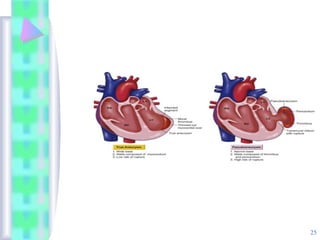
Pseudoaneurysm
• Incomplete rupture of the heart may
occur when organizing thrombus
and hematoma, together with
pericardium, seal a rupture of the left
ventricle and thus prevent the
development of hemopericardium
24
• Pseudoaneurysms can become
large, even equaling the true
ventricular cavity in size, and
communicate with the left ventricular
cavity through a narrow neck.
• Frequently, pseudoaneurysms
contain significant quantities of old
and recent thrombi, superficial
portions of which can cause arterial
emboli
25
26
Diagnosis
• The diagnosis of pseudoaneurysm
can usually be made by
echocardiography and contrast
angiography, although at times,
differentiation between true
aneurysm and pseudoaneurysm can
be difficult by any imaging technique
27
• Immediate pericardiocentesis confirms
the diagnosis and relieves the
pericardial tamponade, at least
momentarily.
• If the patient's condition is relatively
stable, echocardiography may help in
establishing the diagnosis of
tamponade.
28
• When rupture is subacute and a
pseudoaneurysm is suspected or
present, prompt elective surgery is
indicated because rupture of the
pseudoaneurysm occurs relatively
frequently
29
• Surgery should not be delayed in
patients with a correctable lesion
who agree to an aggressive
management strategy and require
pharmacologic and/or mechanical
(counterpulsation) support. Such
patients frequently develop a
serious complication (e.g., infection,
adult respiratory distress syndrome,
extension of the infarct, renal
failure) if surgery is delayed.
30
Surgical survival
predicted by
 early operation
 short duration of shock
 mild degrees of right and left
ventricular impairment

Complications ami

  • 1.
    Surgical treatment of complicationof acute MI Dr .HIRALAL PAWAR
  • 2.
    2 Post MI Complications “ACTRAPID” • Arrhythmias • Congestive Heart Failure • Tamponade / Thromboembolic disorder • Rupture (Ventricle, septum, papillary muscle) • Aneurysm (Ventricle) • Pericarditis • Infection • Death / Dressler’s Syndrome
  • 3.
    3 Rupture of theInterventricular Septum • In 1847 Lathem first described a post MI VSD at autopsy • In 1923 Brann made diagnosis clinically • In 1957 Cooly first reported the surgical repair of VSD
  • 4.
    4 Natural history • Earlydeath occurs frequently in patient with post infarct VSD: Only about 75% survived the first 24 hour 50% the first week Less than 30% in 2 week Only 10-20% more than 4 week
  • 5.
    5 • ruptured interventricularseptum is characterized by the appearance of a new harsh, loud holosystolic murmur that is heard best at the lower left sternal border and that is usually accompanied by a thrill  Biventricular failure generally ensues within hours to days.
  • 6.
    6 • Clinical featuresassociated with an increased risk of rupture of the interventricular septum include:  lack of development of a collateral network, advanced age hypertension, anterior location of infarction, and  possibly fibrinolysis.
  • 7.
    7 • Rupture ofthe septum with an anterior infarction tends to be apical in location, whereas inferior infarctions are associated with perforation of the basal septum and have a worse prognosis than those in an anterior location
  • 8.
    8 • In contrastwith rupture of the free wall, rupture of the ventricular septum is  more often associated with complete heart block, right bundle branch block, or  atrial fibrillation.
  • 9.
    9 Almost all patientshave multivessel coronary artery disease, with most exhibiting lesions in all the major vessels. The likelihood of survival depends on the degree of impairment of ventricular function and the size of the defect
  • 10.
    10 The defect canalso be recognized by echocardiography with color flow Doppler imaging or  insertion of a pulmonary artery balloon catheter to document the left-to-right shunt. Catheter placement of an umbrella-shaped device within the ruptured septum may stabilize the condition of critically ill patients with acute septal rupture after STEMI.
  • 11.
    MANAGMENT In such patients,the circulation should at first be supported by intra-aortic balloon pulsation and a positive inotropic agent such as dopamine or dobutamine in combination with a vasodilator, unless the patient is hypotensive 11
  • 12.
    12 Surgical technique • Mediansternotomy • On pump surgery • Cardioplegia via coronary sinus • VSD usually approach through LV • Using a collagen or gelatin impregnated polyester patch or autologous or bovine pericardium
  • 13.
    13 Indication for operation •Post MI VSD is almost always an indication for operation • The only question is timing of operation ?
  • 14.
    14 Criteria for deferment 1.Adequate CO with no evidence of cardiogenic shock 2. Absence of symptoms of pulmonary venous hypertension or early control of initial symptom with appropriate drug therapy 3. Absence of fluid retentions or early control by digital and diuretic 4. Good renal function with normal Cr and BUN
  • 15.
    Rupture of aPapillary Muscle • Inferior wall infarction can lead to rupture of the posteromedial papillary muscle, which occurs more commonly than rupture of the anterolateral muscle, a consequence of anterolateral MI. 15
  • 16.
    16 • Complete transectionof a left ventricular papillary muscle is incompatible with life because the sudden massive mitral regurgitation that develops cannot be tolerated.
  • 17.
    17 • Rupture ofa portion of a papillary muscle, usually the tip or head of the muscle, resulting in severe, although not necessarily overwhelming, mitral regurgitation, is much more frequent and is not immediately fatal
  • 18.
    18 • Unlike ruptureof the ventricular septum, which occurs with large infarcts, papillary muscle rupture occurs with a relatively small infarction in approximately half of the cases seen. • The extent of coronary artery disease in these patients sometimes is modest as well.
  • 19.
    19 • those withpapillary muscle rupture manifest a new holosystolic murmur and develop increasingly severe heart failure. In both conditions, the murmur may become softer or disappear as arterial pressure falls
  • 20.
    20 Technical operation • Theapproach is generally through the left atrium • With acute total papillary muscle rupture the MV is replaced with a mechanical or bioprosthesis • When the papillary muscle is not ruptured and the chordal mechnism is intact or only one head is ruptured and there is anular dilation reparative techniques and anuloplasty with or without use of an anoloplasty ring are preferable to valve replacement
  • 21.
    21 • When thehemodynamic state is reasonably good one sterategy has been to delay operation 2wk to 2 mo.
  • 22.
  • 23.
    23 Pseudoaneurysm • Incomplete ruptureof the heart may occur when organizing thrombus and hematoma, together with pericardium, seal a rupture of the left ventricle and thus prevent the development of hemopericardium
  • 24.
    24 • Pseudoaneurysms canbecome large, even equaling the true ventricular cavity in size, and communicate with the left ventricular cavity through a narrow neck. • Frequently, pseudoaneurysms contain significant quantities of old and recent thrombi, superficial portions of which can cause arterial emboli
  • 25.
  • 26.
    26 Diagnosis • The diagnosisof pseudoaneurysm can usually be made by echocardiography and contrast angiography, although at times, differentiation between true aneurysm and pseudoaneurysm can be difficult by any imaging technique
  • 27.
    27 • Immediate pericardiocentesisconfirms the diagnosis and relieves the pericardial tamponade, at least momentarily. • If the patient's condition is relatively stable, echocardiography may help in establishing the diagnosis of tamponade.
  • 28.
    28 • When ruptureis subacute and a pseudoaneurysm is suspected or present, prompt elective surgery is indicated because rupture of the pseudoaneurysm occurs relatively frequently
  • 29.
    29 • Surgery shouldnot be delayed in patients with a correctable lesion who agree to an aggressive management strategy and require pharmacologic and/or mechanical (counterpulsation) support. Such patients frequently develop a serious complication (e.g., infection, adult respiratory distress syndrome, extension of the infarct, renal failure) if surgery is delayed.
  • 30.
    30 Surgical survival predicted by early operation  short duration of shock  mild degrees of right and left ventricular impairment