
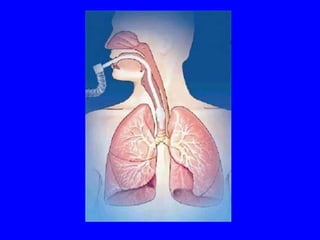


Ventilator-Associated Pneumonia
Josh Solomon, MD
VAP
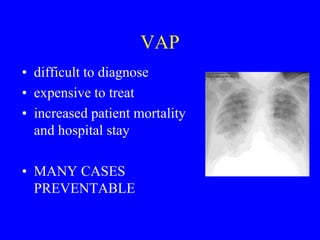
• difficult to diagnose
• expensive to treat
• increased patient mortality
and hospital stay
• MANY CASES
PREVENTABLE
Definition
• hospital acquired pneumonia after 48h on
ventilator (endotracheal or tracheotomy)
• EARLY ONSET - <96 hours on ventilator
• LATE ONSET - >96 hours on ventilator
Incidence
• Difficult to determine due to definition
• Intubated patients have 21 times the risk to
develop pneumonia
• Estimate that 28% of ventilated patients will
get VAP – 1 out of every 4!
Outcome
• Mortality increased but % unknown
(15-50%)
• Increased ICU stay by an average of 4 days
Heyland. AJRCCM 1999, 159, 1249-56
• 28% patients x 4 days in ICU =$$$$
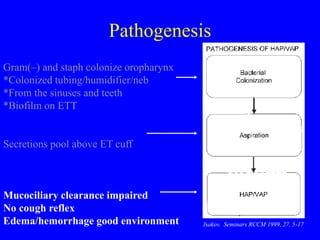
Pathogenesis
Isakov. Seminars RCCM 1999, 27, 5-17
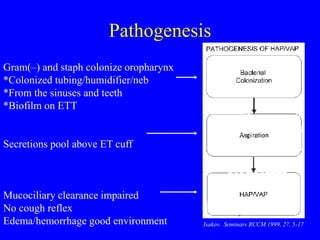
Gram(–) and staph colonize oropharynx
*Colonized tubing/humidifier/neb
*From the sinuses and teeth
*Biofilm on ETT
Secretions pool above ET cuff
Mucociliary clearance impaired
No cough reflex
Edema/hemorrhage good environment
Pathogenesis
Isakov. Seminars RCCM 1999, 27, 5-17
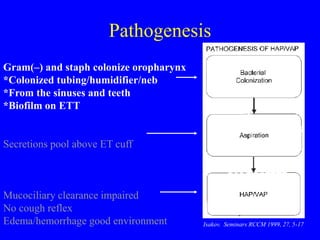
Gram(–) and staph colonize oropharynx
*Colonized tubing/humidifier/neb
*From the sinuses and teeth
*Biofilm on ETT
Secretions pool above ET cuff
Mucociliary clearance impaired
No cough reflex
Edema/hemorrhage good environment
Pathogenesis
Isakov. Seminars RCCM 1999, 27, 5-17
Gram(–) and staph colonize oropharynx
*Colonized tubing/humidifier/neb
*From the sinuses and teeth
*Biofilm on ETT
Secretions pool above ET cuff
Mucociliary clearance impaired
No cough reflex
Edema/hemorrhage good environment
Pathogenesis
Isakov. Seminars RCCM 1999, 27, 5-17
Gram(–) and staph colonize oropharynx
*Colonized tubing/humidifier/neb
*From the sinuses and teeth
*Biofilm on ETT
Secretions pool above ET cuff
Mucociliary clearance impaired
No cough reflex
Edema/hemorrhage good environment
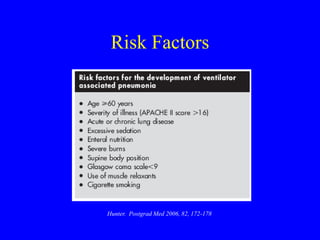
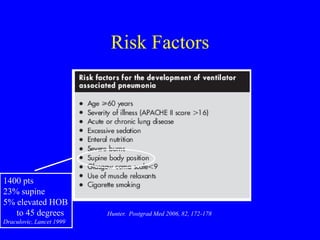
Risk Factors
Hunter. Postgrad Med 2006, 82, 172-178
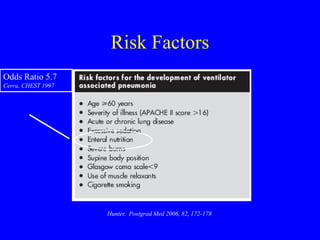
Risk Factors
Hunter. Postgrad Med 2006, 82, 172-178
Odds Ratio 5.7
Cerra, CHEST 1997
Risk Factors
1400 pts
23% supine
5% elevated HOB
to 45 degrees
Draculovic, Lancet 1999
Hunter. Postgrad Med 2006, 82, 172-178
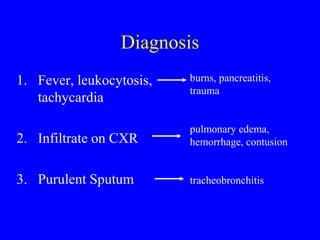
Diagnosis
1. Fever, leukocytosis,
tachycardia
2. Infiltrate on CXR
3. Purulent Sputum
burns, pancreatitis,
trauma
pulmonary edema,
hemorrhage, contusion
tracheobronchitis
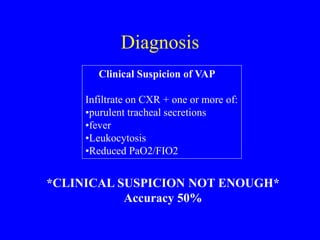
Diagnosis
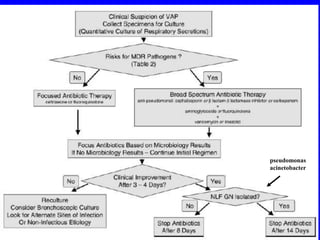
Clinical Suspicion of VAP
Infiltrate on CXR + one or more of:
•purulent tracheal secretions
•fever
•Leukocytosis
•Reduced PaO2/FIO2
*CLINICAL SUSPICION NOT ENOUGH*
Accuracy 50%
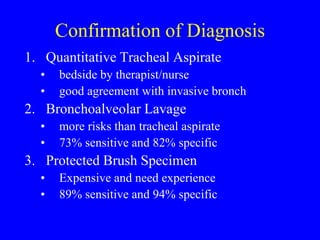
Confirmation of Diagnosis
1. Quantitative Tracheal Aspirate
• bedside by therapist/nurse
• good agreement with invasive bronch
2. Bronchoalveolar Lavage
• more risks than tracheal aspirate
• 73% sensitive and 82% specific
3. Protected Brush Specimen
• Expensive and need experience
• 89% sensitive and 94% specific
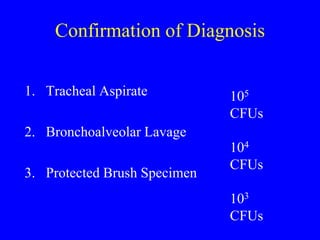
Confirmation of Diagnosis
1. Tracheal Aspirate
2. Bronchoalveolar Lavage
3. Protected Brush Specimen
105
CFUs
104
CFUs
103
CFUs
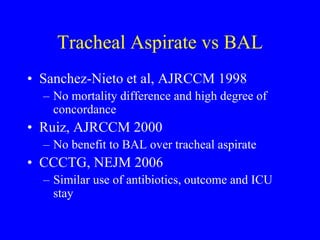
Tracheal Aspirate vs BAL
• Sanchez-Nieto et al, AJRCCM 1998
– No mortality difference and high degree of
concordance
• Ruiz, AJRCCM 2000
– No benefit to BAL over tracheal aspirate
• CCCTG, NEJM 2006
– Similar use of antibiotics, outcome and ICU
stay
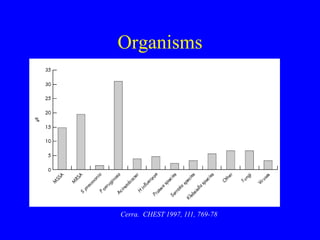
Organisms
Cerra. CHEST 1997, 111, 769-78
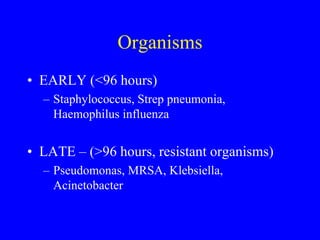
Organisms
• EARLY (<96 hours)
– Staphylococcus, Strep pneumonia,
Haemophilus influenza
• LATE – (>96 hours, resistant organisms)
– Pseudomonas, MRSA, Klebsiella,
Acinetobacter
Treatment
• start early and before microbiological data
is back
– delay is associated with increased mortality
(69.7 vs 28.4 with 16h delay)
Iregui. Chest 2002, 122, 262-8
• start with appropriate regimen
– inappropriate initial abx associated with
increased mortality and increased length of stay
Kolleff. Clin Infect Dis 2000, 31, S131-8
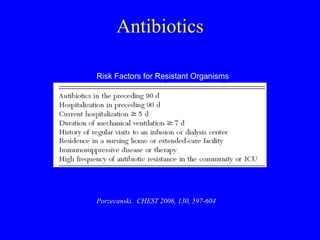
Antibiotics
Risk Factors for Resistant Organisms
Porzecanski. CHEST 2006, 130, 597-604
Antibiotics
• No Risk Factors for Resistance
– Ceftriaxone/Cefotaxime, fluroquinolone,
ampicillin/sulbactam, ertapenem
Antibiotics
• Risk Factors for Resistance (3 abx)
– antipseudomonal cephalosporin (ceftazadime,
cefepime) or antipseudomonal carbapenem
(imipenem, meropenem) or B-lactam/B-
lactamase inhibitor (pip/tazo) PLUS
– antipseudomonal fluoroquinolone
(ciprofloxacin, levofloxacin) or aminoglycoside
(gentamycin, amikacin, tobramycin) PLUS
– vancomycin or linazolid
Antibiotics
DURATION
• study looking at 8d vs 14d found no
difference in recurrence or mortality
Chastre. JAMA 2003, 290, 2588-98
• if Pseudomonas or Acinetobacter, treat 14d
pseudomonas
acinetobacter
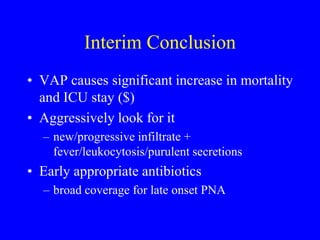
Interim Conclusion
• VAP causes significant increase in mortality
and ICU stay ($)
• Aggressively look for it
– new/progressive infiltrate +
fever/leukocytosis/purulent secretions
• Early appropriate antibiotics
– broad coverage for late onset PNA
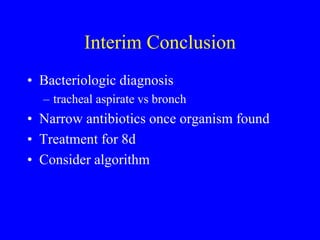
Interim Conclusion
• Bacteriologic diagnosis
– tracheal aspirate vs bronch
• Narrow antibiotics once organism found
• Treatment for 8d
• Consider algorithm
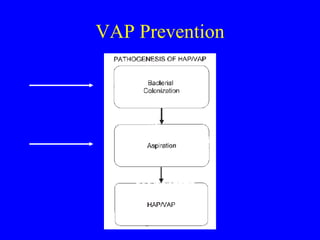
VAP Prevention
VAP Prevention
VAP Prevention
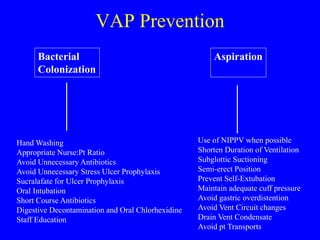
Hand Washing
Appropriate Nurse:Pt Ratio
Avoid Unnecessary Antibiotics
Avoid Unnecessary Stress Ulcer Prophylaxis
Sucralafate for Ulcer Prophylaxis
Oral Intubation
Short Course Antibiotics
Digestive Decontamination and Oral Chlorhexidine
Staff Education
Use of NIPPV when possible
Shorten Duration of Ventilation
Subglottic Suctioning
Semi-erect Position
Prevent Self-Extubation
Maintain adequate cuff pressure
Avoid gastric overdistention
Avoid Vent Circuit changes
Drain Vent Condensate
Avoid pt Transports
Bacterial
Colonization
Aspiration
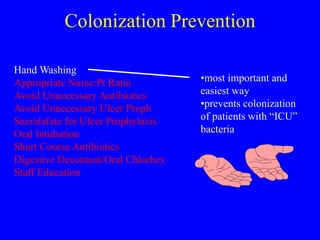
Colonization Prevention
Hand Washing
Appropriate Nurse:Pt Ratio
Avoid Unnecessary Antibiotics
Avoid Unnecessary Ulcer Proph
Sucralafate for Ulcer Prophylaxis
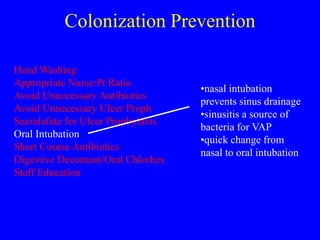
Oral Intubation
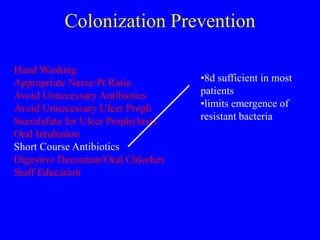
Short Course Antibiotics
Digestive Decontam/Oral Chlorhex
Staff Education
•most important and
easiest way
•prevents colonization
of patients with “ICU”
bacteria
Colonization Prevention
Hand Washing
Appropriate Nurse:Pt Ratio
Avoid Unnecessary Antibiotics
Avoid Unnecessary Ulcer Proph
Sucralafate for Ulcer Prophylaxis
Oral Intubation
Short Course Antibiotics
Digestive Decontam/Oral Chlorhex
Staff Education
•nurses more likely to
wash hands between
patients
•more likely to keep
the head of the bed
elevated
•education on VAP
helps with prevention
(team approach)
Colonization Prevention
Hand Washing
Appropriate Nurse:Pt Ratio
Avoid Unnecessary Antibiotics
Avoid Unnecessary Ulcer Proph
Sucralafate for Ulcer Prophylaxis
Oral Intubation
Short Course Antibiotics
Digestive Decontam/Oral Chlorhex
Staff Education
•nasal intubation
prevents sinus drainage
•sinusitis a source of
bacteria for VAP
•quick change from
nasal to oral intubation
Colonization Prevention
Hand Washing
Appropriate Nurse:Pt Ratio
Avoid Unnecessary Antibiotics
Avoid Unnecessary Ulcer Proph
Sucralafate for Ulcer Prophylaxis
Oral Intubation
Short Course Antibiotics
Digestive Decontam/Oral Chlorhex
Staff Education
•8d sufficient in most
patients
•limits emergence of
resistant bacteria
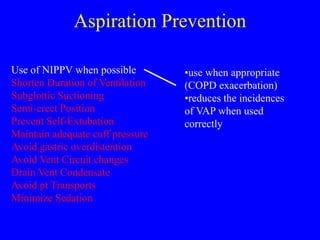
Aspiration Prevention
Use of NIPPV when possible
Shorten Duration of Ventilation
Subglottic Suctioning
Semi-erect Position
Prevent Self-Extubation
Maintain adequate cuff pressure
Avoid gastric overdistention
Avoid Vent Circuit changes
Drain Vent Condensate
Avoid pt Transports
Minimize Sedation
•use when appropriate
(COPD exacerbation)
•reduces the incidences
of VAP when used
correctly
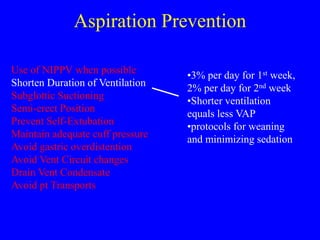
Aspiration Prevention
Use of NIPPV when possible
Shorten Duration of Ventilation
Subglottic Suctioning
Semi-erect Position
Prevent Self-Extubation
Maintain adequate cuff pressure
Avoid gastric overdistention
Avoid Vent Circuit changes
Drain Vent Condensate
Avoid pt Transports
•3% per day for 1st week,
2% per day for 2nd week
•Shorter ventilation
equals less VAP
•protocols for weaning
and minimizing sedation
Aspiration Prevention
Use of NIPPV when possible
Shorten Duration of Ventilation
Subglottic Suctioning
Semi-erect Position
Prevent Self-Extubation
Maintain adequate cuff pressure
Avoid gastric overdistention
Avoid Vent Circuit changes
Drain Vent Condensate
Avoid pt Transports
Minimize Sedation
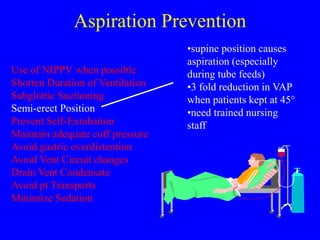
•supine position causes
aspiration (especially
during tube feeds)
•3 fold reduction in VAP
when patients kept at 45°
•need trained nursing
staff
Aspiration Prevention
Use of NIPPV when possible
Shorten Duration of Ventilation
Subglottic Suctioning
Semi-erect Position
Prevent Self-Extubation
Maintain adequate cuff pressure
Avoid gastric overdistention
Avoid Vent Circuit changes
Drain Vent Condensate
Avoid pt Transports
Minimize Sedation
•reintubation carries
significant increase in
VAP risk
•VAP in 30% patients
with unexpected
extubation vs 13.8% in
controls
de Lassence. Anesthesiology 2002, 97, 148-56
Aspiration Prevention
Use of NIPPV when possible
Shorten Duration of Ventilation
Subglottic Suctioning
Semi-erect Position
Prevent Self-Extubation
Maintain adequate cuff pressure
Avoid gastric overdistention
Avoid Vent Circuit changes
Drain Vent Condensate
Avoid pt Transports
Minimize Sedation
•maintain at > 20 cm
H2O to prevent drainage
Aspiration Prevention
Use of NIPPV when possible
Shorten Duration of Ventilation
Subglottic Suctioning
Semi-erect Position
Prevent Self-Extubation
Maintain adequate cuff pressure
Avoid gastric overdistention
Avoid Vent Circuit changes
Drain Vent Condensate
Avoid pt Transports
Minimize Sedation
1. check residuals
2. minimize narcotics
3. use prokinetic agents
like metoclopramide
4. small bore feeding
tubes post pyloric
reduces VAP
5. ?delay feeds in high
risk patients
Aspiration Prevention
Use of NIPPV when possible
Shorten Duration of Ventilation
Subglottic Suctioning
Semi-erect Position
Prevent Self-Extubation
Maintain adequate cuff pressure
Avoid gastric overdistention
Avoid Vent Circuit changes
Drain Vent Condensate
Avoid pt Transports
Minimize Sedation
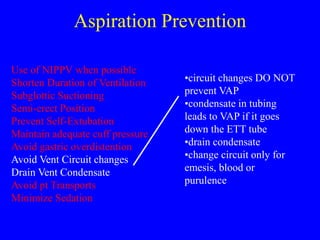
•circuit changes DO NOT
prevent VAP
•condensate in tubing
leads to VAP if it goes
down the ETT tube
•drain condensate
•change circuit only for
emesis, blood or
purulence
Aspiration Prevention
Use of NIPPV when possible
Shorten Duration of Ventilation
Subglottic Suctioning
Semi-erect Position
Prevent Self-Extubation
Maintain adequate cuff pressure
Avoid gastric overdistention
Avoid Vent Circuit changes
Drain Vent Condensate
Avoid pt Transports
Minimize Sedation
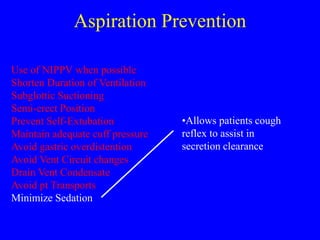
•Allows patients cough
reflex to assist in
secretion clearance
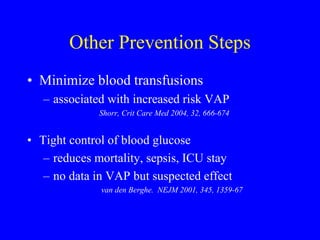
Other Prevention Steps
• Minimize blood transfusions
– associated with increased risk VAP
Shorr, Crit Care Med 2004, 32, 666-674
• Tight control of blood glucose
– reduces mortality, sepsis, ICU stay
– no data in VAP but suspected effect
van den Berghe. NEJM 2001, 345, 1359-67
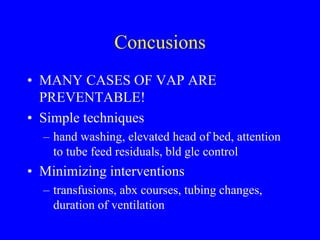
Concusions
• MANY CASES OF VAP ARE
PREVENTABLE!
• Simple techniques
– hand washing, elevated head of bed, attention
to tube feed residuals, bld glc control
• Minimizing interventions
– transfusions, abx courses, tubing changes,
duration of ventilation
Implementation
1. Strict monitoring of monthly cases of VAP
2. Staff education (doctors, nurses,
technicians)
3. Protocols for all patients on ventilators that
address patient and ventilator management
4. Documentation of success in decreasing
incidence of VAP
Conclusion
• VAP is pneumonia after 48 hours on a vent
• It is difficult to diagnose and treat
• It prolongs stay and increases mortality
• It results from aspiration of contaminated
secretions
• Simple measures decrease the incidence
• Appropriate treatment improves outcome
Future
• Vaccines
– investigating vaccine against S.aureus
• Nebulized Antibiotics
– shown to reduce colonization with gram
negatives
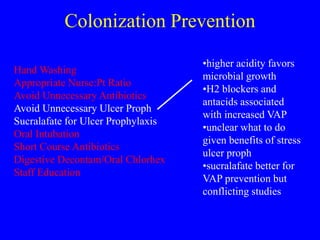
Colonization Prevention
Hand Washing
Appropriate Nurse:Pt Ratio
Avoid Unnecessary Antibiotics
Avoid Unnecessary Ulcer Proph
Sucralafate for Ulcer Prophylaxis
Oral Intubation
Short Course Antibiotics
Digestive Decontam/Oral Chlorhex
Staff Education
•higher acidity favors
microbial growth
•H2 blockers and
antacids associated
with increased VAP
•unclear what to do
given benefits of stress
ulcer proph
•sucralafate better for
VAP prevention but
conflicting studies
Aspiration Prevention
Use of NIPPV when possible
Shorten Duration of Ventilation
Subglottic Suctioning
Semi-erect Position
Prevent Self-Extubation
Maintain adequate cuff pressure
Avoid gastric overdistention
Avoid Vent Circuit changes
Drain Vent Condensate
Avoid pt Transports
Minimize Sedation
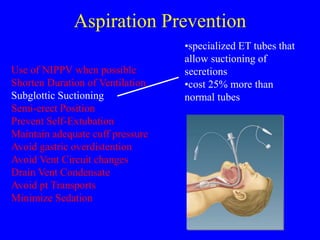
•specialized ET tubes that
allow suctioning of
secretions
•cost 25% more than
normal tubes

1 vap

  • 1.
  • 2.
    VAP • difficult todiagnose • expensive to treat • increased patient mortality and hospital stay • MANY CASES PREVENTABLE
  • 3.
    Definition • hospital acquiredpneumonia after 48h on ventilator (endotracheal or tracheotomy) • EARLY ONSET - <96 hours on ventilator • LATE ONSET - >96 hours on ventilator
  • 4.
    Incidence • Difficult todetermine due to definition • Intubated patients have 21 times the risk to develop pneumonia • Estimate that 28% of ventilated patients will get VAP – 1 out of every 4!
  • 5.
    Outcome • Mortality increasedbut % unknown (15-50%) • Increased ICU stay by an average of 4 days Heyland. AJRCCM 1999, 159, 1249-56 • 28% patients x 4 days in ICU =$$$$
  • 6.
    Pathogenesis Isakov. Seminars RCCM1999, 27, 5-17 Gram(–) and staph colonize oropharynx *Colonized tubing/humidifier/neb *From the sinuses and teeth *Biofilm on ETT Secretions pool above ET cuff Mucociliary clearance impaired No cough reflex Edema/hemorrhage good environment
  • 7.
    Pathogenesis Isakov. Seminars RCCM1999, 27, 5-17 Gram(–) and staph colonize oropharynx *Colonized tubing/humidifier/neb *From the sinuses and teeth *Biofilm on ETT Secretions pool above ET cuff Mucociliary clearance impaired No cough reflex Edema/hemorrhage good environment
  • 9.
    Pathogenesis Isakov. Seminars RCCM1999, 27, 5-17 Gram(–) and staph colonize oropharynx *Colonized tubing/humidifier/neb *From the sinuses and teeth *Biofilm on ETT Secretions pool above ET cuff Mucociliary clearance impaired No cough reflex Edema/hemorrhage good environment
  • 11.
    Pathogenesis Isakov. Seminars RCCM1999, 27, 5-17 Gram(–) and staph colonize oropharynx *Colonized tubing/humidifier/neb *From the sinuses and teeth *Biofilm on ETT Secretions pool above ET cuff Mucociliary clearance impaired No cough reflex Edema/hemorrhage good environment
  • 12.
    Risk Factors Hunter. PostgradMed 2006, 82, 172-178
  • 13.
    Risk Factors Hunter. PostgradMed 2006, 82, 172-178 Odds Ratio 5.7 Cerra, CHEST 1997
  • 14.
    Risk Factors 1400 pts 23%supine 5% elevated HOB to 45 degrees Draculovic, Lancet 1999 Hunter. Postgrad Med 2006, 82, 172-178
  • 15.
    Diagnosis 1. Fever, leukocytosis, tachycardia 2.Infiltrate on CXR 3. Purulent Sputum burns, pancreatitis, trauma pulmonary edema, hemorrhage, contusion tracheobronchitis
  • 16.
    Diagnosis Clinical Suspicion ofVAP Infiltrate on CXR + one or more of: •purulent tracheal secretions •fever •Leukocytosis •Reduced PaO2/FIO2 *CLINICAL SUSPICION NOT ENOUGH* Accuracy 50%
  • 17.
    Confirmation of Diagnosis 1.Quantitative Tracheal Aspirate • bedside by therapist/nurse • good agreement with invasive bronch 2. Bronchoalveolar Lavage • more risks than tracheal aspirate • 73% sensitive and 82% specific 3. Protected Brush Specimen • Expensive and need experience • 89% sensitive and 94% specific
  • 18.
    Confirmation of Diagnosis 1.Tracheal Aspirate 2. Bronchoalveolar Lavage 3. Protected Brush Specimen 105 CFUs 104 CFUs 103 CFUs
  • 19.
    Tracheal Aspirate vsBAL • Sanchez-Nieto et al, AJRCCM 1998 – No mortality difference and high degree of concordance • Ruiz, AJRCCM 2000 – No benefit to BAL over tracheal aspirate • CCCTG, NEJM 2006 – Similar use of antibiotics, outcome and ICU stay
  • 20.
  • 21.
    Organisms • EARLY (<96hours) – Staphylococcus, Strep pneumonia, Haemophilus influenza • LATE – (>96 hours, resistant organisms) – Pseudomonas, MRSA, Klebsiella, Acinetobacter
  • 22.
    Treatment • start earlyand before microbiological data is back – delay is associated with increased mortality (69.7 vs 28.4 with 16h delay) Iregui. Chest 2002, 122, 262-8 • start with appropriate regimen – inappropriate initial abx associated with increased mortality and increased length of stay Kolleff. Clin Infect Dis 2000, 31, S131-8
  • 23.
    Antibiotics Risk Factors forResistant Organisms Porzecanski. CHEST 2006, 130, 597-604
  • 24.
    Antibiotics • No RiskFactors for Resistance – Ceftriaxone/Cefotaxime, fluroquinolone, ampicillin/sulbactam, ertapenem
  • 25.
    Antibiotics • Risk Factorsfor Resistance (3 abx) – antipseudomonal cephalosporin (ceftazadime, cefepime) or antipseudomonal carbapenem (imipenem, meropenem) or B-lactam/B- lactamase inhibitor (pip/tazo) PLUS – antipseudomonal fluoroquinolone (ciprofloxacin, levofloxacin) or aminoglycoside (gentamycin, amikacin, tobramycin) PLUS – vancomycin or linazolid
  • 26.
    Antibiotics DURATION • study lookingat 8d vs 14d found no difference in recurrence or mortality Chastre. JAMA 2003, 290, 2588-98 • if Pseudomonas or Acinetobacter, treat 14d
  • 27.
  • 28.
    Interim Conclusion • VAPcauses significant increase in mortality and ICU stay ($) • Aggressively look for it – new/progressive infiltrate + fever/leukocytosis/purulent secretions • Early appropriate antibiotics – broad coverage for late onset PNA
  • 29.
    Interim Conclusion • Bacteriologicdiagnosis – tracheal aspirate vs bronch • Narrow antibiotics once organism found • Treatment for 8d • Consider algorithm
  • 30.
  • 31.
  • 32.
    VAP Prevention Hand Washing AppropriateNurse:Pt Ratio Avoid Unnecessary Antibiotics Avoid Unnecessary Stress Ulcer Prophylaxis Sucralafate for Ulcer Prophylaxis Oral Intubation Short Course Antibiotics Digestive Decontamination and Oral Chlorhexidine Staff Education Use of NIPPV when possible Shorten Duration of Ventilation Subglottic Suctioning Semi-erect Position Prevent Self-Extubation Maintain adequate cuff pressure Avoid gastric overdistention Avoid Vent Circuit changes Drain Vent Condensate Avoid pt Transports Bacterial Colonization Aspiration
  • 33.
    Colonization Prevention Hand Washing AppropriateNurse:Pt Ratio Avoid Unnecessary Antibiotics Avoid Unnecessary Ulcer Proph Sucralafate for Ulcer Prophylaxis Oral Intubation Short Course Antibiotics Digestive Decontam/Oral Chlorhex Staff Education •most important and easiest way •prevents colonization of patients with “ICU” bacteria
  • 34.
    Colonization Prevention Hand Washing AppropriateNurse:Pt Ratio Avoid Unnecessary Antibiotics Avoid Unnecessary Ulcer Proph Sucralafate for Ulcer Prophylaxis Oral Intubation Short Course Antibiotics Digestive Decontam/Oral Chlorhex Staff Education •nurses more likely to wash hands between patients •more likely to keep the head of the bed elevated •education on VAP helps with prevention (team approach)
  • 35.
    Colonization Prevention Hand Washing AppropriateNurse:Pt Ratio Avoid Unnecessary Antibiotics Avoid Unnecessary Ulcer Proph Sucralafate for Ulcer Prophylaxis Oral Intubation Short Course Antibiotics Digestive Decontam/Oral Chlorhex Staff Education •nasal intubation prevents sinus drainage •sinusitis a source of bacteria for VAP •quick change from nasal to oral intubation
  • 36.
    Colonization Prevention Hand Washing AppropriateNurse:Pt Ratio Avoid Unnecessary Antibiotics Avoid Unnecessary Ulcer Proph Sucralafate for Ulcer Prophylaxis Oral Intubation Short Course Antibiotics Digestive Decontam/Oral Chlorhex Staff Education •8d sufficient in most patients •limits emergence of resistant bacteria
  • 37.
    Aspiration Prevention Use ofNIPPV when possible Shorten Duration of Ventilation Subglottic Suctioning Semi-erect Position Prevent Self-Extubation Maintain adequate cuff pressure Avoid gastric overdistention Avoid Vent Circuit changes Drain Vent Condensate Avoid pt Transports Minimize Sedation •use when appropriate (COPD exacerbation) •reduces the incidences of VAP when used correctly
  • 38.
    Aspiration Prevention Use ofNIPPV when possible Shorten Duration of Ventilation Subglottic Suctioning Semi-erect Position Prevent Self-Extubation Maintain adequate cuff pressure Avoid gastric overdistention Avoid Vent Circuit changes Drain Vent Condensate Avoid pt Transports •3% per day for 1st week, 2% per day for 2nd week •Shorter ventilation equals less VAP •protocols for weaning and minimizing sedation
  • 39.
    Aspiration Prevention Use ofNIPPV when possible Shorten Duration of Ventilation Subglottic Suctioning Semi-erect Position Prevent Self-Extubation Maintain adequate cuff pressure Avoid gastric overdistention Avoid Vent Circuit changes Drain Vent Condensate Avoid pt Transports Minimize Sedation •supine position causes aspiration (especially during tube feeds) •3 fold reduction in VAP when patients kept at 45° •need trained nursing staff
  • 40.
    Aspiration Prevention Use ofNIPPV when possible Shorten Duration of Ventilation Subglottic Suctioning Semi-erect Position Prevent Self-Extubation Maintain adequate cuff pressure Avoid gastric overdistention Avoid Vent Circuit changes Drain Vent Condensate Avoid pt Transports Minimize Sedation •reintubation carries significant increase in VAP risk •VAP in 30% patients with unexpected extubation vs 13.8% in controls de Lassence. Anesthesiology 2002, 97, 148-56
  • 41.
    Aspiration Prevention Use ofNIPPV when possible Shorten Duration of Ventilation Subglottic Suctioning Semi-erect Position Prevent Self-Extubation Maintain adequate cuff pressure Avoid gastric overdistention Avoid Vent Circuit changes Drain Vent Condensate Avoid pt Transports Minimize Sedation •maintain at > 20 cm H2O to prevent drainage
  • 42.
    Aspiration Prevention Use ofNIPPV when possible Shorten Duration of Ventilation Subglottic Suctioning Semi-erect Position Prevent Self-Extubation Maintain adequate cuff pressure Avoid gastric overdistention Avoid Vent Circuit changes Drain Vent Condensate Avoid pt Transports Minimize Sedation 1. check residuals 2. minimize narcotics 3. use prokinetic agents like metoclopramide 4. small bore feeding tubes post pyloric reduces VAP 5. ?delay feeds in high risk patients
  • 43.
    Aspiration Prevention Use ofNIPPV when possible Shorten Duration of Ventilation Subglottic Suctioning Semi-erect Position Prevent Self-Extubation Maintain adequate cuff pressure Avoid gastric overdistention Avoid Vent Circuit changes Drain Vent Condensate Avoid pt Transports Minimize Sedation •circuit changes DO NOT prevent VAP •condensate in tubing leads to VAP if it goes down the ETT tube •drain condensate •change circuit only for emesis, blood or purulence
  • 44.
    Aspiration Prevention Use ofNIPPV when possible Shorten Duration of Ventilation Subglottic Suctioning Semi-erect Position Prevent Self-Extubation Maintain adequate cuff pressure Avoid gastric overdistention Avoid Vent Circuit changes Drain Vent Condensate Avoid pt Transports Minimize Sedation •Allows patients cough reflex to assist in secretion clearance
  • 45.
    Other Prevention Steps •Minimize blood transfusions – associated with increased risk VAP Shorr, Crit Care Med 2004, 32, 666-674 • Tight control of blood glucose – reduces mortality, sepsis, ICU stay – no data in VAP but suspected effect van den Berghe. NEJM 2001, 345, 1359-67
  • 46.
    Concusions • MANY CASESOF VAP ARE PREVENTABLE! • Simple techniques – hand washing, elevated head of bed, attention to tube feed residuals, bld glc control • Minimizing interventions – transfusions, abx courses, tubing changes, duration of ventilation
  • 47.
    Implementation 1. Strict monitoringof monthly cases of VAP 2. Staff education (doctors, nurses, technicians) 3. Protocols for all patients on ventilators that address patient and ventilator management 4. Documentation of success in decreasing incidence of VAP
  • 48.
    Conclusion • VAP ispneumonia after 48 hours on a vent • It is difficult to diagnose and treat • It prolongs stay and increases mortality • It results from aspiration of contaminated secretions • Simple measures decrease the incidence • Appropriate treatment improves outcome
  • 50.
    Future • Vaccines – investigatingvaccine against S.aureus • Nebulized Antibiotics – shown to reduce colonization with gram negatives
  • 51.
    Colonization Prevention Hand Washing AppropriateNurse:Pt Ratio Avoid Unnecessary Antibiotics Avoid Unnecessary Ulcer Proph Sucralafate for Ulcer Prophylaxis Oral Intubation Short Course Antibiotics Digestive Decontam/Oral Chlorhex Staff Education •higher acidity favors microbial growth •H2 blockers and antacids associated with increased VAP •unclear what to do given benefits of stress ulcer proph •sucralafate better for VAP prevention but conflicting studies
  • 52.
    Aspiration Prevention Use ofNIPPV when possible Shorten Duration of Ventilation Subglottic Suctioning Semi-erect Position Prevent Self-Extubation Maintain adequate cuff pressure Avoid gastric overdistention Avoid Vent Circuit changes Drain Vent Condensate Avoid pt Transports Minimize Sedation •specialized ET tubes that allow suctioning of secretions •cost 25% more than normal tubes