Dengue- Prevention & Control
Dr Geetha M
Synopsis
• Distribution and determinants
• Dynamics of Dengue transmission with
Dengue prevention & control
• Vector- Aedes spp.
• Vector control – Integrated Vector
management
• Recent initiatives & Advances in Dengue
control
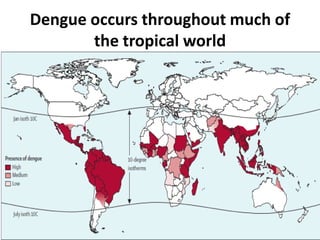
Dengue occurs throughout much of
the tropical world
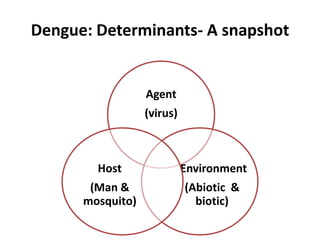
Dengue: Determinants- A snapshot
Agent
(virus)
Environment
(Abiotic &
biotic)
Host
(Man &
mosquito)
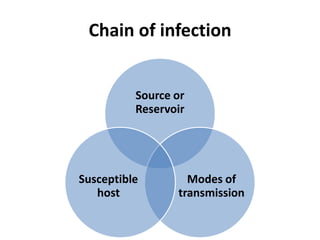
Chain of infection
Source or
Reservoir
Modes of
transmission
Susceptible
host
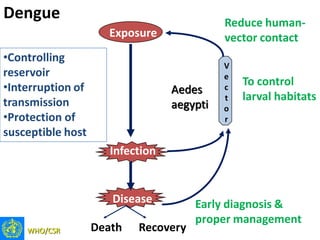
Exposure
Infection
Disease
Death Recovery
V
e
c
t
o
r
Dengue
Aedes
aegypti
Reduce human-
vector contact
To control
larval habitats
WHO/CSR
Early diagnosis &
proper management
•Controlling
reservoir
•Interruption of
transmission
•Protection of
susceptible host
Prevention & control of Dengue
• To control larval habitats
• To reduce human-vector contact
• To ensure prompt diagnosis of cases of fever &
appropriate treatment
No specific antiviral treatment or vaccine
against Dengue is available
INTEGRATED VECTOR MANAGEMENT
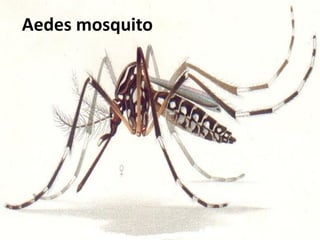
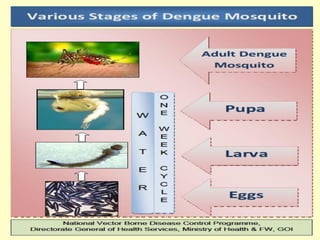
Aedes mosquito
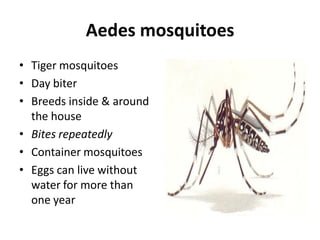
Aedes mosquitoes
• Tiger mosquitoes
• Day biter
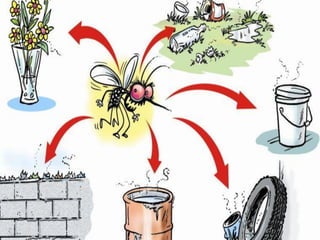
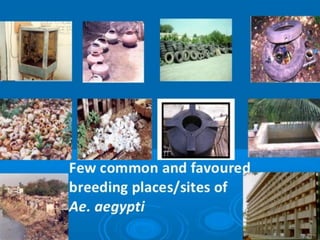
• Breeds inside & around
the house
• Bites repeatedly
• Container mosquitoes
• Eggs can live without
water for more than
one year
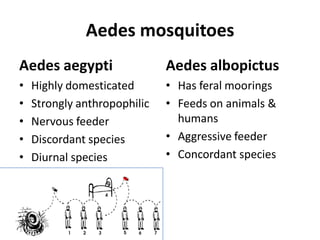
Aedes mosquitoes
Aedes aegypti
• Highly domesticated
• Strongly anthropophilic
• Nervous feeder
• Discordant species
• Diurnal species
Aedes albopictus
• Has feral moorings
• Feeds on animals &
humans
• Aggressive feeder
• Concordant species
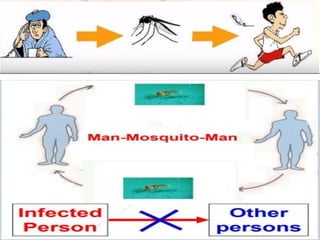
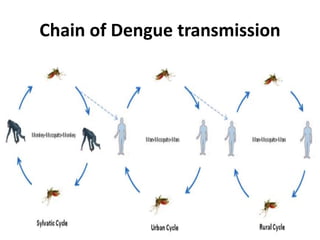
Chain of Dengue transmission
Risk factors associated with DF/DHF
• Demographic & societal changes
• Water supply
• Solid waste management
• Mosquito control infrastructure
• Consumerism
• Increased travel & globalization of trade
• Microevolution of viruses
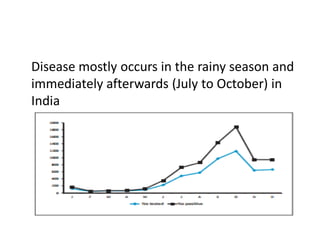
Disease mostly occurs in the rainy season and
immediately afterwards (July to October) in
India
Integrated vector management
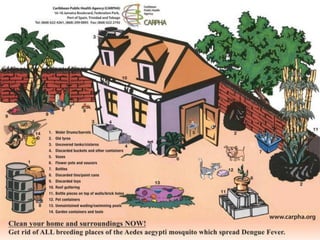
• Prevent mosquito breeding
• Prevent mosquito-human contact
Integrated Vector Management (IVM)
A rational decision-making process for the
optimal use of resources for vector control
• Improved efficacy
• Cost-effectiveness
• Ecological soundness
• Sustainability
IVM Strategy- 5 elements
• Integrated approach
• Evidence-based decision-making
• Intra- and inter-sectoral collaboration
• Advocacy, social mobilization & legislation
• Capacity building
Integration in IVM
• Collaboration within health sector and with
other sectors through the optimal use of
resources, planning, monitoring and decision-
making.
• Integration of non-chemical and chemical
vector control methods
• integration with other disease control
measures.
ANTILARVAL MEASURES
Vector control
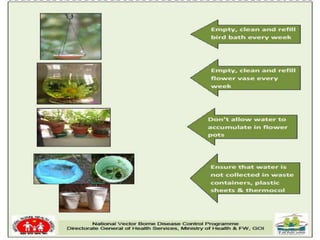
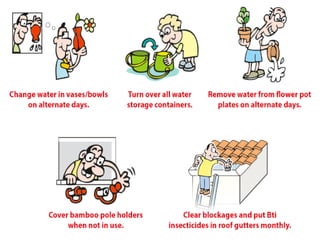
• Environmental management
• Chemical control
• Biological control
Environmental management
• Aim: to prevent or minimize vector
propagation and human contact with the
vector-pathogen
Environmental modification
Environmental manipulation
Changes to human habitation or behaviour
Environmental modification
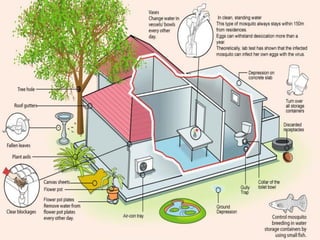
• Improvement of water supply and water-
storage systems
• Mosquito-proofing of water-storage
containers
• Solid waste management
• Street cleansing
• Building structures
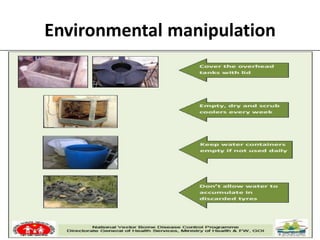
Environmental manipulation
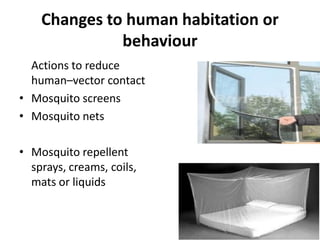
Changes to human habitation or
behaviour
Actions to reduce
human–vector contact
• Mosquito screens
• Mosquito nets
• Mosquito repellent
sprays, creams, coils,
mats or liquids
Biological control
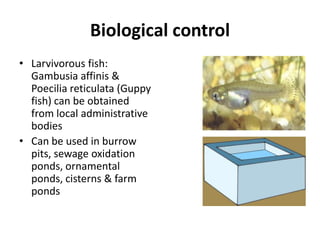
• Larvivorous fish:
Gambusia affinis &
Poecilia reticulata (Guppy
fish) can be obtained
from local administrative
bodies
• Can be used in burrow
pits, sewage oxidation
ponds, ornamental
ponds, cisterns & farm
ponds
Biological control
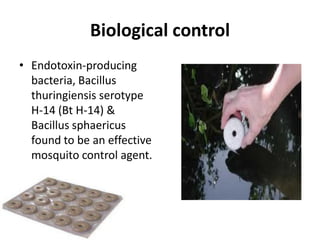
• Endotoxin-producing
bacteria, Bacillus
thuringiensis serotype
H-14 (Bt H-14) &
Bacillus sphaericus
found to be an effective
mosquito control agent.
Chemical control
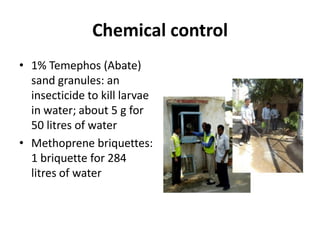
• 1% Temephos (Abate)
sand granules: an
insecticide to kill larvae
in water; about 5 g for
50 litres of water
• Methoprene briquettes:
1 briquette for 284
litres of water
Chemical control
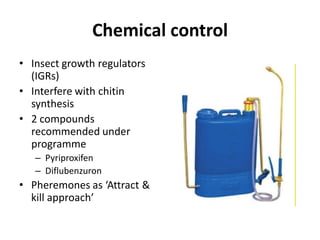
• Insect growth regulators
(IGRs)
• Interfere with chitin
synthesis
• 2 compounds
recommended under
programme
– Pyriproxifen
– Diflubenzuron
• Pheremones as ‘Attract &
kill approach’
ANTI-ADULT MEASURES
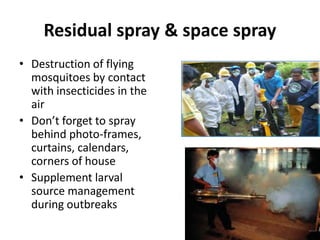
Residual spray & space spray
• Destruction of flying
mosquitoes by contact
with insecticides in the
air
• Don’t forget to spray
behind photo-frames,
curtains, calendars,
corners of house
• Supplement larval
source management
during outbreaks
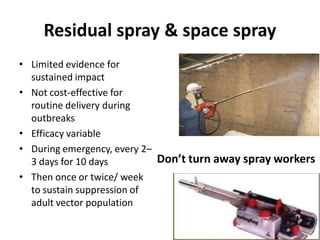
Residual spray & space spray
• Limited evidence for
sustained impact
• Not cost-effective for
routine delivery during
outbreaks
• Efficacy variable
• During emergency, every 2–
3 days for 10 days
• Then once or twice/ week
to sustain suppression of
adult vector population
Don’t turn away spray workers
DISEASE SURVEILLANCE
Disease surveillance
Epidemiological surveillance
• Passive
• Active
• Event-based
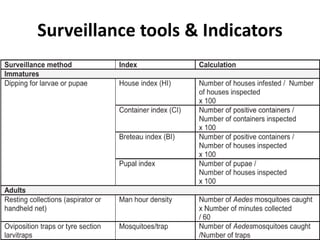
Entomological or Vector surveillance
• Larval surveys
• Pupal/ demographic surveys
• Adult surveys
Surveillance tools & Indicators
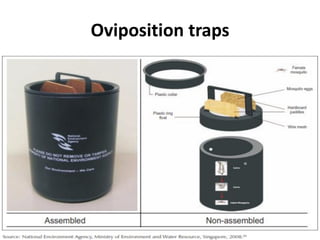
Oviposition traps
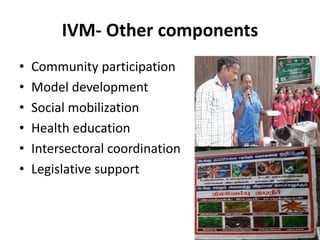
IVM- Other components
• Community participation
• Model development
• Social mobilization
• Health education
• Intersectoral coordination
• Legislative support
When to implement? Where to
implement?
• Background interventions in endemic areas
• Scaling up & additional interventions during
outbreaks
• Early warning systems
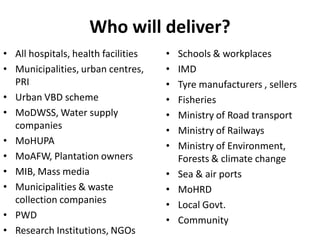
Who will deliver?
• All hospitals, health facilities
• Municipalities, urban centres,
PRI
• Urban VBD scheme
• MoDWSS, Water supply
companies
• MoHUPA
• MoAFW, Plantation owners
• MIB, Mass media
• Municipalities & waste
collection companies
• PWD
• Research Institutions, NGOs
• Schools & workplaces
• IMD
• Tyre manufacturers , sellers
• Fisheries
• Ministry of Road transport
• Ministry of Railways
• Ministry of Environment,
Forests & climate change
• Sea & air ports
• MoHRD
• Local Govt.
• Community
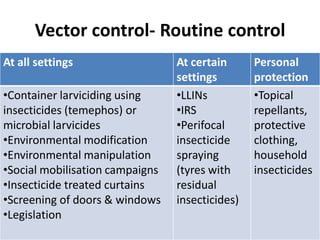
Vector control- Routine control
At all settings At certain
settings
Personal
protection
•Container larviciding using
insecticides (temephos) or
microbial larvicides
•Environmental modification
•Environmental manipulation
•Social mobilisation campaigns
•Insecticide treated curtains
•Screening of doors & windows
•Legislation
•LLINs
•IRS
•Perifocal
insecticide
spraying
(tyres with
residual
insecticides)
•Topical
repellants,
protective
clothing,
household
insecticides
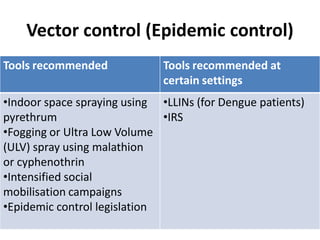
Vector control (Epidemic control)
Tools recommended Tools recommended at
certain settings
•Indoor space spraying using
pyrethrum
•Fogging or Ultra Low Volume
(ULV) spray using malathion
or cyphenothrin
•Intensified social
mobilisation campaigns
•Epidemic control legislation
•LLINs (for Dengue patients)
•IRS
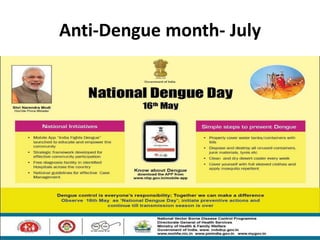
Anti-Dengue month- July
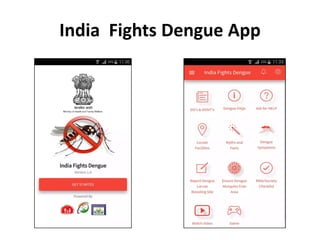
India Fights Dengue App
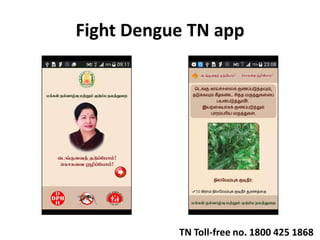
Fight Dengue TN app
TN Toll-free no. 1800 425 1868
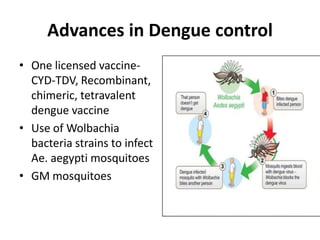
Advances in Dengue control
• One licensed vaccine-
CYD-TDV, Recombinant,
chimeric, tetravalent
dengue vaccine
• Use of Wolbachia
bacteria strains to infect
Ae. aegypti mosquitoes
• GM mosquitoes
WHO Global strategy for Dengue
prevention & control, 2012-2020
• To reduce the burden of Dengue
• To reduce mortality from Dengue by 2020 by
atleast 50% (using 2010 as baseline)
• To reduce morbidity from Dengue by 2020 by
atleast 25% (using 2010 as baseline)
Dengue fever can be easily
prevented
IT IS A COLLECTIVE
RESPONSIBILITY
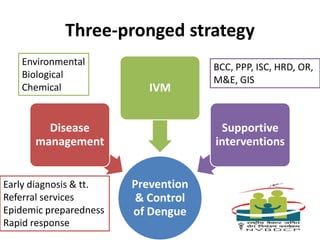
Three-pronged strategy
Prevention
& Control
of Dengue
Disease
management
IVM
Supportive
interventions
Early diagnosis & tt.
Referral services
Epidemic preparedness
Rapid response
Environmental
Biological
Chemical
BCC, PPP, ISC, HRD, OR,
M&E, GIS
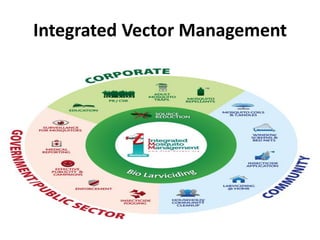
Integrated Vector Management
References
• GOI, MOHFW, Operational manual for Integrated
Vector Management in India. March 2016.
• Pang T, Mak TK, Gubler DJ. Prevention and control of
dengue- the light at the end of the tunnel. Lancet
Infectious Diseases, 2017; 17:e79-87.
• Comprehensive Guidelines for Prevention & Control of
Dengue & DHF, SEARO, WHO, 2011.
• WHO, Dengue control.
• www.nvbdcp.gov.in
Government of India (2006), National Vector Borne
Disease Control Programme. MOHFW, New Delhi
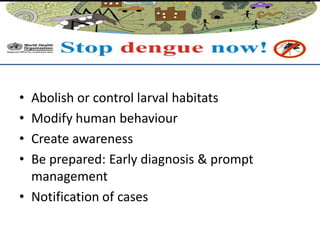
• Abolish or control larval habitats
• Modify human behaviour
• Create awareness
• Be prepared: Early diagnosis & prompt
management
• Notification of cases
Thank you….

Dengue prevention & control

  • 1.
    Dengue- Prevention &Control Dr Geetha M
  • 2.
    Synopsis • Distribution anddeterminants • Dynamics of Dengue transmission with Dengue prevention & control • Vector- Aedes spp. • Vector control – Integrated Vector management • Recent initiatives & Advances in Dengue control
  • 3.
    Dengue occurs throughoutmuch of the tropical world
  • 4.
    Dengue: Determinants- Asnapshot Agent (virus) Environment (Abiotic & biotic) Host (Man & mosquito)
  • 5.
    Chain of infection Sourceor Reservoir Modes of transmission Susceptible host
  • 6.
    Exposure Infection Disease Death Recovery V e c t o r Dengue Aedes aegypti Reduce human- vectorcontact To control larval habitats WHO/CSR Early diagnosis & proper management •Controlling reservoir •Interruption of transmission •Protection of susceptible host
  • 7.
    Prevention & controlof Dengue • To control larval habitats • To reduce human-vector contact • To ensure prompt diagnosis of cases of fever & appropriate treatment No specific antiviral treatment or vaccine against Dengue is available INTEGRATED VECTOR MANAGEMENT
  • 8.
  • 9.
    Aedes mosquitoes • Tigermosquitoes • Day biter • Breeds inside & around the house • Bites repeatedly • Container mosquitoes • Eggs can live without water for more than one year
  • 10.
    Aedes mosquitoes Aedes aegypti •Highly domesticated • Strongly anthropophilic • Nervous feeder • Discordant species • Diurnal species Aedes albopictus • Has feral moorings • Feeds on animals & humans • Aggressive feeder • Concordant species
  • 14.
    Chain of Denguetransmission
  • 15.
    Risk factors associatedwith DF/DHF • Demographic & societal changes • Water supply • Solid waste management • Mosquito control infrastructure • Consumerism • Increased travel & globalization of trade • Microevolution of viruses
  • 19.
    Disease mostly occursin the rainy season and immediately afterwards (July to October) in India
  • 20.
    Integrated vector management •Prevent mosquito breeding • Prevent mosquito-human contact
  • 21.
    Integrated Vector Management(IVM) A rational decision-making process for the optimal use of resources for vector control • Improved efficacy • Cost-effectiveness • Ecological soundness • Sustainability
  • 22.
    IVM Strategy- 5elements • Integrated approach • Evidence-based decision-making • Intra- and inter-sectoral collaboration • Advocacy, social mobilization & legislation • Capacity building
  • 23.
    Integration in IVM •Collaboration within health sector and with other sectors through the optimal use of resources, planning, monitoring and decision- making. • Integration of non-chemical and chemical vector control methods • integration with other disease control measures.
  • 24.
  • 25.
    Vector control • Environmentalmanagement • Chemical control • Biological control
  • 26.
    Environmental management • Aim:to prevent or minimize vector propagation and human contact with the vector-pathogen Environmental modification Environmental manipulation Changes to human habitation or behaviour
  • 27.
    Environmental modification • Improvementof water supply and water- storage systems • Mosquito-proofing of water-storage containers • Solid waste management • Street cleansing • Building structures
  • 28.
  • 31.
    Changes to humanhabitation or behaviour Actions to reduce human–vector contact • Mosquito screens • Mosquito nets • Mosquito repellent sprays, creams, coils, mats or liquids
  • 32.
    Biological control • Larvivorousfish: Gambusia affinis & Poecilia reticulata (Guppy fish) can be obtained from local administrative bodies • Can be used in burrow pits, sewage oxidation ponds, ornamental ponds, cisterns & farm ponds
  • 33.
    Biological control • Endotoxin-producing bacteria,Bacillus thuringiensis serotype H-14 (Bt H-14) & Bacillus sphaericus found to be an effective mosquito control agent.
  • 34.
    Chemical control • 1%Temephos (Abate) sand granules: an insecticide to kill larvae in water; about 5 g for 50 litres of water • Methoprene briquettes: 1 briquette for 284 litres of water
  • 35.
    Chemical control • Insectgrowth regulators (IGRs) • Interfere with chitin synthesis • 2 compounds recommended under programme – Pyriproxifen – Diflubenzuron • Pheremones as ‘Attract & kill approach’
  • 36.
  • 37.
    Residual spray &space spray • Destruction of flying mosquitoes by contact with insecticides in the air • Don’t forget to spray behind photo-frames, curtains, calendars, corners of house • Supplement larval source management during outbreaks
  • 38.
    Residual spray &space spray • Limited evidence for sustained impact • Not cost-effective for routine delivery during outbreaks • Efficacy variable • During emergency, every 2– 3 days for 10 days • Then once or twice/ week to sustain suppression of adult vector population Don’t turn away spray workers
  • 39.
  • 40.
    Disease surveillance Epidemiological surveillance •Passive • Active • Event-based Entomological or Vector surveillance • Larval surveys • Pupal/ demographic surveys • Adult surveys
  • 41.
  • 42.
  • 43.
    IVM- Other components •Community participation • Model development • Social mobilization • Health education • Intersectoral coordination • Legislative support
  • 44.
    When to implement?Where to implement? • Background interventions in endemic areas • Scaling up & additional interventions during outbreaks • Early warning systems
  • 45.
    Who will deliver? •All hospitals, health facilities • Municipalities, urban centres, PRI • Urban VBD scheme • MoDWSS, Water supply companies • MoHUPA • MoAFW, Plantation owners • MIB, Mass media • Municipalities & waste collection companies • PWD • Research Institutions, NGOs • Schools & workplaces • IMD • Tyre manufacturers , sellers • Fisheries • Ministry of Road transport • Ministry of Railways • Ministry of Environment, Forests & climate change • Sea & air ports • MoHRD • Local Govt. • Community
  • 46.
    Vector control- Routinecontrol At all settings At certain settings Personal protection •Container larviciding using insecticides (temephos) or microbial larvicides •Environmental modification •Environmental manipulation •Social mobilisation campaigns •Insecticide treated curtains •Screening of doors & windows •Legislation •LLINs •IRS •Perifocal insecticide spraying (tyres with residual insecticides) •Topical repellants, protective clothing, household insecticides
  • 47.
    Vector control (Epidemiccontrol) Tools recommended Tools recommended at certain settings •Indoor space spraying using pyrethrum •Fogging or Ultra Low Volume (ULV) spray using malathion or cyphenothrin •Intensified social mobilisation campaigns •Epidemic control legislation •LLINs (for Dengue patients) •IRS
  • 48.
  • 49.
  • 50.
    Fight Dengue TNapp TN Toll-free no. 1800 425 1868
  • 51.
    Advances in Denguecontrol • One licensed vaccine- CYD-TDV, Recombinant, chimeric, tetravalent dengue vaccine • Use of Wolbachia bacteria strains to infect Ae. aegypti mosquitoes • GM mosquitoes
  • 52.
    WHO Global strategyfor Dengue prevention & control, 2012-2020 • To reduce the burden of Dengue • To reduce mortality from Dengue by 2020 by atleast 50% (using 2010 as baseline) • To reduce morbidity from Dengue by 2020 by atleast 25% (using 2010 as baseline)
  • 53.
    Dengue fever canbe easily prevented IT IS A COLLECTIVE RESPONSIBILITY
  • 54.
    Three-pronged strategy Prevention & Control ofDengue Disease management IVM Supportive interventions Early diagnosis & tt. Referral services Epidemic preparedness Rapid response Environmental Biological Chemical BCC, PPP, ISC, HRD, OR, M&E, GIS
  • 55.
  • 56.
    References • GOI, MOHFW,Operational manual for Integrated Vector Management in India. March 2016. • Pang T, Mak TK, Gubler DJ. Prevention and control of dengue- the light at the end of the tunnel. Lancet Infectious Diseases, 2017; 17:e79-87. • Comprehensive Guidelines for Prevention & Control of Dengue & DHF, SEARO, WHO, 2011. • WHO, Dengue control. • www.nvbdcp.gov.in Government of India (2006), National Vector Borne Disease Control Programme. MOHFW, New Delhi
  • 59.
    • Abolish orcontrol larval habitats • Modify human behaviour • Create awareness • Be prepared: Early diagnosis & prompt management • Notification of cases
  • 60.