THERAPEUTI
C MASSAGE
Dr.Kavita Meena
Faculty of Physiotherapy
INTRODUCTION
 The word ‘Massage’ comes from the Arabic word
‘mass’ denoting ‘to press’.
 Massage is the scientific manipulation of soft tissues of
body with hands in order to produce effect on nervous,
muscular & circulatory systems which will help to
restore or improve function.
 It is a means used to create energy & is a natural
method of restoring part either locally or generally
injured, to its normal condition.
 Massage demands the skilled use of hands & brain that
comes with practice.
 Therapeutic massage is a treatment that involves the
application of pressure on the body for corrective or
rehabilitative purposes applied by the hands, fingers,
elbow, knees, forearm, feet, or mechanical aids.
PRINCIPLES OF THERAPEUTIC
MASSAGE
 Depth of pressure: Depth of pressure is the amount of force
applied to the tissue by stroking. The depth of the pressure should
be increased gradually and with great care, and also watch for
signs of discomfort.
 Speed of the stroke: Speed of the stroke is how fast or slow
stroking is performed. Depending on the desired response any
stroke may be applied slowly and quickly.
 Rhythm: Rhythm is the regularity or constancy with which the
stroke is applied. Rhythm can be slow or fast, depending on the
condition being treated.
 Duration: Duration is the length of time each stroke lasts during
its application or the length of time the stroke remains on any
given body part.
 Direction: Direction is the path of the stroke, it is always towards
the heart.
 Frequency: Frequency is the number of times each stroke is
performed.
VARIOUS CONDITIONS THAT CAN BE TREATED BY
THERAPEUTIC MASSAGE
 Neck, shoulder, elbows, back, or knees pain,
 Tendinitis,
 Nerve injuries,
 Muscle tension,
 Myofascial Pain Syndrome,
 Rotator Cuff Syndrome,
 Sciatica,
 Tennis Elbow,
 Frozen Shoulder,
 Osteoarthritis,
 Rheumatoid Arthritis,
 Muscle sprains and strains,
 Sports injuries,
 Carpal Tunnel syndrome,
 Fibromyalgia,
 Poor circulation
MERITS
 Reduces stress: One of the most common benefits of massage is
stress reduction. A good massage can help you relax, lower your
heart rate, and decrease your cortisol levels.
 Relieves pain: Massage can help relieve pain from sore muscles,
tension headaches, and other common ailments.
 Improves circulation: Massage can increase blood flow and
oxygen to the muscles, which can help speed up recovery and
improve overall health.
 Enhances mood: Massage can help release endorphins, which can
improve mood and promote feelings of well-being.
 Boosts immune system: Massage can help improve the
functioning of the immune system, which can help ward off illness
and disease.
DEMERITS
 Expensive: Massage therapy can be costly, especially if you want
to get regular massages.
 Time-consuming: Massage therapy sessions can take a significant
amount of time, which can be challenging to fit into a busy
schedule.
 Potential for injury: In rare cases, massage therapy can cause
injury, particularly if the therapist is not properly trained or if the
client has an underlying medical condition.
 Unpleasant side effects: Some people may experience soreness,
bruising, or other unpleasant side effects after a massage.
 Uncomfortable experience: Some people may feel uncomfortable
or embarrassed during a massage, particularly if they are not used
to being touched in a professional setting.
EFFECTS OF MASSAGE THERAPY
Massage facilitates the energy flow throughout the body
and reduces discomfort. It has various other therapeutic
effects like:
 Decreases pain.
 Increases movement.
 Eases muscle tension.
 Improves blood flow.
 Improves functionality.
 Promotes relaxation.
 Relieves stress.
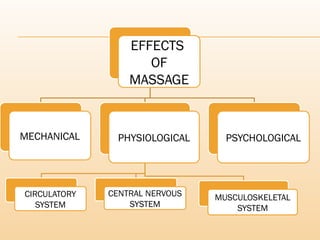
EFFECTS
OF
MASSAGE
MECHANICAL PHYSIOLOGICAL
CIRCULATORY
SYSTEM
CENTRAL NERVOUS
SYSTEM
MUSCULOSKELETAL
SYSTEM
PSYCHOLOGICAL
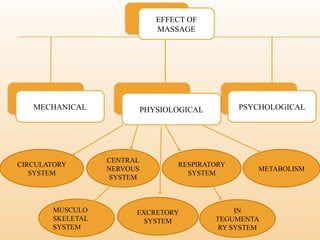
EFFECT OF
MASSAGE
MECHANICAL PHYSIOLOGICAL PSYCHOLOGICAL
CIRCULATORY
SYSTEM
MUSCULO
SKELETAL
SYSTEM
CENTRAL
NERVOUS
SYSTEM
EXCRETORY
SYSTEM
RESPIRATORY
SYSTEM
METABOLISM
IN
TEGUMENTA
RY SYSTEM
MECHANICAL EFFECTS
 Removes dead cells.
 Allows sweat glands, hair follicles & sebaceous glands to
be free of obstruction & function better.
 Increases lubricant effect.
 Increases warmth.
 Used in the treatment of scar tissues & adhesions.
 Promote & retain mobility of new skin tissues.
 Over lungs – frees adherent mucus from bronchial tree.
 Encourage hyperaemia (due to histamine release) –
increases suppleness of tissues & parasympathetic
activity, relaxes muscle tone, reduces edema, activates
mast cells.
PHYSIOLOGICAL EFFECTS – CIRCULATORY SYSTEM
 Change in skin color – due to increased circulatory flow,
blood velocity & blood viscosity.
 Effect on BP, HR, skin temperature & conductivity &
oxygen consumption.
 Increased release of histamine from mast cells &
basophills & platelets from blood – initiates triple
response – 1. Dilation of minute blood vessels
2. Flush (flare of redness) around area
3. Slight swelling
PHYSIOLOGICAL EFFECTS – NERVOUS SYSTEM
 Spinal motor neuron excitability of spinal reflex
pathways is reduced due to decreased H-reflex.
 Inhibitory influence on ά motor neuron excitability but
no carryover effect.
 Releases endorphine – reduces chronic pain
PHYSIOLOGICAL EFFECTS – MS SYSTEM
 Affects muscle fatigue.
 Affects degree of muscle tone.
PHYSIOLOGICAL EFFECTS RESPIRATORY SYSTEM
 Improved breathing: If you struggle with any kind of
respiratory issues such as allergies, asthma, or bronchitis,
you know how difficult breathing can become.
 Many of the muscles on the front of your body and in the
back assist your respiratory system.
 When they become tight, they can further restrict your
breathing. Receiving a massage can help to loosen and
lengthen the muscle, allowing the muscle to relax and
breathing capacity to return.
 Deeper breathing: Regular massages can be one of the
most effective ways to help improve breathing.
 The act of massage breaks down adhesions in the
muscles, moving the body away from its state of stress
and into one of relaxation.
 When you’re fully relaxed, your lungs can expand to
their full capacity, allowing for deeper breathing.
 Less mucus: Certain massage strokes cause vibration in
the body. This causes built-up mucus in the lungs to
loosen and clear the airway for easier breathing.
 Better posture: Massage has proven to promote better
posture. Improved posture means the chest can open up,
creating an expanded space for lung function.
 A hunch-over posture also puts pressure on the
diaphragm, causing muscle fatigue and not allowing it to
fully collapse when you breathe. If the diaphragm
doesn’t give way for the lungs to expand, you won’t be
able to breathe as deeply.
METABOLISM
 deep tissue massage contributes to improved metabolism
and fat reduction.
 Receive massage in the area with excess fat
accumulation and it will break up the fat stores, making
it ready for absorption inside the body.
MUSCULOSKELETAL SYSTEM
 Massage therapy can increase healing during
musculoskeletal disorders through increasing blood
circulation and cellular exchange.
 Massage can increase healing by increasing blood
circulation which can increase the chance of the body's
natural repair cells coming into contact with the injury
site.
EXCRETORY SYSTEM
 The body's sphincter muscles keep the urine from leaking
until the body is signaled to eliminate it.
 Massage therapy activates the urinary system.
 Fluids in the muscles are pushed into the lymphatic system,
which is then filtered and excreted via the urinary system.
INTEGUMENTARY SYSTEM
 Massage assists the integumentary system in the following ways:
 provides overall stimulation and health of the skin. stimulates
sebaceous glands, which produce sweat. improves skin condition,
texture and tone.
PSYCHOLOGICAL EFFECTS
 Positive effects on psychological well being
 Increase feeling of relaxation & rest
 Decreases anxiety level & stress hormone level
 Increased levels of immunoglobin A – improves immune system
 Helps in reducing depression & adjustment disorders
 Improves pain outcomes, mental energy & self rated health
 Improves sleep outcomes
CONTRAINDICATIONS - ABSOLUTE
 Tissue inflammation / malignancy
 Circulatory disorders (bleeding tendency)
 Abnormal sensations
 Skin disorders
 Recent, unhealed scars or open wounds
 Adjacent to recent fracture site
 Acute inflammation / tubercular infection of joint & tissue
 h/o or suspected DVT
 Burns
 Advanced osteoporosis
CONTRAINDICATIONS - RELATIVE
 Older people
 Those with fragile skin
 Early stage of osteoporosis
 Children
 Adults with learning &/or physical disabilities
 People recovering from infections & bone #
TREATMENT PLANNING
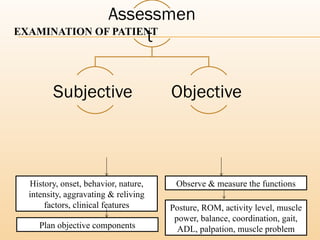
EXAMINATION OF PATIENT
Assessmen
t
Subjective Objective
History, onset, behavior, nature,
intensity, aggravating & reliving
factors, clinical features
Plan objective components
Observe & measure the functions
Posture, ROM, activity level, muscle
power, balance, coordination, gait,
ADL, palpation, muscle problem
ASSESSING FINDINGS
 Examination – assess findings – plan treatment
according to indications & contraindications.
CLINICAL REASONING
 Types of clinical reasoning –
 Hypotheticodeductive (form hypothesis)
 Pattern recognition (comes with experience – integral
part)
 Narrative (express in their terms)
 Predictive (estimate outcomes)
DETERMINE INDICATIONS
 Decision to apply massage & to select particular
techniques – based on examination
 Observation & palpation (tissue response, end feels)
 Determine nature of tissue glide (eg. Loss of elasticity –
kneeding, picking up; stiffness – skin rolling)
MEASURING CHANGE & OUTCOME MEASURES
 HR,
 BP,
 RR,
 EMG,
 mood & anxiety measures,
 pain,
 vital capacities,
 joint ROM,
 spasm,
 swelling/ oedema,
 proprioception,
 ADL’s
PALPATION & SKILLS
 Palpation should be repeatable, reliable & valid.
 Attention to patients & physiotherapist position,
ensuring hands are accurate, sensitive & testing what is
claimed.
 Decide accurately when to apply massage & when not to
apply.
PREPARATION FOR MASSAGE
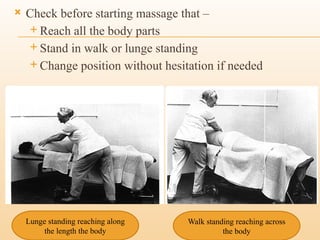
 Check before starting massage that –
 Reach all the body parts
 Stand in walk or lunge standing
 Change position without hesitation if needed
Lunge standing reaching along
the length the body
Walk standing reaching across
the body
SELF PREPARATION
 Attention to personal appearance, hygiene & manicure is
important.
 Wear protective clothing (easy laundry, freedom of movement)
 Restrain long hair, jewelry
 Well care of hands
 Cleanliness (avoid infection) – hand wash before & after
treatment
 Use warm hands
 Maintain ROM of forearm & arm which stretches
(abduction/extension of thumb, flexion/extension of wrist,
pronation/supination)
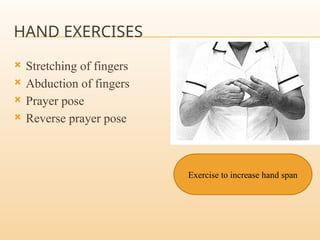
HAND EXERCISES
 Stretching of fingers
 Abduction of fingers
 Prayer pose
 Reverse prayer pose
Exercise to increase hand span
RELAXATION
 Relaxation of hands – important to keep in full contact
with patient & mold to the shape of the body.
 Natural rest position – thumb & fingers slightly flexed &
a little apart
 Relax whole arm – needed for some manipulations
 Practice relaxation prior to learning massage – good
method is reciprocal relaxation
 Co-ordinated & integrated movements of body without
fatigue & physical stress are important.
THE ENVIRONMENT
 Quiet with discreet colors, well heated, well ventilated
 Couch / chair – padded, adjustable, washable covers
 Towels (to cover untreated part), pillows, disposable
paper sheets
CONTACT MEDIUM
 For easy glide – to reduce friction
 Powder (talcum powder/ corn starch)
 Oils (pure lanoline)
 Liquid oils (vegetable oils, liquid paraffin, baby oil)
 Creams (water based lubricants, soap & water)
ALLERGIC REACTIONS
 Some contact medium might cause mild to severe allergy
to the patients.
 Check allergic response before use
 Eg. Nut & wheat content
PREPARATION OF PATIENT
 Undress (part to be treated) – free of jwellery
 Upper Limb (neck to fingers)
 Lower Limb (groin to toe)
 Back (head to buttock)
 Neck (head to T12)
 Face (hairline to just below clavicle)
 Keep patient warm
 Position pillows
PALPATION & DEVELOPING SENSORY AWARENESS
 Palpation – skill acquired with practice
 Hands should be clean, warm, relaxed, firm, comfortable
contact.
 Thinking hands (mind investigates structures, felt by
hands, identify structures & become aware of variations)
 Learn with colleagues – very firm (drill dragging), firm
& very light (butterfly) pressure to different body parts;
palpate for specific anatomical features (arteries, veins,
tendons, muscles, bony prominences)
 Only touch – no tickle
EXAMINATION OF PART
 As described previously
 Look at skin state (dry/ oily/ wet/ hairy) (bruises/
abrasions/ lacerations).
 The feel with your hand while running your hand down
the length on every aspect (temprature, muscle tension,
joint posture, painful areas)
TICKLISH SUBJECTS
 Always put hands in very firm contact & never lift hands
off by tackling.
 No one hand component (especially fingers)
 Light works tickle, so perform manipulations at
maximum depth as tolerated.
MANIPULATIONS
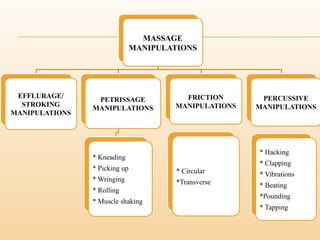
MASSAGE
MANIPULATIONS
EFFLURAGE/
STROKING
MANIPULATIONS
PETRISSAGE
MANIPULATIONS
* Kneading
* Picking up
* Wringing
* Rolling
* Muscle shaking
FRICTION
MANIPULATIONS
* Circular
*Transverse
PERCUSSIVE
MANIPULATIONS
* Hacking
* Clapping
* Vibrations
* Beating
*Pounding
* Tapping
THANK
YOU

Therapeutic massage, effects, uses .pptx

  • 1.
  • 2.
  • 3.
     The word‘Massage’ comes from the Arabic word ‘mass’ denoting ‘to press’.  Massage is the scientific manipulation of soft tissues of body with hands in order to produce effect on nervous, muscular & circulatory systems which will help to restore or improve function.  It is a means used to create energy & is a natural method of restoring part either locally or generally injured, to its normal condition.  Massage demands the skilled use of hands & brain that comes with practice.
  • 4.
     Therapeutic massageis a treatment that involves the application of pressure on the body for corrective or rehabilitative purposes applied by the hands, fingers, elbow, knees, forearm, feet, or mechanical aids.
  • 5.
    PRINCIPLES OF THERAPEUTIC MASSAGE Depth of pressure: Depth of pressure is the amount of force applied to the tissue by stroking. The depth of the pressure should be increased gradually and with great care, and also watch for signs of discomfort.  Speed of the stroke: Speed of the stroke is how fast or slow stroking is performed. Depending on the desired response any stroke may be applied slowly and quickly.  Rhythm: Rhythm is the regularity or constancy with which the stroke is applied. Rhythm can be slow or fast, depending on the condition being treated.
  • 6.
     Duration: Durationis the length of time each stroke lasts during its application or the length of time the stroke remains on any given body part.  Direction: Direction is the path of the stroke, it is always towards the heart.  Frequency: Frequency is the number of times each stroke is performed.
  • 7.
    VARIOUS CONDITIONS THATCAN BE TREATED BY THERAPEUTIC MASSAGE  Neck, shoulder, elbows, back, or knees pain,  Tendinitis,  Nerve injuries,  Muscle tension,  Myofascial Pain Syndrome,  Rotator Cuff Syndrome,  Sciatica,  Tennis Elbow,  Frozen Shoulder,  Osteoarthritis,  Rheumatoid Arthritis,  Muscle sprains and strains,  Sports injuries,  Carpal Tunnel syndrome,  Fibromyalgia,  Poor circulation
  • 8.
    MERITS  Reduces stress:One of the most common benefits of massage is stress reduction. A good massage can help you relax, lower your heart rate, and decrease your cortisol levels.  Relieves pain: Massage can help relieve pain from sore muscles, tension headaches, and other common ailments.  Improves circulation: Massage can increase blood flow and oxygen to the muscles, which can help speed up recovery and improve overall health.
  • 9.
     Enhances mood:Massage can help release endorphins, which can improve mood and promote feelings of well-being.  Boosts immune system: Massage can help improve the functioning of the immune system, which can help ward off illness and disease.
  • 10.
    DEMERITS  Expensive: Massagetherapy can be costly, especially if you want to get regular massages.  Time-consuming: Massage therapy sessions can take a significant amount of time, which can be challenging to fit into a busy schedule.  Potential for injury: In rare cases, massage therapy can cause injury, particularly if the therapist is not properly trained or if the client has an underlying medical condition.
  • 11.
     Unpleasant sideeffects: Some people may experience soreness, bruising, or other unpleasant side effects after a massage.  Uncomfortable experience: Some people may feel uncomfortable or embarrassed during a massage, particularly if they are not used to being touched in a professional setting.
  • 12.
    EFFECTS OF MASSAGETHERAPY Massage facilitates the energy flow throughout the body and reduces discomfort. It has various other therapeutic effects like:  Decreases pain.  Increases movement.  Eases muscle tension.  Improves blood flow.  Improves functionality.  Promotes relaxation.  Relieves stress.
  • 13.
  • 14.
    EFFECT OF MASSAGE MECHANICAL PHYSIOLOGICALPSYCHOLOGICAL CIRCULATORY SYSTEM MUSCULO SKELETAL SYSTEM CENTRAL NERVOUS SYSTEM EXCRETORY SYSTEM RESPIRATORY SYSTEM METABOLISM IN TEGUMENTA RY SYSTEM
  • 15.
    MECHANICAL EFFECTS  Removesdead cells.  Allows sweat glands, hair follicles & sebaceous glands to be free of obstruction & function better.  Increases lubricant effect.  Increases warmth.  Used in the treatment of scar tissues & adhesions.  Promote & retain mobility of new skin tissues.  Over lungs – frees adherent mucus from bronchial tree.  Encourage hyperaemia (due to histamine release) – increases suppleness of tissues & parasympathetic activity, relaxes muscle tone, reduces edema, activates mast cells.
  • 16.
    PHYSIOLOGICAL EFFECTS –CIRCULATORY SYSTEM  Change in skin color – due to increased circulatory flow, blood velocity & blood viscosity.  Effect on BP, HR, skin temperature & conductivity & oxygen consumption.  Increased release of histamine from mast cells & basophills & platelets from blood – initiates triple response – 1. Dilation of minute blood vessels 2. Flush (flare of redness) around area 3. Slight swelling
  • 17.
    PHYSIOLOGICAL EFFECTS –NERVOUS SYSTEM  Spinal motor neuron excitability of spinal reflex pathways is reduced due to decreased H-reflex.  Inhibitory influence on ά motor neuron excitability but no carryover effect.  Releases endorphine – reduces chronic pain
  • 18.
    PHYSIOLOGICAL EFFECTS –MS SYSTEM  Affects muscle fatigue.  Affects degree of muscle tone.
  • 19.
    PHYSIOLOGICAL EFFECTS RESPIRATORYSYSTEM  Improved breathing: If you struggle with any kind of respiratory issues such as allergies, asthma, or bronchitis, you know how difficult breathing can become.  Many of the muscles on the front of your body and in the back assist your respiratory system.  When they become tight, they can further restrict your breathing. Receiving a massage can help to loosen and lengthen the muscle, allowing the muscle to relax and breathing capacity to return.
  • 20.
     Deeper breathing:Regular massages can be one of the most effective ways to help improve breathing.  The act of massage breaks down adhesions in the muscles, moving the body away from its state of stress and into one of relaxation.  When you’re fully relaxed, your lungs can expand to their full capacity, allowing for deeper breathing.
  • 21.
     Less mucus:Certain massage strokes cause vibration in the body. This causes built-up mucus in the lungs to loosen and clear the airway for easier breathing.  Better posture: Massage has proven to promote better posture. Improved posture means the chest can open up, creating an expanded space for lung function.  A hunch-over posture also puts pressure on the diaphragm, causing muscle fatigue and not allowing it to fully collapse when you breathe. If the diaphragm doesn’t give way for the lungs to expand, you won’t be able to breathe as deeply.
  • 22.
    METABOLISM  deep tissuemassage contributes to improved metabolism and fat reduction.  Receive massage in the area with excess fat accumulation and it will break up the fat stores, making it ready for absorption inside the body.
  • 23.
    MUSCULOSKELETAL SYSTEM  Massagetherapy can increase healing during musculoskeletal disorders through increasing blood circulation and cellular exchange.  Massage can increase healing by increasing blood circulation which can increase the chance of the body's natural repair cells coming into contact with the injury site.
  • 24.
    EXCRETORY SYSTEM  Thebody's sphincter muscles keep the urine from leaking until the body is signaled to eliminate it.  Massage therapy activates the urinary system.  Fluids in the muscles are pushed into the lymphatic system, which is then filtered and excreted via the urinary system.
  • 25.
    INTEGUMENTARY SYSTEM  Massageassists the integumentary system in the following ways:  provides overall stimulation and health of the skin. stimulates sebaceous glands, which produce sweat. improves skin condition, texture and tone.
  • 26.
    PSYCHOLOGICAL EFFECTS  Positiveeffects on psychological well being  Increase feeling of relaxation & rest  Decreases anxiety level & stress hormone level  Increased levels of immunoglobin A – improves immune system  Helps in reducing depression & adjustment disorders  Improves pain outcomes, mental energy & self rated health  Improves sleep outcomes
  • 27.
    CONTRAINDICATIONS - ABSOLUTE Tissue inflammation / malignancy  Circulatory disorders (bleeding tendency)  Abnormal sensations  Skin disorders  Recent, unhealed scars or open wounds  Adjacent to recent fracture site  Acute inflammation / tubercular infection of joint & tissue  h/o or suspected DVT  Burns  Advanced osteoporosis
  • 28.
    CONTRAINDICATIONS - RELATIVE Older people  Those with fragile skin  Early stage of osteoporosis  Children  Adults with learning &/or physical disabilities  People recovering from infections & bone #
  • 29.
  • 30.
    EXAMINATION OF PATIENT Assessmen t SubjectiveObjective History, onset, behavior, nature, intensity, aggravating & reliving factors, clinical features Plan objective components Observe & measure the functions Posture, ROM, activity level, muscle power, balance, coordination, gait, ADL, palpation, muscle problem
  • 31.
    ASSESSING FINDINGS  Examination– assess findings – plan treatment according to indications & contraindications.
  • 32.
    CLINICAL REASONING  Typesof clinical reasoning –  Hypotheticodeductive (form hypothesis)  Pattern recognition (comes with experience – integral part)  Narrative (express in their terms)  Predictive (estimate outcomes)
  • 33.
    DETERMINE INDICATIONS  Decisionto apply massage & to select particular techniques – based on examination  Observation & palpation (tissue response, end feels)  Determine nature of tissue glide (eg. Loss of elasticity – kneeding, picking up; stiffness – skin rolling)
  • 34.
    MEASURING CHANGE &OUTCOME MEASURES  HR,  BP,  RR,  EMG,  mood & anxiety measures,  pain,  vital capacities,  joint ROM,  spasm,  swelling/ oedema,  proprioception,  ADL’s
  • 35.
    PALPATION & SKILLS Palpation should be repeatable, reliable & valid.  Attention to patients & physiotherapist position, ensuring hands are accurate, sensitive & testing what is claimed.  Decide accurately when to apply massage & when not to apply.
  • 36.
  • 37.
     Check beforestarting massage that –  Reach all the body parts  Stand in walk or lunge standing  Change position without hesitation if needed Lunge standing reaching along the length the body Walk standing reaching across the body
  • 38.
    SELF PREPARATION  Attentionto personal appearance, hygiene & manicure is important.  Wear protective clothing (easy laundry, freedom of movement)  Restrain long hair, jewelry  Well care of hands  Cleanliness (avoid infection) – hand wash before & after treatment  Use warm hands  Maintain ROM of forearm & arm which stretches (abduction/extension of thumb, flexion/extension of wrist, pronation/supination)
  • 39.
    HAND EXERCISES  Stretchingof fingers  Abduction of fingers  Prayer pose  Reverse prayer pose Exercise to increase hand span
  • 40.
    RELAXATION  Relaxation ofhands – important to keep in full contact with patient & mold to the shape of the body.  Natural rest position – thumb & fingers slightly flexed & a little apart  Relax whole arm – needed for some manipulations  Practice relaxation prior to learning massage – good method is reciprocal relaxation  Co-ordinated & integrated movements of body without fatigue & physical stress are important.
  • 41.
    THE ENVIRONMENT  Quietwith discreet colors, well heated, well ventilated  Couch / chair – padded, adjustable, washable covers  Towels (to cover untreated part), pillows, disposable paper sheets
  • 42.
    CONTACT MEDIUM  Foreasy glide – to reduce friction  Powder (talcum powder/ corn starch)  Oils (pure lanoline)  Liquid oils (vegetable oils, liquid paraffin, baby oil)  Creams (water based lubricants, soap & water)
  • 43.
    ALLERGIC REACTIONS  Somecontact medium might cause mild to severe allergy to the patients.  Check allergic response before use  Eg. Nut & wheat content
  • 44.
    PREPARATION OF PATIENT Undress (part to be treated) – free of jwellery  Upper Limb (neck to fingers)  Lower Limb (groin to toe)  Back (head to buttock)  Neck (head to T12)  Face (hairline to just below clavicle)  Keep patient warm  Position pillows
  • 45.
    PALPATION & DEVELOPINGSENSORY AWARENESS  Palpation – skill acquired with practice  Hands should be clean, warm, relaxed, firm, comfortable contact.  Thinking hands (mind investigates structures, felt by hands, identify structures & become aware of variations)  Learn with colleagues – very firm (drill dragging), firm & very light (butterfly) pressure to different body parts; palpate for specific anatomical features (arteries, veins, tendons, muscles, bony prominences)  Only touch – no tickle
  • 46.
    EXAMINATION OF PART As described previously  Look at skin state (dry/ oily/ wet/ hairy) (bruises/ abrasions/ lacerations).  The feel with your hand while running your hand down the length on every aspect (temprature, muscle tension, joint posture, painful areas)
  • 47.
    TICKLISH SUBJECTS  Alwaysput hands in very firm contact & never lift hands off by tackling.  No one hand component (especially fingers)  Light works tickle, so perform manipulations at maximum depth as tolerated.
  • 48.
  • 49.
    MASSAGE MANIPULATIONS EFFLURAGE/ STROKING MANIPULATIONS PETRISSAGE MANIPULATIONS * Kneading * Pickingup * Wringing * Rolling * Muscle shaking FRICTION MANIPULATIONS * Circular *Transverse PERCUSSIVE MANIPULATIONS * Hacking * Clapping * Vibrations * Beating *Pounding * Tapping
  • 50.