


ACTIVE MOVEMENT –
RESISTED EXERCISE
Prof. Dr. M. Rajesh, PT, M.P.T(cardio), B.C.R.C
TRINITY MISSION AND MEDICAL FOUNDATION
MADURAI
INTRODUCTION
 Active exercise or active movement is a term commonly used by
physical therapy, rehabilitation and fitness centres. ‘Active
movement’ is that which an individual does voluntary
movement, one’s own strength or energy. Active exercise help
keep joints flexible, maintain good blood flow to the exercised
joints and may help prevent blood clots. A health care
practitioner may assign active exercises after an injury or in
connection with medications and other therapies to help
manage chronic pain.
VOLUNTARY MOVEMENT
Definition
 Movement performed or controlled by the voluntary action of
muscles, working in opposition to and external force.
CLASSIFICATION
 Free exercise – the working muscles are subject only to the
forces of gravity acting upon the part moved or stabilized.
 Assister exercise – when muscle strength or co-ordination is
inadequate to perform a movement an external force is applied
to compensate for the deficiency.
 Assisted-resisted exercise – muscles may be strong enough to
work against resistance in part of the range and not in others.
This type of exercise ensures that the external forces applied
are adapted in every part of the range to the abilities of the
muscles.
 Resisted exercise – the forces of resistance offered to the action
of the working muscles are artificially and systematically
increased to develop the power endurance of the muscles.
RESISTED EXERCISE
THE PRINCIPLES OF
RESISTANCE
 An external force may be applied to the body levers to oppose
the force of muscular contraction. Tension is increased within
the muscles by the opposing force (or resistance) and the
muscles respond by an increase in their power and hypertrophy.
As the increase in muscular development occurs in response to
the increase in intramuscular tension it follows that the
application of the maximum resistance which is consistent with
the ability of the muscles to overcome it will elicit the maximum
development.
 The resisting force applied to an isotonic contraction must be
sufficient to increase intra-muscular tension to the maximum
without interfering with the ability of the muscles to produce co-
ordinated movement. A maximum increase in intra-muscular
tension during an isometric contraction is elicited by a
resistance which equals the muscles ability to maintain the hold.
 There are five factors which contribute to the development of
muscular efficiency, i.e. power, endurance, volume, speed of
contraction and co-ordination. The first three are inter-related
and can be built up by the use of resisted exercise.
 POWER develops in response to the application of the maximum
resistance which is consistent with the ability of the muscles to
overcome it, therefore power can be built up when they work
against a progressively increasing resistance. As the essential
factor in power development is the magnitude of the resistance
the method used to promote it is called PREGRESSIVE
RESISTANCE-LOW REPETITION EXERCISE, the number of times
the movement is repeated being relatively few to allow the
resistance to be as great as possible.
 ENDURANCE is a quality which develops in response to
repetitive contraction, therefore as it is the number of
contractions which is the essential factor, the method used in
this case is called LOW RESISTANCE-HIGH REPETITION
EXERCISE.
 VOLUME, which can be observed or measured as an indication
of hypertrophy, usually develops in proportion to power. It
serves as a means of demonstrating progress to the patient
although it is not invariably a reliable indication of successful
treatment.
 Skill is estimating the capacity of the muscles at every stage of
treatment and in matching this with the correct amount of
resistance is the keynote to success in the use of resisted
exercise.
VARIATIONS OF THE POWER OF
MUSCLES IN DIFFERENT PARTS OF
THEIR RANGE
 Muscles which are capable of producing a considerable range of
joint movement are not equally powerful in all parts of their
range.
 Physiologically, muscles are capable of exerting their greatest
strength when they are fully extended, i.e. in outer range, and
as they shorten their force diminishes. This, however, is
modified in the case of some muscles by mechanical factors
such as the angle of pull of tension of insertion, i.e. the effect of
the pull on the lever is greatest when the angle of pull
approaches a right angle.
 For example; physiologically the flexors of the Elbow are strongest
in their outer range, but mechanically stronger at about mid-range.
When both these factors are taken into account, and allowance is
made for overcoming the initial inertia at the beginning of the
movement, it can be roughly estimated that the muscles will be
most efficient in the outer part of the middle range. This, in fact,
can be proved by experiment.
 It seems, however, that the relative importance of these factors
varies in different muscle groups but, broadly speaking, each group
is found to be most powerful in the part of the range in which it is
habitually used, i.e. Shoulder flexors in outer range, hip extensors
in inner range. In giving manual resistance these variations in
power can be felt and the resistance adjusted according, but other
means of providing resistance are not so accurate from this point of
view.
TECHNIQUES OF RESISTED
EXERCISE
STARTING POSITION
 Starting position – comfort and stability for the body as a whole
ensures that the patient’s whole attention can be concentrated
on the pattern of movement and the effort required to
overcome the resistance.
THE PATTERN OF MOVEMENT
 The pattern of movement – this must be well known by the
patient and can be taught as passively or a free exercise. The
pattern selected should, whenever possible, be one which
allows contraction of the muscles in full range and it should be
based on a natural pattern of purposeful movement.
STABILIZATION
 Stabilization - stabilization of the bone or bones of origin of the
muscles to be resisted improves their efficiency. This
stabilization of the rarely static when a natural pattern of
movement is used as it is constantly being adapted to the
circumstances of the movement. Provided the muscles normally
responsible for the stabilization have remained efficient they
should be sued for this purpose, as their action is considered to
provide reinforcement for the muscles producing the movement.
If, however, there is a tendency for movement to be transferred
to neighbouring joints so that the pattern of movement is
altered, then additional means of fixation such as manual
pressure or a strap must be used to ensure movement at the
required joints.
TRACTION
 Traction – preliminary stretching of the muscles to elicit the
myotatic (stretch) reflex provides a powerful stimulus to
contraction, and traction maintained throughout the range
facilitates joint movement and maintains tension on the muscles
and so augments the effect of the resisting force.
THE RESISTING FORCE
 The resisting force - a variety of means may be employed to
supply the force used to resist the contraction of the working
muscles, e.g. manual pressure, weights, springs, etc., but in
every case it should be applied in a manner which ensures that
pressure is exerted on the surface of the patient’s skin which is
in the direction of the movement. The advantage of manual
pressure is that it can be adjusted accurately to match the
power of the muscles in all circumstances and in every part of
the range, but it also has the disadvantage of not being easily
measurable. Mechanical resistances are usually measureable
and therefore proved a useful means of recording progress.
 The magnitude of the resisting force, in relation to that of the
muscle power, varies according to the purpose for which it is
used. Maximal resistance elicits maximal effort on the part of
the muscles and it is therefore used to develop power and
hypertrophy. As the quality of muscular endurance is developed
by repeated contraction against resistance the latter is
considerably less than maximal to allow a greater number of
repetitions to make place.
THE CHARACTER OF THE
MOVEMENT
 The character of the movement – the movement is essentially
smooth and controlled throughout, the effort involved
commanding the patient’s full attention. The speed of
movement is consistent with the optimum rate of contraction
for the particular group of muscles in relation to the resistance
which constitutes the load. The range movement is full
whenever possible, but resistance cab be applied in any part of
the range which is convenient or desirable and the muscles can
also be resisted so that they work statically at any particular
point in their range.
REPETITIONS
 Repetitions – the number of times the muscles are thrown into
action against a resistance varies according to the condition and
the individual patient, and it is inadvisable to accept any rule of
thumb procedure.
 Low resistance-high repetition exercises appear to be more suitable
for weak or elderly patients whose muscles are less resilient than
those of the young and strong, and they have proved to be
effective in such conditions as Osteo-arthritis. High resistance-low
repetitions exercises on the other hand undoubtedly build up power
and hypertrophy muscles suffering from disuse as the result of
traumatic injury or in connection with orthopaedic surgery, e.g.
menisectormy, when there is effusion or joint changes are present,
as in Rheumatoid arthritis, static resisted contraction of the muscles
passing over the joint with a high repetition figure are valuable for
retaining muscular efficiency and they can be performed In any part
of the range which is pain-free. The number of repetitions may also
be determined by the desirability of, or the contraindication to,
fatiguing the neuromuscular mechanism in the treatment of a
specific condition.
THE CO-OPERATION OF THE
PATIENT
 The co-operation of the patient – the effort exerted by the
patient and his interest in the treatment undoubtedly play and
important part in the development of his muscles by means of
resisted exercise. Interest is stimulated by precision in applying
the resistance, regular measurement and recording of progress,
verbal encouragement and, in suitable cases, by competition.
RESISTANCE
A resistance force other that provided by gravity and friction may
be provided by:
The physiotherapist
The patient
Weights
Weight and pulley circuits
Springs and other elastic structures
Substances which are malleable
water
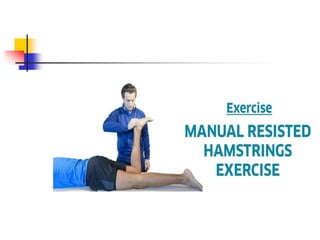
RESISTANCE BY THE PHYSIOTHERAPIST
 This is usually applied manually in the line of the movement,
and the physiotherapist’s hand is placed on the surface of the
skin which is in the direction of the movement. To prevent
waste of effort and to ensure smooth controlled pressure the
physiotherapist’s stance must be in the line of the movement,
so that the thrusting action of the legs and the body weight are
utilized. Traction or approximation may be maintained
throughout the movement and the resistance varied according
to the variation in power in different parts of the muscles’s
range.
RESISTANCE BY THE PATIENT
 The patient can resist his own movements with the sound limb,
or by using his own body weight. The latter method is probably
more accurately classified as a free exercise, but is included
here as the quantity of resistance is obviously much greater
when, as in this case, the muscles work with reversed origin
and insertion to move the trunk on the limbs. This type of
resistance is convenient, but tends to be unreliable as it cannot
be measured or felt by the physiotherapist and it requires
careful instruction and the co-operation and understanding of
the patient.
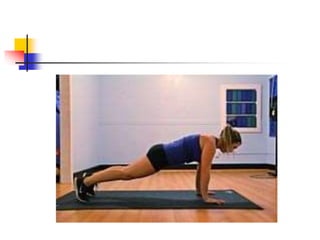
 EXAMPLES – from high sitting the extensors of one knee
can be resisted by the weight and pressure of the other leg
when the ankles are crossed. The body can be pressed up from
the floor by the arms, if their strength is sufficient.
RESISTANCE BY WEIGHT
 The direct application of weights to the body forms a simple and
effective method of resisting active exercise. The apparatus
required is commonly sandbags, metal weights or a medicine
ball, which can be applied by being held in the hand, by
attachment to a shoe, or to any other part, by suitable straps.
When sandbags or metal weights are used, a canvas bag may
be strapped to the part and any number of units of weight can
be inserted top provide the required resistance. It is essential
that the means of attachment should be comfortable and
efficient, but it need not be elaborate.
 By this method, resistance must, of necessity, be given in the
direcxtion of gravity; its effect increases progressively if the
weight is moved away from the central axis of the body. It is a
convenient method and suitable for home practice after
adequate instruction has been giver.
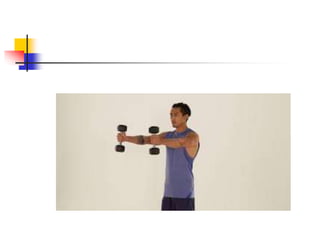
 EXAMPLES – Lifting a weight held in the hand or attached
to the foot or throwing a medicine ball are common examples.
 Resistance by weights is also used for the technique known
as “progressive resistance exercise”.
RESISTANCE BY WEIGHT AND PULLEY CIRCUIT
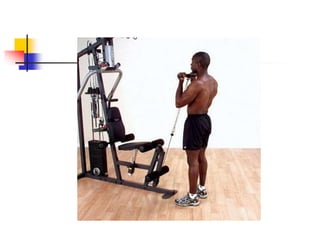
 The use of a rope and pulley allows the force exerted by a
weight to act in any direction. Therefore the muscles need not be
required to work against the resistance of both gravity and the
weight. The effect of gravity cab be counterbalanced if the
movement takes place in a horizontal plane. This provides a
useful method of arranging resistance for weak muscles when
the limb is heavy.
 EXAMPLE – in sitting the resistance of gravity to the knee
extensors is approximately 5kg. if these muscles are unable to
straighten the knee against this resistance, they may still be able
to perform the exercise adequately when, in side lying, the leg is
supported horizontally and resistance of, perhaps, 4kg is applied.
 As the angle of pull of the rope by which it is applied. And
therefore the resistance itself, must vary during the course of a
movement, a resistance can be offered to the muscles which
matches the variation of their power in different parts of the
range more accurately than that supplied by means of a weight
applied directly to the part or by a spring.
 Assuming that a particular muscle group is most powerful
in midrange it is there that the resistance is applied at right
angles. Both the power of the muscles and the force of the
resistance will diminish on either side of this point.

 To ensure relaxation and lack of strain on the joints between
movements a relaxation stop is incorporated on the circuit by
means of a clip or knot which prevents the rope from passing
the pulley, or by arranging for the weight to be supported at the
end of the movement. Psychologically, it is of the greatest
importance for the patient to be able to see the weight moving
as the result of his work and to know and record the poundage
lifted.
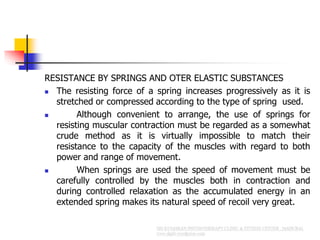
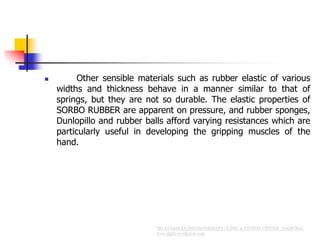
RESISTANCE BY SPRINGS AND OTER ELASTIC SUBSTANCES
 The resisting force of a spring increases progressively as it is
stretched or compressed according to the type of spring used.
 Although convenient to arrange, the use of springs for
resisting muscular contraction must be regarded as a somewhat
crude method as it is virtually impossible to match their
resistance to the capacity of the muscles with regard to both
power and range of movement.
 When springs are used the speed of movement must be
carefully controlled by the muscles both in contraction and
during controlled relaxation as the accumulated energy in an
extended spring makes its natural speed of recoil very great.
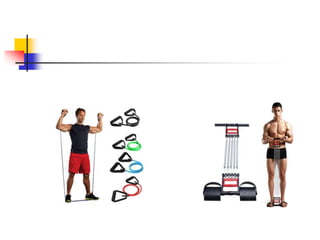
 Other sensible materials such as rubber elastic of various
widths and thickness behave in a manner similar to that of
springs, but they are not so durable. The elastic properties of
SORBO RUBBER are apparent on pressure, and rubber sponges,
Dunlopillo and rubber balls afford varying resistances which are
particularly useful in developing the gripping muscles of the
hand.
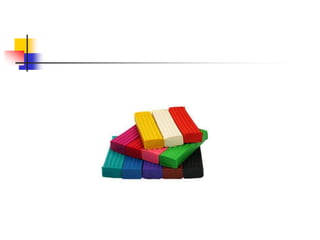
RESISTANCE BY SUBSTANCES WHICH ARE MALLEABLE
 Substances such as putty, clay, some kinds of wax, plasticine
and wet sand can be moulded into different shapes. The
resistance they offer to this change in form is variable and can
be used both for strengthening and for mobilizing the hands.
RESISTANCE BY WATER
 As the power of the muscle increases, the resistance must be
increased proportionately.
METHODS OF INCREASING
RESISTANCE
There are four main methods of increasing resistance to muscle
action. Each method may be used singly or in combination with
any other method:
1. Increase in poundage or weight of the resisting force
2. Increase in leverage of the resistance force
3. Alteration in the speed of movement
4. Increases in the duration of the exercise
INCREASE IN POUNDAGE OR WEIGHT
 For example: it is found that a muscle group, able to achieve
full-range contraction against a weight of 2 kg. when it is
applied at a specific point, can contract at a specific speed and
for a specific duration. As the muscle power increases, the
weight is increased proportionately to 2.3 kg, 3 kg, or 4 kg.,
while the other conditions remain constant. The actual amount
of the increase is variable according to the particular muscle
group, its rate of progress to recovery and the frequency at
which an increase is made.
INCREASE IN LEVERAGE
 The total resistance offered by a given weight depends on the
position of its point of application in relation to the fulcrum. (
moment of force = weight × perpendicular distance from the
fulcrum) the greater the perpendicular distance of the point of
application from the fulcrum, i.e. the joint at which movement
takes place, the greater the resistance offered by the weight.
 EXAMPLE – the effect of a resistance, which constant,
given to the shoulder abductors with the arm straight, is much
greater when applied at the wrist than at the elbow.
ALTERATION IN THE SPEED OF MOVEMENT
 Muscular contraction is most efficient when it takes place at an
optimum or natural speed. This speed varies according to the
form and structure of the muscles concerned, the resistance,
and the individual. Increase or decrease in this natural speed of
contraction increases the effect of the resistance the slower the
movement the greater the effect of the resistance, i.e.
concentric work is easiest at natural speed, eccentric work at
high speeds.
 EXAMPLE – It is eaier to climb a steep hill at your own
speed than at one dictated by a companion who may prefer to
go faster or slower than you do, but it is easier to come down
rapidly.
INCREASE IN THE DURATION
 As muscles warm up to their task of overcoming a resistance,
they become more efficient and therefore the effect of the
resistance decreases and the exercise seems easier. If,
however, it is continued a sufficient number of times, fatigue
reduces the efficiency of the muscles and the resistance
therefore appears greater.
 EXAMPLE – Sawing a log of wood may seem to become
easier as you warm up to it, but it becomes hard work by the
end of an hour.
EFFECTS AND USES OF
RESISTED EXERCISES
1. Muscle power can only be maintained or increased by
contraction, and in these exercises the working muscles are
strengthened and hypertrophied in response to the tension
created in them by the resistance. Their power and endurance
is increased.
Resisted exercises are used to build up weak muscles and so to
restore the balance of muscle power which is essential for
stability and co-ordinated movement.
2. The blood flow to the working muscles is increased in
proportion to the amount of work they are called upon to don
thus providing the materials for repair and hypertrophy.
Although the flow is impeded during the actual contraction, the
amount of blood contained in the muscles immediately after
contraction may be as much as ten times as great during
strenuous exercise as the amount contained during rest.
This increase in the blood flow to the muscles continues for
sometime after exercise, bringing oxygen and nutrition to the
part and assisting the removal of metabolic products.
 3. A general rise in blood pressure frequently anticipates
exercise and may be increased by the mental effort required to
perform these exercises correctly
 4. Heat, which is produced as the result of strenuous muscular
activity, stimulates the heat-regulating centre causing vaso-
dilatation in the skin. This follows a constriction of these vessels
which occurs in the first place to compensate for the increase in
the blood flow to the muscles. If there has been sufficient
exercise, the skin feels warm and possible moist and appears
pink, indicating that heat is being lost from the surface to
balance the gain from muscle activity and so keep the body
temperature within normal limits. The degree of moisture
depends largely on the temperature, humidity and movement of
the atmosphere.
THANK YOU
Prof. Dr. M. RAJESH, PT,M.P.T(cardio),B.C.R.C
TRINITY MISSIOIN AND MEDICAL FOUNDATION
MADURAI.
Visit:
www.skpfc.wordpress.com

Active movement resisted exercises

  • 1.
    ACTIVE MOVEMENT – RESISTEDEXERCISE Prof. Dr. M. Rajesh, PT, M.P.T(cardio), B.C.R.C TRINITY MISSION AND MEDICAL FOUNDATION MADURAI
  • 2.
    INTRODUCTION  Active exerciseor active movement is a term commonly used by physical therapy, rehabilitation and fitness centres. ‘Active movement’ is that which an individual does voluntary movement, one’s own strength or energy. Active exercise help keep joints flexible, maintain good blood flow to the exercised joints and may help prevent blood clots. A health care practitioner may assign active exercises after an injury or in connection with medications and other therapies to help manage chronic pain.
  • 3.
    VOLUNTARY MOVEMENT Definition  Movementperformed or controlled by the voluntary action of muscles, working in opposition to and external force.
  • 4.
    CLASSIFICATION  Free exercise– the working muscles are subject only to the forces of gravity acting upon the part moved or stabilized.  Assister exercise – when muscle strength or co-ordination is inadequate to perform a movement an external force is applied to compensate for the deficiency.  Assisted-resisted exercise – muscles may be strong enough to work against resistance in part of the range and not in others. This type of exercise ensures that the external forces applied are adapted in every part of the range to the abilities of the muscles.  Resisted exercise – the forces of resistance offered to the action of the working muscles are artificially and systematically increased to develop the power endurance of the muscles.
  • 5.
  • 6.
    THE PRINCIPLES OF RESISTANCE An external force may be applied to the body levers to oppose the force of muscular contraction. Tension is increased within the muscles by the opposing force (or resistance) and the muscles respond by an increase in their power and hypertrophy. As the increase in muscular development occurs in response to the increase in intramuscular tension it follows that the application of the maximum resistance which is consistent with the ability of the muscles to overcome it will elicit the maximum development.
  • 7.
     The resistingforce applied to an isotonic contraction must be sufficient to increase intra-muscular tension to the maximum without interfering with the ability of the muscles to produce co- ordinated movement. A maximum increase in intra-muscular tension during an isometric contraction is elicited by a resistance which equals the muscles ability to maintain the hold.  There are five factors which contribute to the development of muscular efficiency, i.e. power, endurance, volume, speed of contraction and co-ordination. The first three are inter-related and can be built up by the use of resisted exercise.
  • 8.
     POWER developsin response to the application of the maximum resistance which is consistent with the ability of the muscles to overcome it, therefore power can be built up when they work against a progressively increasing resistance. As the essential factor in power development is the magnitude of the resistance the method used to promote it is called PREGRESSIVE RESISTANCE-LOW REPETITION EXERCISE, the number of times the movement is repeated being relatively few to allow the resistance to be as great as possible.
  • 9.
     ENDURANCE isa quality which develops in response to repetitive contraction, therefore as it is the number of contractions which is the essential factor, the method used in this case is called LOW RESISTANCE-HIGH REPETITION EXERCISE.  VOLUME, which can be observed or measured as an indication of hypertrophy, usually develops in proportion to power. It serves as a means of demonstrating progress to the patient although it is not invariably a reliable indication of successful treatment.  Skill is estimating the capacity of the muscles at every stage of treatment and in matching this with the correct amount of resistance is the keynote to success in the use of resisted exercise.
  • 10.
    VARIATIONS OF THEPOWER OF MUSCLES IN DIFFERENT PARTS OF THEIR RANGE  Muscles which are capable of producing a considerable range of joint movement are not equally powerful in all parts of their range.  Physiologically, muscles are capable of exerting their greatest strength when they are fully extended, i.e. in outer range, and as they shorten their force diminishes. This, however, is modified in the case of some muscles by mechanical factors such as the angle of pull of tension of insertion, i.e. the effect of the pull on the lever is greatest when the angle of pull approaches a right angle.
  • 11.
     For example;physiologically the flexors of the Elbow are strongest in their outer range, but mechanically stronger at about mid-range. When both these factors are taken into account, and allowance is made for overcoming the initial inertia at the beginning of the movement, it can be roughly estimated that the muscles will be most efficient in the outer part of the middle range. This, in fact, can be proved by experiment.  It seems, however, that the relative importance of these factors varies in different muscle groups but, broadly speaking, each group is found to be most powerful in the part of the range in which it is habitually used, i.e. Shoulder flexors in outer range, hip extensors in inner range. In giving manual resistance these variations in power can be felt and the resistance adjusted according, but other means of providing resistance are not so accurate from this point of view.
  • 12.
  • 13.
    STARTING POSITION  Startingposition – comfort and stability for the body as a whole ensures that the patient’s whole attention can be concentrated on the pattern of movement and the effort required to overcome the resistance.
  • 14.
    THE PATTERN OFMOVEMENT  The pattern of movement – this must be well known by the patient and can be taught as passively or a free exercise. The pattern selected should, whenever possible, be one which allows contraction of the muscles in full range and it should be based on a natural pattern of purposeful movement.
  • 15.
    STABILIZATION  Stabilization -stabilization of the bone or bones of origin of the muscles to be resisted improves their efficiency. This stabilization of the rarely static when a natural pattern of movement is used as it is constantly being adapted to the circumstances of the movement. Provided the muscles normally responsible for the stabilization have remained efficient they should be sued for this purpose, as their action is considered to provide reinforcement for the muscles producing the movement. If, however, there is a tendency for movement to be transferred to neighbouring joints so that the pattern of movement is altered, then additional means of fixation such as manual pressure or a strap must be used to ensure movement at the required joints.
  • 16.
    TRACTION  Traction –preliminary stretching of the muscles to elicit the myotatic (stretch) reflex provides a powerful stimulus to contraction, and traction maintained throughout the range facilitates joint movement and maintains tension on the muscles and so augments the effect of the resisting force.
  • 17.
    THE RESISTING FORCE The resisting force - a variety of means may be employed to supply the force used to resist the contraction of the working muscles, e.g. manual pressure, weights, springs, etc., but in every case it should be applied in a manner which ensures that pressure is exerted on the surface of the patient’s skin which is in the direction of the movement. The advantage of manual pressure is that it can be adjusted accurately to match the power of the muscles in all circumstances and in every part of the range, but it also has the disadvantage of not being easily measurable. Mechanical resistances are usually measureable and therefore proved a useful means of recording progress.
  • 18.
     The magnitudeof the resisting force, in relation to that of the muscle power, varies according to the purpose for which it is used. Maximal resistance elicits maximal effort on the part of the muscles and it is therefore used to develop power and hypertrophy. As the quality of muscular endurance is developed by repeated contraction against resistance the latter is considerably less than maximal to allow a greater number of repetitions to make place.
  • 19.
    THE CHARACTER OFTHE MOVEMENT  The character of the movement – the movement is essentially smooth and controlled throughout, the effort involved commanding the patient’s full attention. The speed of movement is consistent with the optimum rate of contraction for the particular group of muscles in relation to the resistance which constitutes the load. The range movement is full whenever possible, but resistance cab be applied in any part of the range which is convenient or desirable and the muscles can also be resisted so that they work statically at any particular point in their range.
  • 20.
    REPETITIONS  Repetitions –the number of times the muscles are thrown into action against a resistance varies according to the condition and the individual patient, and it is inadvisable to accept any rule of thumb procedure.
  • 21.
     Low resistance-highrepetition exercises appear to be more suitable for weak or elderly patients whose muscles are less resilient than those of the young and strong, and they have proved to be effective in such conditions as Osteo-arthritis. High resistance-low repetitions exercises on the other hand undoubtedly build up power and hypertrophy muscles suffering from disuse as the result of traumatic injury or in connection with orthopaedic surgery, e.g. menisectormy, when there is effusion or joint changes are present, as in Rheumatoid arthritis, static resisted contraction of the muscles passing over the joint with a high repetition figure are valuable for retaining muscular efficiency and they can be performed In any part of the range which is pain-free. The number of repetitions may also be determined by the desirability of, or the contraindication to, fatiguing the neuromuscular mechanism in the treatment of a specific condition.
  • 22.
    THE CO-OPERATION OFTHE PATIENT  The co-operation of the patient – the effort exerted by the patient and his interest in the treatment undoubtedly play and important part in the development of his muscles by means of resisted exercise. Interest is stimulated by precision in applying the resistance, regular measurement and recording of progress, verbal encouragement and, in suitable cases, by competition.
  • 23.
    RESISTANCE A resistance forceother that provided by gravity and friction may be provided by: The physiotherapist The patient Weights Weight and pulley circuits Springs and other elastic structures Substances which are malleable water
  • 24.
    RESISTANCE BY THEPHYSIOTHERAPIST  This is usually applied manually in the line of the movement, and the physiotherapist’s hand is placed on the surface of the skin which is in the direction of the movement. To prevent waste of effort and to ensure smooth controlled pressure the physiotherapist’s stance must be in the line of the movement, so that the thrusting action of the legs and the body weight are utilized. Traction or approximation may be maintained throughout the movement and the resistance varied according to the variation in power in different parts of the muscles’s range.
  • 26.
    RESISTANCE BY THEPATIENT  The patient can resist his own movements with the sound limb, or by using his own body weight. The latter method is probably more accurately classified as a free exercise, but is included here as the quantity of resistance is obviously much greater when, as in this case, the muscles work with reversed origin and insertion to move the trunk on the limbs. This type of resistance is convenient, but tends to be unreliable as it cannot be measured or felt by the physiotherapist and it requires careful instruction and the co-operation and understanding of the patient.
  • 28.
     EXAMPLES –from high sitting the extensors of one knee can be resisted by the weight and pressure of the other leg when the ankles are crossed. The body can be pressed up from the floor by the arms, if their strength is sufficient.
  • 29.
    RESISTANCE BY WEIGHT The direct application of weights to the body forms a simple and effective method of resisting active exercise. The apparatus required is commonly sandbags, metal weights or a medicine ball, which can be applied by being held in the hand, by attachment to a shoe, or to any other part, by suitable straps. When sandbags or metal weights are used, a canvas bag may be strapped to the part and any number of units of weight can be inserted top provide the required resistance. It is essential that the means of attachment should be comfortable and efficient, but it need not be elaborate.
  • 30.
     By thismethod, resistance must, of necessity, be given in the direcxtion of gravity; its effect increases progressively if the weight is moved away from the central axis of the body. It is a convenient method and suitable for home practice after adequate instruction has been giver.  EXAMPLES – Lifting a weight held in the hand or attached to the foot or throwing a medicine ball are common examples.  Resistance by weights is also used for the technique known as “progressive resistance exercise”.
  • 32.
    RESISTANCE BY WEIGHTAND PULLEY CIRCUIT  The use of a rope and pulley allows the force exerted by a weight to act in any direction. Therefore the muscles need not be required to work against the resistance of both gravity and the weight. The effect of gravity cab be counterbalanced if the movement takes place in a horizontal plane. This provides a useful method of arranging resistance for weak muscles when the limb is heavy.  EXAMPLE – in sitting the resistance of gravity to the knee extensors is approximately 5kg. if these muscles are unable to straighten the knee against this resistance, they may still be able to perform the exercise adequately when, in side lying, the leg is supported horizontally and resistance of, perhaps, 4kg is applied.
  • 33.
     As theangle of pull of the rope by which it is applied. And therefore the resistance itself, must vary during the course of a movement, a resistance can be offered to the muscles which matches the variation of their power in different parts of the range more accurately than that supplied by means of a weight applied directly to the part or by a spring.  Assuming that a particular muscle group is most powerful in midrange it is there that the resistance is applied at right angles. Both the power of the muscles and the force of the resistance will diminish on either side of this point. 
  • 34.
     To ensurerelaxation and lack of strain on the joints between movements a relaxation stop is incorporated on the circuit by means of a clip or knot which prevents the rope from passing the pulley, or by arranging for the weight to be supported at the end of the movement. Psychologically, it is of the greatest importance for the patient to be able to see the weight moving as the result of his work and to know and record the poundage lifted.
  • 36.
    RESISTANCE BY SPRINGSAND OTER ELASTIC SUBSTANCES  The resisting force of a spring increases progressively as it is stretched or compressed according to the type of spring used.  Although convenient to arrange, the use of springs for resisting muscular contraction must be regarded as a somewhat crude method as it is virtually impossible to match their resistance to the capacity of the muscles with regard to both power and range of movement.  When springs are used the speed of movement must be carefully controlled by the muscles both in contraction and during controlled relaxation as the accumulated energy in an extended spring makes its natural speed of recoil very great.
  • 37.
     Other sensiblematerials such as rubber elastic of various widths and thickness behave in a manner similar to that of springs, but they are not so durable. The elastic properties of SORBO RUBBER are apparent on pressure, and rubber sponges, Dunlopillo and rubber balls afford varying resistances which are particularly useful in developing the gripping muscles of the hand.
  • 39.
    RESISTANCE BY SUBSTANCESWHICH ARE MALLEABLE  Substances such as putty, clay, some kinds of wax, plasticine and wet sand can be moulded into different shapes. The resistance they offer to this change in form is variable and can be used both for strengthening and for mobilizing the hands.
  • 41.
    RESISTANCE BY WATER As the power of the muscle increases, the resistance must be increased proportionately.
  • 43.
    METHODS OF INCREASING RESISTANCE Thereare four main methods of increasing resistance to muscle action. Each method may be used singly or in combination with any other method: 1. Increase in poundage or weight of the resisting force 2. Increase in leverage of the resistance force 3. Alteration in the speed of movement 4. Increases in the duration of the exercise
  • 44.
    INCREASE IN POUNDAGEOR WEIGHT  For example: it is found that a muscle group, able to achieve full-range contraction against a weight of 2 kg. when it is applied at a specific point, can contract at a specific speed and for a specific duration. As the muscle power increases, the weight is increased proportionately to 2.3 kg, 3 kg, or 4 kg., while the other conditions remain constant. The actual amount of the increase is variable according to the particular muscle group, its rate of progress to recovery and the frequency at which an increase is made.
  • 45.
    INCREASE IN LEVERAGE The total resistance offered by a given weight depends on the position of its point of application in relation to the fulcrum. ( moment of force = weight × perpendicular distance from the fulcrum) the greater the perpendicular distance of the point of application from the fulcrum, i.e. the joint at which movement takes place, the greater the resistance offered by the weight.  EXAMPLE – the effect of a resistance, which constant, given to the shoulder abductors with the arm straight, is much greater when applied at the wrist than at the elbow.
  • 46.
    ALTERATION IN THESPEED OF MOVEMENT  Muscular contraction is most efficient when it takes place at an optimum or natural speed. This speed varies according to the form and structure of the muscles concerned, the resistance, and the individual. Increase or decrease in this natural speed of contraction increases the effect of the resistance the slower the movement the greater the effect of the resistance, i.e. concentric work is easiest at natural speed, eccentric work at high speeds.  EXAMPLE – It is eaier to climb a steep hill at your own speed than at one dictated by a companion who may prefer to go faster or slower than you do, but it is easier to come down rapidly.
  • 47.
    INCREASE IN THEDURATION  As muscles warm up to their task of overcoming a resistance, they become more efficient and therefore the effect of the resistance decreases and the exercise seems easier. If, however, it is continued a sufficient number of times, fatigue reduces the efficiency of the muscles and the resistance therefore appears greater.  EXAMPLE – Sawing a log of wood may seem to become easier as you warm up to it, but it becomes hard work by the end of an hour.
  • 48.
    EFFECTS AND USESOF RESISTED EXERCISES 1. Muscle power can only be maintained or increased by contraction, and in these exercises the working muscles are strengthened and hypertrophied in response to the tension created in them by the resistance. Their power and endurance is increased. Resisted exercises are used to build up weak muscles and so to restore the balance of muscle power which is essential for stability and co-ordinated movement.
  • 49.
    2. The bloodflow to the working muscles is increased in proportion to the amount of work they are called upon to don thus providing the materials for repair and hypertrophy. Although the flow is impeded during the actual contraction, the amount of blood contained in the muscles immediately after contraction may be as much as ten times as great during strenuous exercise as the amount contained during rest. This increase in the blood flow to the muscles continues for sometime after exercise, bringing oxygen and nutrition to the part and assisting the removal of metabolic products.
  • 50.
     3. Ageneral rise in blood pressure frequently anticipates exercise and may be increased by the mental effort required to perform these exercises correctly
  • 51.
     4. Heat,which is produced as the result of strenuous muscular activity, stimulates the heat-regulating centre causing vaso- dilatation in the skin. This follows a constriction of these vessels which occurs in the first place to compensate for the increase in the blood flow to the muscles. If there has been sufficient exercise, the skin feels warm and possible moist and appears pink, indicating that heat is being lost from the surface to balance the gain from muscle activity and so keep the body temperature within normal limits. The degree of moisture depends largely on the temperature, humidity and movement of the atmosphere.
  • 52.
    THANK YOU Prof. Dr.M. RAJESH, PT,M.P.T(cardio),B.C.R.C TRINITY MISSIOIN AND MEDICAL FOUNDATION MADURAI. Visit: www.skpfc.wordpress.com