
Topic
Vat Dyes
History
 Until 1850s, all dyes were obtained from naturals
sources, most commonly from vegetables, plants,
trees, and lichens with a few from insects
 Around 1900 Rene Bohn in GERMANY
accidently prepared a blue dye from ANTHRA scene,
which he named as INDIGO dye.
 After this, BOHN and his Coworkers synthesize many
other VAT DYES
Definition
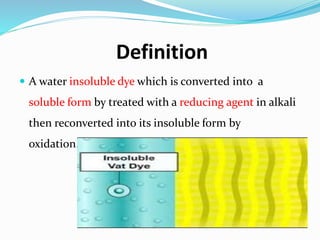
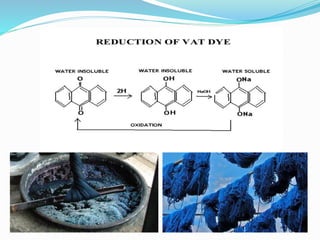
 A water insoluble dye which is converted into a
soluble form by treated with a reducing agent in alkali
then reconverted into its insoluble form by
oxidation.
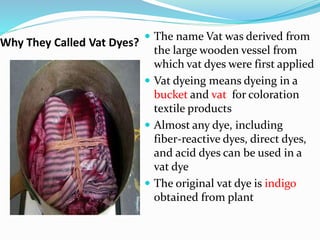
 The name Vat was derived from
the large wooden vessel from
which vat dyes were first applied
 Vat dyeing means dyeing in a
bucket and vat for coloration
textile products
 Almost any dye, including
fiber-reactive dyes, direct dyes,
and acid dyes can be used in a
vat dye
 The original vat dye is indigo
obtained from plant
Why They Called Vat Dyes?
 Redox reaction take place in this process
• Indigo is an example of this dye class, it changes from
yellow to green in the bath and then blue as the air hits it
• But not all vat dyeing is done with vat dye
GENERAL PROPERTIES OF VAT DYES
 Insoluble in water
 Can not be used directly for dyeing
 Can be converted to water soluble form
 Possess affinity to cellulosic fibers
 Involves two steps
 Reduction of vat dye into weakly Acidic Leuco form
 Salt formation by NaOH
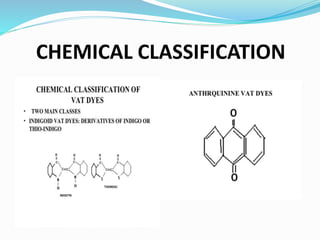
CHEMICAL CLASSIFICATION
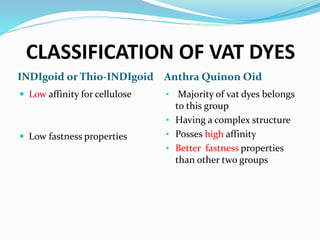
CLASSIFICATION OF VAT DYES
INDIgoid or Thio-INDIgoid Anthra Quinon Oid
 Low affinity for cellulose
 Low fastness properties
• Majority of vat dyes belongs
to this group
• Having a complex structure
• Posses high affinity
• Better fastness properties
than other two groups
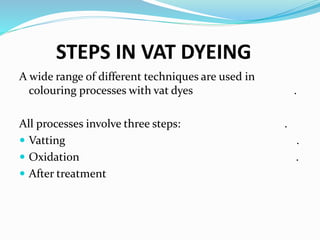
STEPS IN VAT DYEING
A wide range of different techniques are used in
colouring processes with vat dyes .
All processes involve three steps: .
 Vatting .
 Oxidation .
 After treatment
Vatting
 Process of converting water insoluble form to water
soluble form known as vatting
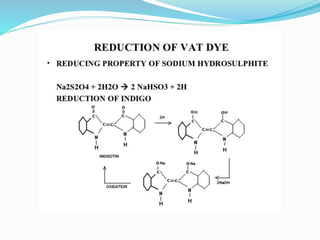
 Sodium hydrosulphite is mostly used reducing agents with
NaOH
Oxidation
 After absorption by the fibre, the dye in its soluble
leuco form is converted to the original pigments by
oxidation
.
 This process is carried out in the course of wet
treatment (washing) by addition of oxidants
such as hydrogen peroxide
After treatment
 The final step consists in after treating the material in
weakly alkaline liqour with a detergent at boiling
temperature
 This soap treatment is not only aimed to remove
pigments particles, but also allows the crystallization
of amorphous dye particles, which give the material
the final shade and the fastness properties typical of
vat dyes
ADVANTAGES
 The vat dye have high color fastness, which is
uncommon in other dye classes
 The poor rubbing fastness
 inkodye is a type of vat dye that uses light rather than
oxygen to fix the dye
 Mostly used in garments industry
DISADVANTAGES
 Limited shade range (bright shade)
 Sensitive to abrasion
 Complicated application procedure
 Time consuming
 Slow process
 Not more suitable for wool
Vat Dyes
Vat Dyes

Vat Dyes

  • 2.
  • 3.
    History  Until 1850s,all dyes were obtained from naturals sources, most commonly from vegetables, plants, trees, and lichens with a few from insects  Around 1900 Rene Bohn in GERMANY accidently prepared a blue dye from ANTHRA scene, which he named as INDIGO dye.  After this, BOHN and his Coworkers synthesize many other VAT DYES
  • 4.
    Definition  A waterinsoluble dye which is converted into a soluble form by treated with a reducing agent in alkali then reconverted into its insoluble form by oxidation.
  • 5.
     The nameVat was derived from the large wooden vessel from which vat dyes were first applied  Vat dyeing means dyeing in a bucket and vat for coloration textile products  Almost any dye, including fiber-reactive dyes, direct dyes, and acid dyes can be used in a vat dye  The original vat dye is indigo obtained from plant Why They Called Vat Dyes?
  • 6.
     Redox reactiontake place in this process • Indigo is an example of this dye class, it changes from yellow to green in the bath and then blue as the air hits it • But not all vat dyeing is done with vat dye
  • 7.
    GENERAL PROPERTIES OFVAT DYES  Insoluble in water  Can not be used directly for dyeing  Can be converted to water soluble form  Possess affinity to cellulosic fibers  Involves two steps  Reduction of vat dye into weakly Acidic Leuco form  Salt formation by NaOH
  • 10.
  • 11.
    CLASSIFICATION OF VATDYES INDIgoid or Thio-INDIgoid Anthra Quinon Oid  Low affinity for cellulose  Low fastness properties • Majority of vat dyes belongs to this group • Having a complex structure • Posses high affinity • Better fastness properties than other two groups
  • 12.
    STEPS IN VATDYEING A wide range of different techniques are used in colouring processes with vat dyes . All processes involve three steps: .  Vatting .  Oxidation .  After treatment
  • 13.
    Vatting  Process ofconverting water insoluble form to water soluble form known as vatting  Sodium hydrosulphite is mostly used reducing agents with NaOH
  • 14.
    Oxidation  After absorptionby the fibre, the dye in its soluble leuco form is converted to the original pigments by oxidation .  This process is carried out in the course of wet treatment (washing) by addition of oxidants such as hydrogen peroxide
  • 15.
    After treatment  Thefinal step consists in after treating the material in weakly alkaline liqour with a detergent at boiling temperature  This soap treatment is not only aimed to remove pigments particles, but also allows the crystallization of amorphous dye particles, which give the material the final shade and the fastness properties typical of vat dyes
  • 18.
    ADVANTAGES  The vatdye have high color fastness, which is uncommon in other dye classes  The poor rubbing fastness  inkodye is a type of vat dye that uses light rather than oxygen to fix the dye  Mostly used in garments industry
  • 19.
    DISADVANTAGES  Limited shaderange (bright shade)  Sensitive to abrasion  Complicated application procedure  Time consuming  Slow process  Not more suitable for wool