WELCOME
 Presentation on:
Acid dye
PRESENTED BY
Md. Al-Amin Masum
ID: 2015100400011
Batch: 29th
BSc in Textile Engineering
Southeast University
alaminmasum11@gmail.com
ACID DYE
 The acid dyes are large dyes containing one or more sulfonic or
carboxylic acid salt functional groups.
 These dyes are dyed onto fibers from acid solution, since positive
charge development within the fiber in acid solutions acts as a
driving force for dye diffusion and migration into the fiber.
 Only fibers which develop a positive charge in the presence of acid,
such as wool, silk, and other protein fibers, nylon, and certain
modified synthetics, are readily dyed by acid dyes,
 Acid dyes on fibers are reasonably colorfast to light and laundering,
but mordanting (more complete insolubilization of the dye through
reaction with a metal salt) will improve the overall fastness
properties of the dye.
 The color of the dye may be affected somewhat by mordanting;
however, pre-metallized acid dyes are a special class of acid dyes
which have been reacted wi th a mordant prior to dyeing and which
have sufficient solubility to be dyed under conditions normally used
for acid dyes.
PROPERTIES OF ACID DYE
 Most of the acid dye are sodium salt of sulphuric acid and
carboxylic acid and anion group is the active colored
component
 Water soluble.
 Always applied on acidic medium with organic or inorganic
acid.
 Acid dye have direct affinity towards protein fiber and
polyamide fibers.
 Maximum cellulose fiber can not absorb acid dye.
 Some acid dye has good light fastness.
 Many bright shades are found.
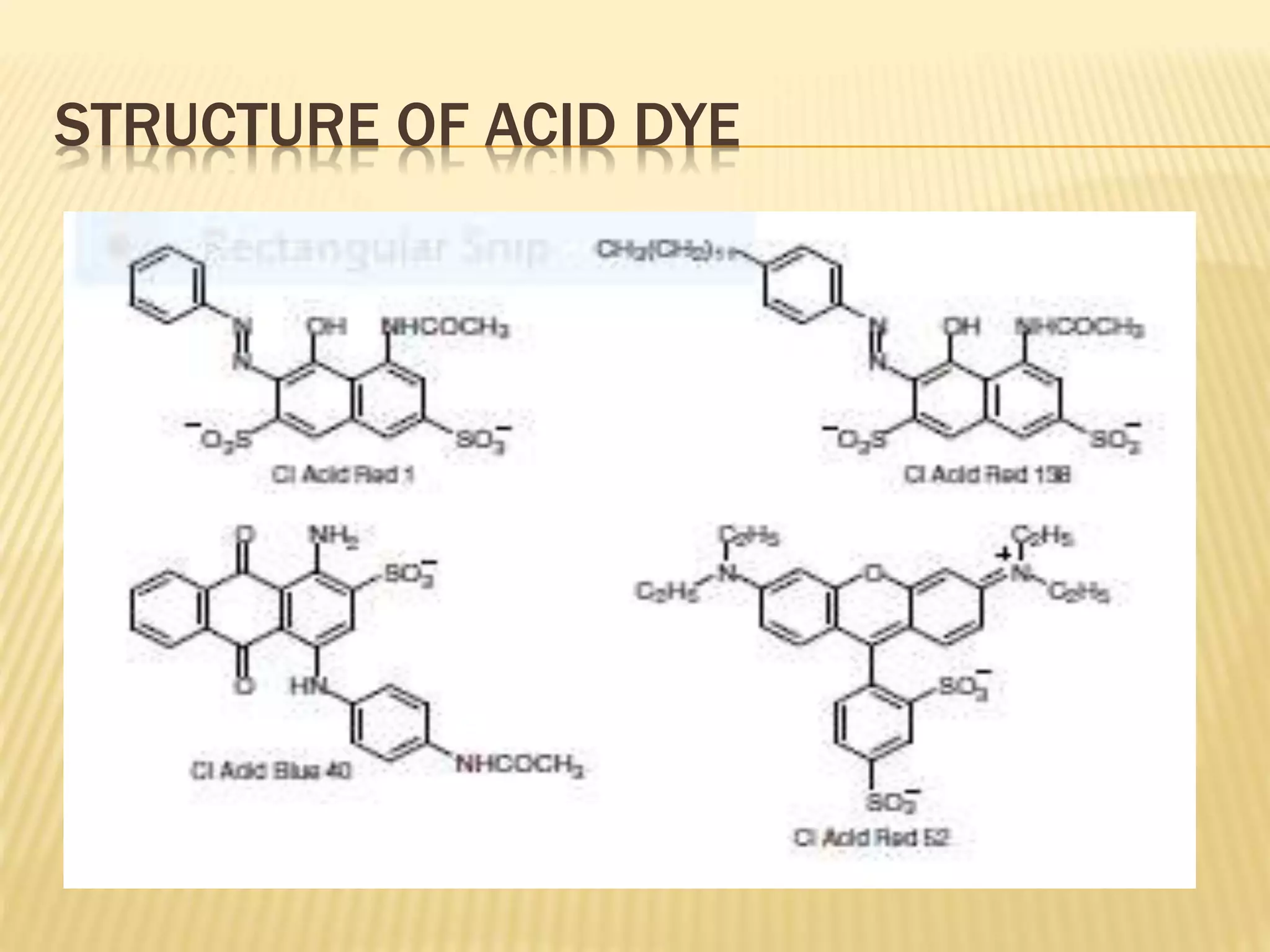
STRUCTURE OF ACID DYE
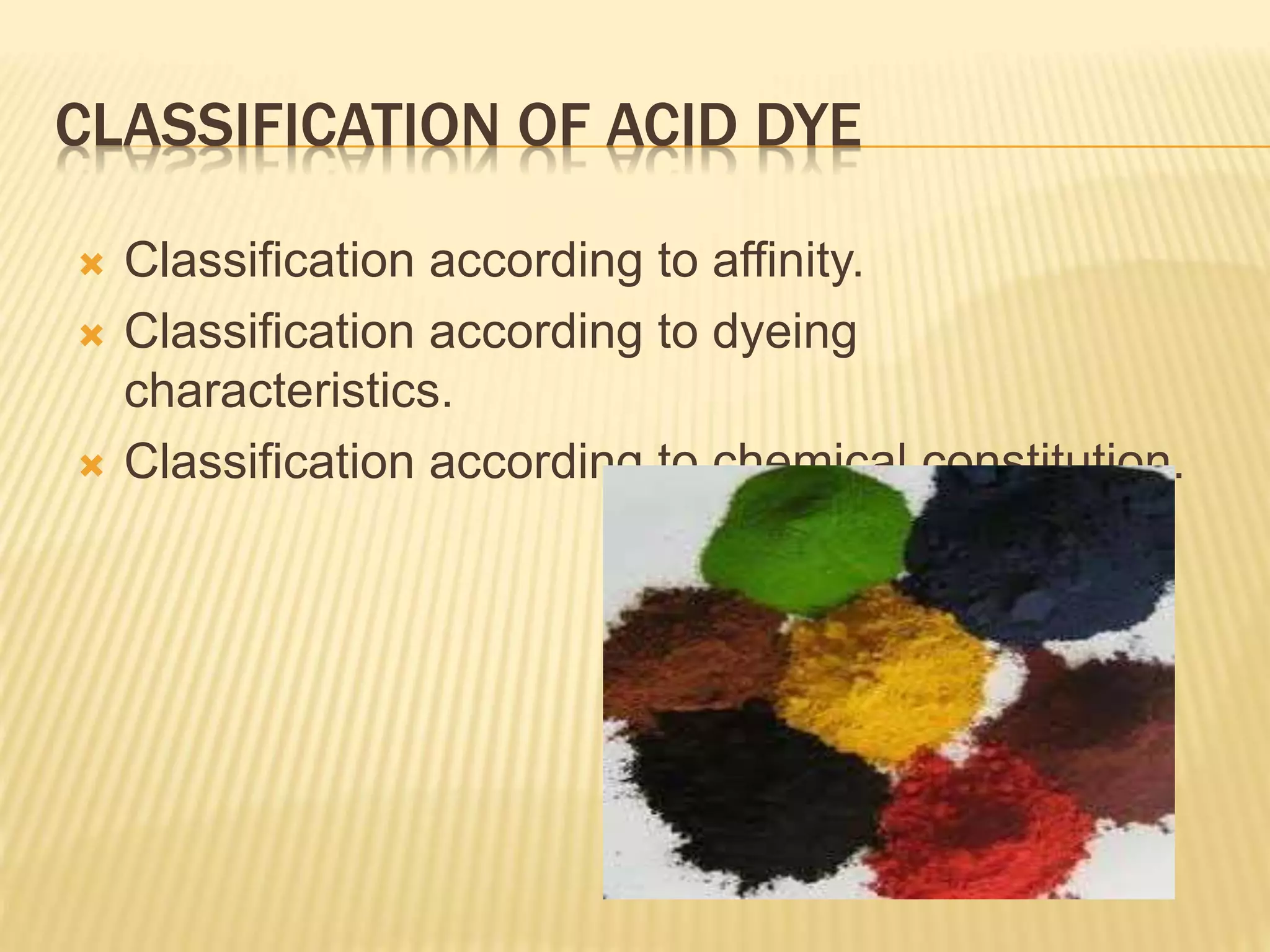
CLASSIFICATION OF ACID DYE
 Classification according to affinity.
 Classification according to dyeing
characteristics.
 Classification according to chemical constitution.
CLASSIfiCATION ACCORDING TO AFFINITY.
I. Levelling dyes form a salt-like bond with the protein fi
bre and are relatively small molecules.
II. Milling dyes for which salt formation with the fi bre and
the adsorption forces between the hydrophobic regions
of the dye molecules and those of the protein fi bre
predominate. They are the large volume molecules.
III. Dyes which not only form a salt-like bond with the wool
fi bre but also bonded to the fi bre by intermolecular
forces. They have properties lying in an intermediate
position between those of the levelling and milling dyes
with intermediate molecular size.
CLASSIfiCATION ACCORDING TO DYEING
CHARACTERISTICS.
 Level dyeing or equalizing dyes.
 Fast acid dyes.
 Milling acid dyes.
 Super-milling acid dyes.
LEVELLING OR EQUALISING ACID DYES
 These dyes require considerable amounts of strong acids along with Glauber’s
salt to achieve good exhaustion.
 Under the high concentration of acid high concentration of cationic ammonium
groups are generated in the wool and the dyes have rapid strike for the wool.
 The dye molecules, however, are not strongly bound to the sites.
 Initial non-uniformity in colour is evened out by their good migration at the boil.
 As a consequence of ease of migration these dyes have poor to moderate wash
fastness.
 The light fastness, however, ranges from fair to good.
 They have relatively small molecular size and hence have good water solubility.
 They have good penetration into individual fibres of tightly woven fabrics and
high twist yarns.
 The dye molecules do aggregate in solution and at higher temperatures enough
individual molecules are present for good penetration.
FAST ACID DYES
 Compared to the typical levelling dyes fast
acid dyes are of somewhat higher molecular
weight and are usually monosulphonated
ones.
 The dyeing method is also similar.
 They have reasonable migration at boil, and
sometimes a levelling agent is
recommended.
 Fast acid dyes are used when level dyeing is
necessary with good washing and
perspiration fastness.
MILLING ACID DYES
 Milling is the process in which a woollen material is treated in weakly
alkaline solution, with considerable mechanical action to promote felting.
 Dyes of good fastness to milling are necessary to avoid bleeding of
colour during the milling.
 Milling dyes have higher molecular weights and greater substantivity for
wool than levelling or fast acid dyes.
 They have fewer sulphonate groups per dye molecule and hence they
have lower water solubility.
 They have a strong tendency to aggregate even in boiling water giving
colloidal solutions.
 Dyeing with milling dyes is usually started in the presence of sodium
acetate or ammonium sulphate and is carried out in the pH range from
5.0 to 7.0.
 The exhaustion is increased by the addition of acetic acid. They have
low rates of diffusion in wool and hence poor levelling ability
SUPER-MILLING ACID DYES
 These are similar to milling dyes but much more hydrophobic.
 The hydrophobicity is manifested due to the presence of long-chain alkyl
groups in the molecule.
 They have good wash fastness, and good to very good light fastness.
 They are used for yarn dyeing when there is a requirement of scouring
and milling of the final fabric.
 Milling and super-milling dyes have very rapid absorption behaviour
resulting in unlevel dyeing, and they do not migrate easily.
 The rate of absorption of the dye needs to be controlled by gradual
increase in the dyebath, followed by gradual decrease in the pH of the
dyebath.
 The initial pH of the dyebath must be even higher than 7.0 for dyeing
pale shades to mitigate the initial strike.
 Dyeing rate with these dyes increase rapidly above 70°C, once the dye
aggregates in solution begin to break up with increasing temperature.
CLASSIfiCATION ACCORDING TO CHEMICAL
CONSTITUTION
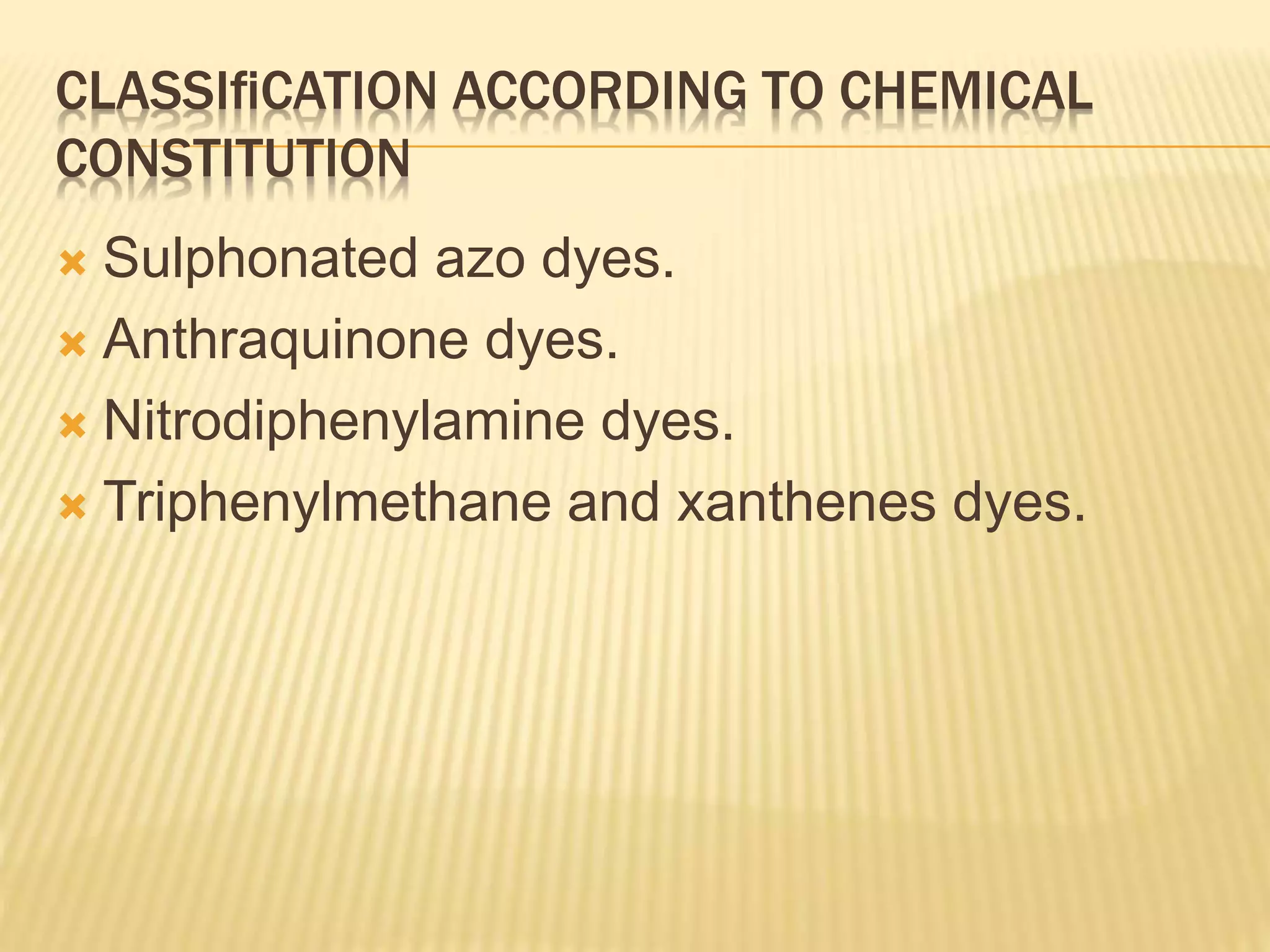
 Sulphonated azo dyes.
 Anthraquinone dyes.
 Nitrodiphenylamine dyes.
 Triphenylmethane and xanthenes dyes.
ANTHRAQUINONE DYES
 Anthraquinone acid dyes are rich in violet through
blue to green complementing the azo dyes. They
have very good light fastness.
They may be subdivided into the following types.
 1-Amino-4-(substituted)amino anthraquinone-2-
sulphonic acids.
 Diamino dihydroxy anthraquinone sulphonic acids.
 1,4-Diaminoanthraquinones with external sulphonic
acids.
 1-Amino-4-hydroxy anthraquinones with external
sulphonic acid groups.
 Other acid anthraquinone dyes.
PROPERTIES OF ANTHRAQUINONE ACID DYES
 Anthraquinone acid dyes offer bright blue shades not
obtainable in azo dyes.
 The red and yellow anthraquinone dyes are of little
importance.
 Green dyes obtained by the combination of yellow
and blue dyes have mostly inferior wash fastness.
 The uniformly dyeing green dyes of the
anthraquinone series have proved their special value
in this context.
 Synthetic polyamides were known some selected
dyes from this series were used. Special acid dyes of
this class have been recently developed for this
purpose.
WATER-REPELLENT DYES
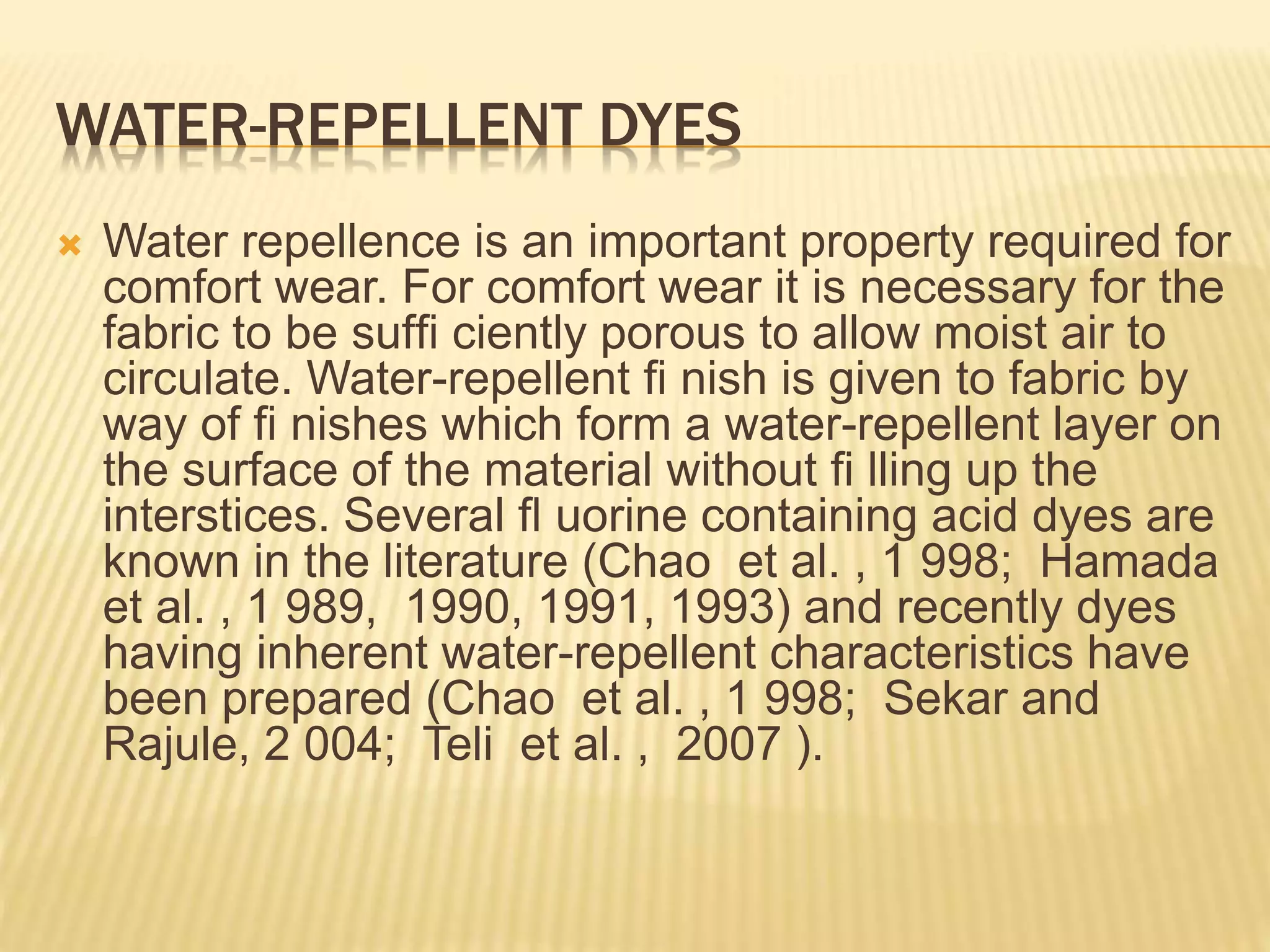
 Water repellence is an important property required for
comfort wear. For comfort wear it is necessary for the
fabric to be suffi ciently porous to allow moist air to
circulate. Water-repellent fi nish is given to fabric by
way of fi nishes which form a water-repellent layer on
the surface of the material without fi lling up the
interstices. Several fl uorine containing acid dyes are
known in the literature (Chao et al. , 1 998; Hamada
et al. , 1 989, 1990, 1991, 1993) and recently dyes
having inherent water-repellent characteristics have
been prepared (Chao et al. , 1 998; Sekar and
Rajule, 2 004; Teli et al. , 2007 ).
DYEING OF WOOL FIBER WITH ACID DYE
 Wool fiber polymer represent as:
 H2N – W – COOH Wool
 That is to say wool polymer has amino group of one side
and carboxylic group in another. In certain condition it
become.
 H2N – W – COOH H3N+ - W – COO-
 The attached hydrogen the carboxylic group is
transferred/ replaced by amino group in other . Thus
when wool fiber is taken in a acid solution negative
ionized carboxylic group of wool molecule takes H+ from
HCI and is produce d electrically neutralised carboxylic
acid group. Chloride ion (Cl) from acid is absorbed by
positively charged amino group.
CONTINUE….
 HCl H+ + Cl-
 NH3
+ - W – COO- + HCl Cl NH3 – W – COOH
 When wool is immersed in acid solution the
concentration of acid reduces and the
absorption of acid by wool fiber increases. This
absorption continues until equilibrium absorption
until. When strong acid is in Acid dye
(DSO3Na), then dye is splitted up in following.
 DSO3 Na DSO3
- + Na+
 ClH3N – W – COOH + ( DSO3
- + Na+ ) DSO3 H3N W – COONa
+ HCl
DYEING OF WOOL FIBER WITH ACID DYE
 Dyestuff = 2% owf
 H2SO4 = 2g/l
 Salt ( Na2SO4 . 10 H2O) = 10g/l
 Wetting agent = 1g/l
 Sequestering agent = 1g/l
 M:L = 1:20
 Time = 1 hr
 Temp = 100c
 PH = 4.5 TO 5.5
DYEING OF SILK FIBER WITH ACID DYE
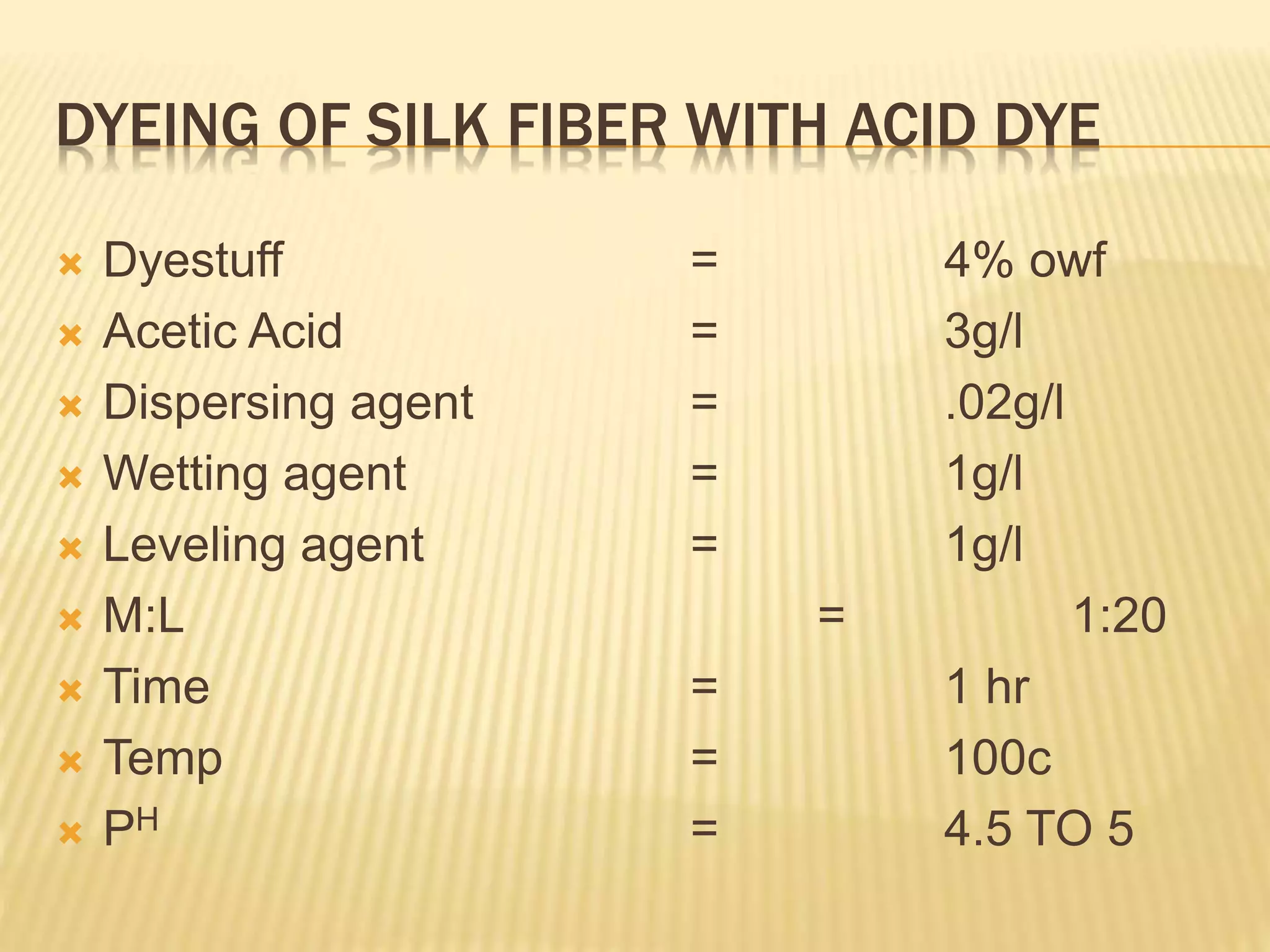
 Dyestuff = 4% owf
 Acetic Acid = 3g/l
 Dispersing agent = .02g/l
 Wetting agent = 1g/l
 Leveling agent = 1g/l
 M:L = 1:20
 Time = 1 hr
 Temp = 100c
 PH = 4.5 TO 5
DYEING PROCESSES
 Dyeing
 Washing
 Neutralisation
 Soap wash & boiling
 Cold wash
 After treatment:
 For increasing fastness properties of silk by using
 4% Tannic acid
 1 % Tartar emetic acid
 For improving lusture by treatment with 4% Acetic acid
 For increasing smoothness , treatment with 1% T.R. Oil
THANK YOU

Acid dye presentation

  • 1.
  • 2.
    PRESENTED BY Md. Al-AminMasum ID: 2015100400011 Batch: 29th BSc in Textile Engineering Southeast University alaminmasum11@gmail.com
  • 3.
    ACID DYE  Theacid dyes are large dyes containing one or more sulfonic or carboxylic acid salt functional groups.  These dyes are dyed onto fibers from acid solution, since positive charge development within the fiber in acid solutions acts as a driving force for dye diffusion and migration into the fiber.  Only fibers which develop a positive charge in the presence of acid, such as wool, silk, and other protein fibers, nylon, and certain modified synthetics, are readily dyed by acid dyes,  Acid dyes on fibers are reasonably colorfast to light and laundering, but mordanting (more complete insolubilization of the dye through reaction with a metal salt) will improve the overall fastness properties of the dye.  The color of the dye may be affected somewhat by mordanting; however, pre-metallized acid dyes are a special class of acid dyes which have been reacted wi th a mordant prior to dyeing and which have sufficient solubility to be dyed under conditions normally used for acid dyes.
  • 4.
    PROPERTIES OF ACIDDYE  Most of the acid dye are sodium salt of sulphuric acid and carboxylic acid and anion group is the active colored component  Water soluble.  Always applied on acidic medium with organic or inorganic acid.  Acid dye have direct affinity towards protein fiber and polyamide fibers.  Maximum cellulose fiber can not absorb acid dye.  Some acid dye has good light fastness.  Many bright shades are found.
  • 5.
  • 6.
    CLASSIFICATION OF ACIDDYE  Classification according to affinity.  Classification according to dyeing characteristics.  Classification according to chemical constitution.
  • 7.
    CLASSIfiCATION ACCORDING TOAFFINITY. I. Levelling dyes form a salt-like bond with the protein fi bre and are relatively small molecules. II. Milling dyes for which salt formation with the fi bre and the adsorption forces between the hydrophobic regions of the dye molecules and those of the protein fi bre predominate. They are the large volume molecules. III. Dyes which not only form a salt-like bond with the wool fi bre but also bonded to the fi bre by intermolecular forces. They have properties lying in an intermediate position between those of the levelling and milling dyes with intermediate molecular size.
  • 8.
    CLASSIfiCATION ACCORDING TODYEING CHARACTERISTICS.  Level dyeing or equalizing dyes.  Fast acid dyes.  Milling acid dyes.  Super-milling acid dyes.
  • 9.
    LEVELLING OR EQUALISINGACID DYES  These dyes require considerable amounts of strong acids along with Glauber’s salt to achieve good exhaustion.  Under the high concentration of acid high concentration of cationic ammonium groups are generated in the wool and the dyes have rapid strike for the wool.  The dye molecules, however, are not strongly bound to the sites.  Initial non-uniformity in colour is evened out by their good migration at the boil.  As a consequence of ease of migration these dyes have poor to moderate wash fastness.  The light fastness, however, ranges from fair to good.  They have relatively small molecular size and hence have good water solubility.  They have good penetration into individual fibres of tightly woven fabrics and high twist yarns.  The dye molecules do aggregate in solution and at higher temperatures enough individual molecules are present for good penetration.
  • 10.
    FAST ACID DYES Compared to the typical levelling dyes fast acid dyes are of somewhat higher molecular weight and are usually monosulphonated ones.  The dyeing method is also similar.  They have reasonable migration at boil, and sometimes a levelling agent is recommended.  Fast acid dyes are used when level dyeing is necessary with good washing and perspiration fastness.
  • 11.
    MILLING ACID DYES Milling is the process in which a woollen material is treated in weakly alkaline solution, with considerable mechanical action to promote felting.  Dyes of good fastness to milling are necessary to avoid bleeding of colour during the milling.  Milling dyes have higher molecular weights and greater substantivity for wool than levelling or fast acid dyes.  They have fewer sulphonate groups per dye molecule and hence they have lower water solubility.  They have a strong tendency to aggregate even in boiling water giving colloidal solutions.  Dyeing with milling dyes is usually started in the presence of sodium acetate or ammonium sulphate and is carried out in the pH range from 5.0 to 7.0.  The exhaustion is increased by the addition of acetic acid. They have low rates of diffusion in wool and hence poor levelling ability
  • 12.
    SUPER-MILLING ACID DYES These are similar to milling dyes but much more hydrophobic.  The hydrophobicity is manifested due to the presence of long-chain alkyl groups in the molecule.  They have good wash fastness, and good to very good light fastness.  They are used for yarn dyeing when there is a requirement of scouring and milling of the final fabric.  Milling and super-milling dyes have very rapid absorption behaviour resulting in unlevel dyeing, and they do not migrate easily.  The rate of absorption of the dye needs to be controlled by gradual increase in the dyebath, followed by gradual decrease in the pH of the dyebath.  The initial pH of the dyebath must be even higher than 7.0 for dyeing pale shades to mitigate the initial strike.  Dyeing rate with these dyes increase rapidly above 70°C, once the dye aggregates in solution begin to break up with increasing temperature.
  • 13.
    CLASSIfiCATION ACCORDING TOCHEMICAL CONSTITUTION  Sulphonated azo dyes.  Anthraquinone dyes.  Nitrodiphenylamine dyes.  Triphenylmethane and xanthenes dyes.
  • 14.
    ANTHRAQUINONE DYES  Anthraquinoneacid dyes are rich in violet through blue to green complementing the azo dyes. They have very good light fastness. They may be subdivided into the following types.  1-Amino-4-(substituted)amino anthraquinone-2- sulphonic acids.  Diamino dihydroxy anthraquinone sulphonic acids.  1,4-Diaminoanthraquinones with external sulphonic acids.  1-Amino-4-hydroxy anthraquinones with external sulphonic acid groups.  Other acid anthraquinone dyes.
  • 15.
    PROPERTIES OF ANTHRAQUINONEACID DYES  Anthraquinone acid dyes offer bright blue shades not obtainable in azo dyes.  The red and yellow anthraquinone dyes are of little importance.  Green dyes obtained by the combination of yellow and blue dyes have mostly inferior wash fastness.  The uniformly dyeing green dyes of the anthraquinone series have proved their special value in this context.  Synthetic polyamides were known some selected dyes from this series were used. Special acid dyes of this class have been recently developed for this purpose.
  • 16.
    WATER-REPELLENT DYES  Waterrepellence is an important property required for comfort wear. For comfort wear it is necessary for the fabric to be suffi ciently porous to allow moist air to circulate. Water-repellent fi nish is given to fabric by way of fi nishes which form a water-repellent layer on the surface of the material without fi lling up the interstices. Several fl uorine containing acid dyes are known in the literature (Chao et al. , 1 998; Hamada et al. , 1 989, 1990, 1991, 1993) and recently dyes having inherent water-repellent characteristics have been prepared (Chao et al. , 1 998; Sekar and Rajule, 2 004; Teli et al. , 2007 ).
  • 17.
    DYEING OF WOOLFIBER WITH ACID DYE  Wool fiber polymer represent as:  H2N – W – COOH Wool  That is to say wool polymer has amino group of one side and carboxylic group in another. In certain condition it become.  H2N – W – COOH H3N+ - W – COO-  The attached hydrogen the carboxylic group is transferred/ replaced by amino group in other . Thus when wool fiber is taken in a acid solution negative ionized carboxylic group of wool molecule takes H+ from HCI and is produce d electrically neutralised carboxylic acid group. Chloride ion (Cl) from acid is absorbed by positively charged amino group.
  • 18.
    CONTINUE….  HCl H++ Cl-  NH3 + - W – COO- + HCl Cl NH3 – W – COOH  When wool is immersed in acid solution the concentration of acid reduces and the absorption of acid by wool fiber increases. This absorption continues until equilibrium absorption until. When strong acid is in Acid dye (DSO3Na), then dye is splitted up in following.  DSO3 Na DSO3 - + Na+  ClH3N – W – COOH + ( DSO3 - + Na+ ) DSO3 H3N W – COONa + HCl
  • 19.
    DYEING OF WOOLFIBER WITH ACID DYE  Dyestuff = 2% owf  H2SO4 = 2g/l  Salt ( Na2SO4 . 10 H2O) = 10g/l  Wetting agent = 1g/l  Sequestering agent = 1g/l  M:L = 1:20  Time = 1 hr  Temp = 100c  PH = 4.5 TO 5.5
  • 20.
    DYEING OF SILKFIBER WITH ACID DYE  Dyestuff = 4% owf  Acetic Acid = 3g/l  Dispersing agent = .02g/l  Wetting agent = 1g/l  Leveling agent = 1g/l  M:L = 1:20  Time = 1 hr  Temp = 100c  PH = 4.5 TO 5
  • 21.
    DYEING PROCESSES  Dyeing Washing  Neutralisation  Soap wash & boiling  Cold wash  After treatment:  For increasing fastness properties of silk by using  4% Tannic acid  1 % Tartar emetic acid  For improving lusture by treatment with 4% Acetic acid  For increasing smoothness , treatment with 1% T.R. Oil
  • 22.