Introduction toVANETTechnology
■ VANET stands forVehicular Ad hoc NETwork.
*Ad hoc means a system of network elements that combine to form a
network requiring little or no planning.
*Two main types of vehicular communication system:
>Vehicle toVehicle (V2V)
>Vehicle to Infrastructure (V2I)
*BothV2V andV2I “Ad hoc” in nature
V2V Communication
■ V2V communication system that provides a 360 degree view of
similarly-equipped vehicles within communication range.
■ Vehicle control information such as the transmission state, break
status and steering wheel angle as well as theVehicle’s path
history and Path prediction.
■ Uses multi hop technique
■ Uses two types of broadcasting
> Naïve
> Intelligent
V2I Communication
■ High bandwidth link between vehicle and roadside equipment.
■ Uses DRSC(Dedicated Short RangeCommunication) technique
Challenges:
■ Routing
■ Security Framework
■ Broadcasting
■ Quality of Services (QoS)
Applications:
■ Major classes of application inVANET are:
■ Safely oriented
■ Convenience oriented
MAIN GOAL
■ It is designed to increase safety, driving efficiency and make
the driving experience more comfortable.
■ About 1.3 million people die from traffic accident per year.
■ About 60 percent of accidents can be avoided by sufficient
warnings.
TECHINCAL SPECIFICATIONS
■ VANETs use IEEE 802.11 wireless communication protocol.
■ Two types of messages sent withinVANETs:
> Periodic safety messages
> Event Driven Messages
■ Broadcast range about 1000 meters and nodes move at an average
speed of 120 kilometer per hour.
VANETs Characteristics
■ Power Supply and Conservation isn’t a major concern.
■ Leading Movement Fashion usually occurs on long Highways.
■ Highly Mobile Nodes in constantly changing networks.
■ Unbounded Network size
■ Real-time, time sensitive data exchange
■ Crucial effect of security and privacy.
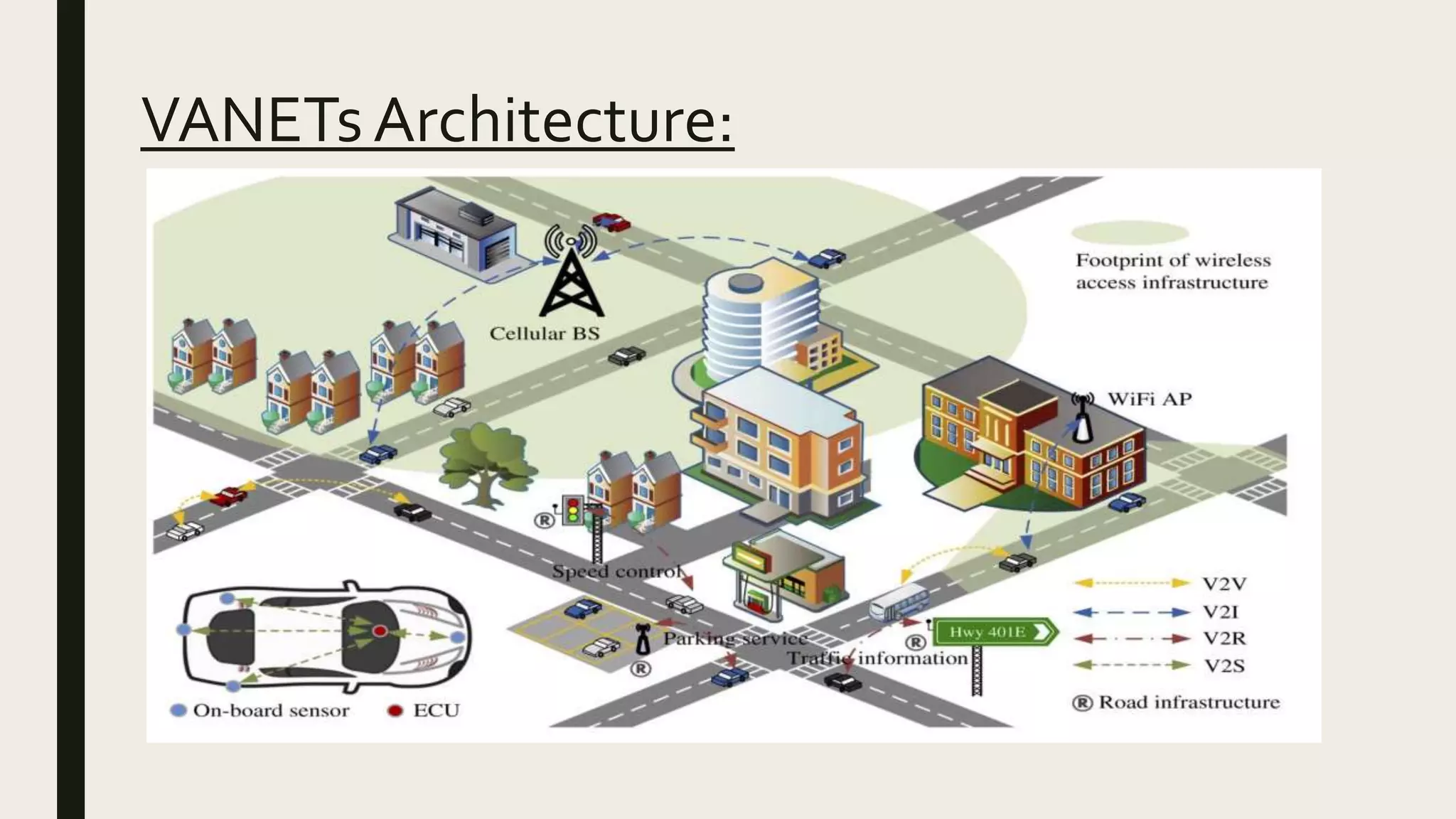
VANETsArchitecture:
TELEMATICS FEATURES
■ Security Features are triggered by sensors and events.
■ Convenience features are used to enhance the driving experience.
■ Components used to communicate with other cars, hubs, stations and
content providers.
■ Two main features:
> Security
> Convenience
CURRENT USES
■ One of the largest content provider’s is OnStar.
■ Provides safety, emergency and convenience services viaVANETs
> Navigation Services
> Emergency Response
>Theft Assistance
Emergency Alerts
■ VANETs are used to disseminate alerts such as Amber Alerts, Silver
Alerts and emergency weather alerts
■ Vehicles GPS location determines the alerts it receives.
■ Potential to save lives.
Security and Privacy
■ Due to high mobility, security is more challenging.
■ Wireless nature of transmission process security and privacy concerns.
■ Information such as location, destinations, and speed history have the
potential to be intercepted.
POSSIBLE INNOVATIONS
■ 30 Percent of accidents involving emergency vehicles are caused by
other drivers.
■ Including Hospitals in theVANETs communication can help further
increase effectiveness of communications.
■ Alerting vehicles on the road that an emergency vehicle is approaching.
Advantages ofVANET
■ Information sharing
■ Cooperative driving
■ Other value added services like navigation, internet access etc.
■ It allows safe and free flow of traffic
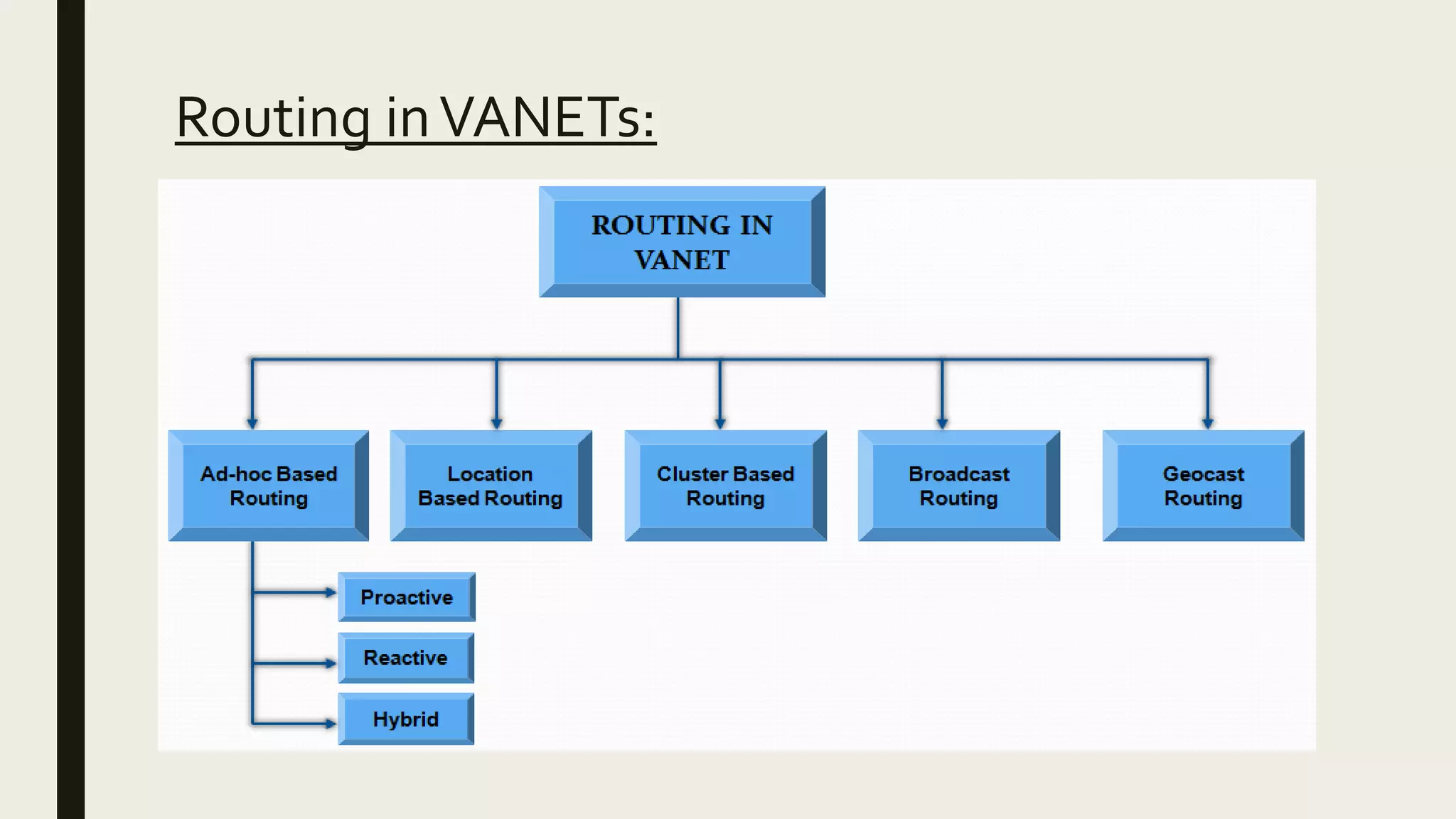
Routing inVANETs:
THANKS 

VANETs Presentation

  • 2.
    Introduction toVANETTechnology ■ VANETstands forVehicular Ad hoc NETwork. *Ad hoc means a system of network elements that combine to form a network requiring little or no planning. *Two main types of vehicular communication system: >Vehicle toVehicle (V2V) >Vehicle to Infrastructure (V2I) *BothV2V andV2I “Ad hoc” in nature
  • 3.
    V2V Communication ■ V2Vcommunication system that provides a 360 degree view of similarly-equipped vehicles within communication range. ■ Vehicle control information such as the transmission state, break status and steering wheel angle as well as theVehicle’s path history and Path prediction. ■ Uses multi hop technique ■ Uses two types of broadcasting > Naïve > Intelligent
  • 4.
    V2I Communication ■ Highbandwidth link between vehicle and roadside equipment. ■ Uses DRSC(Dedicated Short RangeCommunication) technique
  • 5.
    Challenges: ■ Routing ■ SecurityFramework ■ Broadcasting ■ Quality of Services (QoS) Applications: ■ Major classes of application inVANET are: ■ Safely oriented ■ Convenience oriented
  • 6.
    MAIN GOAL ■ Itis designed to increase safety, driving efficiency and make the driving experience more comfortable. ■ About 1.3 million people die from traffic accident per year. ■ About 60 percent of accidents can be avoided by sufficient warnings.
  • 7.
    TECHINCAL SPECIFICATIONS ■ VANETsuse IEEE 802.11 wireless communication protocol. ■ Two types of messages sent withinVANETs: > Periodic safety messages > Event Driven Messages ■ Broadcast range about 1000 meters and nodes move at an average speed of 120 kilometer per hour.
  • 8.
    VANETs Characteristics ■ PowerSupply and Conservation isn’t a major concern. ■ Leading Movement Fashion usually occurs on long Highways. ■ Highly Mobile Nodes in constantly changing networks. ■ Unbounded Network size ■ Real-time, time sensitive data exchange ■ Crucial effect of security and privacy.
  • 9.
  • 10.
    TELEMATICS FEATURES ■ SecurityFeatures are triggered by sensors and events. ■ Convenience features are used to enhance the driving experience. ■ Components used to communicate with other cars, hubs, stations and content providers. ■ Two main features: > Security > Convenience
  • 11.
    CURRENT USES ■ Oneof the largest content provider’s is OnStar. ■ Provides safety, emergency and convenience services viaVANETs > Navigation Services > Emergency Response >Theft Assistance
  • 12.
    Emergency Alerts ■ VANETsare used to disseminate alerts such as Amber Alerts, Silver Alerts and emergency weather alerts ■ Vehicles GPS location determines the alerts it receives. ■ Potential to save lives.
  • 13.
    Security and Privacy ■Due to high mobility, security is more challenging. ■ Wireless nature of transmission process security and privacy concerns. ■ Information such as location, destinations, and speed history have the potential to be intercepted.
  • 14.
    POSSIBLE INNOVATIONS ■ 30Percent of accidents involving emergency vehicles are caused by other drivers. ■ Including Hospitals in theVANETs communication can help further increase effectiveness of communications. ■ Alerting vehicles on the road that an emergency vehicle is approaching.
  • 15.
    Advantages ofVANET ■ Informationsharing ■ Cooperative driving ■ Other value added services like navigation, internet access etc. ■ It allows safe and free flow of traffic
  • 16.
  • 17.